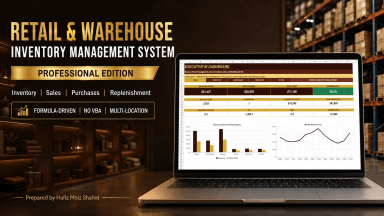
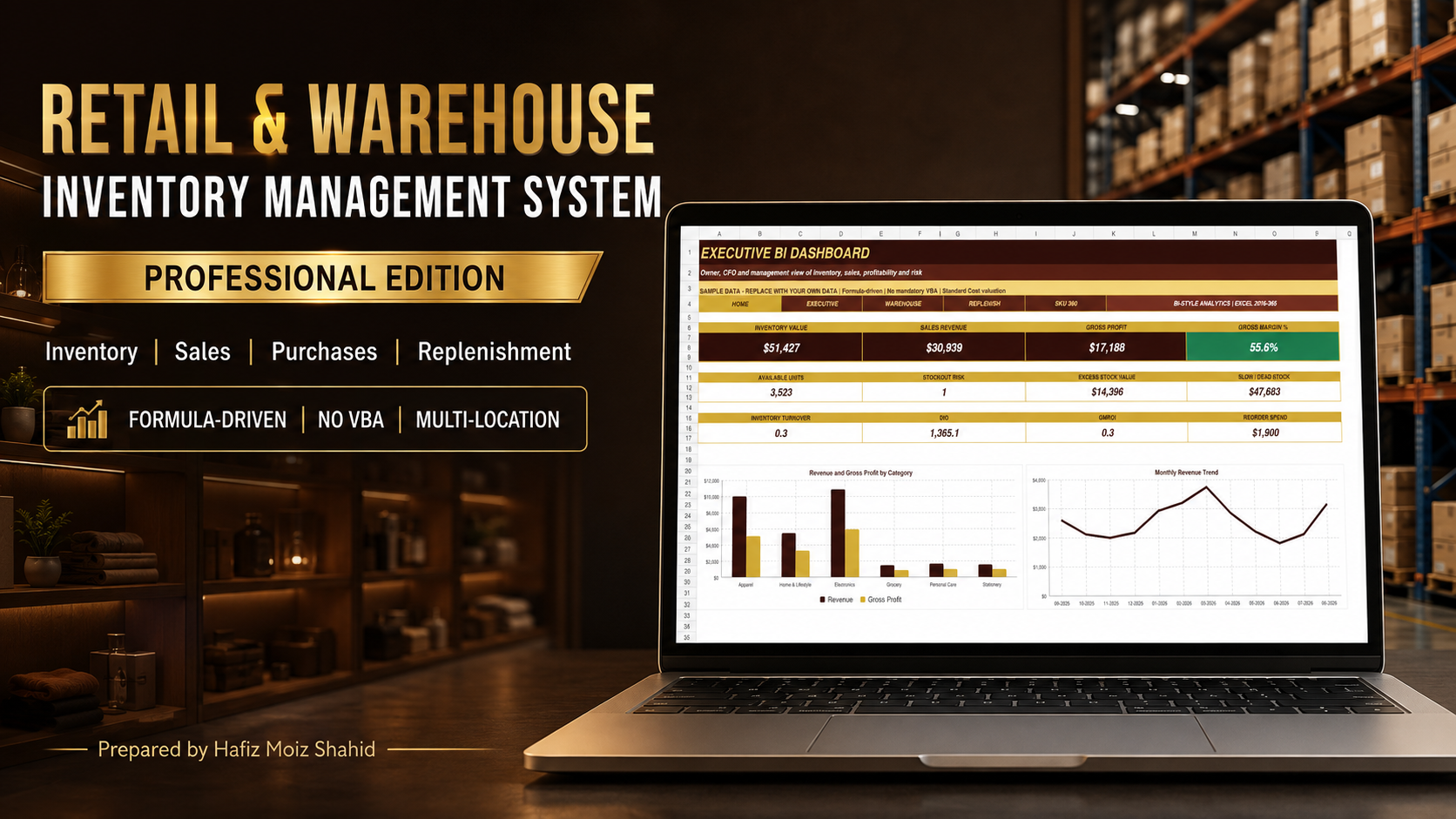
Retail & Warehouse Inventory Management System in Excel | Sales | Purchases | Multi-Location | Power BI Dashboard
Originally published: 05/09/2026 11:46
Publication number: ELQ-78343-1
View all versions & Certificate
certified

Retail & Warehouse Inventory Management System in Excel | Sales | Purchases | Multi-Location | Power BI Dashboard

Manage purchases, sales, stock, transfers, replenishment and multi-location inventory with three Power BI-style Excel dashboards.

Description
The Retail & Warehouse Inventory Management System is a professional Excel-based solution designed for retailers, wholesalers, distributors, warehouses, importers, resellers, e-commerce businesses and multi-location organizations that require better visibility and control over their inventory operations.

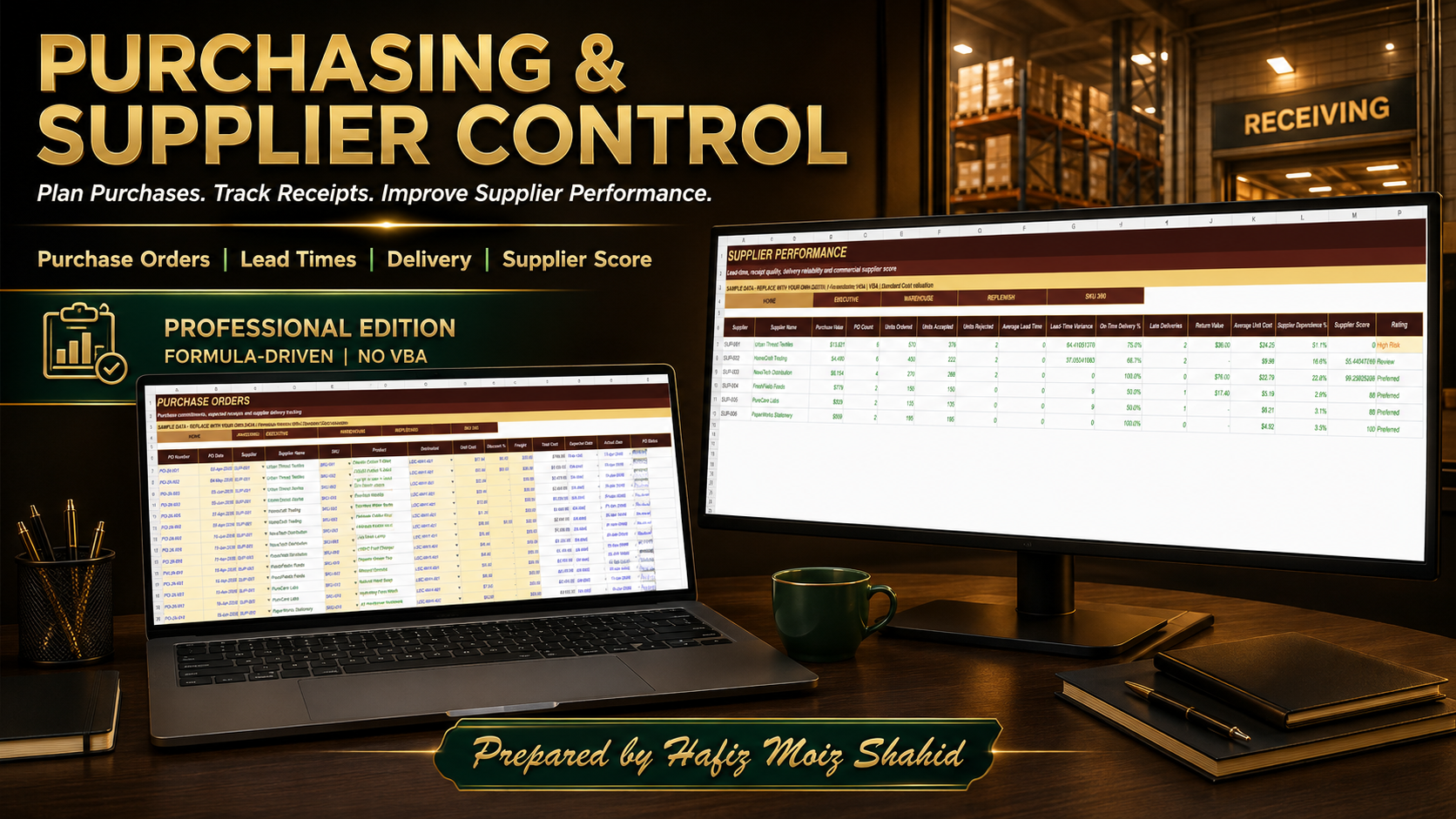
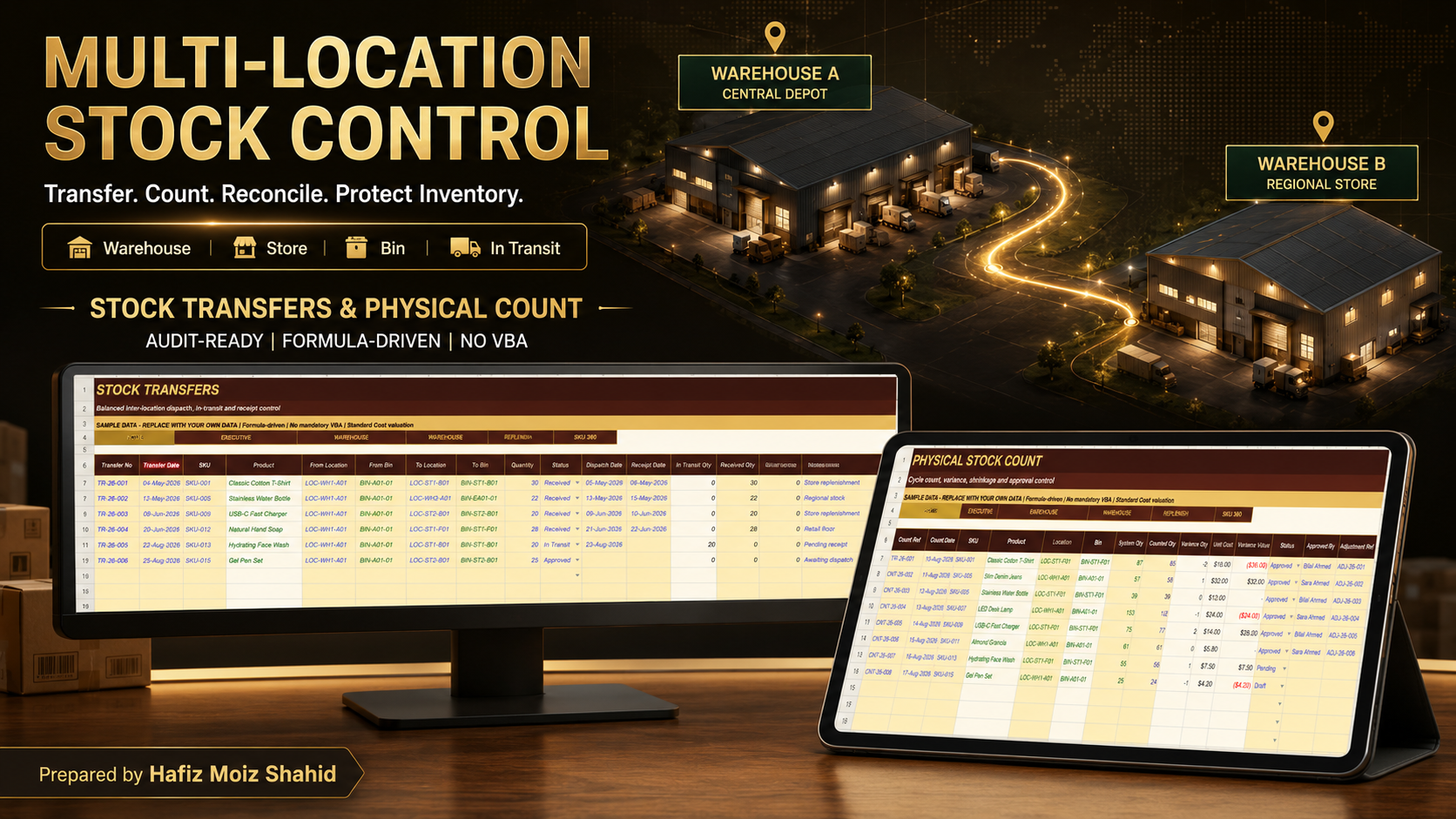
The system connects the complete inventory lifecycle in one structured workbook. Users can maintain product, customer, supplier and location master data; prepare purchase orders; record goods received; manage purchase and sales returns; enter sales transactions; process inter-location stock transfers; perform physical stock counts; and monitor inventory movements through a centralized stock ledger.

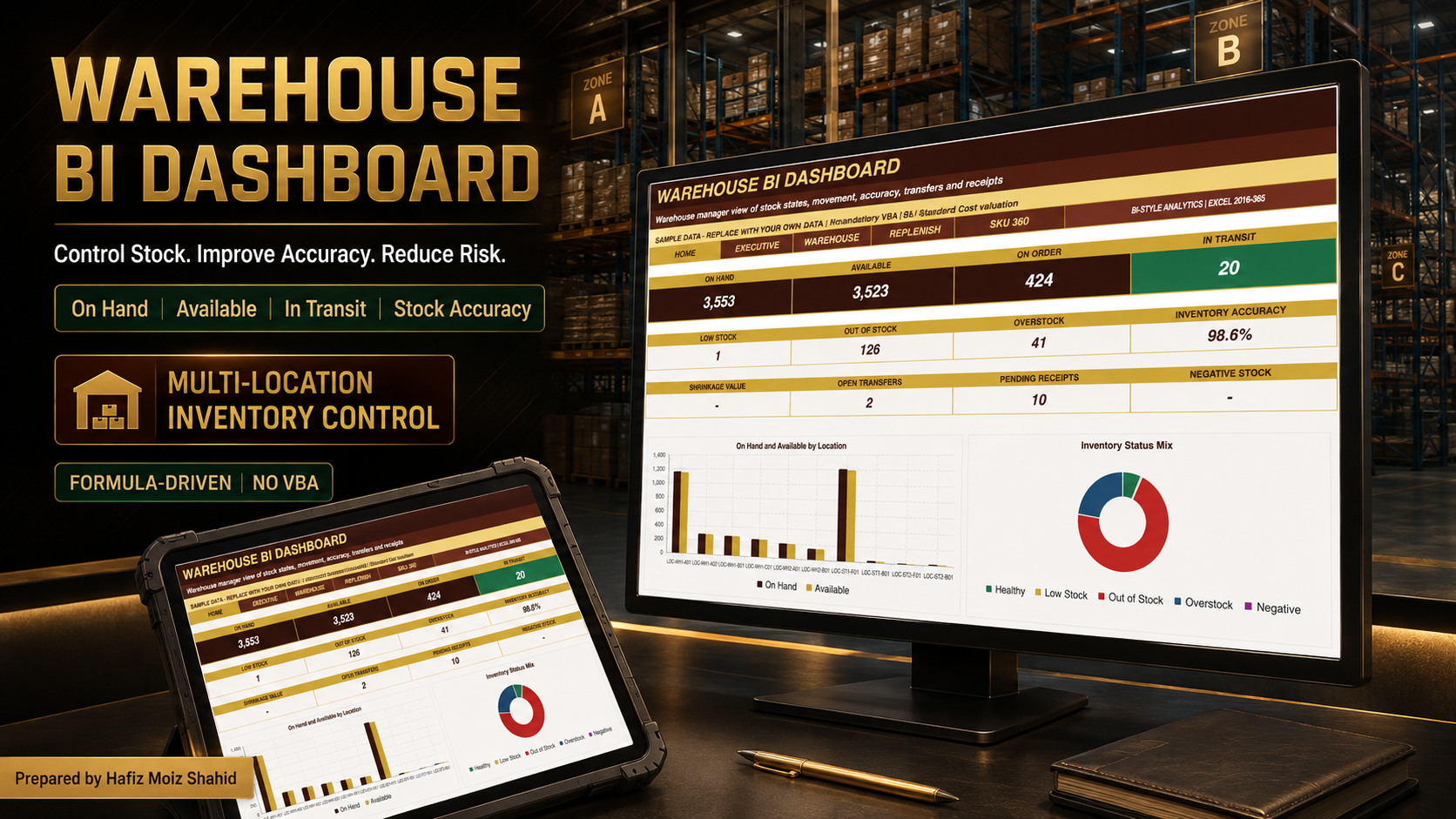
The Inventory Control module calculates On Hand, Committed, Available, On Order, In Transit, Expected Receipts, Projected Available, Standard Cost inventory value and stock status by SKU and location. This provides a clear operational view of inventory across stores, warehouses and bins.

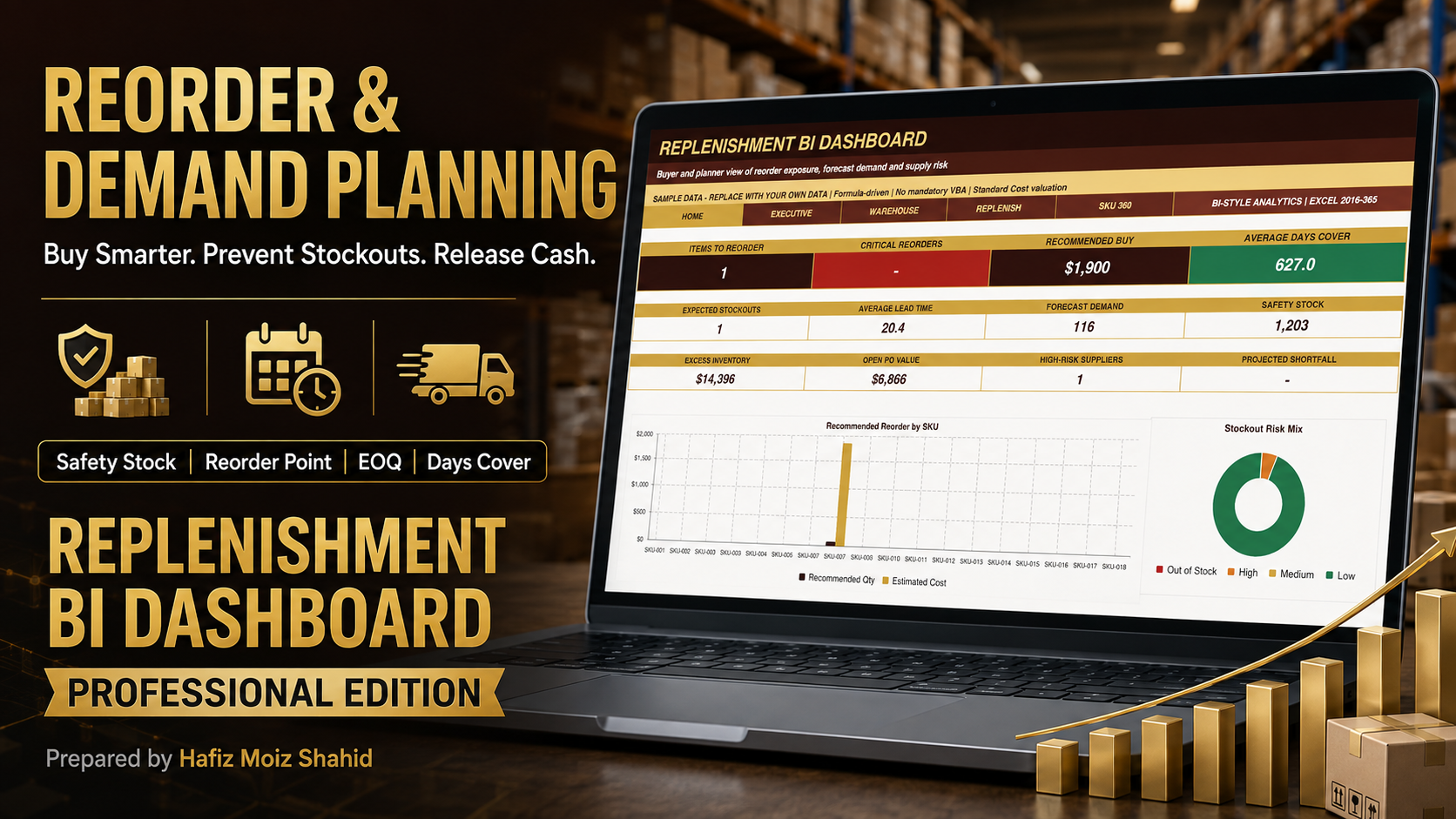
The Reorder & Replenishment module calculates Average Daily Sales, Lead-Time Demand, Safety Stock, Reorder Point, Days Cover, Expected Stockout Date, Economic Order Quantity, Recommended Reorder Quantity, Estimated Reorder Cost, Replenishment Priority and Stockout Risk. A separate Demand Forecast module analyzes transaction history using recent averages, sales velocity, seasonality and adjustable planning assumptions.

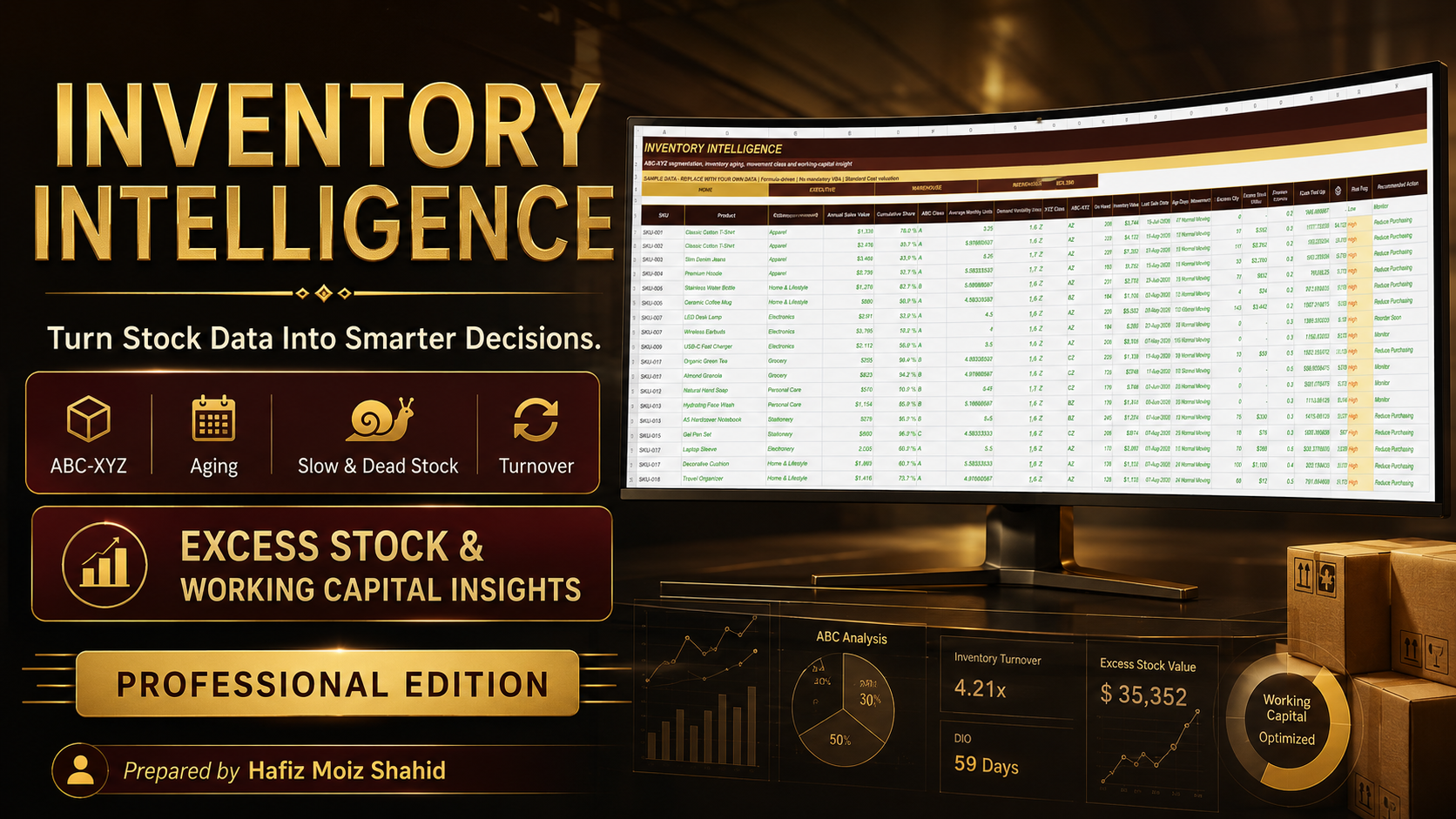
Inventory Intelligence includes ABC Analysis, XYZ Analysis, the ABC-XYZ Matrix, inventory aging, movement classifications, slow-moving and dead-stock identification, excess inventory, inventory turnover, Days Inventory Outstanding and cash tied up in inventory.

Supplier Performance evaluates purchase value, order volume, accepted and rejected quantities, lead times, on-time delivery, late deliveries, supplier returns, purchase-cost movement, supplier dependence and overall supplier score.
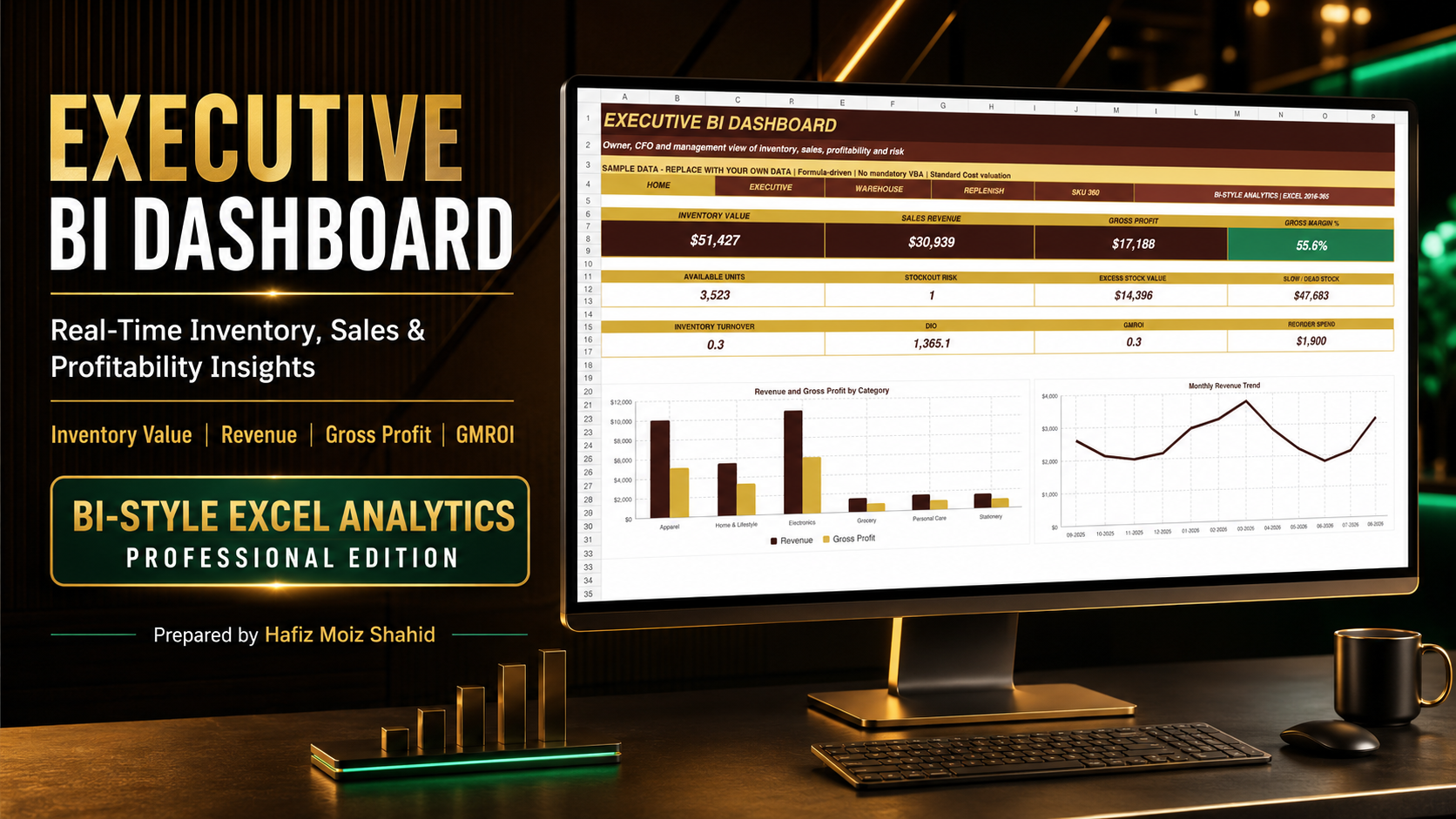
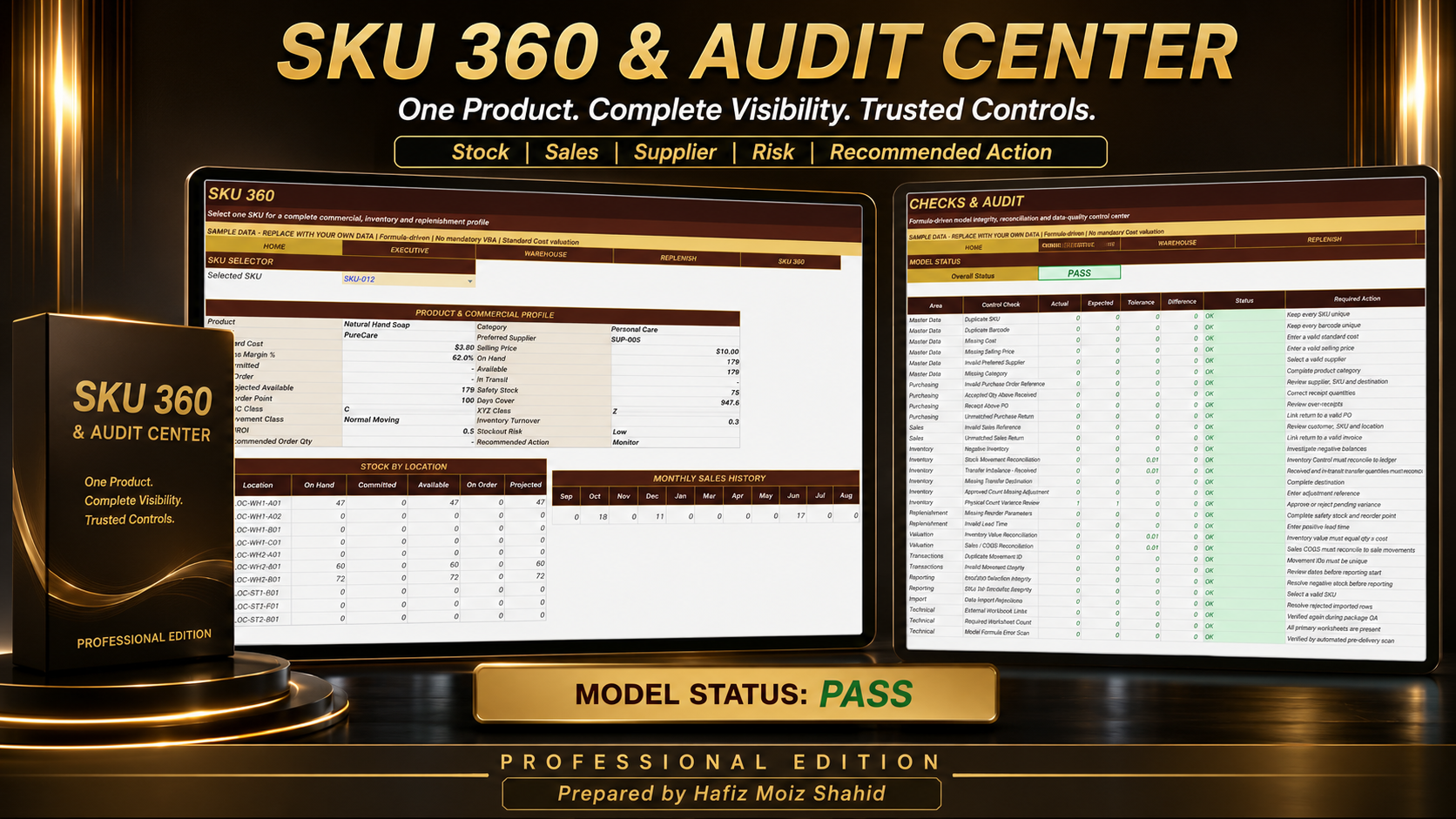
Three BI-style Excel dashboards provide dedicated views for executives, warehouse managers and replenishment teams. The SKU 360 module provides a complete product-level profile covering stock, locations, sales history, purchasing, supplier information, classification, inventory risk and recommended action.
The professional package includes a 23-worksheet Excel workbook, a detailed 36-page User Manual and a 12-page Quick Start Guide. The workbook is formula-driven, requires no mandatory VBA and contains no external workbook links. Microsoft Excel 2019 or Microsoft 365 is recommended.

All included companies, suppliers, customers, products, quantities and financial figures are fictional demonstration data and must be replaced before operational use. The workbook uses Standard Cost valuation and does not claim FIFO, LIFO or weighted-average accounting. It is a management planning and inventory-control model, not a statutory accounting ledger, ERP, POS or certified warehouse-management system.

This Best Practice includes
1 professional Excel workbook with 23 primary worksheets, 1 detailed 36-page User Manual PDF, 12-page Quick Start Guide

Acquire business license for $69.00

Add to cart

Add to bookmarks

Discuss

Further information

This Best Practice helps users establish a structured and controlled inventory-management process covering purchasing, receiving, sales, returns, stock movements, transfers, physical counts, replenishment, demand forecasting, supplier evaluation and management reporting. Its objective is to improve inventory visibility, reduce stockout and excess-stock risk, support purchasing decisions, strengthen warehouse controls and provide decision-ready POWER BI-style Excel dashboards.

This system applies best to retailers, wholesalers, distributors, importers, warehouses, stock rooms, e-commerce sellers and multi-location small or mid-sized businesses that maintain SKU-level inventory. It is particularly suitable where users can regularly update purchases, receipts, sales, returns, transfers and physical-count information in Microsoft Excel and require formula-driven inventory control without mandatory VBA.

This system is not ideal for organizations requiring real-time barcode scanning, live POS integration, automated ERP posting, serial-number or batch-expiry tracking, complex manufacturing production, statutory inventory accounting or simultaneous multi-user transaction processing. It should not be used as a replacement for an ERP, POS, accounting ledger, tax system or certified warehouse-management platform.


0.0 / 5 (0 votes)

please wait...