



Publication number: ELQ-18649-1
View all versions & Certificate

IFRS 16 Lessee Accounting, Lease Liability & ROU Asset Model
Integrated IFRS 16 lessee model for ROU assets, lease liabilities, amortization, modifications, disclosures, sensitivities and journal entries.
📘 IFRS 16 Lessee Financial Model
Integrated Lease Accounting, Measurement, Forecasting and Reporting Solution
The IFRS 16 Lessee Financial Model is a comprehensive Excel-based solution for measuring, analysing, forecasting and reporting lease obligations from a lessee’s perspective.
It connects individual lease-contract assumptions with initial measurement, right-of-use asset calculations, lease-liability amortization, financial-statement impacts, disclosure schedules, forecasts and journal entries.
The workbook is designed for finance teams, accountants, auditors, financial controllers, consultants and analysts who require a transparent and editable framework for IFRS 16 lease accounting.
🎯 What Is This Model Used For?
The model helps users organise lease data and convert contractual assumptions into accounting measurements, financial reports and management analytics.
It can be used to:
- Record lease-level contractual information
- Calculate the present value of future lease payments
- Measure initial lease liabilities
- Calculate initial right-of-use asset values
- Develop lease-liability amortization schedules
- Separate lease payments between principal and interest
- Calculate ROU asset depreciation
- Classify liabilities as current and non-current
- Evaluate lease modifications and remeasurements
- Analyse balance-sheet and profit-and-loss effects
- Assess EBITDA, EBT and cash-flow impacts
- Prepare lease maturity analysis
- Develop IFRS 16 disclosure schedules
- Perform discount-rate and lease-term sensitivities
- Forecast future lease balances and expenses
- Generate structured accounting journal entries
- Reconcile outputs through built-in audit controls
✨ Key Model Features
🏢 1. Structured Lease Register
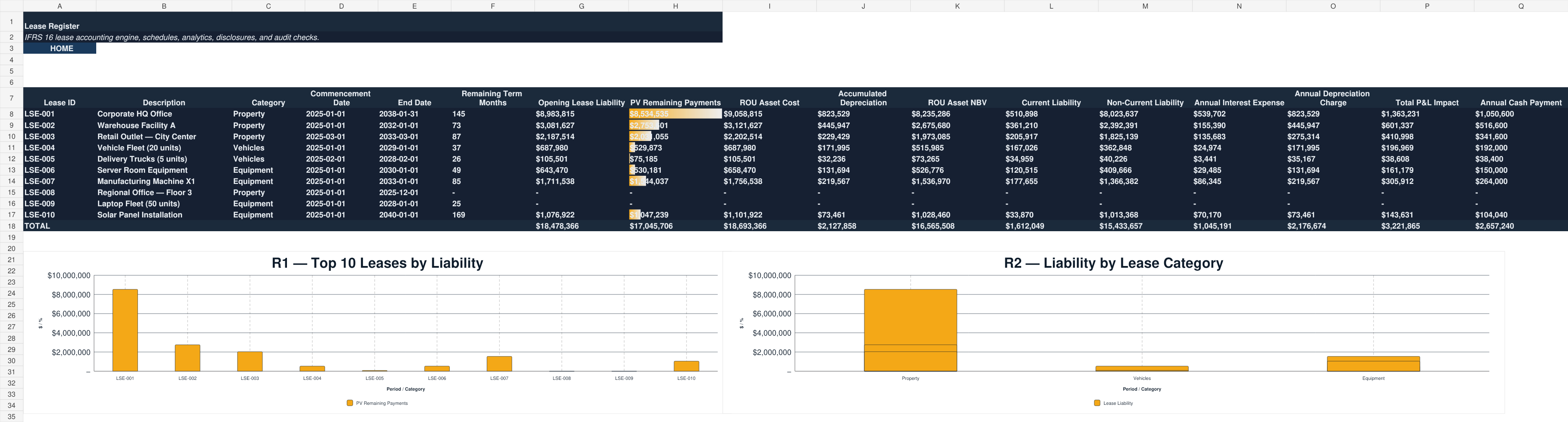
The Lease Register provides a central view of the complete lease portfolio.
Users can record and review:
- Lease identification number and description
- Asset category
- Commencement and end dates
- Remaining lease term
- Payment frequency
- Contractual lease payments
- Payment escalation
- Incremental borrowing rate
- Initial direct costs
- Lease incentives
- Restoration obligations
- Exemption and modification status
- Opening lease liability
- ROU asset cost and carrying value
- Current and non-current lease liabilities
- Annual interest expense
- Annual depreciation charge
- Total profit-and-loss impact
- Annual cash payments
⚙️ 2. Central Assumptions and Scenario Controls
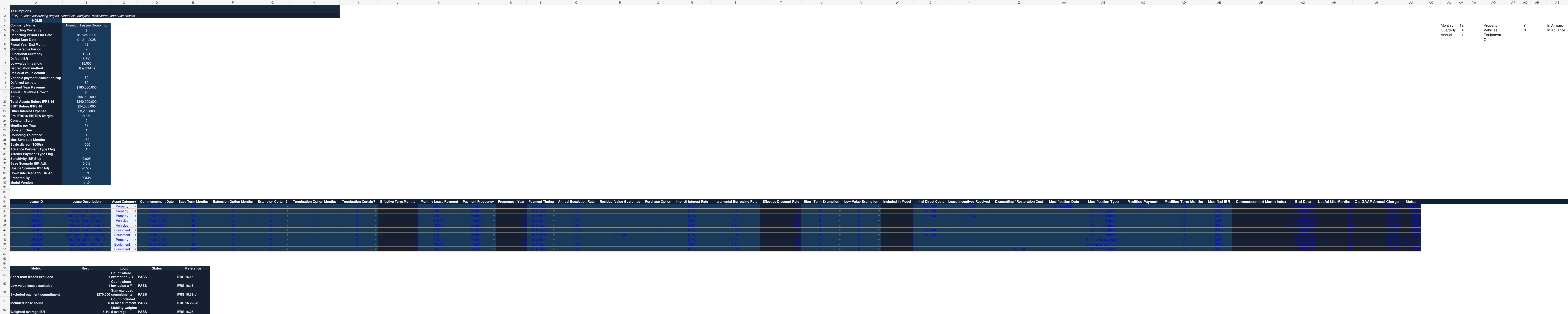
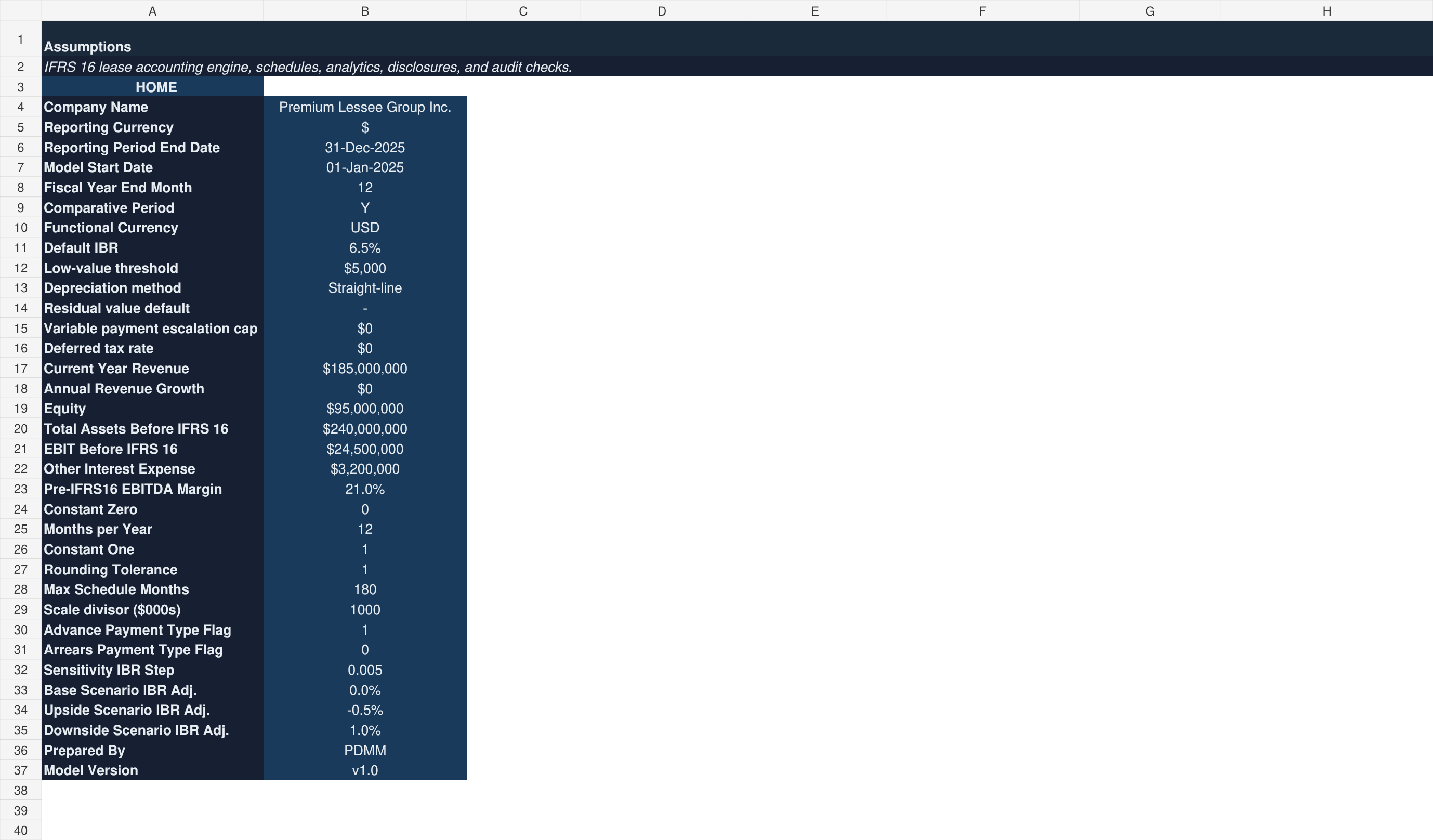
The Assumptions worksheet allows users to configure the model for their company and reporting requirements.
Key assumptions include:
- Company and reporting information
- Reporting and functional currencies
- Reporting-period dates
- Fiscal year-end
- Default incremental borrowing rate
- Low-value lease threshold
- Depreciation method
- Residual-value assumptions
- Variable payment escalation cap
- Deferred tax rate
- Financial forecast assumptions
- Reporting tolerance
- Maximum schedule period
- Sensitivity increments
- Base, upside and downside scenarios
🧮 3. Initial Measurement Engine
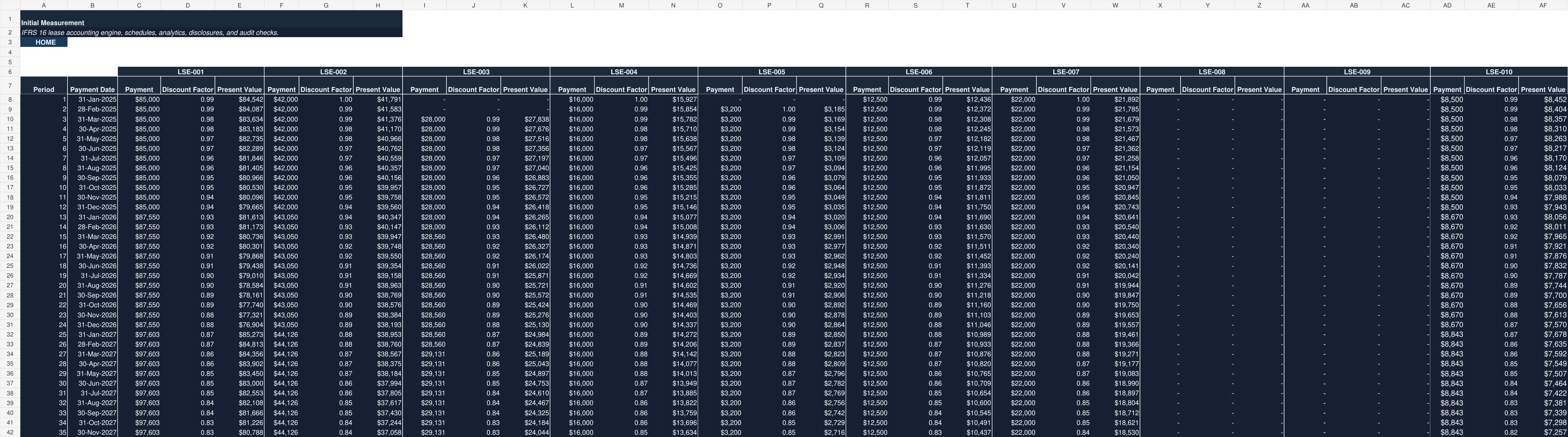
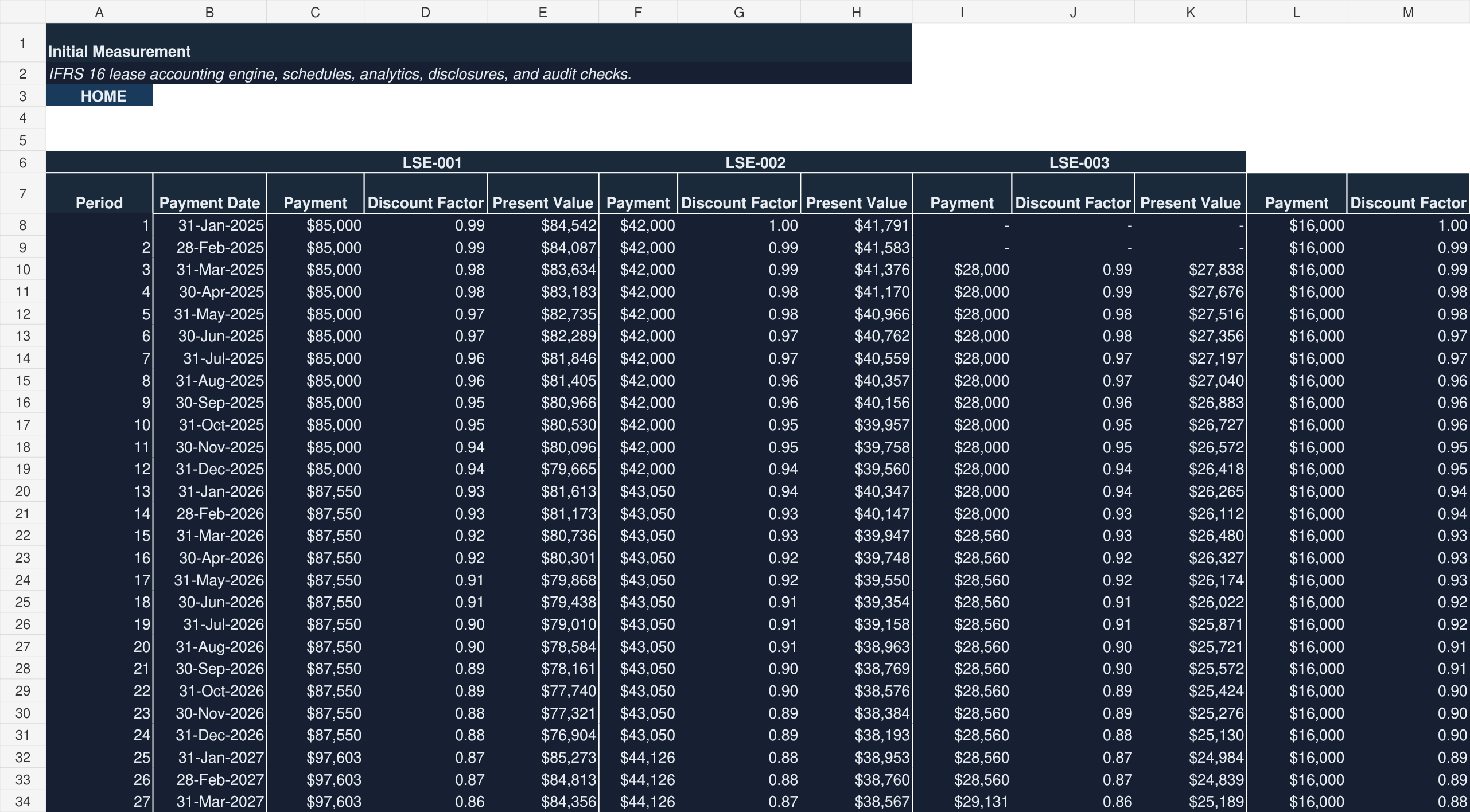
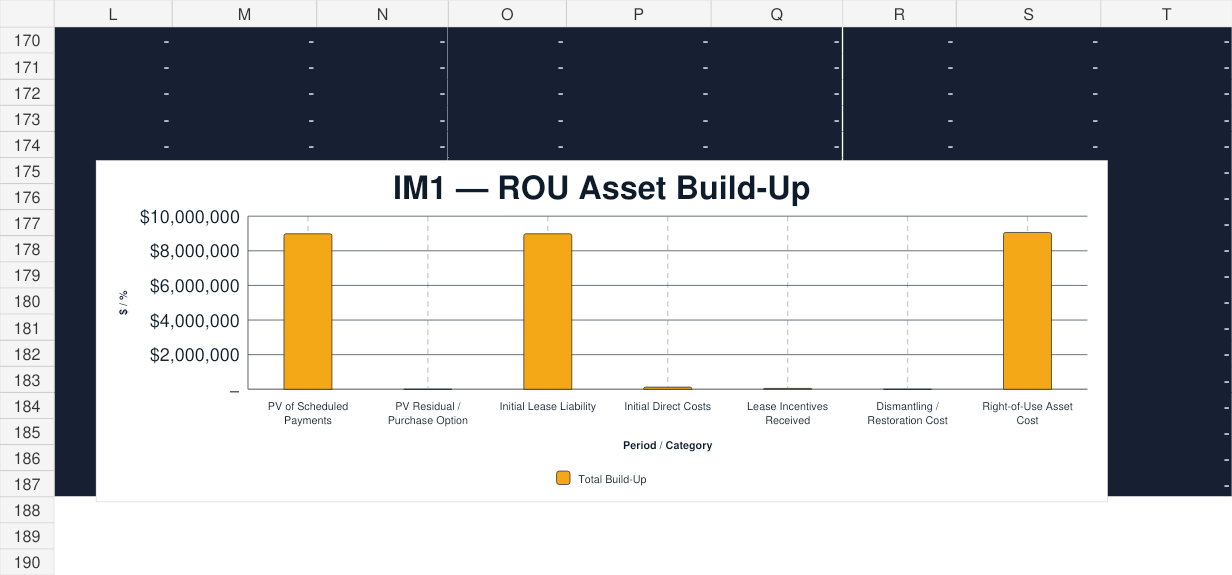
The Initial Measurement module calculates the present value of contractual lease payments and determines the initial lease-liability and right-of-use asset balances.
The calculation framework considers:
- Lease payment amounts and dates
- Payment frequency
- Discount rates and discount factors
- Lease incentives
- Prepayments
- Initial direct costs
- Restoration obligations
- Lease exemptions
- Other ROU asset adjustments
📅 4. Detailed Amortization Schedules
The workbook develops detailed amortization schedules for the lease portfolio.
The schedules calculate:
- Opening lease liability
- Interest accretion
- Contractual lease payment
- Principal repayment
- Closing lease liability
- Right-of-use asset depreciation
- Closing ROU asset carrying value
- Current and non-current liabilities
- Monthly accounting movements
- Annual accounting movements
🔄 5. Lease Modification Analysis
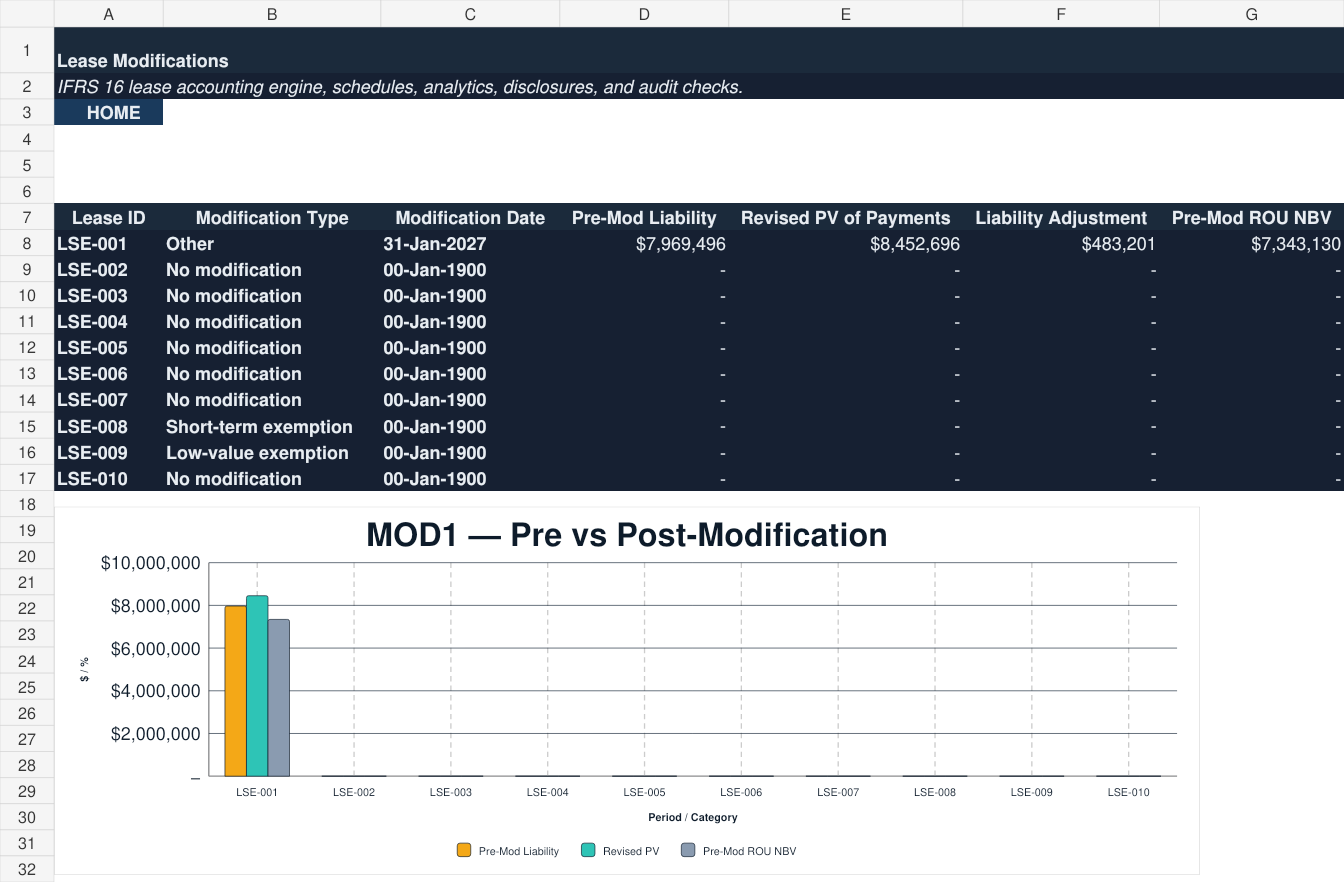
The Lease Modifications worksheet helps users assess changes in lease terms and payments.
The module compares:
- Pre-modification lease liability
- Revised present value of lease payments
- Lease-liability adjustment
- Pre-modification ROU asset carrying value
- Post-modification ROU asset balance
- Remeasurement effects
- Related journal-entry adjustments
Users must determine the appropriate accounting treatment based on the applicable facts and IFRS 16 requirements.
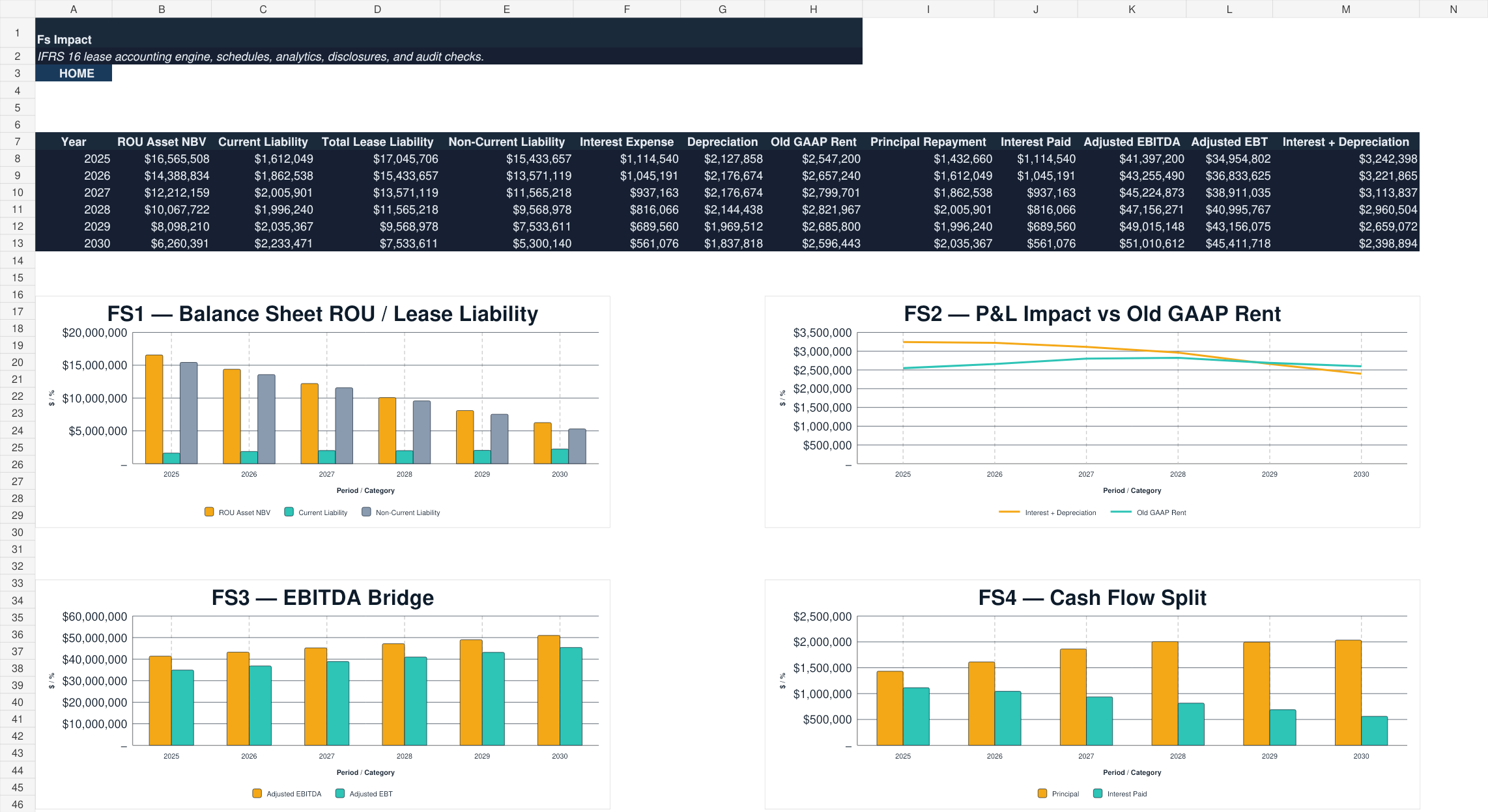
📊 6. Financial-Statement Impact Analysis
The model translates lease calculations into financial-statement effects.
It analyses:
- Right-of-use asset carrying value
- Current and non-current lease liabilities
- Total lease liabilities
- Interest expense
- Depreciation expense
- Principal repayments
- Interest payments
- EBITDA impact
- Earnings-before-tax impact
- Profit-and-loss charge composition
- Cash-flow classification
This helps users understand the potential impact on assets, liabilities, operating expenses, finance costs, EBITDA, profit before tax, cash flows and financial ratios.
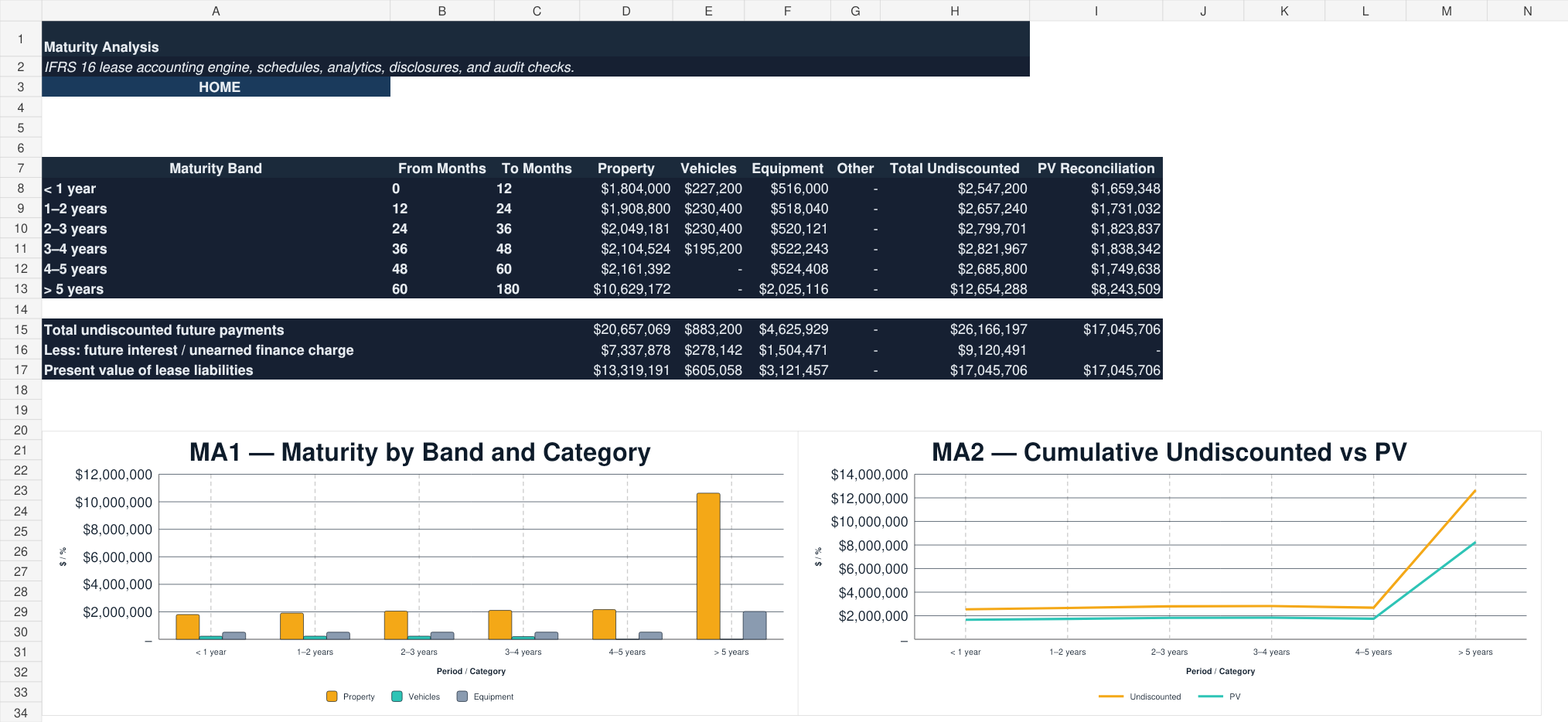
📉 7. Lease Maturity Analysis
Future contractual lease payments are presented by maturity period and asset category.
The maturity bands include:
- Less than one year
- One to two years
- Two to three years
- Three to four years
- Four to five years
- More than five years
- Property, vehicle, equipment and other leases
- Total undiscounted payments
- Future interest charges
- Present value of lease liabilities
- Reconciliation to the reported liability
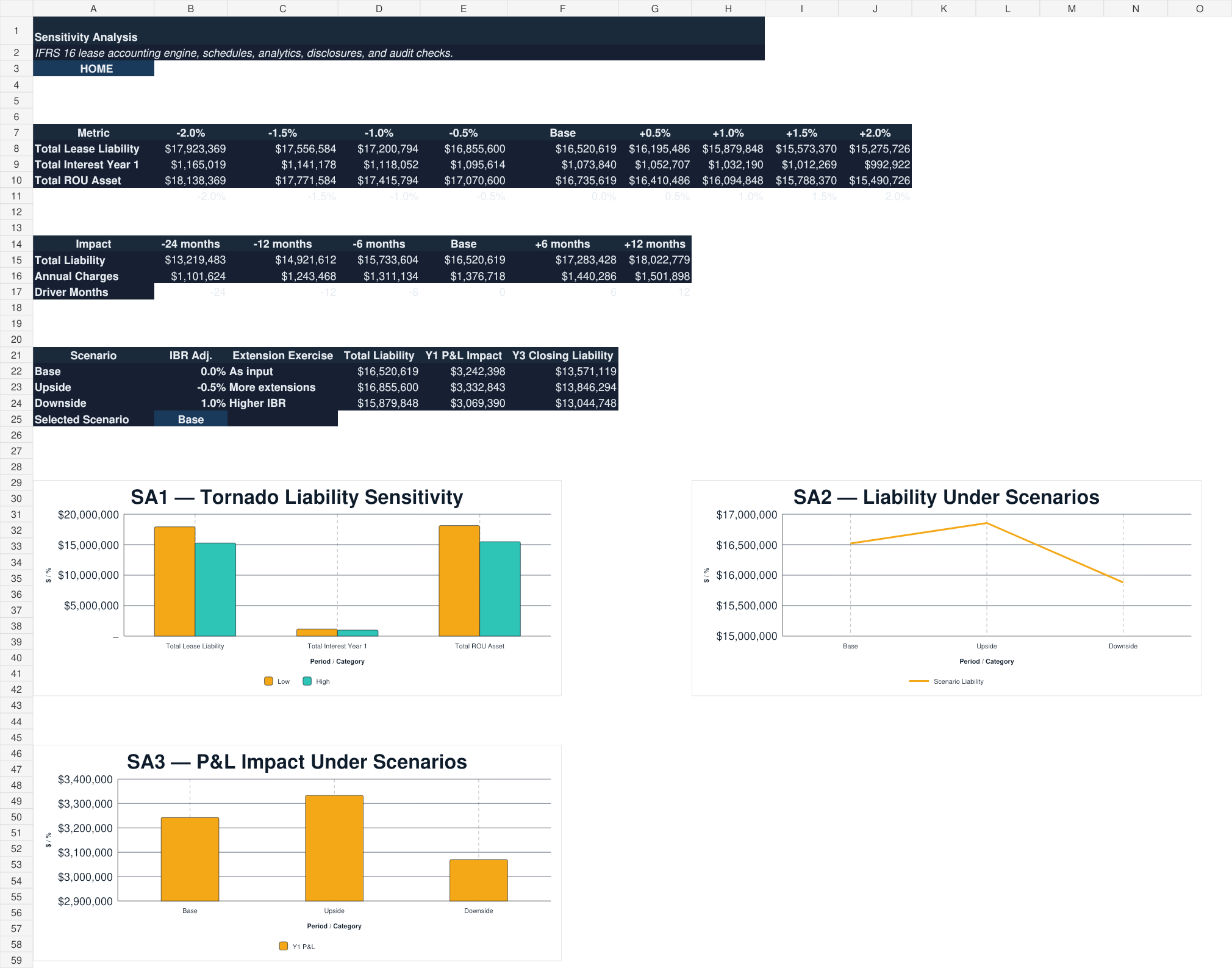
🔍 8. Sensitivity and Scenario Analysis
The model evaluates how changes in important assumptions affect lease-accounting outputs.
Available analyses include:
- Incremental borrowing rate sensitivity
- Lease-term sensitivity
- Extension-period sensitivity
- Lease-liability sensitivity
- ROU asset sensitivity
- Year-one interest sensitivity
- Annual accounting-charge sensitivity
- Base scenario
- Upside scenario
- Downside scenario
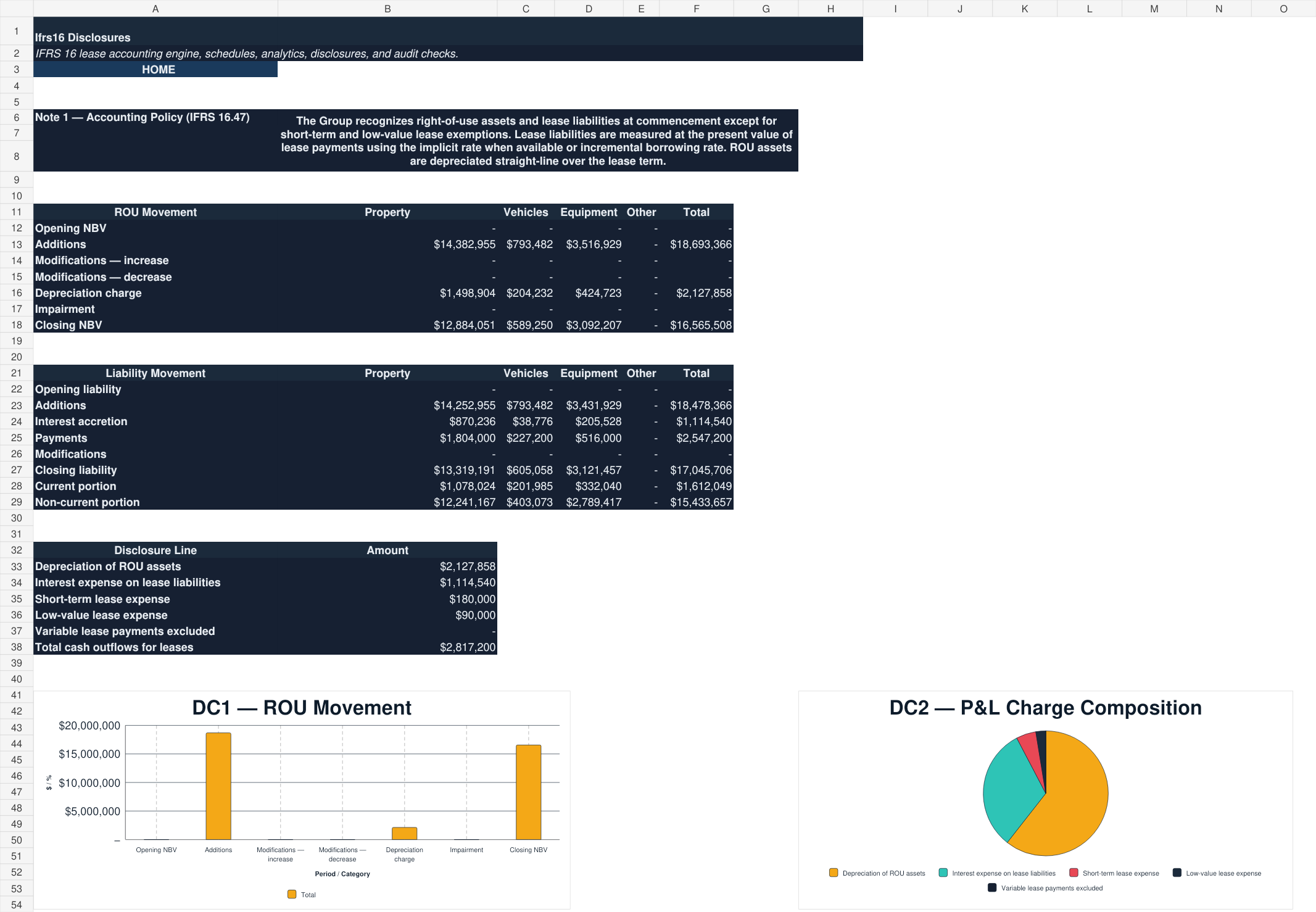
📝 9. IFRS 16 Disclosure Schedules
The workbook provides structured schedules for important IFRS 16 disclosures.
ROU asset movement:
- Opening balance
- Additions
- Modification increases and decreases
- Depreciation
- Impairment
- Closing balance
- Opening liability
- Additions
- Interest accretion
- Lease payments
- Modifications
- Closing liability
- Current and non-current portions
- ROU asset depreciation
- Lease-liability interest expense
- Short-term lease expense
- Low-value lease expense
- Excluded variable lease payments
- Total lease-related cash outflows
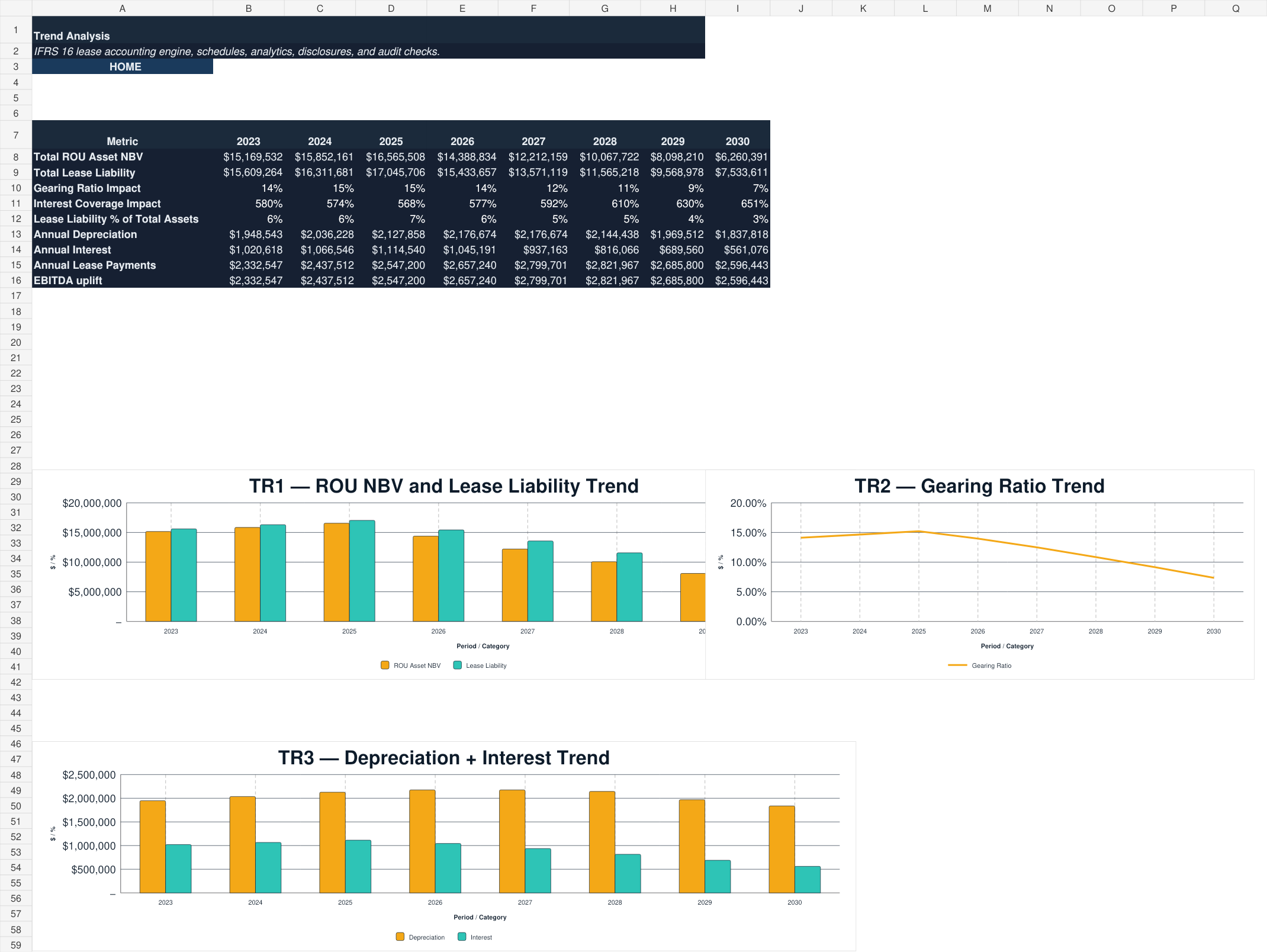
📈 10. Trend Analysis and Forecasting
The model provides historical and forecast analysis for:
- ROU asset carrying value
- Total lease liabilities
- Annual depreciation
- Annual interest expense
- Annual lease payments
- EBITDA uplift
- Gearing-ratio impact
- Interest-coverage impact
- Lease liabilities as a percentage of total assets
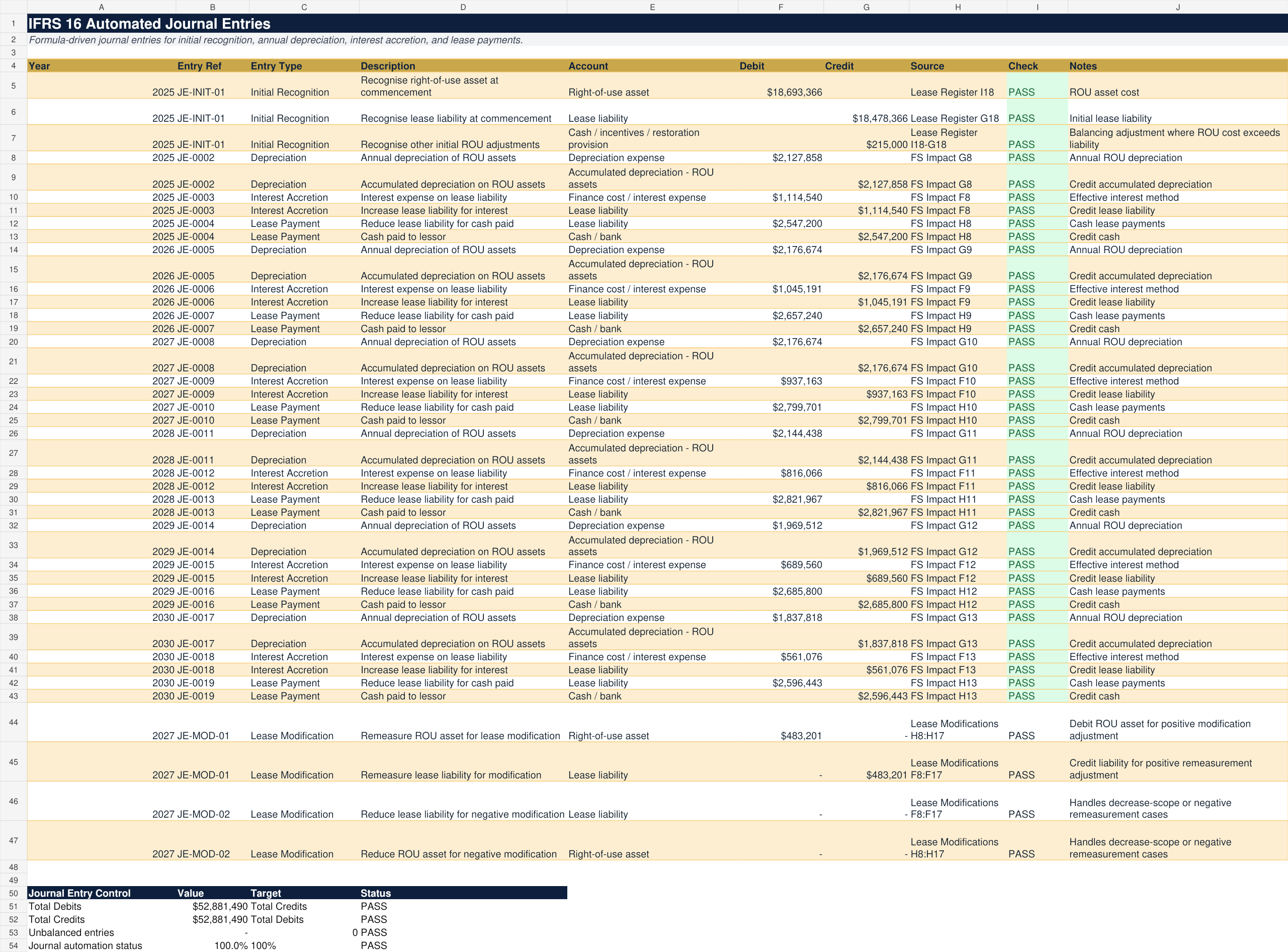
🧾 11. Structured Journal Entries
The Journal Entries worksheet converts model outputs into structured accounting entries covering:
- Initial recognition of the ROU asset
- Initial recognition of the lease liability
- Initial asset adjustments
- ROU asset depreciation
- Accumulated depreciation
- Interest expense and accretion
- Lease payments
- Reduction of the lease liability
- Cash paid to the lessor
- Lease modifications
Built-in controls help confirm that debits and credits remain balanced.
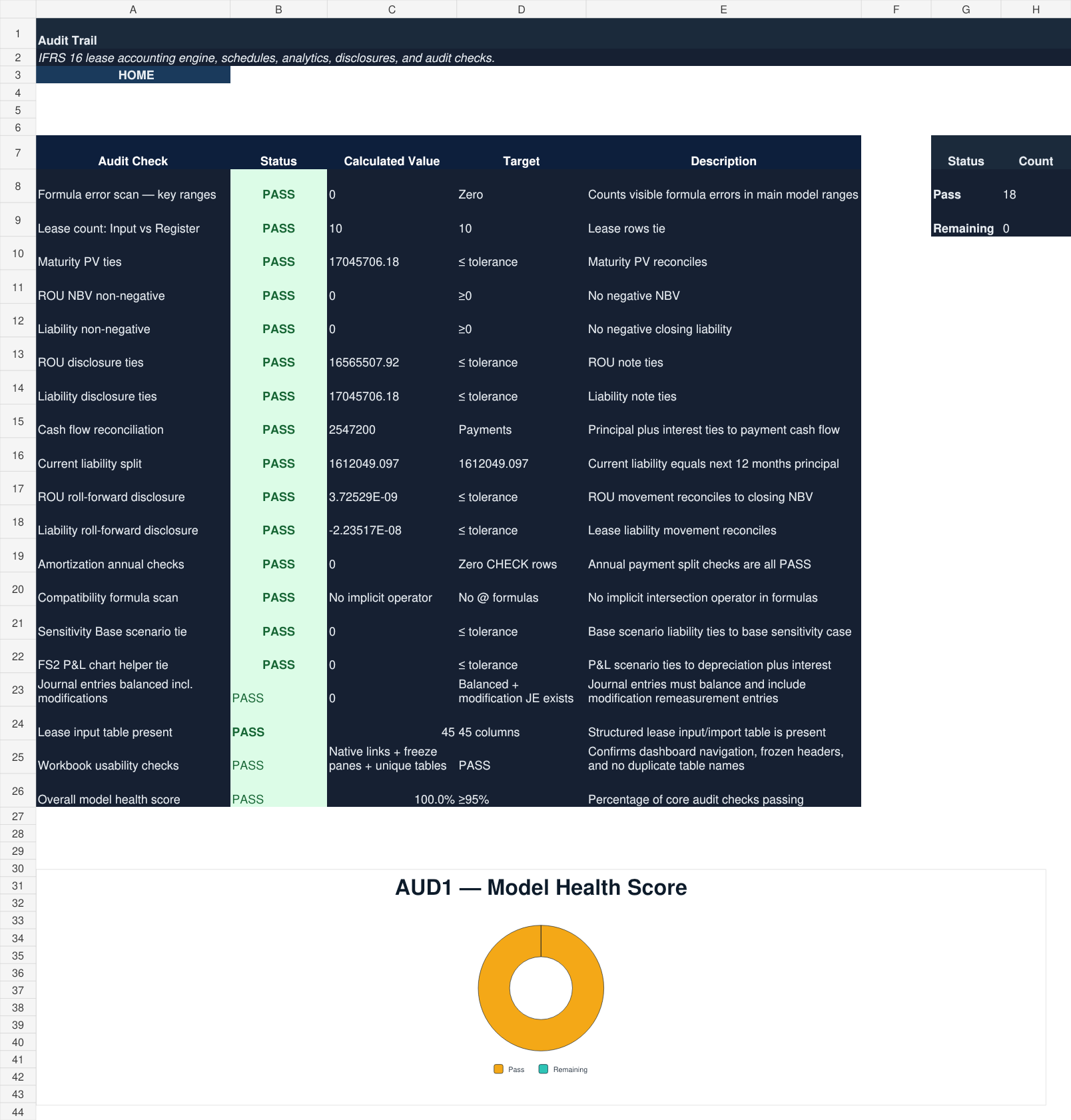
✅ 12. Audit Trail and Model Controls
The workbook contains 18 core audit and integrity checks, including:
- Formula-error scanning
- Lease-count reconciliation
- Maturity present-value reconciliation
- Negative asset and liability checks
- Disclosure reconciliations
- Cash-flow reconciliation
- Current-liability classification checks
- ROU asset and liability roll-forwards
- Annual amortization checks
- Formula compatibility checks
- Sensitivity reconciliation
- Financial-statement helper checks
- Balanced journal-entry verification
- Lease-input table validation
- Workbook usability checks
These checks improve model governance but do not replace an independent accounting or audit review.
📊 13. Executive Dashboard and Visual Analytics
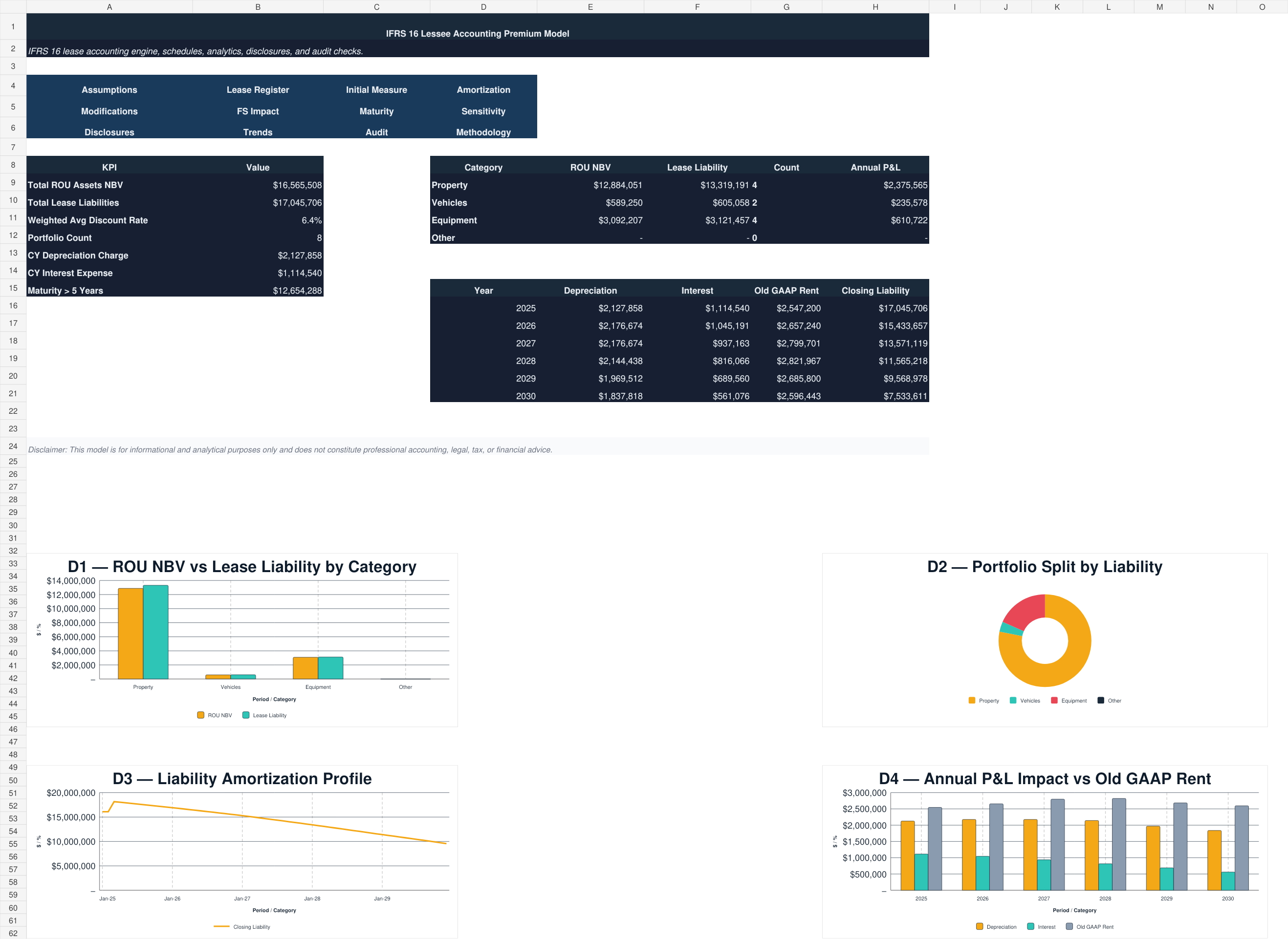
The dashboard summarises:
- Total ROU asset carrying value
- Total lease liabilities
- Weighted-average discount rate
- Portfolio lease count
- Current-year depreciation
- Current-year interest expense
- Commitments extending beyond five years
The charts follow a consistent professional design suitable for management review, financial reporting and presentations.
🗂️ Workbook Structure
The model contains 14 purpose-built worksheets:
- Executive Dashboard
- Assumptions
- Lease Register
- Initial Measurement
- Amortization Schedules
- Lease Modifications
- Financial Statement Impact
- Maturity Analysis
- Sensitivity Analysis
- IFRS 16 Disclosures
- Trend Analysis and Forecasting
- Audit Trail and Error Log
- Disclaimer and Methodology
- Journal Entries
🧭 How to Use the Model
- Save a separate working copy.
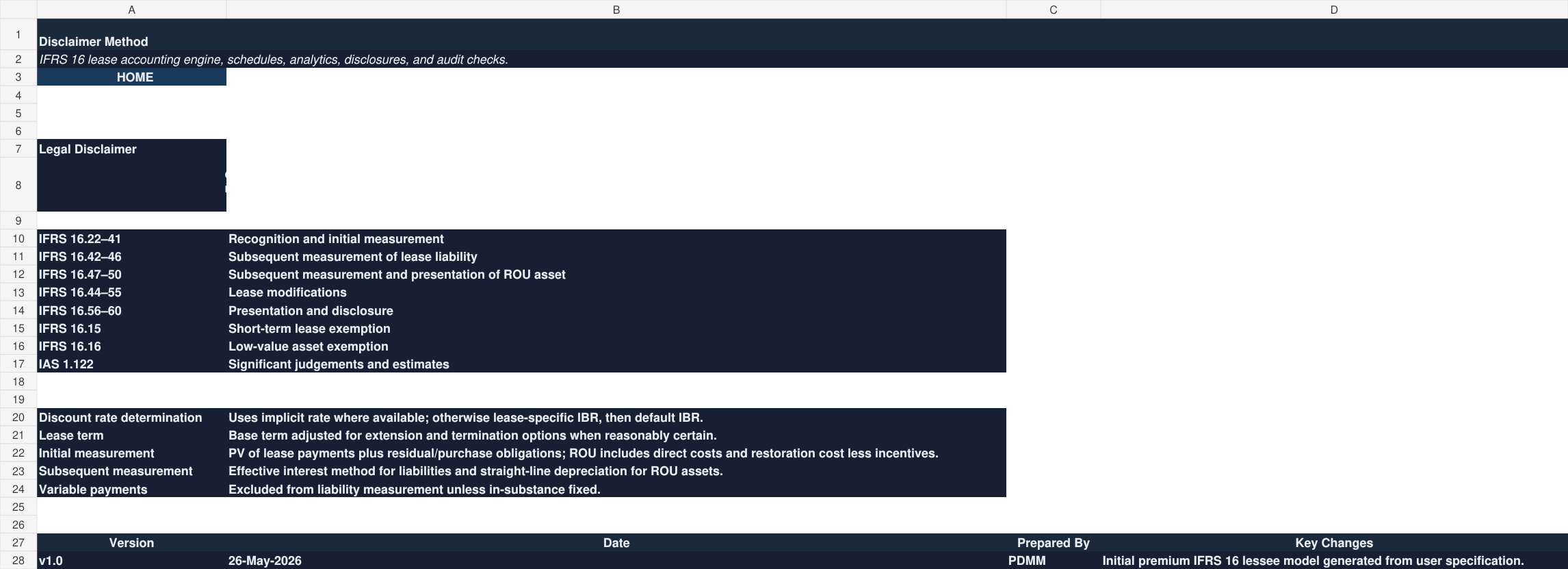
- Review the Disclaimer and Methodology worksheet.
- Update company and reporting assumptions.
- Confirm currencies and reporting dates.
- Review discount-rate and policy assumptions.
- Replace illustrative leases with validated contract data.
- Review short-term and low-value exemptions.
- Confirm payment timing, frequency and escalation.
- Review initial measurement results.
- Examine the amortization schedules.
- Enter relevant modification assumptions.
- Review financial-statement and maturity outputs.
- Evaluate sensitivity and forecast results.
- Review disclosure schedules and journal entries.
- Confirm all audit controls pass.
- Independently validate the results before reporting.
The model is suitable for:
- Chief financial officers
- Financial controllers
- Finance managers
- Accountants
- Financial reporting teams
- FP&A professionals
- Internal and external auditors
- Accounting advisers
- Financial consultants
- Transaction-services professionals
- Corporate finance teams
- Business analysts
- Companies managing property, vehicle, equipment or other leases
Developing an IFRS 16 model from the beginning requires considerable time, accounting knowledge, formula development, schedule construction, reconciliation design and testing.
This template helps users:
- Save model-development time
- Consolidate lease calculations
- Improve consistency across lease records
- Strengthen traceability from inputs to outputs
- Reduce reliance on disconnected spreadsheets
- Analyse lease and portfolio-level results
- Evaluate financial-statement impacts
- Perform sensitivities and scenario analysis
- Prepare disclosure supporting schedules
- Generate structured journal entries
- Strengthen review through audit controls
- Present outputs through professional dashboards and charts
This Best Practice includes
1 Fully Editable Premium Excel Model
Further information
Measure initial lease liabilities and right-of-use assets from lease-level inputs.
Build transparent principal, interest and depreciation schedules.
Evaluate modifications, discount-rate changes, term sensitivities and scenarios.
Quantify balance-sheet, P&L, EBITDA, EBT and cash-flow impacts.
Prepare maturity and disclosure schedules with reconciliation support.
Generate journal entries and strengthen review through built-in audit controls.
A lessee needs a structured Excel framework for a manageable lease portfolio.
Finance teams require transparent calculations and editable assumptions.
Analysts need financial-statement impact, forecast and sensitivity outputs.
Auditors or reviewers need reconciliations and traceable journal entries.
Advisers need a reusable starting point for IFRS 16 modelling and review.
The user needs a fully automated enterprise lease-administration platform or ERP integration.
The portfolio requires multi-entity consolidation, foreign-currency remeasurement or high-volume data feeds beyond the template’s configured structure.
Lessor accounting, US GAAP ASC 842-only reporting or specialised industry rules are required.
Contract data have not been validated or key accounting judgments remain unresolved.
The user expects the model to replace qualified accounting, tax, legal or audit advice.