IFRS 18 Transition Kit (Excel + Google Sheets) | 5-Category P&L · Category Mapping Engine · Main Business Activity Matri
Originally published: 19/08/2026 15:48
Last version published: 10/11/2026 08:48
Publication number: ELQ-61770-2
View all versions & Certificate
certified

IFRS 18 Transition Kit (Excel + Google Sheets) | 5-Category P&L · Category Mapping Engine · Main Business Activity Matri

A 12-tab IFRS 18 transition kit for Excel and Google Sheets: five-category income statement with both subtotals, IAS 1 to IFRS 18 mapping engine, 20x7 activity

Description
The IFRS 18 Transition Kit is a self-contained working model for technical accountants, controllers and audit teams at IFRS reporters who must restate the income statement for IFRS 18 — effective for annual reporting periods beginning on or after 1 January 2027, with comparatives restated — and evidence every classification judgement. Enter your existing income statement or trial-balance lines, select an IFRS 18 item type for each and choose your entity archetype, and the model classifies every line into the five categories and builds the restated subtotals (the presentation tabs are separate, hand-built statements you complete from the same lines) with both required subtotals. It ships pre-filled with a complete, tied-out worked transition for a manufacturer and a second for a retail bank.
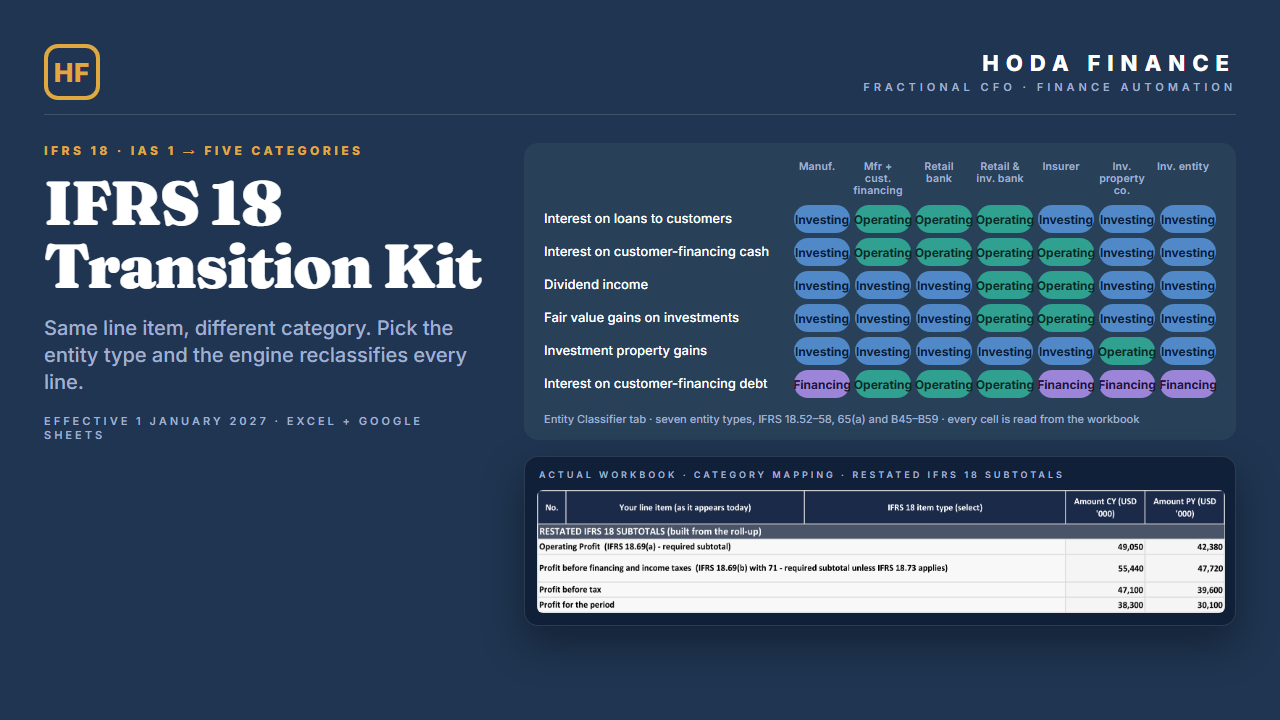
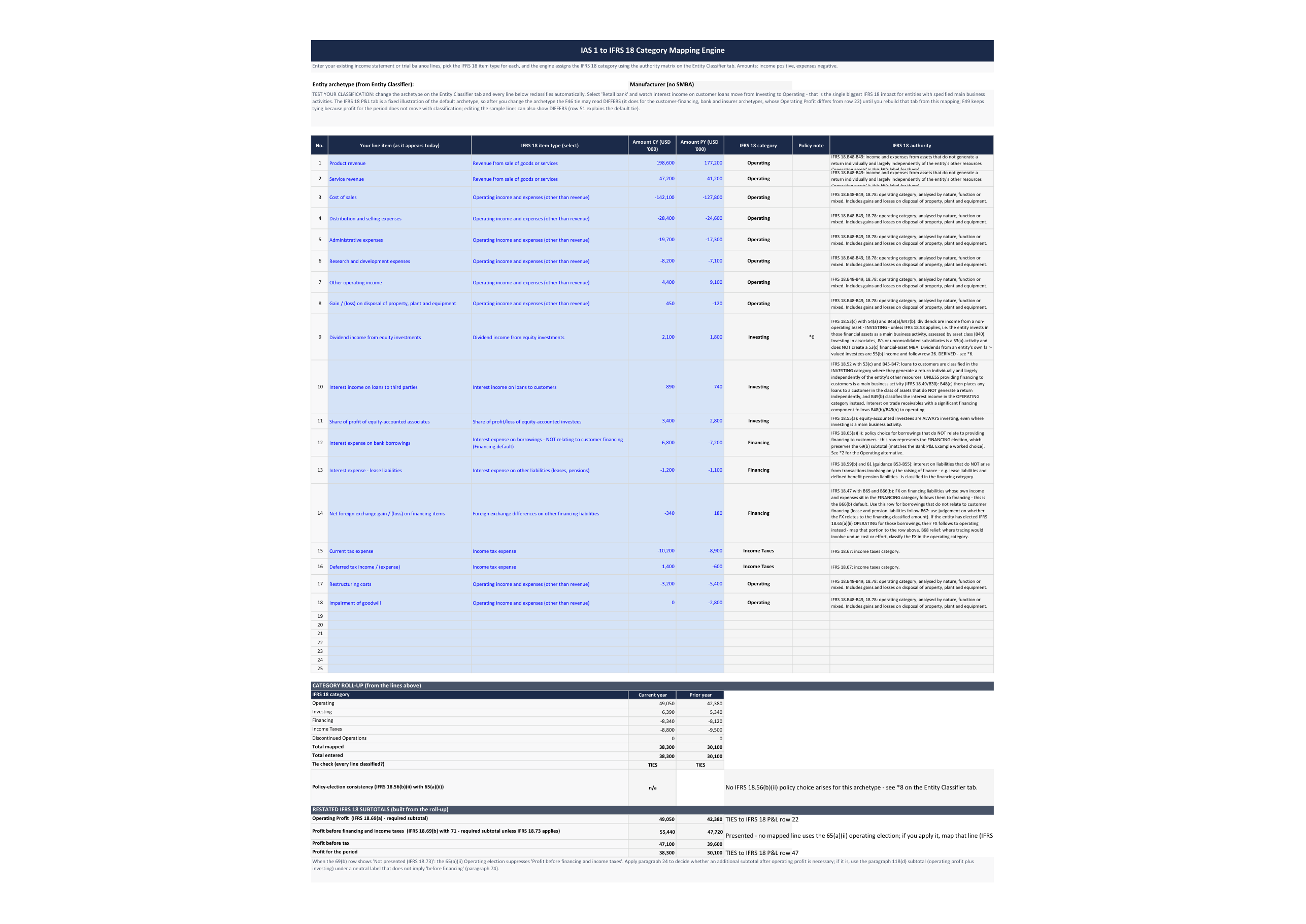
The differentiator is that classification is computed and cited, not assumed. IFRS 18.49 makes entities with a specified main business activity classify the same item differently from everyone else. In the shipped sample the same eighteen lines produce the same profit for the period — 38,300 — for every one of the seven archetypes, while Operating Profit reads 49,050 for a manufacturer, 49,940 with customer financing and 52,040 for a bank that also invests in financial assets. Each row of the 140-cell matrix (126 classifications and 14 marked not applicable) is tied to a paragraph, and the mapping engine reproduces the hand-built statement independently.
**What you get**
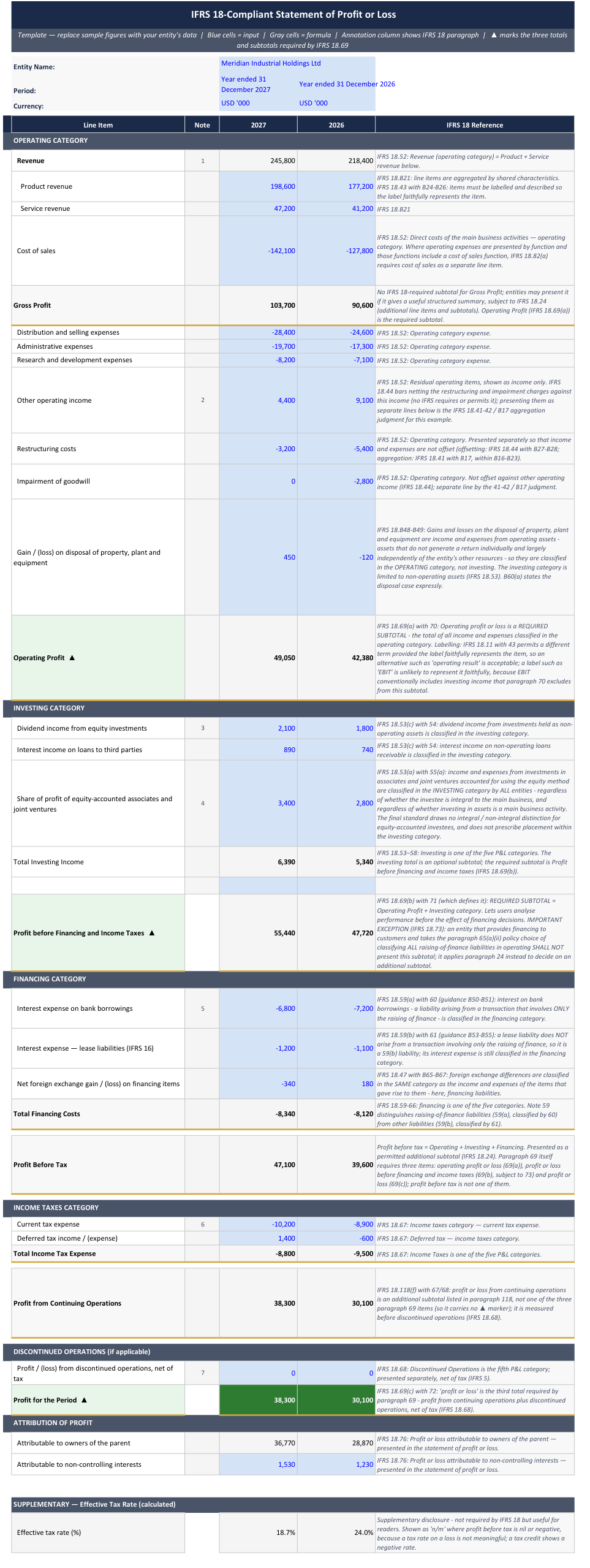
- A five-category IFRS 18 income statement with both required subtotals — Operating Profit 18.69(a) and Profit before financing and income taxes 18.69(b)
- A 20 item type × 7 entity archetype classification matrix (140 cells: 126 classifications and 14 marked not applicable), each row paragraph-cited, with ten accounting-policy footnotes
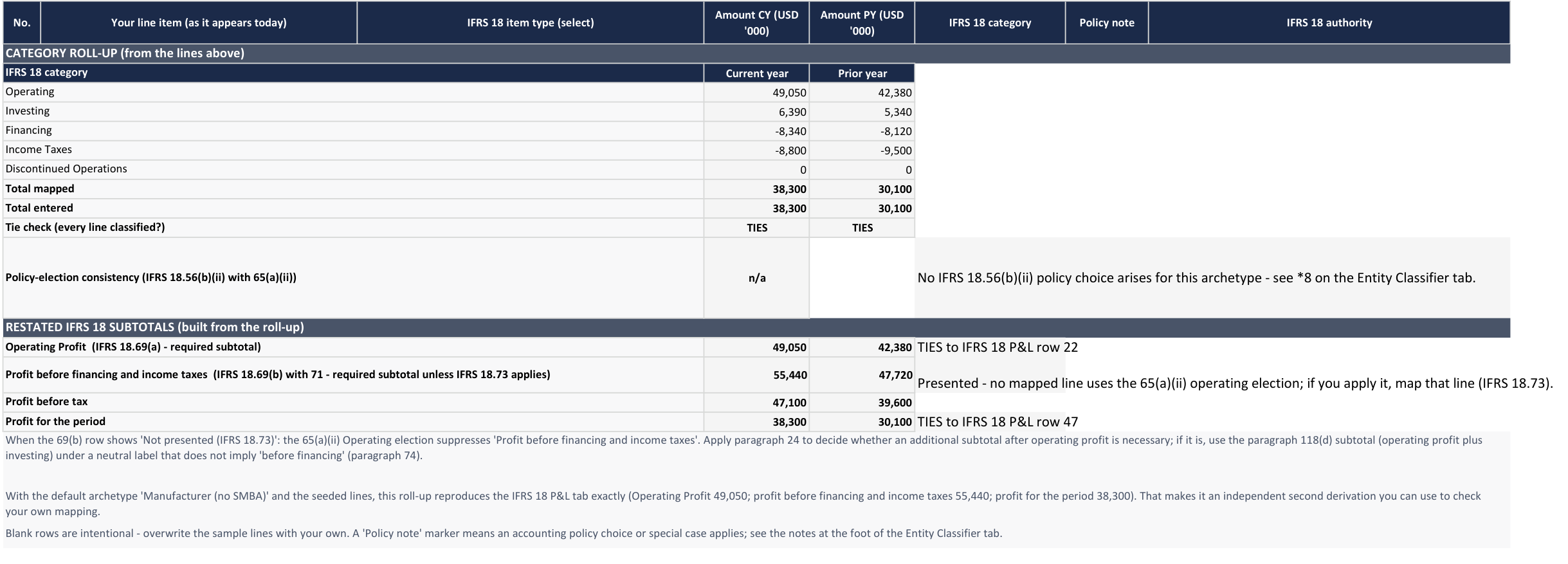
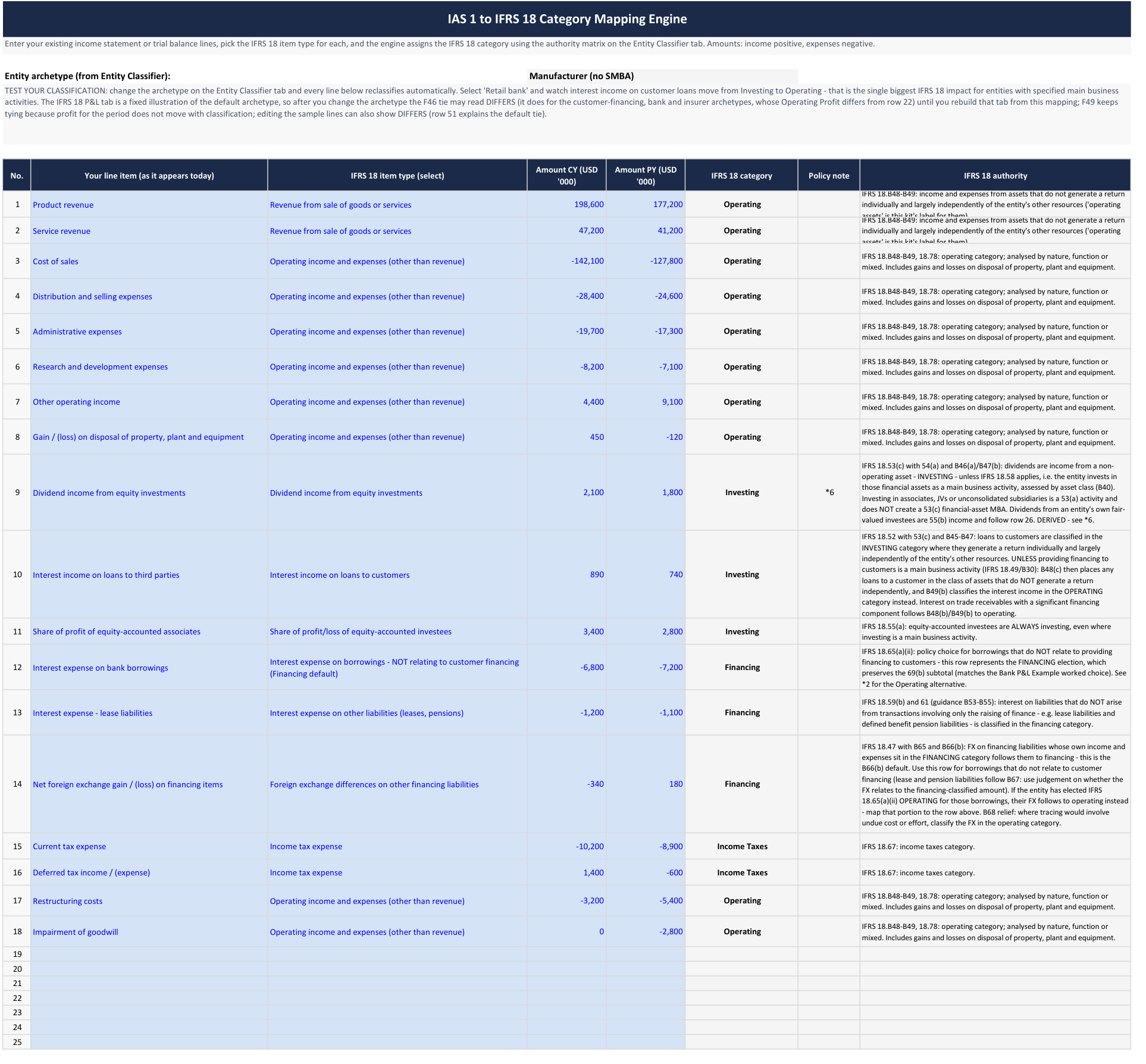
- An IAS 1 to IFRS 18 mapping engine with a tie check and a policy-election consistency check
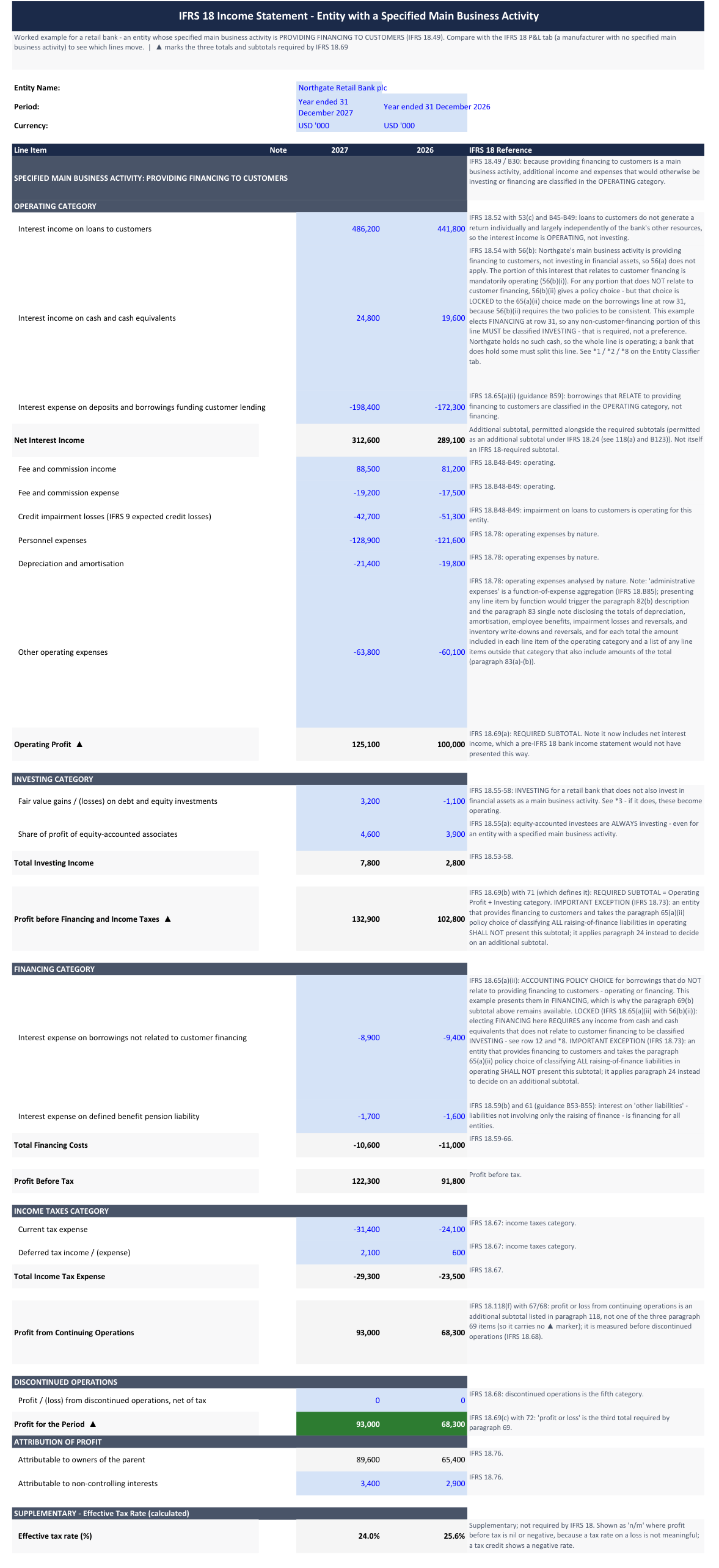
- A second fully worked statement for an entity with a specified main business activity
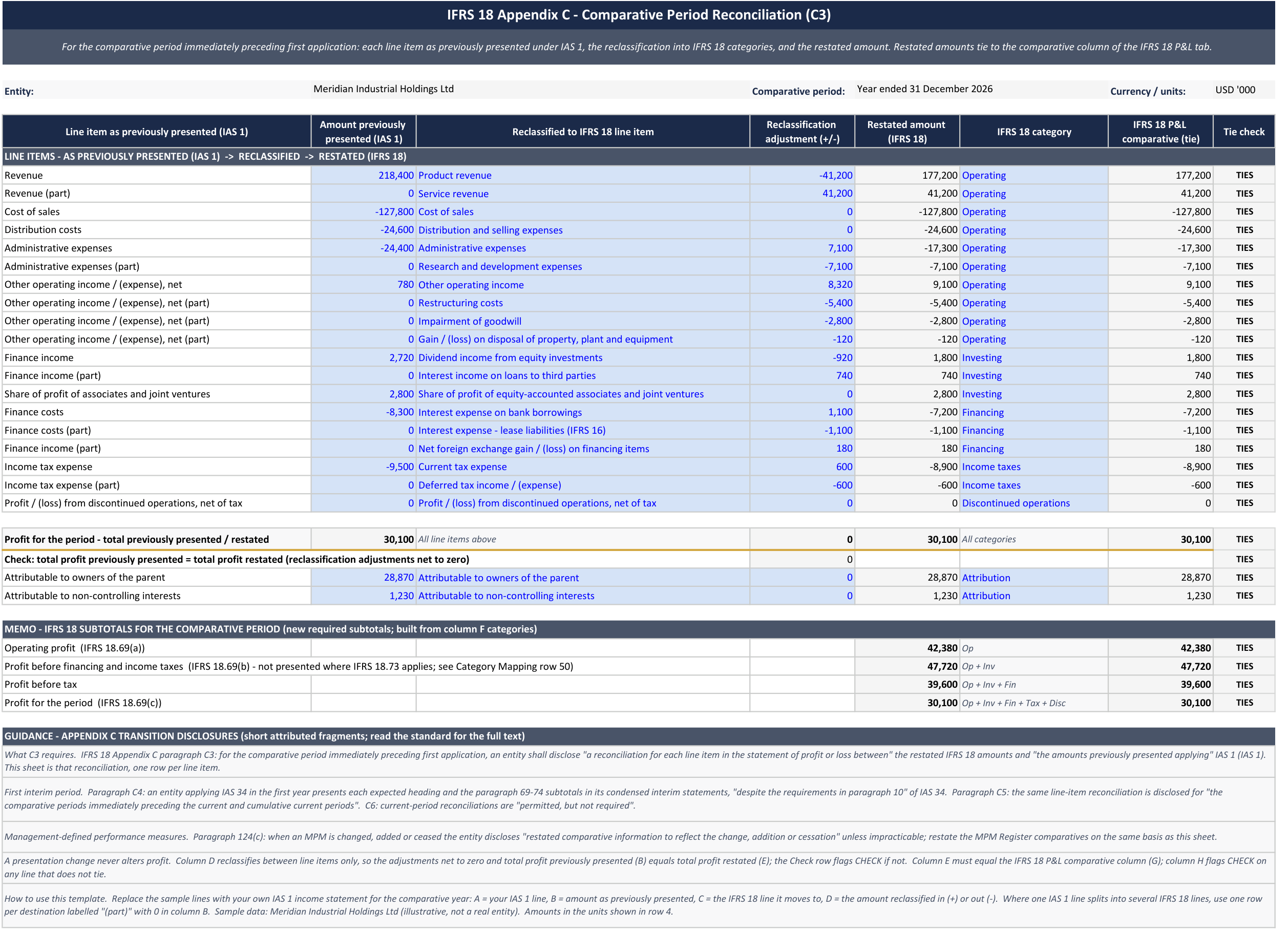
- A C3 Reconciliation tab — comparative-period line-item reconciliation from IAS 1 as previously presented to IFRS 18 restated (Appendix C ¶C3), tying to the IFRS 18 P&L comparative column
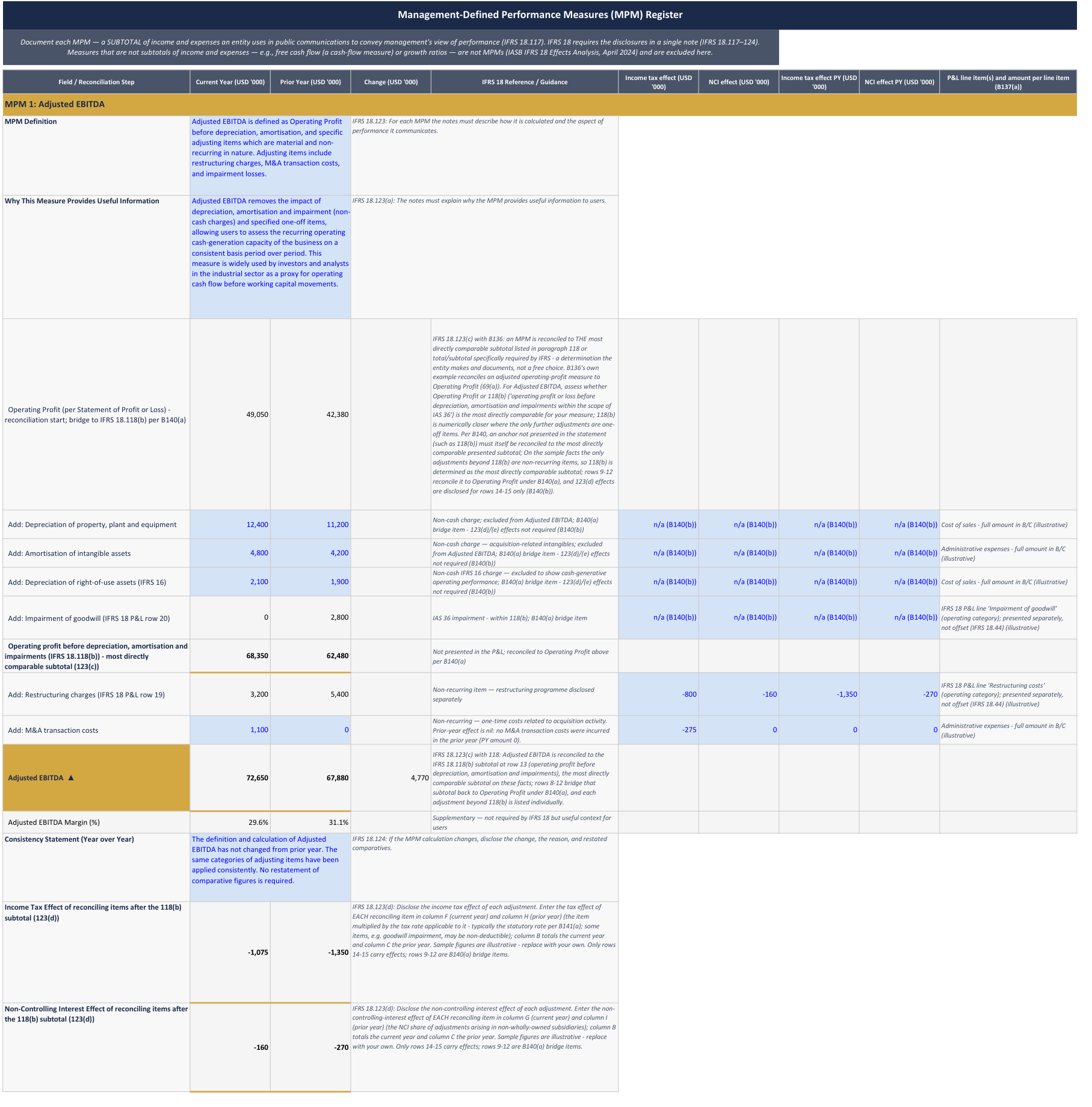
- Three worked management-defined performance measures, reconciled, with 123(d) tax and NCI effect lines, a per-item income-tax-effect and NCI-effect column for every reconciling item after the paragraph 118 anchor (IFRS 18.123(d), B140(b), B141) and a P&L line-item attribution column (B137(a))
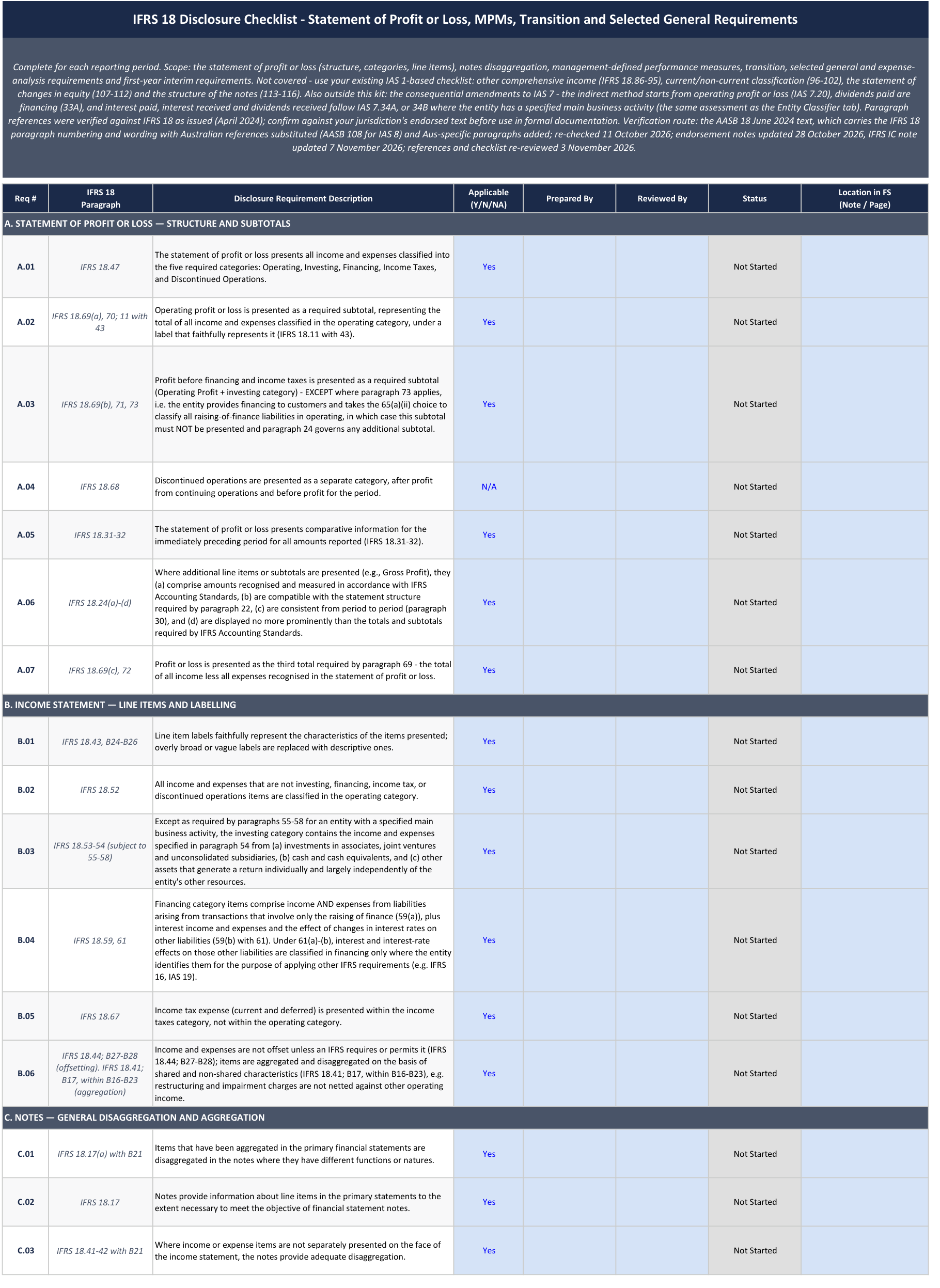
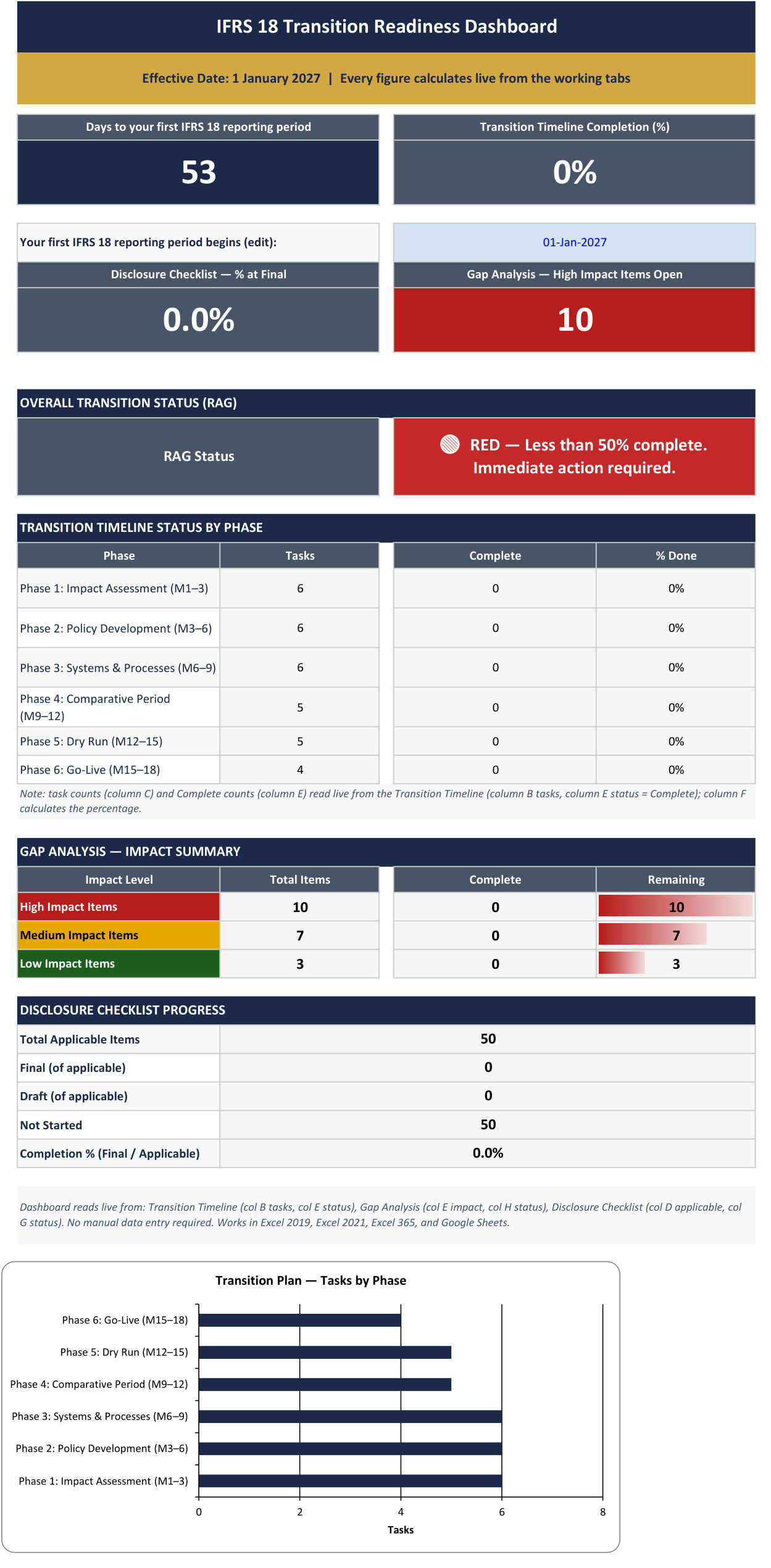
- A 20-point gap analysis, a 55-point disclosure checklist, a six-phase 32-task timeline (18 months in the sample), a readiness dashboard and a board memo template
- A Google Sheets edition and a 4-page practitioner's guide
**Model structure — Excel (12 tabs)**
1. Start Here — what changes, who it applies to, responsibilities, 7-step quick start, disclaimer
2. Dashboard — completion %, RAG status, days to 1 January 2027, tasks-by-phase chart
3. Transition Timeline — 6-phase, 32 tasks (18 months in the sample) with owners and target dates
4. Gap Analysis — 20 paragraph-referenced requirement points, scored for gap and impact
5. Entity Classifier — main-business-activity determination and the 20 × 7 matrix
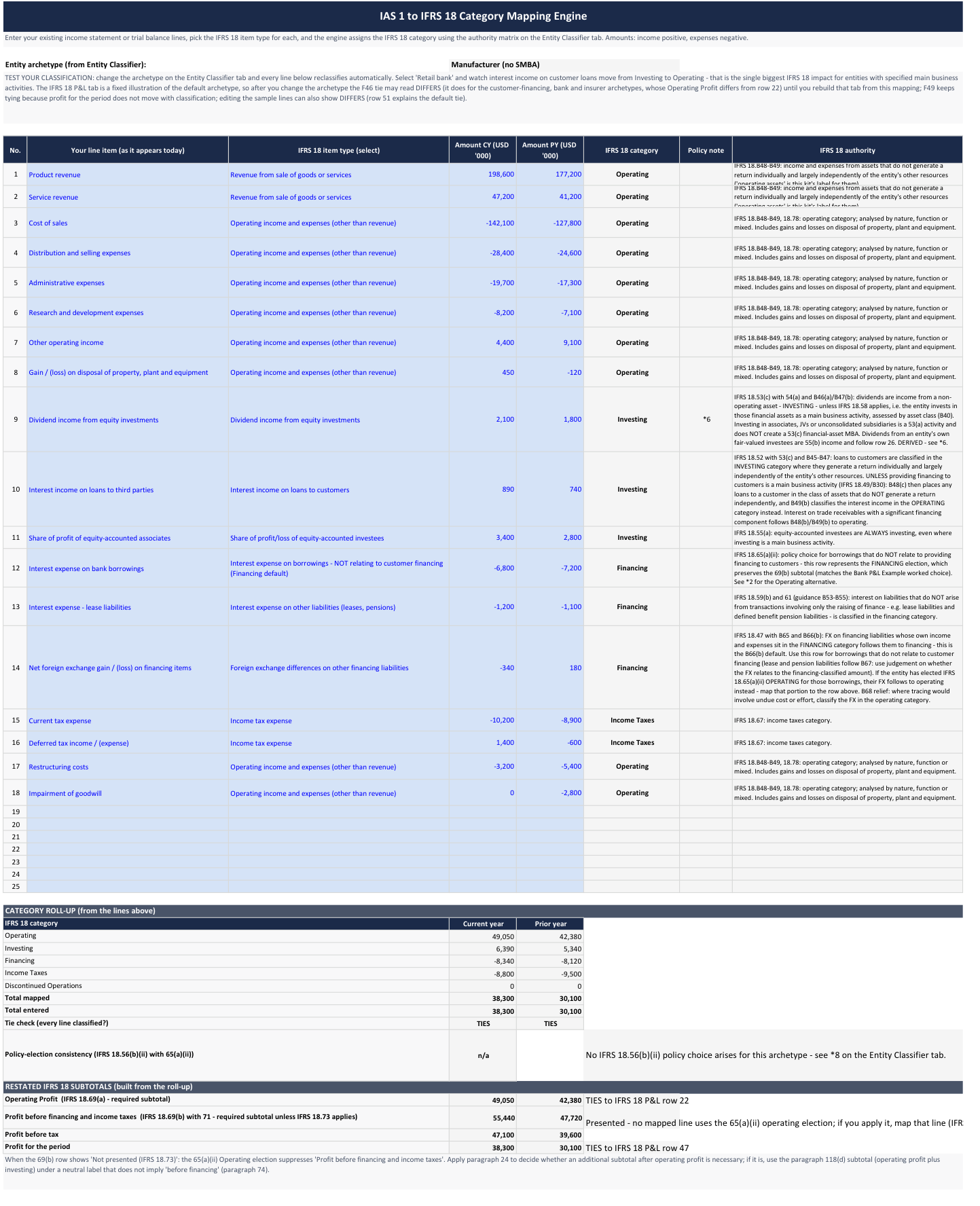
6. Category Mapping — the engine: classification, roll-ups, subtotals, tie check, election check
7. IFRS 18 P&L — worked manufacturer statement, annotated line by line
8. Bank P&L Example — parallel statement for a specified-main-business-activity entity
9. C3 Reconciliation — comparative-period line-item reconciliation, IAS 1 as previously presented → IFRS 18 restated (Appendix C ¶C3), tied to the IFRS 18 P&L comparative column
10. MPM Register — three reconciled measures
11. Disclosure Checklist — 55 points with status roll-up
12. Board Memo Template — briefing for the board or audit committee
**See it working**
"Meridian Industrial Holdings Ltd" (fictional): revenue 245,800 (all figures USD '000, year ended 31 December 2027, prior year 2026) (prior year 218,400); gross profit 103,700; Operating Profit 49,050 (42,380), including a 450 PPE disposal gain retained in operating; investing 6,390, including the 3,400 associates share moved out of operating; Profit before financing and income taxes 55,440 (47,720); profit before tax 47,100; profit for the period 38,300 (30,100). MPMs: Adjusted EBITDA 72,650, Adjusted Operating Profit 53,350, Adjusted Profit Before Tax 51,400. "Northgate Retail Bank plc" (fictional): net interest income 312,600; Operating Profit 125,100; Profit before financing and income taxes 132,900; profit before tax 122,300; profit for the period 93,000. Replace the inputs with your own and every output re-prices.
**Scope**
A presentation and disclosure tool for the income statement and its notes. No measurement or recognition — no IFRS 9, IFRS 16 or IFRS 17 mechanics, no consolidation or translation, no balance sheet, cash flow or equity statement, no XBRL, no filing-ready output.
**Technical specifications**
- Format: .xlsx (Excel) + .xlsx (Google Sheets) + .pdf (guide)
- Compatibility: Excel 2019, 2021, Microsoft 365 (Windows and Mac) and Google Sheets
- No macros, no VBA, no add-ins, no XLOOKUP, no dynamic arrays
- 12 tabs · 334 formulas · 15 input-validation rules over 483 input cells
- Pre-filled worked transition; replace with your own
- Delivery: instant digital download · single-user license
ABOUT THE AUTHOR
Built by Hoda Elmorshidy — Financial Controller & Fractional CFO, 9+ years in IFRS reporting, FP&A, commodity trading, CFO/board reporting, UAE VAT & Corporate Tax, and finance automation. Practitioner-grade tools, not generic templates.
SCOPE - WHOSE RULES THIS KIT ENCODES
Built for entities that prepare financial statements under IFRS Accounting Standards. IFRS 18 Presentation and Disclosure in Financial Statements was issued by the IASB in April 2024 and applies to annual reporting periods beginning on or after 1 January 2027, with early application permitted.
Adoption is jurisdiction by jurisdiction: an entity in the EU or the UK applies IFRS 18 once local endorsement rules have taken it into their own framework, so confirm the endorsement status that applies to you as at your reporting date. This kit records EU endorsement (Commission Regulation (EU) 2026/338, OJ 16 February 2026) and UK adoption (UK Endorsement Board, December 2025) as verified on 3 November 2026, and does not track any other jurisdiction.
Not for US GAAP filers: IFRS 18 is not part of US GAAP (FASB ASC), so a US GAAP filer does not apply it and nothing here encodes US presentation rules. An entity that reports under IFRS Accounting Standards is in scope wherever it is listed; one reporting under US GAAP is not.
No country's tax rules are encoded. "Income taxes" here means the IFRS 18 income-taxes category of the income statement, and the income tax effect of each MPM adjustment disclosed under IFRS 18.123(d), computed at whatever rate applies to you: the kit supplies no tax rates, no thresholds, no filing forms and no tax computation for any territory, and contains no sales tax, VAT or GST content. "Non-GAAP measure" is used in its ordinary sense of a measure not defined by IFRS Accounting Standards; it is not a reference to US GAAP.
DISCLAIMER
Not accounting advice. This template is an analytical and educational tool, not professional financial, investment, tax, accounting, or legal advice, and its use creates no professional relationship. All assumptions and figures are illustrative. Verify every IFRS 18 paragraph reference against the current standard text, and confirm your jurisdiction's endorsement status, as of your reporting date, before relying on any output. The sample entities and all of their figures are fictional. Liability is limited as set out in the licence terms below.
LICENSE & LIABILITY
LICENSE GRANT: Single-user license for your own or your organization's internal use. No resale, redistribution, sublicensing, or repackaging of the file or its templates.
AS IS: Provided "as is" without warranty of any kind, express or implied, including merchantability or fitness for a particular purpose.
LIMITATION OF LIABILITY: To the maximum extent permitted by law, total liability for any claim arising from this product is limited to the amount you paid for it. Not liable for indirect, incidental, or consequential losses.
NON-WAIVABLE RIGHTS: Nothing here limits rights that cannot be excluded under the consumer-protection law of your jurisdiction.
GOVERNING LAW: This purchase is governed by the terms of the platform you bought it on (e.g. Etsy, Gumroad) and by the consumer-protection law of your own country of residence. Where those permit, the limitations above apply to the maximum extent allowed.
DATA & PRIVACY: This is an offline Excel file. It contains no macros, no data connections, no external links and no telemetry - verified in both editions. Nothing you type into it is transmitted anywhere; your figures stay on your own machine. No AI service is called by the workbook at any point.
Past or sample results are not indicative.
REFUNDS: Digital download — refunds are handled per the refund policy of the platform you purchased on for digital/instant-download items.
TRADEMARKS & NON-AFFILIATION: "IFRS", "IAS", "IASB", "International Financial Reporting Standards" and "International Accounting Standards" are trade marks of the IFRS Foundation. This product is an independent analytical template and is not affiliated with, endorsed by, sponsored by, or approved by the IFRS Foundation or the International Accounting Standards Board. It is not a copy of, or a substitute for, the standard: it quotes only short fragments of IFRS 18, cited by paragraph number. Microsoft Excel and Google Sheets are trademarks of Microsoft Corporation and Google LLC respectively; this product is not affiliated with, endorsed by, or sponsored by either. It is likewise not affiliated with, endorsed by, or sponsored by Etsy, Gumroad, Payhip, eFinancialModels or Eloquens, nor by any benchmark publisher referenced in the workbook. Any other third-party names referenced are the property of their respective owners and are used for descriptive purposes only.

This Best Practice includes
- Format: .xlsx (Excel) + .xlsx (Google Sheets) + .pdf (guide) - Compatibility: Excel 2019, 2021, Microsoft 365 (Windows

Acquire business license for $179.00

Add to cart

Add to bookmarks

Discuss

Further information

• Restate an income statement from IAS 1 presentation to the five IFRS 18 categories, with both subtotals the standard requires — Operating Profit 18.69(a) and Profit before financing and income taxes 18.69(b)
• Determine whether the entity has a specified main business activity under IFRS 18.49 and classify income and expenses accordingly, across seven entity archetypes
• Apply the 56(b)(ii) and 65(a)(ii) accounting policy elections consistently, and detect the pairings the standard prohibits
• Identify where IFRS 18.73 bars presentation of the 69(b) subtotal, and present the paragraph 118(d) alternative under paragraph 24 with the paragraph 74 labelling constraint
• Document management-defined performance measures under 117–124 with reconciliations and the 123(d) tax and non-controlling-interest effects
• Plan, track and evidence the transition — gap analysis, disclosure checklist, six-phase timeline, readiness dashboard, board memo

• Entities reporting under IFRS Accounting Standards preparing for the 1 January 2027 effective date
• Technical accountants and financial reporting managers producing the restated income statement
• Entities with specified main business activities — banks, insurers, investment property companies, investment entities
• Groups that publish non-GAAP measures and now need formal MPM disclosures
• Internal and external audit teams reviewing IFRS 18 readiness
• Users on Microsoft Excel 2019/2021/365 or Google Sheets

• Entities not reporting under IFRS Accounting Standards (a US GAAP filer does not apply IFRS 18)
• Users needing measurement or recognition support — IFRS 9, IFRS 16 or IFRS 17 mechanics, consolidation, currency translation
• Users needing a balance sheet, cash flow statement or statement of changes in equity
• Users needing XBRL tagging or filing-ready output
• Users seeking the official standard text or formal accounting advice


0.0 / 5 (0 votes)

please wait...