Budget vs Actual Report – Excel Variance Analysis Template with Automatic Status Flags
Originally published: 19/08/2026 16:32
Publication number: ELQ-14048-1
View all versions & Certificate
certified

Budget vs Actual Report – Excel Variance Analysis Template with Automatic Status Flags

An Excel budgeting tool that compares planned vs. actual spending across 10 categories every month.

Description
This Budget vs Actual Report is a formula-driven Excel template built for business owners, finance teams, and department managers who need to track spending discipline against a plan, not just record what happened after the fact. Setting a budget is only half the job — this tool handles the other half automatically: comparing actual results to that budget every month and flagging exactly where performance is drifting.

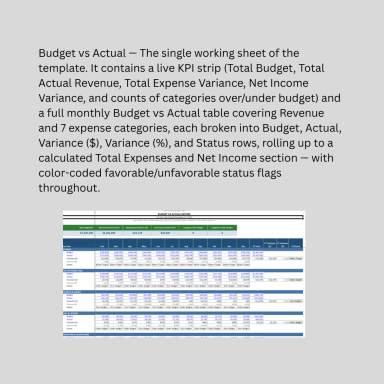
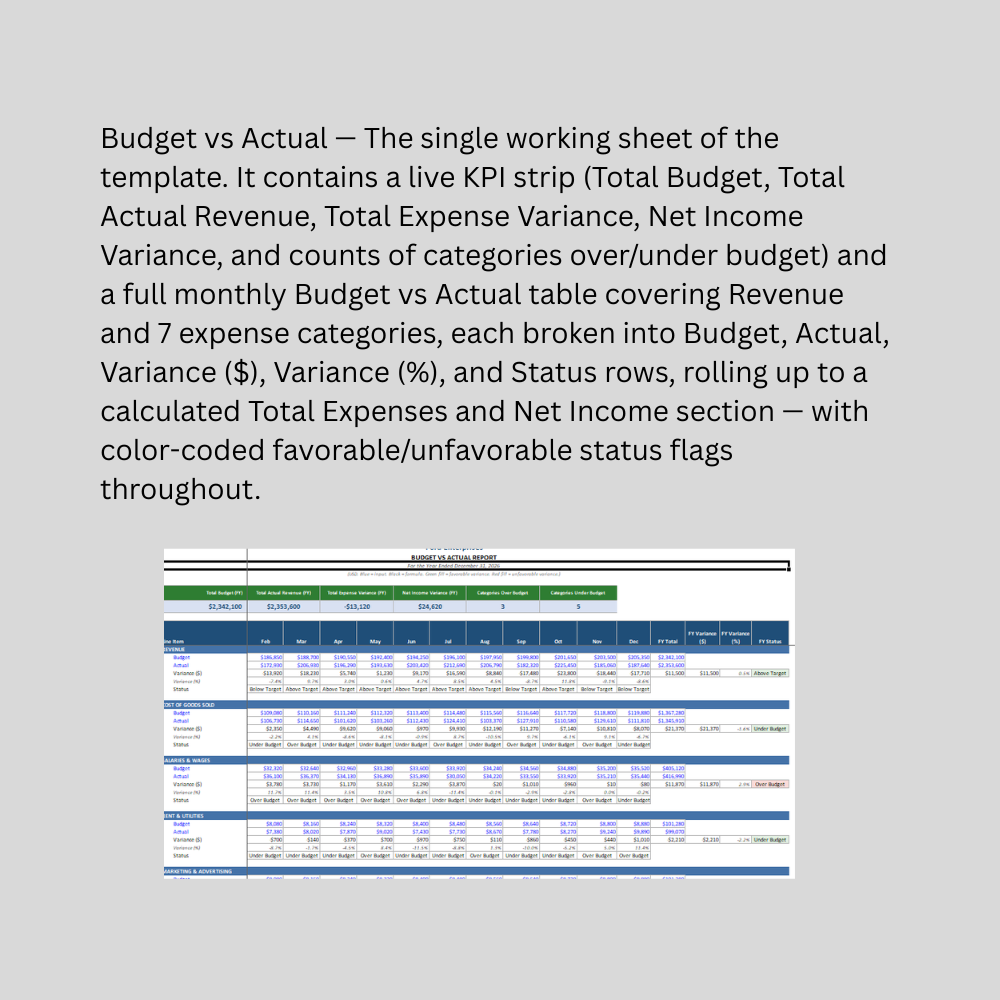
The template covers Revenue and seven standard expense categories — Cost of Goods Sold, Salaries & Wages, Rent & Utilities, Marketing & Advertising, Software & Tools, Office & Admin Expenses, and Other Operating Expenses. For each category, you enter monthly Budget and Actual figures, and the template automatically calculates the dollar variance, the percentage variance, and a plain-language Status (Over Budget / Under Budget for expenses; Above Target / Below Target for revenue). A Total Expenses section rolls up all expense categories automatically, and a Net Income section calculates budgeted vs. actual profit — both fully derived from the categories above, with no manual entry required.
What makes this genuinely useful rather than just a spreadsheet of numbers is the built-in favorability logic: for expenses, spending less than budgeted is automatically flagged green as favorable, while overspending is flagged red; for Revenue and Net Income, the logic correctly flips, so exceeding target is green and falling short is red. A live KPI strip at the top surfaces the headline numbers immediately — total budget, total actual revenue, total expense variance, net income variance, and a count of how many categories are currently over or under budget — without needing to scan the full table. Every column includes both monthly detail and an FY Total/Variance/Status summary, and everything recalculates instantly as you update your numbers.

This Best Practice includes
1 excel dashboard file (xlsx) with instruction set

Acquire business license for $10.00

Add to cart

Add to bookmarks

Discuss

Further information

Compare planned (budget) vs. actual figures across revenue and expense categories every month
Automatically calculate dollar and percentage variance without manual formulas
Flag favorable vs. unfavorable performance instantly using correct, category-aware logic
Roll up category-level budgets into Total Expenses and Net Income automatically
Give managers and owners a fast, KPI-level view of overall budget performance
Support monthly financial reviews and budget accountability conversations

Small to mid-sized businesses tracking spending discipline against a set monthly budget
Department or business unit managers accountable for staying within budget
Finance teams preparing monthly budget review reports for leadership
Businesses with a relatively standard expense category structure
Organizations that already set an annual or monthly budget and want to track performance against it
Users comfortable replacing sample data with their own budget and actual figures each month

Businesses needing budget tracking broken down by department, project, or cost center simultaneously (this template tracks at the whole-company category level)
Organizations requiring rolling/flexible budgets that automatically adjust targets based on activity levels
Multi-year budget comparison or budget planning/forecasting (this tracks a single fiscal year's budget vs. actual, not future budget creation)
Businesses needing approval workflows or budget request/revision tracking
Complex cost allocation across multiple revenue streams or business units
Situations requiring certified financial reporting — this is a management and budgeting tool, not a substitute for formal accounting review


0.0 / 5 (0 votes)

please wait...