Construction Draw Schedule, Lender Yield & Real Estate Investment Pro Forma — Excel Model
Originally published: 06/02/2026 16:28
Publication number: ELQ-60501-1
View all versions & Certificate
certified

Construction Draw Schedule, Lender Yield & Real Estate Investment Pro Forma — Excel Model

Construction Draw Schedule, Lender Yield & Real Estate Investment Pro Forma — Excel Model

Description
A fully integrated Excel pro forma model thatwalks through the complete lifecycle of a commercial real estate developmentproject — from construction draw scheduling and lender yield calculationthrough operational cash flows, depreciation, tax analysis, and investmentdecision-making using IRR and NPV. Designed for developers, analysts, lenders,and MBA/finance professionals seeking a ready-to-use, assumption-drivenframework for office, retail, or mixed-use projects.


This comprehensive Excel model provides a structured, end-to-end financial analysis framework for commercial real estate development projects. It covers the full project lifecycle across two distinct phases: the Construction Phase (Year 0) and the Operational & Disposition Phase (Years 1–5). Every calculation is dynamically linked to a centralized Assumptions sheet, allowing users to modify key inputs and instantly observe the impact on project economics, financing costs, returns, and investment viability.


The model is built around a realistic case study — a62,000 sq ft suburban office development with a 12-month construction timeline,phased draw schedule, permanent loan takeout, 5-year operating horizon, andterminal sale — but is fully adaptable to any commercial property typeincluding retail centers, mixed-use developments, and industrial facilities.


Key Features
• Centralized Assumptions Dashboard — All project inputs (site, construction costs, financing terms, operating parameters, sale & tax assumptions) are consolidated on a single sheet for easy scenario testing.
• Monthly Construction Draw Schedule — Models a two-phase draw structure (front-loaded and steady-state) with month-by-month beginning balance, draw amount, ending balance, and accrued interest.
• Lender Yield Calculation — Computes the construction lender’s annualized yield by combining interest carry with origination fee income against the average outstanding balance.
• Total Project Cost Buildup — Aggregates land, hard costs, soft costs, loan fees, and capitalized interest into a single total project cost figure, with depreciable base allocation.
• Equity Requirement Analysis — Statement of cash flows for the construction phase showing total outflows, loan proceeds, and the resulting equity gap.
• 5-Year Operating Pro Forma — Revenue projections with rent escalation, tenant reimbursements, vacancy adjustments, operating expenses, and Net Operating Income (NOI) for Years 1–5.
• Debt Service & Loan Amortization — Permanent loan modeling with monthly mortgage payment, annual debt service, interest/principal split, and year-end loan balances.
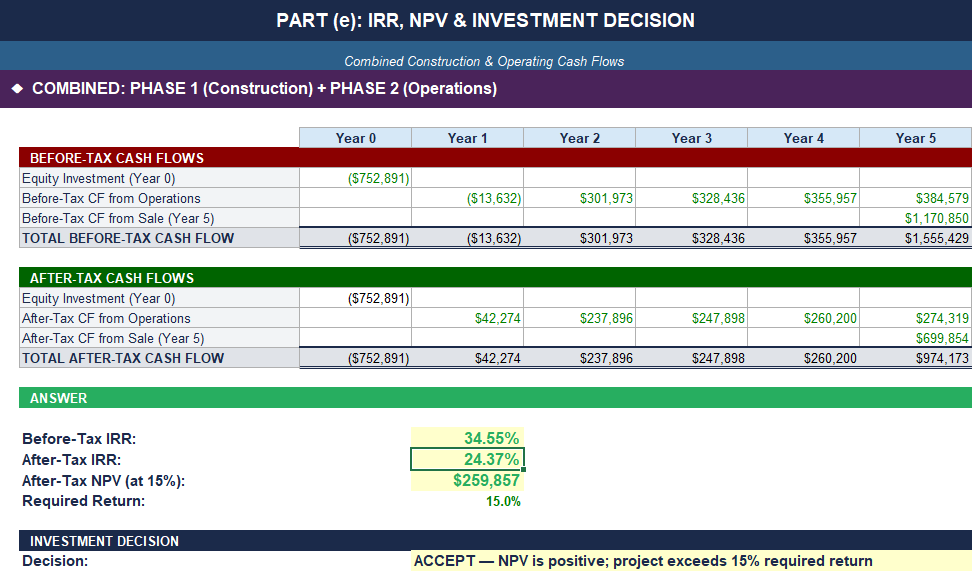
• Before-Tax & After-Tax Cash Flows — Complete BTCF and ATCF computation incorporating depreciation schedules (SL for capital improvements, DDB for tenant improvements), taxable income, and income tax.
• Property Disposition Analysis — Sale proceeds, selling costs, mortgage payoff, adjusted basis, gain on sale, capital gains tax, and after-tax cash flow from sale.
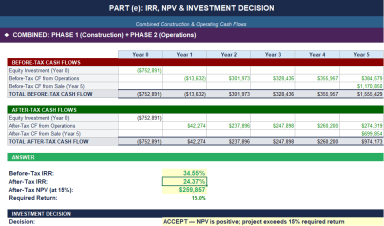
IRR, NPV & Go/No-Go Decision — Before-tax IRR,after-tax IRR, and NPV at the investor’s required return, with a clearACCEPT/REJECT recommendation.

This Best Practice includes
Assumptions | P1(a) Draw Schedule | P1(b) Total Cost | P1(c) Construction CF | P2(d) Operations & Sale | (e) IRR & NPV

Muhammad Nawaz, ACA offers you this Best Practice for free!

download for free

Add to bookmarks

Discuss

Further information

This model is designed for real estate developers and project sponsors evaluating new construction opportunities, commercial lending professionals and credit analysts assessing construction loan risk and yield, investment analysts and fund managers conducting due diligence on development projects, MBA students and finance professionals studying real estate financial modeling, and consulting firms advising on feasibility, project structuring, and investment decisions.

Real estate development projects involve complex, interdependent financial variables that are difficult to model from scratch. This template eliminates that complexity by providing a proven analytical structure that addresses several critical questions simultaneously:
• How should construction loan draws be phased across the build period, and what is the resulting interest carry?
• What is the true all-in cost of the project after accounting for loan origination fees, interest carry, and permanent financing costs?
• How much equity does the developer need to contribute after netting off construction loan proceeds?
• What are the year-by-year operating cash flows after debt service, and how do vacancy assumptions and growth rates affect returns?
• What is the after-tax return to the developer after accounting for depreciation (straight-line and double-declining balance), capital gains tax, and disposition costs?
• Does the project meet the investor’s required rate of return? Should the investment be accepted or rejected based on NPV and IRR?


0.0 / 5 (0 votes)

please wait...