Publication number: ELQ-75353-1
View all versions & Certificate

Smart Business Models
Built in Excel with dynamic assumptions for revenue growth, cost inflation, depreciation, corporation tax, and per-vehicle profitability metrics. Ideal for priv
 by Muhammad Nawaz, ACA
Senior Financial & Business Consultant | 15+ Years in Hospitality, Real Estate & Feasibility Analysis | IFRS, Valuation & Strategic Advisory | Serving Clients Across KSA, UAE, UK & USFollow
Further information
1. Provide a ready-to-use financial planning framework for vehicle rental and private hire startups to project revenues, costs, and profitability over a 6-year horizon.
2. Enable data-driven fleet expansion decisions by modelling the financial impact of scaling from a small fleet to a larger operation with per-vehicle economics.
3. Deliver an integrated three-statement financial model (Income Statement, Balance Sheet, Cash Flow) linked through a centralised assumptions sheet for scenario analysis.
4. Support investor presentations and bank loan applications by presenting professional-grade financial projections with clear growth trajectories and return metrics.
5. Facilitate UK VAT compliance planning by modelling output/input VAT, HMRC payment schedules, and VAT registration thresholds.
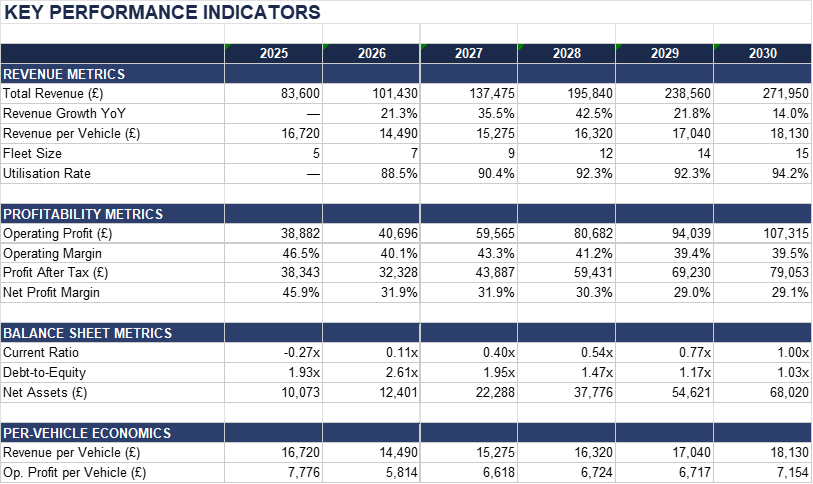
6. Track key performance indicators including fleet utilisation rates, operating margins, current ratios, debt-to-equity ratios, and per-vehicle profitability to benchmark operational performance.
7. Assist business owners in managing director drawings, dividend policies, and loan repayment schedules to optimise cash flow and personal income extraction.
• Private hire and taxi companies planning fleet growth from startup to mid-scale operations (5–15+ vehicles).
• Car rental startups seeking structured financial projections to secure bank financing or investor funding.
• UK-based vehicle rental businesses requiring integrated VAT analysis and corporation tax modelling at both small profits and main rate thresholds.
• Fleet management companies evaluating capital expenditure timing, vehicle depreciation impact, and asset replacement cycles.
• Owner-managed limited companies where director drawings, loan accounts, and dividend extraction strategies need to be planned alongside business growth.
• Transportation and mobility businesses operating on a weekly rental model (as opposed to daily or hourly pricing structures).
• Accountants, consultants, and business advisors preparing feasibility studies or business plans for clients in the vehicle rental and private hire industry.
• Businesses operating in markets with moderate inflation environments where category-specific cost escalation (insurance, maintenance, fuel, licensing) needs to be modelled separately.