
Last version published: 07/08/2026 12:41
Publication number: ELQ-95405-3
View all versions & Certificate

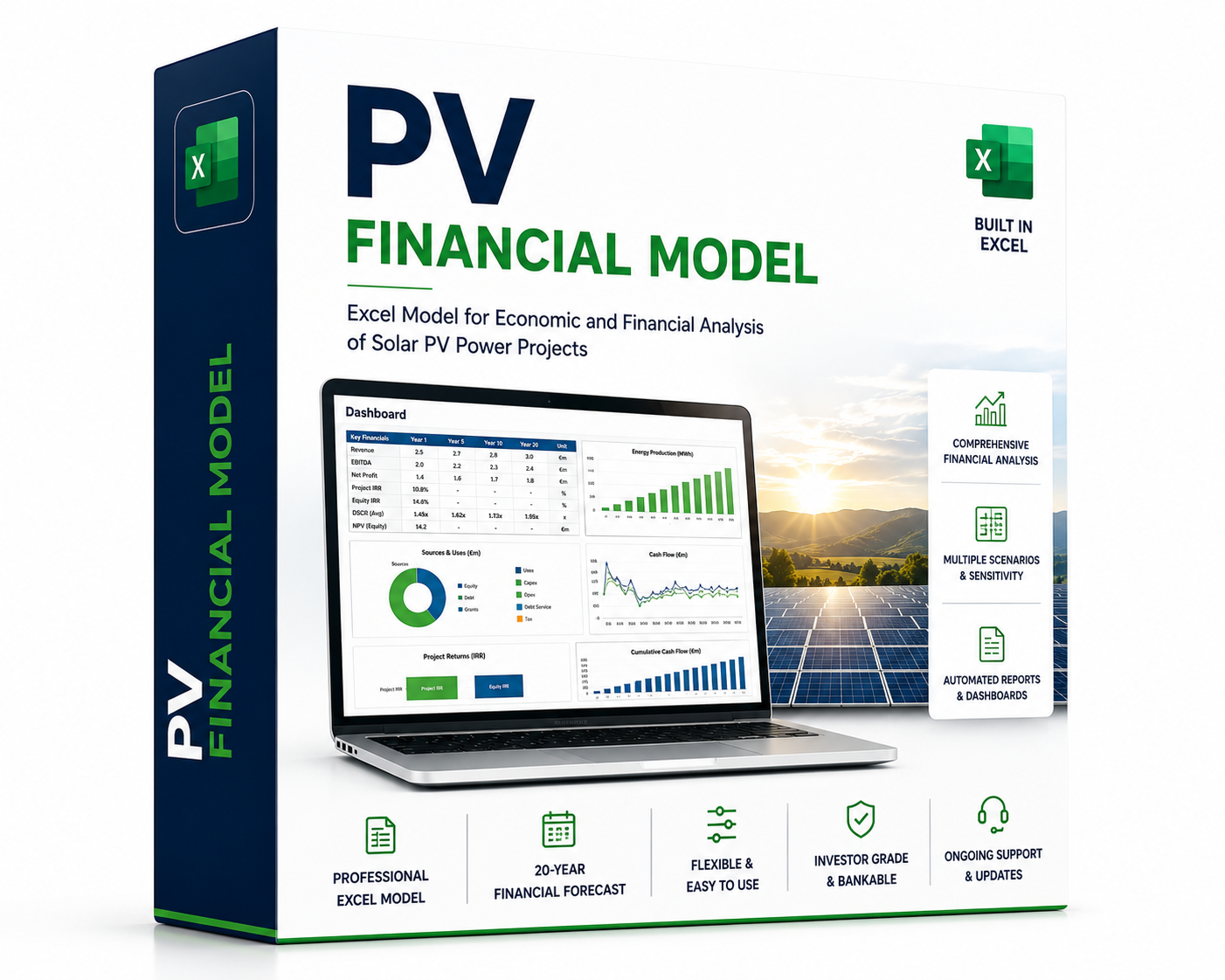
Solar PV Ultimate Model — Build a Bankable Business Case in Minutes, Not Weeks
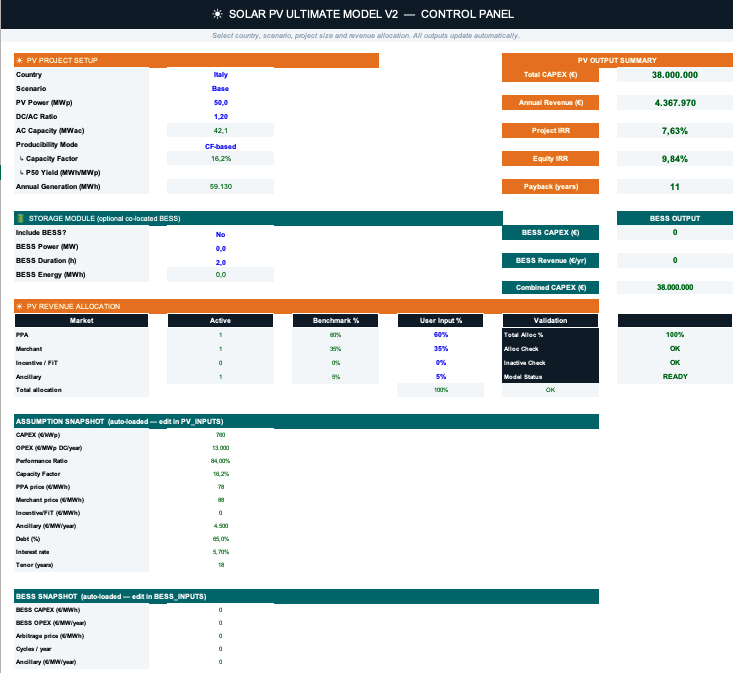
You have a solar PV deal to evaluate. This production-ready Excel model gives you a fully calibrated 20-year DCF across 8 countries and 3 scenarios
Further information
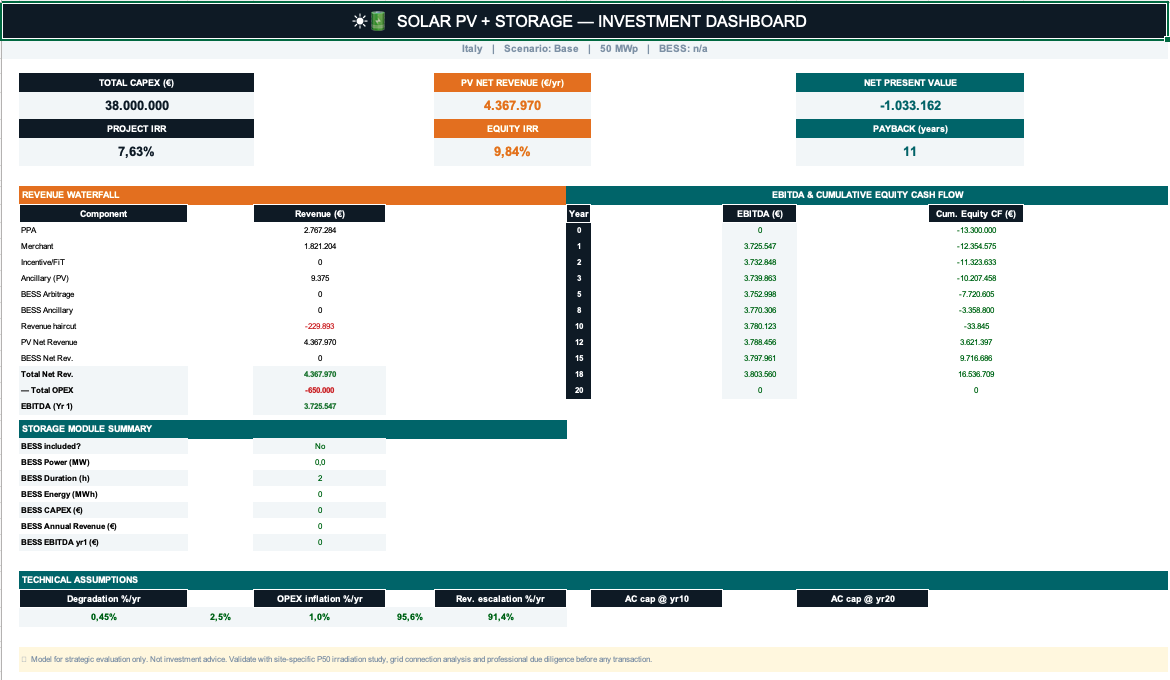
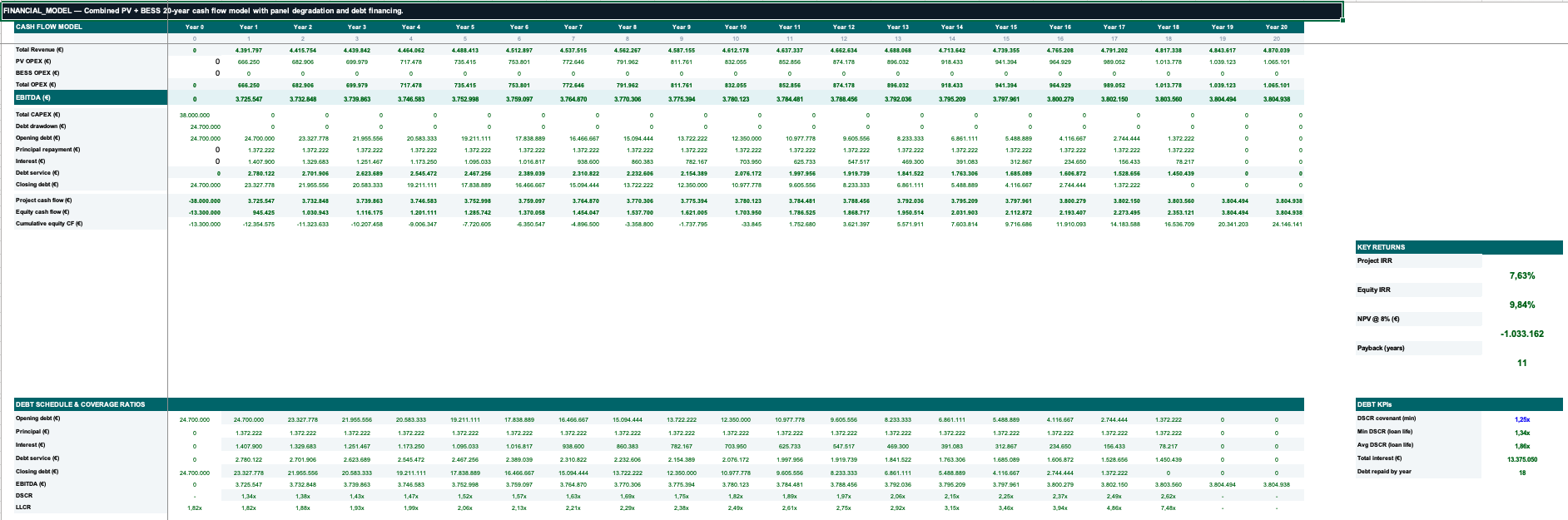
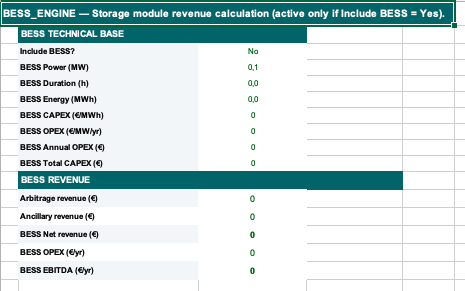
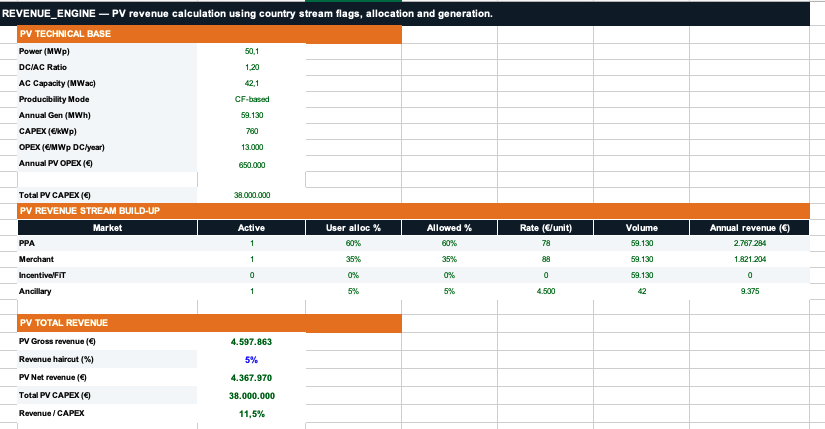
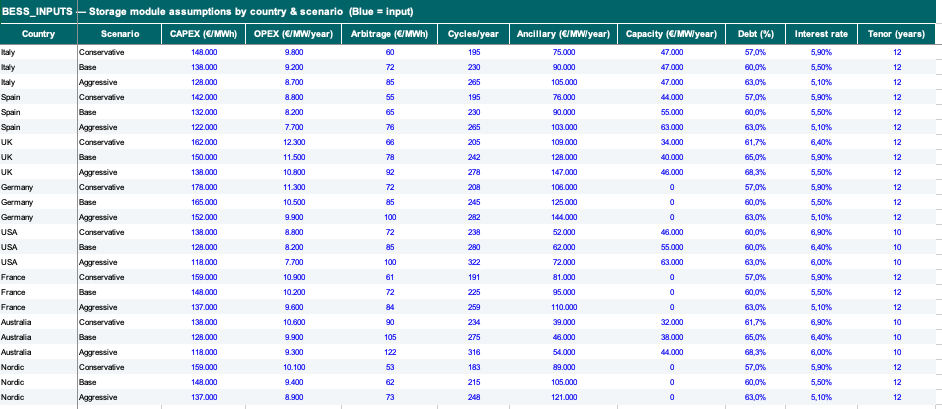
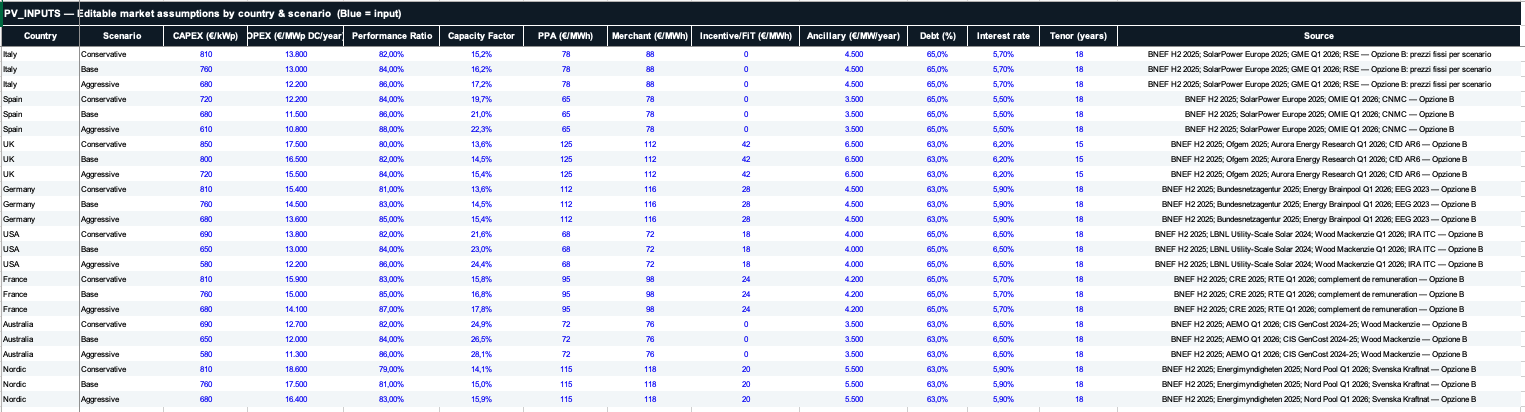
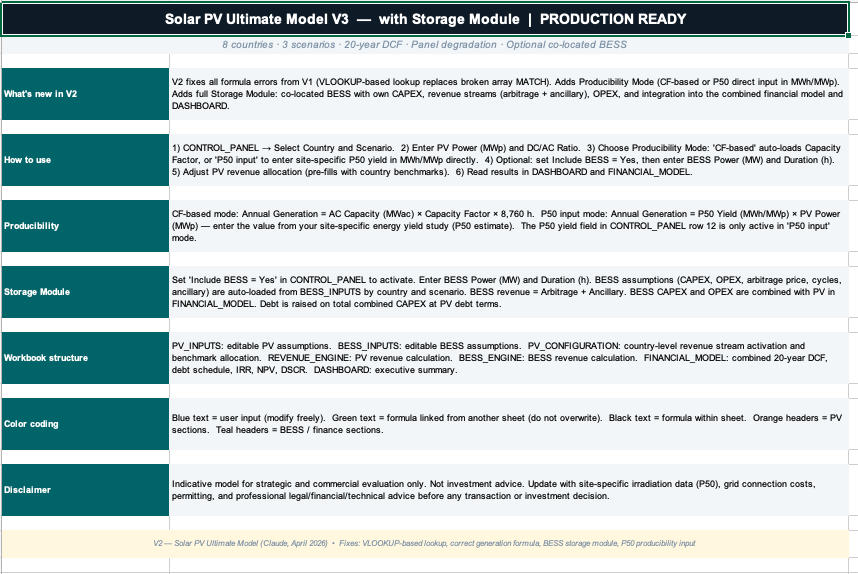
This model enables developers, advisors and investors to evaluate the financial viability of a utility-scale solar PV project across 8 international markets without building a model from scratch. It supports scenario comparison across Conservative, Base and Aggressive assumptions with a single selector, assesses the incremental value of adding co-located BESS storage, and produces Project IRR, Equity IRR, NPV and payback from a fully integrated 20-year cash flow. It also supports two producibility approaches — Capacity Factor-based estimation and P50 direct input from an energy yield study — and enables analysis of revenue stream composition across PPA, Merchant, Incentive and Ancillary streams with country-specific benchmark allocations and full user override capability.
This model is best suited to utility-scale solar PV greenfield projects in the 10–500 MWp range at early-stage feasibility or commercial evaluation, prior to full technical due diligence. It is calibrated for Italy, Spain, UK, Germany, USA, France, Australia and Nordic markets, and works particularly well when a P50 yield study is available to feed directly into the producibility module. It is also well suited to projects considering co-located BESS as an option to be evaluated incrementally, and to advisory, M&A and financing contexts where a clean, auditable Excel model is required.
This model is not designed for distributed generation, commercial & industrial or residential solar, as it does not reflect behind-the-meter self-consumption logic. It is not suited to markets outside the 8 pre-loaded countries without manual customisation of the assumption sets. It should not be used as the sole basis for a final investment decision — it is an indicative tool and must be supplemented with site-specific irradiation data, grid connection and permitting costs, and professional legal, financial and technical advice. It is also not appropriate for offshore or floating PV with materially different cost structures, or for BESS configurations that charge from the grid rather than from the co-located PV plant.