


Publication number: ELQ-83430-1
View all versions & Certificate

Private Medical Practice Financial Model — 3-Location Excel Dashboard | Revenue, Break-Even & 5-Year Forecast
Excel financial model for clinics & practices: 3-location revenue, break-even, staffing, and 5-year scenarios. Clear, professional, and built for healthcare.
 by Sankar Srinivasan
Stock Market Consultant | Options Strategies | Portfolio Risk Management & Professional Trading SystemsFollow
Further information
This financial model equips private medical practice owners, clinic managers, and healthcare consultants with a structured, ready-to-use tool to take full control of their practice finances — without relying on an external accountant for every business decision.
Specifically, this tool enables you to:
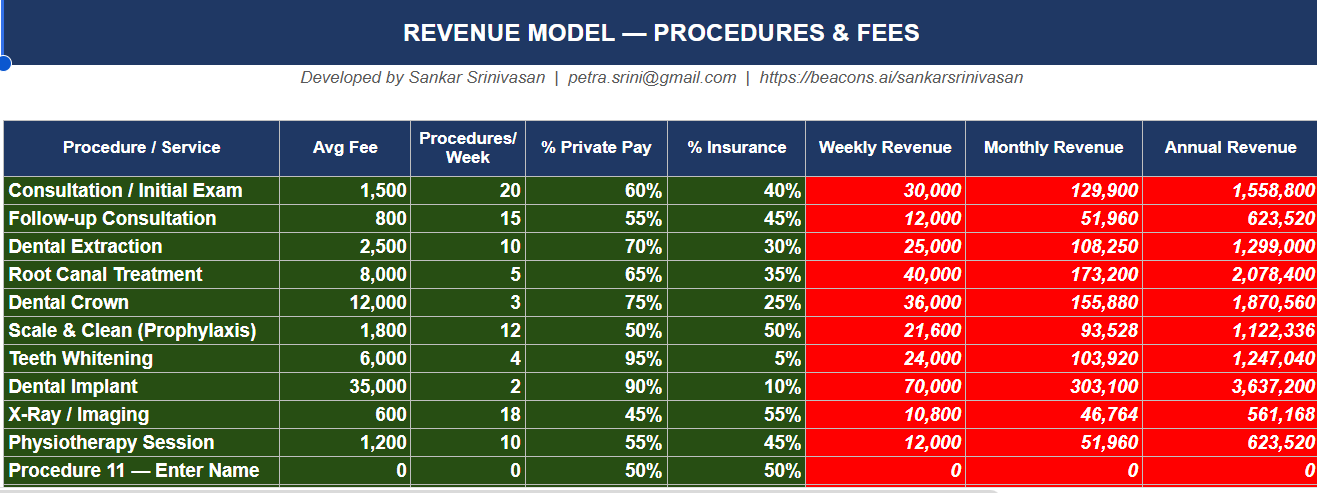
Understand exactly how much revenue each procedure type generates annually across up to three clinic locations
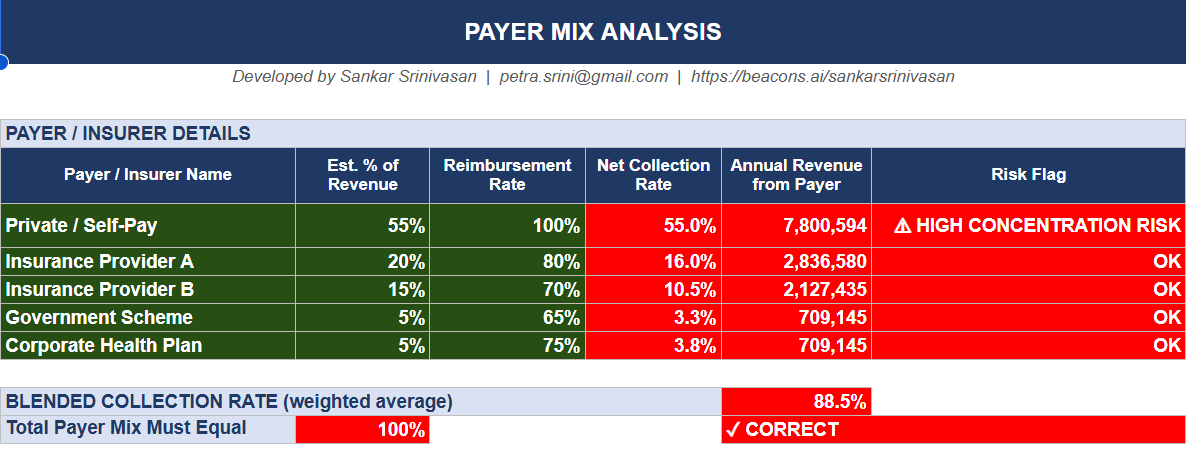
Identify your most and least profitable payer relationships through built-in payer mix and reimbursement rate analysis
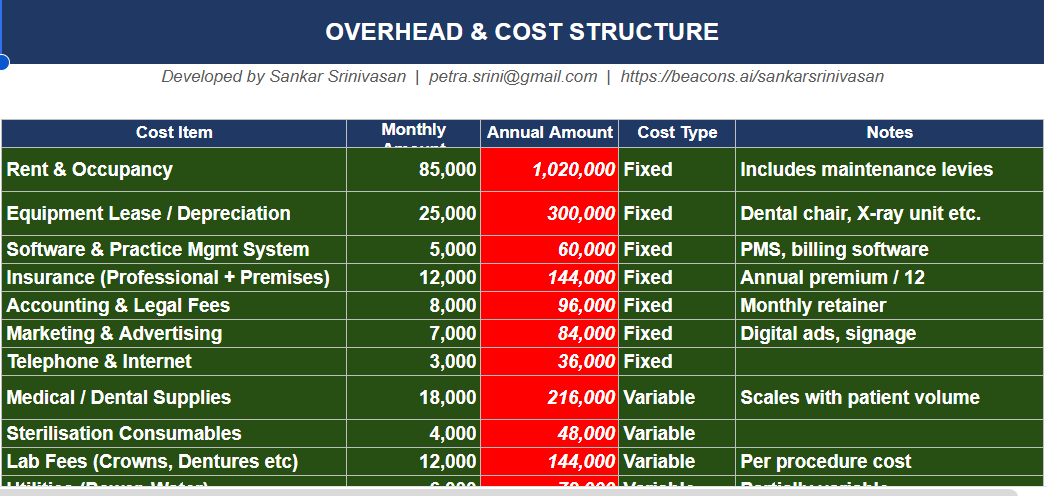
Know your precise break-even point and how much margin of safety your practice currently operates with
Measure staffing efficiency and capacity utilisation to spot hidden revenue leakage from idle consulting rooms
Model three growth scenarios over five years to support expansion decisions, partnership conversations, or bank loan applications
Consolidate multi-location performance into a single executive dashboard for board-level or investor reporting
The ultimate objective is to give healthcare practitioners the same financial discipline that a CFO brings to a corporate business — presented in plain language, with no finance background required. Spend less time guessing and more time growing a practice that is both clinically excellent and financially resilient.
This financial model delivers maximum value under the following conditions:
Practice Type — Designed for private-pay and mixed-billing practices including dental clinics, physiotherapy and rehabilitation centres, GP and family medicine offices, specialist consulting rooms (dermatology, orthopaedics, ENT, ophthalmology), allied health practices (podiatry, chiropractic, occupational therapy), and aesthetic or cosmetic medicine clinics.
Business Stage — Most applicable to established practices seeking financial clarity, practices planning to open a second or third location, and new practices building a business case for a bank loan or investor pitch.
Team Profile — Best suited to practice owners and principal clinicians managing their own business, practice managers without a formal finance background, healthcare accountants onboarding a new clinic client, and business consultants advising medical professionals on growth strategy.
Financial Complexity — Particularly valuable where the practice bills across multiple payers (private, insurance, government scheme, corporate), carries significant staffing overhead, or operates from more than one physical site.
Geography — Applies to any English-speaking private healthcare market including the USA, UK, Australia, Canada, Ireland, Singapore, and the Gulf region, with fully customisable currency and fee inputs.
This financial model is designed specifically for fee-for-service private medical practices and may not apply in the following situations:
Public or government-funded facilities — The model assumes private billing and insurance reimbursement logic. It is not suited for publicly funded hospitals, community health centres, or bulk-billing-only practices where revenue is driven by government schedules rather than procedure fees.
Large hospital or multi-specialty group finance — This tool is optimised for small to mid-size private practices. Organisations requiring consolidated P&L across more than three locations, complex intercompany transactions, or hospital-grade cost accounting should use enterprise financial software instead.
Practices outside fee-for-service models — Subscription-based or direct primary care (DPC) practices operating on monthly membership fees will find the procedure-volume revenue logic does not reflect their income structure.
Jurisdictions with highly complex tax or regulatory reporting — The model does not calculate GST, VAT, Medicare levies, or jurisdiction-specific tax obligations. It is a management planning tool, not a statutory compliance or tax filing document.
Replacement for professional financial advice — This model is a decision-support tool. It does not substitute for advice from a qualified accountant, financial advisor, or healthcare business consultant.