LBO Model — Multi-Tranche Leveraged Buyout (Excel + Google Sheets) | Senior/Mezz/PIK · Cash Sweep · MoIC, IRR & Dated XI
Originally published: 26/07/2026 19:42
Publication number: ELQ-25873-1
View all versions & Certificate
certified

LBO Model — Multi-Tranche Leveraged Buyout (Excel + Google Sheets) | Senior/Mezz/PIK · Cash Sweep · MoIC, IRR & Dated XI

A 7-tab Excel & Sheets LBO model: EV/EBITDA entry, a senior/mezz/PIK/revolver debt stack, a 5-year waterfall with PIK accretion, mandatory amort and a 100% cash

Description
The LBO Model is a self-contained, multi-tranche leveraged-buyout model for private-equity teams, investment-banking analysts, search-fund buyers, and finance students who need to determine — and defend — the returns on a debt-funded acquisition. Set the entry EV/EBITDA multiple and the leverage on each tranche, and the Sources & Uses, the five-year operating projection with a full multi-tranche debt waterfall, and the sponsor's MoIC, IRR, and dated XIRR all populate automatically. The workbook ships pre-filled with a complete, tied-out worked deal and a 4-page methodology PDF.
This is a transparent, robust model — not a black box, and not a file that breaks. The standard LBO identities are written so every line can be traced from input to output, and interest is charged on the beginning debt balance so the waterfall — cash interest, PIK accretion, mandatory amortization, and a 100% cash sweep — fully resolves with no circular reference and no iterative calculation. It runs on arithmetic-only formulas, unchanged, in both Microsoft Excel and Google Sheets.
**How this compares** — Most downloadable LBO templates are single-tranche: one loan, a straight-line paydown, and an approximated IRR. This model carries a full senior / mezzanine / PIK / revolver stack with a genuine cash-sweep waterfall, accreting PIK, and a dated XIRR on the actual sponsor cash flows — the depth an underwriter would otherwise build by hand. Every worked-example output has been recomputed cell-by-cell against an independent rebuild (Sources = Uses, balance check 0), so the returns are defensible in diligence. That hand-build is roughly a half-day of an analyst's time; here it is done and independently tied out.
**What you get**
- A leverage-driven Sources & Uses built from the entry EV/EBITDA multiple (balance check = 0)
- A multi-tranche debt stack: senior term loan + mezzanine + PIK (accreting) + revolver, with a minimum-cash floor
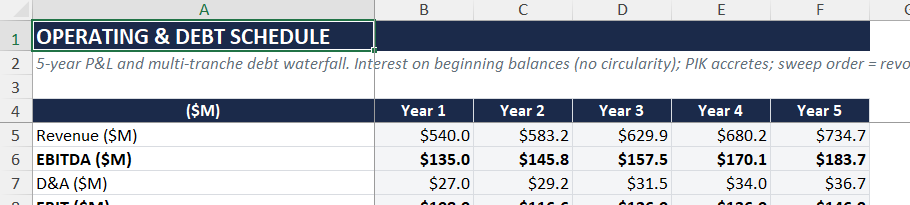
- A 5-year operating projection with the full waterfall: cash interest, PIK accretion, mandatory amortization, 100% cash sweep
- Optional dividend recaps and a variable hold (1-5 years)
- Beginning-balance interest, so there are no circular references and no iterative calc
- Sponsor returns: exit equity, MoIC, annualized IRR, and a dated XIRR
- A 2-way MoIC/IRR sensitivity grid and a dashboard
- A pre-filled, tied-out worked deal and a 4-page methodology PDF
**Model structure — Excel (7 tabs)**
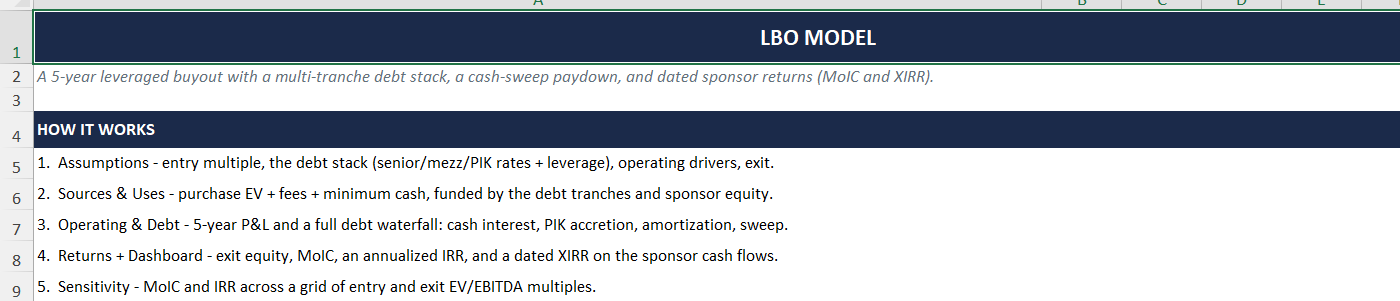
1. START HERE — what the model does, input order, and the method in plain English
2. Assumptions — entry/exit multiples, the debt stack (leverage + rates), operating drivers, tax (all $M)
3. Sources & Uses — EV + fees + minimum cash, funded by the debt tranches and sponsor equity (plug)
4. Operating & Debt — 5-year revenue-driven projection with the full multi-tranche waterfall
5. Returns — exit equity, MoIC, annualized IRR, and a dated XIRR
6. Sensitivity — 2-way MoIC/IRR grid across entry and exit multiples
7. Dashboard — headline returns and deal summary
**Key methodological features**
- Entry on an EV/EBITDA multiple; each tranche off its leverage x entry EBITDA; equity as the plug
- Full waterfall: cash interest, PIK accretion, mandatory amortization, 100% cash sweep (revolver -> senior -> mezz)
- Beginning-balance interest — no circular references, no iterative calculation
- Sponsor returns as MoIC, annualized IRR, and a dated XIRR
- All inputs and outputs in $ millions
- Arithmetic-only — Excel and Google Sheets; no macros, no VBA, no add-ins
**See it working**
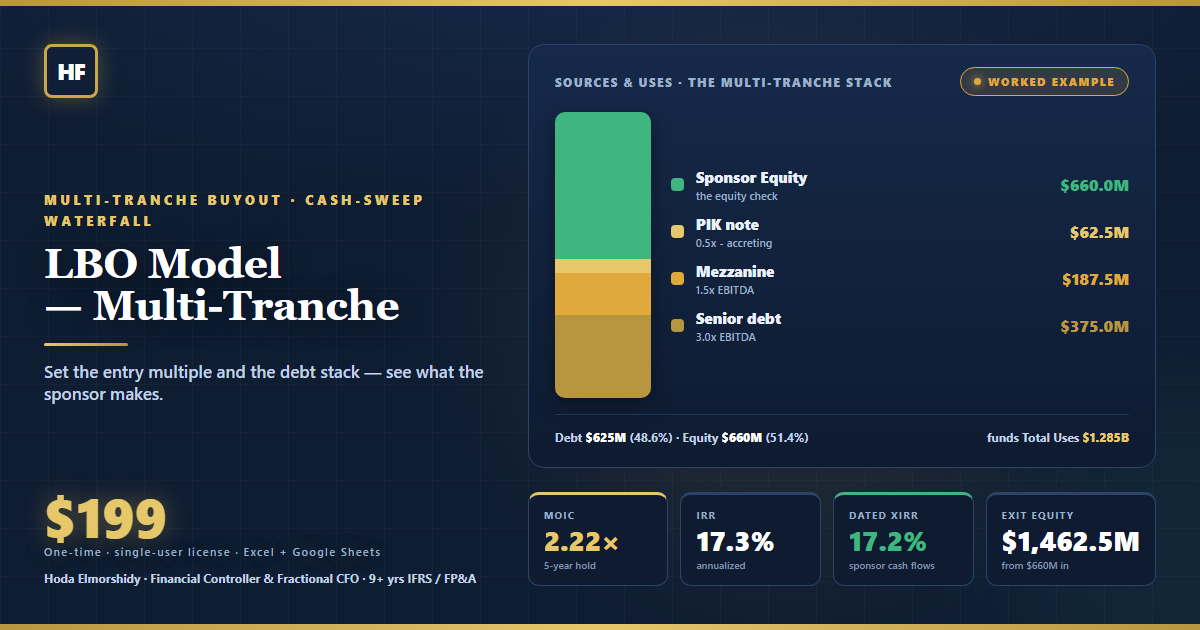
Pre-loaded with a complete deal (all figures in $M): entry EV $1,250 (10x on $125 EBITDA), funded $625 debt (senior $375 / mezz $187.5 / PIK $62.5) and $660 sponsor equity; the waterfall amortizes and sweeps senior from $375 to $86.5 while PIK accretes; net debt at exit is $374. Exit equity reaches $1,462.5 = a 2.22x MoIC, a 17.3% annualized IRR, and a 17.2% dated XIRR. Replace the inputs with your own deal and every output re-prices.
**Technical specifications**
- Format: .xlsx (Excel edition) + .xlsx (Google-Sheets-safe edition) + .pdf (methodology)
- Compatibility: Excel 2019, 2021, Microsoft 365 (Windows and Mac) and Google Sheets
- No macros, no VBA, no add-ins
- No circular references — beginning-balance interest
- Pre-filled worked deal; replace with your own
- 7 tabs · all inputs in $ millions · 5-year multi-tranche debt waterfall
- Delivery: instant digital download · single-user license
────────────────── ABOUT THE AUTHOR ──────────────────
Built by Hoda Elmorshidy — Financial Controller & Fractional CFO, 9+ years in
IFRS reporting, FP&A, commodity trading, CFO/board reporting, UAE VAT & Corporate
Tax, and finance automation. Practitioner-grade tools, not generic templates.
────────────────── DISCLAIMER ──────────────────
This template is an analytical and educational tool, not professional financial,
investment, tax, accounting, or legal advice, and its use creates no professional
relationship. All assumptions and figures are illustrative — verify against your
own data and current standards (IFRS/GAAP, tax rates) before relying on any
output. Past or modeled returns do not predict actual results.
Last reviewed: July 2026.
────────────────── LICENSE & LIABILITY ──────────────────
• License grant: Single-user license for your own or your organization's internal
use. No resale, redistribution, sublicensing, or repackaging of the file or its
templates.
• As-is warranty: Provided "as is" without warranty of any kind, express or
implied, including merchantability or fitness for a particular purpose.
• Limitation of liability: To the maximum extent permitted by law, total liability
for any claim arising from this product is limited to the amount you paid for it.
The author is not liable for indirect, incidental, or consequential losses.
• Non-waivable rights: Nothing here limits rights that cannot be excluded under the
consumer-protection law of your jurisdiction.
• Governing law: This purchase is governed by the terms of the platform you bought
it on (e.g. Etsy, Gumroad) and by the consumer-protection law of your own country
of residence. Where those permit, the limitations above apply to the maximum
extent allowed.

This Best Practice includes
- Format: .xlsx (Excel edition) + .xlsx (Google-Sheets-safe edition) + .pdf (methodology) - Compatibility: Excel 2019, 2

Acquire business license for $199.00

Add to cart

Add to bookmarks

Discuss

Further information

• Determine the sponsor returns (MoIC, annualized IRR, and a dated XIRR) on a leveraged buyout from an entry EV/EBITDA multiple and a multi-tranche debt stack
• Build a leverage-driven Sources & Uses that ties out at entry
• Project five years of operations through a full debt waterfall: cash interest, PIK accretion, mandatory amortization, and a 100% cash sweep
• Charge interest on the beginning debt balance so the waterfall resolves with no circular reference and no iterative calculation
• Provide a transparent, fully traceable LBO — no black box — usable in both Excel and Google Sheets

• Single-entity buyouts with positive, forecastable EBITDA and free cash flow
• Deals using a multi-tranche debt stack (senior + mezzanine + PIK + revolver)
• Private-equity and corporate-development teams underwriting an acquisition
• Investment-banking analysts and candidates preparing LBO analysis
• Search-fund and independent-sponsor buyers
• Finance and MBA students learning leveraged-buyout mechanics
• Users on Microsoft Excel 2019/2021/365 or Google Sheets

• Deals requiring OID, warrants, or detailed tranche-level pricing beyond pro-rata
• Refinancing or staged add-on / roll-up structures requiring bespoke build-outs
• Full three-statement consolidation with detailed combined balance sheets (use a 3-statement model)
• Deals where the target has negative or non-forecastable EBITDA
• Buyers seeking live data feeds — all inputs are entered manually by design


0.0 / 5 (0 votes)

please wait...