Publication number: ELQ-25760-1
View all versions & Certificate

ESG Self-Assessment Toolkit — Excel Scoring Model + Board Report | GRI & SASB Aligned
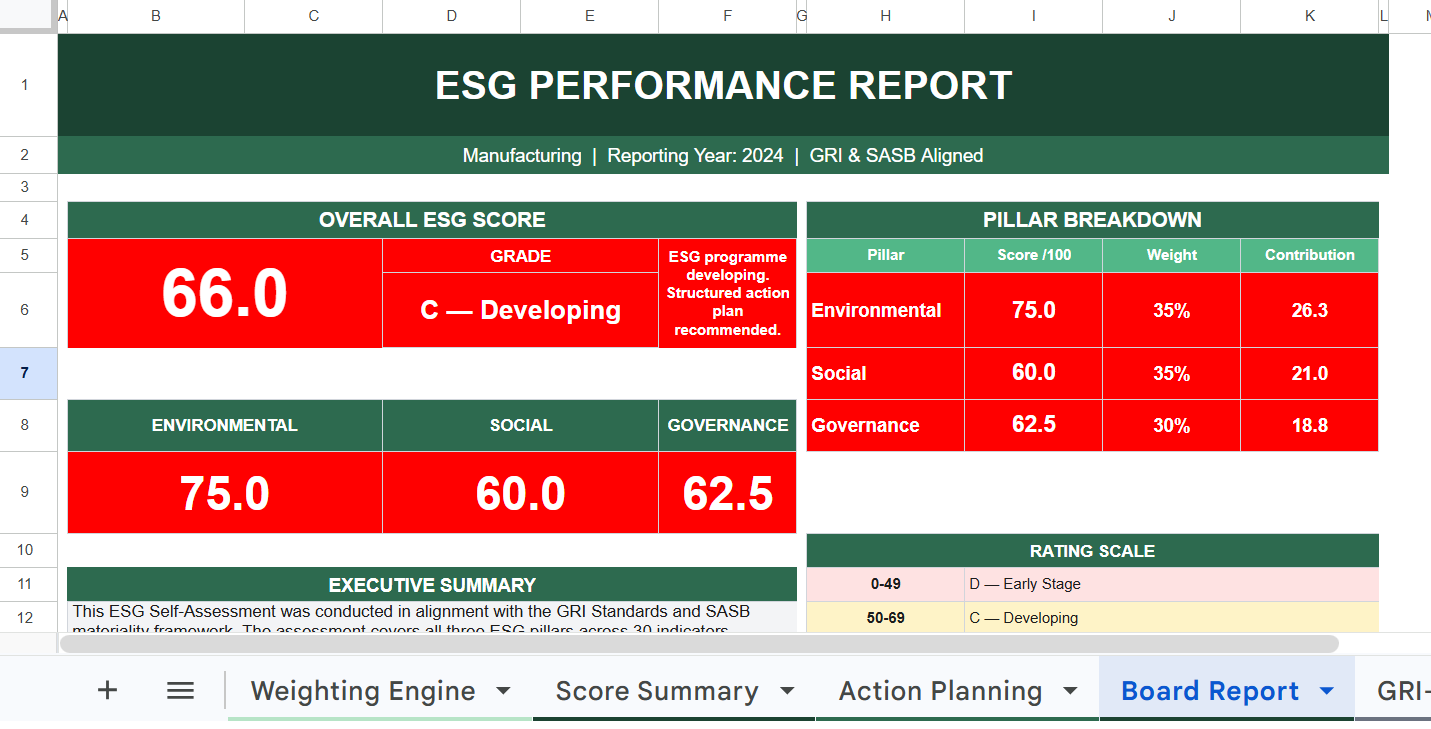
Measure ESG fast: Excel toolkit auto-scores your performance, generates reports, and highlights gaps. Aligned with GRI/SASB. Clarity in hours, not days.
 by Sankar Srinivasan
Stock Market Consultant | Options Strategies | Portfolio Risk Management & Professional Trading SystemsFollow
Further information
This toolkit is designed to give you a clear, structured starting point for ESG without complexity or guesswork. Its primary objective is to help you quickly assess where your company stands today across Environmental, Social, and Governance factors using a practical, standardized approach.
It also aims to translate ESG from theory into action. Instead of vague guidelines, you get measurable scores, defined indicators, and a focused view of your weakest areas—so you know exactly what to improve first.
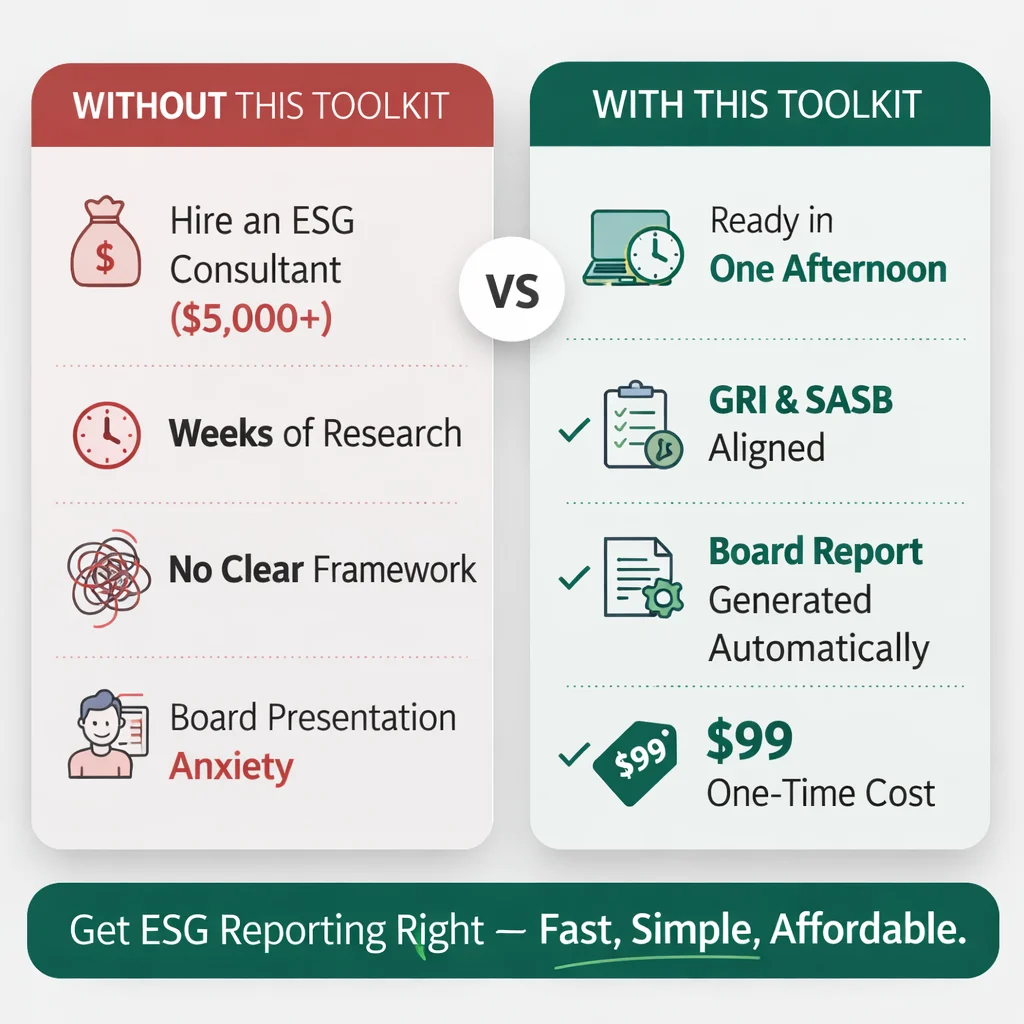
Another key objective is to save time and cost. By replacing weeks of research or expensive consulting engagements, the toolkit enables you to complete a credible ESG assessment and generate a board-ready report in just a few hours.
Finally, it helps you prepare for evolving regulations and stakeholder expectations. With alignment to globally recognized frameworks, you can confidently respond to investors, clients, and internal leadership with structured, defensible ESG insights.
In short, the goal is simple: clarity, credibility, and action—delivered fast.
Best used under these conditions
This downloadable best practice is most effective when a company is at the early to mid stage of its ESG journey and needs a structured starting point rather than a full-scale audit.
You are preparing for your first ESG or sustainability report and need a clear framework
Your company is facing investor, lender, or client ESG requests but lacks internal structure
You need a quick, credible ESG snapshot before engaging auditors or consultants
Your leadership or board has asked for an ESG update with actionable insights
You operate as an SME or mid-sized firm without a dedicated ESG team
You want a repeatable system to track ESG progress annually
You need a time-efficient solution (completed within hours, not weeks)
It works best in environments where speed, clarity, and practicality matter more than complex compliance detail.
This toolkit is designed for practical ESG assessment at the SME and mid-market level. It may not be ideal in the following situations:
Large enterprises with complex structures
Companies with multiple subsidiaries, global operations, or highly granular disclosure requirements may need more advanced, enterprise-grade ESG systems.
Regulated industries with strict reporting mandates
Sectors like banking, insurance, or listed entities under detailed regulatory scrutiny may require fully audited, compliance-specific frameworks beyond a self-assessment model.
Companies seeking formal certification or assurance
This is a self-assessment tool, not a substitute for third-party ESG audits, certifications, or legally verified disclosures.
Highly technical ESG measurements required
If your reporting depends on advanced carbon accounting, lifecycle analysis, or scientific environmental modelling, specialized tools will be necessary.
Lack of internal data availability
The tool assumes access to basic company data. Without reliable internal inputs, results may not be meaningful.
In short, this works best as a starting point and internal decision tool, not as a replacement for full-scale regulatory compliance or external assurance.