Boutique Fitness Studio Financial Model — Class Throughput Engine
Originally published: 24/06/2026 13:05
Last version published: 25/08/2026 15:16
Publication number: ELQ-27570-3
View all versions & Certificate
certified

Boutique Fitness Studio Financial Model — Class Throughput Engine

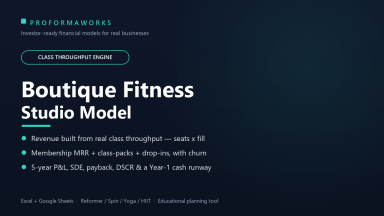
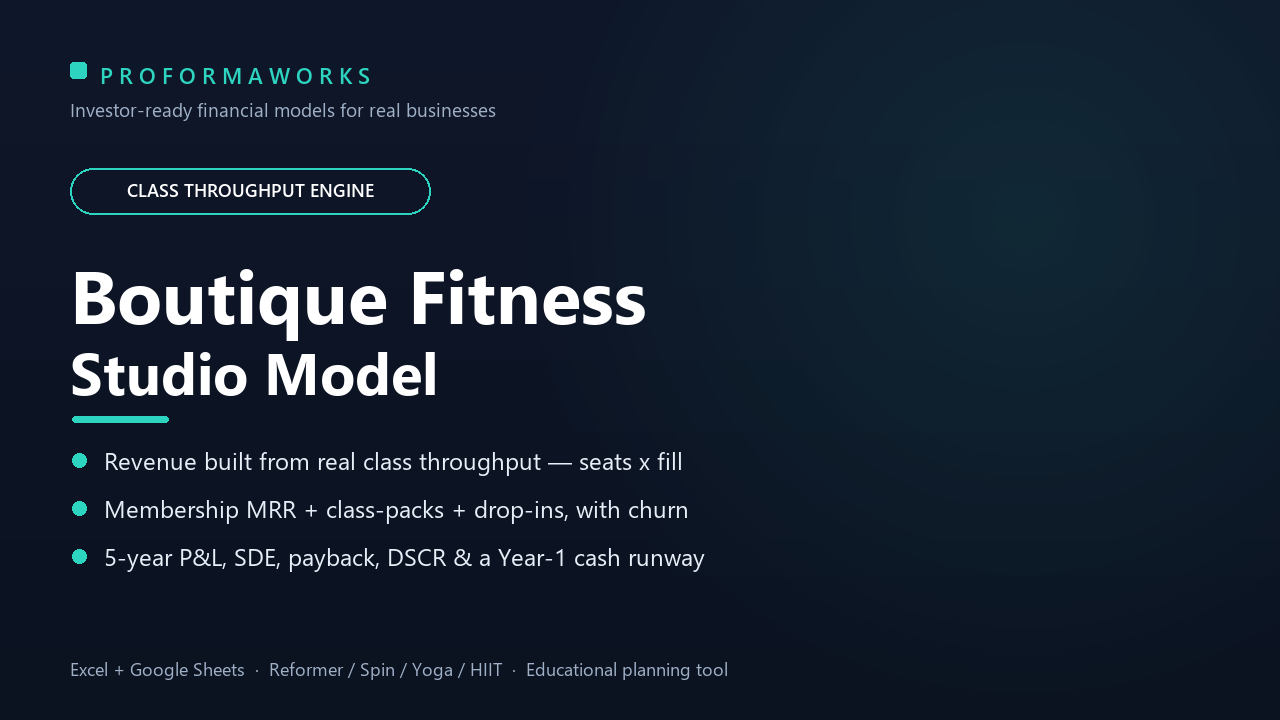
Build a boutique fitness studio's revenue from real class throughput — seats × classes × fill — split into membership MRR, class-packs and drop-ins.

Description
Opening a class-based boutique fitness studio — Reformer Pilates, spin, yoga/barre or HIIT? Every other template makes you type a guessed member count and a flat monthly fee. A studio cannot sell more visits than its schedule holds — so this model builds your revenue from real class throughput instead.
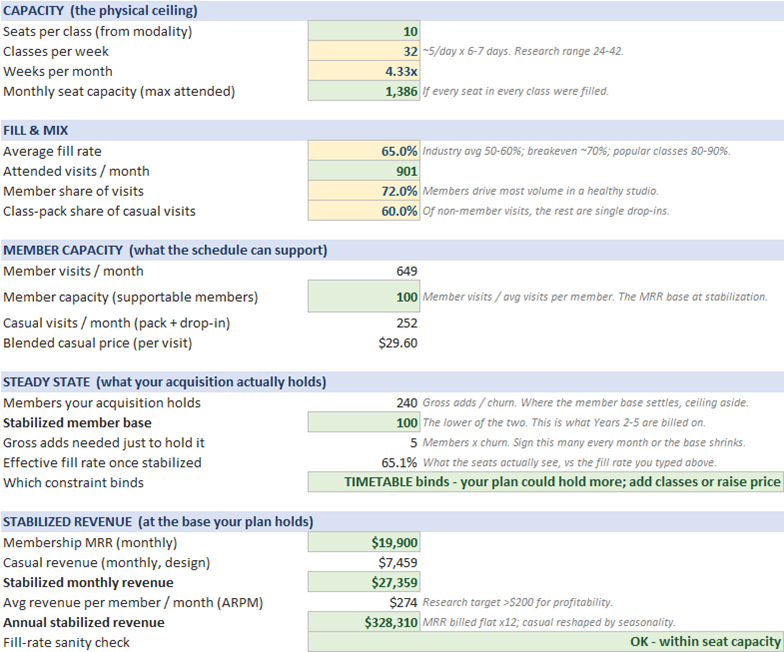
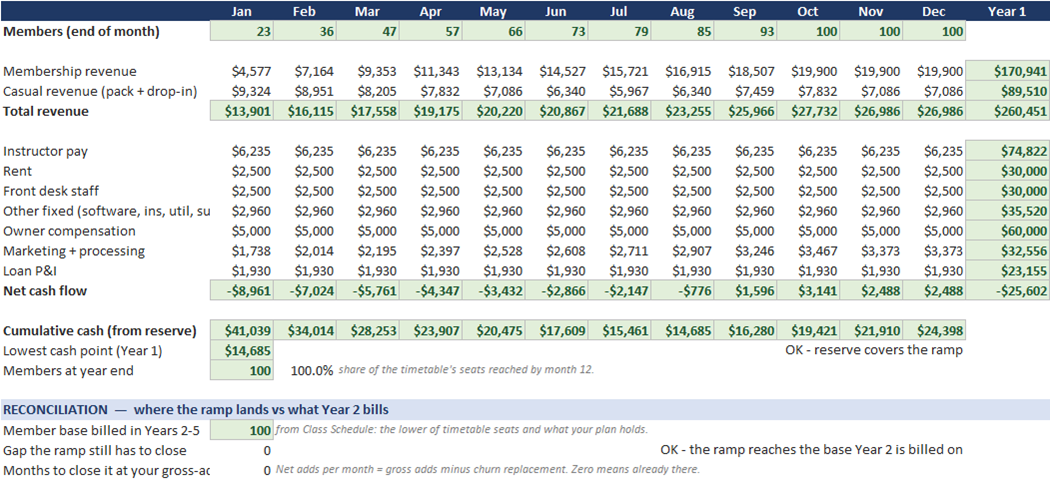
The Class Throughput engine starts from physical capacity: seats per class × classes per week × fill rate = attended visits per month. Those visits are split into recurring membership (MRR), class-packs and drop-ins, and the supportable member base is derived from member visits ÷ visits per member — so the schedule tells you how many members it can physically carry. A Year-1 membership waterfall then builds the base month by month: you sign your gross new members and lose churn off the whole base, so it climbs only as fast as the difference. And the model reconciles the two halves most templates leave apart — the timetable sets a ceiling on members, your marketing sets the level you actually hold against churn (gross adds ÷ churn), and Years 2-5 are billed on the LOWER of the two. The sheet names which constraint is binding, prints the gross new members per month you need just to stand still, and shows the effective fill rate your seats will really see.

A single toggle reloads the whole economics — seats, drop-in and membership price, churn, instructor pay and equipment CAPEX — from an editable preset matrix, so Reformer Pilates, spin, yoga/barre and HIIT all live in one file. You also get a 12-month seasonality vector and a Year-1 monthly cash runway that exposes the launch dip, a 5-year P&L with EBITDA and SDE, and full returns: payback, cash-on-cash, DSCR, breakeven fill rate and a 5-year levered IRR.

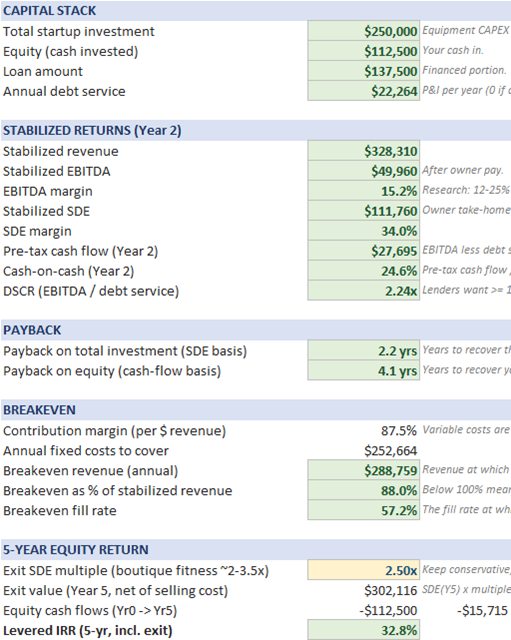
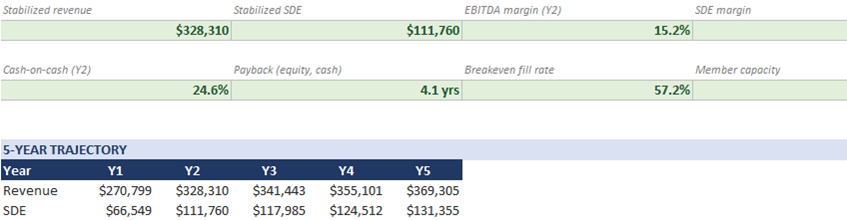
The shipped Reformer Pilates default (1,500 sqft suburban, 55% financed) supports about 100 members at 65% fill, books $328,310 of stabilized revenue at a 34.1% SDE margin (ARPM $274), with a 2.01x DSCR, 19.9% cash-on-cash, a 5.0-year equity payback, a 59.4% breakeven fill rate and a 16.4% five-year IRR. Switch to Yoga/Barre and the higher class capacity lifts the supportable base to about 211 members and revenue to roughly $563,047 — same engine, a different business.

Every formula is machine-verified: the full calculation graph is recomputed by three independent engines, including Excel itself, before release. 10 sheets, Excel and Google Sheets compatible, no macros. Educational planning tool — not financial, legal, tax or investment advice; validate every input against your own market research.

This Best Practice includes
10-sheet Excel workbook (Google Sheets compatible) + 17-page PDF user guide. Sheets: START HERE, Setup Inputs (4-modality preset matrix), Market & Season, Class Schedule (the throughput engine), Year 1 Monthly (membership waterfall + cash runway), P&L 5-Year, Returns & Financing, Sensitivity, Dashboard, Benchmarks & Sources.

Acquire business license for $99.00

Add to cart

Add to bookmarks

Discuss

Further information

Decide whether a class-based boutique fitness studio pencils out before signing a lease: build revenue from real class throughput, project the member base against churn, and produce a lender-ready 5-year pro forma with SDE, DSCR, payback and breakeven fill.

You are opening (or buying) a Reformer Pilates, spin, yoga/barre or HIIT studio and need an investor- or SBA-lender-ready financial model.

You run a large multi-location gym chain or a non-class-based fitness business — the class-throughput engine is built for single-studio, class-based concepts.


0.0 / 5 (0 votes)

please wait...