

Premium 4-Quadrant Corporate Bank Reconciliation Model (Dynamic Control Template)

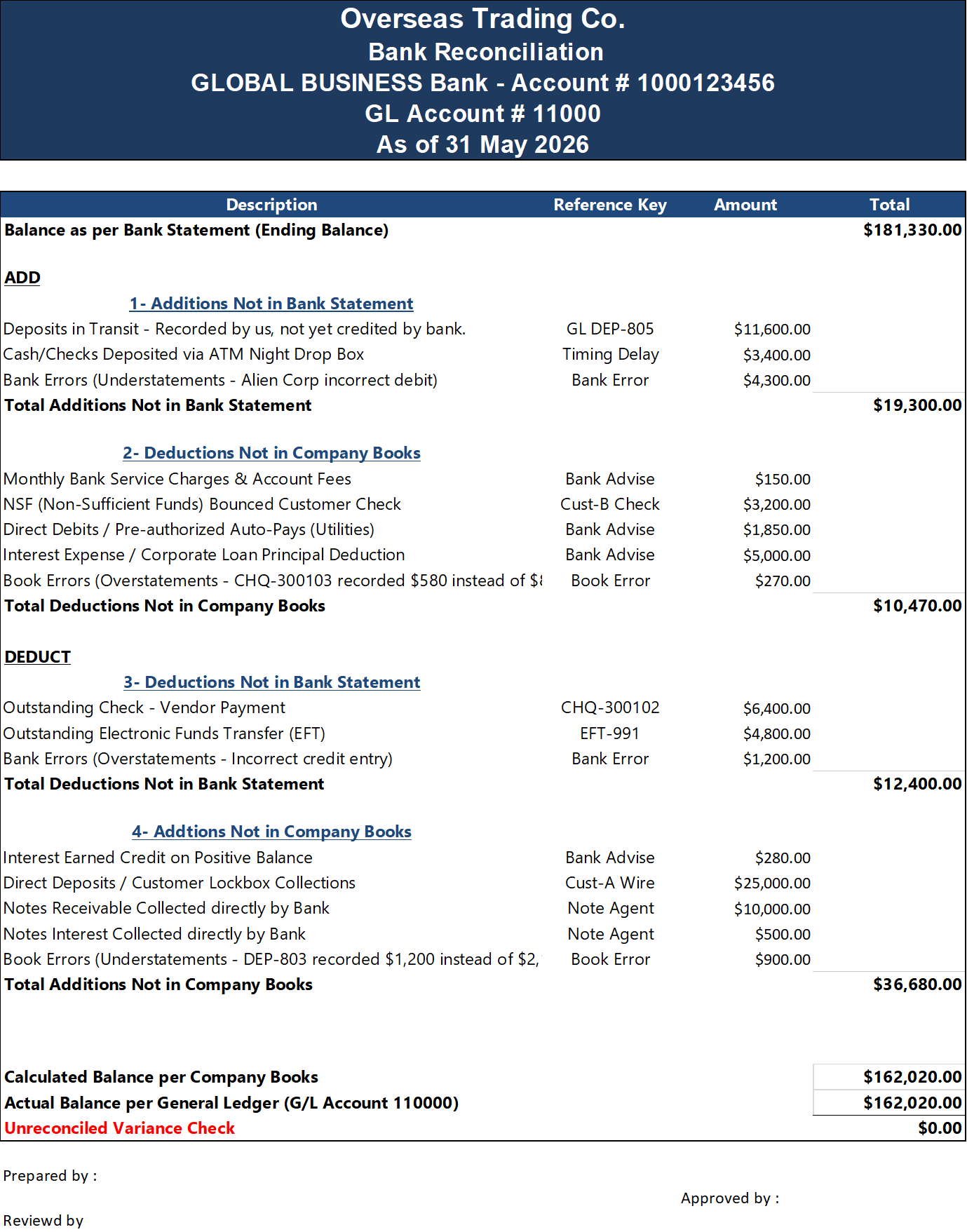
This is a bank account reconciliation bridging the gap between bank records and GL accounts serves as an audit control schedule.

Description

Premium 4-Quadrant Corporate Bank Reconciliation Model (Dynamic Control Template)

Product Overview

In corporate treasury and financial controller operations, bridging the gap between external banking records and internal general ledger accounts is a critical monthly internal control. However, standard reconciliation models often present a fragmented view, adjusting both sides toward a theoretical "true balance."

This premium template offers an advanced, linear, 4-Quadrant Direct Reconciliation Model that starts explicitly from the Ending Bank Statement Balance and applies an airtight algebraic progression to arrive precisely at the Unadjusted Company Book Balance. It serves as an audit-ready control schedule designed to handle complex corporate treasury transactions, timing delays, and transactional errors.


Core Methodology & Mathematical Logic

Unlike basic tutorials, this model is built on an exact linear bridging equation that systematically accounts for every possible variation in both banking and accounting data pipelines. To achieve an explicit trace from Bank to Books, the template isolates adjustments into four distinct logical sets and applies them using the following algebraic formula:

$$\textbf{Bank Balance} + \textbf{Category 1} + \textbf{Category 3} - \textbf{Category 2} - \textbf{Category 4} = \textbf{Book Balance}$$

The 4-Quadrant Framework Explained:

  1. Category 1: Additions Not in Bank Statement (+)Treasury Inflows Recorded Internally but Pending Bank Processing. This quadrant adds funds that have increased your internal books but are missing from the bank due to processing cutoffs (e.g., Deposits in Transit, end-of-month ATM night drops, or restrictive bank understatements like an incorrect third-party debit).

  2. Category 3: Deductions Not in Company Books (+)Bank-Initiated Outflows to be Capitalized on the Ledger. Because this model moves from the bank's perspective down to the unadjusted books, bank-initiated debits (such as Monthly Service Fees, NSF Bounced Checks, Direct Debit Utility Auto-Pays, and Book Ledger Overstatements) are added back to reverse their impact on the starting bank figure.

  3. Category 2: Deductions Not in Bank Statement (-)Treasury Outflows Issued Internally but Outstanding at the Bank. This quadrant subtracts payments that have already decreased your ledger but haven't cleared the bank processing cycle yet (e.g., Outstanding Vendor Checks, pending wire transfers/EFTs, or erroneous bank overstatement credits).

  4. Category 4: Additions Not in Company Books (-)Bank-Initiated Inflows Not Yet Journalized. To bridge down to the unadjusted books, bank-side increases (such as Interest Earned Credits, Direct Lockbox Customer Collections, and Notes Receivable/Interest collected via escrow) are subtracted, as these inflows are not yet reflected in the unadjusted ledger balance.

This Best Practice includes
A 5-tab Excel workbook

Acquire business license for $19.99

Add to cart

Add to bookmarks

Discuss

Further information

Stop using messy, manual bank recs that fail audit reviews. Download this Audit-Ready, Corporate-Grade Bank Reconciliation Model. Built on an advanced 4-Quadrant linear bridging formula, it automates your month-end close and delivers an instantaneous zero-variance proof between your bank statement and general ledger."

When you need to have a comprehensive list of all possible reconciling items between bank and books balances listed in a very simple and smart way and serves as audit control schedule.

Cannot be used as a final Month-end reconciliation


0.0 / 5 (0 votes)

please wait...