
Originally published: 06/11/2023 09:32
Last version published: 24/07/2025 13:46
Publication number: ELQ-31485-4
View all versions & Certificate
Last version published: 24/07/2025 13:46
Publication number: ELQ-31485-4
View all versions & Certificate

Film Production 10-Year 3 Statement Financial Projection Model
10 year rolling financial projection Excel model for a film production business with up to 5 different film productions at different stages of production.
film productionproduction costsdistribution waterfalldistribution channelsfinancial projectionvaluationbudgetingstatementrolling forecastfinancial model
Description
MODEL OVERVIEW
Film production is the process of creating a motion picture or film, from its initial conception to its final release. It involves a series of stages and activities that bring together various creative, technical, and logistical elements to produce a cinematic work of art or entertainment.
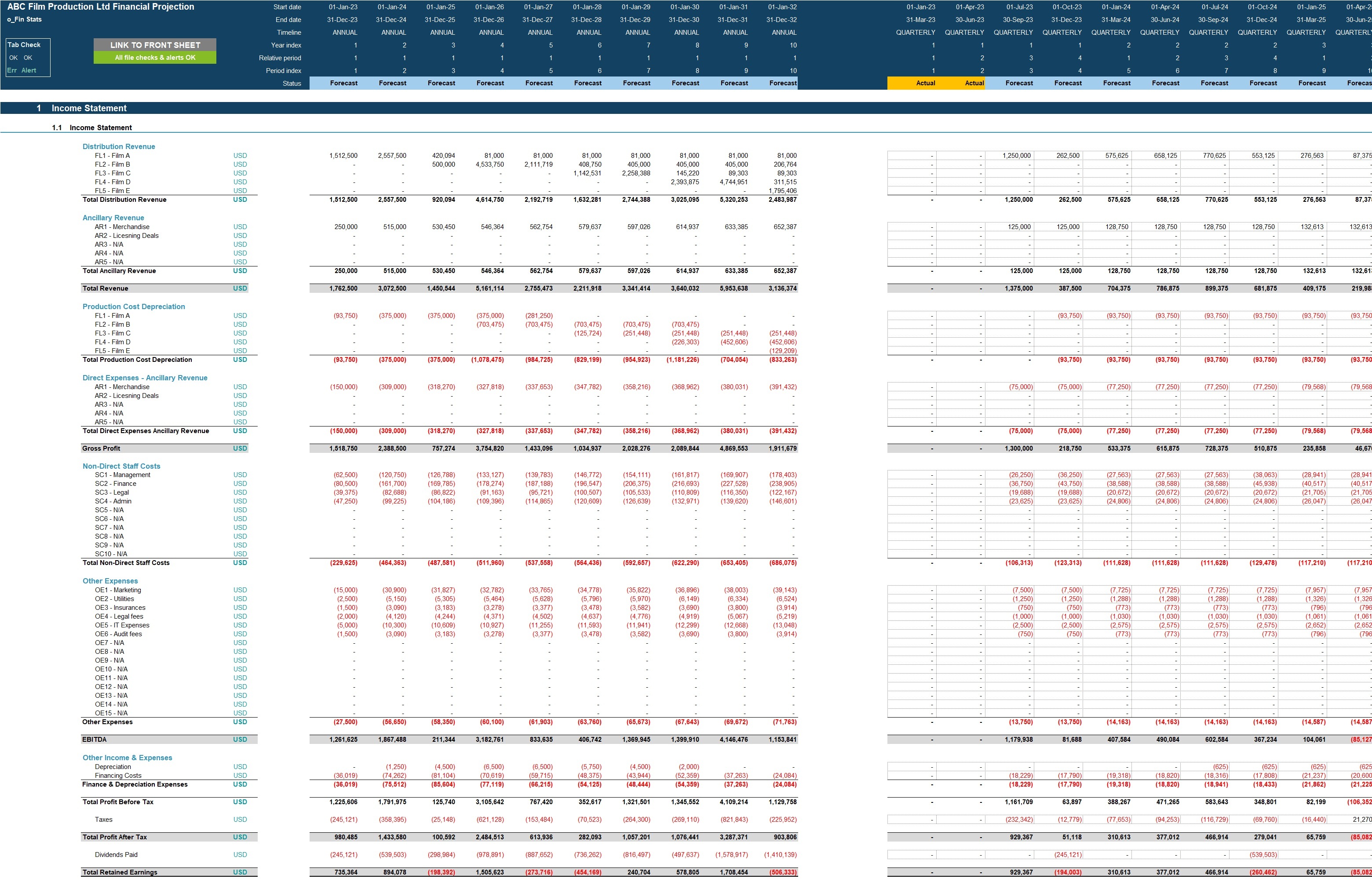
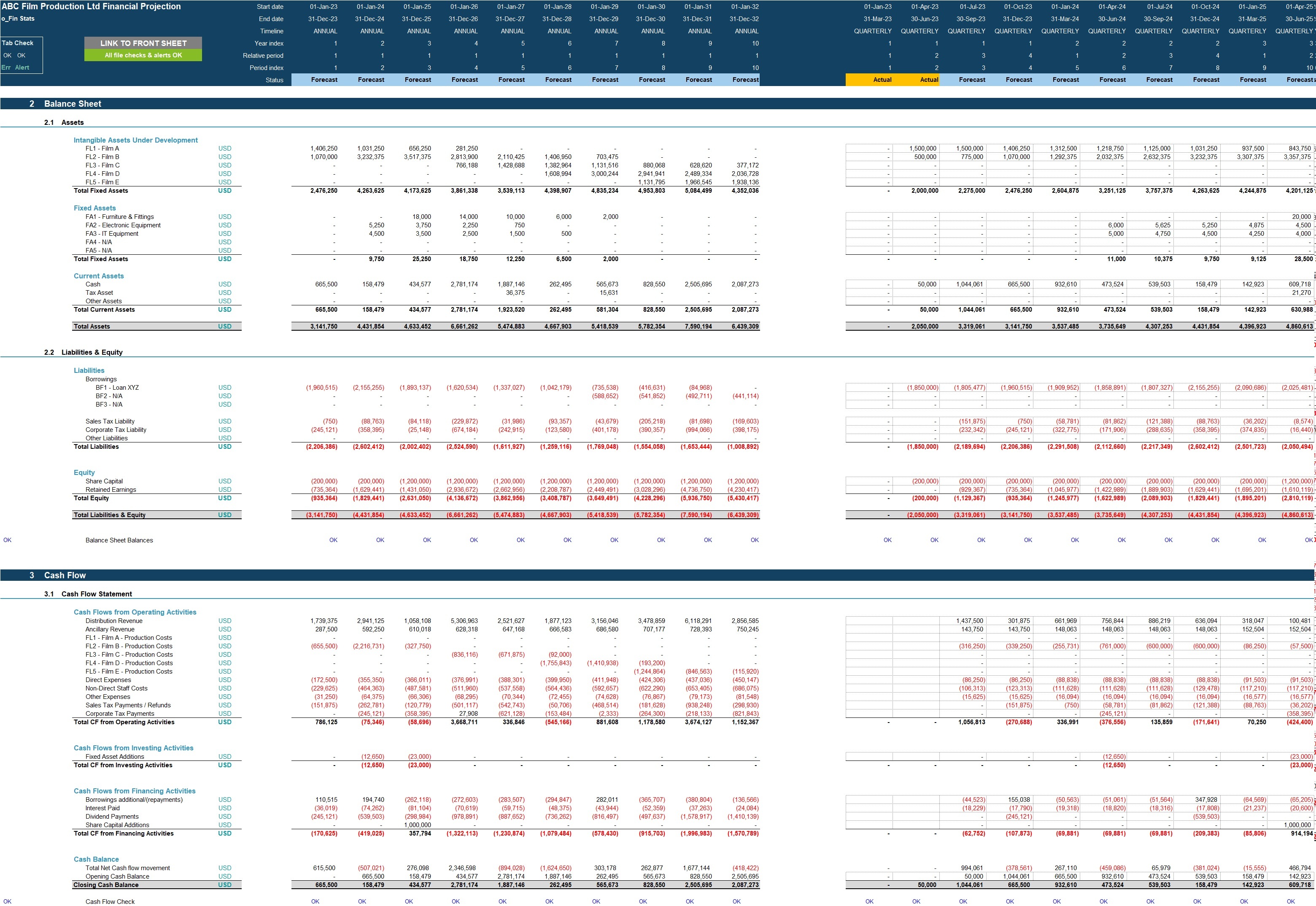
The purpose of our highly versatile and user-friendly Excel model is to prepare a of 10-year rolling 3 statement (Income Statement, Balance Sheet and Cash flow Statement) financial projection with a quarterly timeline for a startup or existing film production business (e.g. Film investor and/or film producer) generating film distribution and ancillary revenues.
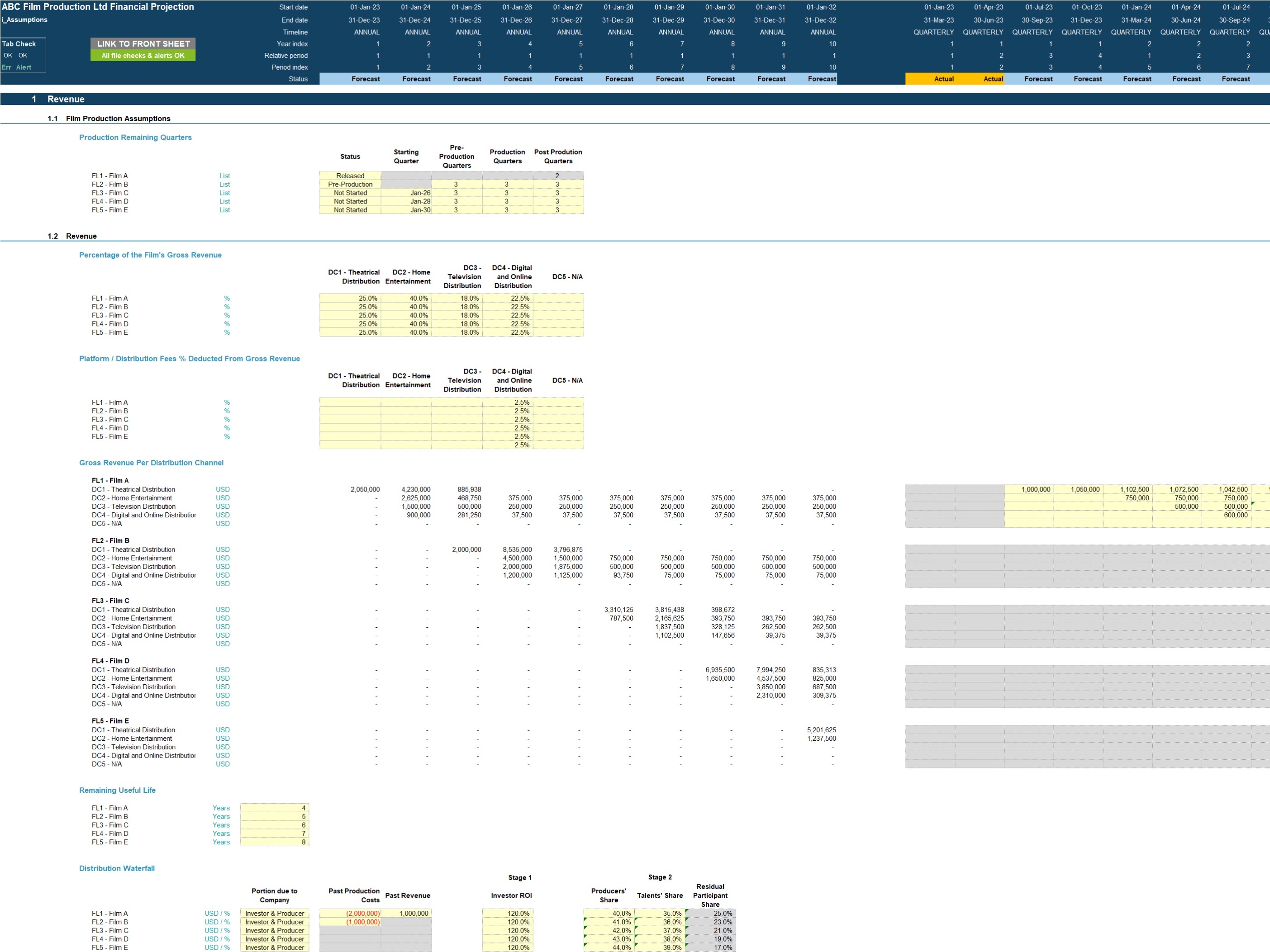
The financial model includes the possibility to model 5 film productions each at different stages of production (not started, pre-production, production, post-production and released) and with their own fee, distribution waterfall and production cost assumptions. The model also include ancillary revenue projection, indirect staff costs, other operating costs, fixed assets, equity and borrowings, sales tax impacts, corporate tax and dividend distributions.
The model follows good practice financial modelling principles and includes instructions, line item explanations, checks and input validations and incorporates a discounted cash flow valuation calculation using the projected cash flows.
KEY OUTPUTS
- Projected full financial statements (Income Statement, Balance Sheet and Cash flow Statement) presented on a quarterly basis across up to 5 years and summarised on an annual basis.
- Dashboard with:
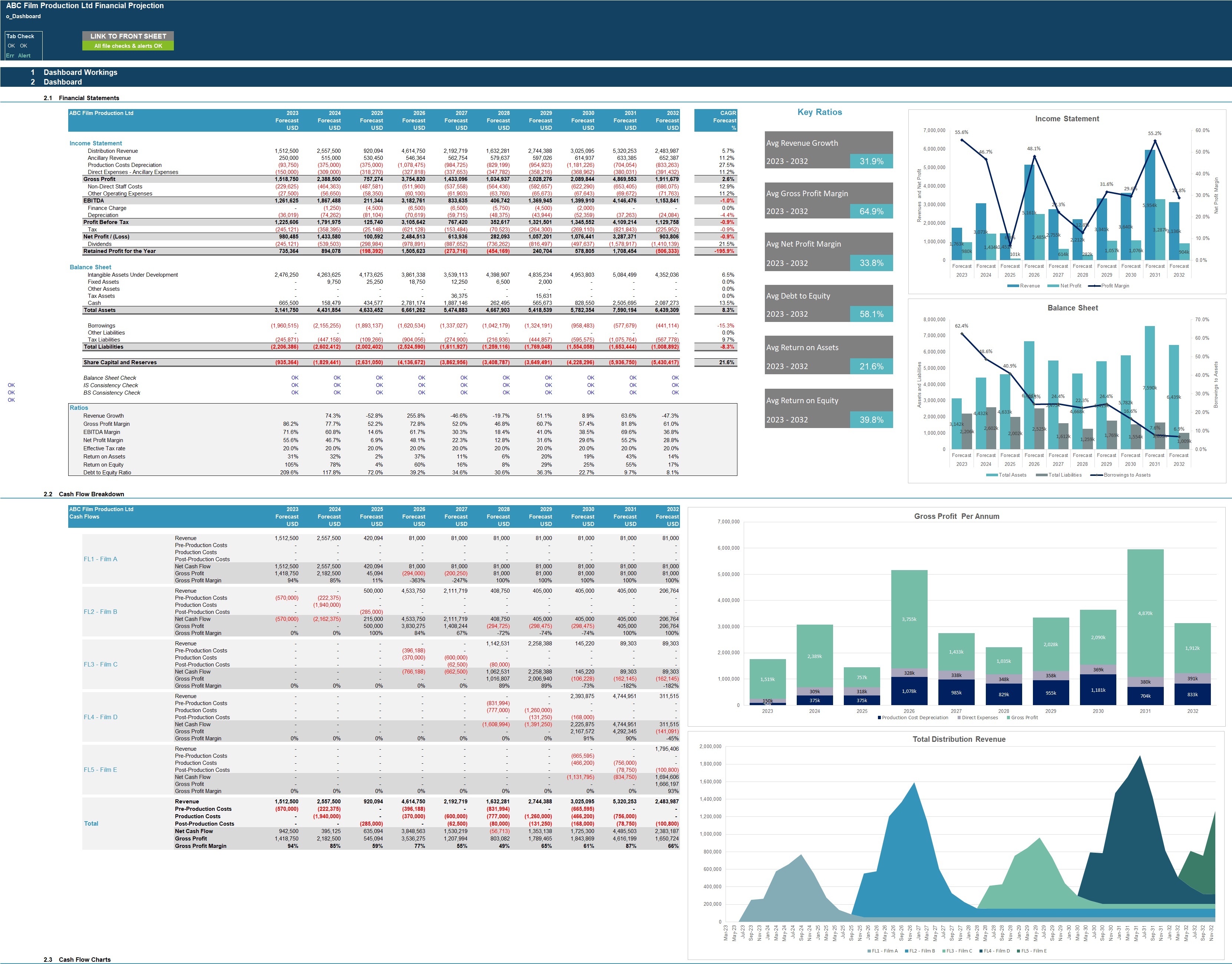
o Summarised projected Income Statement and Balance Sheet;
o Compounded Annual Growth Rate (CAGR) for each summarised income statement and balance sheet line item;
o List of key ratios including average revenue growth, average profit margins, average return on assets and equity and average Debt to Equity ratio;
o Bar charts summarising income statement and balance sheet projections;
o Revenue fitness, exercise and service category and volume of services offered over time.
o Revenue and gross profit by film and year presented in table and chart formats.
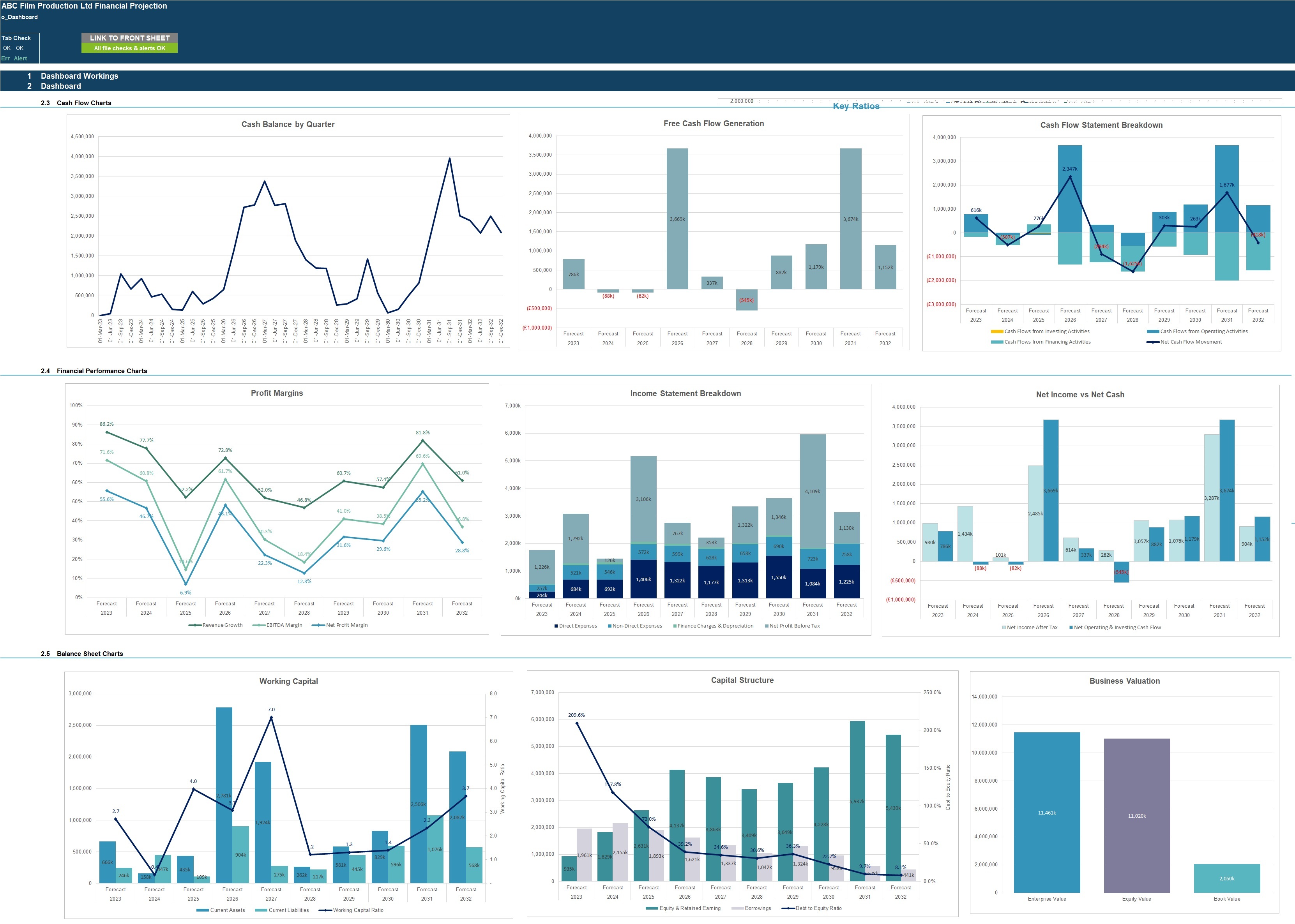
o Charts and graphs showing: cash balance by quarter, free cash flow generation, cash flow statement breakdown, profit margins, income statement breakdown, net cash vs net income, working capital, valuation and capital structure.
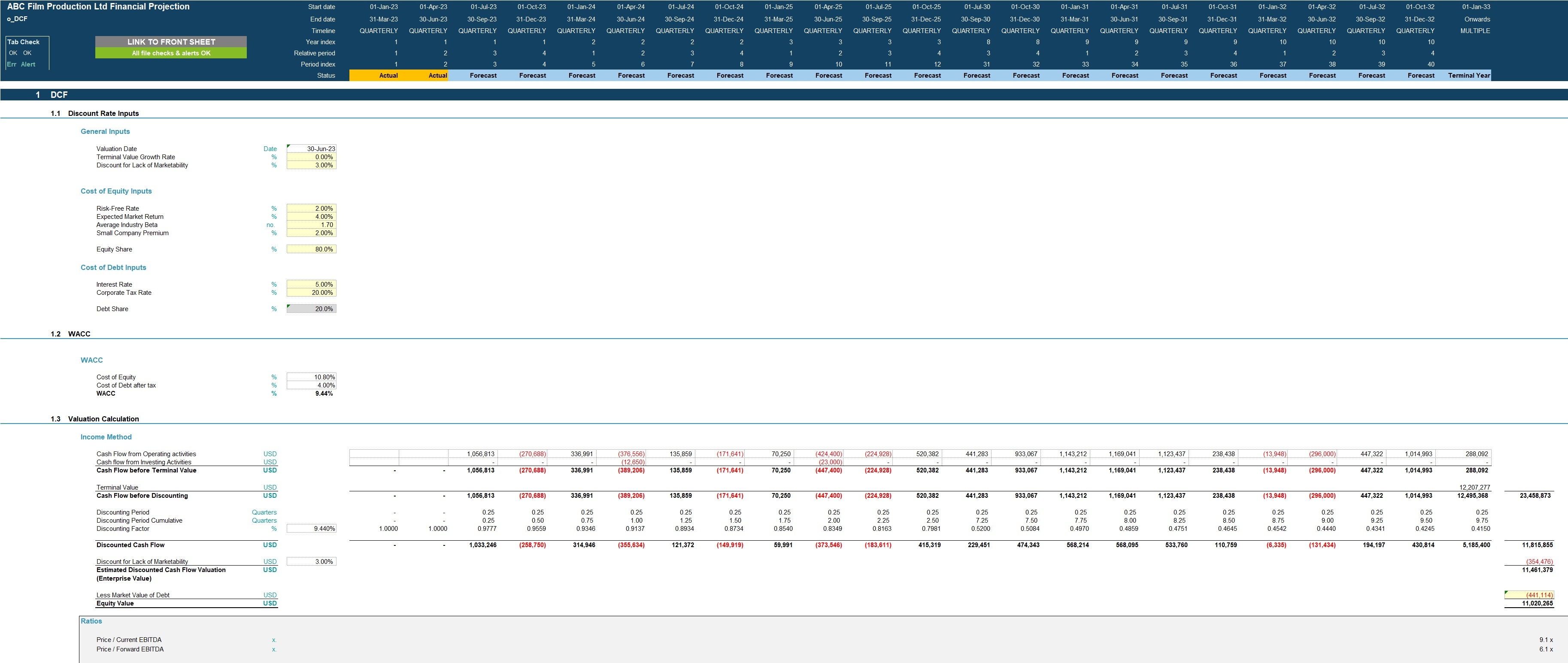
- Discounted cash flow valuation using the projected cash flow output.
- Breakeven analysis
KEY INPUTS
Setup Inputs:
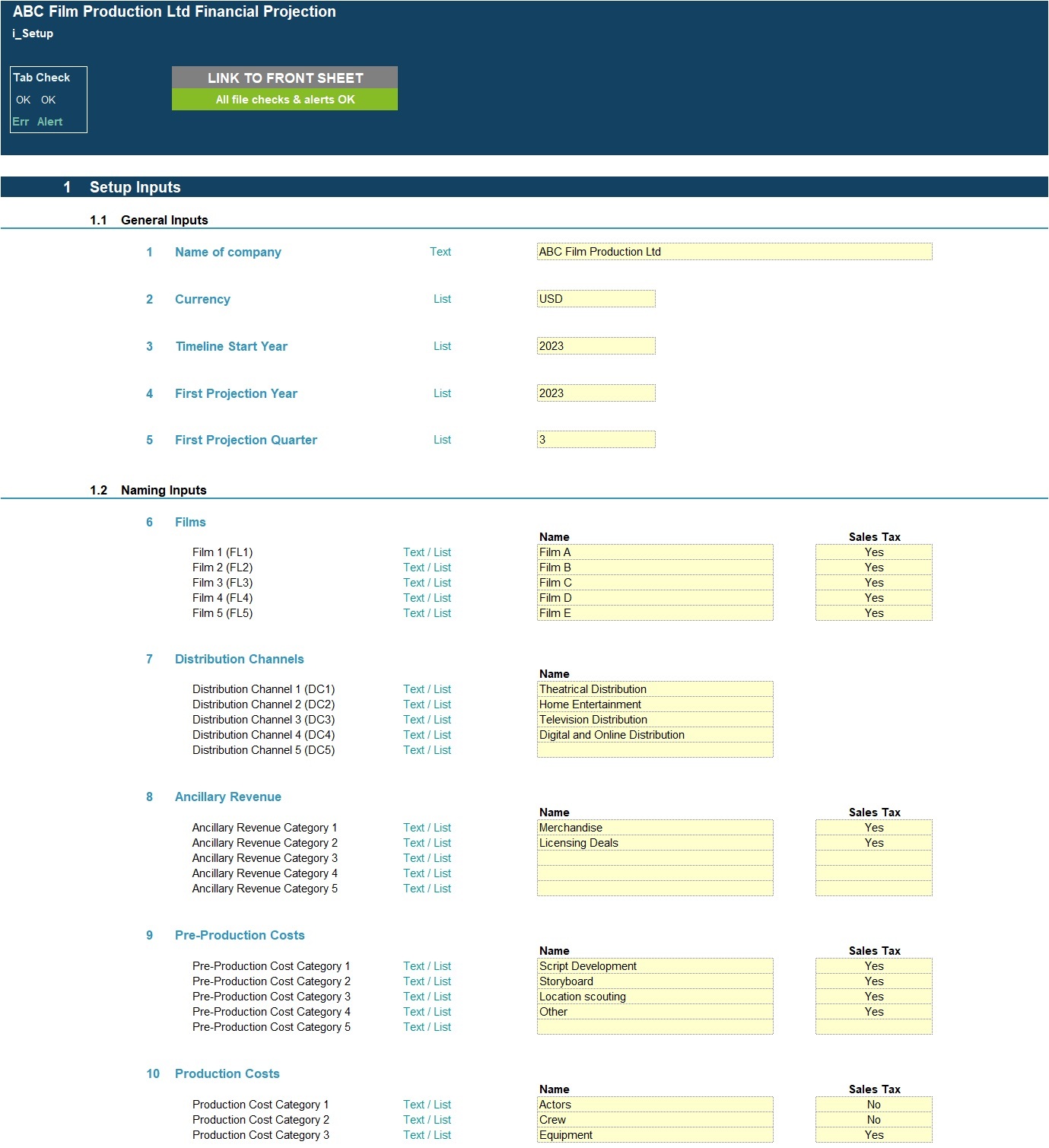
- Name of business;
- Currency;
- First projection year and quarter;
- Naming for films, ancillary revenue categories, production cost categories, indirect staff categories, operating expense costs, fixed assets and borrowings;
- Sales tax applicability for revenues, costs and fixed assets.
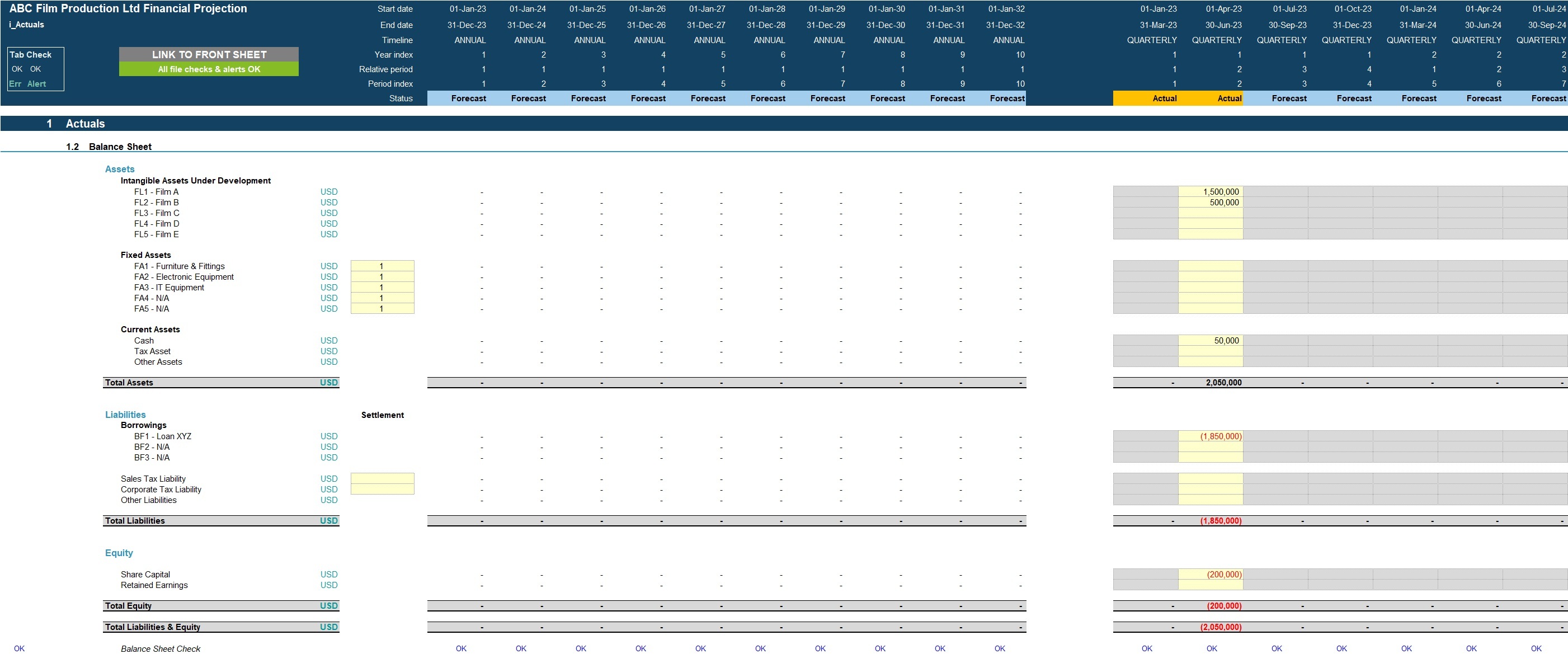
Actuals Inputs:
- Opening balance sheet (for existing businesses);
- Income Statement actuals (for trend analysis);
Projection Inputs:
- Film production inputs for each of the 5 films including:
o Production stage (not started, pre-production, production, post-production and released);
o Stating quarter and remaining quarters for each stage;
o Fees and expenses per distribution channel;
o Gross revenue per distribution channel;
o Useful life of film intangible assets;
o Distribution waterfall including investor ROI, producers’ share, talents’ share and residual participants share.
- Production cost inputs per film split into pre-production, production and post-production costs and depending on film production stage;
- Ancillary revenue inputs including volume, revenue per unit and direct expense per unit;
- Staff cost inputs including staff numbers, average salary per full time position, average employer’s social security percentage of salary, average annual bonus and bonus payment quarters.
- Other operating costs inputs;
- Sales and corporate tax inputs including rate and payment periods;
- Dividend inputs including amount (percentage of retained earnings) and frequency;
- Fixed assets including addition amounts and useful life;
- Borrowings including addition amounts and interest rate;
- Share capital additions;
- Discount rate inputs (for valuation calculation).
MODEL STRUCTURE
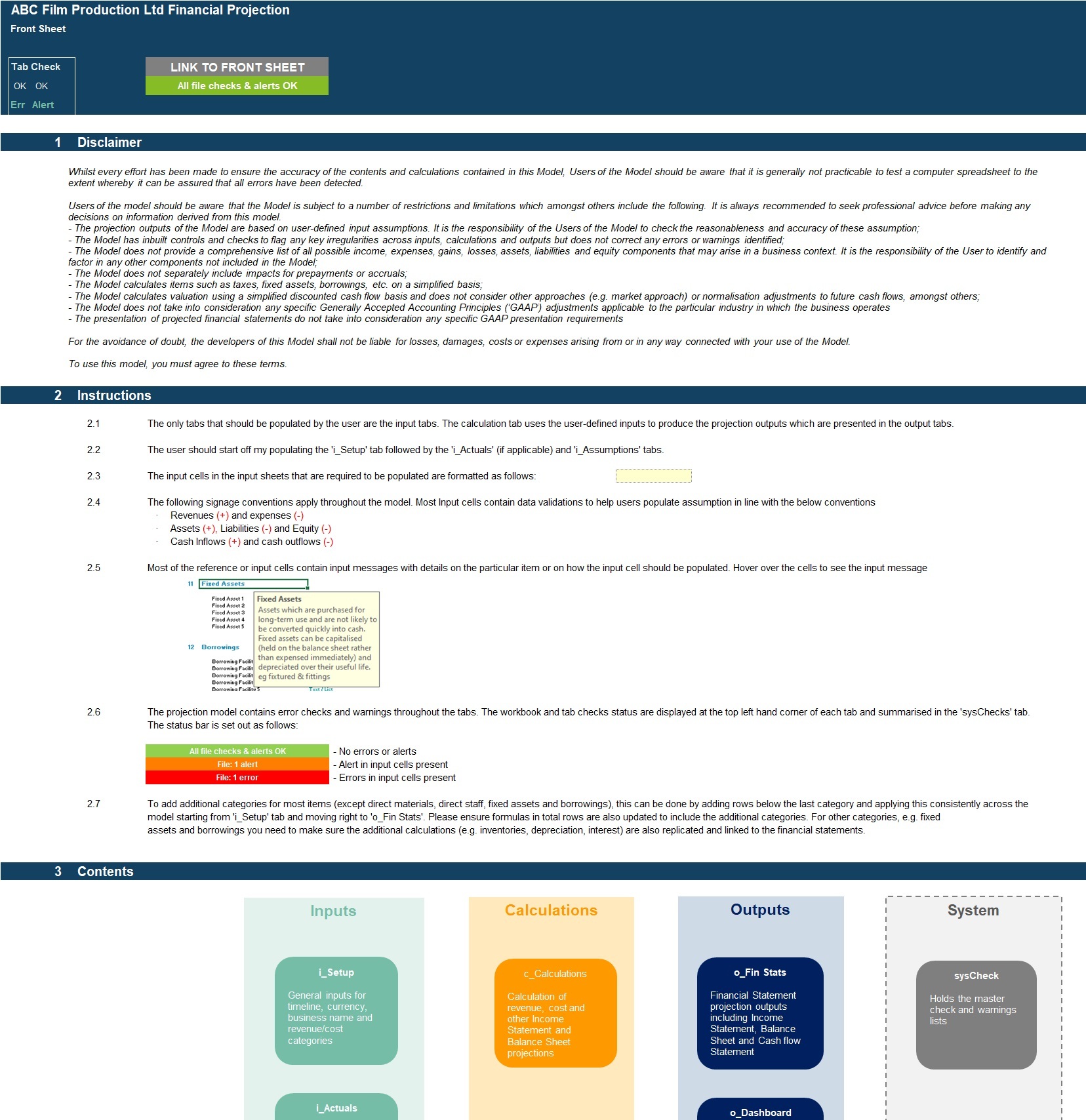
The model comprises of 9 tabs split into input ('i_'), calculation ('c_'), output ('o_’) and system tabs. The tabs to be populated by the user are the input tabs ('i_Setup', ‘i_Actuals’ and 'i_Assumptions'). The calculation tab uses the user-defined inputs to calculate and produce the projection outputs which are presented in 'o_Fin Stats', ‘o_Dashboard’ and ‘o_DCF’.
KEY FEATURES
- The model contains a flexible timeline that allows for a mix of actual and forecast period across a 10-year period. This allows projections to be easily rolled forward as forecast periods become actual period;
- Timeline is split on a quarterly basis and summarised on an annual basis;
- The model allows to model up to 5 separate film productions each with their own unique production stage and timeline, production costs; fees per distribution channel, distribution waterfall and useful life for film intangible assets;
- The model is not password protected and can be modified as required following download;
- The model is reviewed using specialised model audit software to help reduce risk of formula inconsistencies;
- The model allows for the following number of underlying categories for each line item (these can be easily expanded if required):
o Film Productions – 5 separate productions;
o Distribution Channels – 5 categories;
o Ancillary Revenue – 5 categories;
o Pre-production costs – 5 categories;
o Production costs – 8 categories;
o Post-production costs – 5 categories;
o Staff costs – 5 categories;
o Other expenses – 15 categories;
o Fixed assets – 5 categories;
o Borrowings – 3 facilities
- Apart from projecting revenue and costs the model includes the possibility to model fixed assets, borrowings, dividends and corporate tax;
- Business name, currency, starting projection period are fully customisable;
- Revenue, cost and fixed asset descriptions are fully customisable;
- The model included an integrated discounted cash flow valuation using the projected cash flow outputs;
- The model includes instructions, line-item explanations, checks and input validations to help ensure input fields are populated accurately;
- The model includes a checks dashboard which summarises all the checks included in the various tabs making it easier to identify any errors.
SUPPORT / MODIFICATIONS
We are keen to ensure our customers are satisfied and find the models useful for their financial projection needs. Our models are developed with the user in mind and include instructions, line-item explanations, checks and input validations to ensure they are as user-friendly and easy to use as possible without requiring extensive knowledge of Microsoft Excel, finance or accounting. If any questions do arise, we are more than happy to assist. We are also happy to support with any be-spoke modifications you may require to the models to better suit your business needs. To get in touch, please send us a message through the website.
We are also always keen to receive feedback so please do let us know what you think of our models by sending us a message or submitting a review.
ABOUT PROJECTIFY
We are financial modelling professionals with experience working in big 4 business modelling teams and strong experience supporting businesses with their financial modelling and decision support needs. Our aim is to provide robust and easy-to-use tools that follow good practice financial modelling guidelines and assist individuals and businesses with their financial projection and analysis requirements.
MODEL OVERVIEW
Film production is the process of creating a motion picture or film, from its initial conception to its final release. It involves a series of stages and activities that bring together various creative, technical, and logistical elements to produce a cinematic work of art or entertainment.
The purpose of our highly versatile and user-friendly Excel model is to prepare a of 10-year rolling 3 statement (Income Statement, Balance Sheet and Cash flow Statement) financial projection with a quarterly timeline for a startup or existing film production business (e.g. Film investor and/or film producer) generating film distribution and ancillary revenues.
The financial model includes the possibility to model 5 film productions each at different stages of production (not started, pre-production, production, post-production and released) and with their own fee, distribution waterfall and production cost assumptions. The model also include ancillary revenue projection, indirect staff costs, other operating costs, fixed assets, equity and borrowings, sales tax impacts, corporate tax and dividend distributions.
The model follows good practice financial modelling principles and includes instructions, line item explanations, checks and input validations and incorporates a discounted cash flow valuation calculation using the projected cash flows.
KEY OUTPUTS
- Projected full financial statements (Income Statement, Balance Sheet and Cash flow Statement) presented on a quarterly basis across up to 5 years and summarised on an annual basis.
- Dashboard with:
o Summarised projected Income Statement and Balance Sheet;
o Compounded Annual Growth Rate (CAGR) for each summarised income statement and balance sheet line item;
o List of key ratios including average revenue growth, average profit margins, average return on assets and equity and average Debt to Equity ratio;
o Bar charts summarising income statement and balance sheet projections;
o Revenue fitness, exercise and service category and volume of services offered over time.
o Revenue and gross profit by film and year presented in table and chart formats.
o Charts and graphs showing: cash balance by quarter, free cash flow generation, cash flow statement breakdown, profit margins, income statement breakdown, net cash vs net income, working capital, valuation and capital structure.
- Discounted cash flow valuation using the projected cash flow output.
- Breakeven analysis
KEY INPUTS
Setup Inputs:
- Name of business;
- Currency;
- First projection year and quarter;
- Naming for films, ancillary revenue categories, production cost categories, indirect staff categories, operating expense costs, fixed assets and borrowings;
- Sales tax applicability for revenues, costs and fixed assets.
Actuals Inputs:
- Opening balance sheet (for existing businesses);
- Income Statement actuals (for trend analysis);
Projection Inputs:
- Film production inputs for each of the 5 films including:
o Production stage (not started, pre-production, production, post-production and released);
o Stating quarter and remaining quarters for each stage;
o Fees and expenses per distribution channel;
o Gross revenue per distribution channel;
o Useful life of film intangible assets;
o Distribution waterfall including investor ROI, producers’ share, talents’ share and residual participants share.
- Production cost inputs per film split into pre-production, production and post-production costs and depending on film production stage;
- Ancillary revenue inputs including volume, revenue per unit and direct expense per unit;
- Staff cost inputs including staff numbers, average salary per full time position, average employer’s social security percentage of salary, average annual bonus and bonus payment quarters.
- Other operating costs inputs;
- Sales and corporate tax inputs including rate and payment periods;
- Dividend inputs including amount (percentage of retained earnings) and frequency;
- Fixed assets including addition amounts and useful life;
- Borrowings including addition amounts and interest rate;
- Share capital additions;
- Discount rate inputs (for valuation calculation).
MODEL STRUCTURE
The model comprises of 9 tabs split into input ('i_'), calculation ('c_'), output ('o_’) and system tabs. The tabs to be populated by the user are the input tabs ('i_Setup', ‘i_Actuals’ and 'i_Assumptions'). The calculation tab uses the user-defined inputs to calculate and produce the projection outputs which are presented in 'o_Fin Stats', ‘o_Dashboard’ and ‘o_DCF’.
KEY FEATURES
- The model contains a flexible timeline that allows for a mix of actual and forecast period across a 10-year period. This allows projections to be easily rolled forward as forecast periods become actual period;
- Timeline is split on a quarterly basis and summarised on an annual basis;
- The model allows to model up to 5 separate film productions each with their own unique production stage and timeline, production costs; fees per distribution channel, distribution waterfall and useful life for film intangible assets;
- The model is not password protected and can be modified as required following download;
- The model is reviewed using specialised model audit software to help reduce risk of formula inconsistencies;
- The model allows for the following number of underlying categories for each line item (these can be easily expanded if required):
o Film Productions – 5 separate productions;
o Distribution Channels – 5 categories;
o Ancillary Revenue – 5 categories;
o Pre-production costs – 5 categories;
o Production costs – 8 categories;
o Post-production costs – 5 categories;
o Staff costs – 5 categories;
o Other expenses – 15 categories;
o Fixed assets – 5 categories;
o Borrowings – 3 facilities
- Apart from projecting revenue and costs the model includes the possibility to model fixed assets, borrowings, dividends and corporate tax;
- Business name, currency, starting projection period are fully customisable;
- Revenue, cost and fixed asset descriptions are fully customisable;
- The model included an integrated discounted cash flow valuation using the projected cash flow outputs;
- The model includes instructions, line-item explanations, checks and input validations to help ensure input fields are populated accurately;
- The model includes a checks dashboard which summarises all the checks included in the various tabs making it easier to identify any errors.
SUPPORT / MODIFICATIONS
We are keen to ensure our customers are satisfied and find the models useful for their financial projection needs. Our models are developed with the user in mind and include instructions, line-item explanations, checks and input validations to ensure they are as user-friendly and easy to use as possible without requiring extensive knowledge of Microsoft Excel, finance or accounting. If any questions do arise, we are more than happy to assist. We are also happy to support with any be-spoke modifications you may require to the models to better suit your business needs. To get in touch, please send us a message through the website.
We are also always keen to receive feedback so please do let us know what you think of our models by sending us a message or submitting a review.
ABOUT PROJECTIFY
We are financial modelling professionals with experience working in big 4 business modelling teams and strong experience supporting businesses with their financial modelling and decision support needs. Our aim is to provide robust and easy-to-use tools that follow good practice financial modelling guidelines and assist individuals and businesses with their financial projection and analysis requirements.
This Best Practice includes
1 Populated Excel Model and 1 Unpopulated Excel Model
Further information
- Long-Term Financial Planning: Projects revenue, costs, and profitability over a 10-year horizon for film or TV productions.
- Investor & Studio Pitch Support: Provides professional financial statements and ROI metrics to support funding proposals and pitches.
- Customizable Revenue Streams: Models diverse income sources (box office, streaming, licensing) with scenario flexibility.
Startup or existing business / investors engaged in film production.