
-
+
34
more

Originally published: 01/06/2026 16:20
Publication number: ELQ-82500-1
View all versions & Certificate
Publication number: ELQ-82500-1
View all versions & Certificate

Data Centers & Renewable Energy — The Complete Guide for Developers, Investors and Energy Managers
42-page guide covering the full data center energy landscape: PUE, AI workload impact, PPA structuring, 24/7 CFE, financial modelling and European market
data center renewable energydata center ppa guidepue calculationcfe matchinghyperscaler ppa structuringvppa data centerre100 sbti data centerai data center energydata center financial modeleuropean dc energy markets
Description
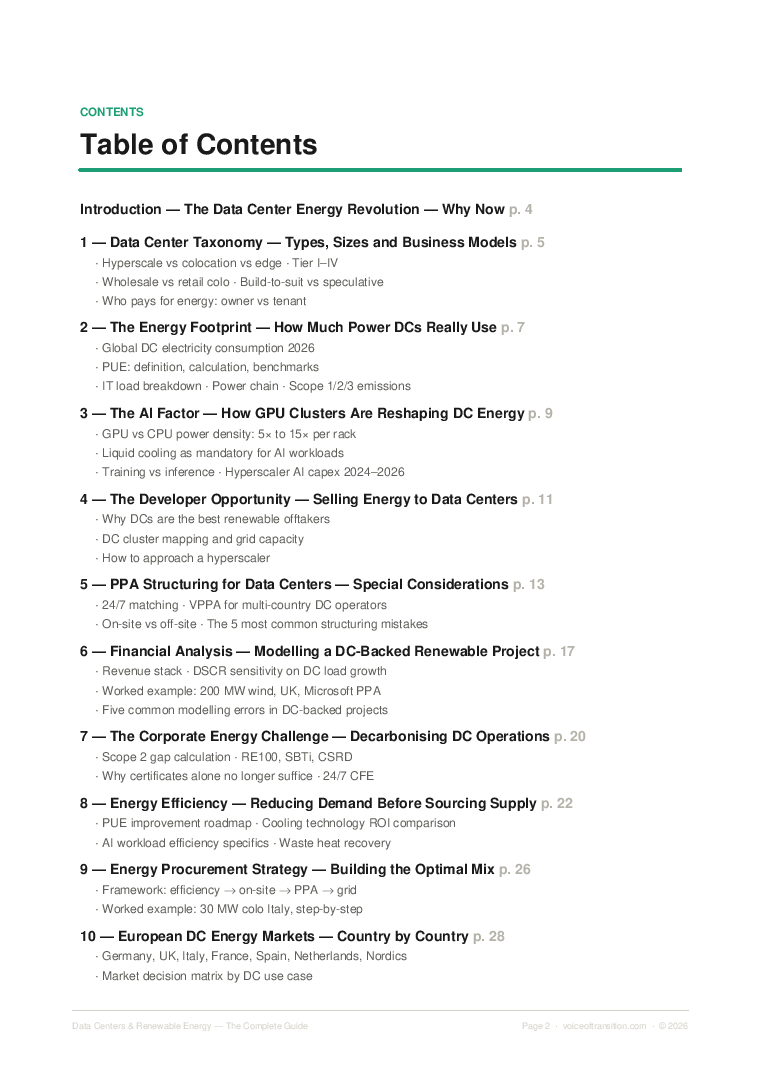
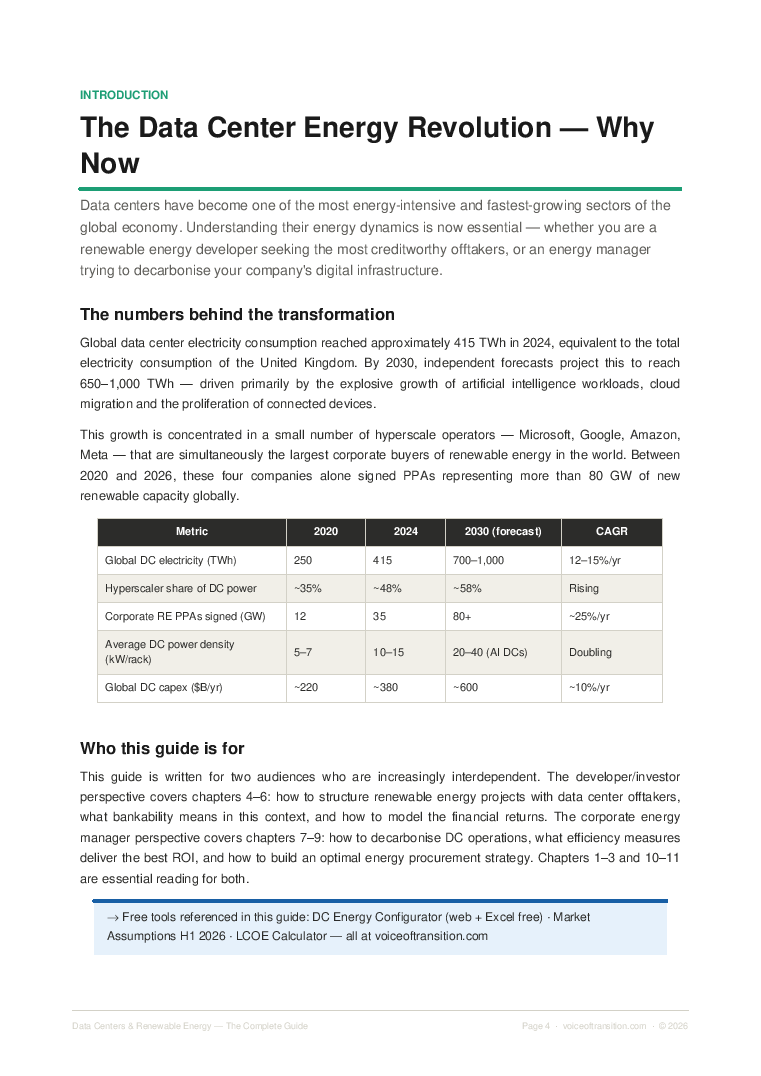
Data centers have become one of the most energy-intensive and fastest-growing sectors of the global economy, and the decisions made by renewable energy developers and corporate energy managers are increasingly intertwined. This guide covers the full picture — from how a data center works and why it consumes so much energy, to how to structure a bankable PPA with a hyperscaler, how to model project returns, and how to build a credible decarbonisation strategy that satisfies RE100, SBTi and EU CSRD requirements.
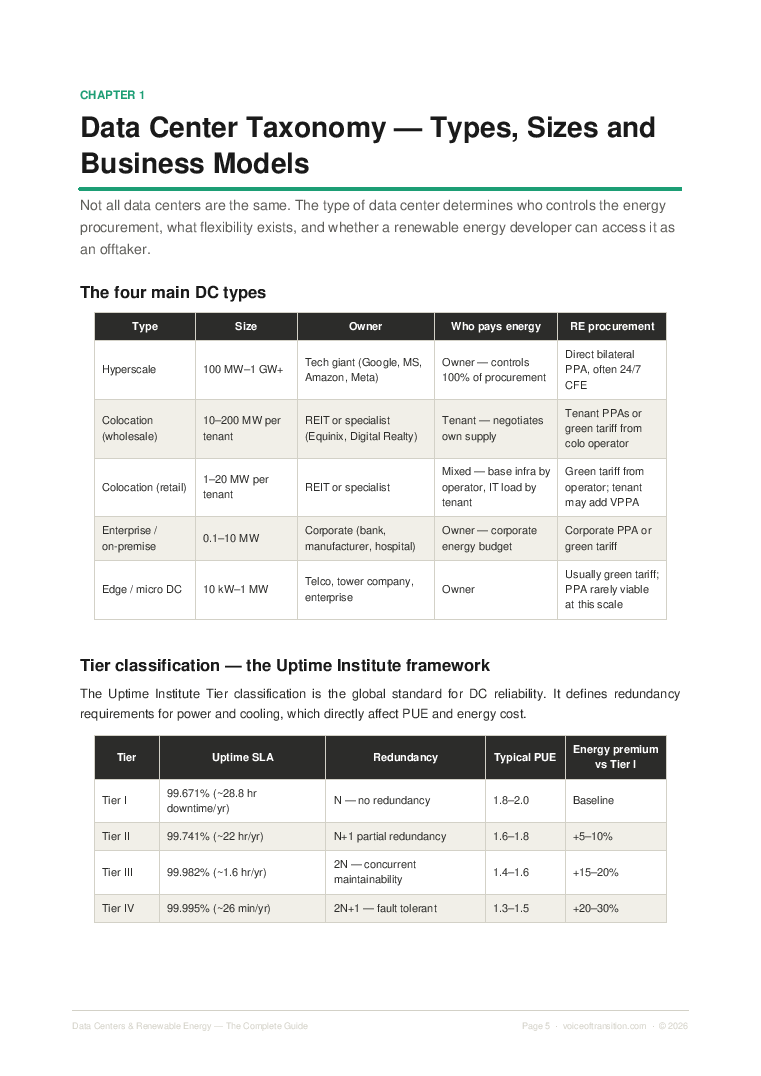
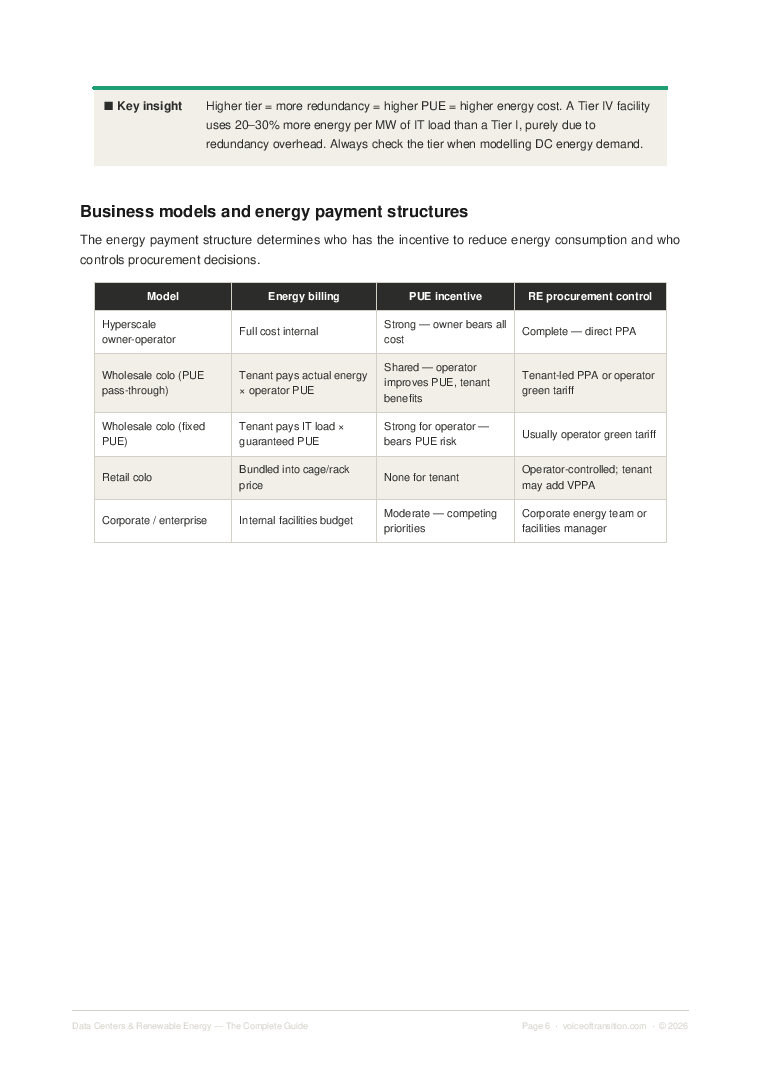
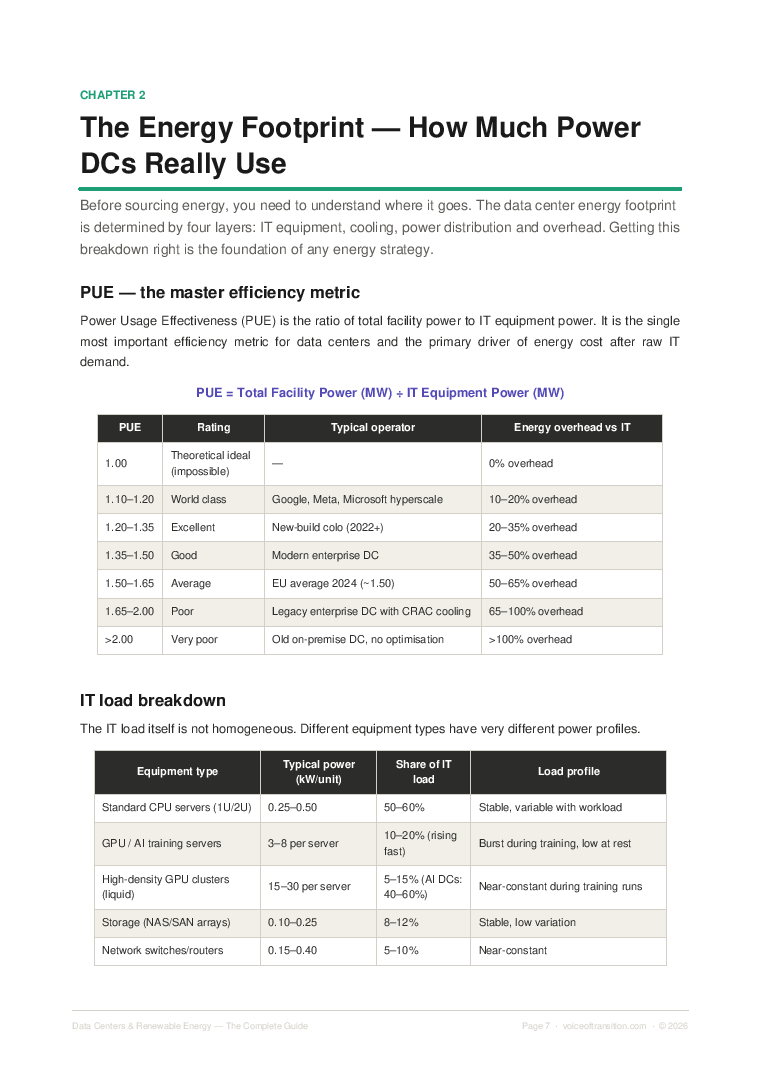
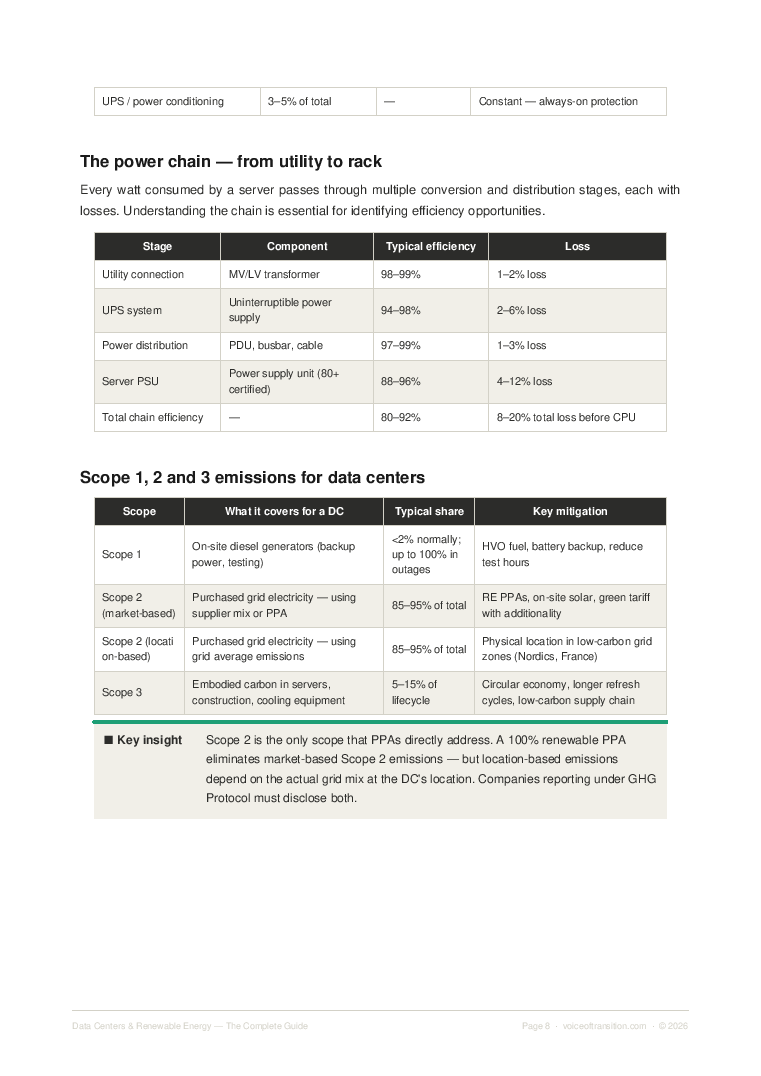
The guide opens with a clear taxonomy of data center types — hyperscale, colocation, enterprise and edge — and explains who controls energy procurement in each model. It then walks through the energy footprint in detail: PUE calculation and benchmarks, the full power chain from utility to rack, IT load breakdown by equipment type, and the Scope 1/2/3 emissions structure that underpins any decarbonisation strategy.
A dedicated chapter on the AI factor explains why GPU clusters are reshaping data center energy demand entirely — with rack densities rising from 5–10 kW to 40–80 kW and beyond, and liquid cooling no longer optional above 25 kW per rack. The guide explains the practical implications for both developers structuring PPAs and energy managers planning facility upgrades.
For renewable energy developers, the guide covers why data centers are the most creditworthy and longest-duration offtakers available, how to approach a hyperscaler procurement process, and how to structure a PPA — including 24/7 CFE portfolio design, VPPA mechanics for multi-country operators, and the five most common structuring mistakes that undermine bankability or ESG credibility.
The financial analysis chapter builds a complete worked example — 200 MW onshore wind, UK, with a Microsoft-style PPA and CfD stacking — showing revenue stack, DSCR sensitivity to DC load growth, and project IRR. The DSCR sensitivity matrix covers six scenarios from AI surge to DC closure, with explicit guidance on termination payment sizing and lender covenant management.
For corporate energy managers, the guide addresses the Scope 2 gap calculation, the compliance requirements of RE100, SBTi, EU CSRD and EU Taxonomy, and why certificates alone no longer satisfy leading ESG raters. It then sets out a structured PUE improvement roadmap with ROI and payback data for each phase, a cooling technology comparison across five configurations, and a complete step-by-step energy procurement plan for a 30 MW colocation facility in Italy.
The final chapters cover European DC energy markets country by country — Germany, UK, Italy, France, Spain, Netherlands and the Nordics — with PPA price benchmarks, grid characteristics, key incentive schemes and a location decision matrix for five DC use cases. The guide closes with a location scoring template, water risk assessment, and four complete worked cases in the appendix.
Every key calculation in the guide is accompanied by a numerical worked example. There are no conceptual frameworks without numbers.
Data centers have become one of the most energy-intensive and fastest-growing sectors of the global economy, and the decisions made by renewable energy developers and corporate energy managers are increasingly intertwined. This guide covers the full picture — from how a data center works and why it consumes so much energy, to how to structure a bankable PPA with a hyperscaler, how to model project returns, and how to build a credible decarbonisation strategy that satisfies RE100, SBTi and EU CSRD requirements.
The guide opens with a clear taxonomy of data center types — hyperscale, colocation, enterprise and edge — and explains who controls energy procurement in each model. It then walks through the energy footprint in detail: PUE calculation and benchmarks, the full power chain from utility to rack, IT load breakdown by equipment type, and the Scope 1/2/3 emissions structure that underpins any decarbonisation strategy.
A dedicated chapter on the AI factor explains why GPU clusters are reshaping data center energy demand entirely — with rack densities rising from 5–10 kW to 40–80 kW and beyond, and liquid cooling no longer optional above 25 kW per rack. The guide explains the practical implications for both developers structuring PPAs and energy managers planning facility upgrades.
For renewable energy developers, the guide covers why data centers are the most creditworthy and longest-duration offtakers available, how to approach a hyperscaler procurement process, and how to structure a PPA — including 24/7 CFE portfolio design, VPPA mechanics for multi-country operators, and the five most common structuring mistakes that undermine bankability or ESG credibility.
The financial analysis chapter builds a complete worked example — 200 MW onshore wind, UK, with a Microsoft-style PPA and CfD stacking — showing revenue stack, DSCR sensitivity to DC load growth, and project IRR. The DSCR sensitivity matrix covers six scenarios from AI surge to DC closure, with explicit guidance on termination payment sizing and lender covenant management.
For corporate energy managers, the guide addresses the Scope 2 gap calculation, the compliance requirements of RE100, SBTi, EU CSRD and EU Taxonomy, and why certificates alone no longer satisfy leading ESG raters. It then sets out a structured PUE improvement roadmap with ROI and payback data for each phase, a cooling technology comparison across five configurations, and a complete step-by-step energy procurement plan for a 30 MW colocation facility in Italy.
The final chapters cover European DC energy markets country by country — Germany, UK, Italy, France, Spain, Netherlands and the Nordics — with PPA price benchmarks, grid characteristics, key incentive schemes and a location decision matrix for five DC use cases. The guide closes with a location scoring template, water risk assessment, and four complete worked cases in the appendix.
Every key calculation in the guide is accompanied by a numerical worked example. There are no conceptual frameworks without numbers.
This Best Practice includes
1 PDF Guide