




Publication number: ELQ-42070-1
View all versions & Certificate

Construction Materials Requirements, Revisions & Inventory Reconciliation Excel Workbook
Use this spreadsheet for managing construction project materials requirements: takeoff, revisions, reconciliation with actual inventory deliveries and usage.
 by Alex Heiphetz - QR Inventory
CEO of AHG, Inc. - prvider of business productivity software, inluding QR InventoryFollow
Alex Heiphetz - QR Inventory offers you this Best Practice for free!
download for free
Add to bookmarks
Further information
The objective of this downloadable workbook is to help construction teams maintain an accurate, current view of project material requirements without overwriting the original takeoff.
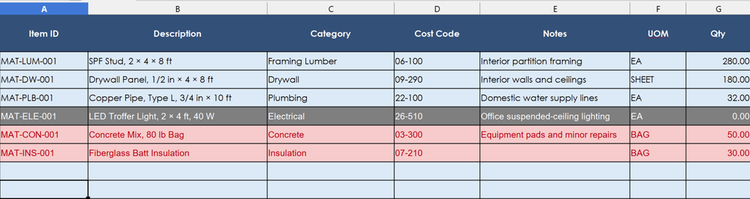
It allows users to preserve the original material list and budget, record approved quantity and cost changes in a separate change ledger, and automatically generate an updated current materials requirements list.
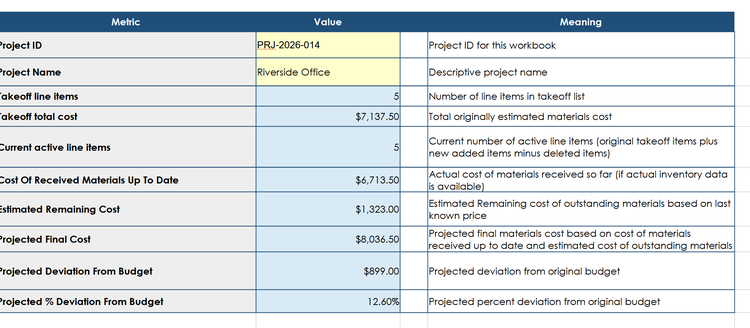
The workbook also helps teams compare current requirements with actual material receiving, usage, returns, on-job quantities, and purchase costs. This makes it easier to identify shortages, over-ordering, quantity discrepancies, budget changes, price deviations, and projected final material costs.
The workbook can be used as a standalone Excel-based project materials management tool or with structured data exported from QR Inventory.
This workbook applies best to construction projects where material requirements change after the original takeoff is prepared and teams need a practical way to maintain an approved current materials list.
It is especially useful when:
* The original takeoff must remain available as a fixed baseline.
* Material additions, reductions, removals, or substitutions occur during the project.
* Changes are currently tracked through separate spreadsheets, emails, or informal notes.
* Project managers need to compare original and current material quantities and costs.
* Purchasing, receiving, usage, and on-job inventory data need to be reconciled with current project requirements.
* The company uses stable Item IDs for matching materials across project records.
* One workbook can be maintained for each project.
* The team uses Microsoft Excel or LibreOffice and prefers a solution that does not require macros.
It is best suited to commercial construction contractors, subcontractors, project managers, estimators, purchasing teams, and project controls personnel managing material-intensive projects.
This workbook is not intended for projects or organizations that require a fully automated, multi-project construction management system.
It may not be suitable when:
* A company needs to manage multiple projects in one workbook or create portfolio-level reports.
* The original takeoff does not use stable, unique Item IDs.
* Users need the workbook to automatically interpret and map arbitrary source spreadsheet columns.
* Material changes must be integrated directly with contractual change orders, accounting, scheduling, or ERP systems.
* Real-time inventory updates are required without importing or connecting external data.
* Supplier invoices, payment status, commitments, and accounts-payable activity must be tracked.
* Detailed vendor quotations, price history, or purchase-order approval workflows are required.
* Google Sheets must refresh QR Inventory data automatically without a separate connector or script.
* Users need macros, automated approval routing, or automatic locking of approved records.
* The company is looking for software that creates a material takeoff from drawings.
The workbook is designed as a practical project-level materials requirements, revision, and planned-versus-actual tracking tool. It does not replace estimating, accounting, ERP, procurement, or complete inventory management software.