Trucking & Logistics Company Financial Forecasting Model
Originally published: 30/08/2026 18:18
Publication number: ELQ-23005-1
View all versions & Certificate
certified

Trucking & Logistics Company Financial Forecasting Model

Download the ready-to-use Trucking & Logistics Company Financial Model for investors, lenders & business planning.

Description
🚛 Download the Trucking & Logistics Company Financial Forecasting Model – a ready-to-use Excel template designed for fleet owners, owner‑operators, and logistics entrepreneurs who need simple, reliable financial projections.


📈 Whether you are starting a new freight business, expanding your fleet, or preparing a Trucking Company business plan for a bank loan, this model gives you a complete financial picture. No more guesswork. No more blank spreadsheets. Just a structured, professional tool that works.

📊 Model OverviewThis Trucking Company financial projections Excel template is a comprehensive 60‑month (5‑year) forecasting tool built specifically for freight transport and fleet management businesses. It supports dry van, reefer, and flatbed operations, as well as owner‑operator and company‑owned fleet models.
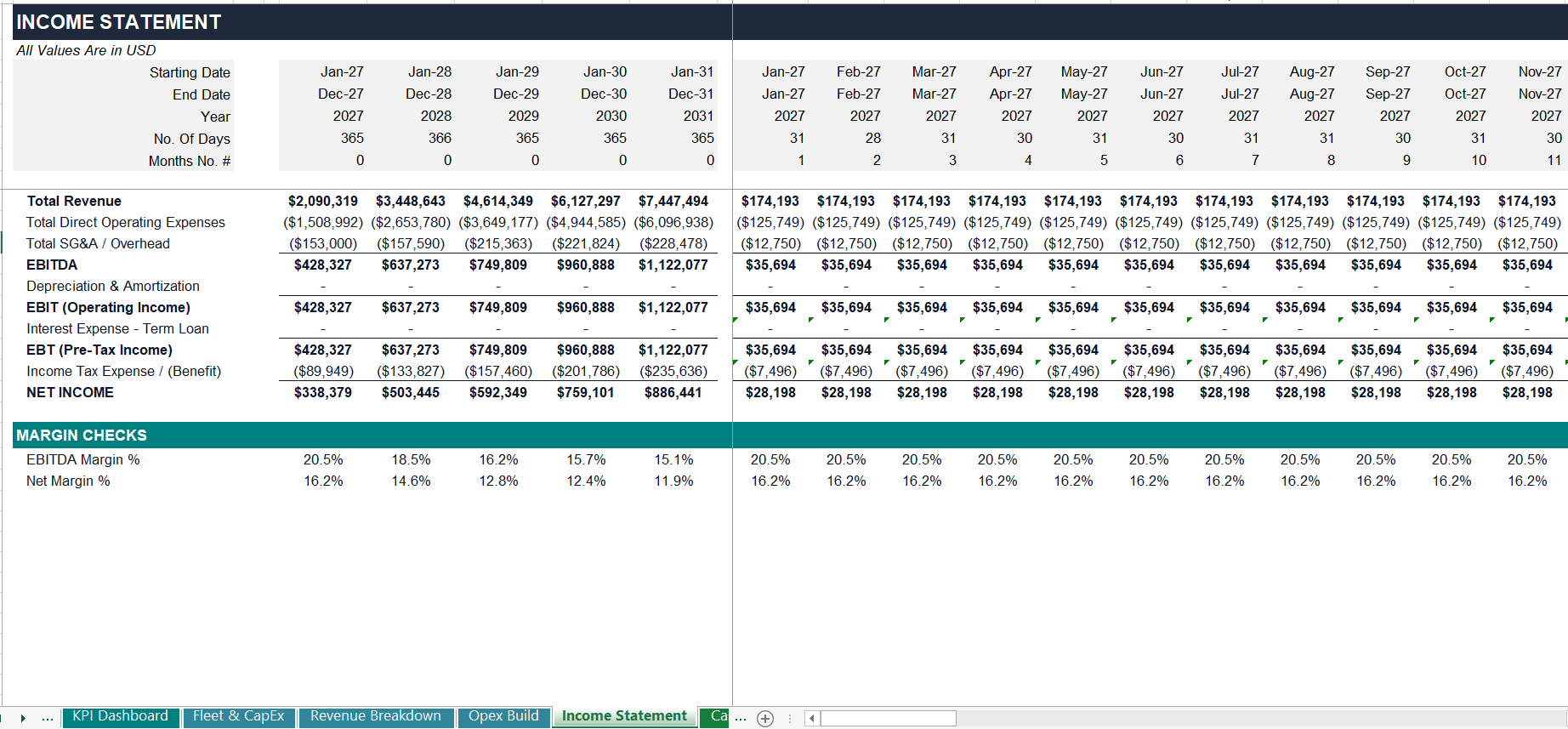
The model generates full 3‑statement financial projections (Income Statement, Balance Sheet, Cash Flow Statement) on a monthly basis, rolled up into annual summaries. Every assumption is editable – change one input and the entire forecast recalculates instantly.


👥 Who Is This Model For?
  • 🚚 Trucking company owners planning fleet expansion or seeking funding
  • 👨‍✈️ Owner‑operators transitioning to a multi‑truck operation
  • 🧭 Logistics startups preparing a Logistics Company financial plan template for investors
  • 📦 Freight brokers and 3PL Company operators needing a financial plan
  • ✍️ Business plan writers and financial consultants serving the transport industry


⚙️ Key Inputs – Built for Real Trucking Operations
The model is driven by operational inputs, not generic percentages. You control every assumption:


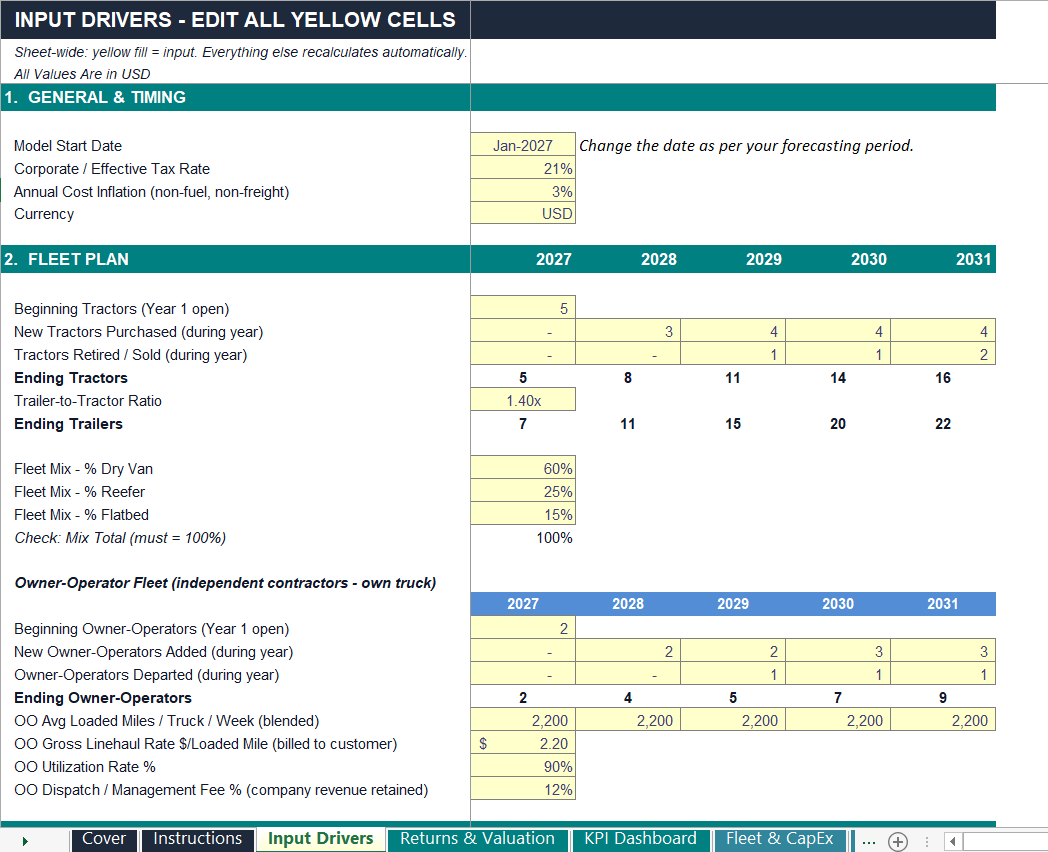
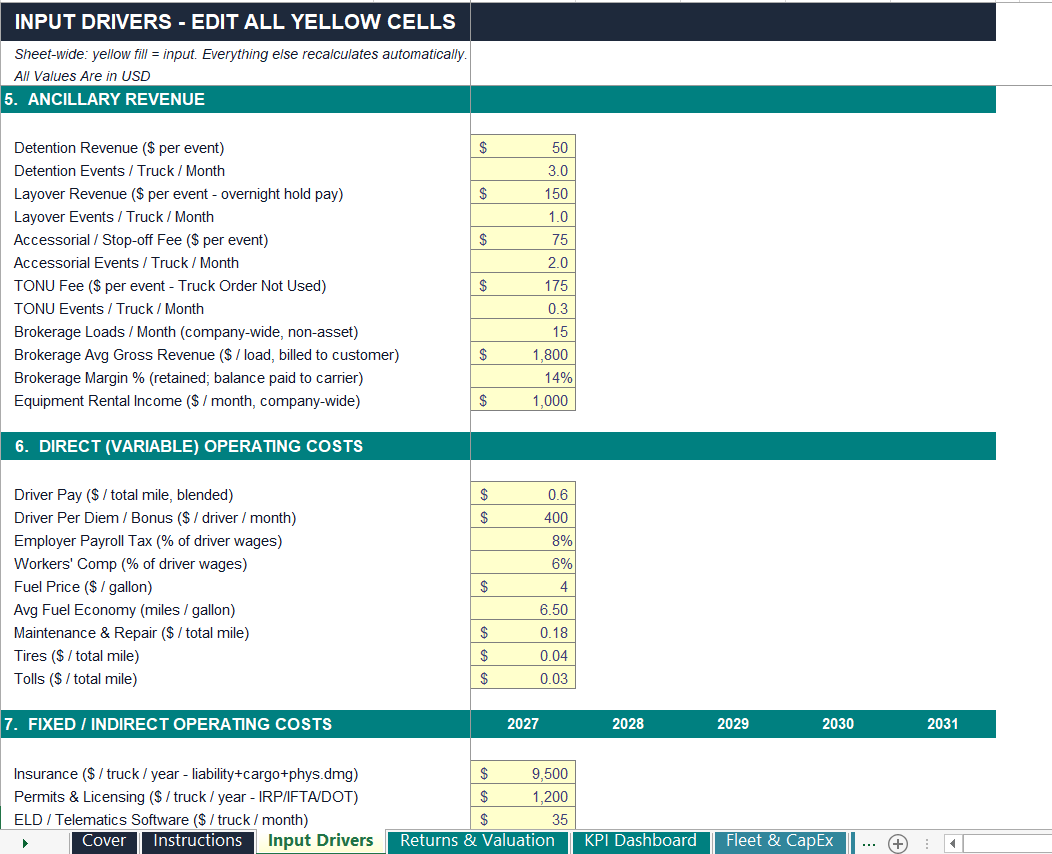
🚛 Fleet Plan
  • Starting tractor count and annual additions/retirements
  • Fleet mix: Dry Van / Reefer / Flatbed percentages
  • Trailer‑to‑tractor ratio
  • Owner‑operator fleet (independent contractors)


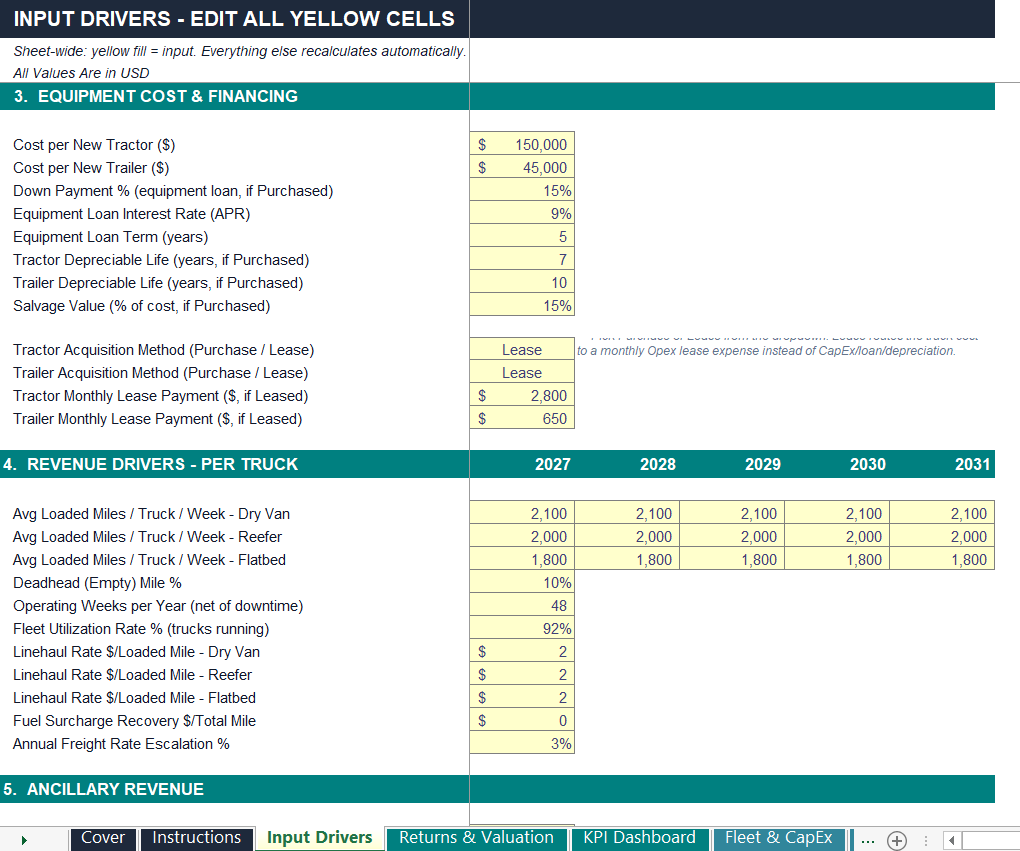
💰 Revenue Drivers
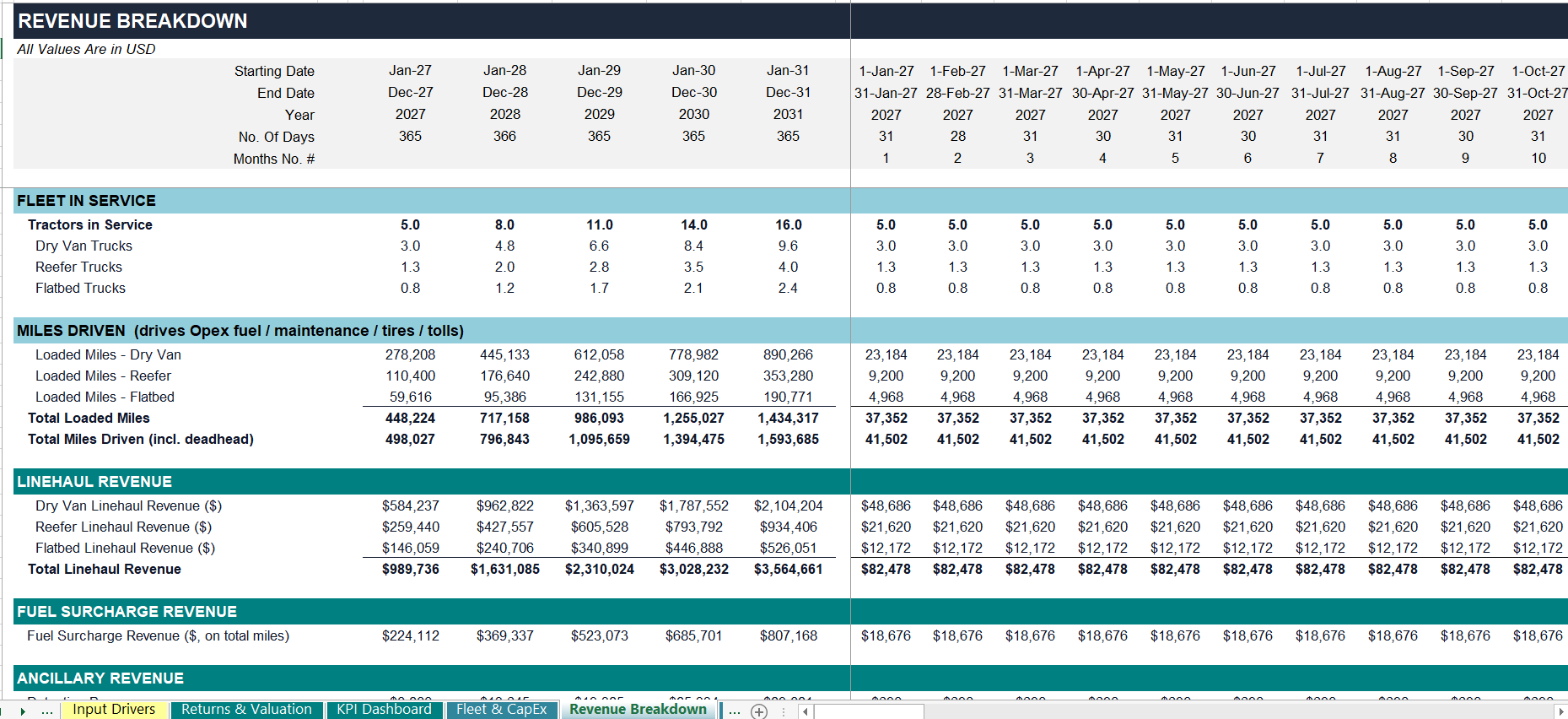
  • Loaded miles per truck per week (by equipment type)
  • Deadhead (empty) mile percentage
  • Linehaul rate per mile (by segment)
  • Fuel surcharge recovery per mile
  • Ancillary revenue: detention, layover, accessorial fees, TONU
  • Brokerage earnings and equipment rental income


⛽ Cost Drivers
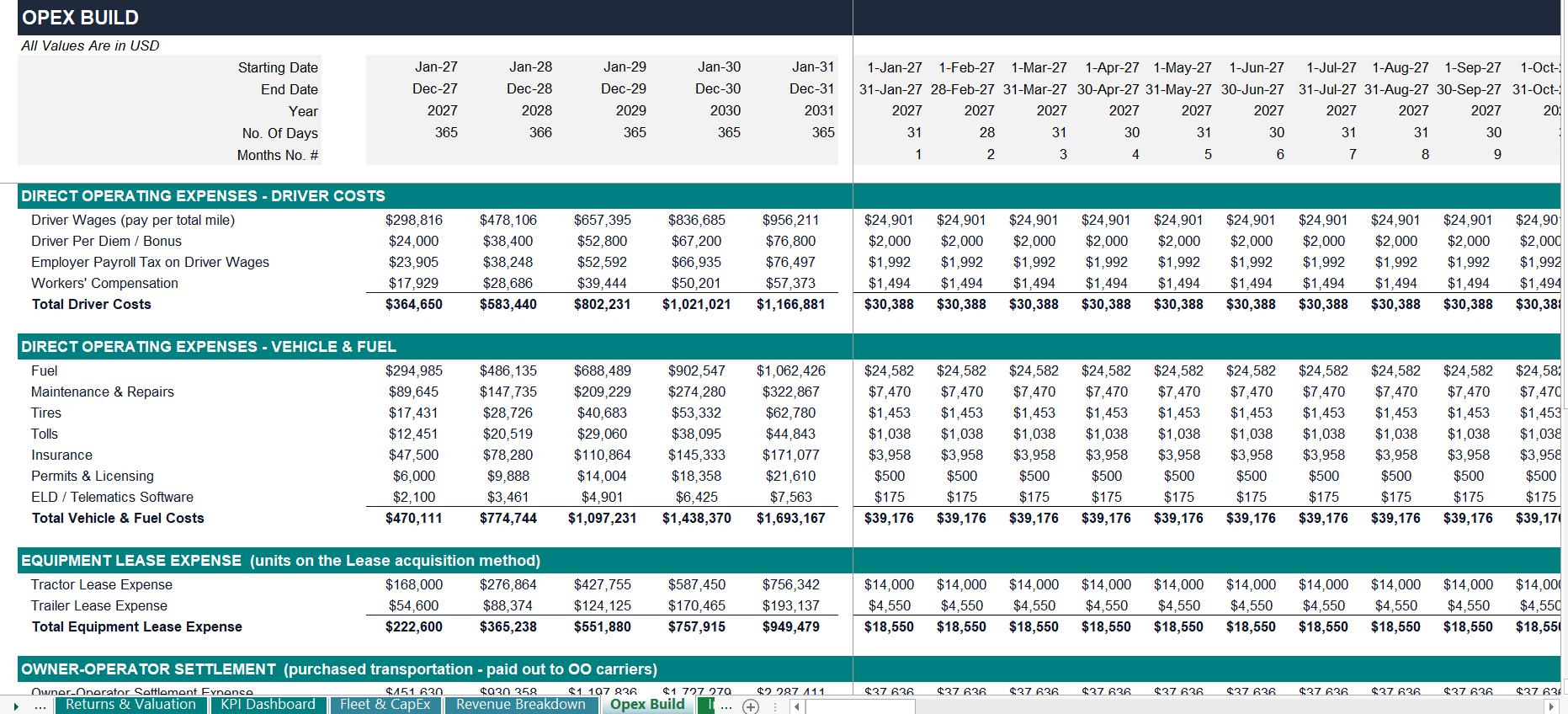
  • Driver pay per mile and per diem/bonus
  • Employer payroll tax and workers' comp rates
  • Fuel price and average MPG
  • Maintenance, tires, and tolls per mile
  • Insurance, permits, ELD/telematics software
  • Yard/terminal rent and staff salaries


🏦 Financing & Capital Structure
  • Equipment purchase vs. lease decision
  • Down payment %, loan rate, and term
  • Working capital revolver with minimum cash target
  • Discount rate and exit EBITDA multiple


📋 Key Outputs – What You Get📄 Financial Statements
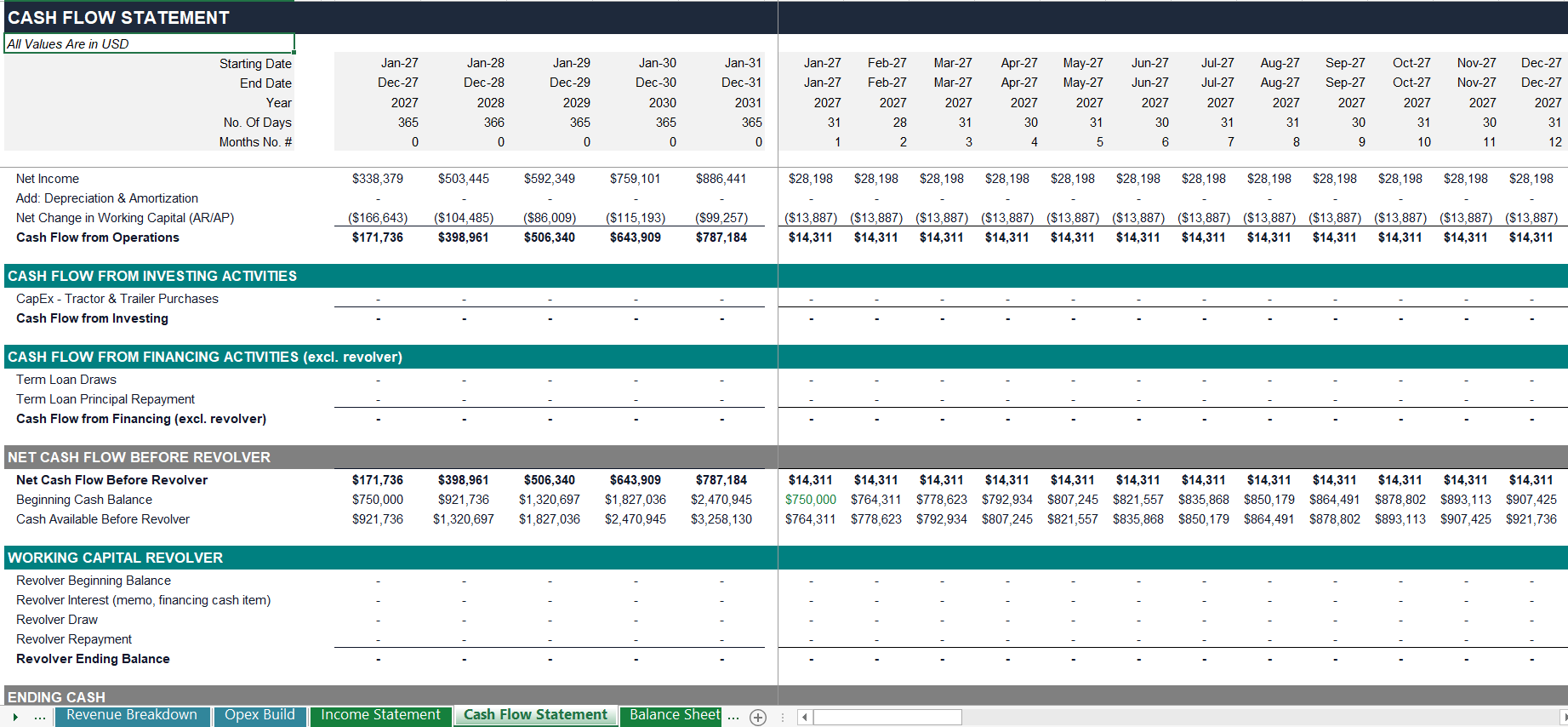
  • 📅 60‑month Income Statement with monthly detail and 5‑year summary
  • 💵 60‑month Cash Flow Statement (operating, investing, financing)
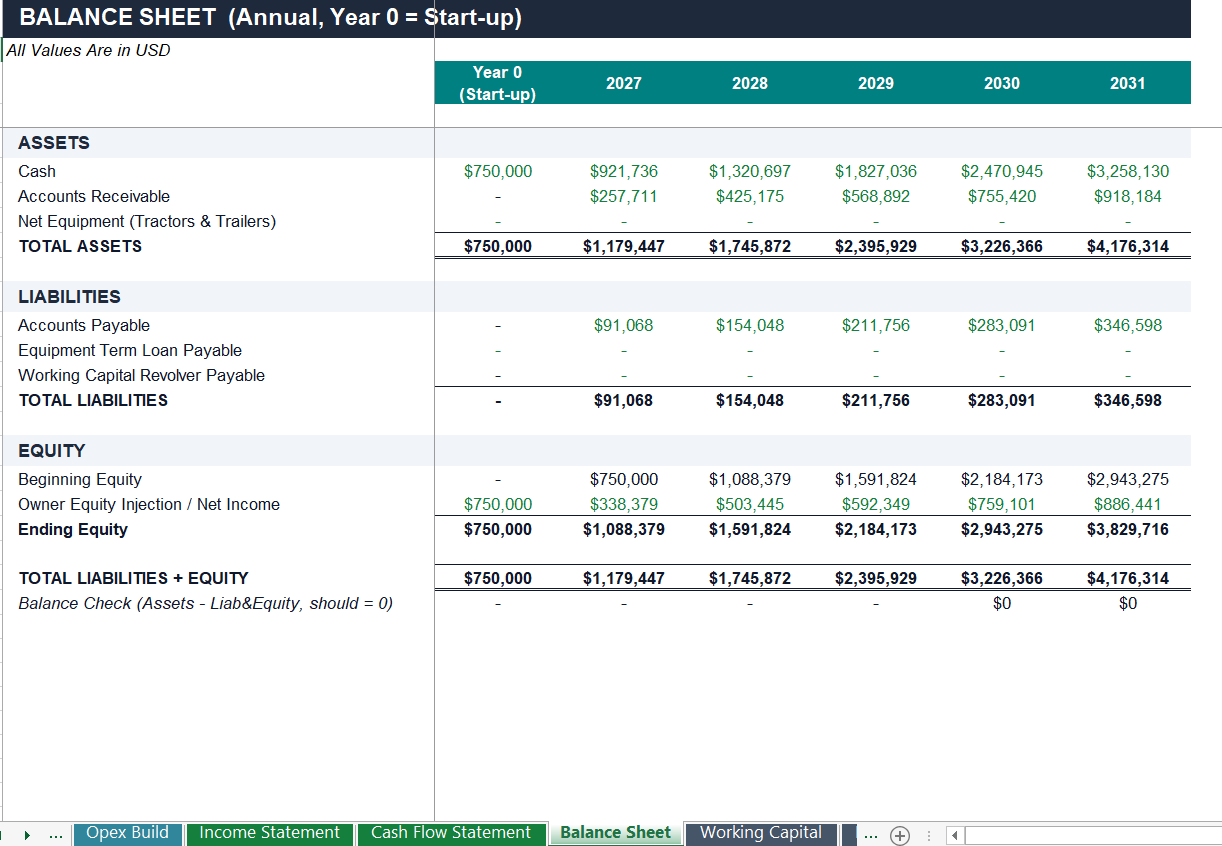
  • 📊 Annual Balance Sheet (Year 0 through Year 5)


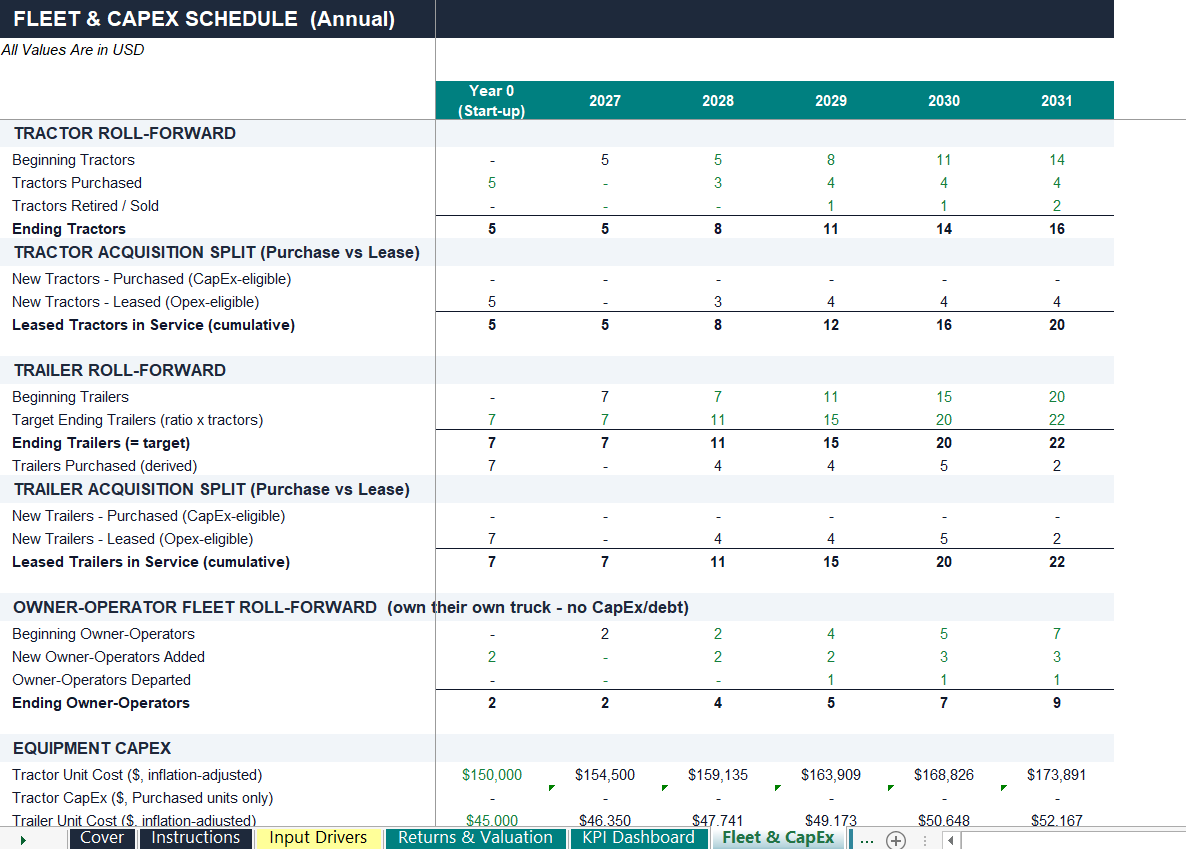
🚜 Fleet & CapEx Schedule
  • Tractor and trailer roll‑forward (beginning, purchases, retirements)
  • Equipment depreciation and net book value
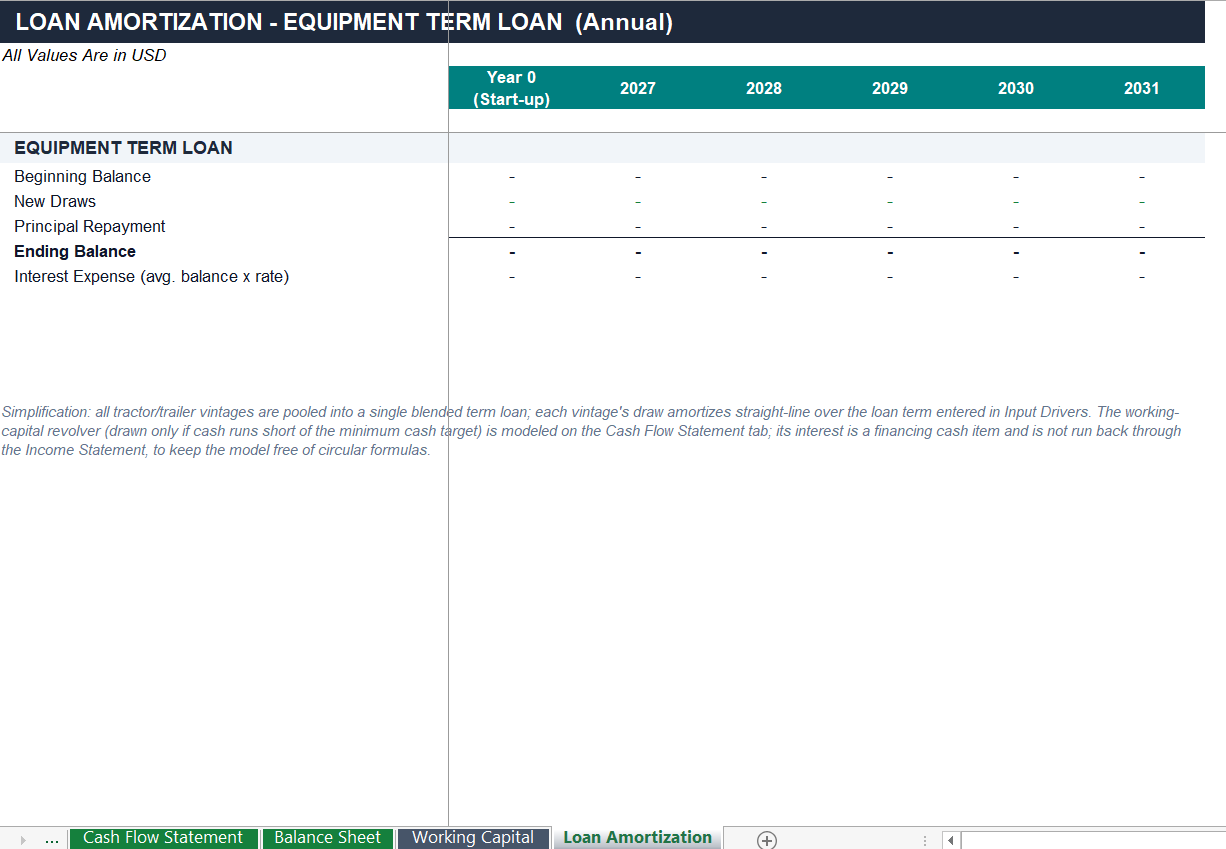
  • Capex and financing draws


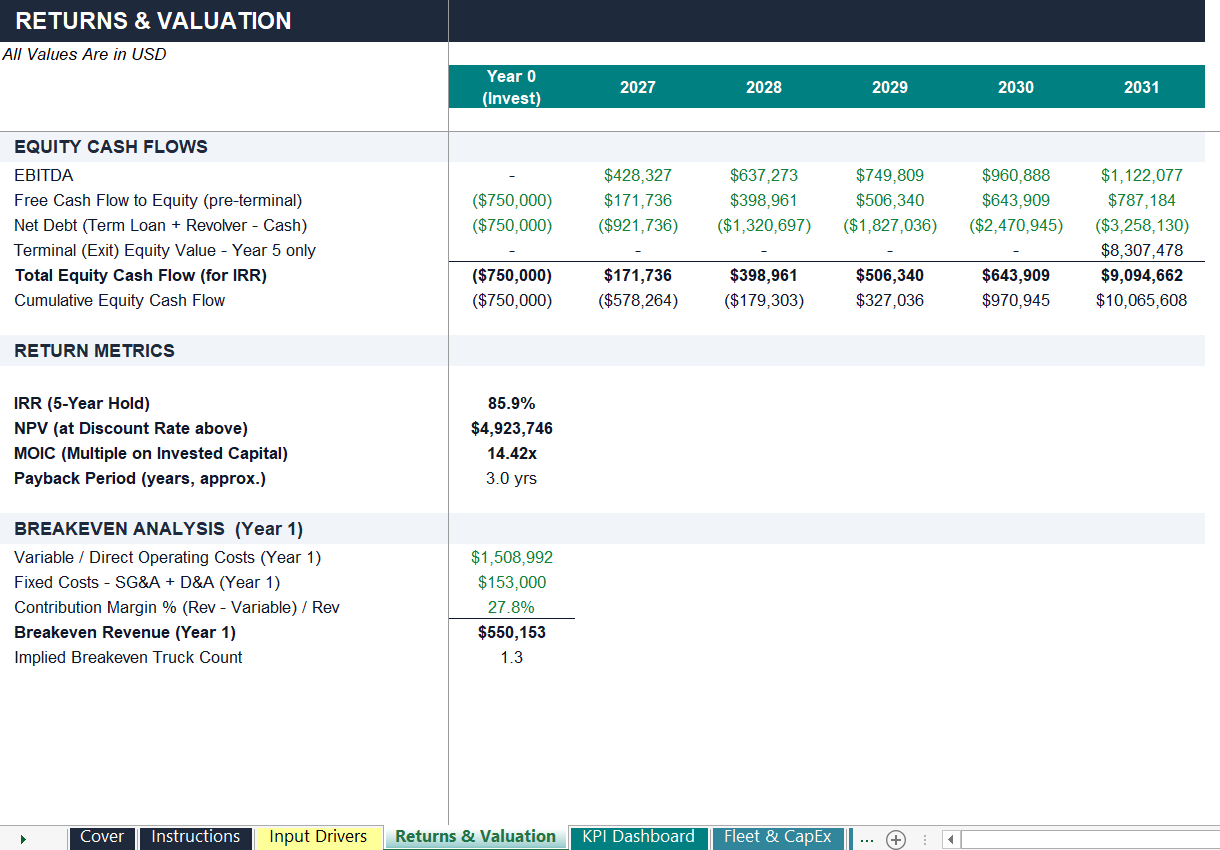
📈 Returns & Valuation
  • 📈 IRR (5‑year hold)
  • 💹 NPV at your discount rate
  • 📊 MOIC (Multiple on Invested Capital)
  • ⏳ Payback period
  • 🧮 Breakeven revenue and implied breakeven truck count


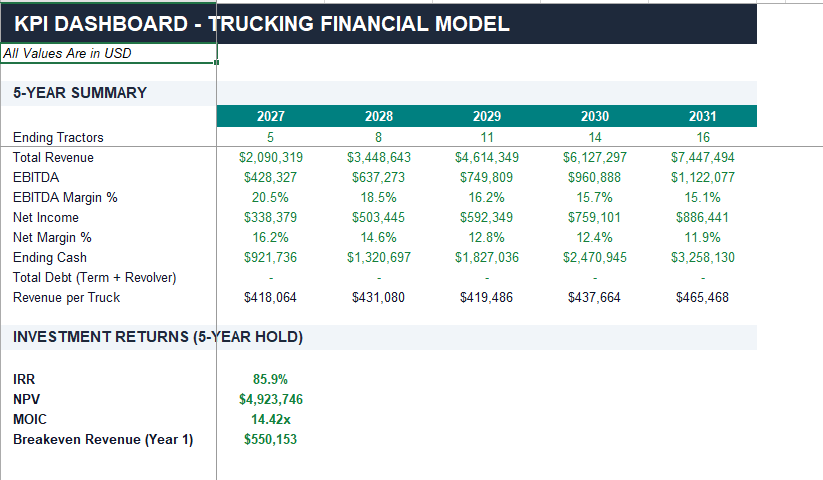
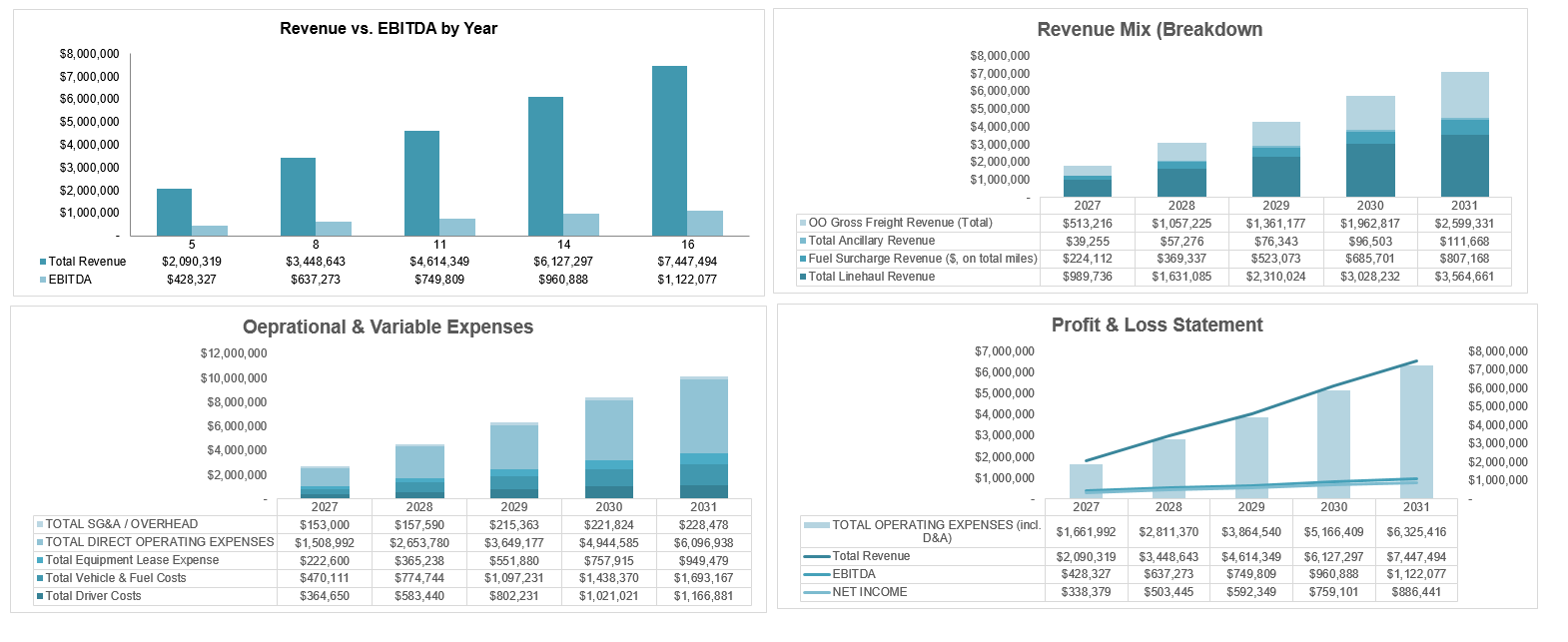
🎯 KPI Dashboard
One‑page summary of:
  • Ending tractors
  • Total Revenue, EBITDA, and Net Income
  • EBITDA Margin % and Net Margin %
  • Ending Cash and Total Debt
  • Revenue per Truck


✨ Key Features
  • 📆 60‑month monthly granularity – see the full 5‑year journey, month by month
  • 🟦 All inputs on one tab – blue font, yellow‑highlighted cells are the only cells you need to change
  • 🔄 Live formulas throughout – change an assumption and the entire model recalculates instantly
  • 🔀 Purchase vs. Lease toggle – compare acquisition strategies with a simple dropdown
  • 👥 Owner‑operator segment – model independent contractors with dispatch fee revenue and settlement costs
  • 🏦 Working capital revolver – automatically draws when cash falls below your minimum target
  • 🔓 No password protection – fully editable and customizable after download
  • 🎨 Clear color coding – blue = input, black = formula, green = link
  • ✅ Built‑in checks – input validations and error checks throughout


🏆 Why Choose This Model?
This is not a generic template. It is a Fleet Management Financial Model built around the actual operating drivers of a freight transport business. Every revenue line and cost item is calculated from real operational inputs – miles driven, fuel burned, trucks in service, and rates per mile.
Whether you need a Trucking Company profit and loss template for internal budgeting, a Freight Transport Business financial plan for a loan application, or a 3PL Company Financial plan template for investor presentations, this model delivers.


🛠️ Modification & Support
We offer free support and error correction to all clients. If you need assistance customizing the model for your specific business, we are happy to help.


🚀 Download the Trucking & Logistics Company Financial Forecasting Model today and take control of your financial future. Simple, ready‑to‑use, and built for results.

This Best Practice includes
Excel Financial Model

Acquire business license for $80.00

Add to cart

Add to bookmarks

Discuss

Further information

To provide a driver‑based, 60‑month, 3‑statement financial projection that enables fleet owners and logistics startups to model revenue, operating costs, and capital requirements with instant scenario‑testing capabilities.

For small to mid‑sized freight carriers (under ~50 company tractors) operating dry van, reefer, or flatbed equipment, using either company drivers or owner‑operators, who need a bank‑ready financial plan or a simple tool to evaluate fleet growth and financing options.

For very large fleets with complex union contracts, multi‑terminal networks, international cross‑border consolidation, or for businesses that require daily cash flow forecasting or project‑based job costing beyond the model’s monthly/ annual summarized structure.


0.0 / 5 (0 votes)

please wait...