Publication number: ELQ-66326-1
View all versions & Certificate

Mastering Cost–Volume–Profit Analysis: Break-Even, Profit Targets and Operating Leverage
Learn break-even, profit targets and operating leverage with ease.
Further information
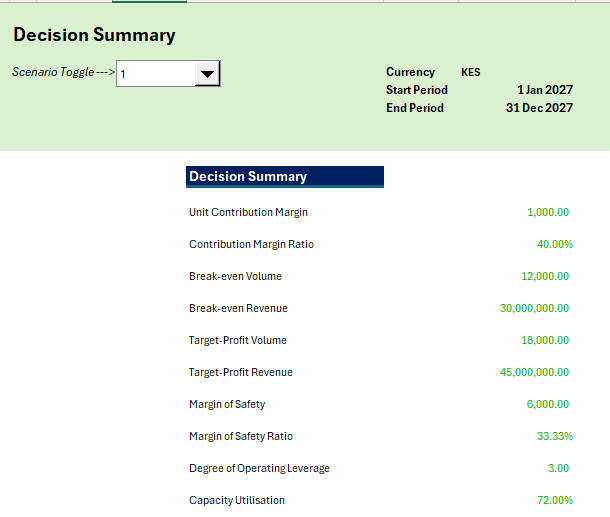
Cost–Volume–Profit analysis examines how sales volume, selling prices, variable costs and fixed costs affect profitability. Its main objectives are to:
Determine the break-even sales volume or revenue.
Calculate the sales required to achieve a target profit.
Measure the contribution generated by each product or unit sold.
Assess the margin of safety above the break-even point.
Evaluate the effect of changes in prices, costs and sales volumes.
Measure operating leverage and the sensitivity of profit to changes in sales.
Support short-term pricing, budgeting, production and sales decisions.
Compare alternative products, sales mixes or operating structures.
CVP analysis is most useful when:
Costs can be reasonably classified as fixed or variable.
The selling price per unit remains constant within the relevant range.
Variable cost per unit remains relatively stable.
Fixed costs remain unchanged within the period and operating range.
Production volume is approximately equal to sales volume.
The business sells a single product or maintains a stable sales mix.
The relationship between revenue, costs and activity is approximately linear.
The analysis covers a short-term planning period.
Production capacity and operating efficiency remain broadly unchanged.
Management needs quick scenario analysis for pricing, sales targets or cost control.
It is particularly suitable for manufacturing, retail, hospitality, transport and service businesses with identifiable units of output and predictable cost behaviour.
CVP analysis is less reliable when:
The business has highly volatile selling prices or input costs.
Costs cannot be clearly separated into fixed and variable components.
Economies of scale cause variable cost per unit to change significantly.
Fixed costs change at different levels of production.
The business has multiple products with a frequently changing sales mix.
Production and sales volumes differ substantially, causing major inventory movements.
Demand is uncertain or strongly affected by competition and customer behaviour.
Capacity constraints prevent the business from reaching the calculated sales target.
Revenue and costs have nonlinear relationships.
The analysis covers a long period during which technology, inflation and market conditions may change.
Qualitative considerations such as customer relationships, product quality, regulation or strategic positioning are more important than short-term profit.
CVP results should therefore be treated as planning estimates rather than precise forecasts.