

Originally published: 21/05/2024 07:50
Last version published: 26/08/2025 16:27
Publication number: ELQ-89295-3
View all versions & Certificate
Last version published: 26/08/2025 16:27
Publication number: ELQ-89295-3
View all versions & Certificate

Health Club (Fitness Centre) Financial Model Excel Template
A comprehensive editable Excel model for tracking health club finances, including yearly summary tabs, integrates Income Statements, Cash Flow, & Balance Sheets
 by AllFinancialModels
AllFinancialModels offer a curated selection of high-quality yet financial model templates designed to support a wide range of business needs.Follow
Description
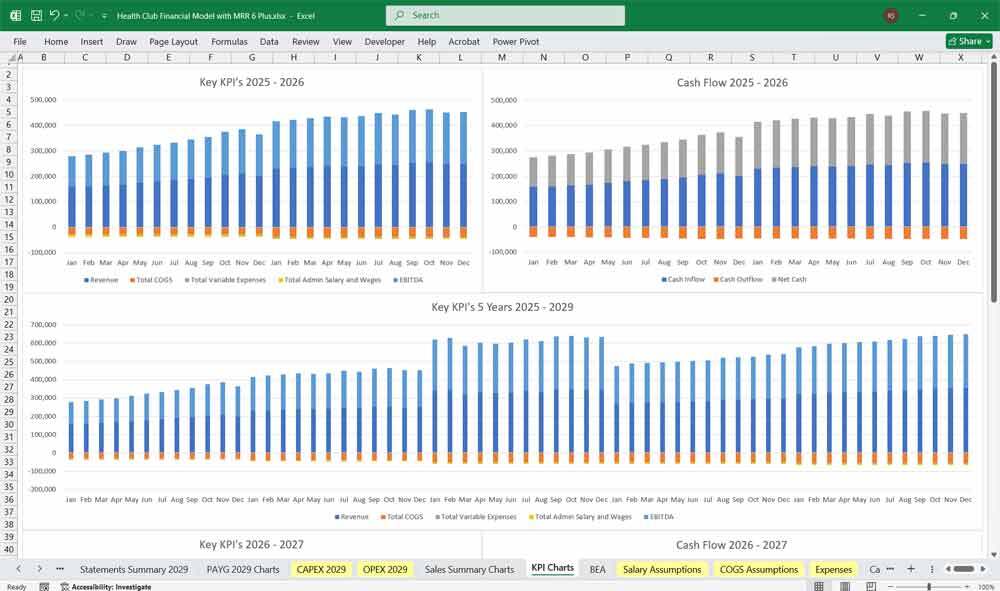
Track specialized funding that is frequently used for health clubs and infrastructure with this 5-Year 3-Statement financial model.
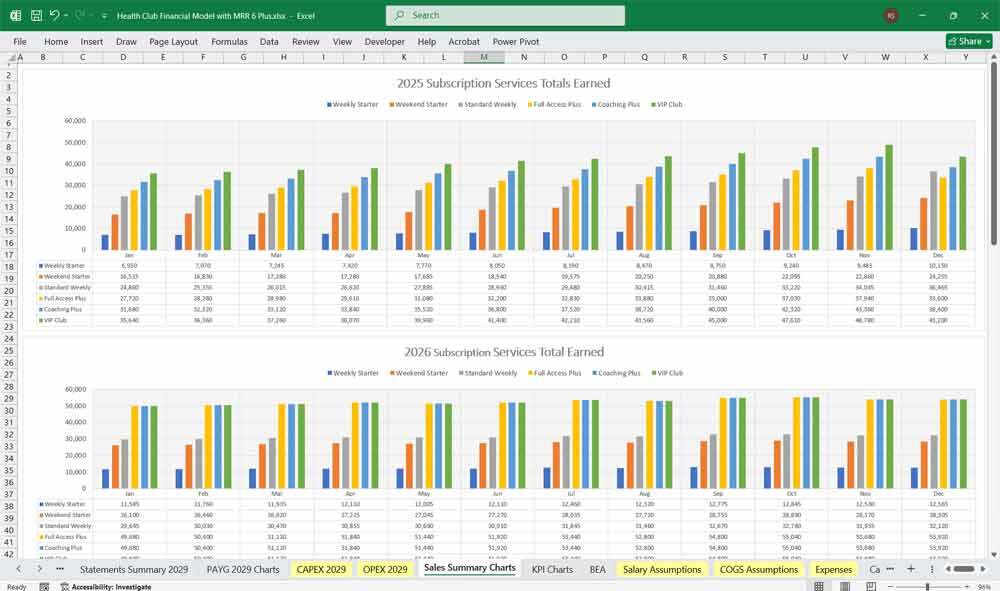
5-Year, 3-Statement with 6 Tier Subscription Tracking ‘Managed Service Agreements’.
Build your MSA book as quickly as possible.
You would typically sell your services under tiered 12-month agreements that increase in price as SLAs (Service Level Agreements) and monthly consulting hours increase.
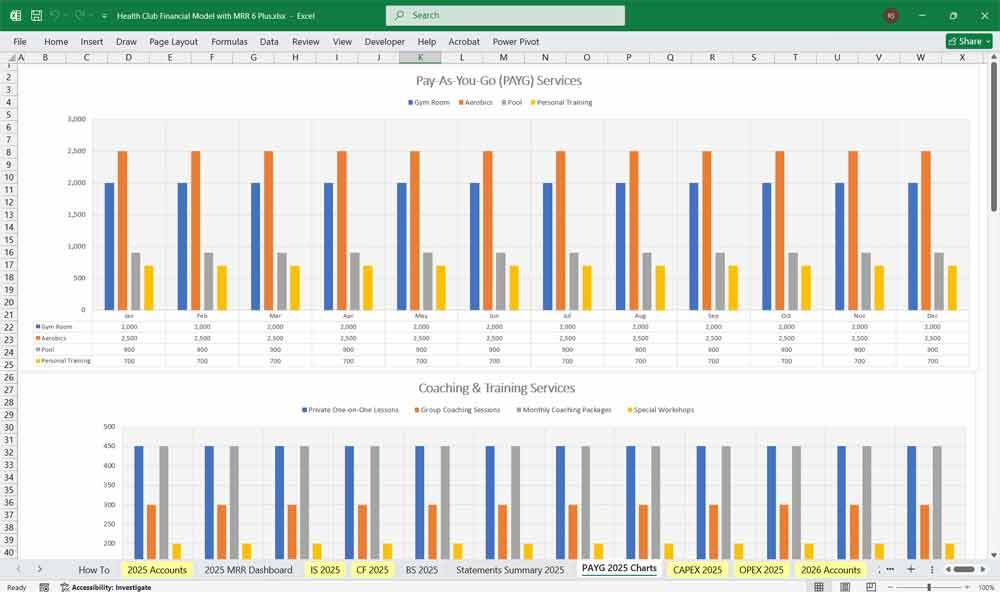
Plus 20 Inputs for PAYG Services,
Maybe you sell Health Club-branded apparel, nutrition, accessories, etc, in your own health club shop.
This entails the detailed planning, organizing, and administration of financial resources and company projections.
Calculate company schedule cash flows from the initial start to the operating phases.
Dive into detailed health club revenue streams for your, aerobics classes, gym room, aerobics machines, pool, and wellness classes. Experiment with pricing scenarios and contract terms to visualize potential revenue variations.
This financial model for a health club (fitness centre) involves several key components that outline its financial health and projections. Below is a detailed description of the structure and components of this comprehensive financial model.
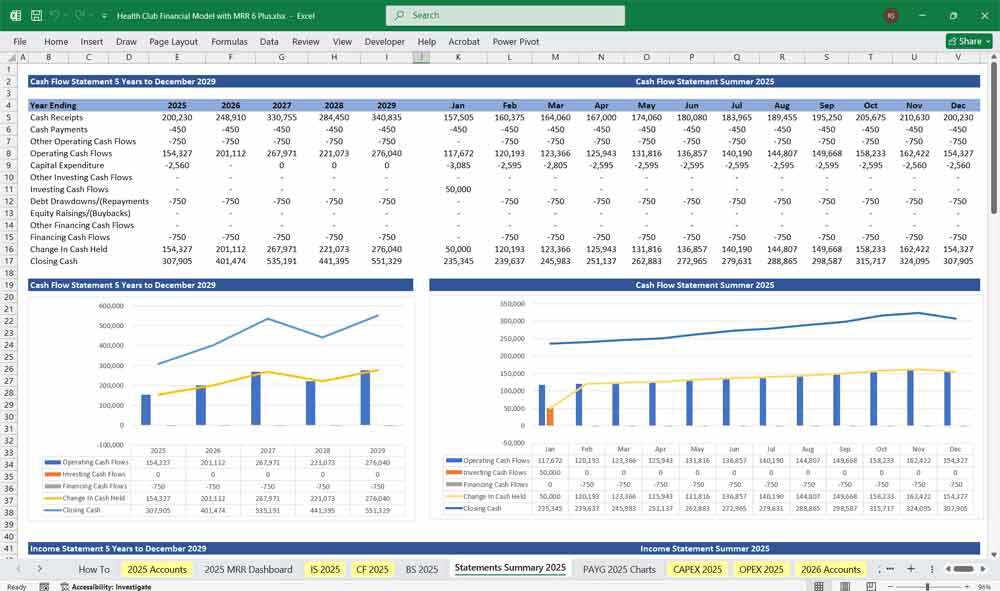
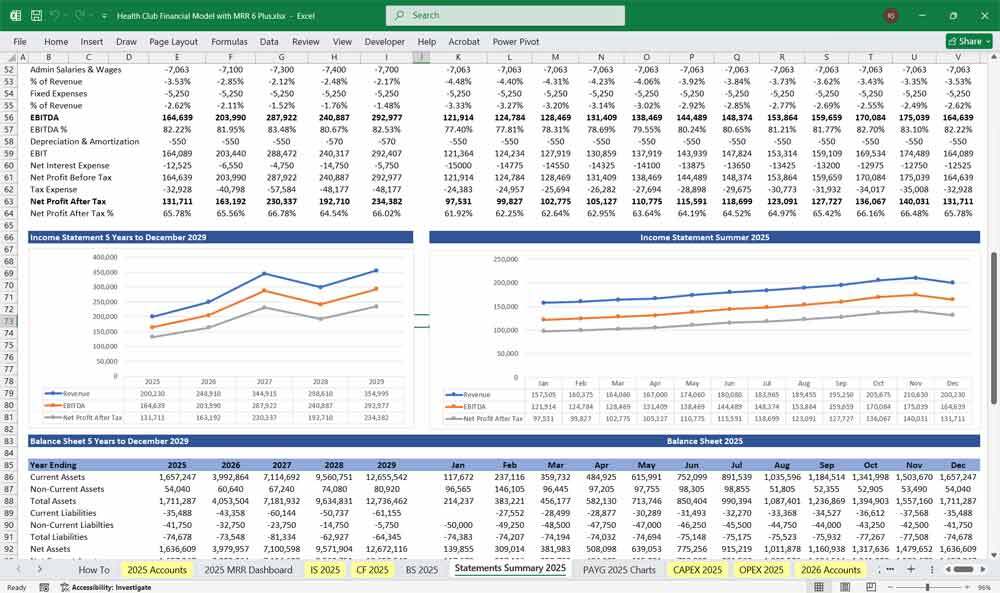
This model typically includes an Income Statement, Cash Flow Statement, and Balance Sheet, with inputs for various revenue and cost drivers.
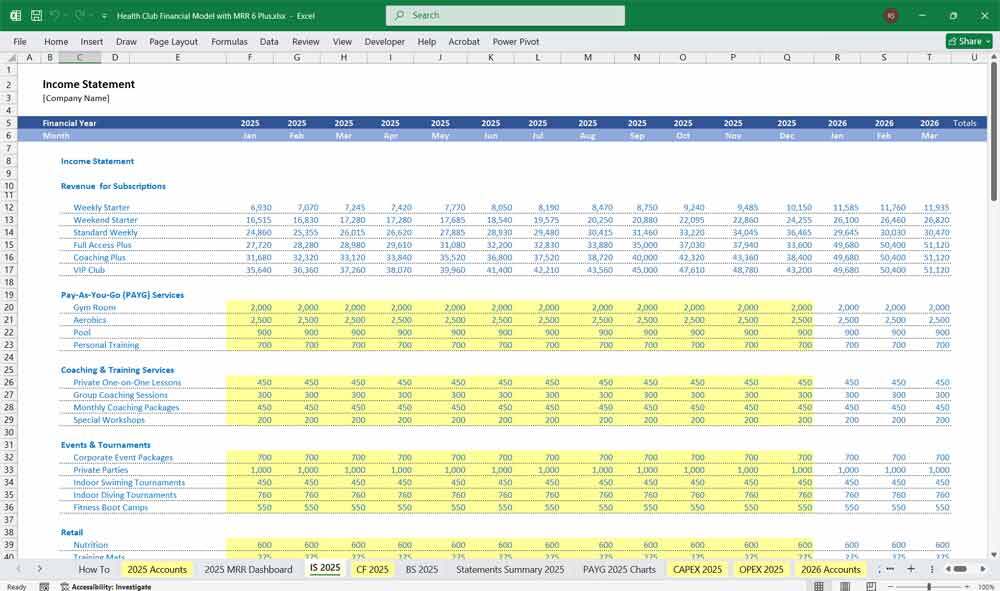
1. Income Statement (Profit and Loss Statement)This section tracks revenues, costs, and profits over a period (monthly, quarterly, or annually).
Revenue Streams:
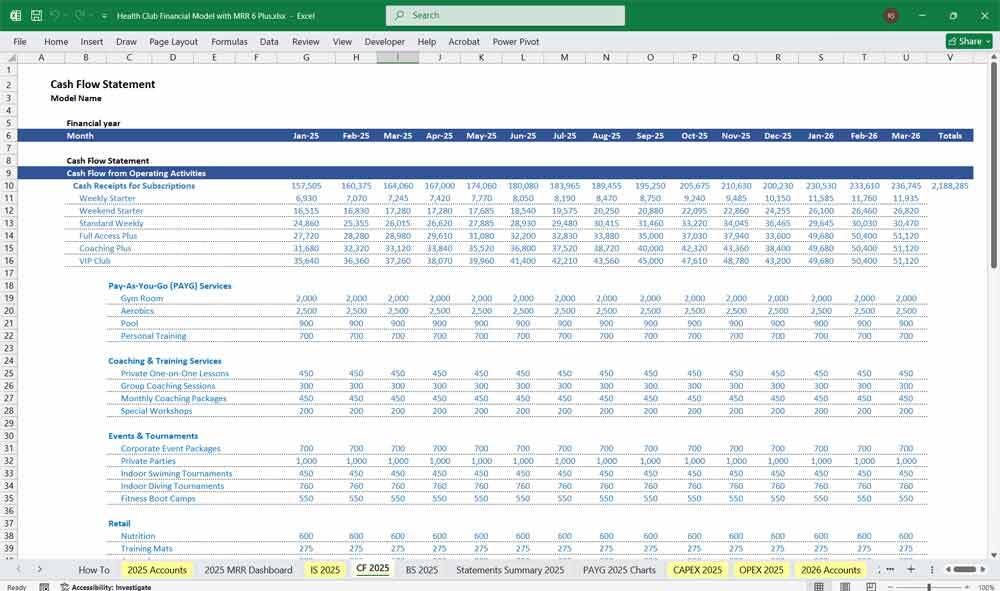
2. Cash Flow StatementThis section shows the inflows and outflows of cash, focusing on operational liquidity.
Operating Cash Flow:
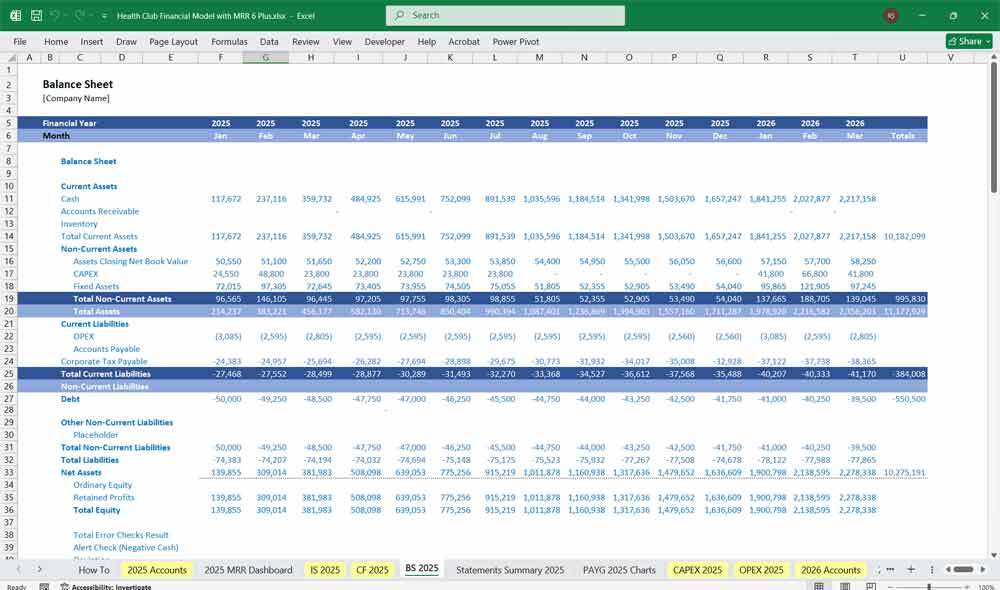
3. Balance SheetThe balance sheet provides a snapshot of the financial position, showing assets, liabilities, and equity.
Assets:
Subscription Revenue Tracking
Focuses on tracking the recurring revenue that forms the backbone of a subscription-based business.
Monthly Recurring Revenue (MRR): Total monthly revenue generated from active subscriptions.
MRR = (Number of subscribers in each tier × Tier price).
Annual Recurring Revenue (ARR): Total expected revenue over a year from recurring subscriptions.
ARR = MRR × 12.
Metrics to Monitor
Subscriber Growth Rate:
(New Subscribers - Cancellations) / Starting Subscribers.
Churn Rate:
(Number of Cancellations / Starting Subscribers).
Lifetime Value (LTV):
Average Revenue Per User (ARPU) × Average Subscriber Lifetime.
Customer Acquisition Cost (CAC):
Total Sales & Marketing Costs / Number of New Subscribers.
LTV/CAC Ratio:
Indicates the ROI on customer acquisition.
Dashboard Components
MRR by Tier:
Breakdown of MRR across different subscription plans ().
MRR Growth:
Month-over-month MRR change percentage.
Churn Analysis:
Identify patterns or reasons for subscriber cancellations.
ARR Projections:
Forecast ARR based on historical MRR trends and growth rates.
This financial model is adaptable, and its metrics should align with the strategic goals of your Health Club, whether focused on scaling the user base, maximizing profitability, or securing investment.
Key Metrics and RatiosTo analyze the financial health of the health club, include the following metrics:
Track specialized funding that is frequently used for health clubs and infrastructure with this 5-Year 3-Statement financial model.
5-Year, 3-Statement with 6 Tier Subscription Tracking ‘Managed Service Agreements’.
Build your MSA book as quickly as possible.
You would typically sell your services under tiered 12-month agreements that increase in price as SLAs (Service Level Agreements) and monthly consulting hours increase.
Plus 20 Inputs for PAYG Services,
Maybe you sell Health Club-branded apparel, nutrition, accessories, etc, in your own health club shop.
This entails the detailed planning, organizing, and administration of financial resources and company projections.
Calculate company schedule cash flows from the initial start to the operating phases.
Dive into detailed health club revenue streams for your, aerobics classes, gym room, aerobics machines, pool, and wellness classes. Experiment with pricing scenarios and contract terms to visualize potential revenue variations.
This financial model for a health club (fitness centre) involves several key components that outline its financial health and projections. Below is a detailed description of the structure and components of this comprehensive financial model.
This model typically includes an Income Statement, Cash Flow Statement, and Balance Sheet, with inputs for various revenue and cost drivers.
1. Income Statement (Profit and Loss Statement)This section tracks revenues, costs, and profits over a period (monthly, quarterly, or annually).
Revenue Streams:
- Membership Fees: Recurring revenue from members (monthly or annual subscriptions).
- Inputs: Membership tiers (basic, premium), number of members, churn rate, pricing per tier.
- Personal Training Fees: Revenue from one-on-one or group training sessions.
- Inputs: Number of sessions, average price per session, trainer utilization rate.
- Classes and Events: Revenue from specialized classes (e.g., yoga, Pilates) or one-off fitness events.
- Inputs: Class capacity, attendance rate, ticket prices.
- Merchandise Sales: Revenue from selling branded merchandise or fitness gear.
- Inputs: Units sold, average price per item, cost of goods sold (COGS).
- Supplement and Food Sales: Revenue from protein shakes, supplements, or healthy snacks sold on-site.
- Inputs: Sales volume, margins.
- Other Services: Revenue from amenities like saunas, massages, or space rentals.
- Fixed Costs:
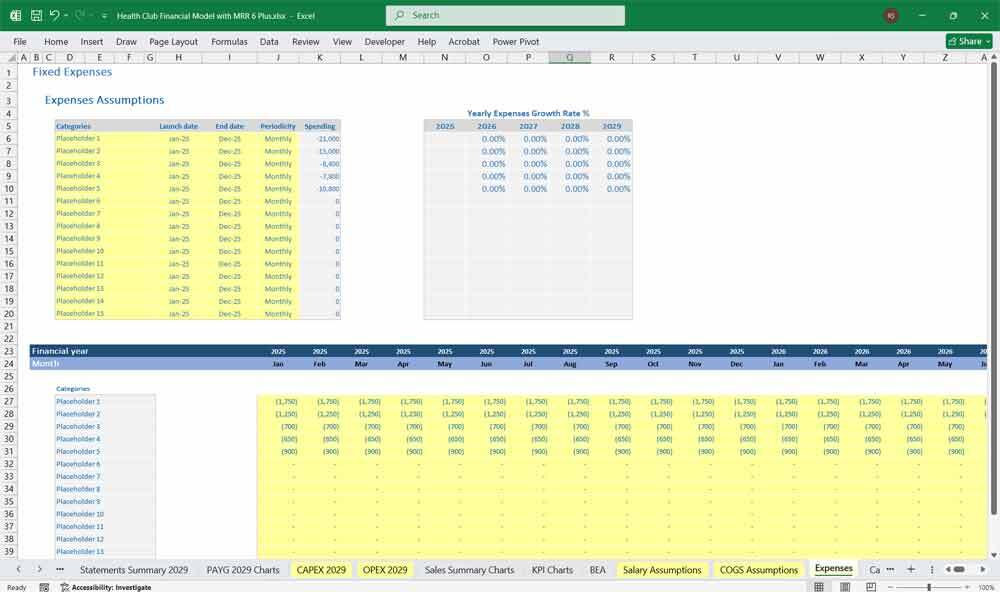
- Rent/Lease: Cost of renting the space.
- Utilities: Electricity, water, heating, and air conditioning costs.
- Insurance: Coverage for liability, property, and staff.
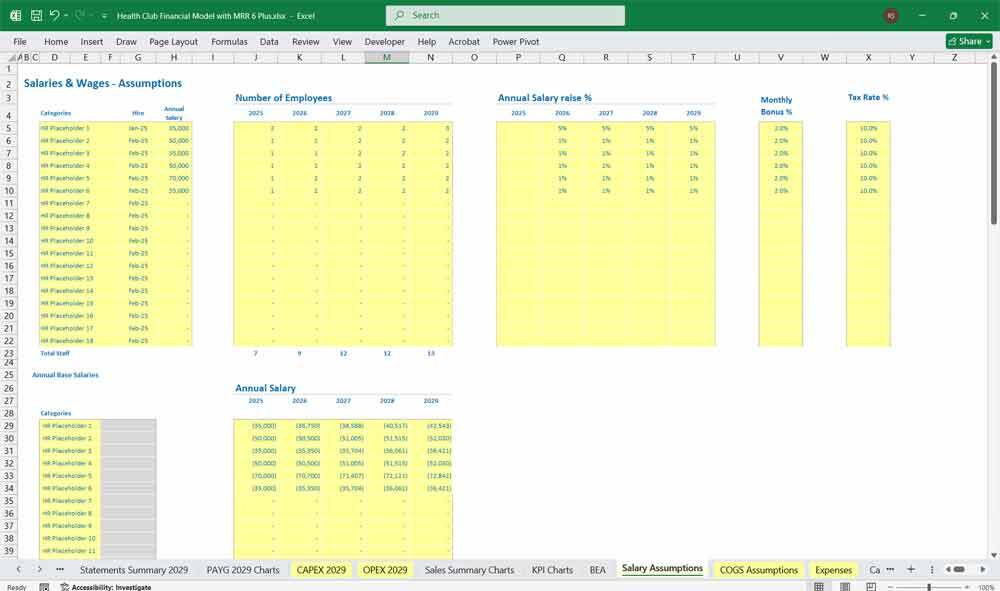
- Staff Salaries: Fixed salaries for administrative, maintenance, and management staff.
- Variable Costs:
- Trainer Payments: Commission or hourly rates for personal trainers.
- Class Instructor Payments: Payment per class or percentage of revenue.
- Marketing Costs: Advertising, social media campaigns, promotional events.
- Maintenance and Repairs: Costs for equipment repairs and facility upkeep.
- Depreciation and Amortization: Depreciation of gym equipment and amortization of intangible assets (if applicable).
- Interest Expense: Interest payments on loans or financing.
- Revenue – Total Operating Expenses – Depreciation – Interest = Net Income (Profit Before Taxes).
2. Cash Flow StatementThis section shows the inflows and outflows of cash, focusing on operational liquidity.
Operating Cash Flow:
- Cash Inflows:
- Membership fees (recurring monthly).
- Training sessions and classes.
- Merchandise and food sales.
- Advanced payments or annual memberships collected upfront.
- Cash Outflows:
- Rent, utilities, and other operating expenses.
- Staff and trainer salaries or commissions.
- Inventory purchases (merchandise, supplements).
- Marketing and advertising expenses.
- Maintenance and equipment servicing costs.
- Cash Inflows:
- Sale of old equipment.
- Divestments in underperforming assets (e.g., unused space).
- Cash Outflows:
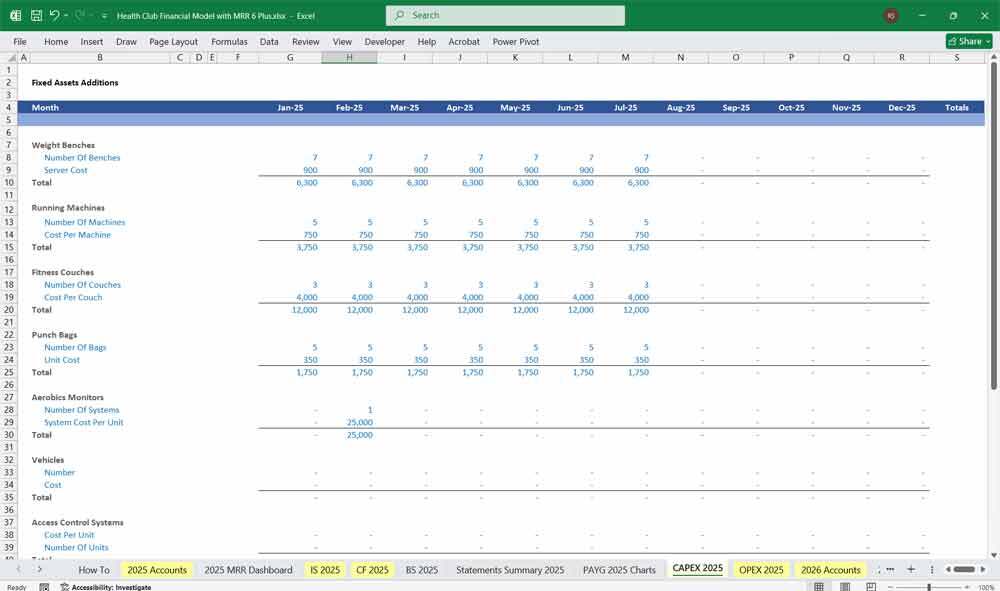
- Purchase of gym equipment, furniture, or renovations.
- Investment in software or technology (e.g., CRM or booking systems).
- Cash Inflows:
- Proceeds from loans or lines of credit.
- Equity investment from partners or investors.
- Cash Outflows:
- Loan repayments (principal and interest).
- Dividend payments to owners or shareholders.
- Sum of Operating, Investing, and Financing Cash Flows = Net Change in Cash.
3. Balance SheetThe balance sheet provides a snapshot of the financial position, showing assets, liabilities, and equity.
Assets:
- Current Assets:
- Cash and Cash Equivalents: Available liquid funds.
- Accounts Receivable: Pending payments (e.g., unpaid membership fees).
- Inventory: Merchandise, supplements, and food items in stock.
- Non-Current Assets:
- Gym Equipment: Treadmills, weights, etc., listed at book value.
- Leasehold Improvements: Renovations to the rented space.
- Technology Assets: CRM software, booking systems.
- Current Liabilities:
- Accounts Payable: Unpaid invoices (e.g., vendor payments for merchandise or utilities).
- Short-Term Debt: Portion of loans due within a year.
- Deferred Revenue: Advance payments for annual memberships.
- Long-Term Liabilities:
- Loans or financing for equipment or space build-out.
- Owner’s Equity: Capital invested by owners or shareholders.
- Retained Earnings: Cumulative profits reinvested into the business.
- Assets = Liabilities + Equity.
Subscription Revenue Tracking
Focuses on tracking the recurring revenue that forms the backbone of a subscription-based business.
Monthly Recurring Revenue (MRR): Total monthly revenue generated from active subscriptions.
MRR = (Number of subscribers in each tier × Tier price).
Annual Recurring Revenue (ARR): Total expected revenue over a year from recurring subscriptions.
ARR = MRR × 12.
Metrics to Monitor
Subscriber Growth Rate:
(New Subscribers - Cancellations) / Starting Subscribers.
Churn Rate:
(Number of Cancellations / Starting Subscribers).
Lifetime Value (LTV):
Average Revenue Per User (ARPU) × Average Subscriber Lifetime.
Customer Acquisition Cost (CAC):
Total Sales & Marketing Costs / Number of New Subscribers.
LTV/CAC Ratio:
Indicates the ROI on customer acquisition.
Dashboard Components
MRR by Tier:
Breakdown of MRR across different subscription plans ().
MRR Growth:
Month-over-month MRR change percentage.
Churn Analysis:
Identify patterns or reasons for subscriber cancellations.
ARR Projections:
Forecast ARR based on historical MRR trends and growth rates.
This financial model is adaptable, and its metrics should align with the strategic goals of your Health Club, whether focused on scaling the user base, maximizing profitability, or securing investment.
Key Metrics and RatiosTo analyze the financial health of the health club, include the following metrics:
- Gross Margin: (Revenue – COGS) / Revenue.
- EBITDA Margin: Earnings Before Interest, Taxes, Depreciation, and Amortization / Revenue.
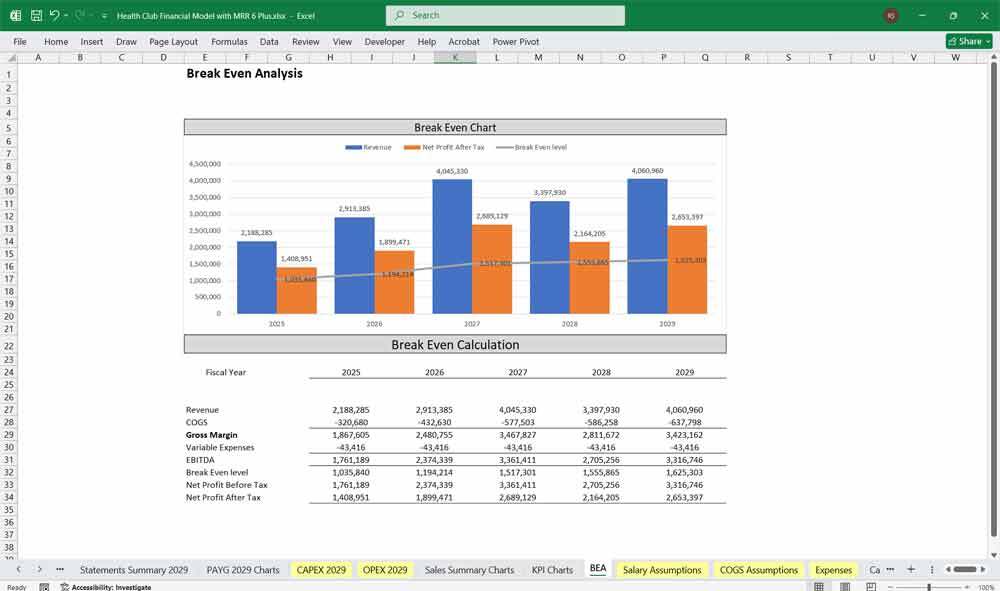
- Break-Even Analysis: Fixed Costs / (Price per Unit – Variable Cost per Unit).
- Membership Churn Rate: (Members Lost During Period / Total Members) x 100%.
- Revenue per Member: Total Revenue / Average Active Members.
This Best Practice includes
1 Health Club Financial Model in MS Excel
Further information
Provides thorough oversight, tracking, and reporting of sports club finances, including updates on budget utilisation and projections.