

Wind Ultimate Model — Build a Bankable Wind Farm Business Case in Minutes
Originally published: 16/05/2026 18:13
Publication number: ELQ-95998-1
View all versions & Certificate
certified

Wind Ultimate Model — Build a Bankable Wind Farm Business Case in Minutes

You have a wind farm to evaluate. This production-ready Excel model gives you a fully calibrated 20-year DCF across 8 countries and 3 scenarios

Description
If you develop, advise on or finance utility-scale onshore wind projects, you know the problem: every new deal means rebuilding the same financial model — recalibrating CAPEX, hunting for market prices, reworking the debt schedule, justifying your methodology to a lender or technical advisor. It takes days. Sometimes weeks. And one wrong formula in the revenue engine can invalidate the whole analysis.

This model eliminates that problem.
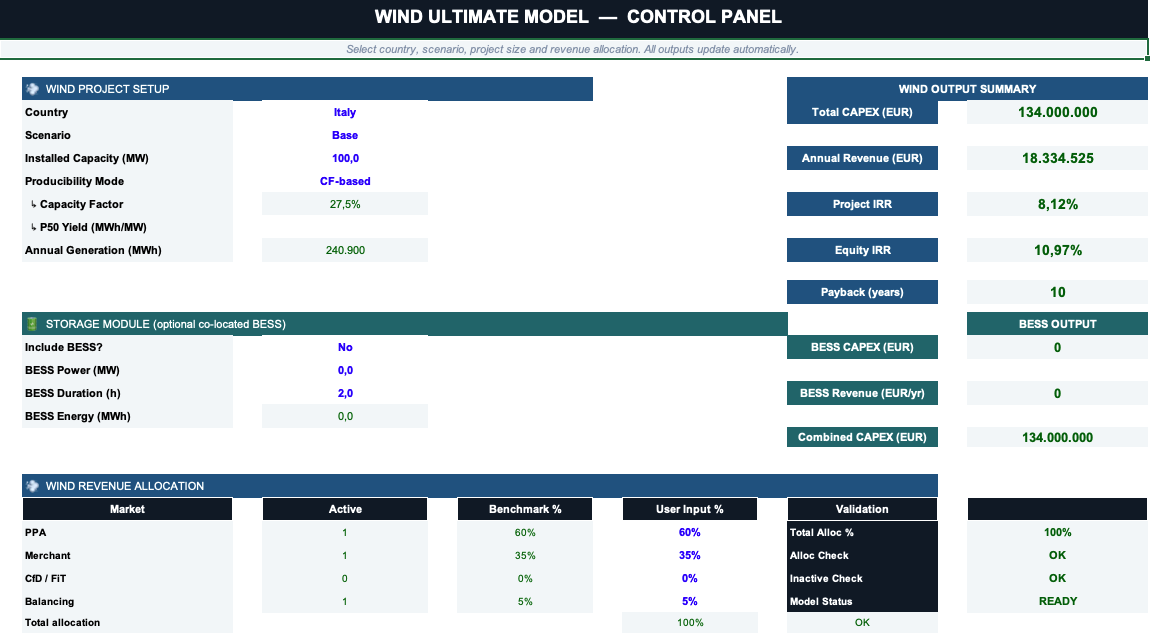
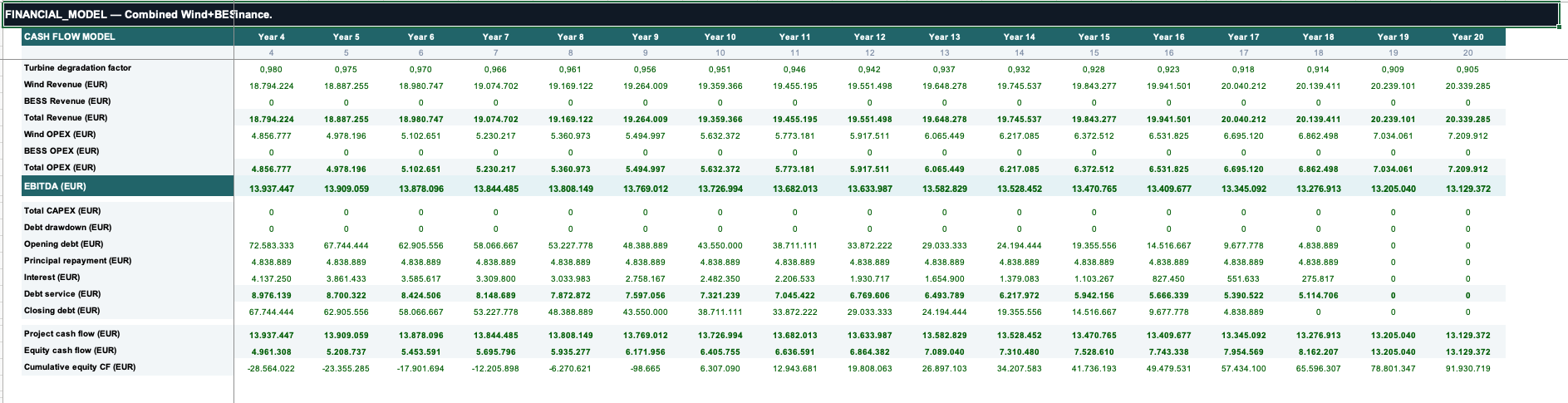
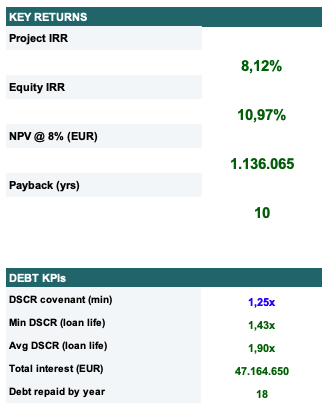
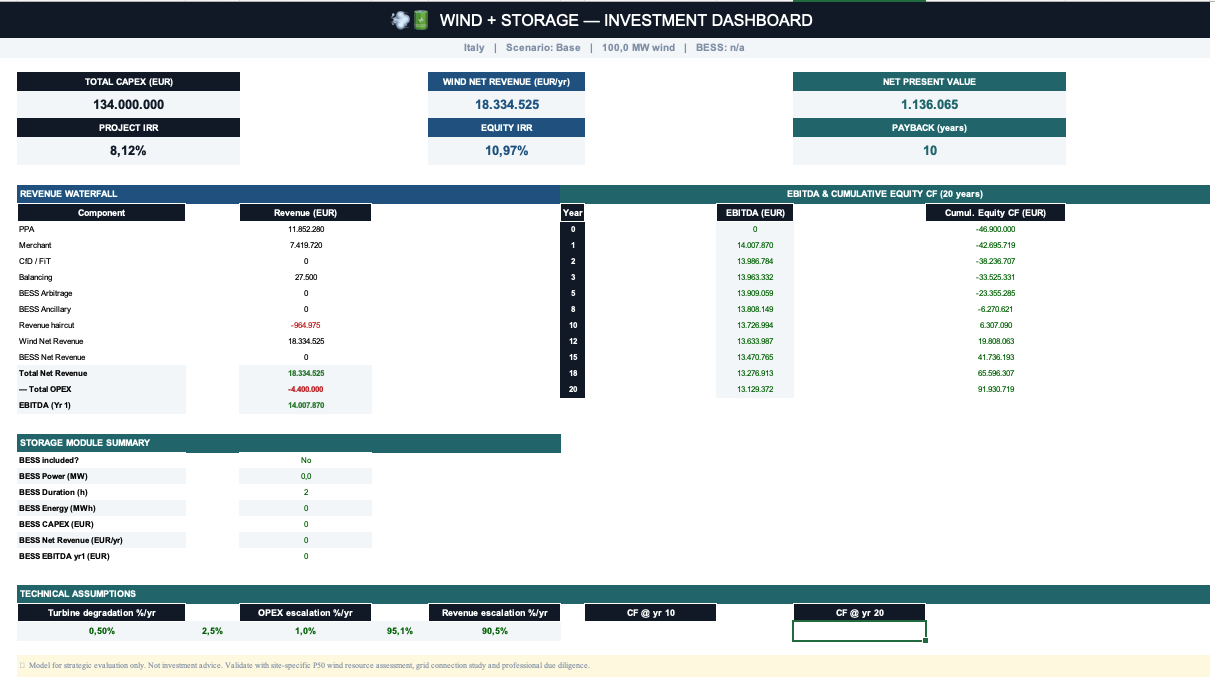
Select your country and scenario, enter your installed capacity and revenue allocation — and every output updates automatically. Project IRR, Equity IRR, NPV, payback. A full 20-year cash flow with turbine degradation at 0.5%/yr, OPEX escalation and a complete debt schedule. Ready to present, ready to share, ready to defend.


What makes it different from a generic DCF template
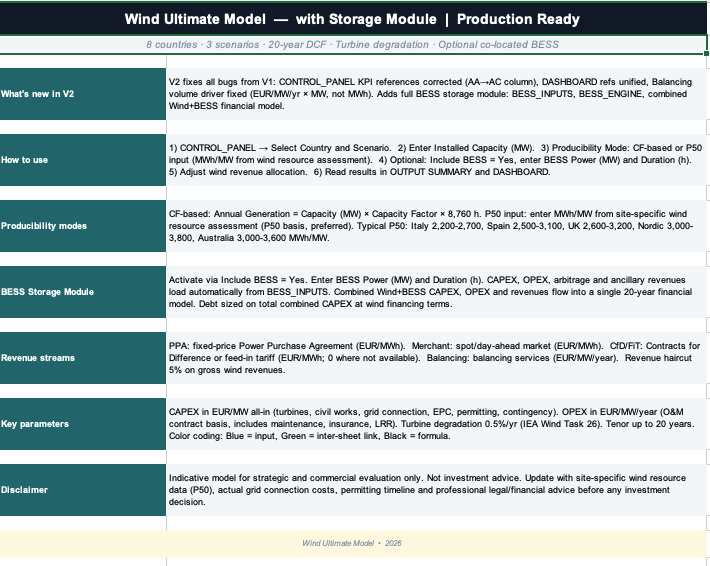
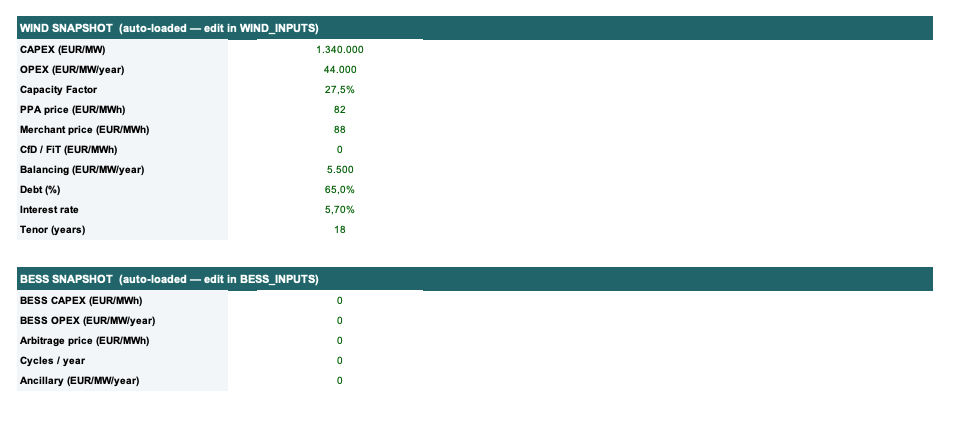
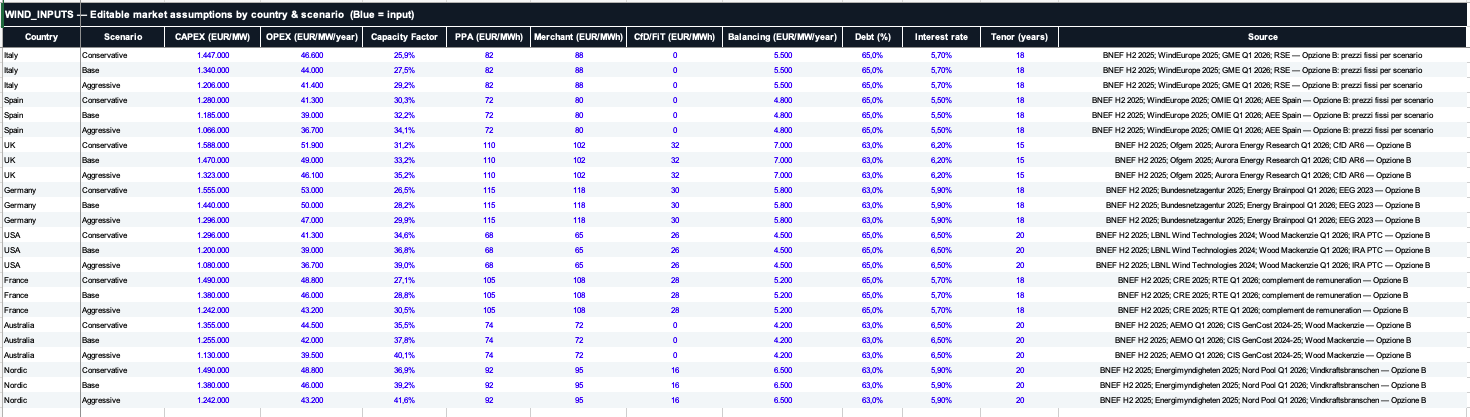
The assumptions are already calibrated for your market. 8 countries — Italy, Spain, UK, Germany, USA, France, Australia and Nordic — each with Conservative, Base and Aggressive scenarios built from BNEF H2 2025, WindEurope 2025, Aurora Energy Research, Wood Mackenzie and national regulatory sources. You are not starting from a blank sheet and guessing at capacity factors. Typical P50 ranges by country are provided in the model so you can immediately sense-check your site data against market benchmarks.
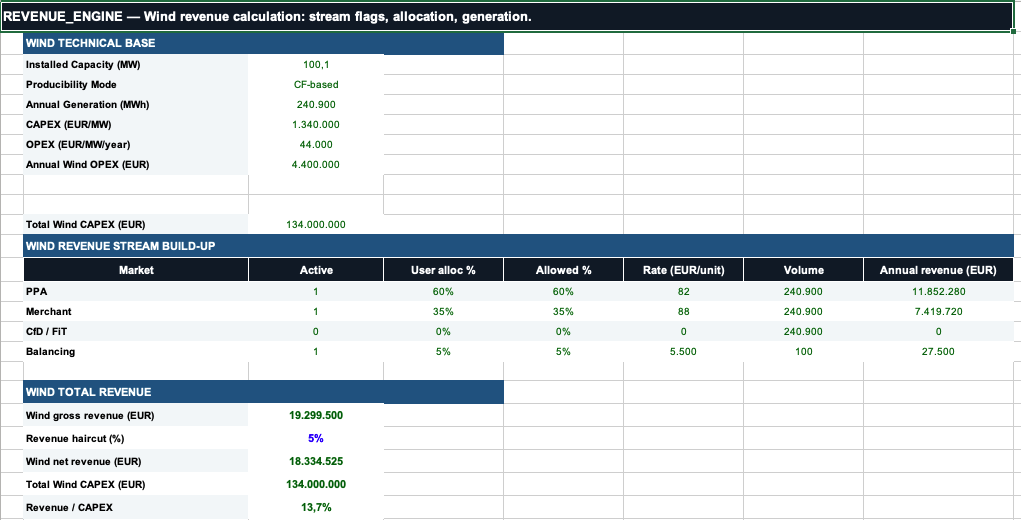
The revenue engine reflects how wind projects actually get financed. Four configurable streams — PPA, Merchant, CfD/FiT and Balancing — with country-specific market configurations pre-loaded. CfD and FiT streams are active only where the relevant mechanism exists in reality: the UK has CfD AR6, Germany has EEG, Italy and Spain are merchant-dominant. Benchmark allocations are pre-loaded and fully user-overridable. A 5% revenue haircut is applied to gross revenues to account for availability losses and curtailment.
Two producibility modes are available. If you have a P50 wind resource assessment, feed it in directly in MWh/MW. If you are at screening stage, the CF-based mode gives you a calibrated market estimate immediately.
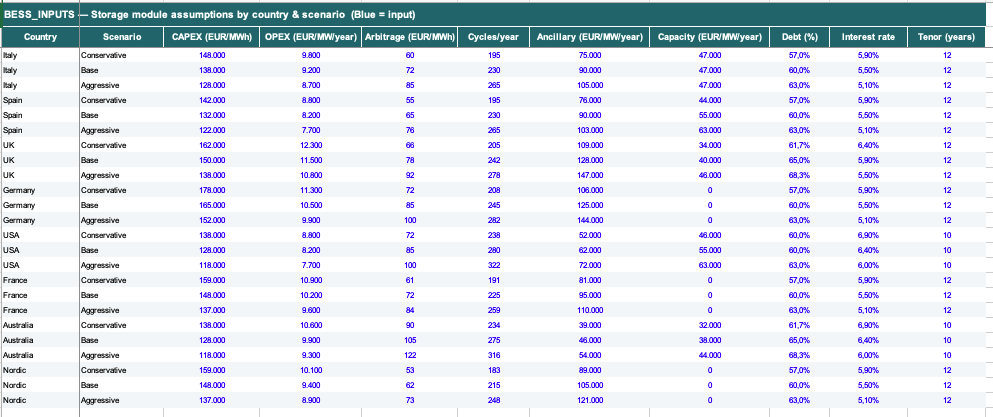
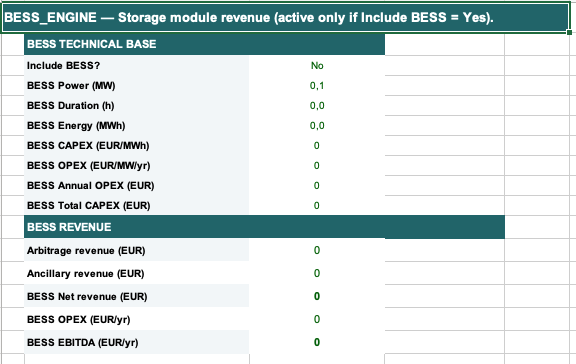
The optional BESS module lets you evaluate co-located battery storage with a single toggle. BESS CAPEX, OPEX, arbitrage and ancillary revenues load automatically by country and scenario, giving you a fully integrated Wind+BESS financial picture without building a second model.


Who this is for
Developers running early-stage feasibility on new markets or project sizes. Financial advisors preparing investment memoranda or lender presentations. M&A teams running quick-turn valuations on wind assets. Anyone who needs a defensible, auditable number fast.


Workbook: CONTROL_PANEL · WIND_INPUTS · BESS_INPUTS · WIND_CONFIGURATION · REVENUE_ENGINE · BESS_ENGINE · FINANCIAL_MODEL · DASHBOARD.


For custom versions, country extensions or specific requests, contact us at [email protected]

This Best Practice includes
1 Excel Model, 1 PDF Guide

Acquire business license for $161.00

Add to cart

Add to bookmarks

Discuss

Further information

This model enables developers, advisors and investors to evaluate the financial viability of a utility-scale onshore wind project across 8 international markets without building a model from scratch. It supports scenario comparison across Conservative, Base and Aggressive assumptions with a single selector, assesses the incremental value of adding co-located BESS storage, and produces Project IRR, Equity IRR, NPV and payback from a fully integrated 20-year cash flow with turbine degradation. It supports two producibility approaches — Capacity Factor-based estimation and P50 direct input from a wind resource assessment — and enables analysis of revenue stream composition across PPA, Merchant, CfD/FiT and Balancing streams with country-specific market configurations and full user override capability.

This model is best suited to utility-scale onshore wind greenfield projects in the 10–500 MW range at early-stage feasibility or commercial evaluation, prior to full technical due diligence. It is calibrated for Italy, Spain, UK, Germany, USA, France, Australia and Nordic markets, and works particularly well when a P50 wind resource assessment is available to feed directly into the producibility module. It is also well suited to projects considering co-located BESS as an option to be evaluated incrementally, and to advisory, M&A and financing contexts where a clean, auditable Excel model is required.

This model is designed for onshore wind only and is not suited to offshore wind, which has materially different CAPEX structures, vessel-based O&M logistics and financing terms — for that use case, the Offshore Wind Ultimate Model is the right tool. It does not cover distributed or small-scale wind installations where behind-the-meter logic applies. It is not suited to markets outside the 8 pre-loaded countries without manual customization of the assumption sets. It should not be used as the sole basis for a final investment decision — it is an indicative tool and must be supplemented with site-specific wind resource data from a bankable P50 study, actual grid connection and permitting costs, and professional legal, financial and technical advice. It is also not appropriate for BESS configurations that charge from the grid rather than from the co-located wind plant.


0.0 / 5 (0 votes)

please wait...