


13-Week Cash Flow & Liquidity Forecast Excel | Treasury Pro, Revolving Credit, Stress Testing & Actual vs Forecast

💰13-week cash flow Excel model with revolving credit, liquidity stress tests, actual-vs-forecast tracking, 8 charts and a 27-page PDF guide.

Description
💰 TREASURY PRO v2.4 – 13-WEEK CASH FLOW & LIQUIDITY CONTROL


Forecast Cash. Protect Liquidity. Manage Credit. Track Actuals.
Bring clarity, control and structure to your company's short-term cash management with Treasury Pro by SheetworksStudio.


This advanced Excel treasury model connects weekly customer receipts, supplier payments, payroll, taxes, operating costs, capital expenditure, cleared bank transactions and revolving credit financing into one comprehensive liquidity forecasting system.


Designed for CFOs, treasury teams, controllers, finance managers, business owners, FP&A professionals and financial consultants.


✨ KEY HIGHLIGHTS
📊 13-Week Direct-Method Cash Forecast
💳 Receivables, Payables and Payment Schedules
🏦 Revolving Credit Facility Planning
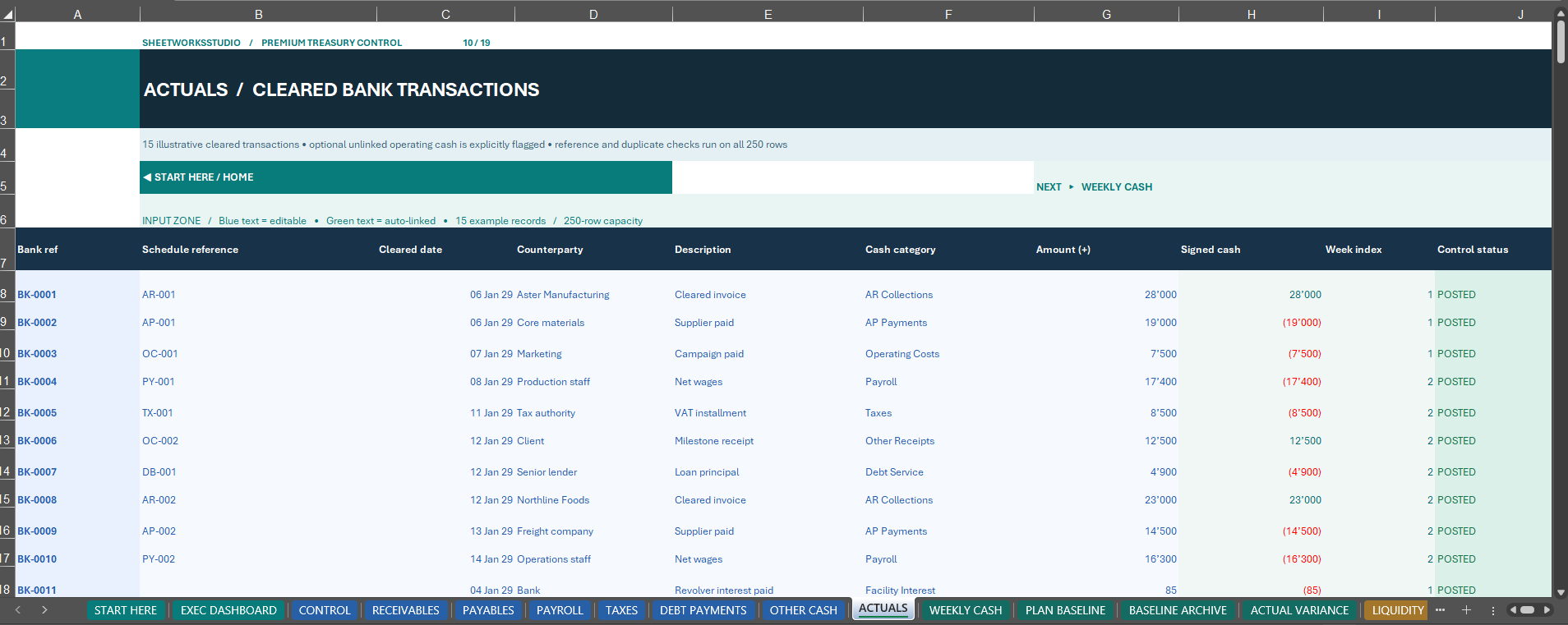
✅ Cleared Bank Actuals Tracking
🔄 Base, Upside and Downside Scenarios
🌡️ Dedicated Liquidity Stress Testing
📋 Manual Forecast Baseline Archive
↔️ Actual vs Forecast Variance Analysis
📅 Directional 52-Week Liquidity Outlook
📈 8 Native Executive Dashboard Charts
🛡️ Financial Reconciliation and Data Quality Controls
📘 Comprehensive 27-Page English Operations Guide


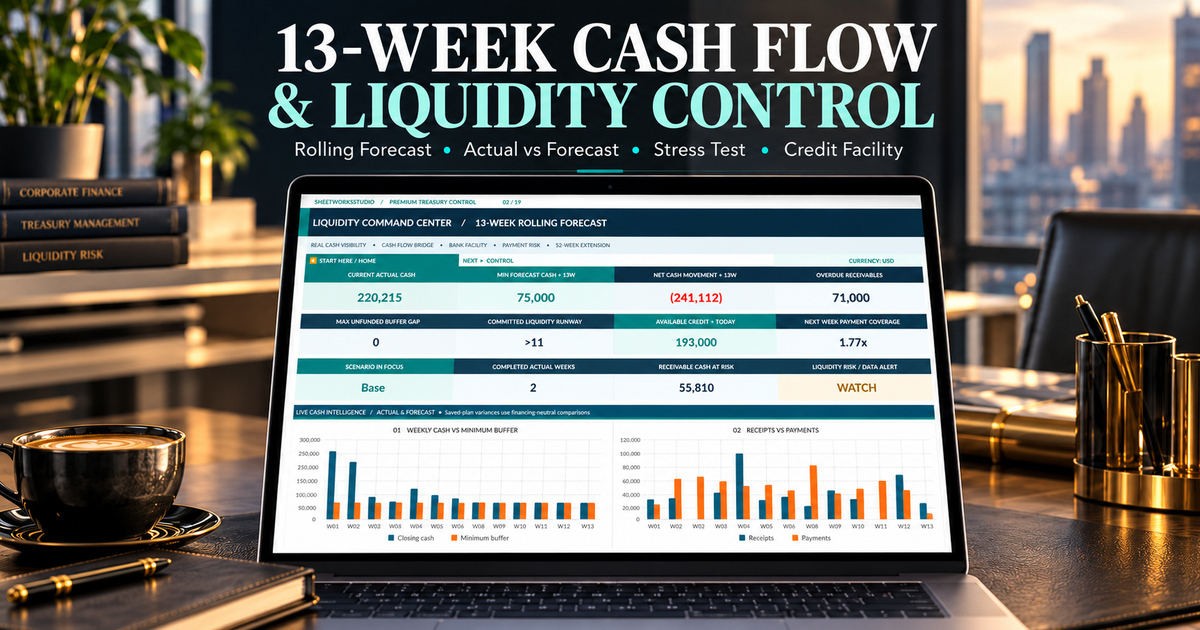
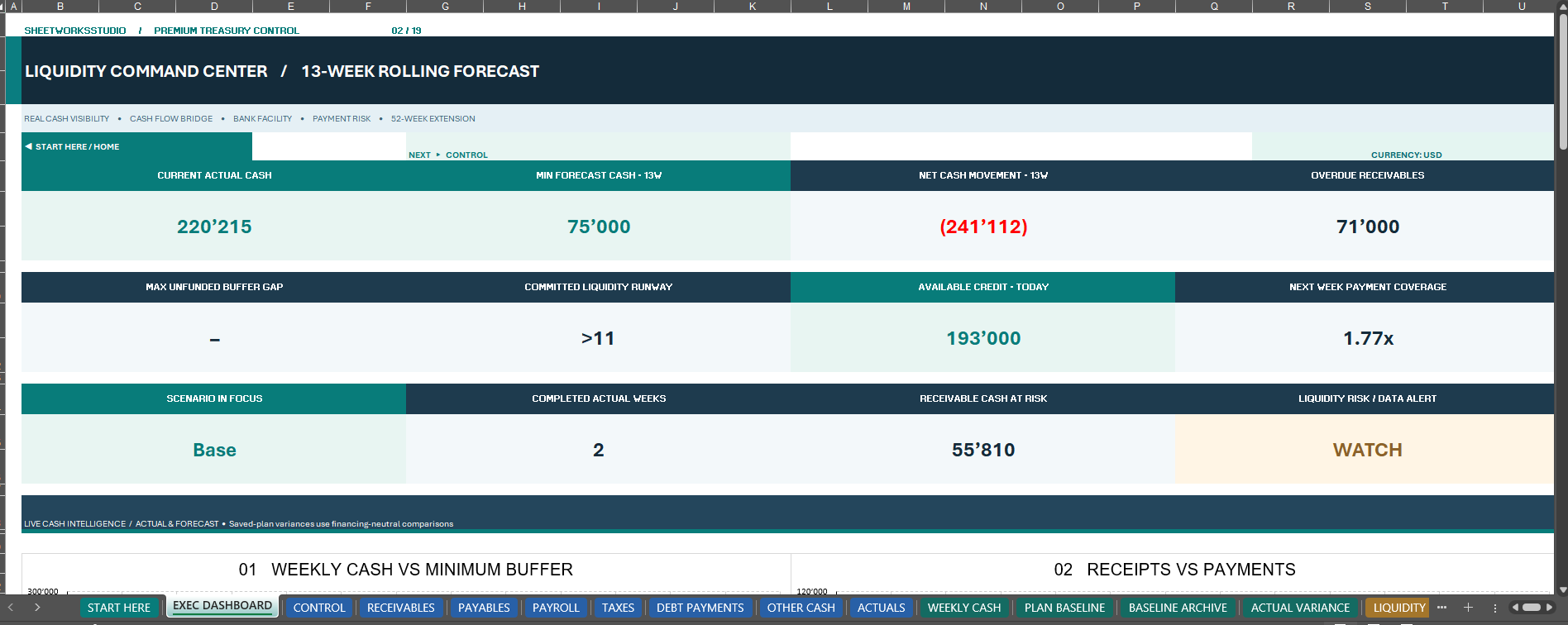
📊 01 | EXECUTIVE LIQUIDITY DASHBOARD
Monitor the most important short-term cash and funding indicators.
The executive dashboard includes:
  • Actual Unrestricted Cash
  • Minimum Forecast Cash
  • 13-Week Net Cash Movement
  • Overdue Receivables
  • Maximum Unfunded Cash Buffer Gap
  • Committed Liquidity Runway
  • Available Credit Facility Headroom
  • Next-Week Payment Coverage
  • Receivable Cash at Risk
  • Scenario and Liquidity Warning Indicators
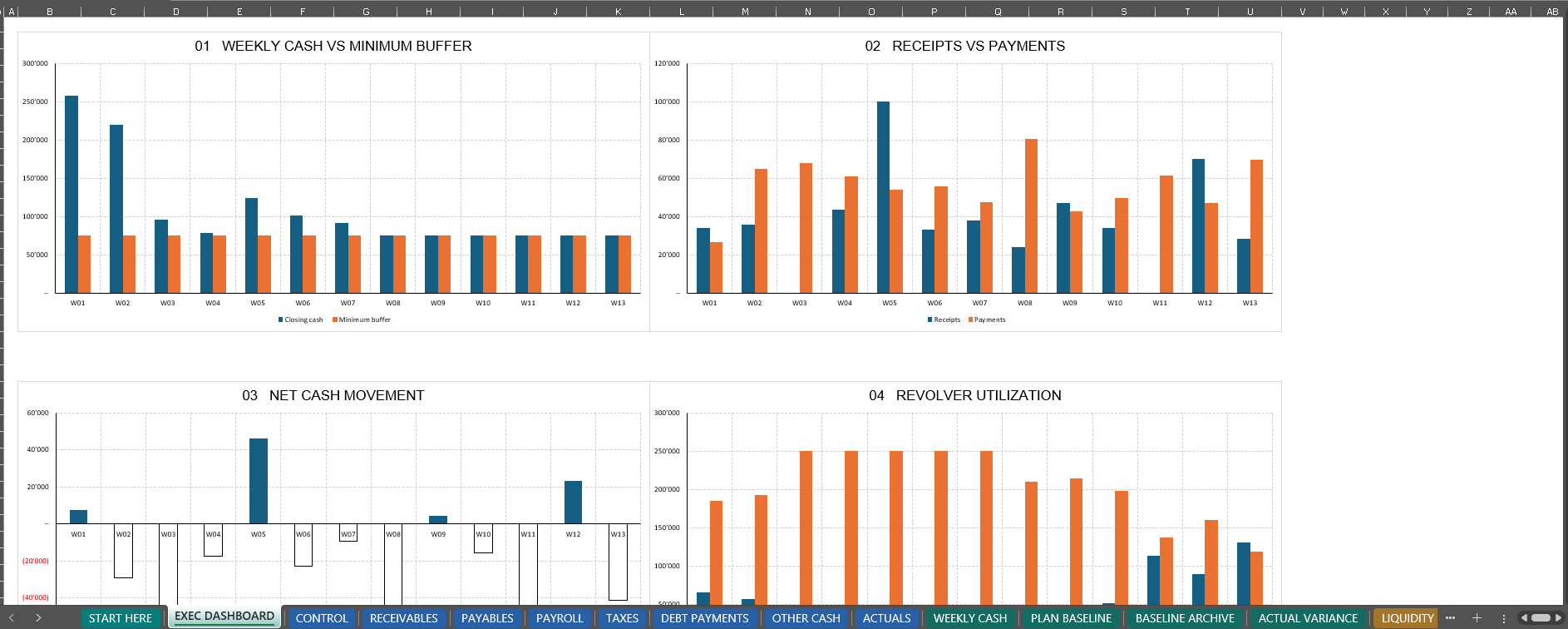
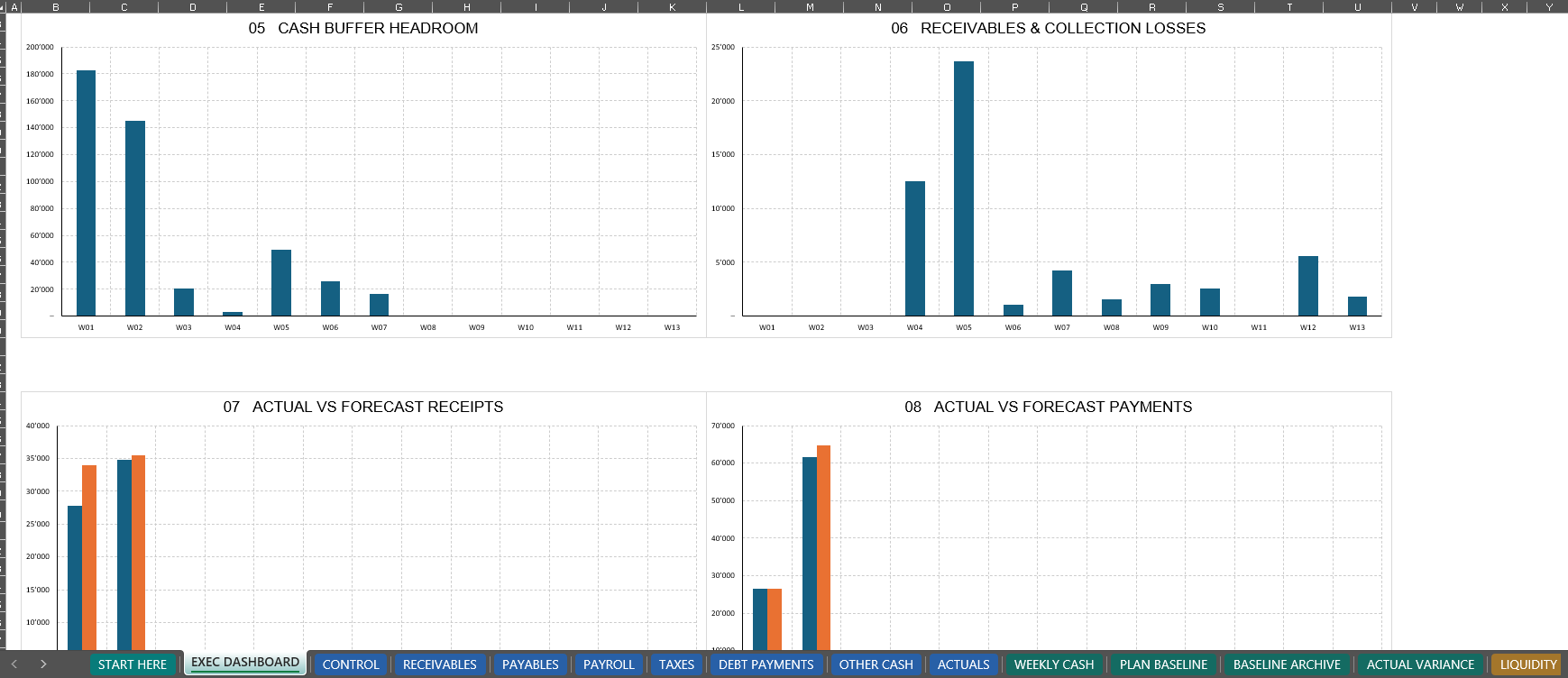
  • Eight Linked Excel Charts
Business Value: Understand short-term liquidity pressure, funding availability and cash flow performance from one central reporting view.


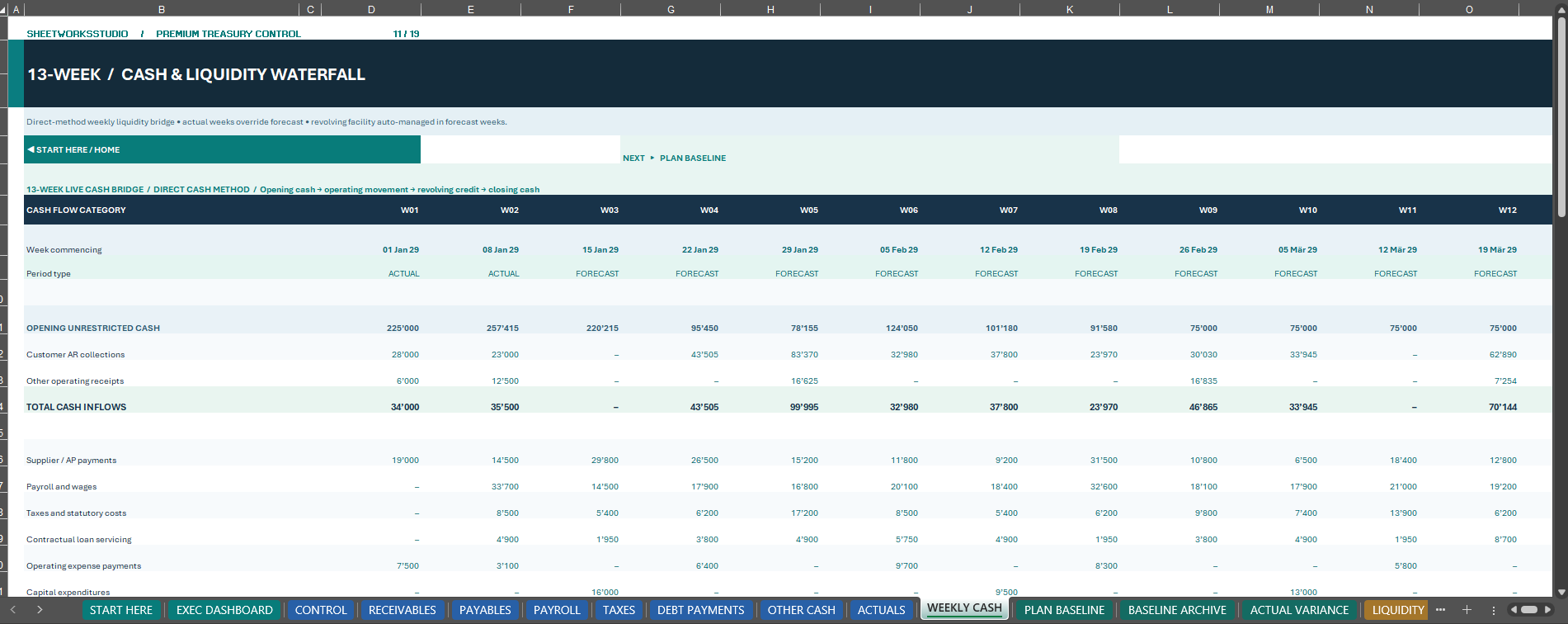
💰 02 | DIRECT-METHOD 13-WEEK CASH FORECAST
Build a weekly view of incoming and outgoing cash using actual transaction schedules.
The forecast consolidates:
✅ Customer Receipts
✅ Other Cash Collections
✅ Supplier Disbursements
✅ Payroll Payments
✅ Taxes and Statutory Costs
✅ Debt Service
✅ Operating Expenditure
✅ Capital Expenditure
✅ Revolving Credit Movements
✅ Weekly Opening and Closing Cash
Completed weeks use recorded bank actuals. Future weeks use the remaining transaction schedules and selected scenario assumptions.
Business Value: Identify expected cash shortfalls and near-term payment requirements before they arise.


💳 03 | RECEIVABLES AND PAYABLES CONTROL
Maintain detailed customer collection and supplier payment schedules.
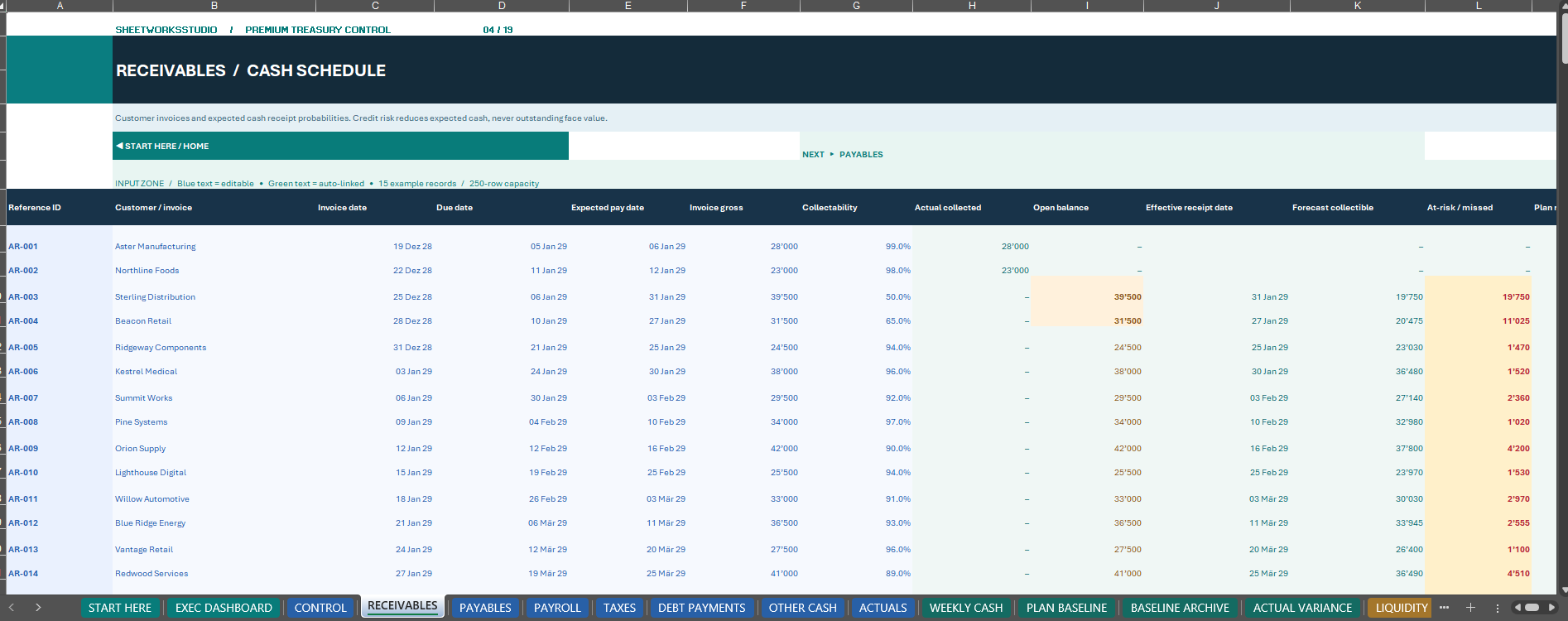
Accounts Receivable
  • Customer and Invoice References
  • Original Invoice Amounts
  • Invoice and Due Dates
  • Expected Collection Dates
  • Collection Probability Assumptions
  • Outstanding Balances
  • Expected Cash Collections
  • Overdue Amounts
  • Collection Risk Indicators
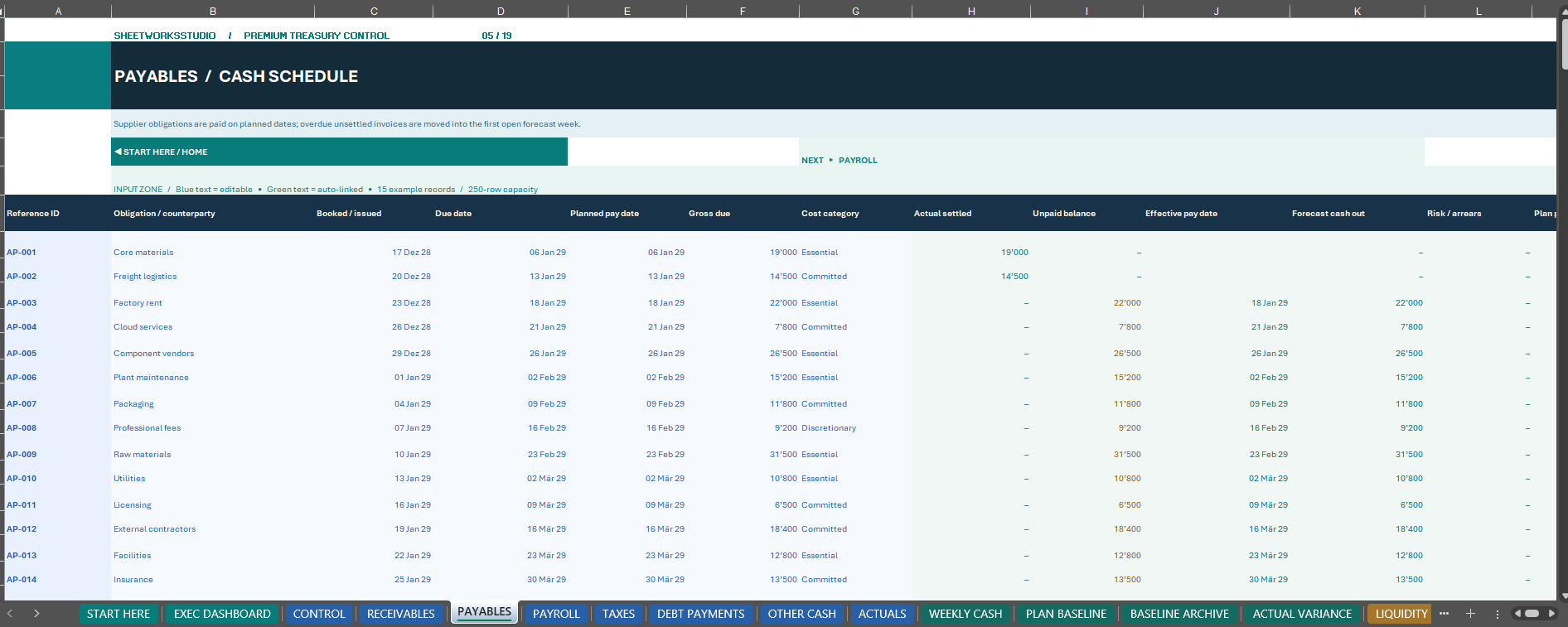
Accounts Payable
  • Supplier and Payment References
  • Scheduled Payment Dates
  • Outstanding Obligations
  • Settlement Tracking
  • Payment Timing Assumptions
  • Supplier Arrears Indicators
Additional schedules support payroll, taxes, debt repayments and other operating cash movements.
Business Value: Connect operational obligations and collections to weekly cash forecasting.


🏦 04 | REVOLVING CREDIT FACILITY MANAGEMENT
Integrate liquidity planning with a revolving credit facility.
The model includes:
  • Committed Facility Limit
  • Opening Borrowing Balance
  • Weekly Facility Drawdowns
  • Scheduled Repayments
  • Outstanding Credit Balances
  • Facility Headroom
  • Interest Calculations
  • Financing-Related Cash Movements
Borrowing activity is distinguished from operating cash generation.
Business Value: Review potential funding needs and the effect of credit facility usage on available liquidity.


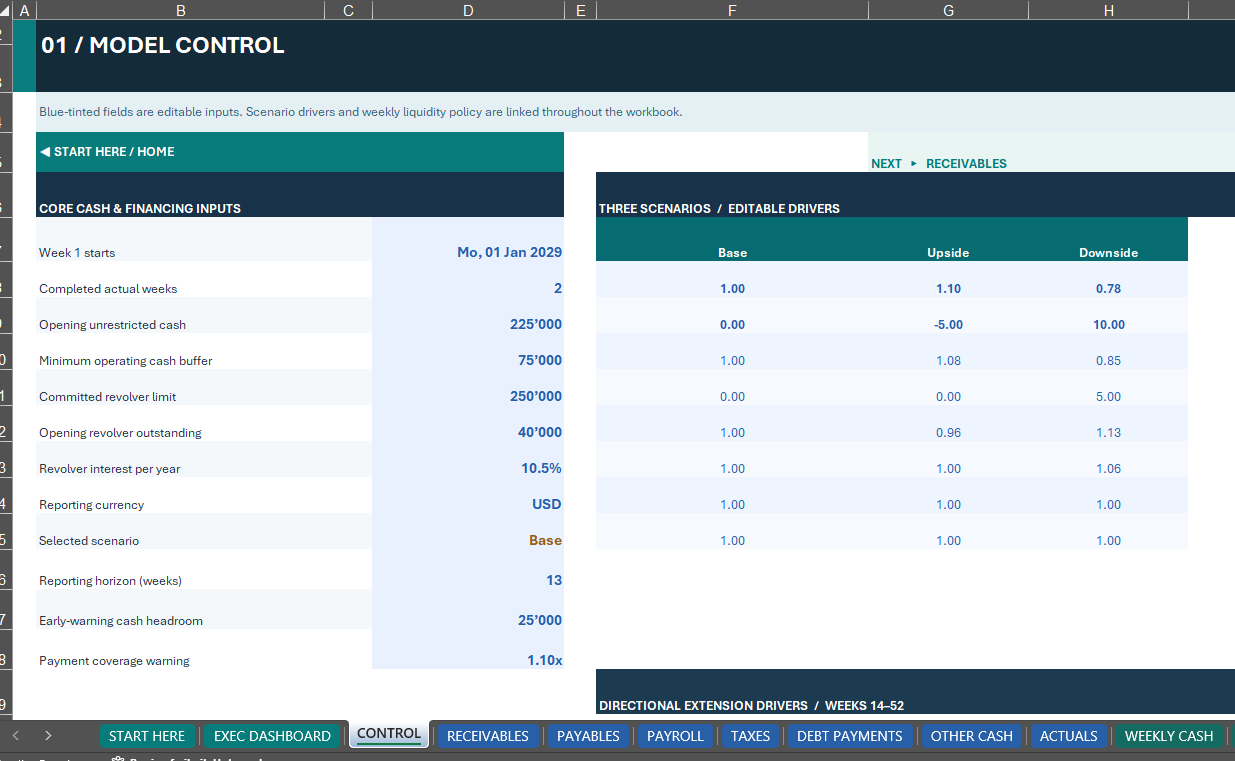
🔄 05 | BASE, UPSIDE AND DOWNSIDE SCENARIOS
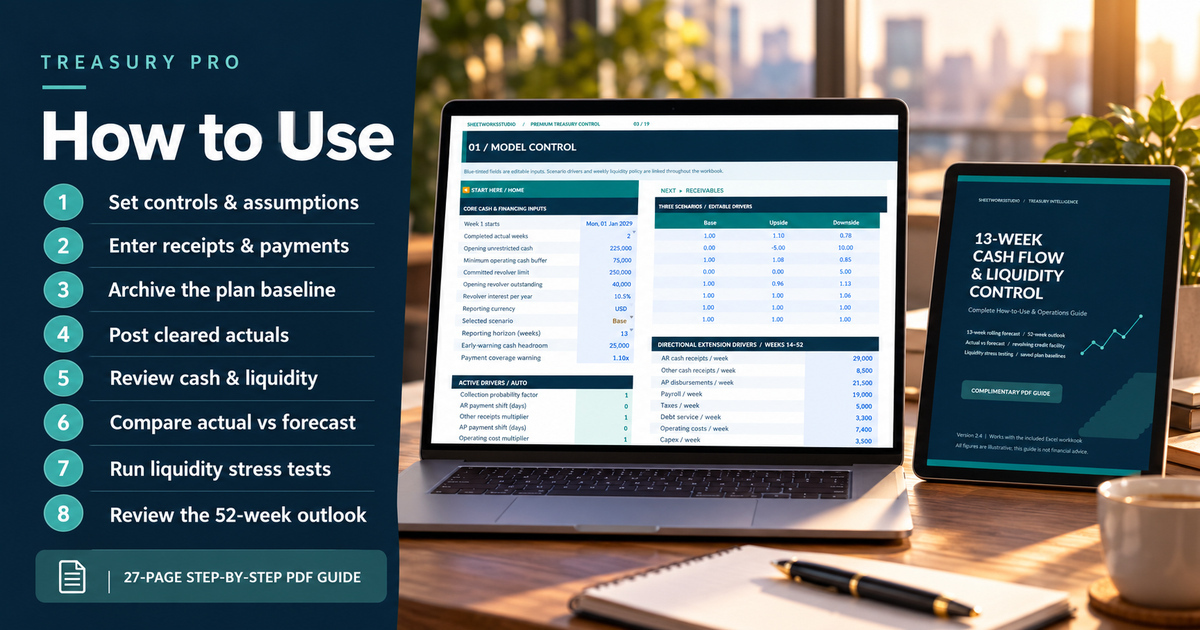
Select one of three operating scenarios through the CONTROL worksheet.
BASE – Your central operating assumptions.
UPSIDE – More favorable cash collection and selected payment assumptions.
DOWNSIDE – Weaker collections, timing delays and higher selected costs.
Scenario drivers include:
  • Collection Probability Adjustments
  • Receivable Timing Shifts
  • Other Receipt Multipliers
  • Supplier Payment Timing
  • Operating Cost Multipliers
  • Payroll and Tax Assumptions
  • Debt Service Assumptions
Business Value: Compare how changes in operational conditions affect future weekly liquidity.


🌡️ 06 | DEDICATED LIQUIDITY STRESS TEST
Apply additional downside assumptions without changing the core planning framework.
Stress inputs include:
  • Customer Collection Haircuts
  • Collection Delays
  • Increased Cash Expenses
  • Stressed Receipts and Payments
  • Revised Credit Facility Drawdowns
  • Remaining Available Credit
  • Cash Buffer Shortfalls
  • Stressed Weekly Closing Cash
Completed actual weeks remain historical.
Business Value: Examine possible funding pressures under more adverse cash collection and spending conditions.
The stress engine provides directional analysis and does not fully iteratively reprice interest arising from additional stressed borrowing.


📋 07 | FORECAST BASELINES AND ACTUAL-VS-PLAN ANALYSIS
Improve forecasting discipline by retaining a copy of the original plan.
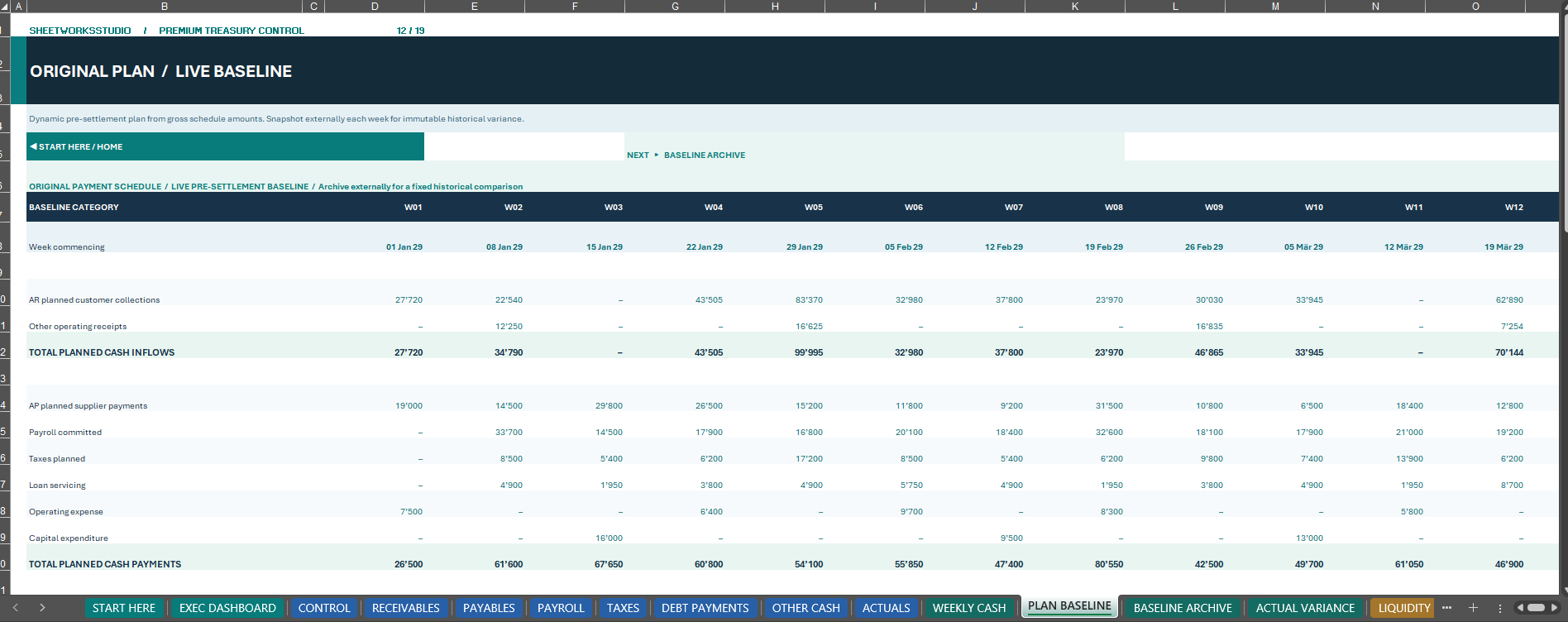
PLAN BASELINE
Review the current planned cash receipts and payments.
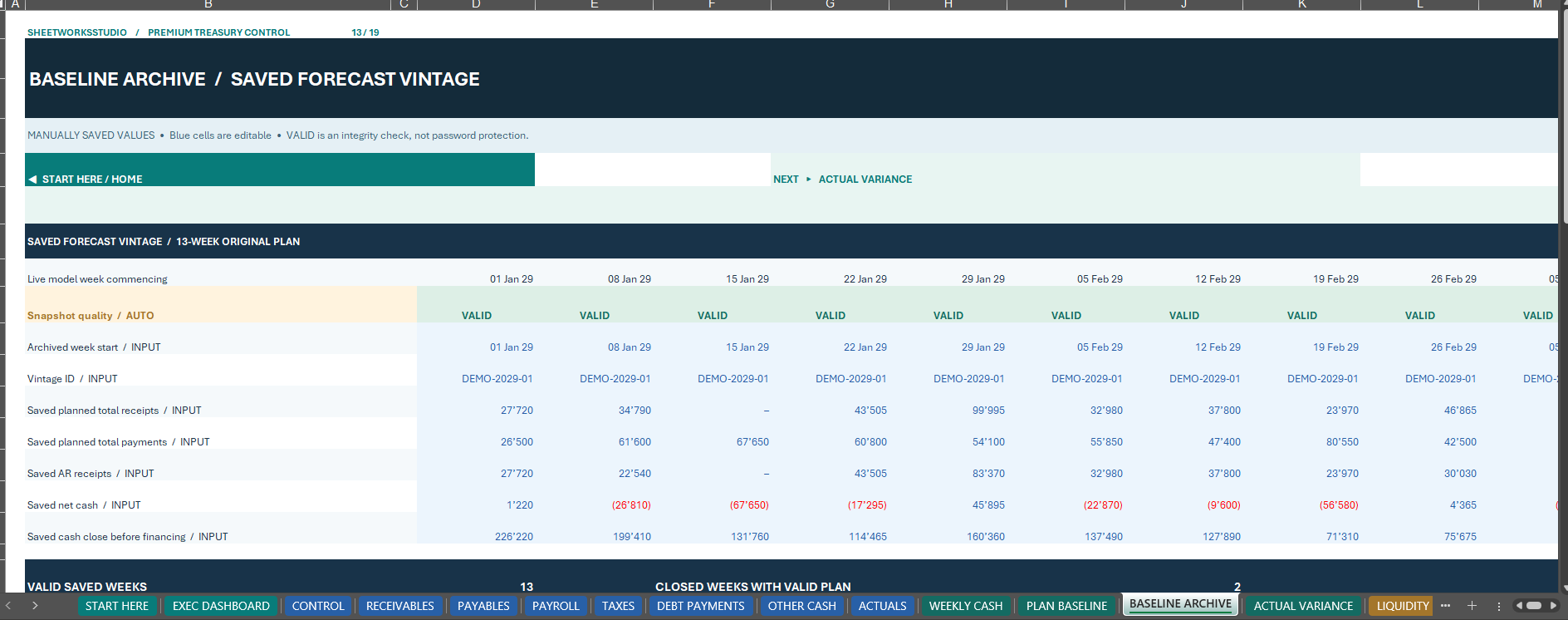
BASELINE ARCHIVE
Manually preserve a forecast snapshot using Paste Special → Values.
The archive checks saved dates, snapshot completeness and vintage identification.
ACTUAL VARIANCE
Compare completed actual weeks with valid archived forecasts.
Analyze:
  • Actual Receipts
  • Actual Payments
  • Actual Net Operating Cash
  • Original Planned Operating Cash
  • Weekly Cash Variances
  • Cumulative Variances
  • Receivable Collection Variances
  • Bank Cash Reconciliation
The comparison is financing-neutral to help separate operating performance from credit facility movements.
Business Value: Understand why actual cash flow differs from the originally approved forecast.
Historical snapshots are maintained manually. They are not automatically captured.


📅 08 | DIRECTIONAL 52-WEEK LIQUIDITY OUTLOOK
Extend planning beyond the detailed 13-week window.
Weeks 1–13: Linked to the detailed treasury forecast.
Weeks 14–52: Driven by configurable weekly run-rate assumptions.
Available outputs include:
  • Cash Receipts
  • Cash Payments
  • Net Cash Movement
  • Credit Facility Activity
  • Outstanding Borrowing
  • Available Facility Headroom
  • Weekly Closing Cash
  • Minimum Cash Buffer Shortfalls
  • Potential Funding Requirements
Business Value: Review medium-term liquidity direction and emerging financing requirements.
This extension is based on simplified assumptions and is not a transaction-level 52-week forecast.


🛡️ 09 | FINANCIAL CONTROLS AND MODEL CHECKS
Review financial reconciliations and input quality through the MODEL CHECKS worksheet.
Control areas include:
✅ Weekly Cash Flow Bridges
✅ Opening and Closing Cash Continuity
✅ Credit Facility Roll-Forwards
✅ Borrowing Limit Checks
✅ Actual Bank Transaction Validation
✅ Duplicate Transaction References
✅ Invalid Schedule Identifiers
✅ Excessive Invoice Collections
✅ Supplier Payment Over-Settlements
✅ Scenario Validation
✅ Baseline Snapshot Validation
✅ Actual-versus-Plan Reconciliation
✅ 52-Week Extension Consistency
The model also provides warning indicators for liquidity shortfalls, overdue receivables and supplier obligations.
A technical PASS indicates that the relevant numerical check meets its defined conditions. It does not guarantee adequate liquidity or financing availability.


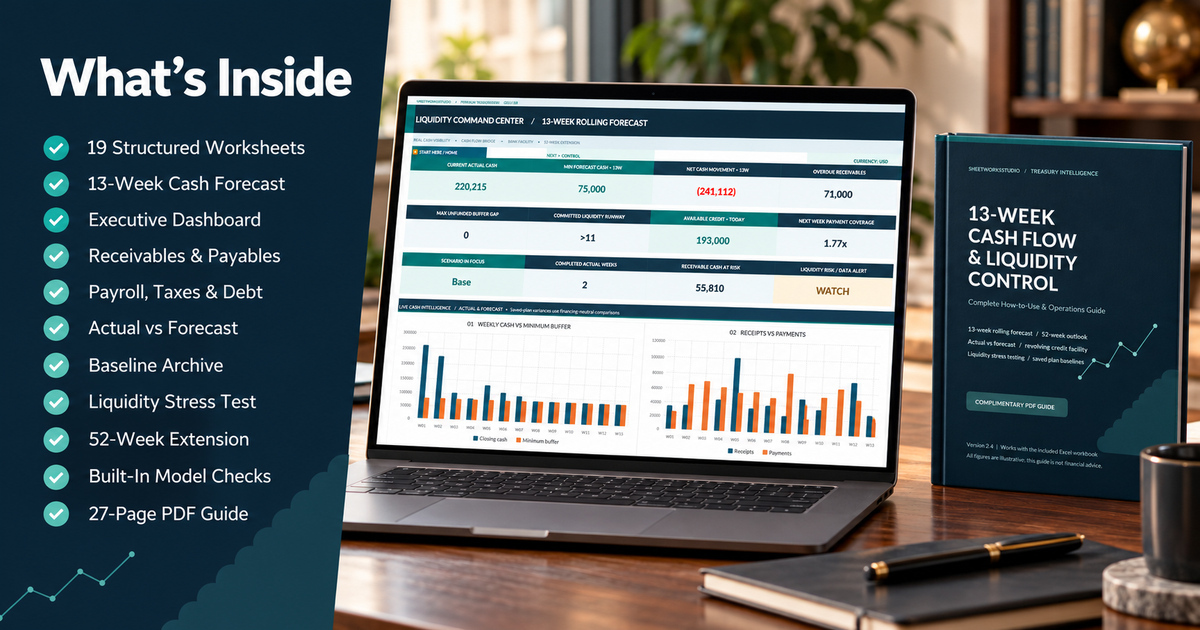
📦 WHAT YOU RECEIVE
📊 1 Complete Treasury Pro Excel Workbook
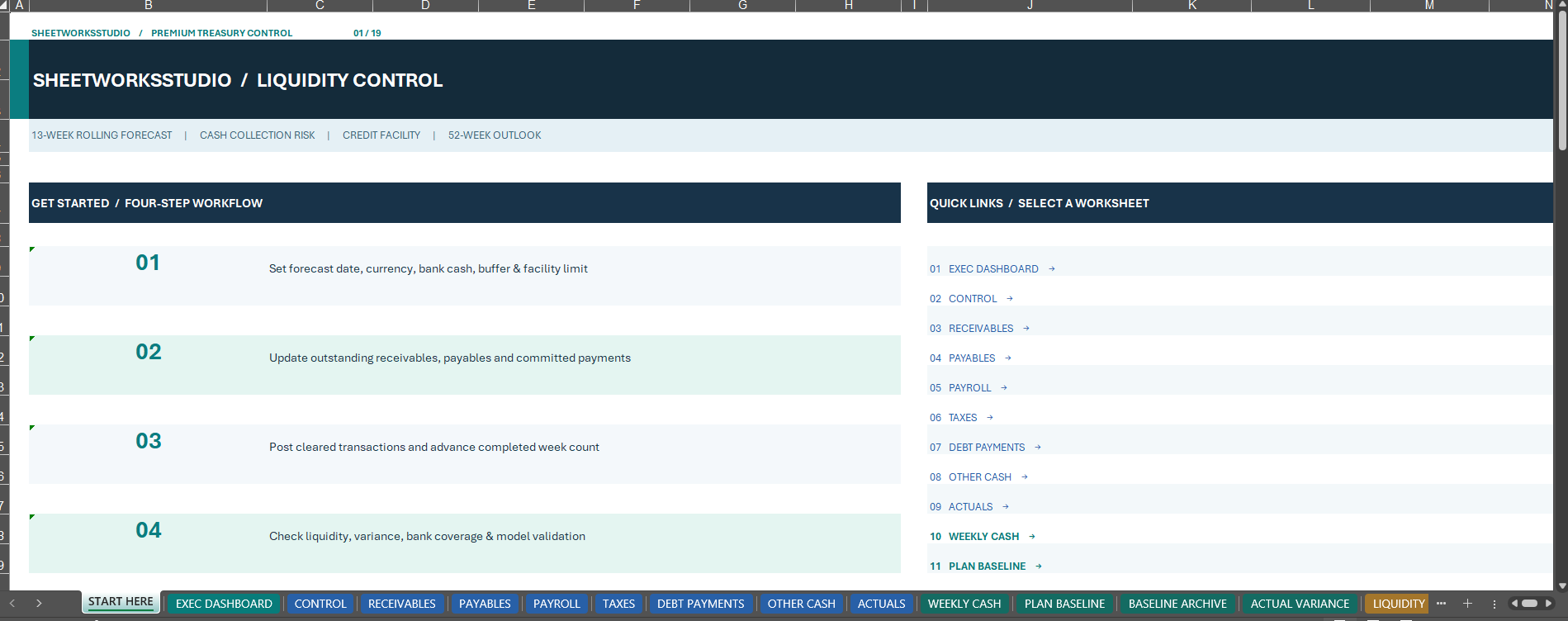
  • 19 Structured Worksheets
  • 13-Week Cash Flow Forecast
  • Receivables and Payables Registers
  • Payroll, Tax and Debt Payment Schedules
  • Cleared Bank Actuals
  • Revolving Credit Facility Planning
  • Three Operating Scenarios
  • Dedicated Liquidity Stress Test
  • Live Plan Baseline
  • Manual Baseline Archive
  • Actual-Vs-Forecast Variance Analysis
  • Directional 52-Week Outlook
  • Eight Native Dashboard Charts
  • Model Integrity Controls
  • Built-In Workbook Instructions
📘 1 Comprehensive PDF Operations Guide
  • 27 English-Language Pages
  • Setup and Navigation
  • Weekly Cash Forecasting Methodology
  • Transaction Scheduling
  • Credit Facility Management
  • Actuals Recording
  • Baseline Archiving
  • Variance Analysis
  • Stress Testing
  • Weekly Treasury Workflow
  • Troubleshooting and Limitations
Both files are included in one downloadable ZIP package.


🎯 PERFECT FOR
💼 Chief Financial Officers
🏦 Treasury Professionals
📊 Financial Controllers
💰 Finance Managers
🏢 Business Owners
📈 FP&A Teams
🔄 Turnaround and Restructuring Professionals
🧮 Cash Flow Consultants
📋 Working Capital Managers
🎓 Advanced Finance Students


💻 TECHNICAL SPECIFICATIONS
✅ Microsoft Excel XLSX
✅ Microsoft Excel Desktop Recommended
✅ Editable Financial Inputs
✅ Formula-Driven Forecasting
✅ No VBA Macros
✅ No Required External Data Connections
✅ No Subscription Required
✅ Separate 27-Page PDF Manual
Google Sheets compatibility has not been independently verified.


⚖️ IMPORTANT INFORMATION
This template is intended for financial planning, cash management analysis and educational purposes.


It is not a complete accounting system, audited financial report, bank reconciliation platform or credit approval tool.


It does not provide automatic bank feeds, foreign-exchange conversion, comprehensive lending covenant calculations or guaranteed financing access.


All sample data and financial results are fictional.


Users must validate their source information, review relevant lending agreements and consult qualified professionals before making material financial decisions.


Independent, unofficial template. No accounting, financial, legal, tax, lending or investment advice is provided.


SheetworksStudio – Calm design. Clear logic.

This Best Practice includes
FILE 1 – EXCEL TREASURY MODEL (19 WORKSHEETS), FILE 2 – PDF OPERATIONS GUIDE (27 Pages in English)

Acquire business license for $149.00

Add to cart

Add to bookmarks

Discuss

Further information

🎯 **OBJECTIVES**

✅ Build a structured 13-week direct-method cash flow forecast.

✅ Consolidate scheduled cash receipts and payments into a weekly liquidity view.

✅ Distinguish completed bank actuals from future projected cash movements.

✅ Monitor cash balances, minimum operating buffers and potential funding gaps.

✅ Evaluate revolving credit facility drawdowns, repayments and available borrowing capacity.

✅ Explore Base, Upside and Downside cash flow assumptions.

✅ Apply additional collection, timing and expense stress tests.

✅ Preserve original cash forecasts through manual baseline snapshots.

✅ Compare actual operational cash movements with archived forecasts.

✅ Extend short-term planning into a directional 52-week liquidity outlook.

✅ Support regular treasury reviews and financial decision-making with reconciliations and dashboard indicators.

👍 **CONDITIONS FOR WHICH THIS DOWNLOADABLE BEST PRACTICE APPLIES BEST**

✅ Finance teams seeking a structured weekly operating cash flow forecast.

✅ CFOs and treasury managers monitoring near-term liquidity and funding requirements.

✅ Businesses managing receivables, supplier payments, payroll and tax obligations.

✅ Companies using a revolving credit facility alongside operational cash resources.

✅ Controllers comparing cleared bank transactions with original forecast assumptions.

✅ Businesses requiring manual forecast snapshot archiving and actual-versus-plan analysis.

✅ Organizations exploring liquidity exposure under downside operating conditions.

✅ Financial consultants supporting cash planning, turnaround and working capital reviews.

✅ Spreadsheet users able to maintain transaction schedules and validate financial assumptions regularly.

👎 **CONDITIONS FOR WHICH THIS DOWNLOADABLE BEST PRACTICE DOES NOT APPLY IDEALLY**

❌ Organizations requiring real-time bank feeds or automated transaction imports.

❌ Businesses needing a complete general ledger or audited financial statements.

❌ Treasury teams requiring detailed daily intraday cash forecasts rather than weekly planning.

❌ Companies requiring comprehensive multi-currency cash management or automatic FX conversion.

❌ Borrowers requiring certified borrowing-base calculations, full covenant testing or lender-approved credit analysis.

❌ Users expecting automatically stored historical forecast snapshots.

❌ Teams requiring a fully detailed, transaction-by-transaction 52-week cash forecasting engine.

❌ Businesses requiring iterative repricing of all additional stress-driven revolving credit interest.

❌ Organizations expecting complete ERP integration, automated payment execution or multi-user approval workflows.

❌ Users relying on unverified Google Sheets compatibility or guaranteed future cash availability.


0.0 / 5 (0 votes)

please wait...