

Business Startup DCF and IPO Valuation Financial Model 10-Year Forecast
Originally published: 19/08/2026 16:41
Publication number: ELQ-58450-1
View all versions & Certificate
certified

Business Startup DCF and IPO Valuation Financial Model 10-Year Forecast

Startup-Friendly: Built to help you structure financial assumptions even if you're not a professional financial analyst.

Description
Stop making important business decisions based on guesswork. Build your business with a financial model that brings your assumptions, forecasts, profitability, cash flow, valuation, and investor returns together in one professional and easy-to-use Excel workbook.


Whether you're launching a startup, planning business expansion, preparing for investors, evaluating profitability, or simply trying to understand where your business is heading, this Advanced Financial Projection & Analysis Model gives you the structure you need to plan ahead with confidence.


With up to 10 years of financial projections, scenario analysis, detailed financial statements, valuation tools, breakeven analysis, profitability metrics, financial ratios, DuPont analysis, and investor return calculations, you can turn your business assumptions into a comprehensive financial plan.


This model is designed to help entrepreneurs, startup founders, business owners, financial analysts, consultants, and investors understand not only how much a business can make, but also why the numbers change and what they mean for future growth and value.


# Why Choose This Financial Model?
• Comprehensive Financial Planning: Manage your revenue, costs, payroll, assets, inventory, financing, profitability, and financial statements in one integrated model.
• 10-Year Business Forecast: Build long-term financial projections to understand future revenue, expenses, profitability, cash flow, and business growth.
• Scenario-Based Planning: Compare Base Case, Best Case, and Worst Case scenarios to understand how changes in assumptions can affect your business.
• Professional-Level Analysis: Evaluate your business using valuation, profitability, financial ratios, DuPont analysis, breakeven analysis, and investor return metrics.
• Startup-Friendly: Built to help you structure financial assumptions even if you're not a professional financial analyst.
• All-in-One Excel Model: Instead of using multiple disconnected spreadsheets, manage your core financial planning and analysis within one integrated workbook.


# What's Inside This Financial Toolkit?


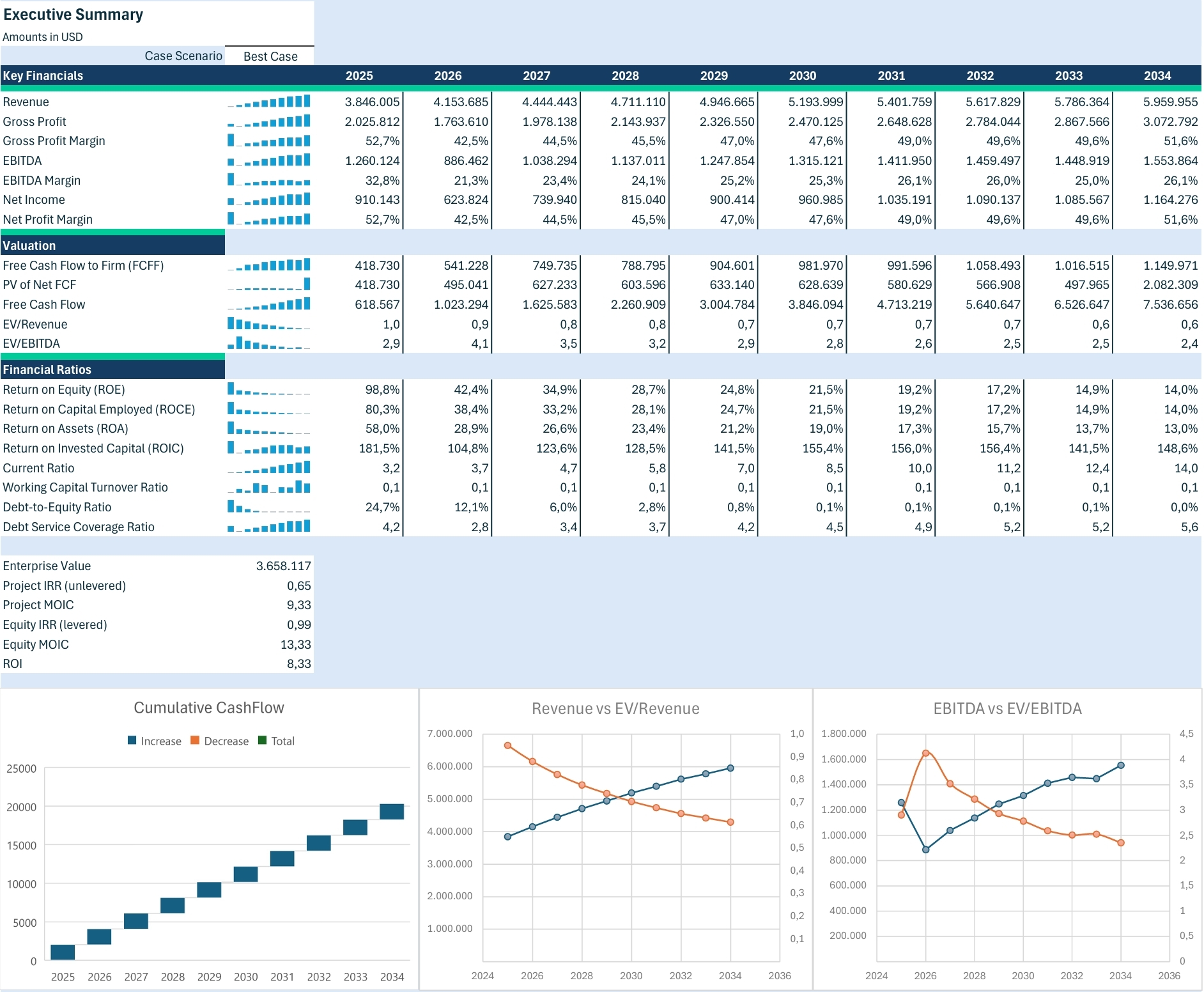
## 1. Executive SummaryGet a high-level view of your business performance, including key financial metrics, revenue, gross profit, profitability, and long-term financial development.


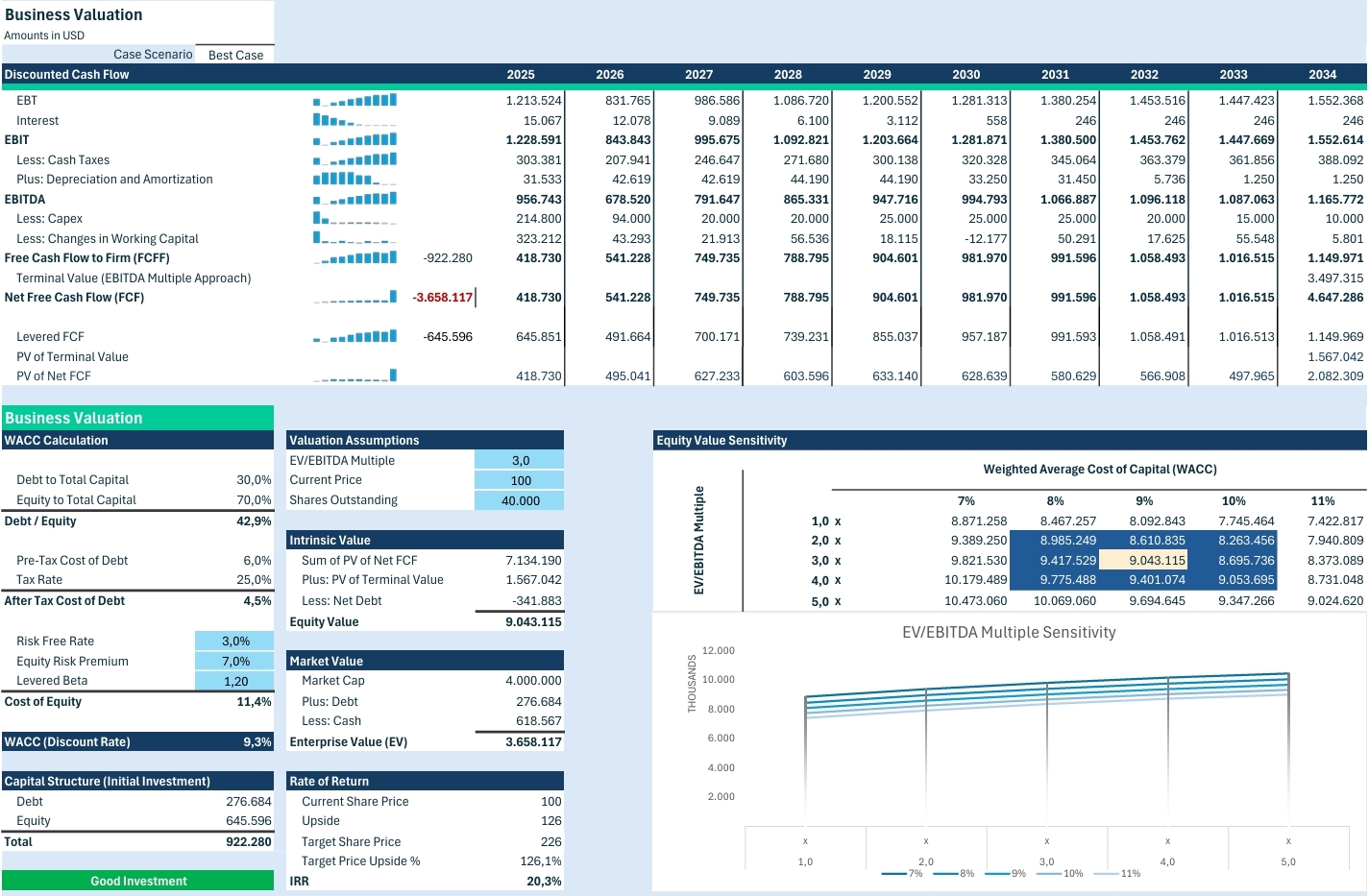
## 2. Business ValuationEstimate the potential value of your business using a structured valuation framework based on projected financial performance and future cash flows.


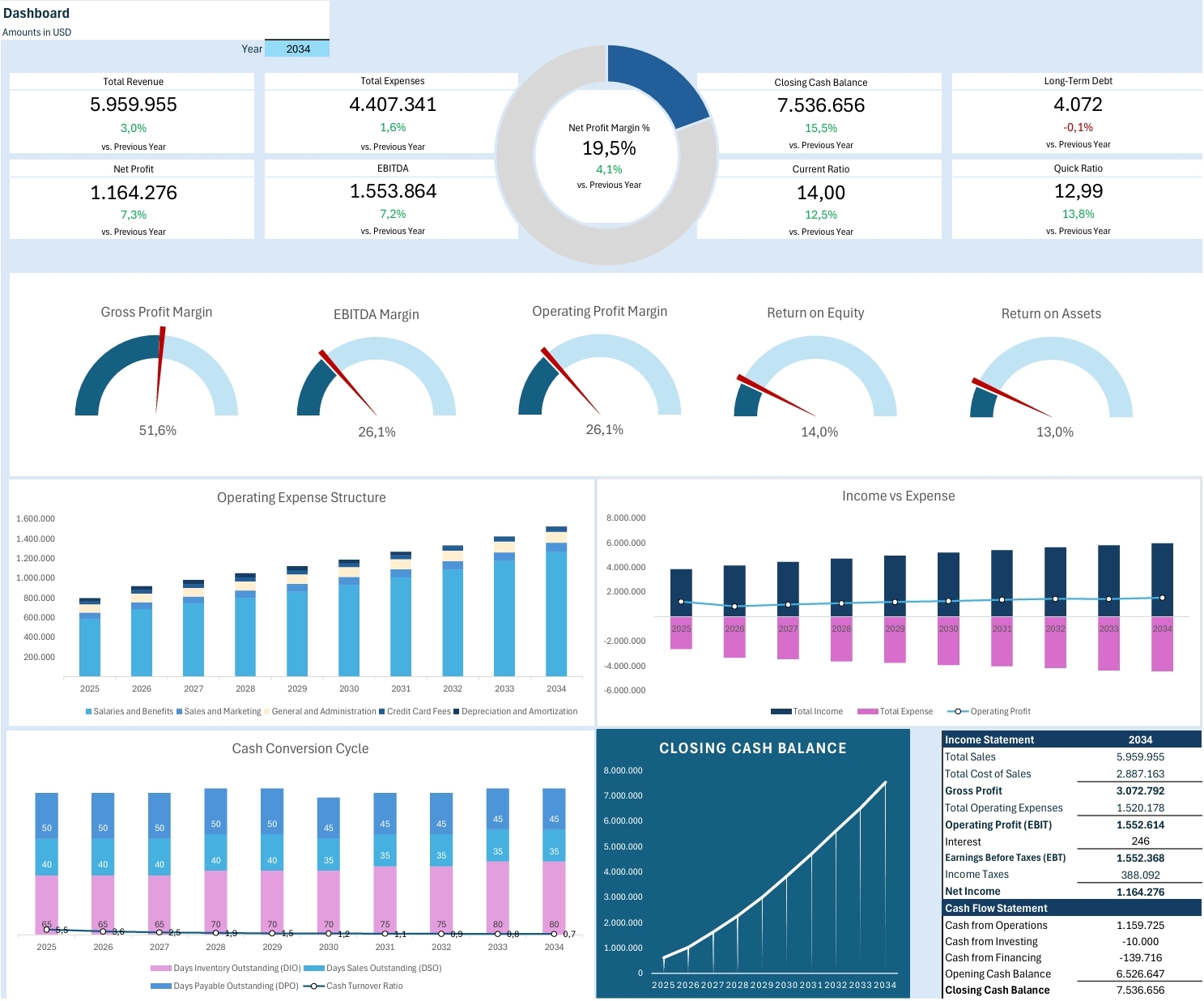
## 3. Interactive DashboardMonitor important business indicators through a visual dashboard designed for quick performance tracking and decision-making.


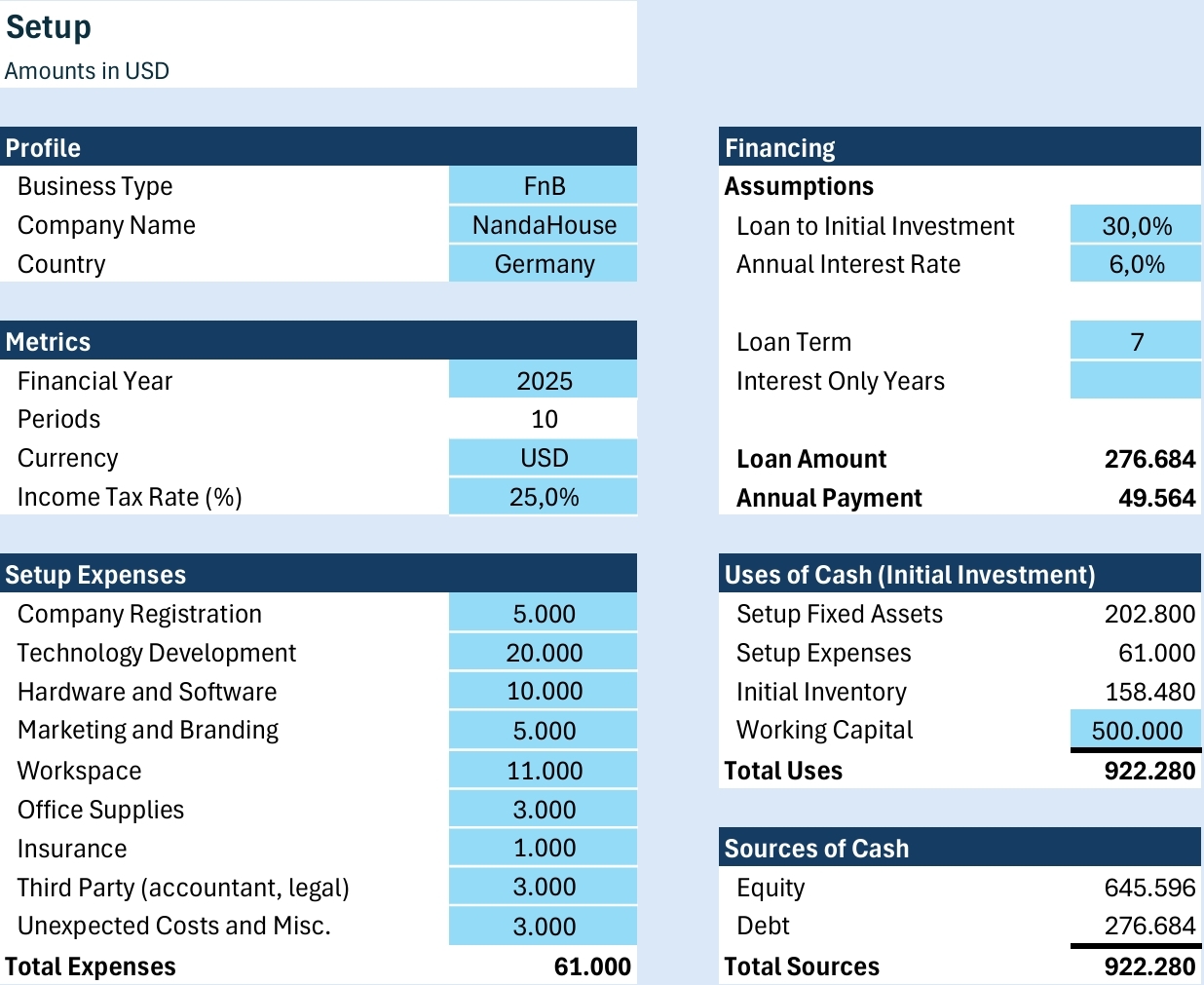
## 4. Setup & AssumptionsDefine your company's core profile, business type, financing assumptions, interest rates, inflation, and other global parameters that drive the model


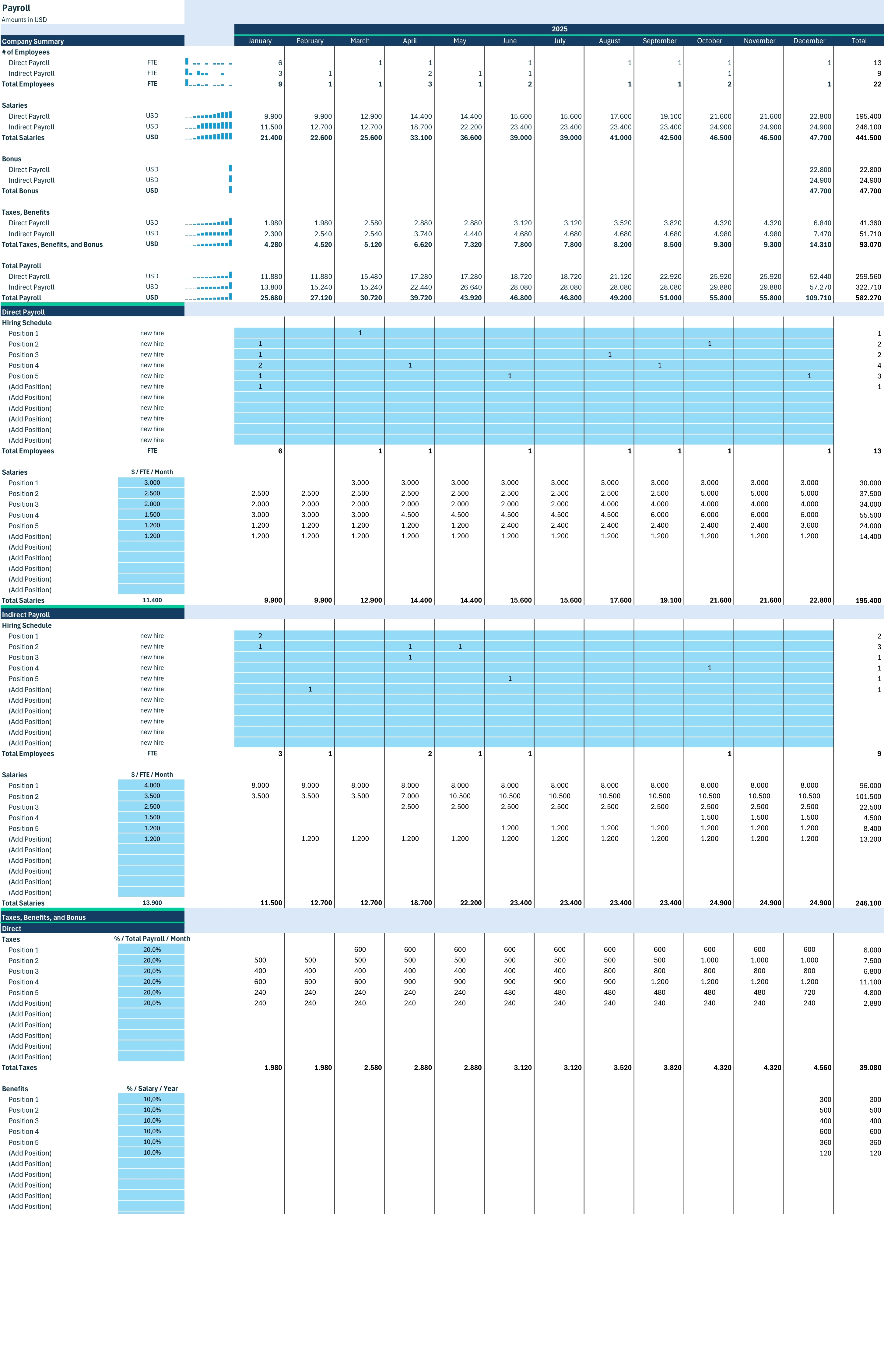
.## 5. Payroll PlanningModel employee headcount and payroll costs to understand how your workforce affects operating expenses and future profitability.


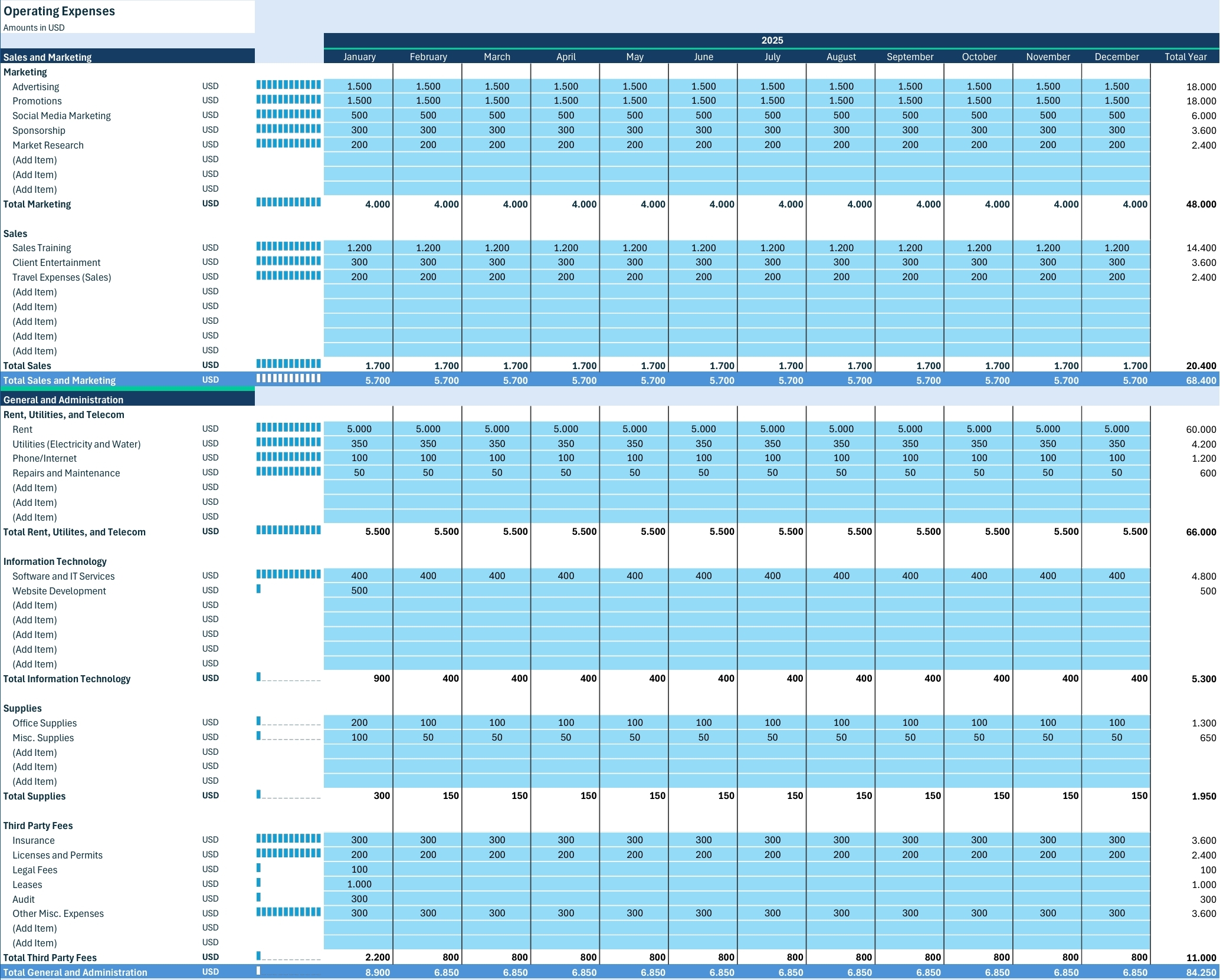
## 6. Operating ExpensesPlan and analyze operating costs across areas such as marketing, administration, and other business expenses.


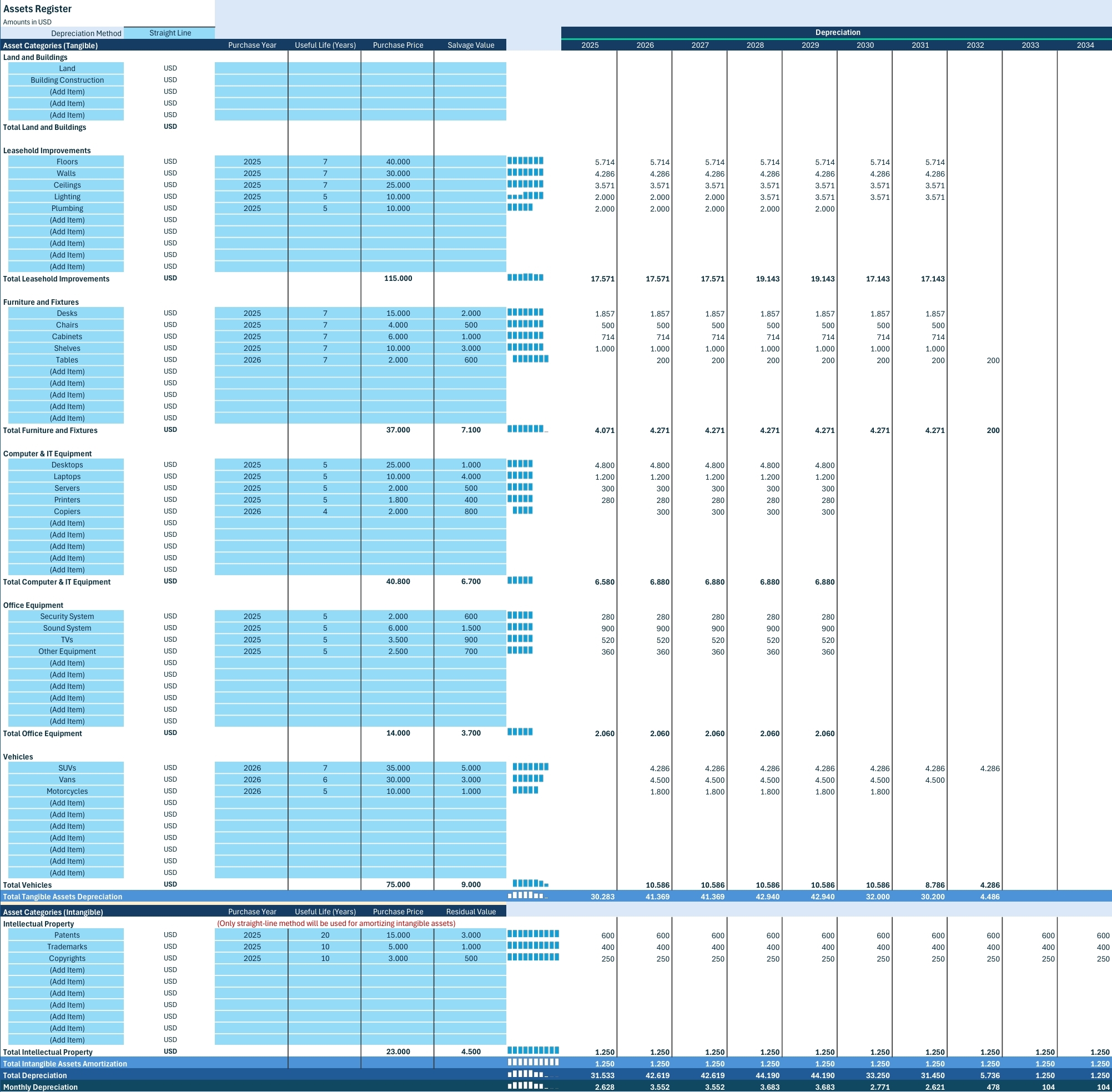
## 7. Assets RegisterTrack tangible assets, purchase costs, useful life, salvage value, and depreciation to incorporate asset investments into your financial projections.


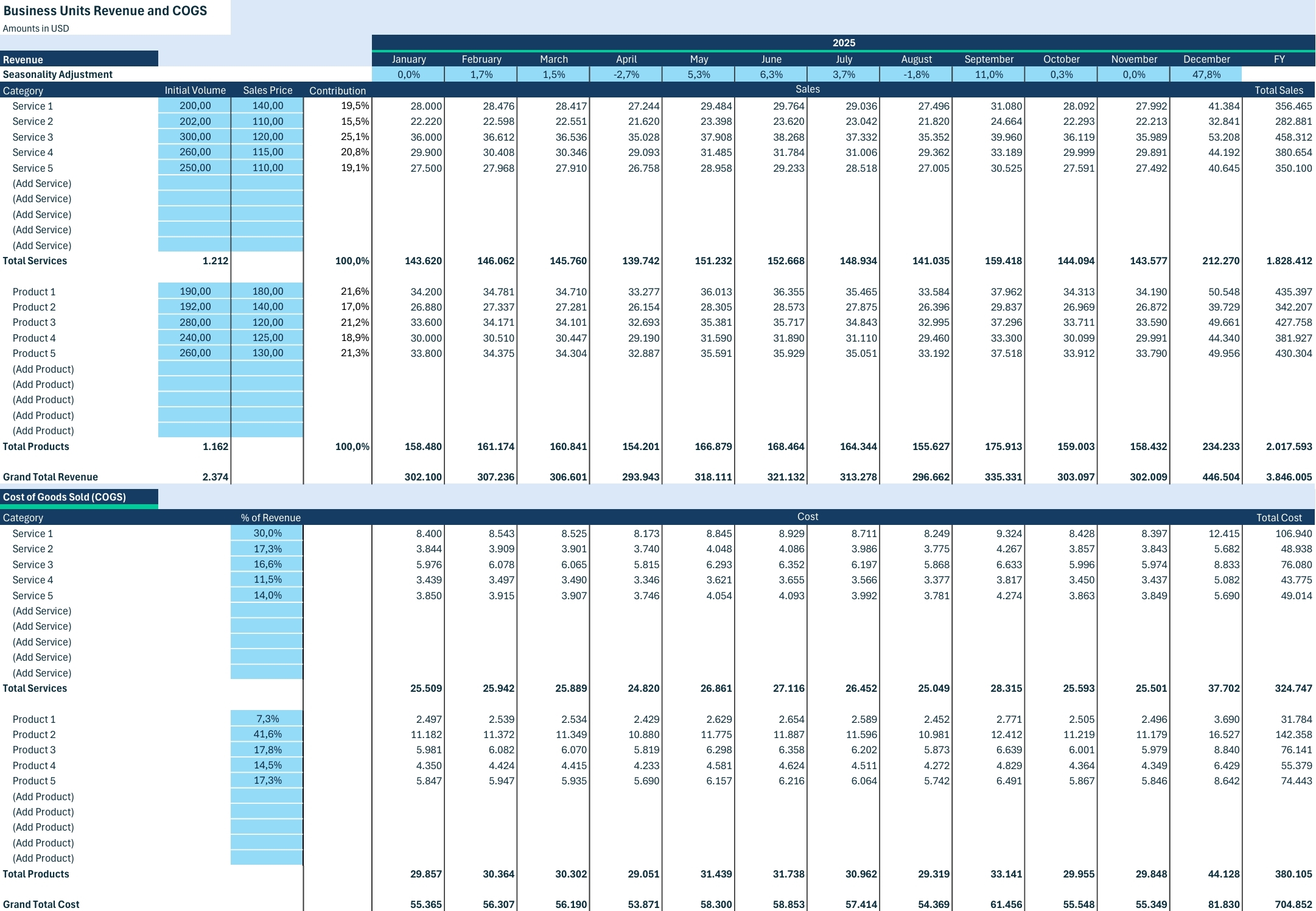
## 8. Revenue & COGS ModelBuild revenue projections by business unit or product category, including sales volume, pricing, contribution, sales, and cost of goods sold.


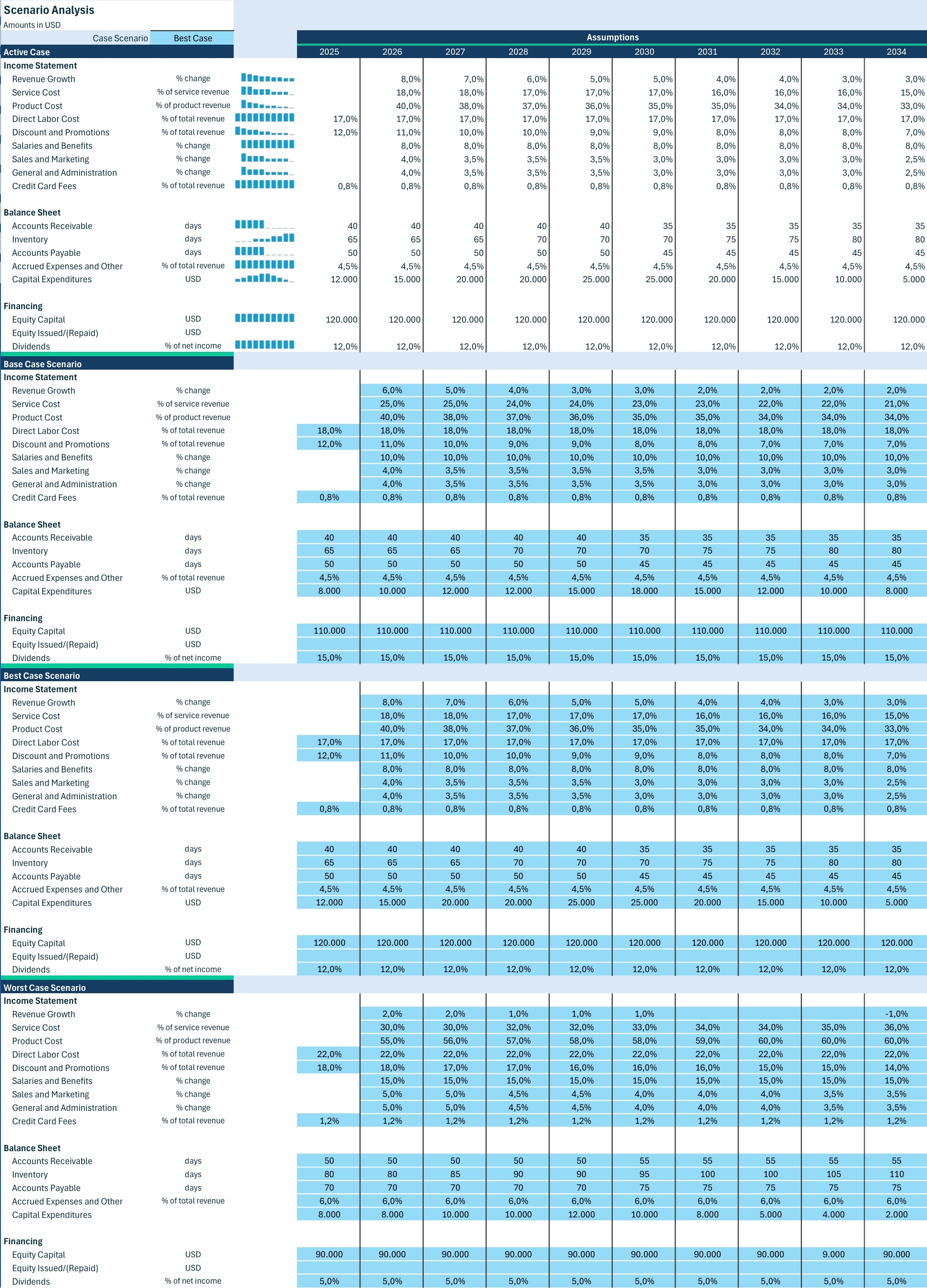
## 9. Scenario Analysis


Evaluate three different business scenarios:
• Base Case
• Best Case
• Worst Case


Test how changes in revenue growth, costs, margins, and other assumptions can influence your financial results.


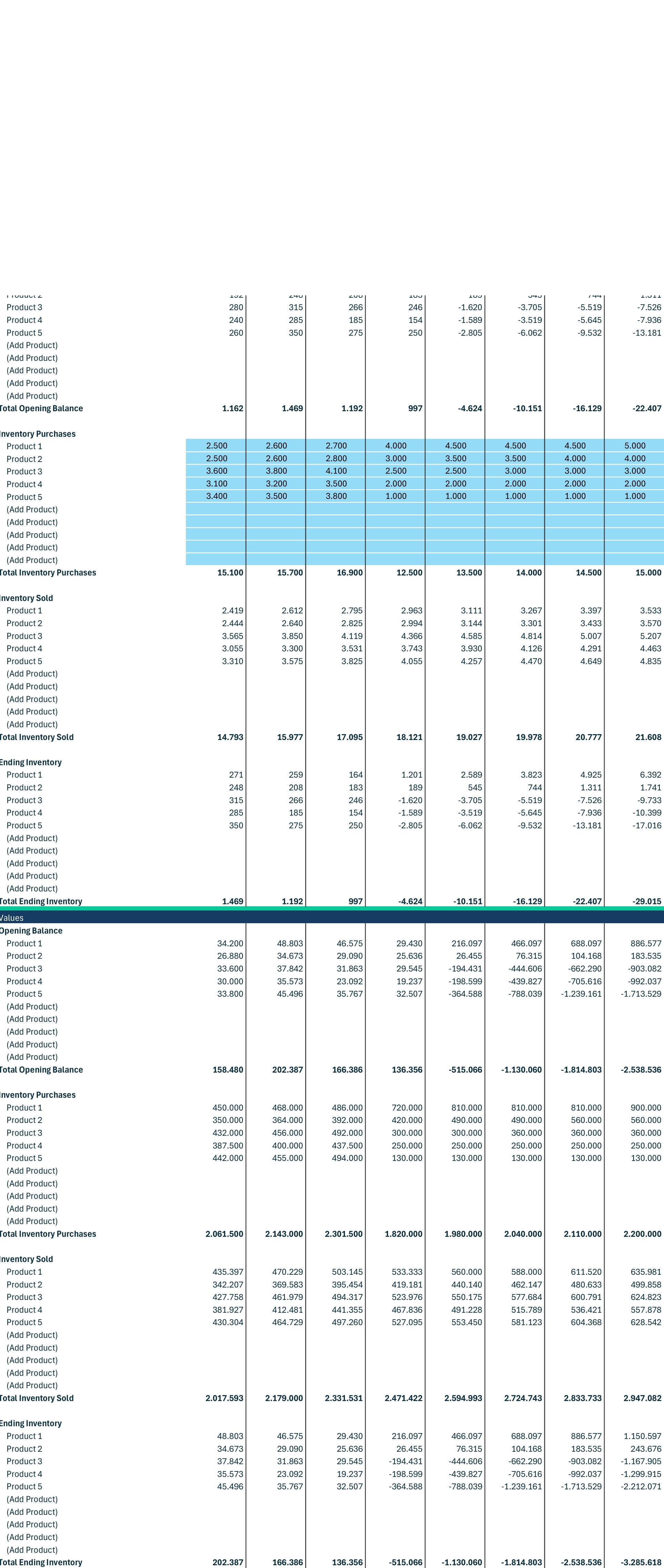
## 10. Inventory ControlTrack inventory-related assumptions and analyze inventory performance using metrics such as Days Inventory Outstanding (DIO).


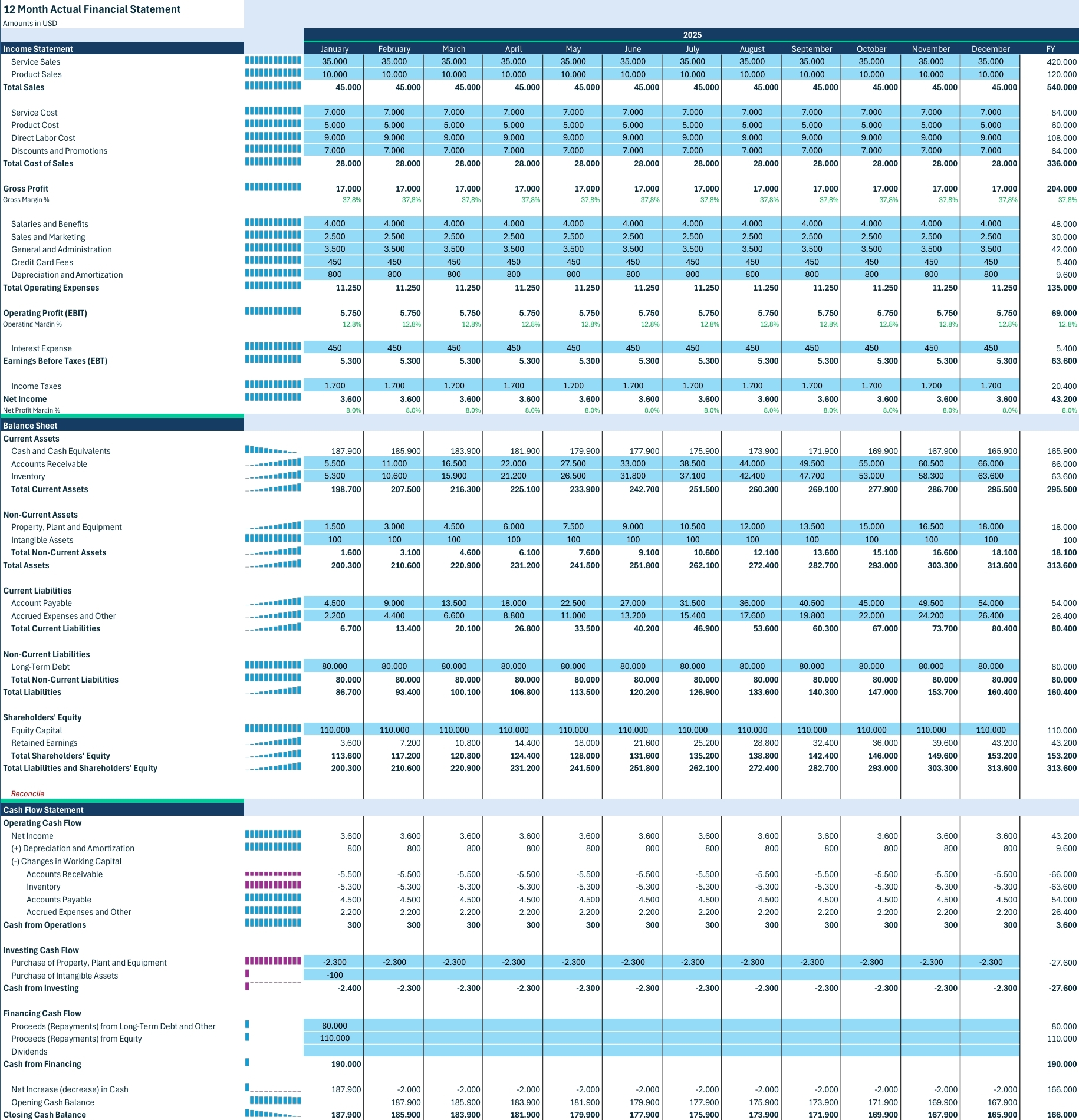
## 11. 12-Month Actual Financial StatementsInput and analyze your actual monthly financial performance, providing the foundation for comparison with your projections.


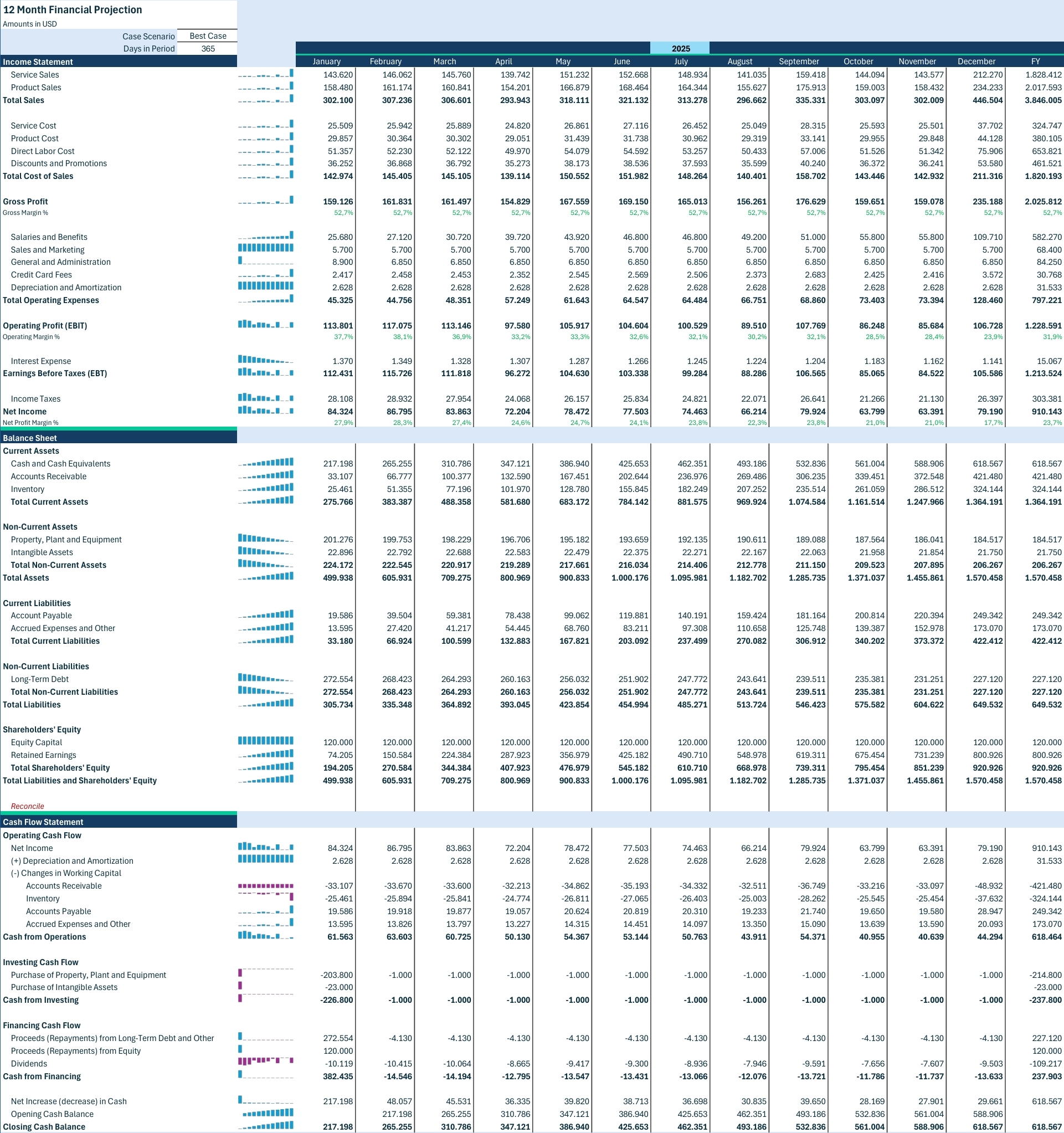
## 12. 12-Month Financial ProjectionCreate a detailed monthly financial projection covering revenue, expenses, profitability, and other key financial statement components.


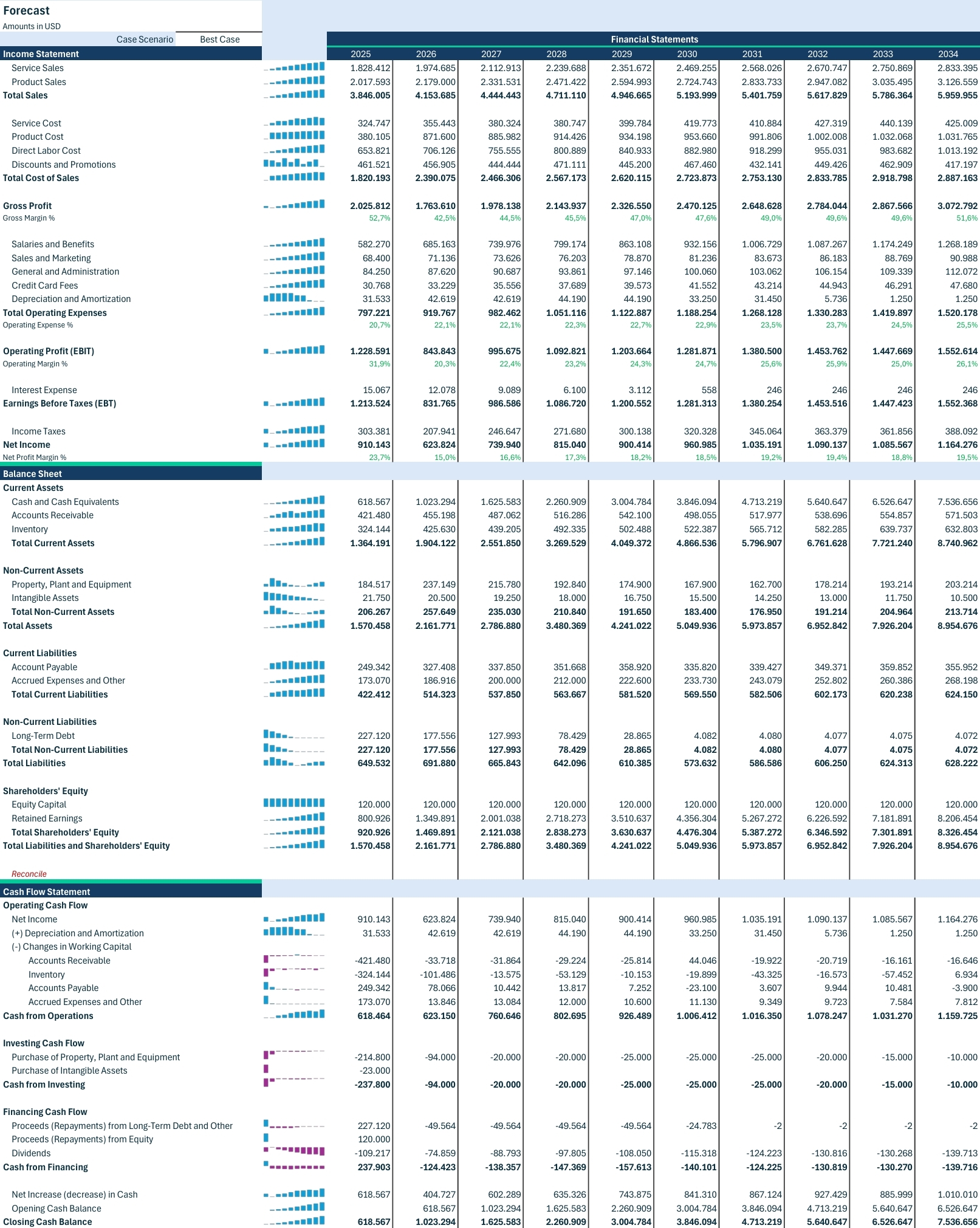
## 13. 10-Year Annual ForecastExtend your business projections into a long-term financial forecast covering up to 10 years.


Analyze projected:
• Revenue
• Cost of Goods Sold
• Gross Profit
• Operating Expenses
• EBITDA / Operating Performance
• Interest
• Taxes
• Net Profit
• Assets
• Liabilities
• Equity
• Cash Flow


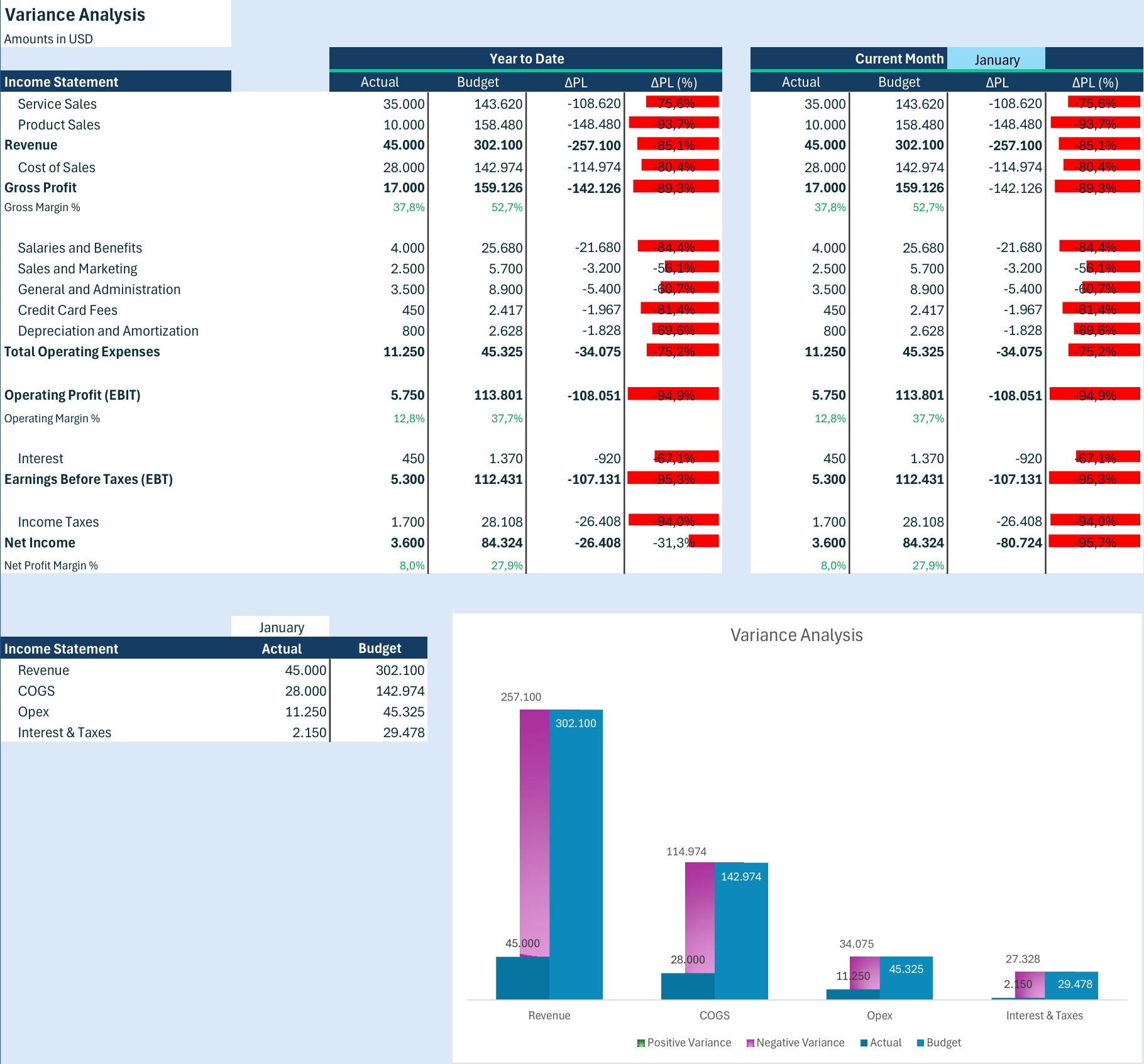
## 14. Variance AnalysisCompare actual results against budget or projected results and identify financial variances in both absolute and percentage terms.
This helps you understand where your business is performing above or below expectations.


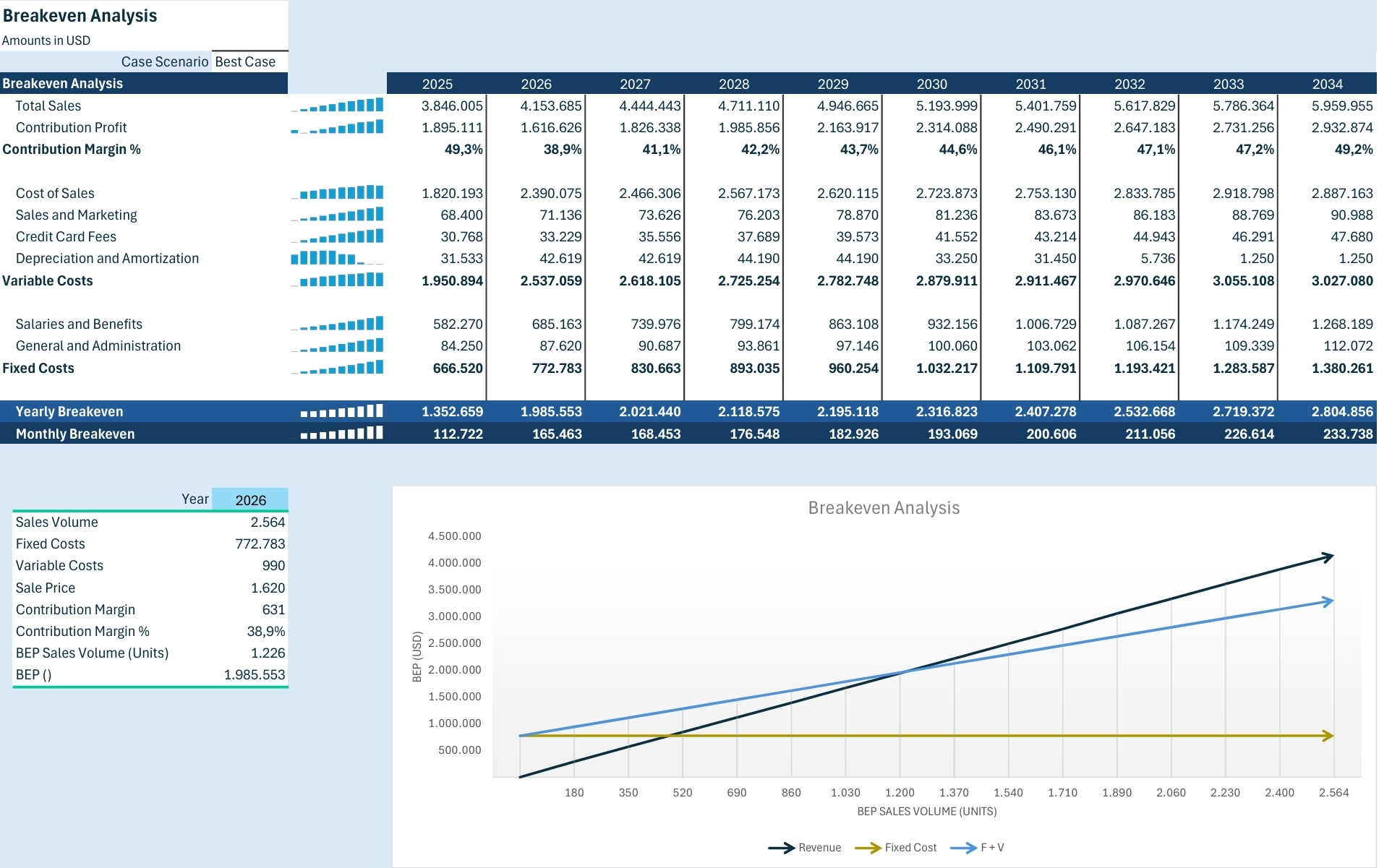
## 15. Breakeven AnalysisDetermine the sales level required to cover your costs and understand when your business is expected to reach its breakeven point.


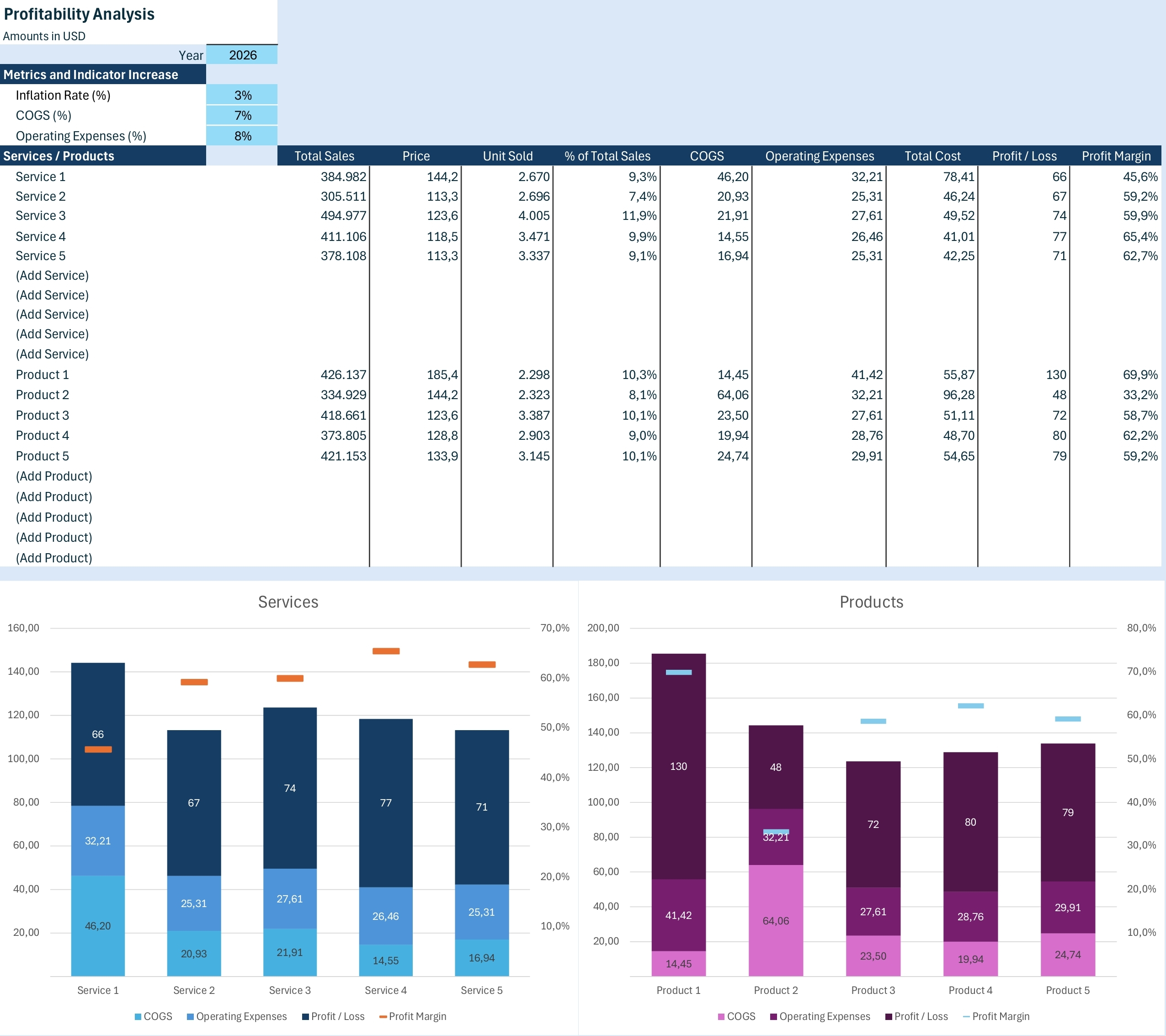
## 16. Profitability AnalysisEvaluate business profitability using key performance indicators and financial assumptions to understand how efficiently your business converts revenue into profit.


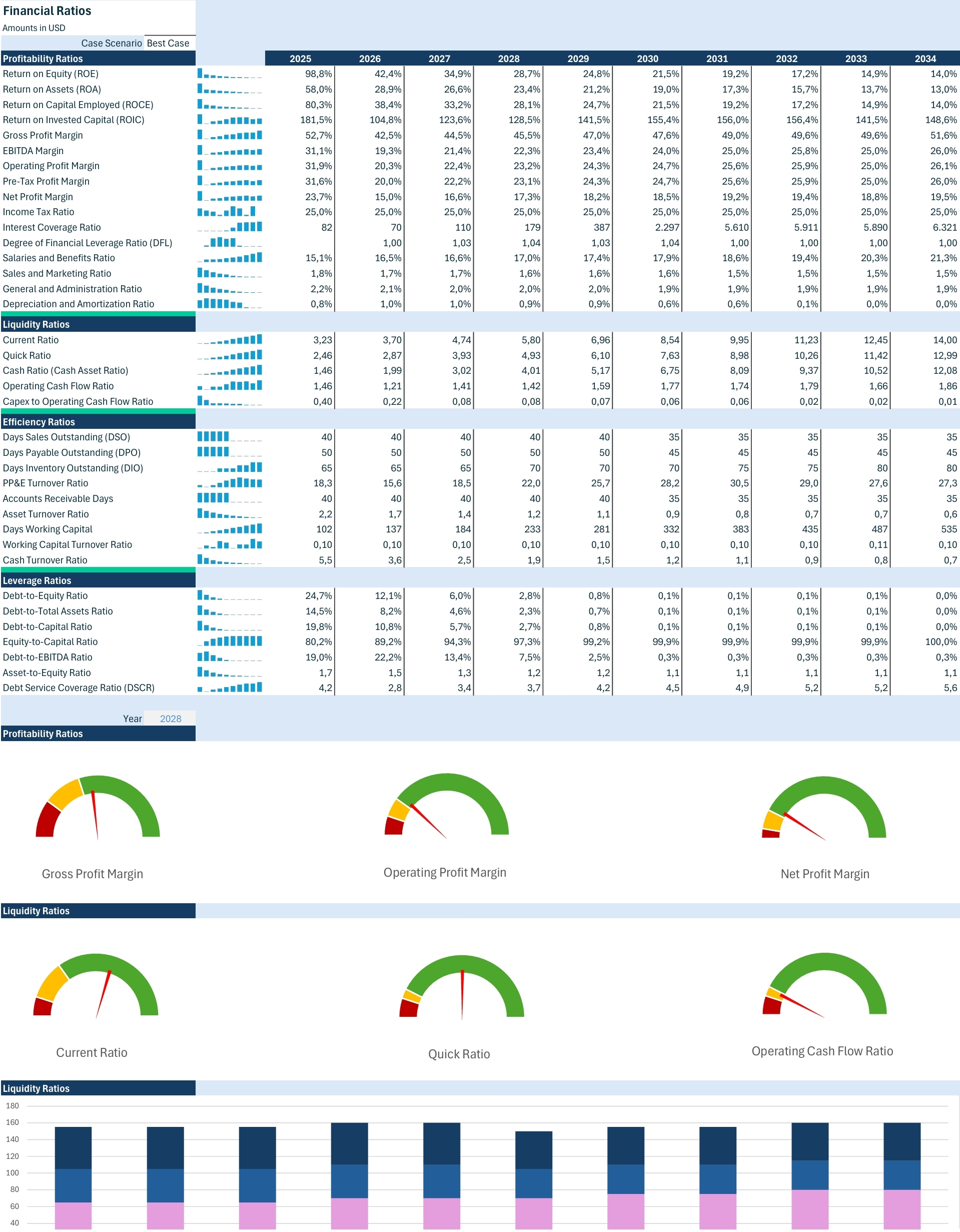
## 17. Financial Ratio AnalysisAnalyze your business using a comprehensive range of financial ratios, including profitability, liquidity, efficiency, leverage, and other important financial indicators.


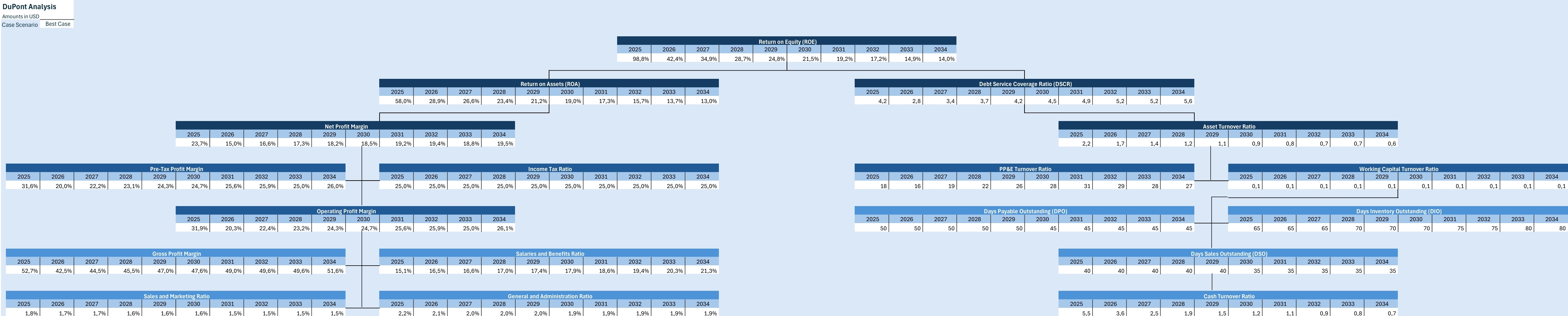
## 18. DuPont AnalysisBreak down Return on Equity (ROE) into its underlying drivers to better understand whether profitability, asset efficiency, or financial leverage is driving shareholder returns.


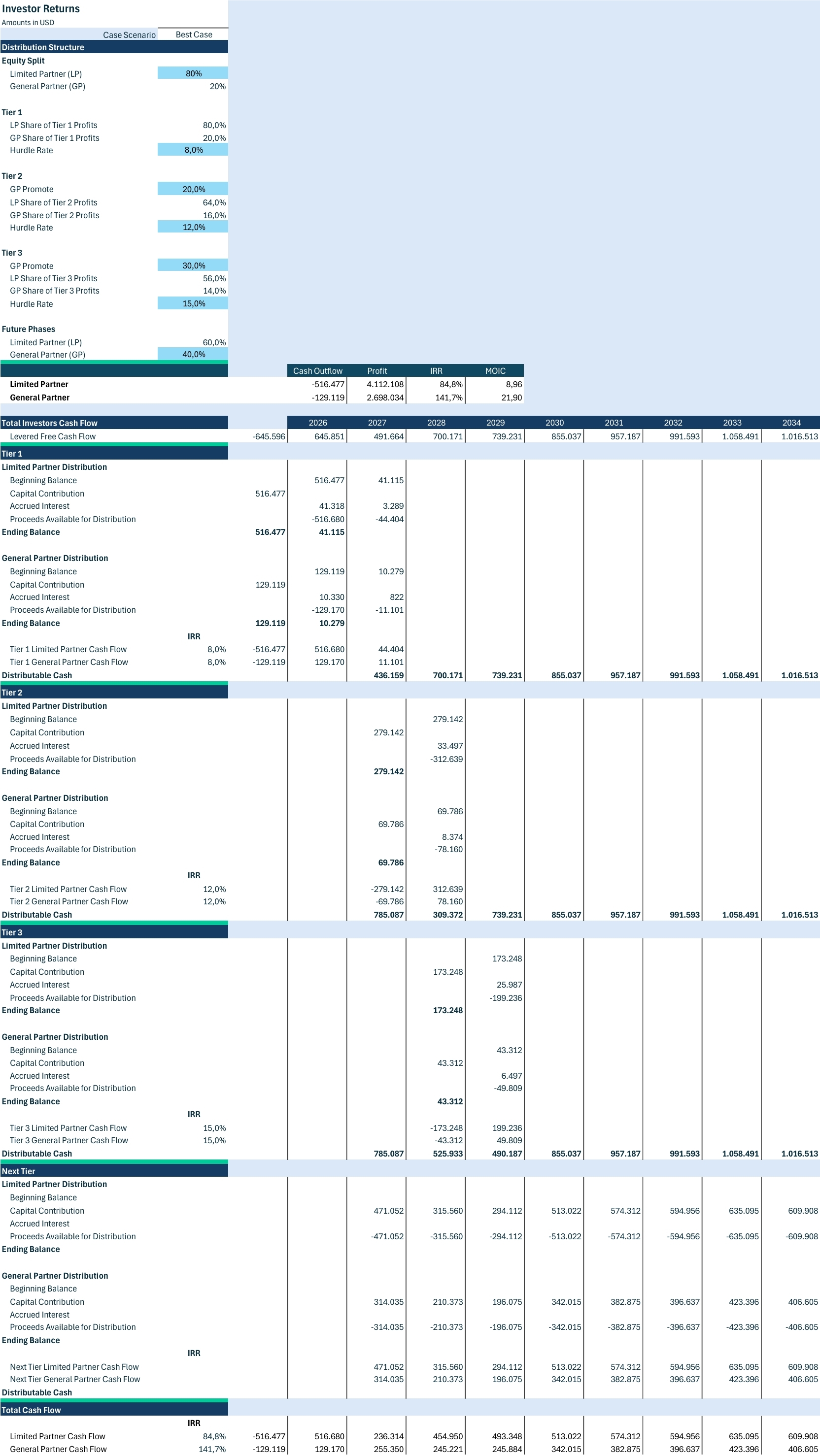
## 19. Investor ReturnsAnalyze potential investor returns using an integrated investment structure, equity split, and return analysis.


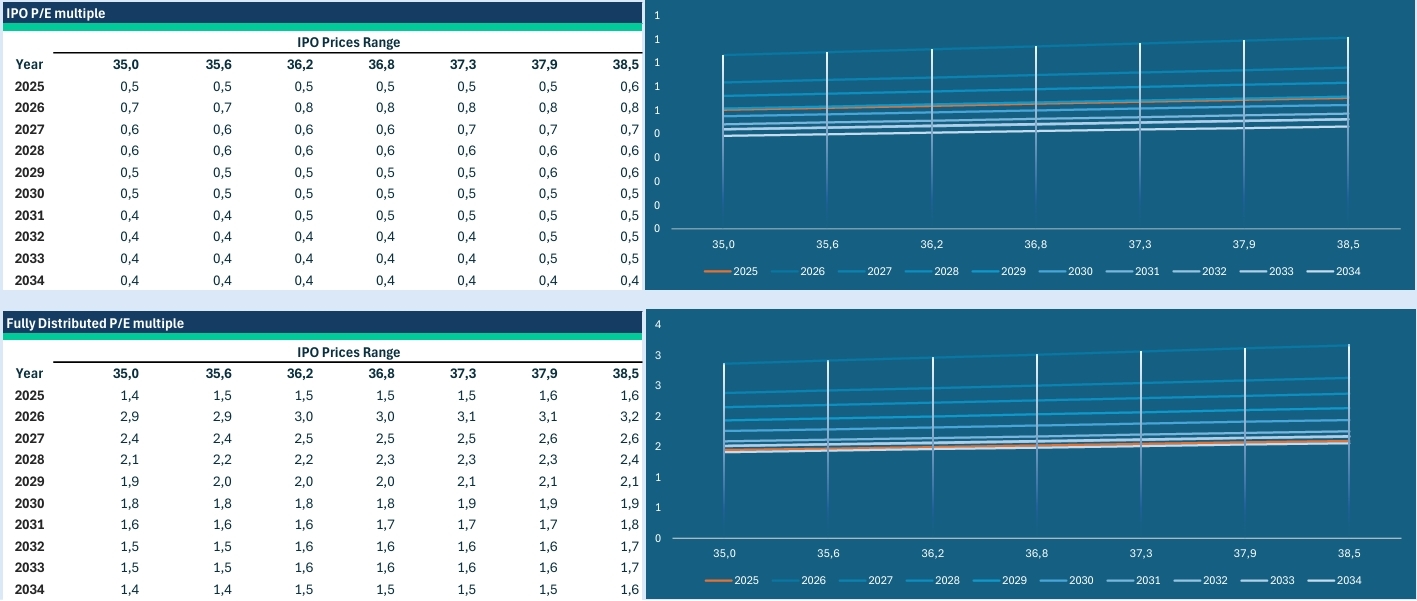
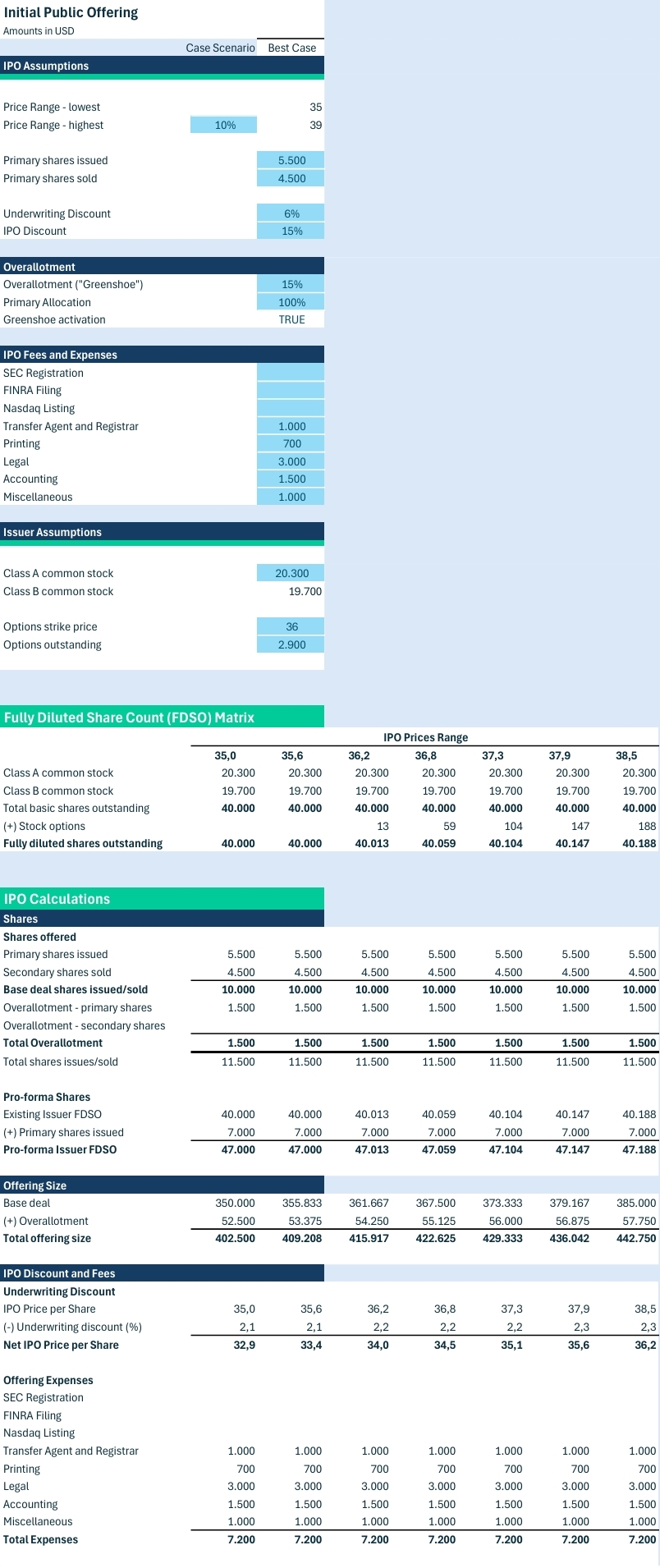
## 20. IPO AnalysisExplore potential IPO assumptions and valuation scenarios, including price range assumptions and other inputs relevant to an initial public offering analysis.


# Built for Strategic Decision-MakingThis isn't just a spreadsheet for entering numbers.


Use the model to answer important business questions such as:
• How much revenue can my business generate over the next 10 years?
• When will my business break even?
• How profitable can the business become?
• What happens if revenue growth is lower than expected?
• How much will payroll and operating expenses affect profitability?
• How much cash will the business generate?
• What happens under a Best Case or Worst Case scenario?
• How efficiently is the business using its assets?
• What is driving my Return on Equity?
• How attractive could the business be to investors?
• What could the business be worth based on its projected financial performance?
• How could different IPO assumptions affect potential valuation?


# Why It's a Great Investment?
Hiring a financial consultant to build a customized financial model can be expensive and time-consuming.
This template gives you a structured financial modelling framework at a fraction of the cost.


## Save TimeStart with an integrated model instead of building dozens of interconnected spreadsheets from scratch.


## Save MoneyGet a professional financial planning framework without the cost of commissioning a custom model.


## Gain ClaritySee how your assumptions flow through revenue, expenses, financial statements, profitability, valuation, and investor returns.


## Make Better DecisionsUse scenario analysis, variance analysis, breakeven analysis, ratios, and dashboards to make more informed strategic decisions.


## Take ControlCustomize the assumptions and adapt the model to your own business, industry, financial plan, or investment analysis.


## No Macros RequiredThe financial model is designed without relying on VBA macros, making it easier to use, edit, and customize.


# List of Tabs
1. License
2. Profile
3. Summary
4. Valuation
5. Dashboard
6. Setup
7. Payroll
8. Operating Expenses
9. Assets Register
10. Revenue
11. Scenario
12. Inventory Control
13. Actual FS
14. 12-Month Projection
15. Annual Forecast
16. Variance
17. Break Even
18. Profitability
19. Ratios
20. DuPont
21. Investor Returns
22. IPO


# Perfect For
• Startup Founders
• Entrepreneurs
• Small Business Owners
• Business Consultants
• Financial Analysts
• Management Teams
• Investors
• Business Planners
• Startup Financial Planning
• Business Valuation
• Investment Analysis
• Financial Forecasting
• Fundraising Preparation
• Business Expansion Planning


# Start Building a Stronger Financial FutureYour business doesn't have to be a collection of assumptions and guesses.


Build a structured financial plan, test different scenarios, understand your profitability, evaluate your business value, and see how today's decisions can affect tomorrow's results.


Start your financial planning journey today with this Business Startup DCF and IPO Valuation Financial Model 10-Year Forecast.

This Best Practice includes
1 Excel file

Acquire business license for $197.00 $157.60

Add to cart

Add to bookmarks

Discuss

Further information

- Give founders, finance teams, and analysts a structured 3-statement model (income statement, balance sheet, and cash flow) that links a detailed first-year monthly projection to a 10-year annual forecast.
- Enable scenario-based planning (base/best/worst case assumptions driven from a single scenario sheet) so users can stress-test revenue, cost, and financing assumptions without rebuilding formulas.
- Support budgeting and performance tracking through built-in Variance Analysis (budget vs. actual).
- Provide decision-support outputs commonly needed for fundraising, planning, or internal reviews: breakeven analysis, financial ratios, and a basic business valuation.
- Reduce the time and technical modeling skill required to produce an investor- or management-ready financial model from scratch.

- Small to mid-sized businesses or startups needing a financial model for internal planning, budgeting, or an investor/lender pitch.
- Companies with a single legal entity and relatively standard revenue/cost structure (not multi-entity consolidation).
- Situations where a reasonably close approximation of monthly and annual figures is acceptable, e.g., early-stage planning, board decks, and feasibility studies.

- Businesses requiring multi-entity, multi-currency, or consolidated financial modeling.
- Cases requiring statutory/regulatory-grade accuracy (e.g., IFRS/GAAP audit support, tax filings, lender covenant compliance).
- Debt/financing structures where interest precision materially matters (e.g., large debt balances relative to cash flow or complex tranches/covenants)
- Businesses needing granular monthly detail beyond Year 1. Years 2–10 in the Annual Forecast use a simplified beginning-of-year balance approach rather than full monthly amortization.
- Users looking for a highly specialized model (e.g., project finance, real estate waterfall structures, complex equity cap tables).


0.0 / 5 (0 votes)

please wait...