IFRS Fixed Asset & Depreciation Model – IAS 16 PPE Register, Revaluation, Impairment, Tax, Deferred Tax, Journals & Disc
Originally published: 31/08/2026 08:16
Publication number: ELQ-59702-1
View all versions & Certificate
certified

IFRS Fixed Asset & Depreciation Model – IAS 16 PPE Register, Revaluation, Impairment, Tax, Deferred Tax, Journals & Disc

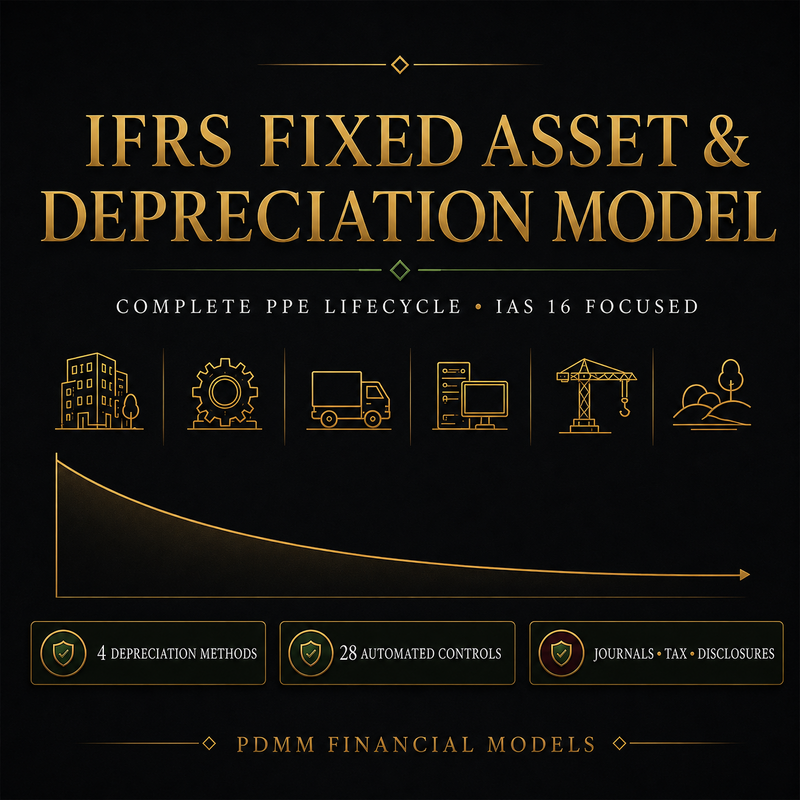
Complete IFRS fixed-asset model with four depreciation methods, revaluation, impairment, tax, journals, disclosures and 28 live controls.

Description

🏢 Manage the Complete Fixed-Asset Lifecycle in One Integrated Excel Model
The Ledger Noir IFRS Fixed Asset & Depreciation Model is a professional fixed-asset accounting, calculation, control, and reporting system—not merely a basic depreciation calculator. It connects asset recognition, cost build-up, depreciation, revaluation, impairment, disposal, tax, journals, roll-forwards, disclosures, and management reporting in one transparent workbook.

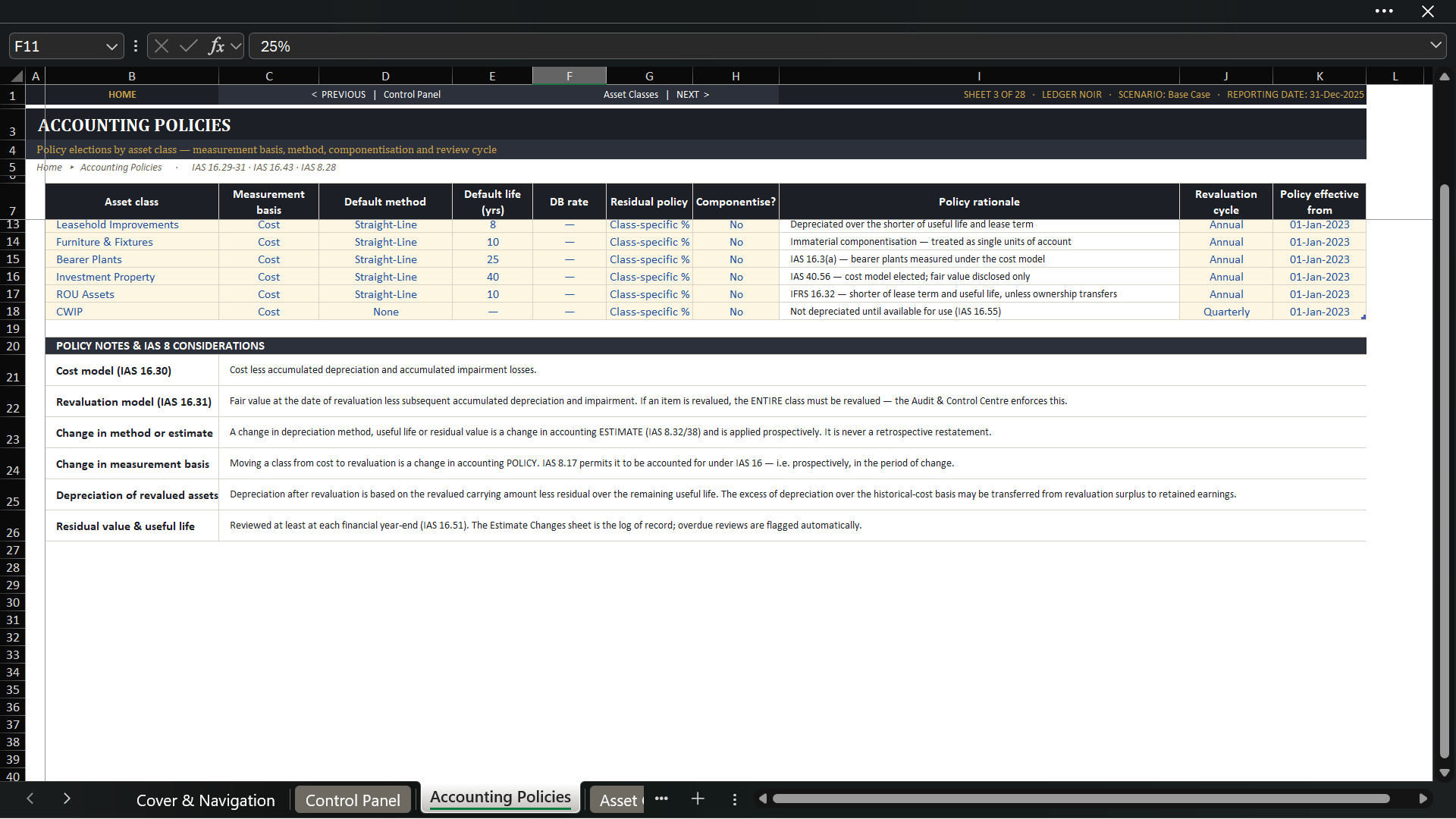
Built primarily around IAS 16, the model also incorporates relevant mechanics from IAS 2, IAS 8, IAS 12, IAS 23, IAS 36, IAS 37/IFRIC 1, IAS 40, IFRS 5, IFRS 13, and IFRS 16.

📚 What Is Included?
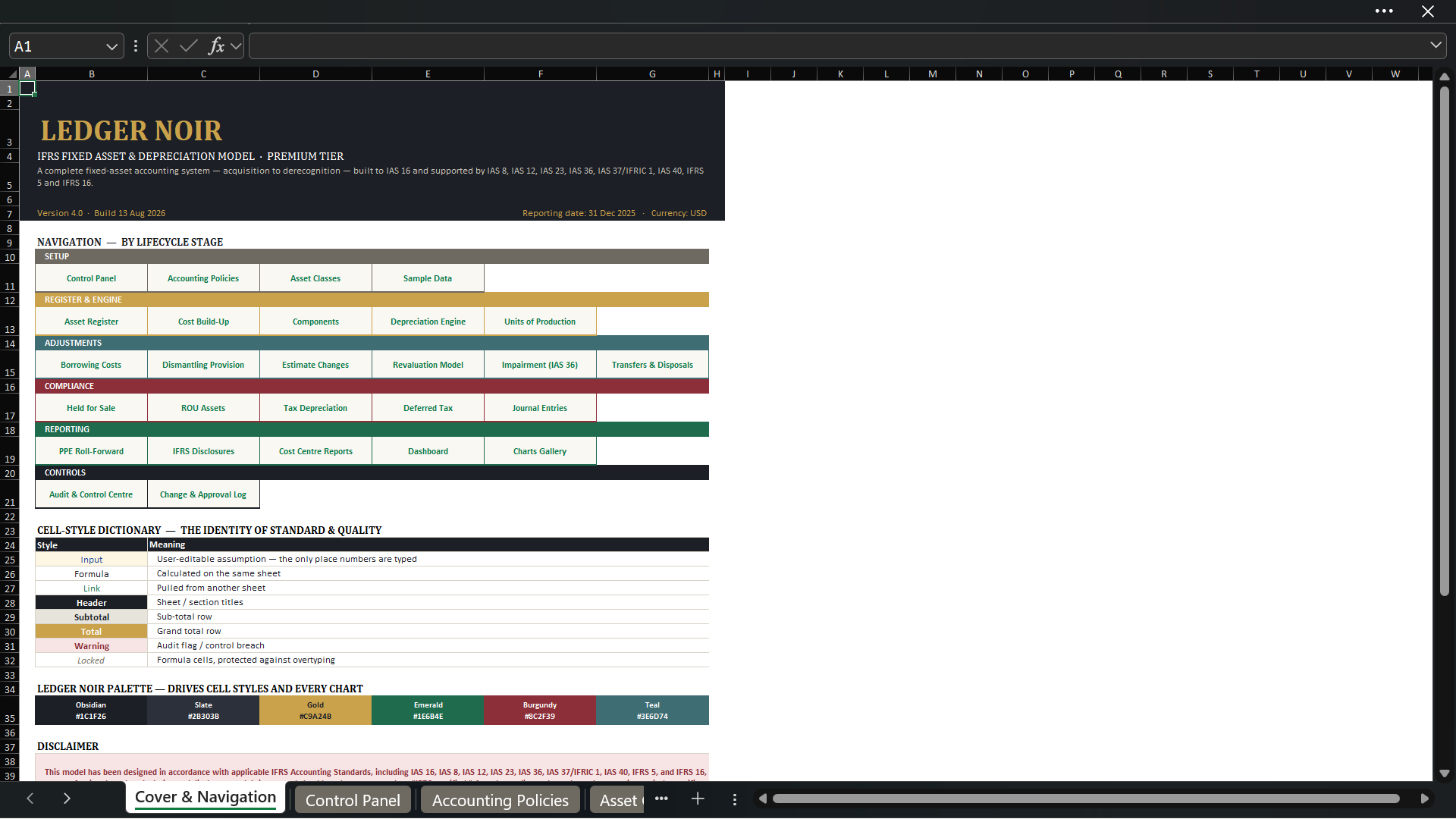
The workbook contains 28 integrated worksheets covering:

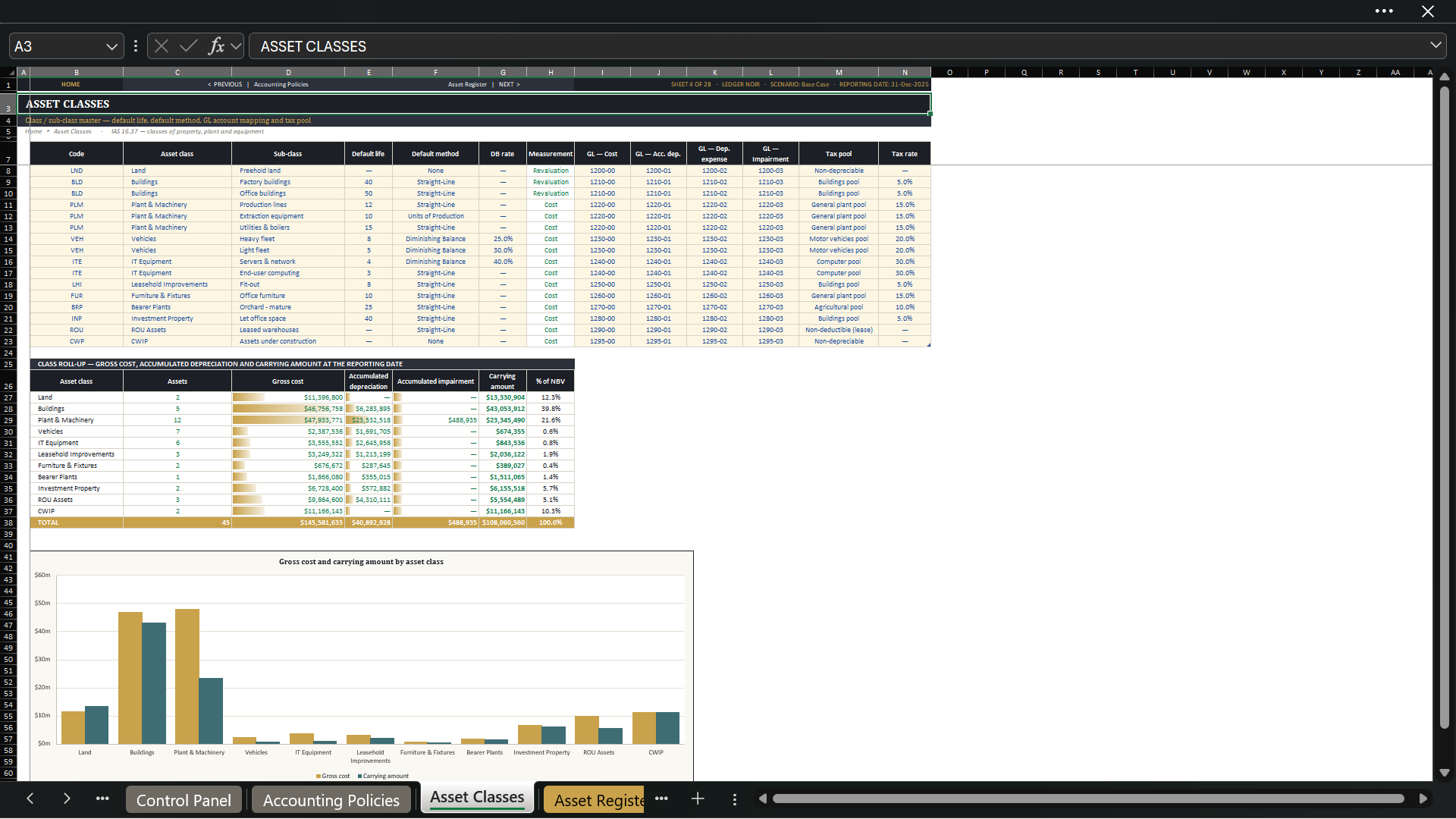
  • Settings, policies, scenarios, asset classes, and register
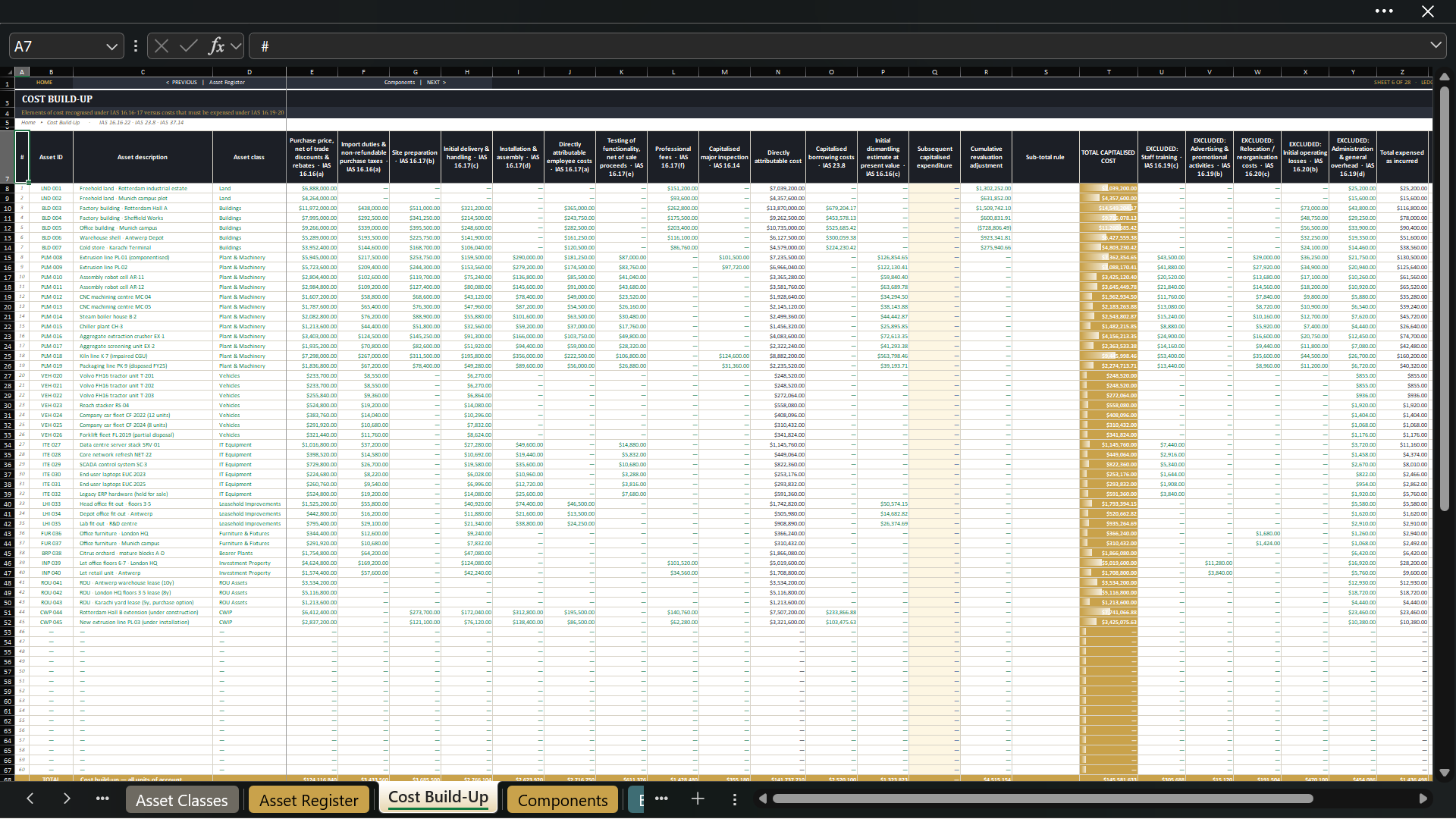
  • Cost build-up, components, borrowing costs, and provisions
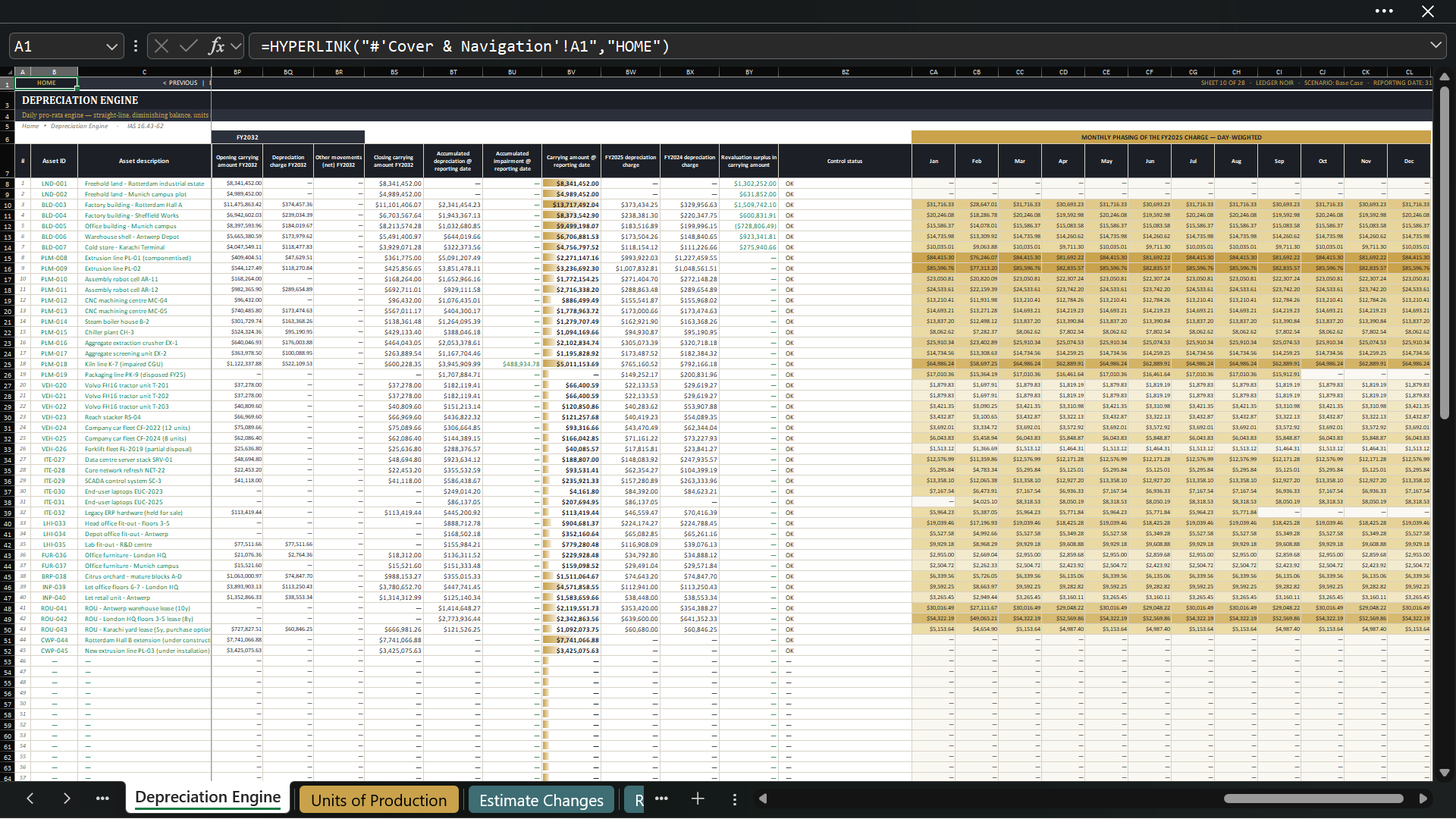
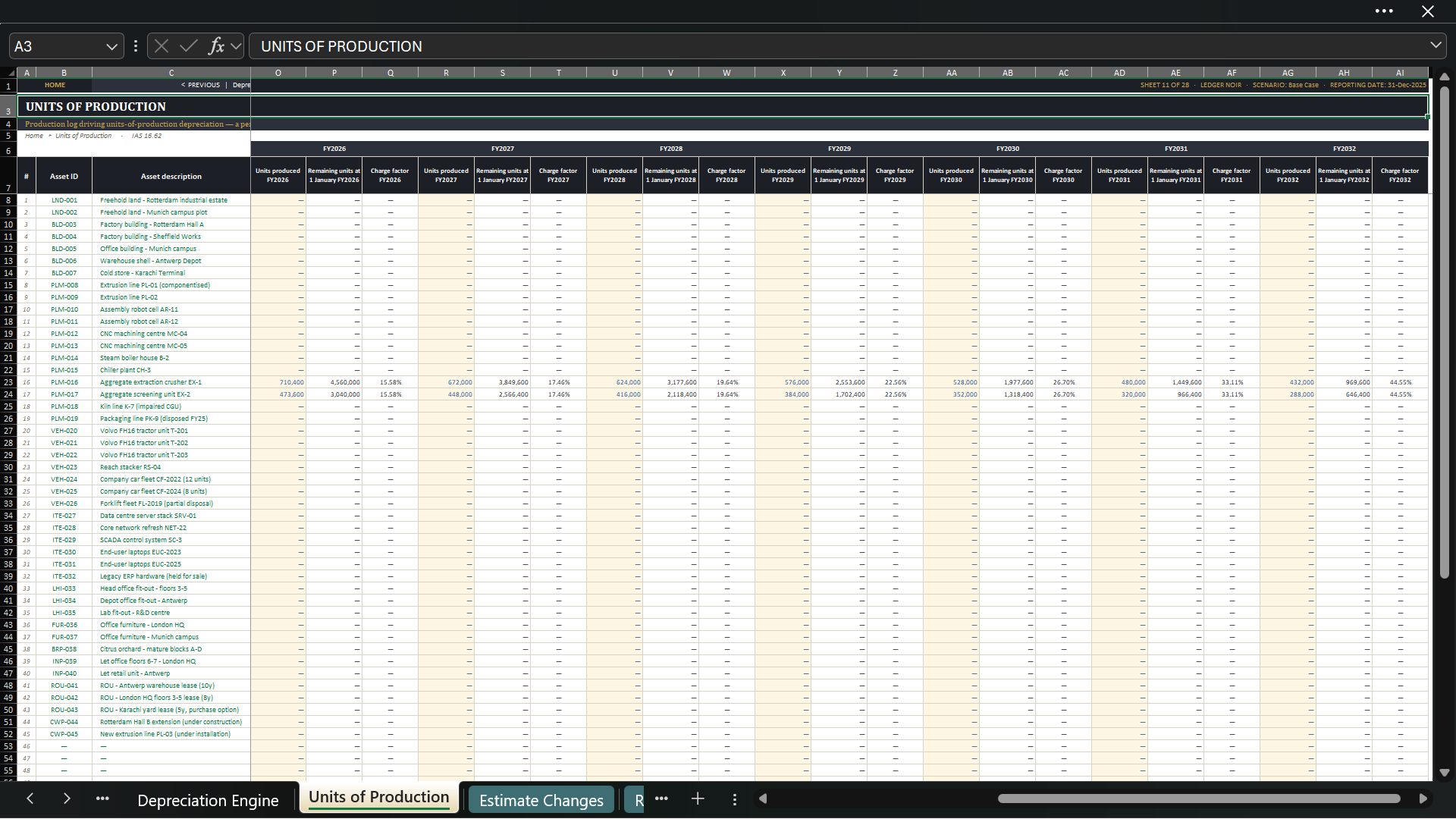
  • Ten-year depreciation and units-of-production engines
  • Estimate changes, revaluation, and impairment
  • Disposals, held-for-sale treatment, and ROU assets
  • Tax, deferred tax, journals, roll-forwards, and disclosures
  • Reports, dashboard, charts, and controls
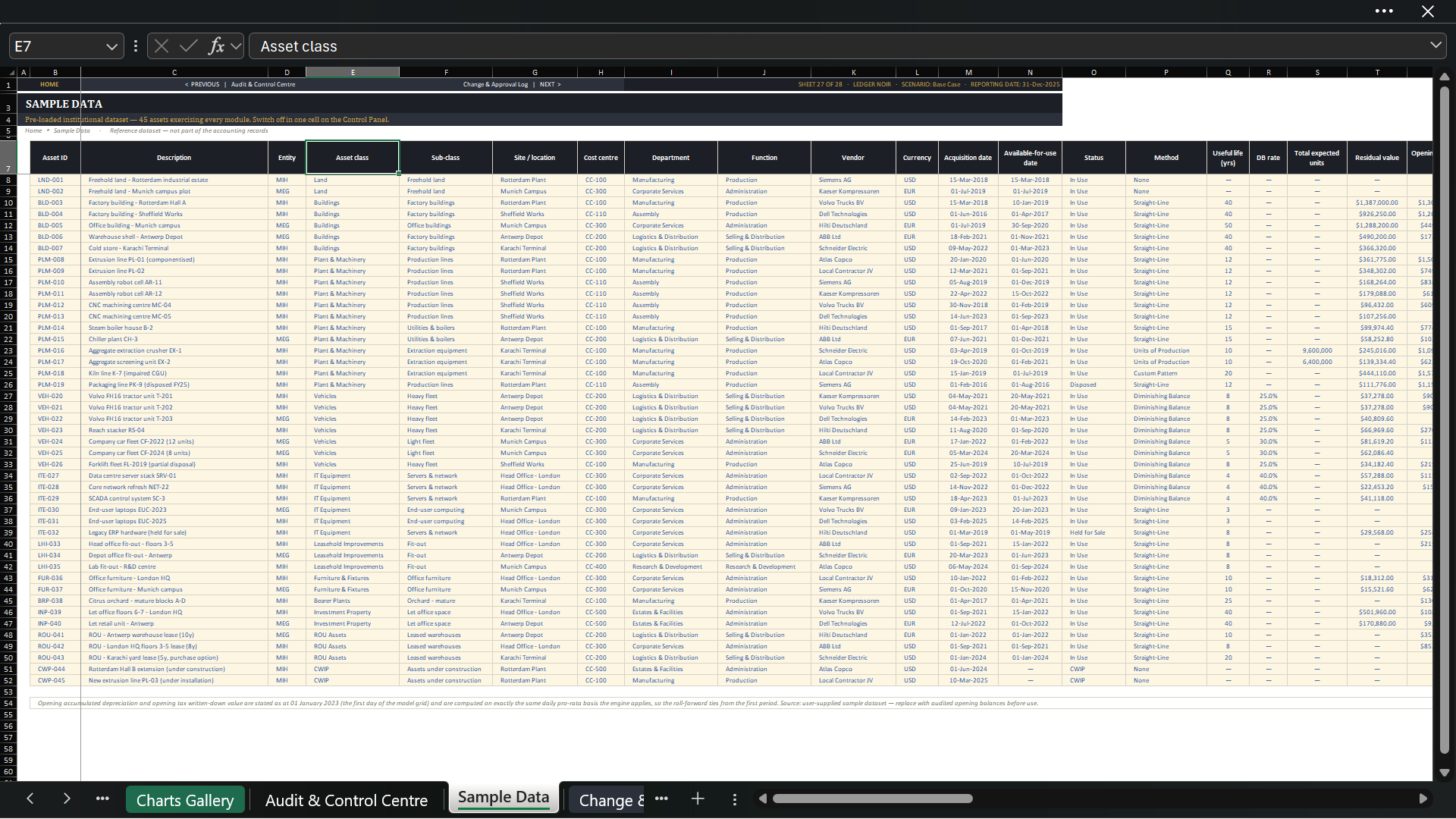
The file includes more than 24,000 formulas, 36 charts, 396 defined names, 45 illustrative assets, 11 asset classes, and 28 automated checks. It contains no macros, VBA, external workbook links, or external data connections.

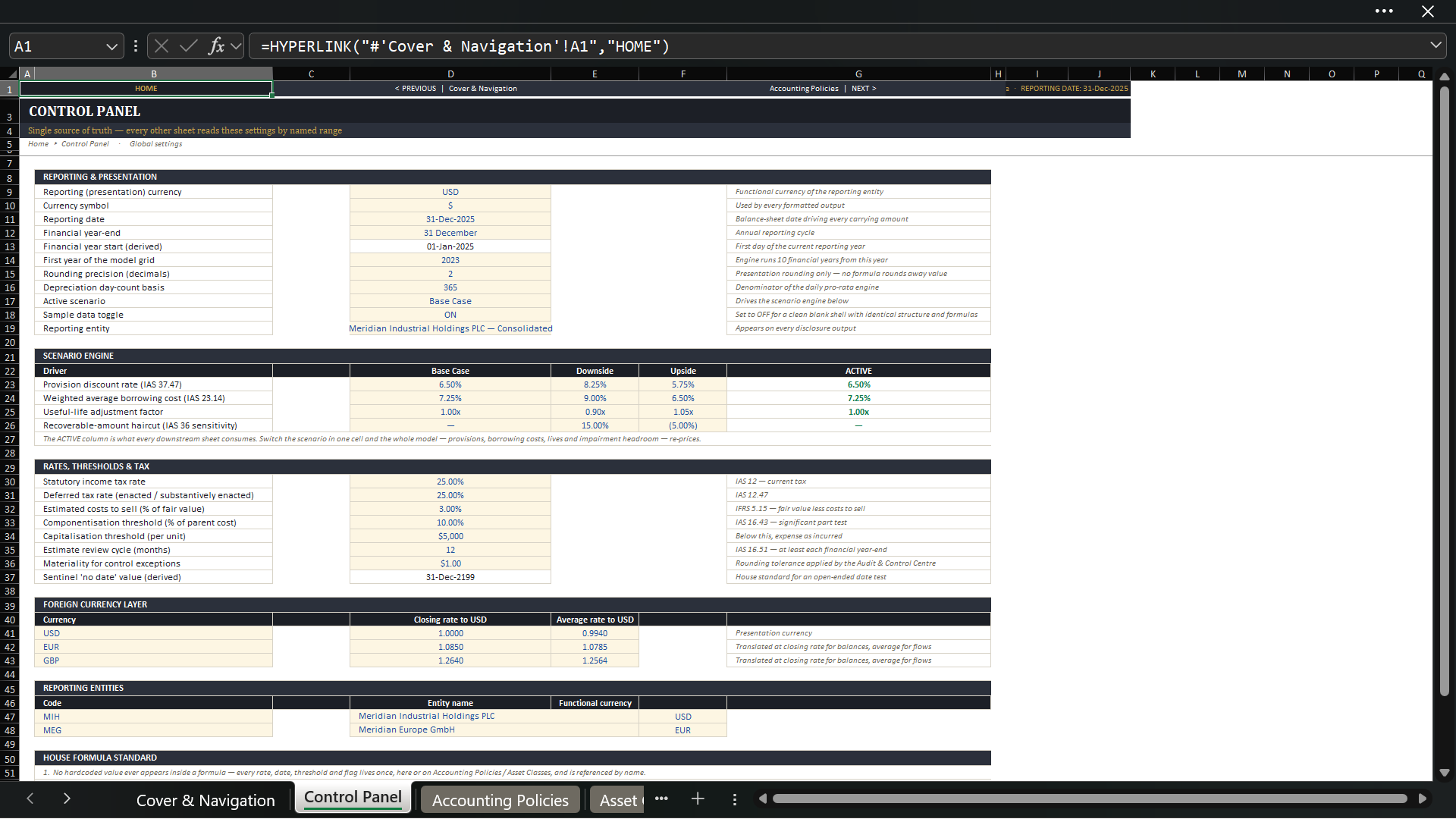
⚙️ Central Control Panel
The Control Panel centralizes reporting dates and currencies, entities and FX rates, calculation periods, scenarios, sample-data toggle, discount and borrowing rates, tax rates, useful-life and recoverable-amount sensitivities, capitalization thresholds, review cycles, and control materiality.

Changing the active scenario updates provision discounting, borrowing costs, useful lives, and impairment headroom across the linked schedules. Turning sample data OFF creates a clean working shell while retaining the formulas and structure.

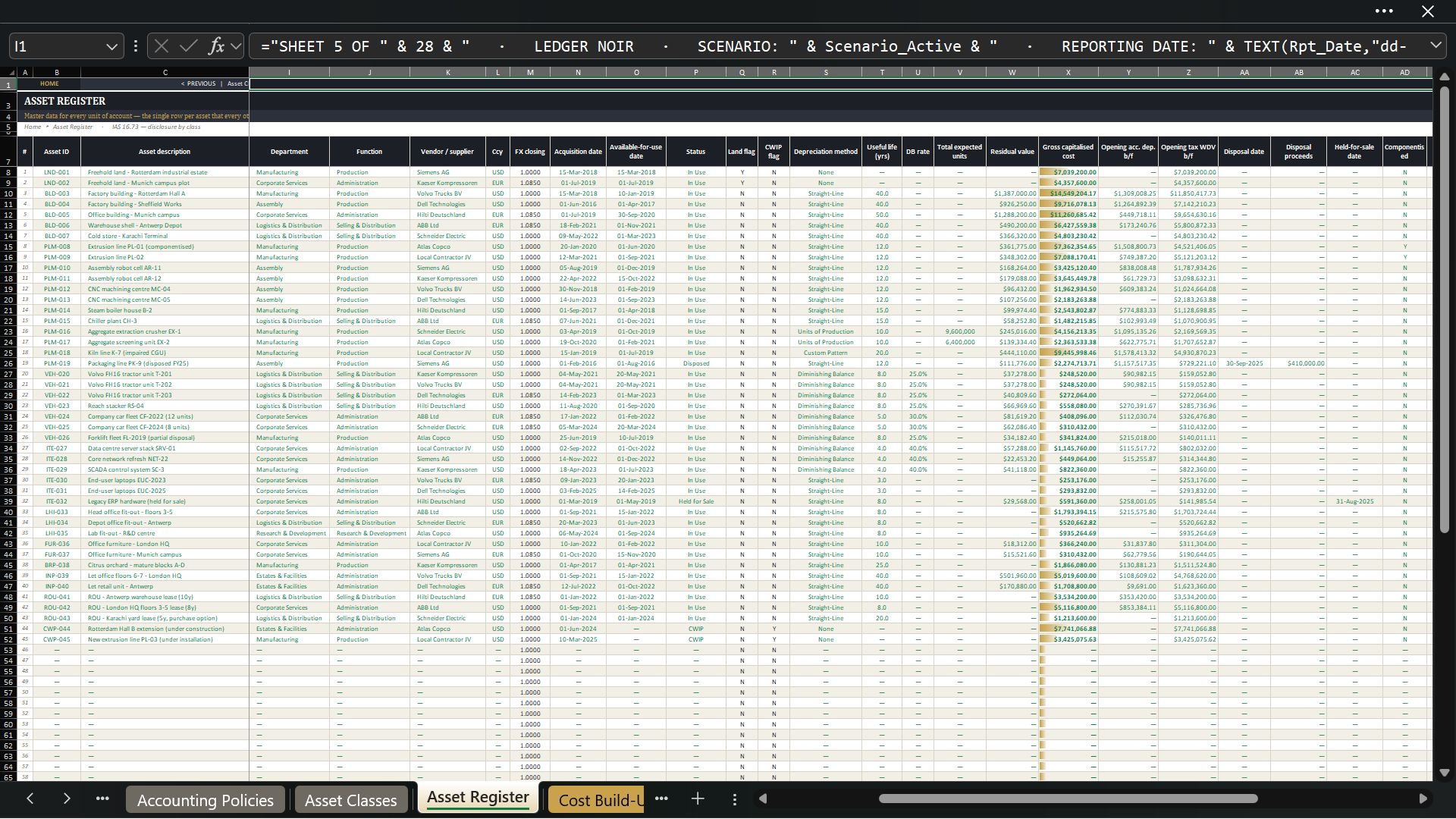
🧾 Asset Register and Cost Build-Up
The register captures the operational and accounting master data needed for each asset, including entity, class, location, cost centre, currency, acquisition and available-for-use dates, depreciation method, useful life, residual value, gross cost, opening balances, disposal information, held-for-sale date, componentization, pledged status, estimate reviews, measurement basis, carrying amount, and control status.

The Cost Build-Up sheet separates purchase price and directly attributable costs from excluded expenditure such as training, promotion, relocation, initial operating losses, and general overhead.

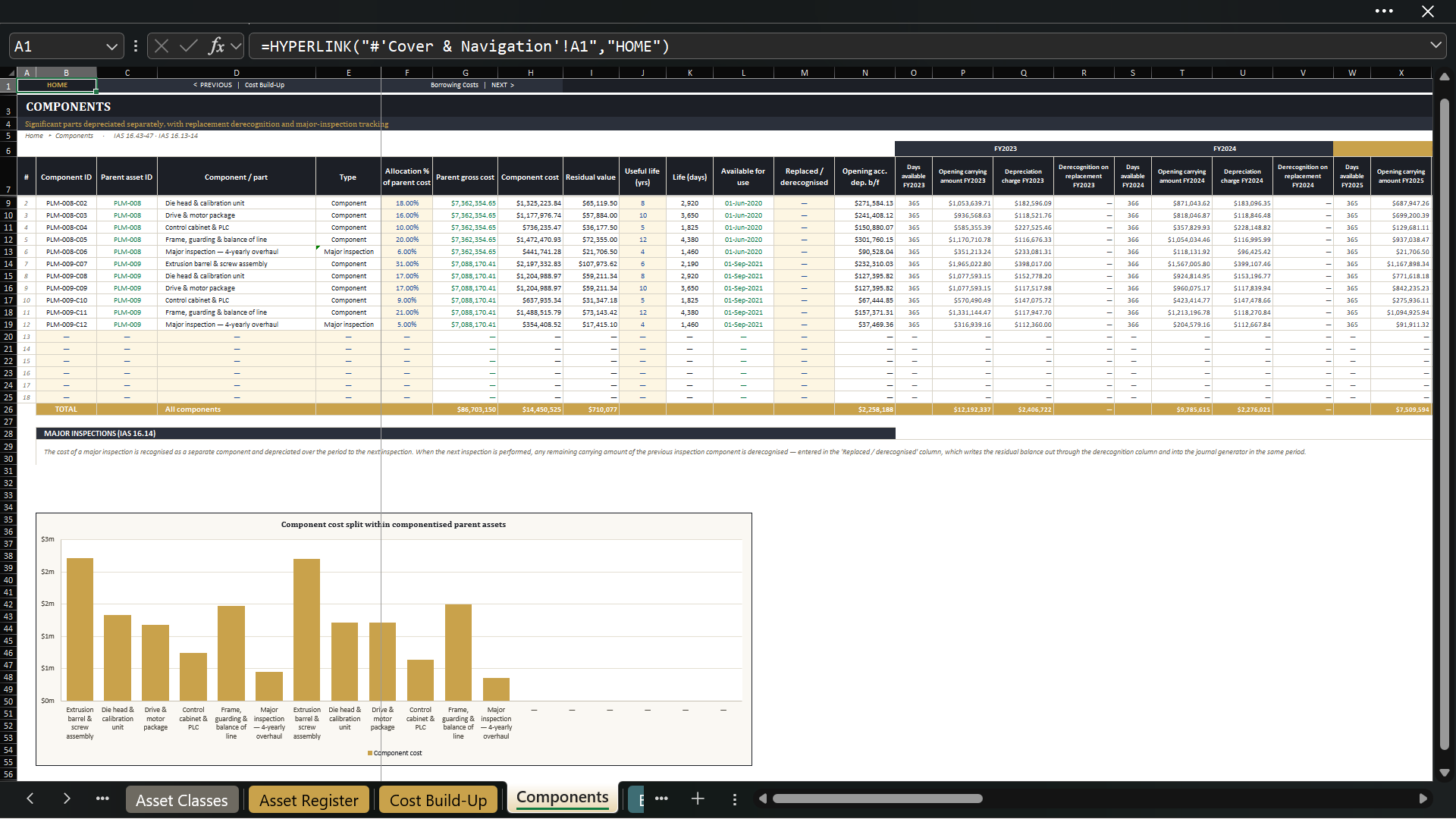
🧩 Components and Major Inspections
Significant parts and major inspections can be depreciated separately. The schedule tracks allocation, useful life, depreciation, replacement, derecognition, and parent reconciliation.

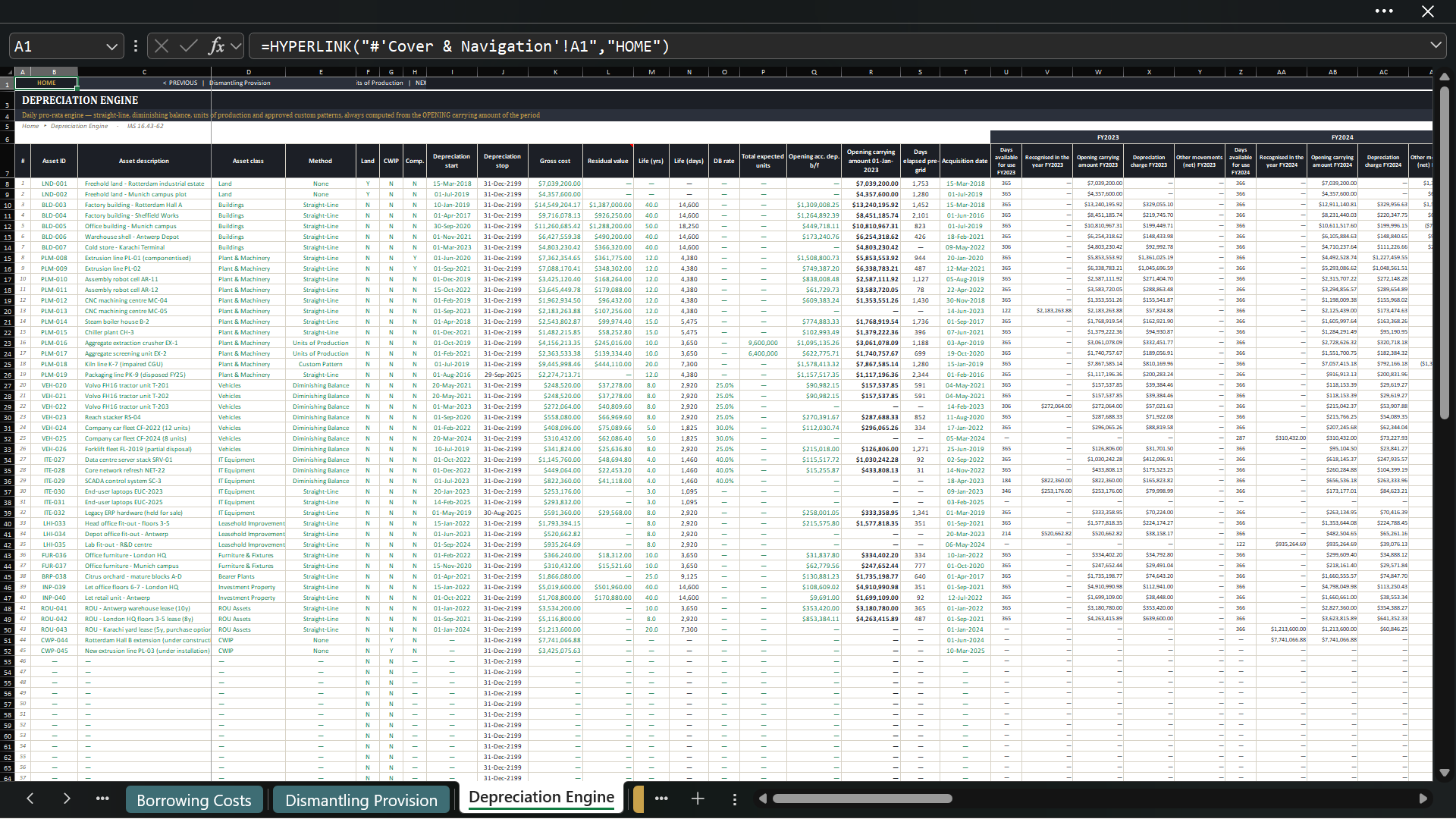
📅 Ten-Year Depreciation Engine
The daily pro-rata engine supports:

  • Straight-line depreciation
  • Diminishing-balance depreciation
  • Units-of-production depreciation
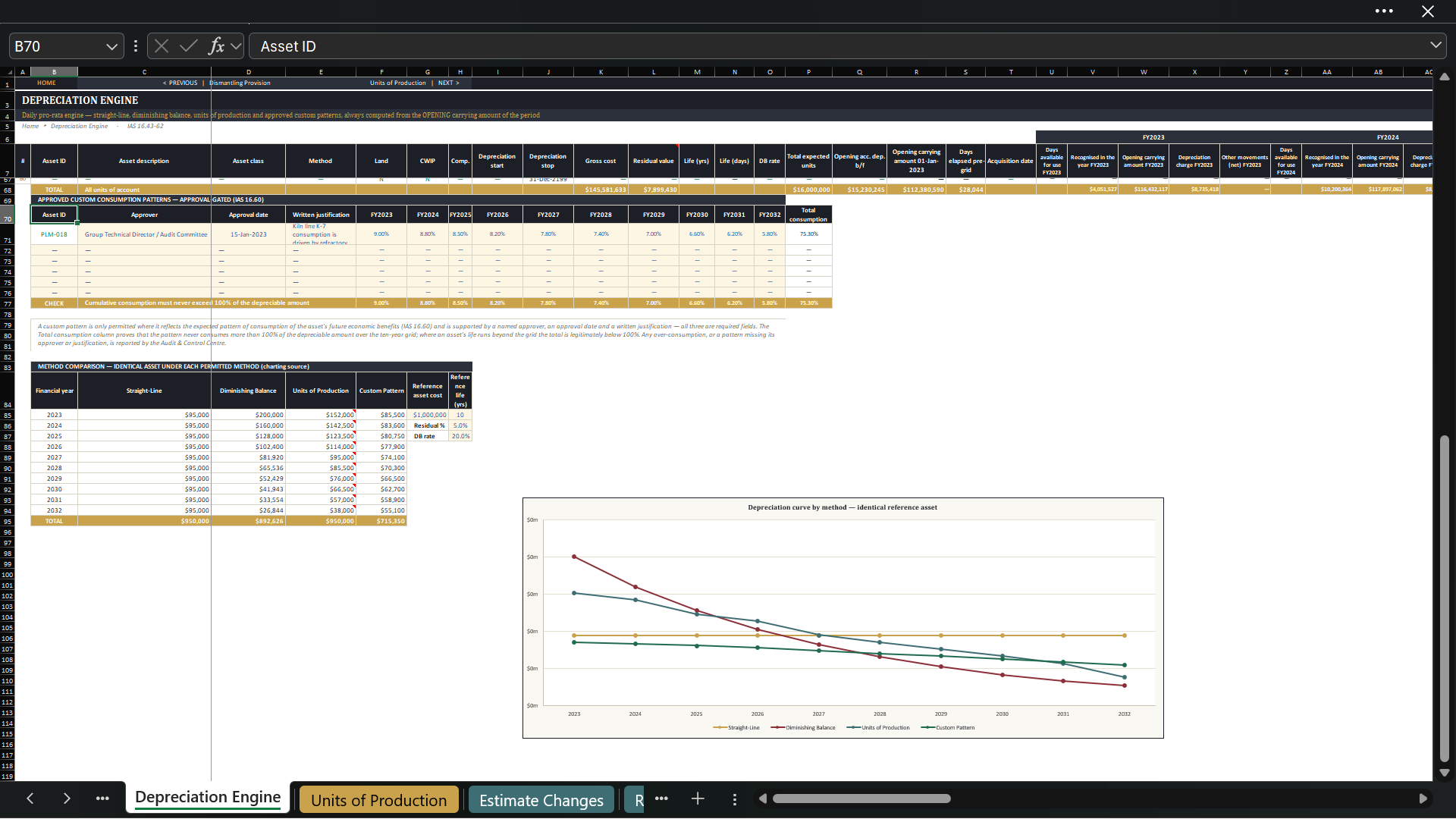
  • Approval-gated custom consumption patterns
  • Non-depreciable land and CWIP
  • Separate component depreciation
  • Residual-value floors
  • Monthly reporting-year charges
  • Revaluation, impairment, disposal, and held-for-sale movements

Depreciation is calculated from each period’s opening carrying amount, avoiding circular references. It does not begin before the asset is available for use, continues while an available asset is idle, and stops automatically on disposal or IFRS 5 classification. Custom patterns require approval evidence and are checked against over-consumption.

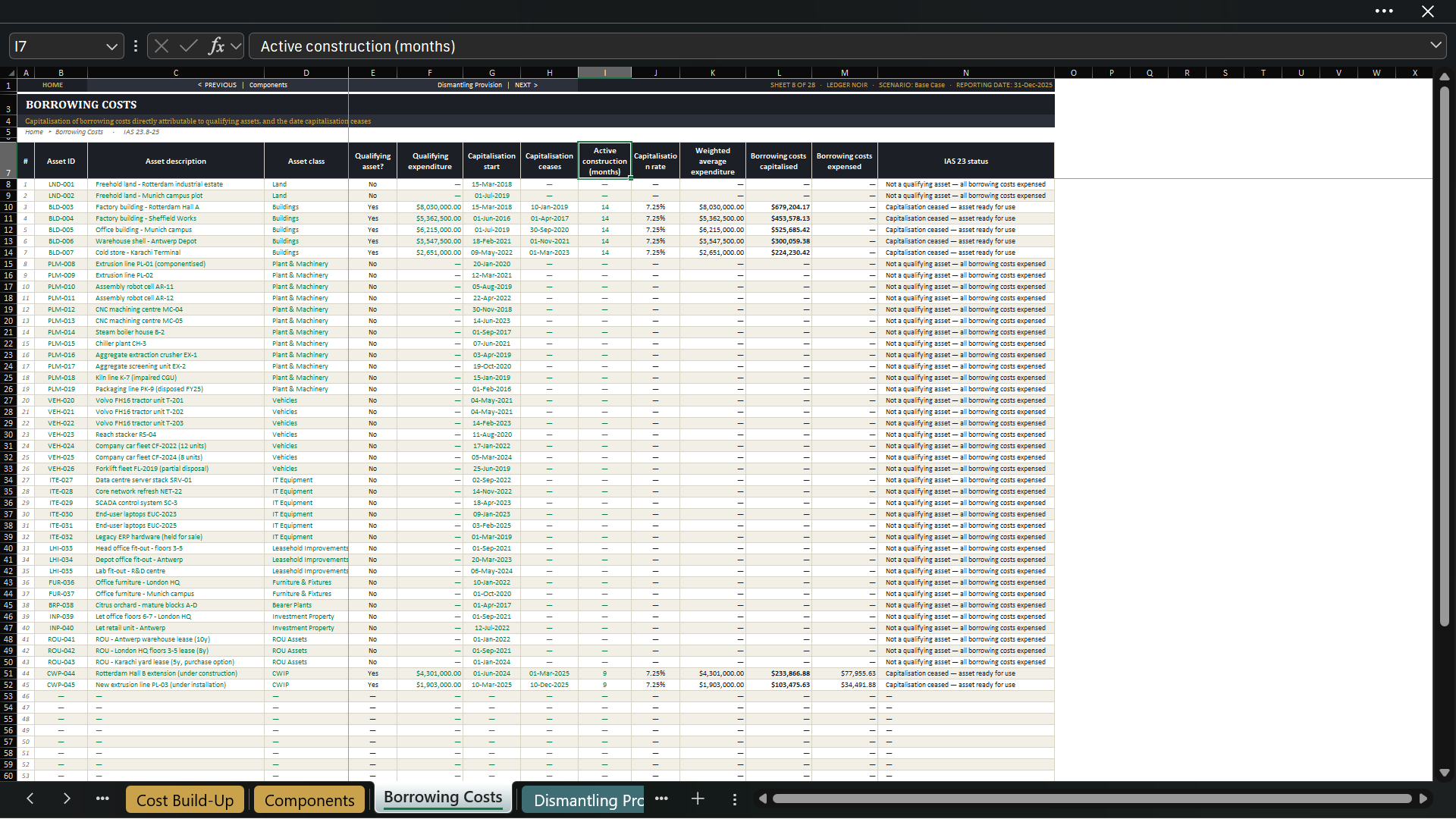
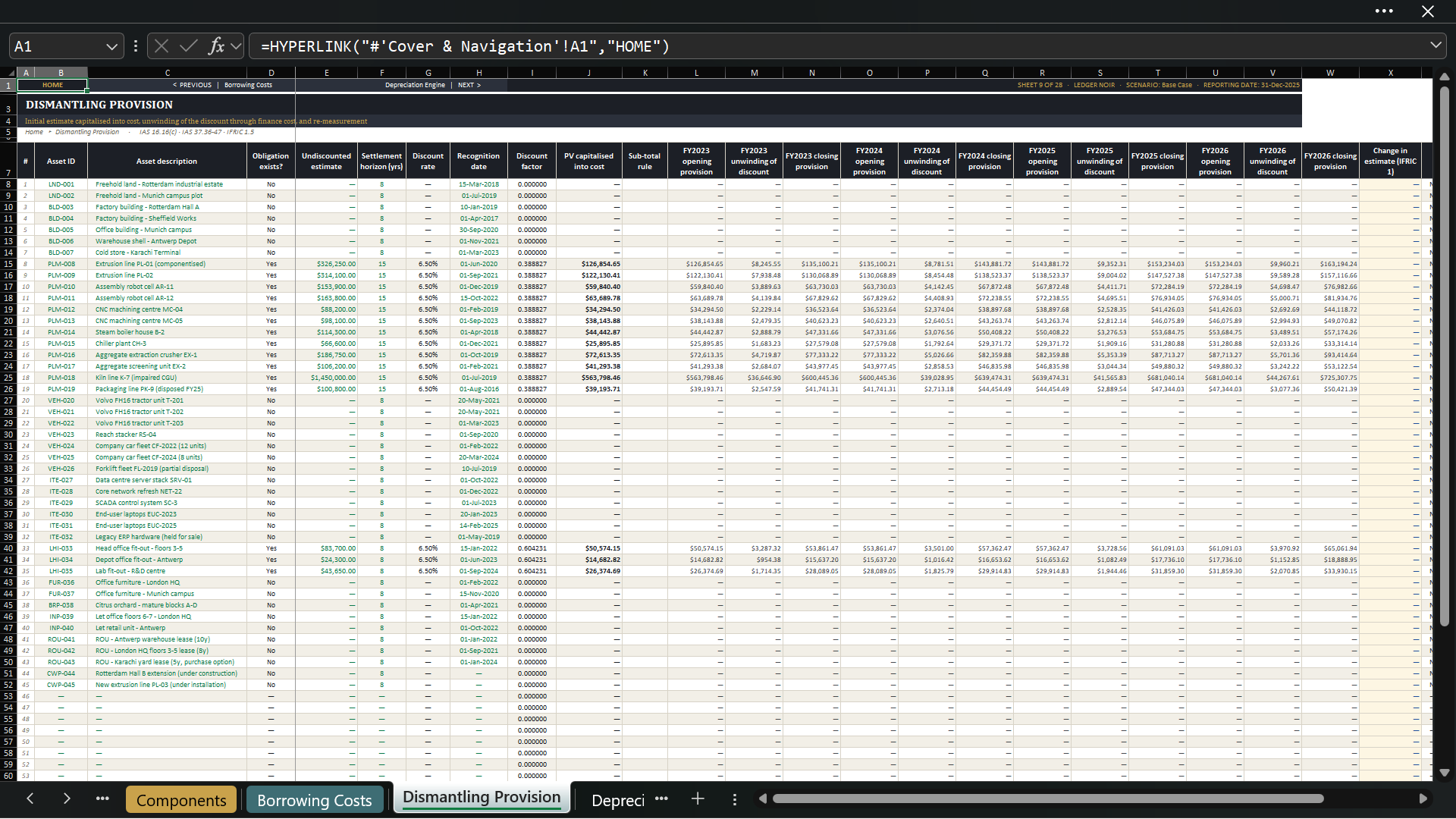
💳 Borrowing Costs and Dismantling Provisions
The IAS 23 module calculates qualifying expenditure, capitalization periods, rates, capitalized borrowing costs, expensed borrowing costs, and asset-level status.
The dismantling module calculates present value, capitalized asset cost, provision roll-forward, finance-cost unwinding, and IFRIC 1 remeasurement.

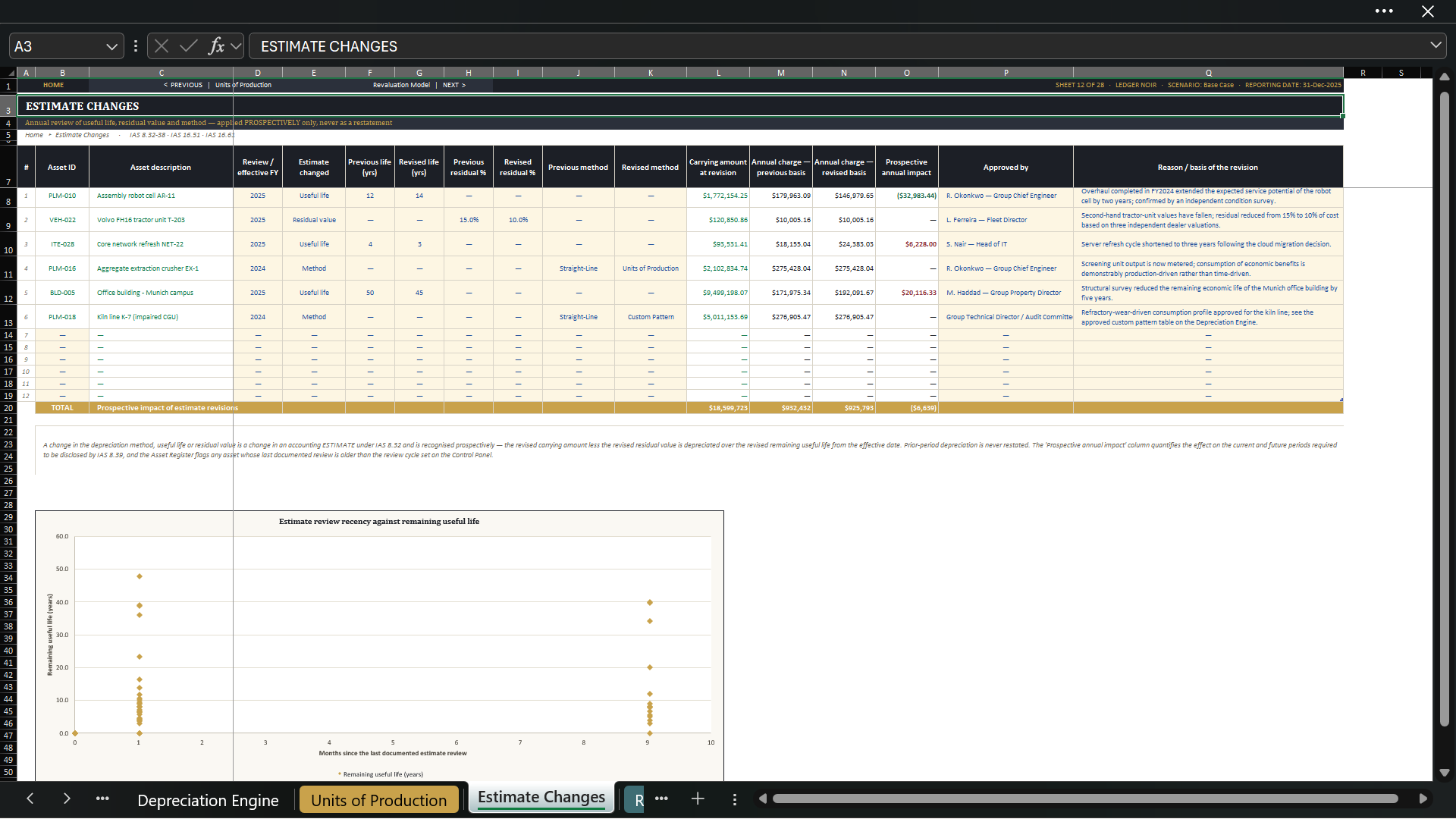
🔄 Estimate Changes
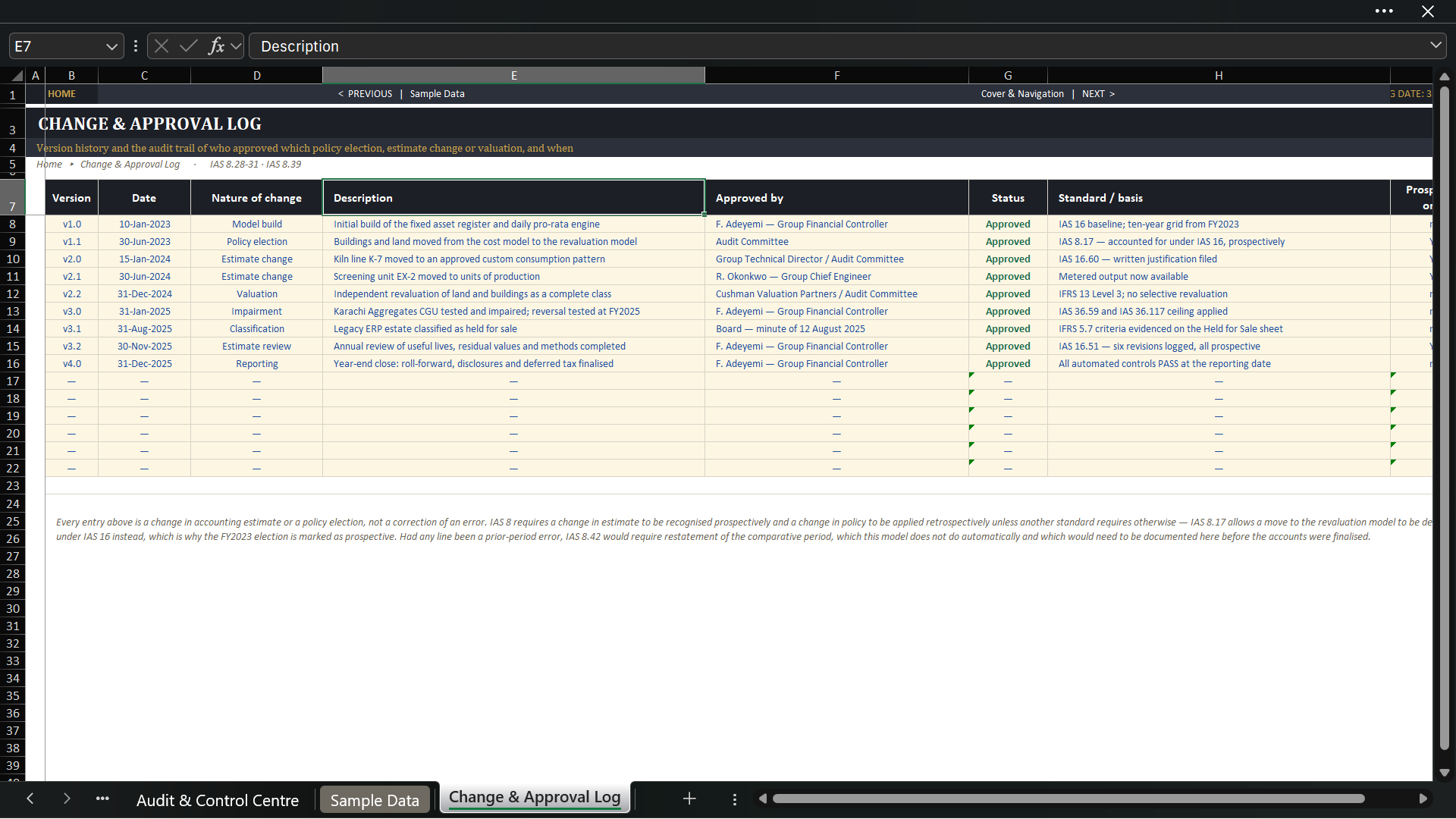
Useful-life, residual-value, and method changes are applied prospectively. The model compares previous and revised charges, calculates the future impact, records approval and rationale, and flags overdue reviews without automatically restating prior periods.

📈 Revaluation and Impairment
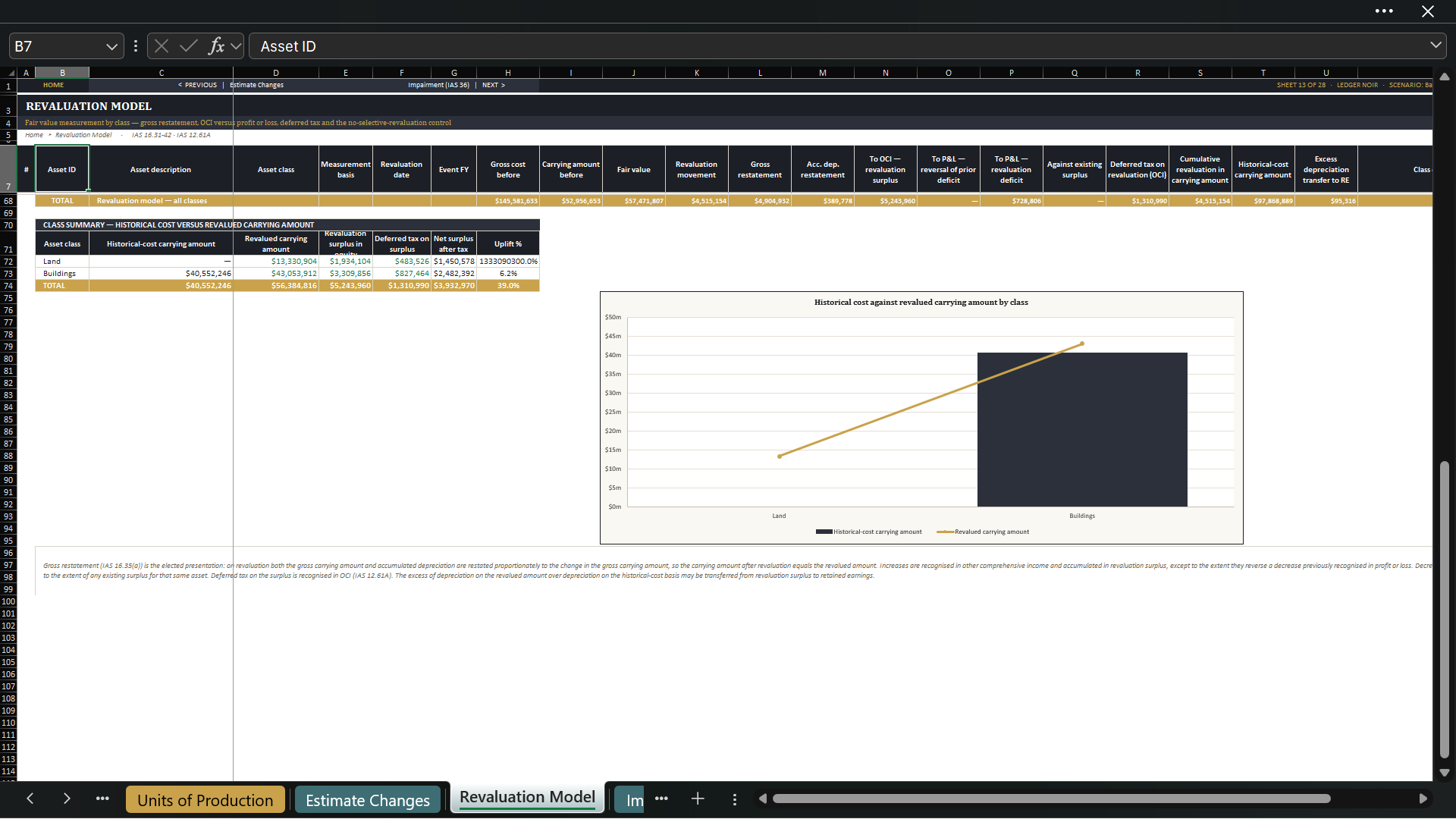
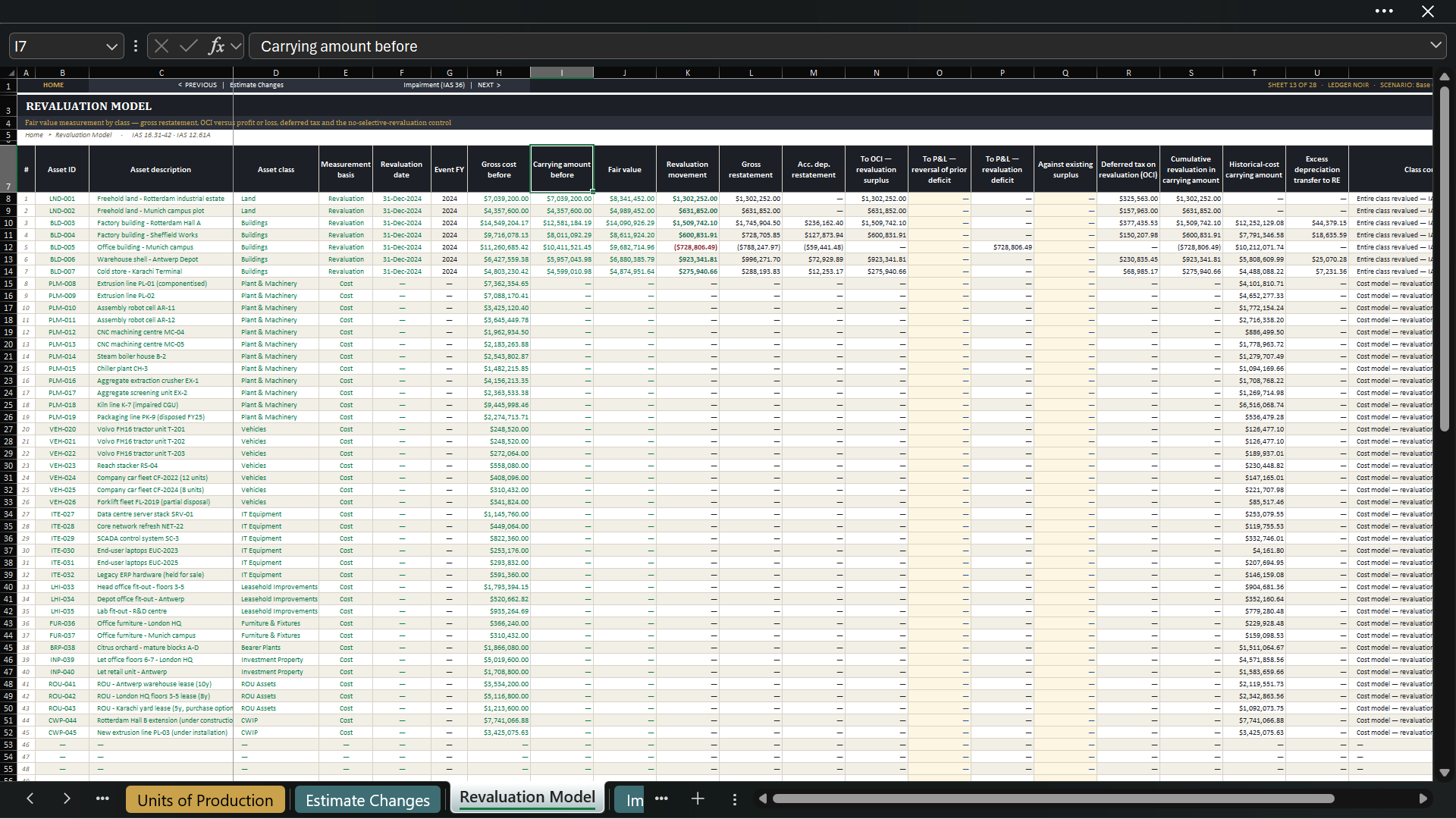
The Revaluation Model calculates gross and accumulated-depreciation restatement, OCI and profit-or-loss movements, deferred tax in OCI, historical-cost carrying amount, excess-depreciation transfers, and class completeness.
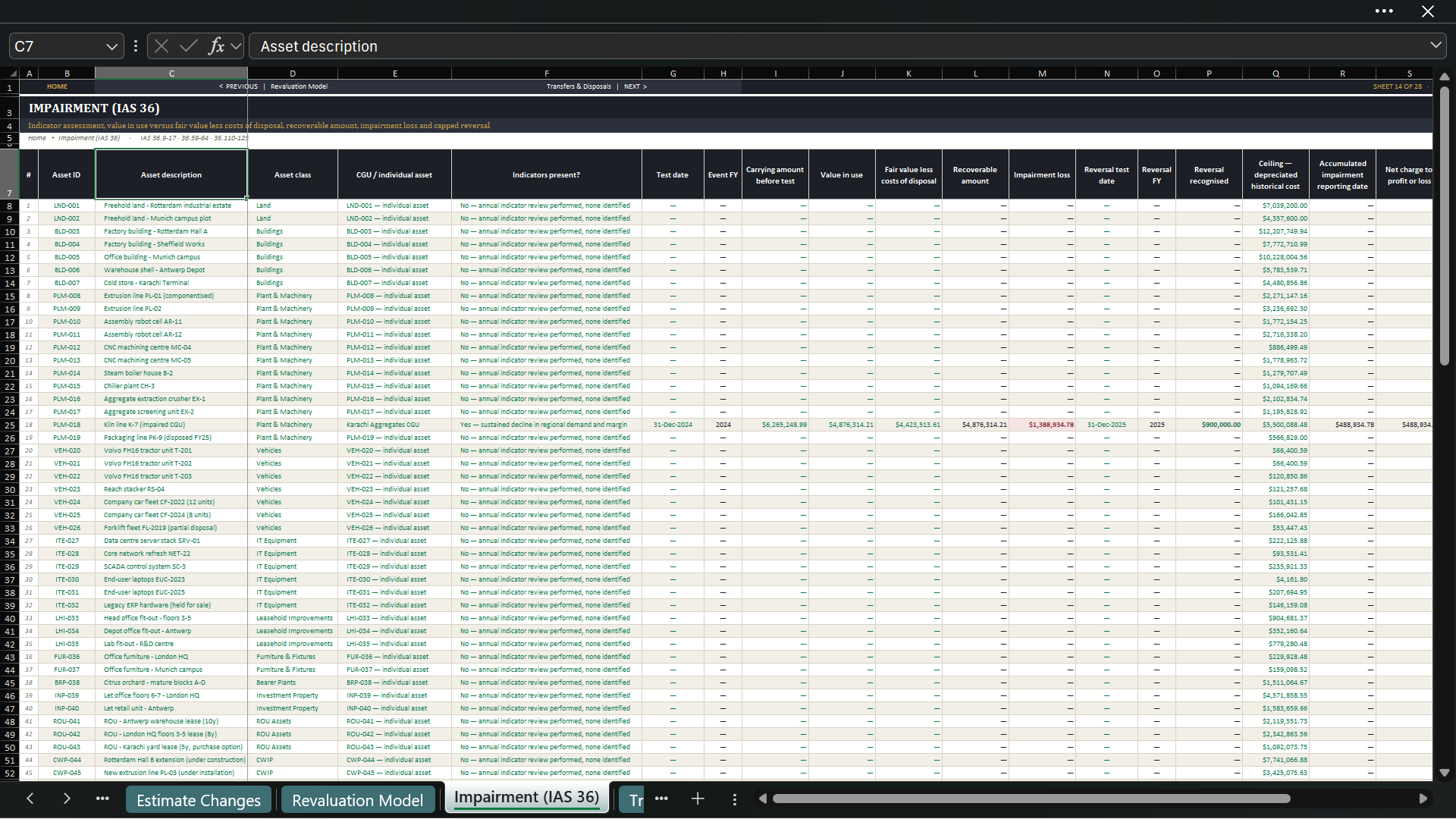
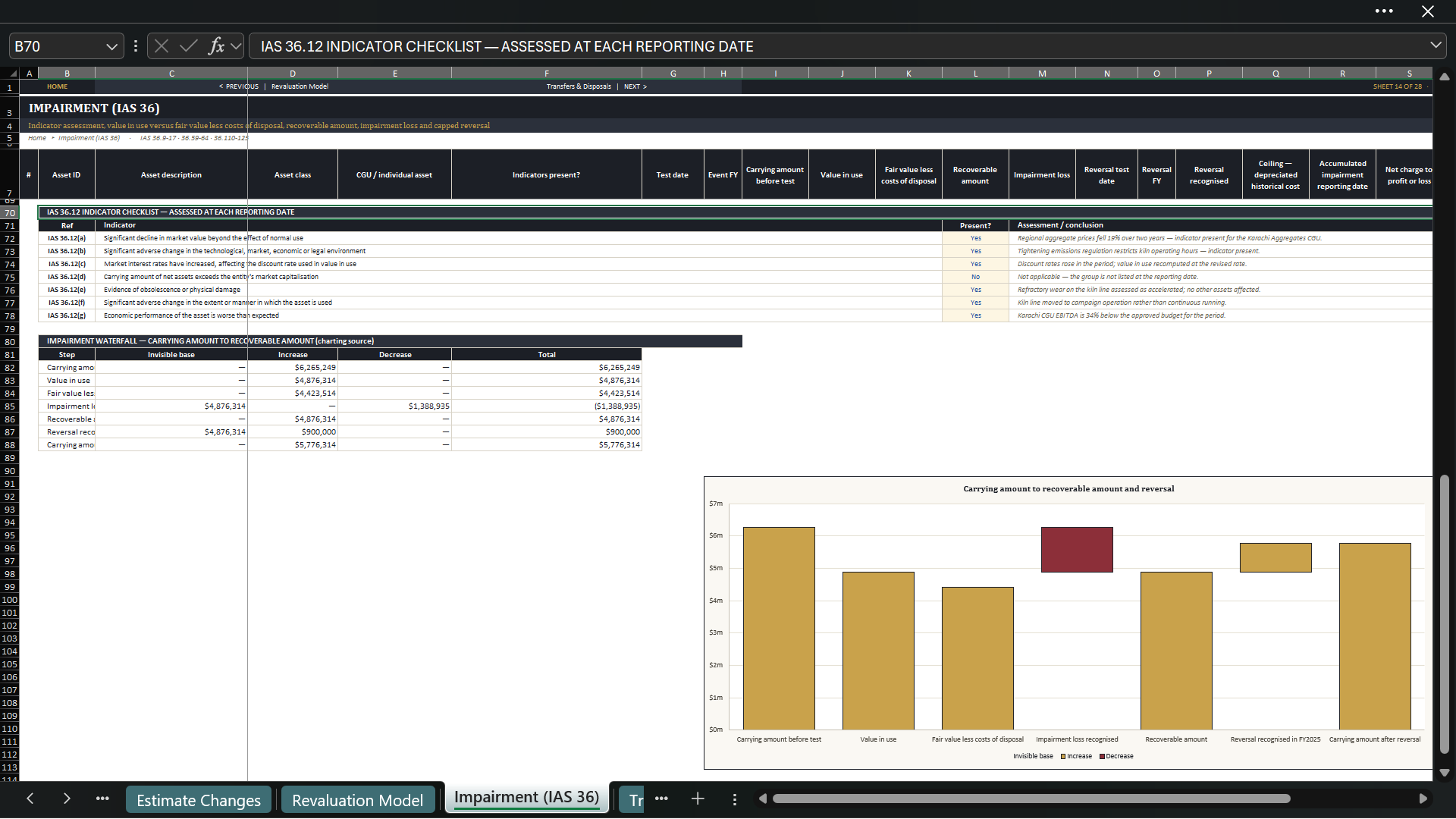
The IAS 36 module compares value in use with fair value less costs of disposal, calculates recoverable amount, losses and reversals, and applies the reversal ceiling. Users must supply supported valuation inputs.

🔁 Disposals and Held for Sale
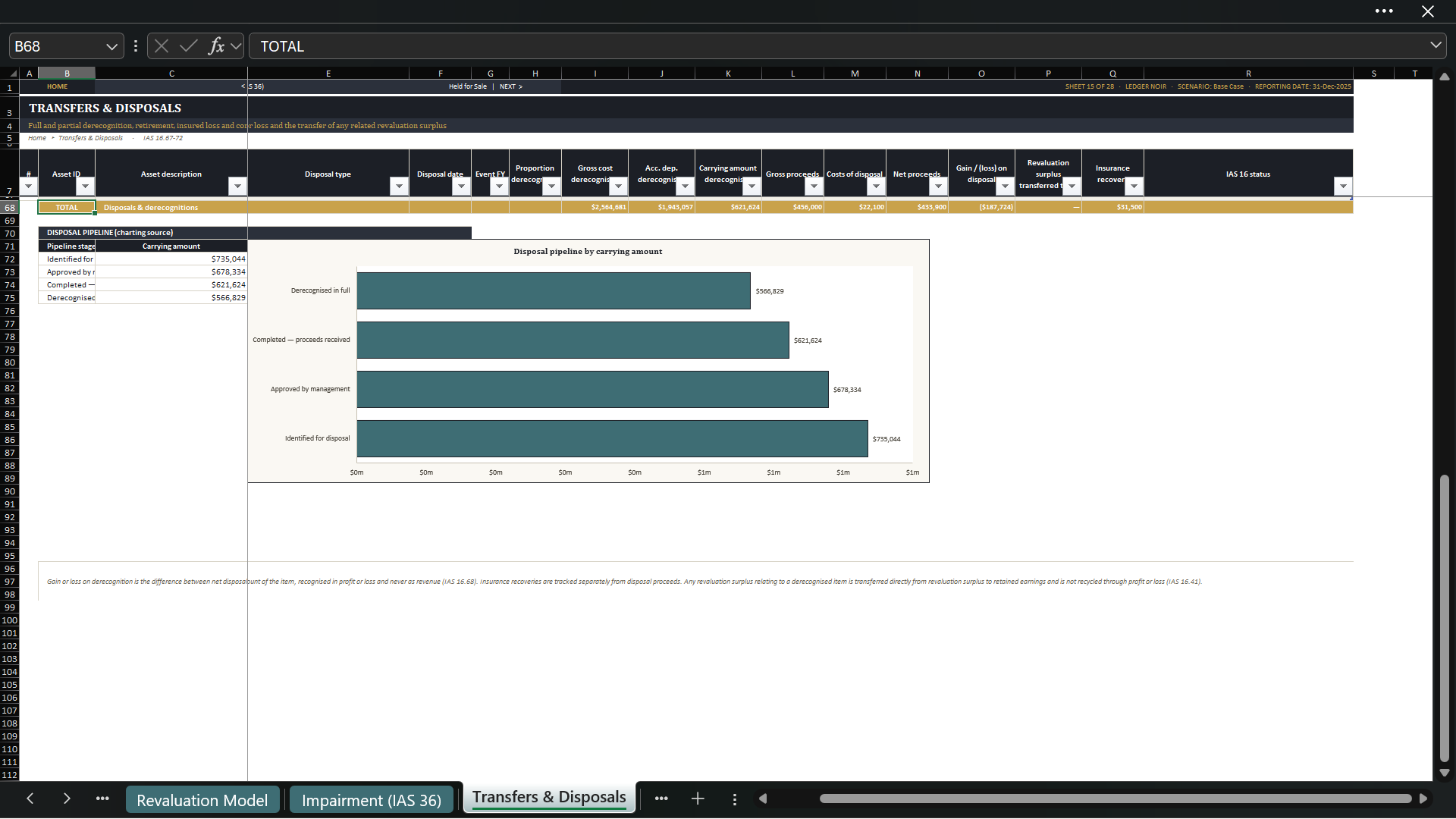
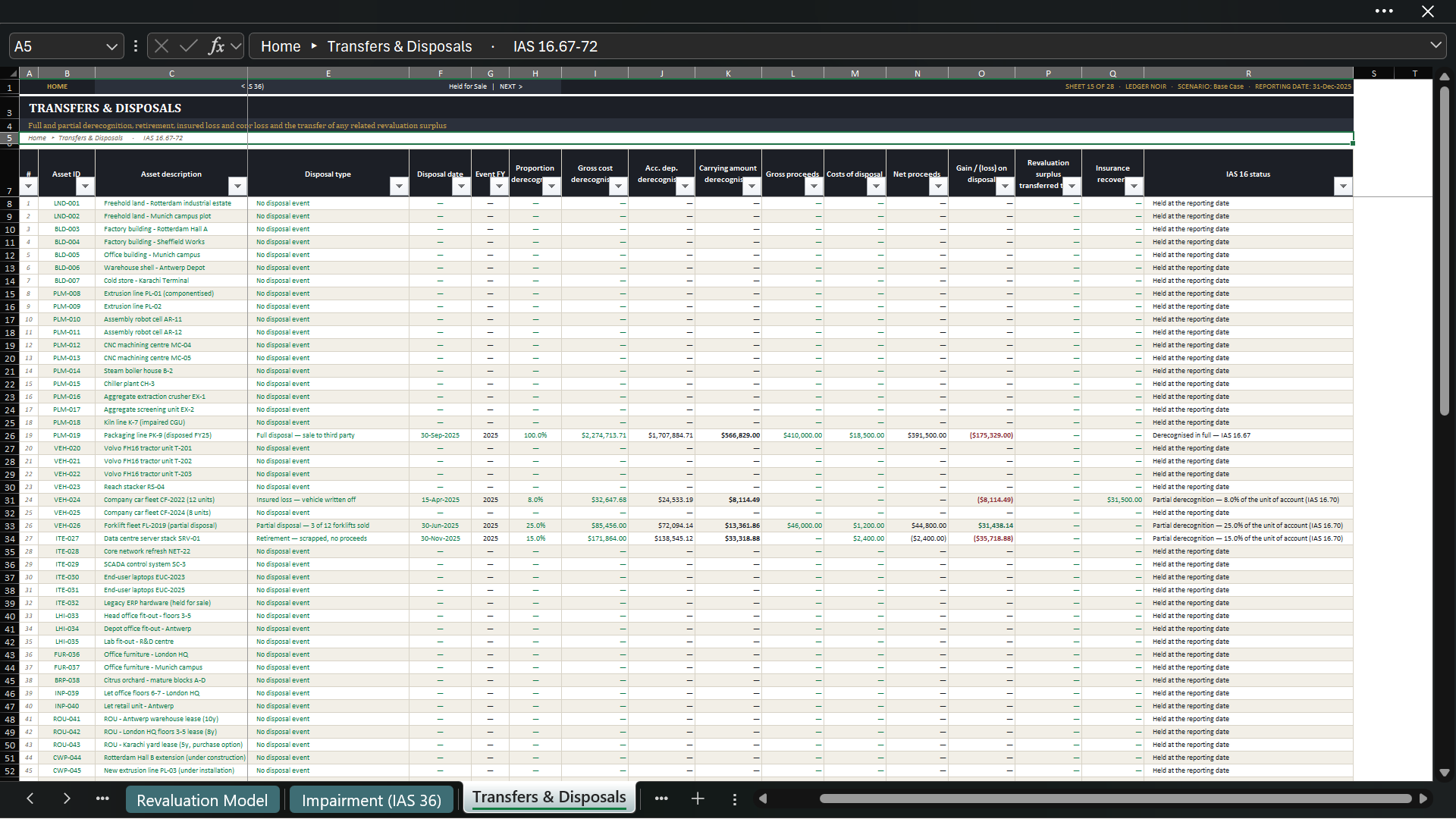
The disposal schedule supports full and partial derecognition, proceeds, disposal costs, gains or losses, surplus transfers, and insurance recovery.
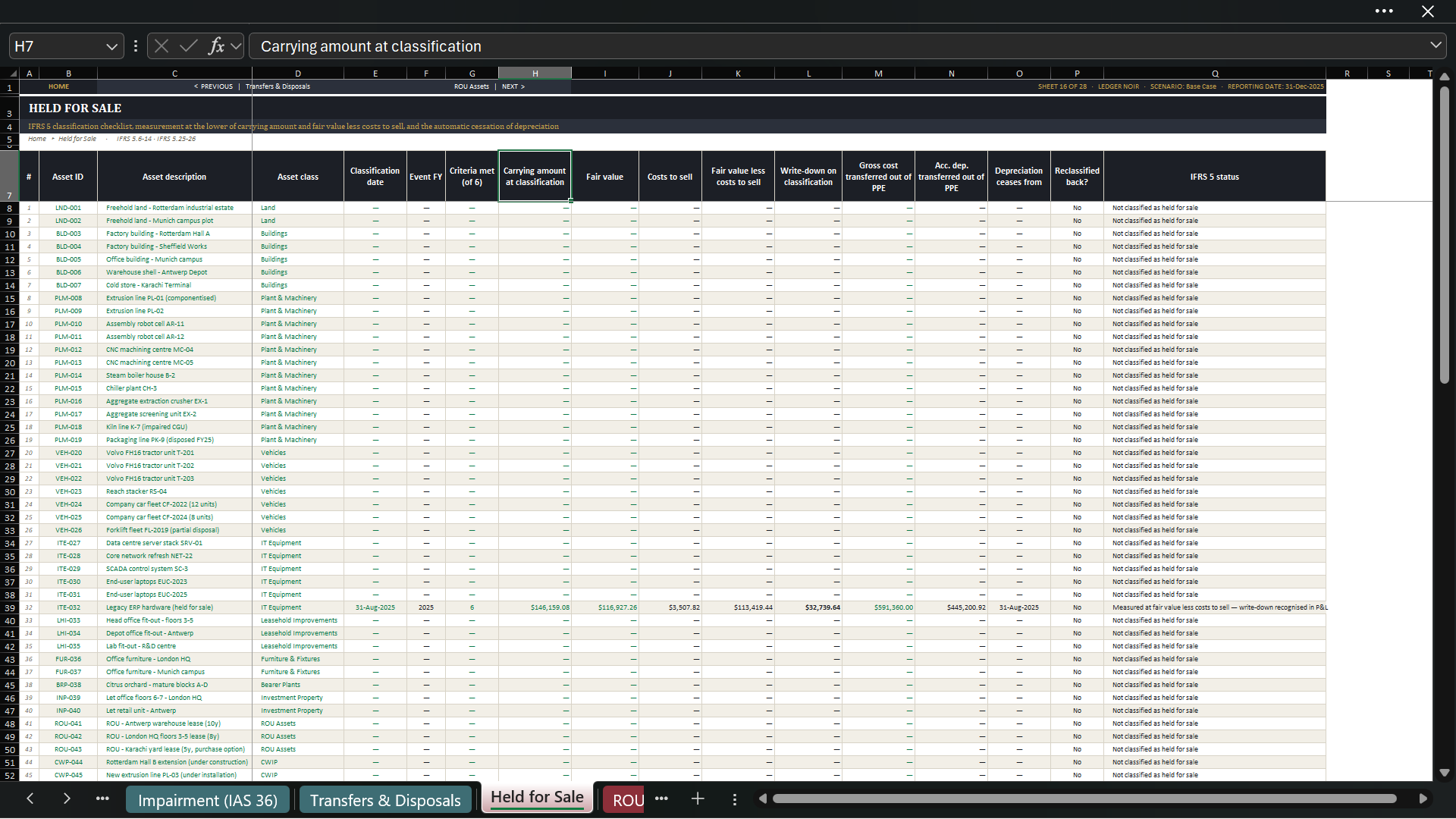
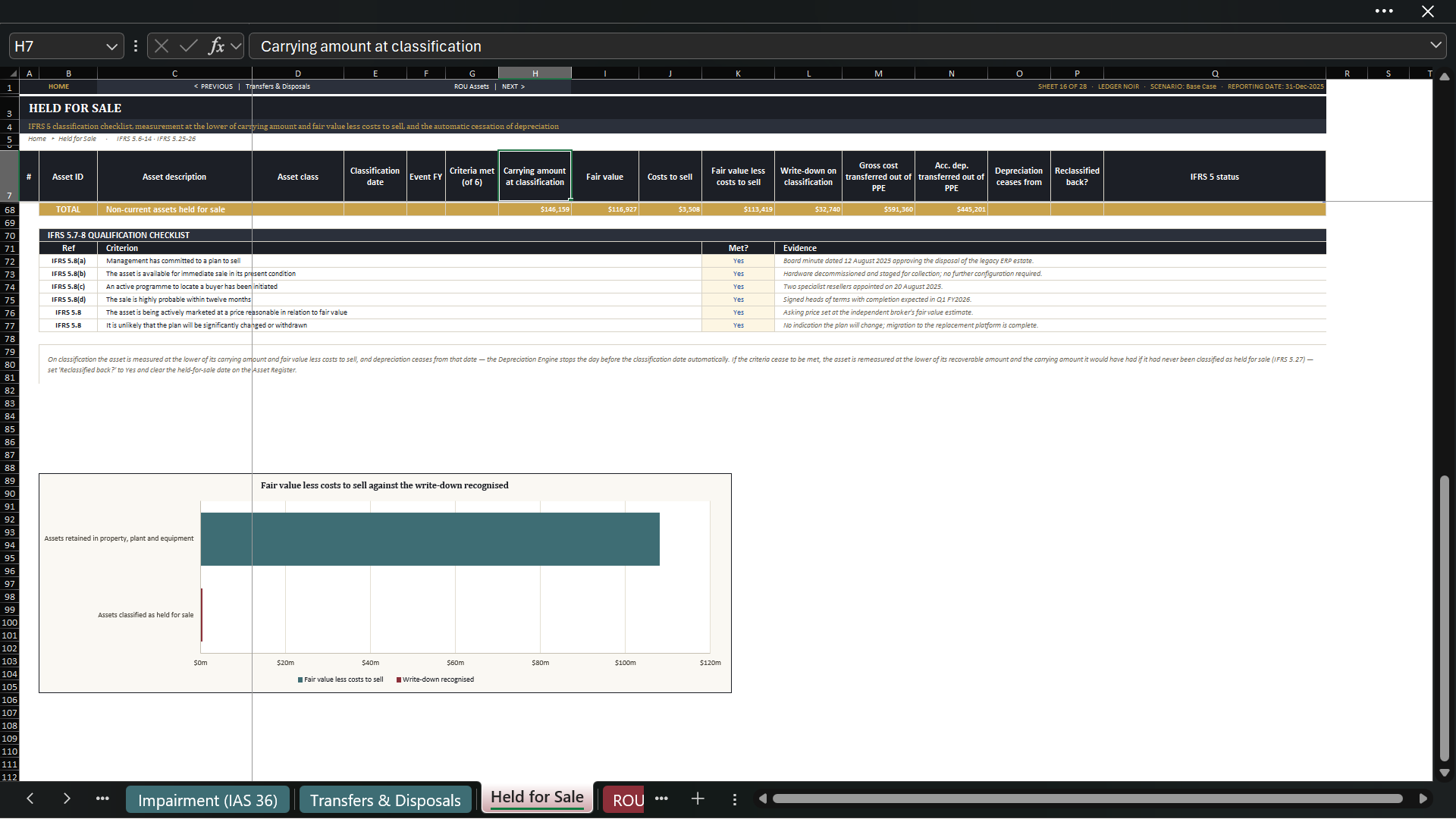
The IFRS 5 module includes a six-condition checklist, lower-of measurement, write-down, PPE reclassification, reclassification-back support, and automatic depreciation cessation.

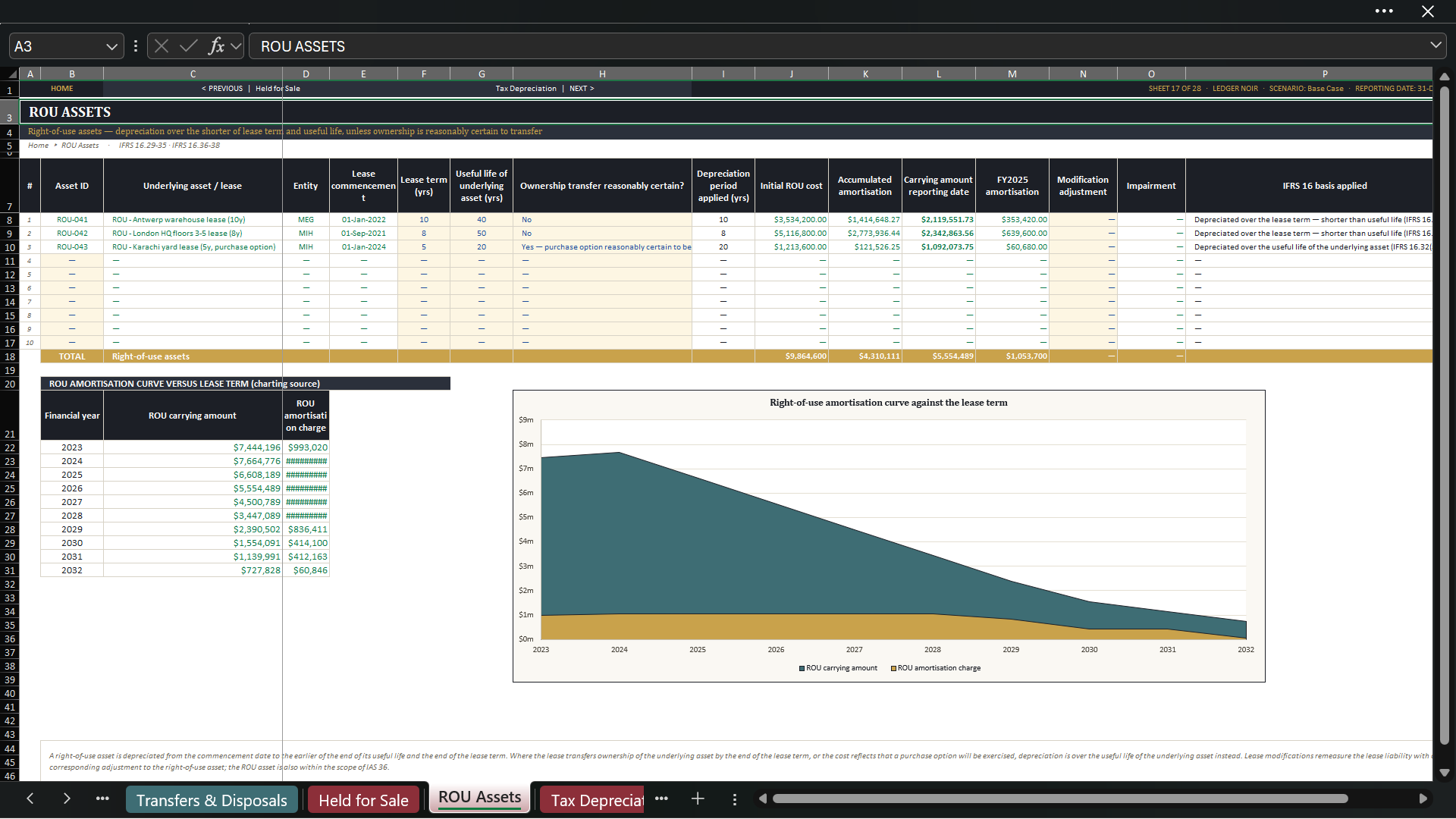
🏢 ROU-Asset Depreciation
The IFRS 16 schedule tracks lease term, useful life, ownership or purchase-option assessment, depreciation period, ROU cost, carrying amount, charge, modifications, and impairment.
This schedule covers ROU-asset depreciation; it is not a complete lease-liability amortization or lease-management engine.

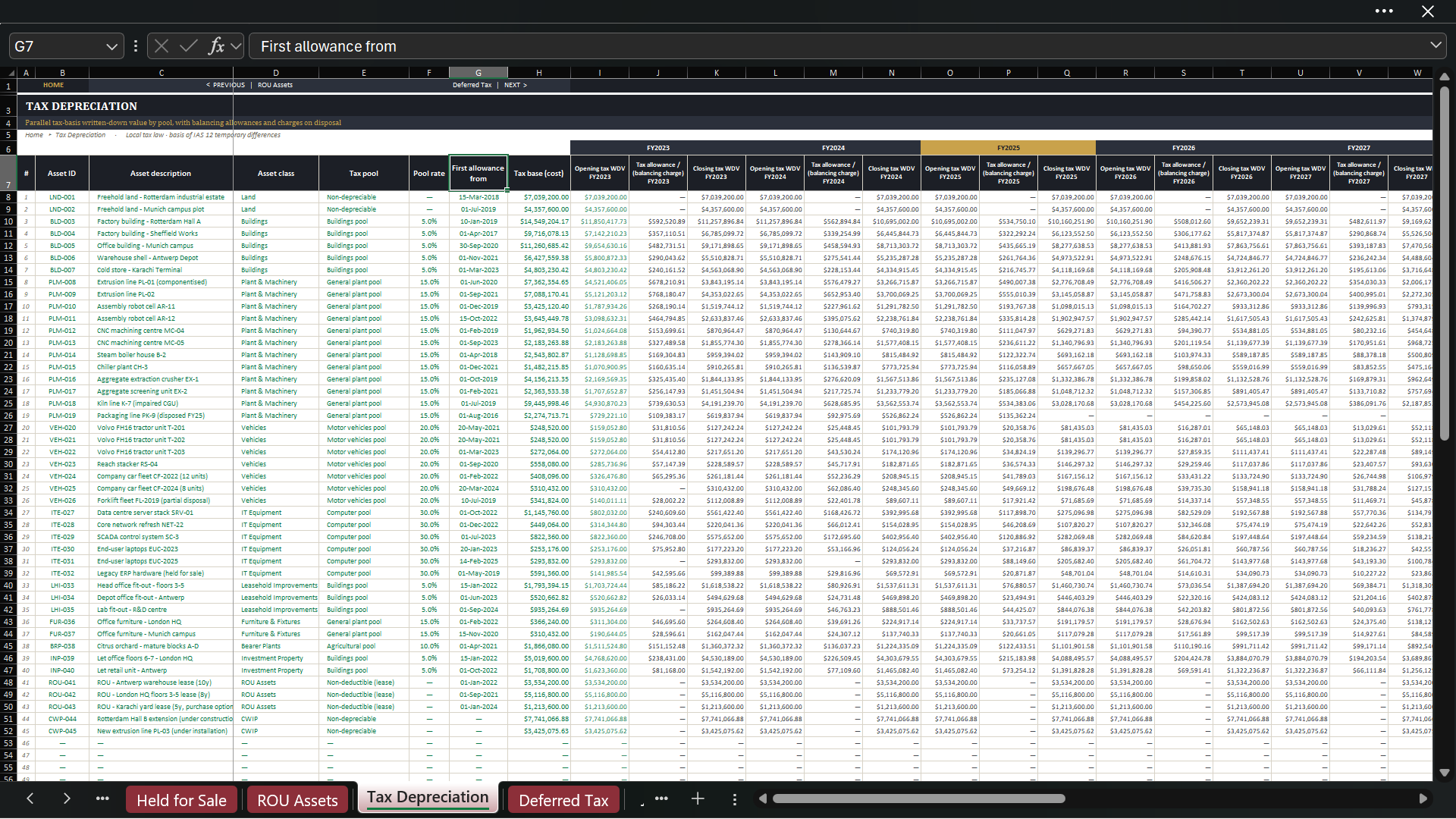
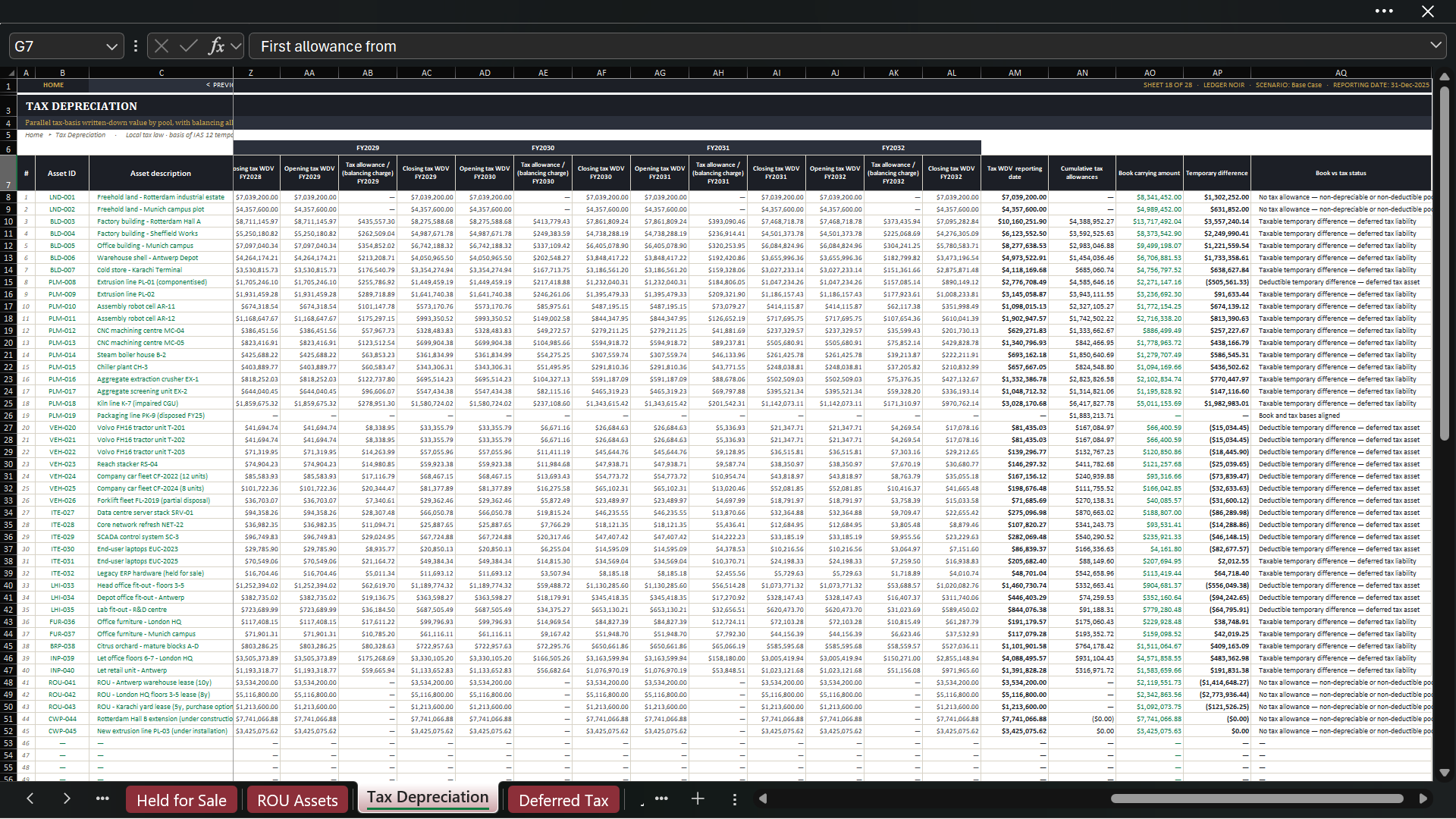
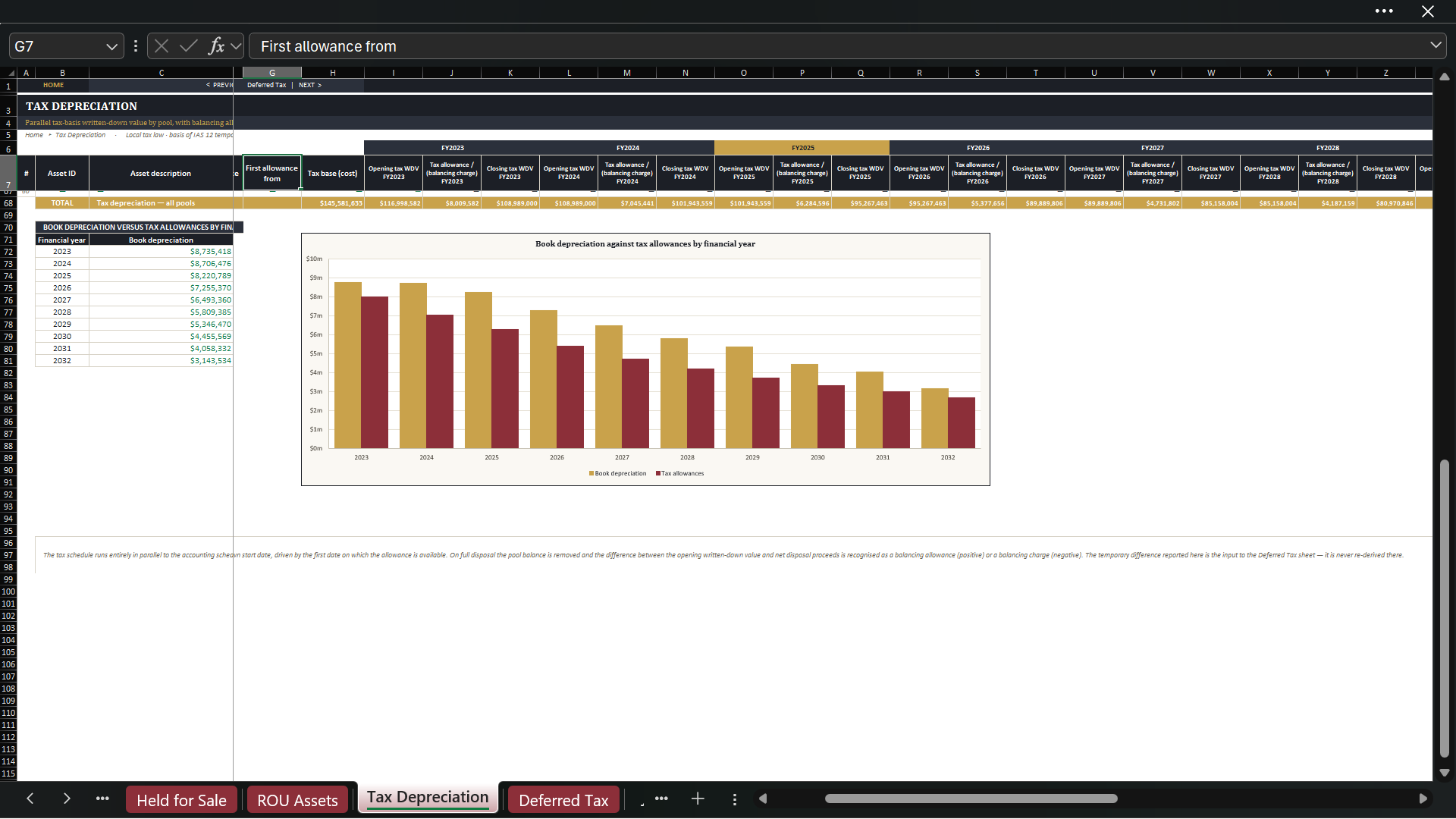
🧮 Tax Depreciation and Deferred Tax
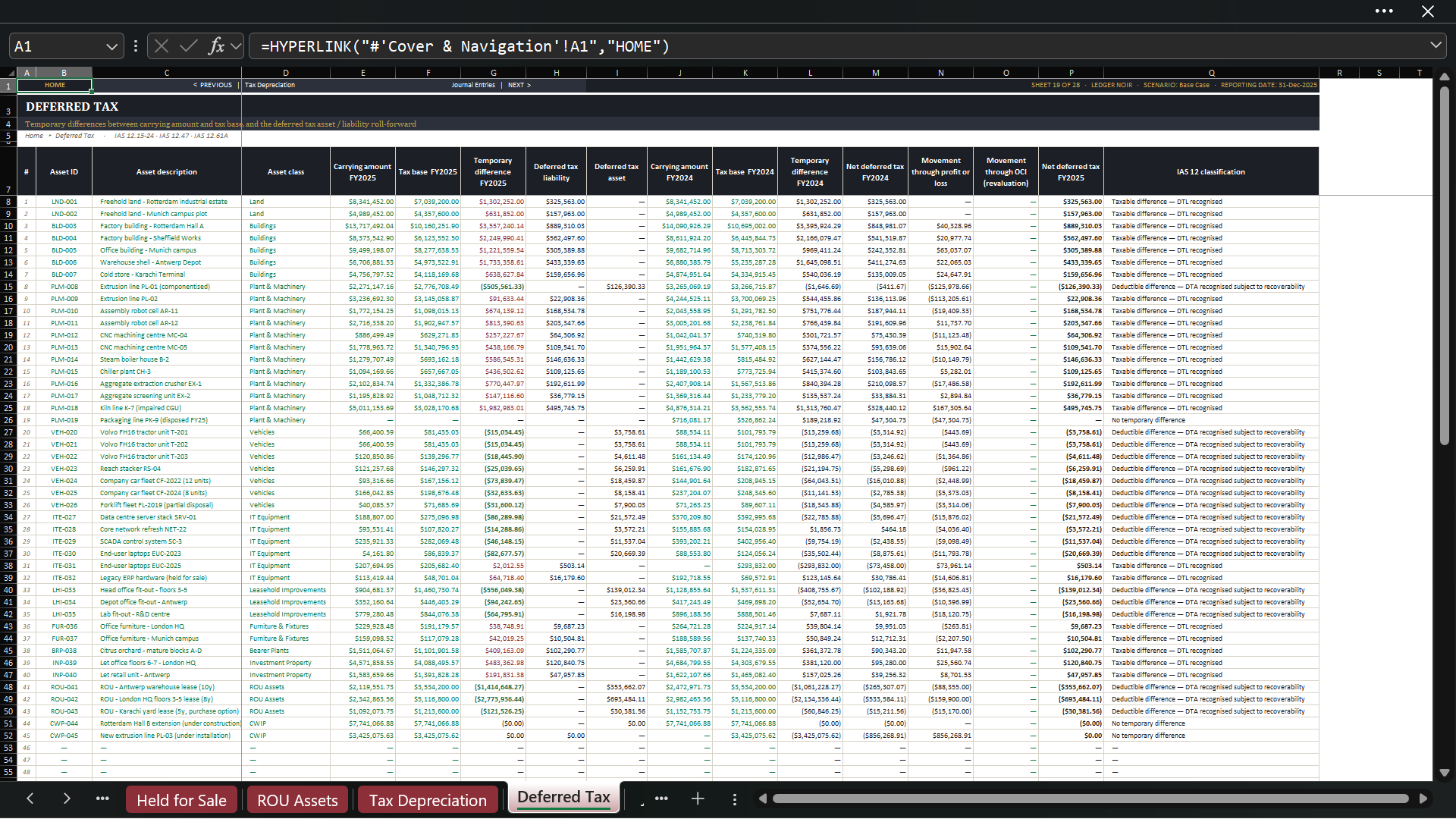
The tax schedule includes configurable pools, rates, tax WDV, allowances, balancing adjustments, and temporary differences.
The IAS 12 sheet calculates temporary differences, deferred-tax assets and liabilities, profit-or-loss and OCI movements, and the closing position. Illustrative tax inputs must be replaced with applicable rules.

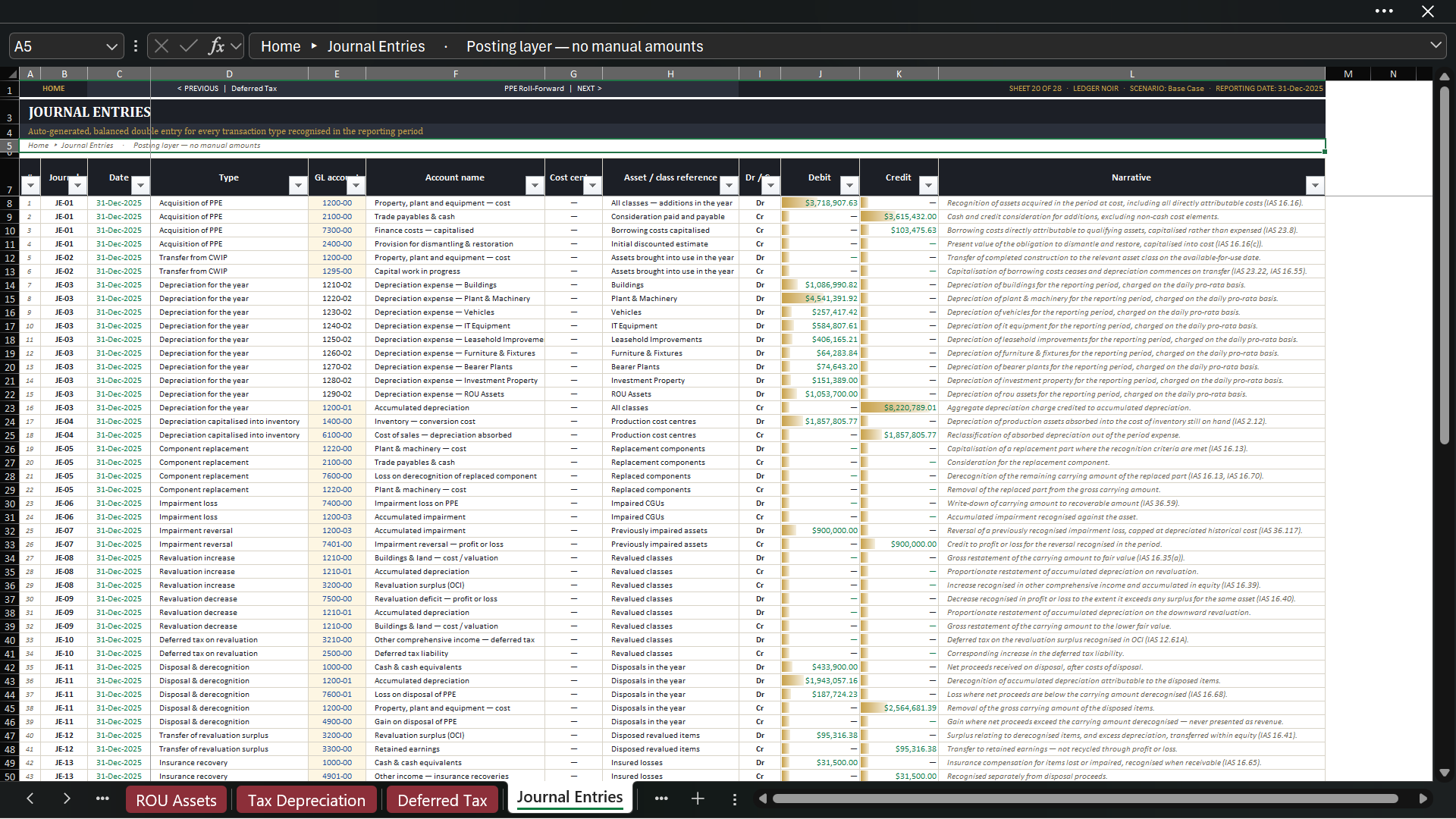
🧾 Auto-Generated Journals
The workbook generates balanced entries for acquisitions, borrowing costs, provisions, CWIP, depreciation, components, impairment, revaluation, disposals, held-for-sale movements, and deferred tax.
Each line includes posting details, amount, and narrative, while a live control confirms that every journal balances.

📑 Roll-Forwards, Disclosures, and Reporting
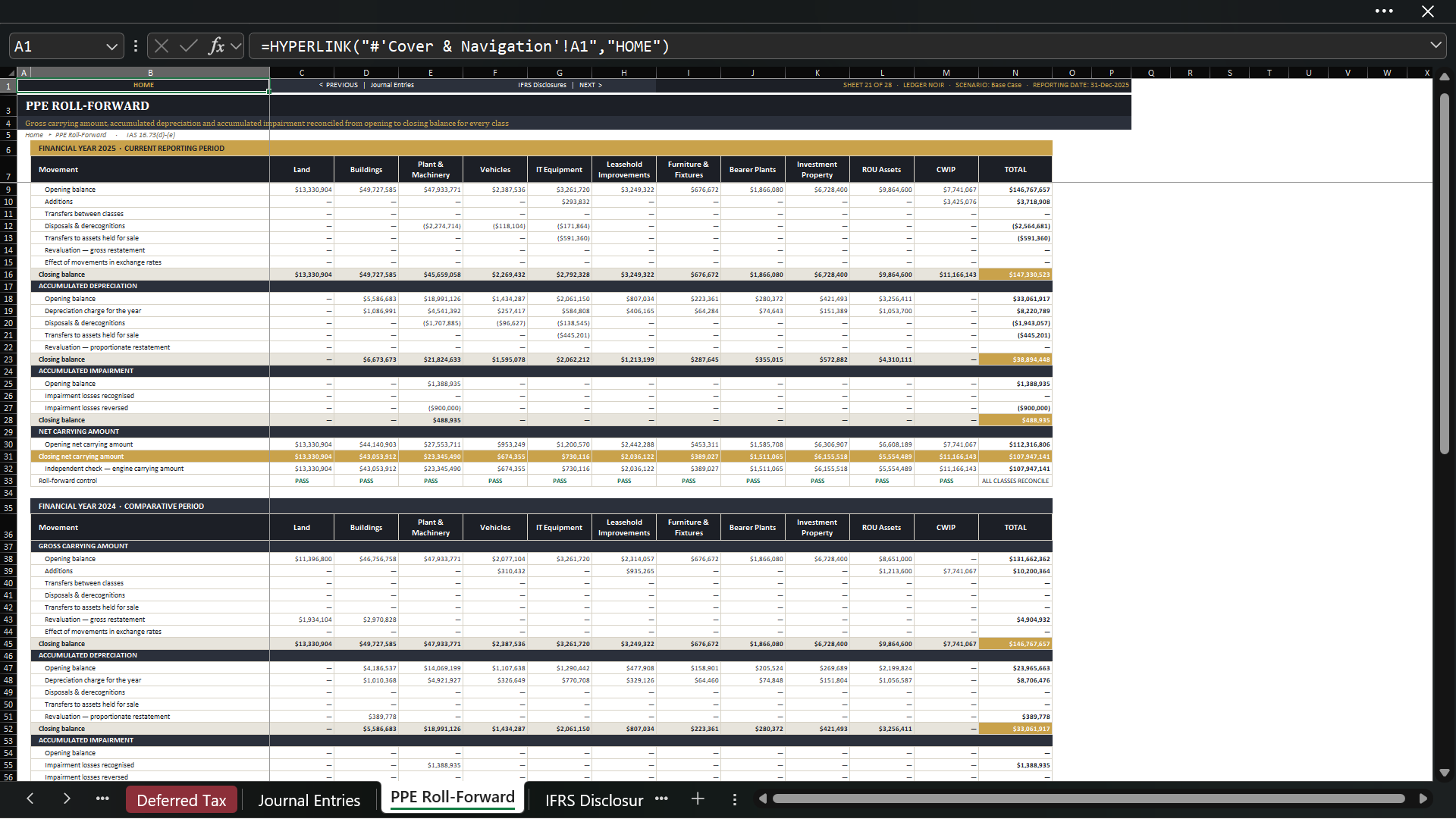
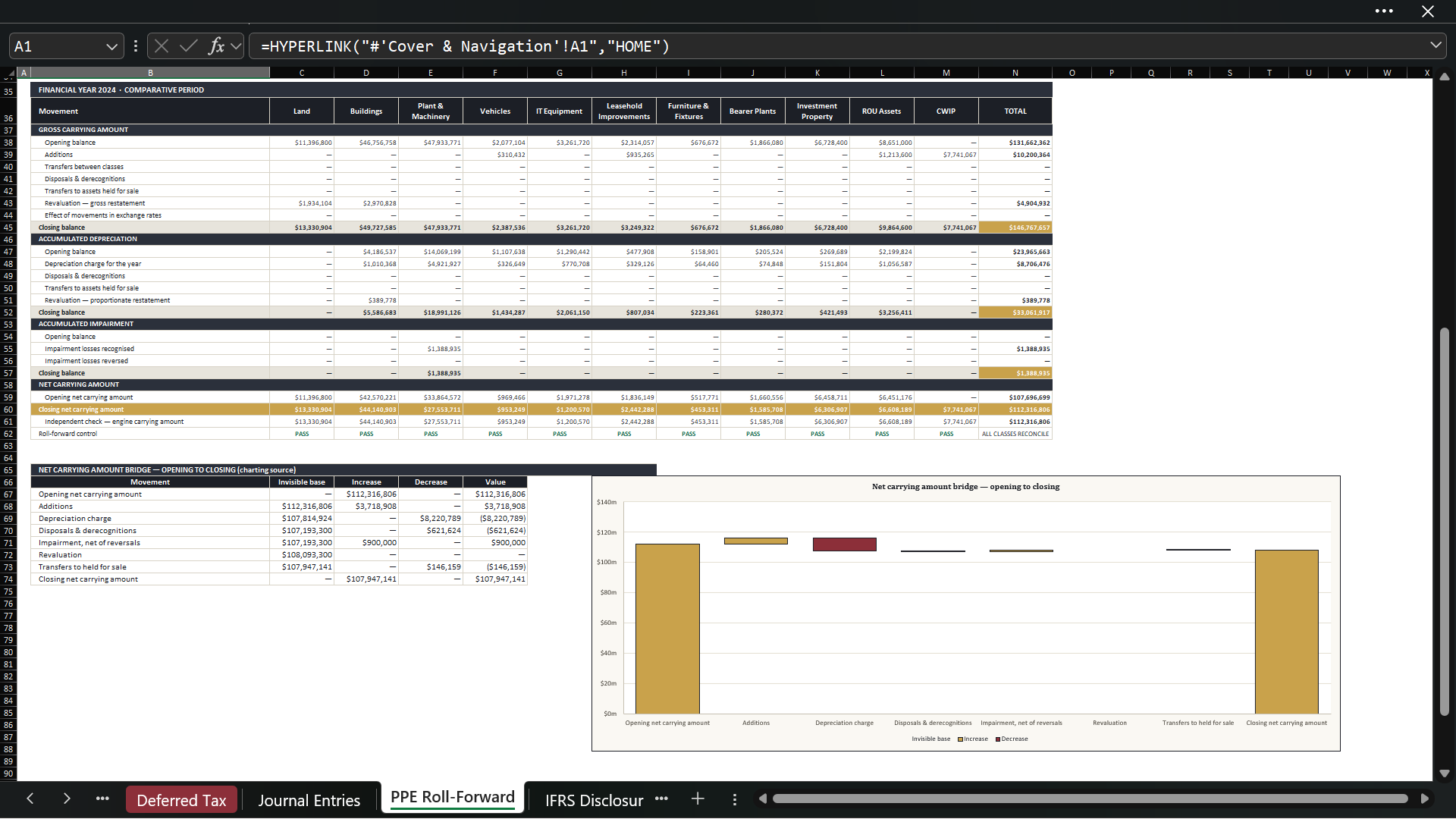
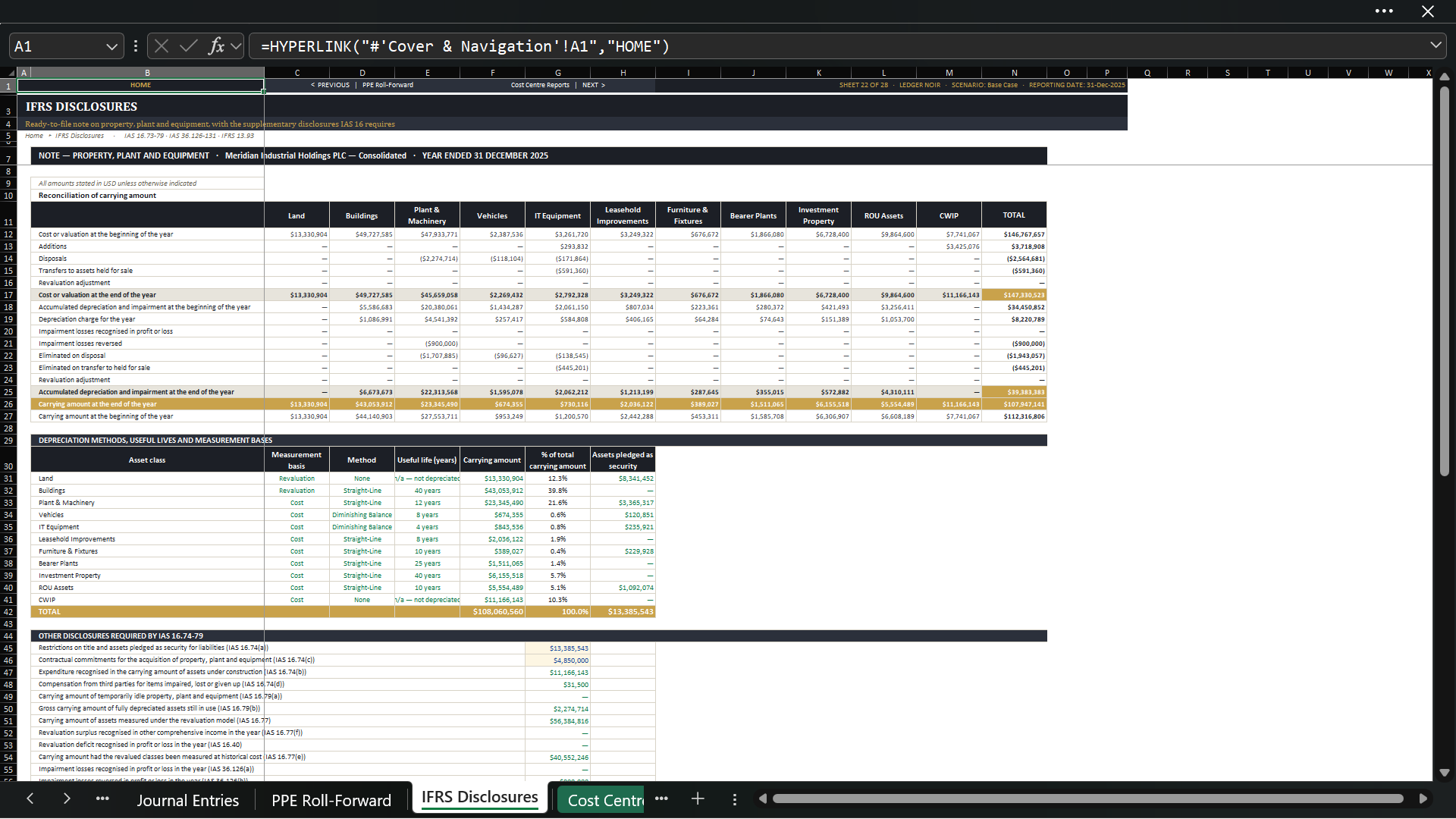
The PPE Roll-Forward reconciles gross carrying amount, accumulated depreciation, impairment, and net carrying amount by class for current and comparative periods.
The disclosure note presents class movements, policies, useful lives, pledged assets, commitments, revaluation, impairment, ROU assets, held-for-sale assets, borrowing costs, and provisions.
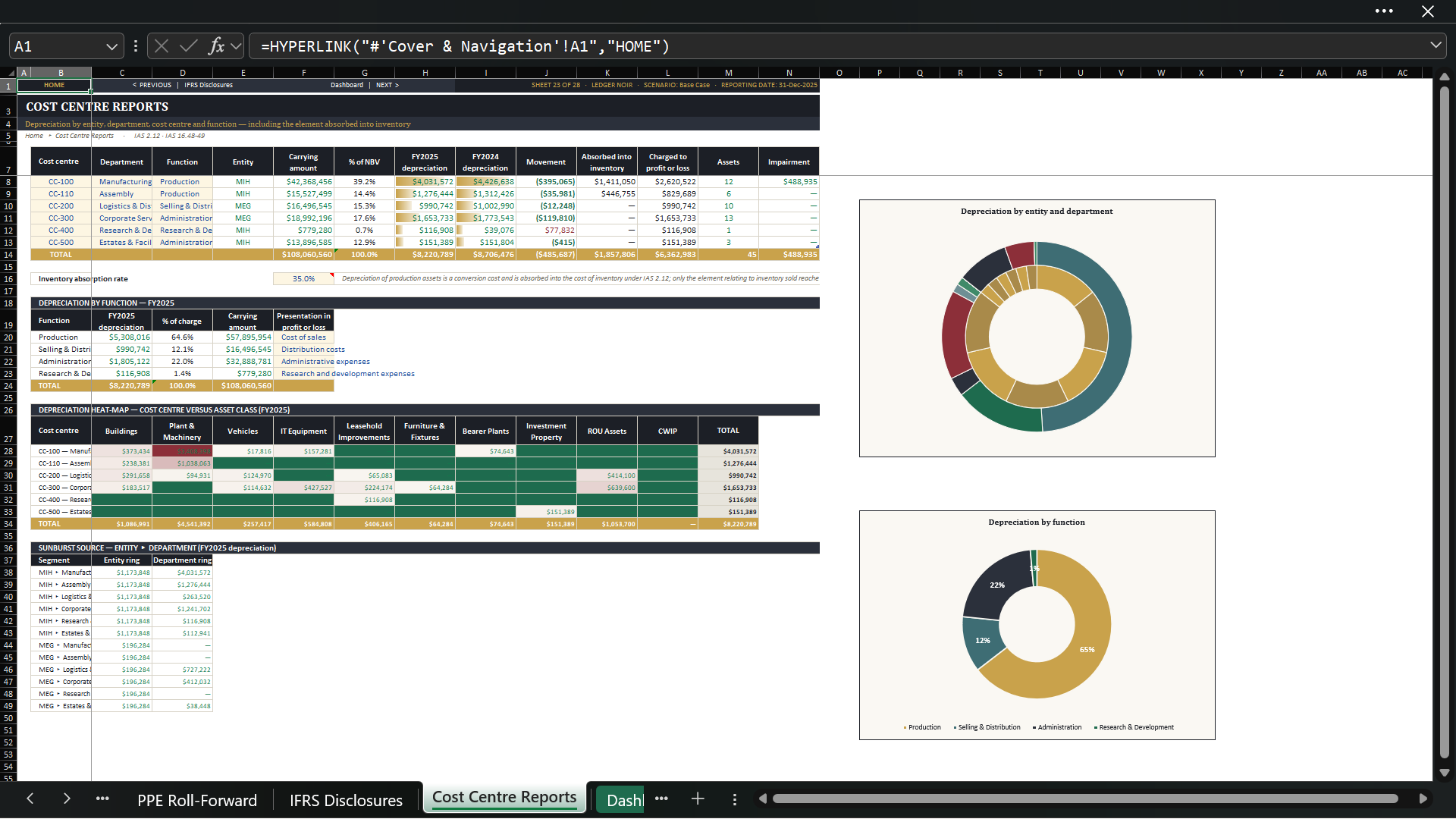
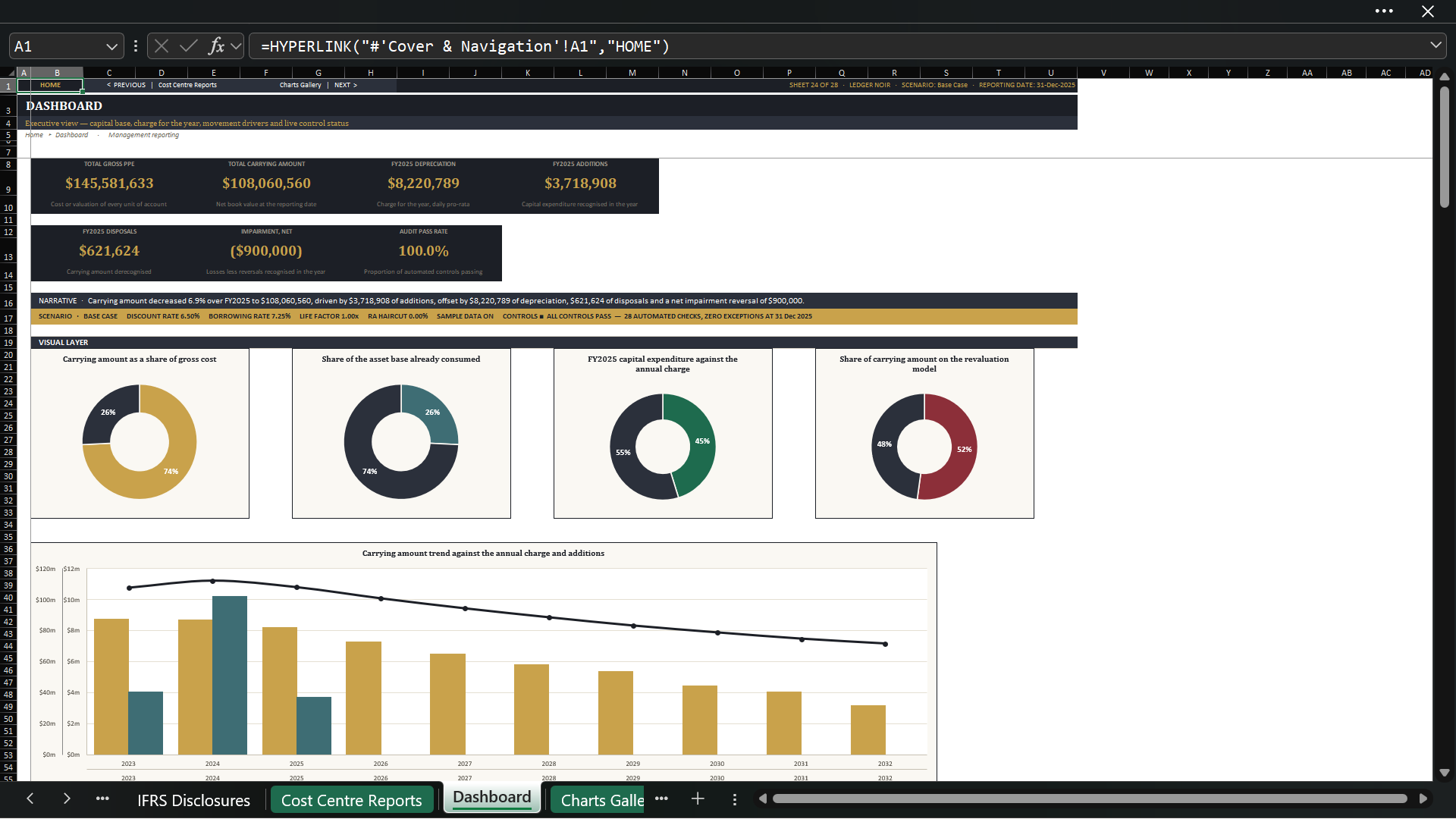
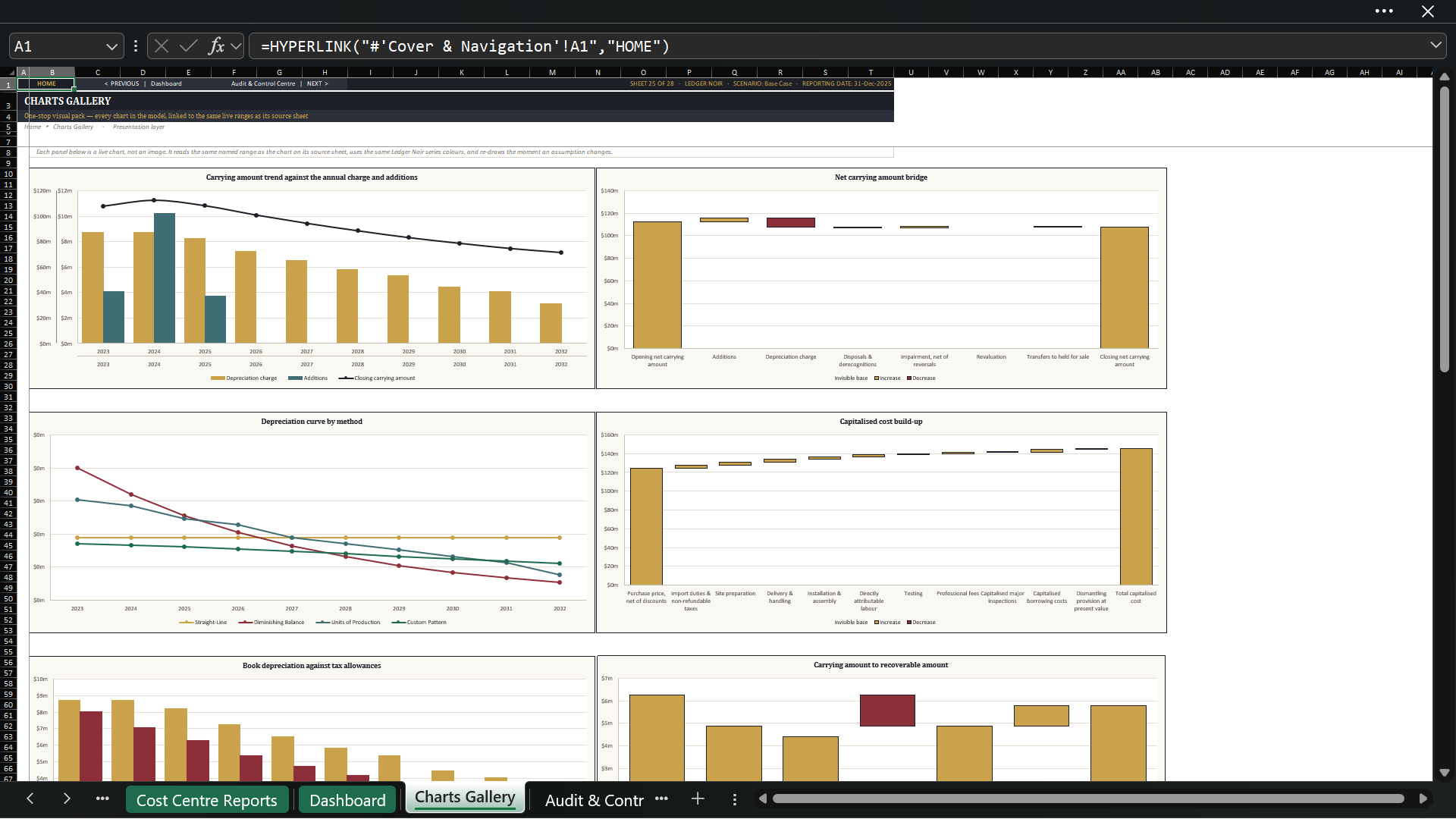
Reports analyze depreciation and carrying amount by entity, department, cost centre, function, and asset class. The dashboard summarizes principal balances, movements, scenarios, and controls.

✅ 28 Automated Controls
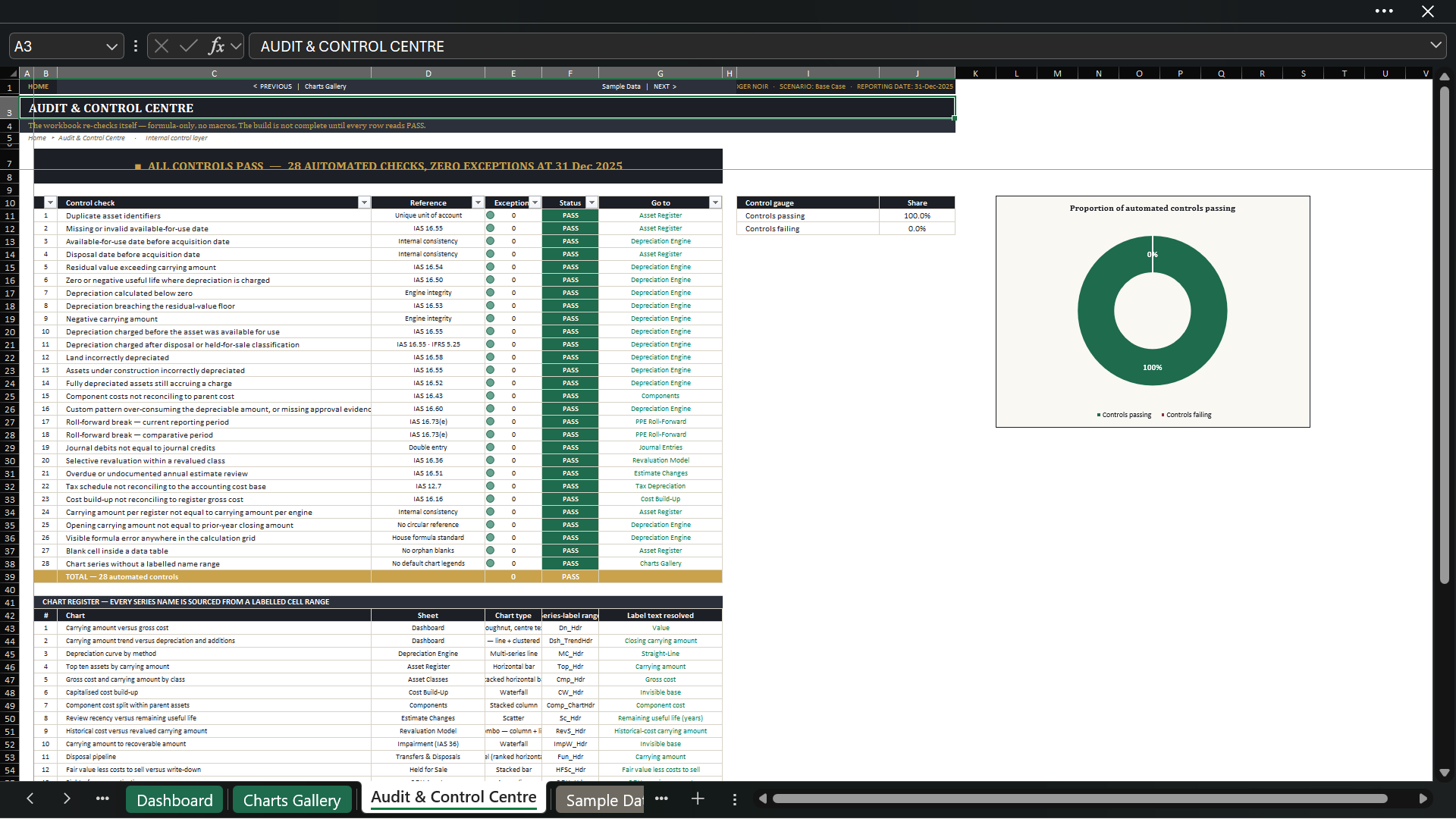
The Audit & Control Centre checks asset IDs, dates, useful lives, residual values, negative amounts, depreciation timing, land and CWIP treatment, components, custom-pattern approval, roll-forwards, journal balancing, class-wide revaluation, estimate reviews, tax reconciliation, cost build-up, register-to-engine agreement, opening-balance continuity, formula errors, table blanks, and chart labels.

The supplied demonstration case reports all 28 controls passing with zero exceptions.

🎯 Who Should Use This Model?

  • Financial controllers and fixed-asset accountants
  • Group-reporting, IFRS, audit, and advisory teams
  • Manufacturing, construction, infrastructure, energy, mining, utility, and transport businesses
  • Companies with material PPE, CWIP, leased assets, or restoration obligations
  • Finance transformation teams, students, and IFRS trainers

📦 Delivery

  • One fully editable Microsoft Excel workbook
  • Approximate size: 0.81 MB
  • 28 worksheets and a ten-year calculation grid
  • More than 24,000 formulas
  • 36 charts and 396 defined names
  • 28 automated controls
  • No macros, external links, or data connections

This Best Practice includes
1 Fully Editable Excel Model

Acquire business license for $160.00

Add to cart

Add to bookmarks

Discuss

Further information

Maintain a structured multi-entity fixed-asset register.
Separate capitalizable asset costs from expenditure recognized as incurred.
Depreciate significant components and major inspections separately.
Calculate daily pro-rata depreciation across a ten-year grid.
Support straight-line, diminishing-balance, units-of-production, and approved custom methods.
Capitalize eligible borrowing costs for qualifying assets.
Model dismantling and restoration provisions and discount unwinding.
Apply useful-life, residual-value, and method changes prospectively.
Calculate revaluation increases, decreases, OCI, profit-or-loss, deferred-tax, and equity movements.
Test impairment and reversals using recoverable amount and reversal ceilings.
Process full and partial disposals, insurance recovery, and held-for-sale classification.
Calculate ROU-asset depreciation under the applicable lease-period logic.
Compare book carrying amounts with tax bases and calculate deferred tax.
Generate balanced journal entries, PPE roll-forwards, disclosure notes, and management reports.
Detect integrity issues through 28 automated controls.

An entity holds material property, plant and equipment across multiple classes.
Finance teams need one linked register, depreciation engine, accounting workflow, and reporting pack.
Assets inclde components, CWIP, qualifying assets, decommissioning obligations, revalued classes, impairment indicators, ROU assets, or tax-book differences.
Daily pro-rating and a multi-year view are required.
The organization reports under IFRS Accounting Standards or uses IFRS-based internal policies.
Users need transparent formulas and auditable schedules rather than a black-box application.
The model will support year-end close, audit preparation, policy documentation, disclosure preparation, management reporting, consulting, or training.

The user needs a live ERP subledger with barcode scanning, procurement integration, automated postings, or user-access workflows.
The requirement is a complete IFRS 16 lease-liability, reassessment, payment, and modification engine.
The entity needs automatic local-tax compliance without configuring jurisdiction-specific pools, rates, and rules.
A revaluation or impairment conclusion must be produced without independent valuation evidence or a supported cash-flow model.
The asset population requires database-scale processing without adapting and testing the workbook architecture.
The user wants an “IFRS-certified” output or a substitute for management judgment, audit procedures, or professional advice.
The reporting framework is US GAAP, statutory tax accounting, or another basis requiring different recognition and measurement rules.


0.0 / 5 (0 votes)

please wait...