Single & Dual-Stream MRF Financial Model — Techno-Economic Analysis & ProjectFinance
Originally published: 29/06/2026 08:23
Publication number: ELQ-78272-1
View all versions & Certificate
certified

Single & Dual-Stream MRF Financial Model — Techno-Economic Analysis & ProjectFinance

A ready-to-use Excel model to assess the financial viability of a single-stream or dual-stream MRF — full P&L, cash flow, project & equity returns, debt sizing.

Description
Overview
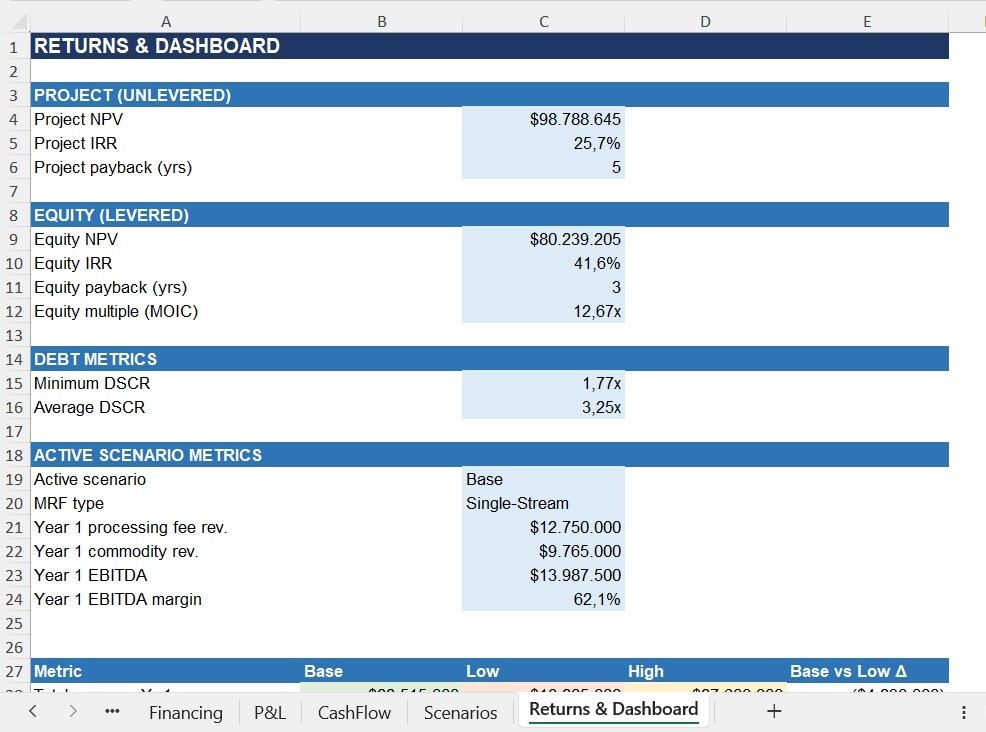
This is a complete techno-economic and project finance model for Materials Recovery Facilities (MRFs) processing municipal solid waste (MSW). Toggle between single-streamand dual-stream configurations, activate or deactivate individual material streams, chooseyour commodity pricing scenario, and get a fully linked financial analysis in minutes:revenue build-up by material, operating costs (detailed or simplified), CAPEX anddepreciation, a full debt schedule, income statement, project and equity cash flows, and areturns dashboard with NPV, IRR, payback, DSCR, equity multiple and a three-scenariocomparison table.
It was built by a practitioner — a chemical engineer and waste management specialist with more than two decades designing, implementing and operating waste treatment and valorization projects — not by a financial modelling generalist. The model reflects how
MRF economics actually work in 2026: processing fees as the revenue base, commodity revenue as the upside (and risk), and labor as the dominant cost driver.


Who it is for
• Developers and EPCs evaluating a new MRF or retrofit project
• Municipalities and public authorities assessing recycling infrastructure investment
• Private equity, infrastructure funds and lenders running MRF due diligence
• Waste management consultants preparing feasibility studies and business cases
• Circular economy startups or operators building an investor-ready financial narrative
• Anyone who needs a credible, auditable MRF financial model fast


What's inside (10 linked worksheets)
README — instructions, colour legend, stream-type presets and scenario guide
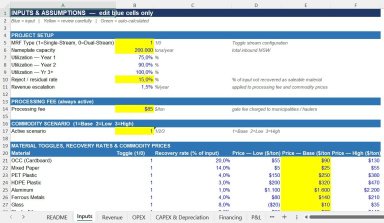
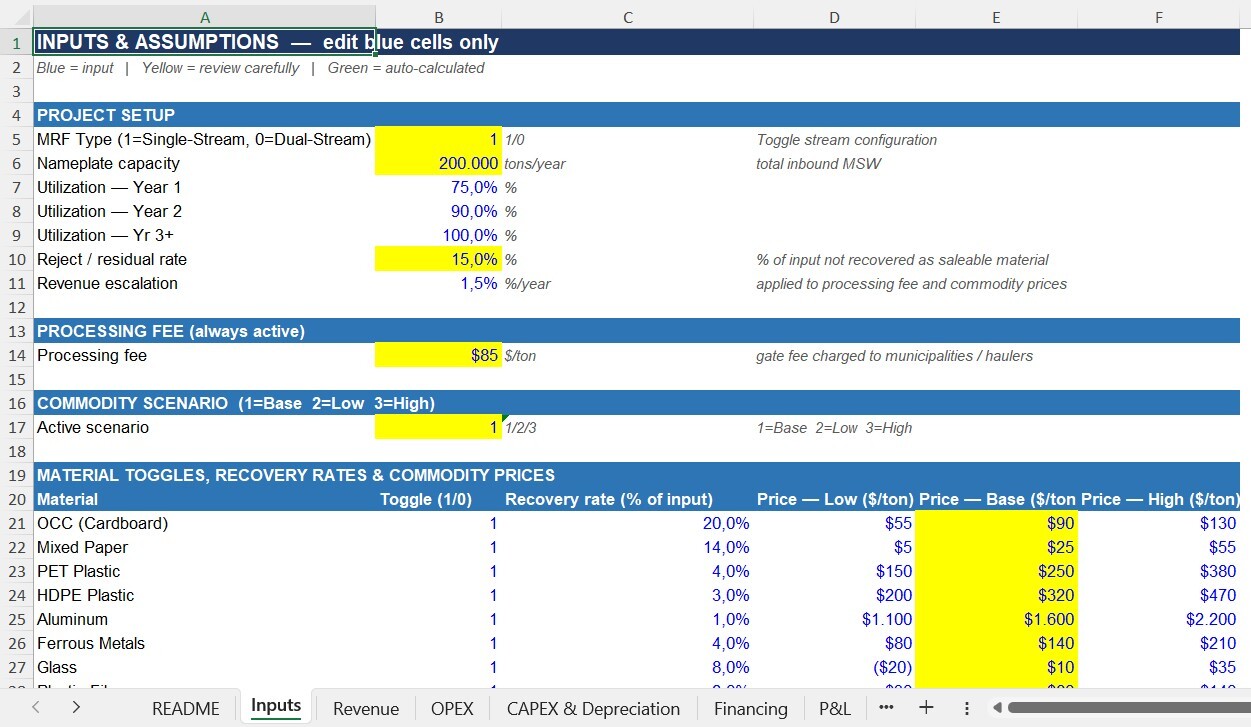
Inputs — every assumption in one place (edit only the blue cells)
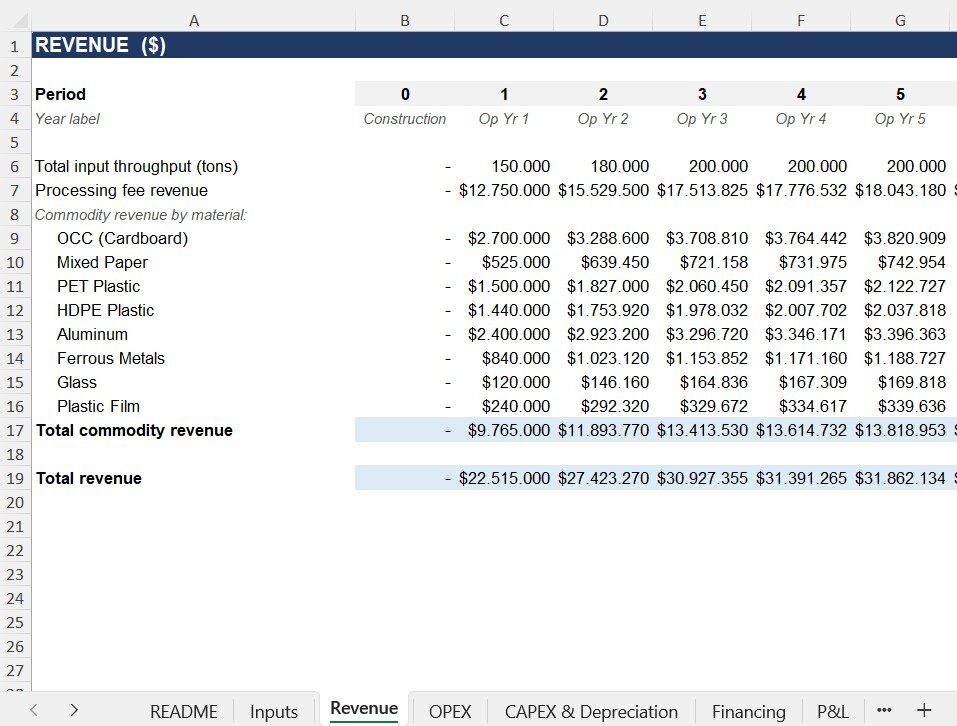
Revenue — processing fee (always active) + 8 toggleable material streams (OCC, Mixed Paper, PET, HDPE, Aluminium, Ferrous Metals, Glass, Plastic Film)
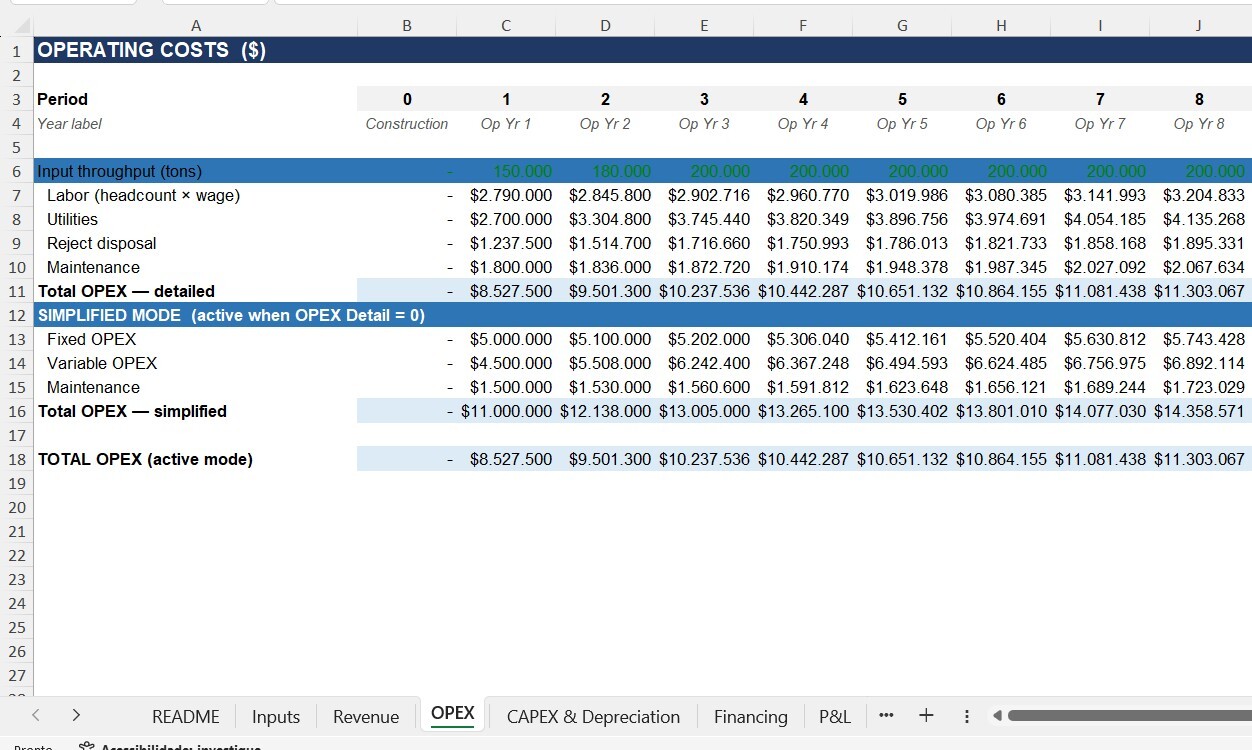
OPEX — detailed mode (labor × headcount, utilities, reject disposal, maintenance) and simplified mode (fixed $/yr + variable $/ton), switchable via toggle
CAPEX & Depreciation — investment and straight-line depreciation schedule
Financing — full debt schedule with interest, amortization and DSCR by year
P&L — income statement
Cash Flow — project (unlevered) and equity (levered) cash flows
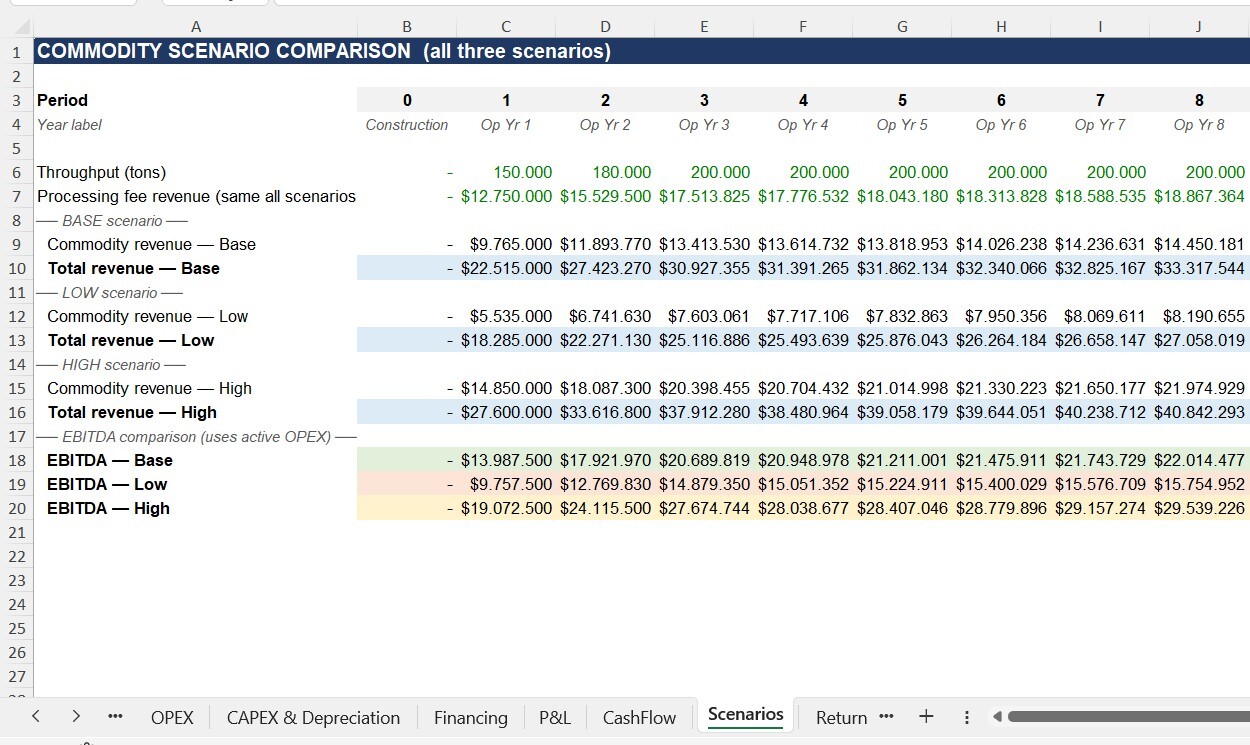
Scenarios — explicit revenue and EBITDA calculation for all three commodity scenarios (Base, Low, High) across all 20 operating years
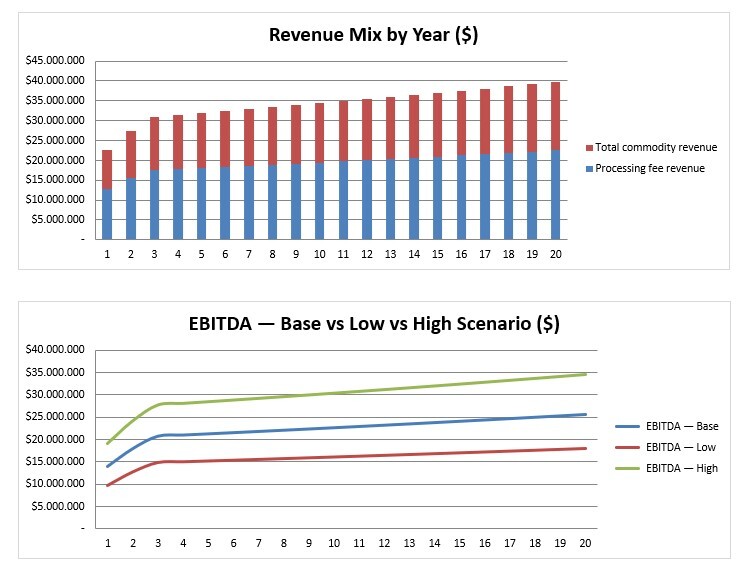
Returns & Dashboard — NPV, IRR, payback, DSCR, MOIC, scenario comparison table and three dynamic charts


Key outputs
Project NPV & IRR · Equity NPV & IRR · Simple payback · Minimum and average DSCR ·Equity multiple (MOIC) · Revenue mix chart (processing fee vs commodity, stacked) · EBITDA comparison chart (Base vs Low vs High scenario) · Cumulative equity cash flow (payback) chart · Year 1 and Year 20 scenario comparison table.


Why this model is different
3-scenario commodity stress-test — built in. The single biggest financial risk for a U.S.MRF in 2026 is commodity price volatility — from the China National Sword shock tocurrent EU export restrictions and suppressed plastics prices. This model has Base, Lowand High commodity scenarios pre-loaded for all 8 materials. Switch scenarios with onecell; the Dashboard shows all three side by side so you can immediately see how yourproject holds up under stress.
Single-stream / dual-stream toggle. One file covers both configurations. Dual-stream auto-disables Glass and Plastic Film revenue streams (uncommon in DS programs). Switch with one cell in the Inputs tab.
OPEX built for MRF reality.U.S. MRFs spend 40–50% of operating costs on labor. The detailed OPEX mode models headcount × fully-loaded wage + utilities (/ton) + reject disposal (/ton of rejects).
• equipment maintenance (% of CAPEX). Switch to simplified mode for quick-and-dirty runs. Toggle between the two without breaking any formula.
Lender-ready. Includes the debt schedule and DSCR metrics that banks and infrastructure funds require. Minimum DSCR and average DSCR are flagged prominently on the Dashboard.
Built by an operator, not a spreadsheet builder. Processing fees, recovery rates, reject ratios, commodity price ranges and OPEX benchmarks are calibrated to real-world MRF project data — not text book assumptions.


What you get
Two files in a single download: the Excel model (.xlsx) and a 2-page Quick Start Guide(.pdf). Example figures are included as place holders — replace the blue input cells with your project's real numbers and the entire model recalculates automatically.


Requirements & notes
• Works in Microsoft Excel and Google Sheets.
• Built for 1 construction year + 20 operating years.
• The example inputs are illustrative; calibrate them to your project before use.

• This is a financial modelling tool, not investment, legal or tax advice.

This Best Practice includes
1. Single & Dual-Stream MRF Financial Model (.xlsx); 2. Quick Start Guide (.pdf)

Acquire business license for $18.75

Add to cart

Add to bookmarks

Discuss

Further information

Objectives of your Downloadable Best Practice

This model enables users to assess the financial viability of a single-stream or dual-stream Materials Recovery Facility (MRF) from first principles. Specifically, it allowsyou to:

• Model revenue from processing fees and up to 8 individual material streams(OCC, Mixed Paper, PET, HDPE, Aluminium, Ferrous Metals, Glass, Plastic Film),each toggleable on/off;
• Switch between single-stream and dual-stream configurations with one cell;
• Run and compare three commodity pricing scenarios (Base, Low, High)simultaneously to quantify the impact of market volatility on project viability;
• Model operating costs in either detailed mode (labor + utilities + reject disposalmaintenance) or simplified mode (fixed $/yr + variable $/ton);
• Size capital expenditure, depreciation and a project finance debt structure;
• Generate a fully linked financial model (P&L, cash flow, debt schedule) from asingle input tab;
• Calculate project and equity returns: NPV, IRR, payback, DSCR and equitymultiple;
• Produce lender-ready output including annual DSCR and debt service coveragemetrics.

Conditions for which this Downloadable Best Practice applies best

This model is best suited for:

• Feasibility and pre-feasibility analysis of new or retrofit single-stream and dual-stream MRF projects processing municipal solid waste;
• Developers, EPCs, municipalities and consultants building an initial investmentcase or preparing a feasibility study for a recycling facility;
• Investors, private equity and lenders running first-pass due diligence on an MRFopportunity, particularly where commodity price risk is a key concern;
• Projects with a clearly defined material mix and processing fee structure;
• Users who need a transparent, auditable model that can be adapted and presentedto municipalities, co-investors or financing institutions.

Conditions for which this Downloadable Best Practice does not apply ideally

This model is not the best fit if:

• Your project requires mass-balance simulation of individual material streamsthrough multiple sorting stages (this requires process simulation software, not afinancial model);
• You need a probabilistic (Monte Carlo) risk model — this is a deterministic modelwith scenario analysis, not a full stochastic simulation;
• Your financing structure involves sculpted debt service, mezzanine tranches ortax equity — the financing module uses equal principal repayment;
• You require jurisdiction-specific tax treatment (e.g. bonus depreciation, taxcredits, loss carry-forward) beyond a flat corporate tax rate;
• Your project horizon exceeds 20 operating years without modifying the columnstructure;
• You need integration with commodity price feeds or live market data — all inputsare manual and must be calibrated by the user.


0.0 / 5 (0 votes)

please wait...