Offshore Wind CfD Explained — How Contracts for Difference Work, Market by Market (Free)
Originally published: 07/05/2026 16:02
Publication number: ELQ-25143-1
View all versions & Certificate
certified

Offshore Wind CfD Explained — How Contracts for Difference Work, Market by Market (Free)

Free guide explaining how Contracts for Difference work for offshore wind across 8 markets: UK, Germany, France, Italy, Netherlands, Nordics, USA and Taiwan

Description
This free guide explains the Contract for Difference mechanism that makes offshore wind bankable — from the basic two-sided concept to the specific implementation in 8 major markets globally.


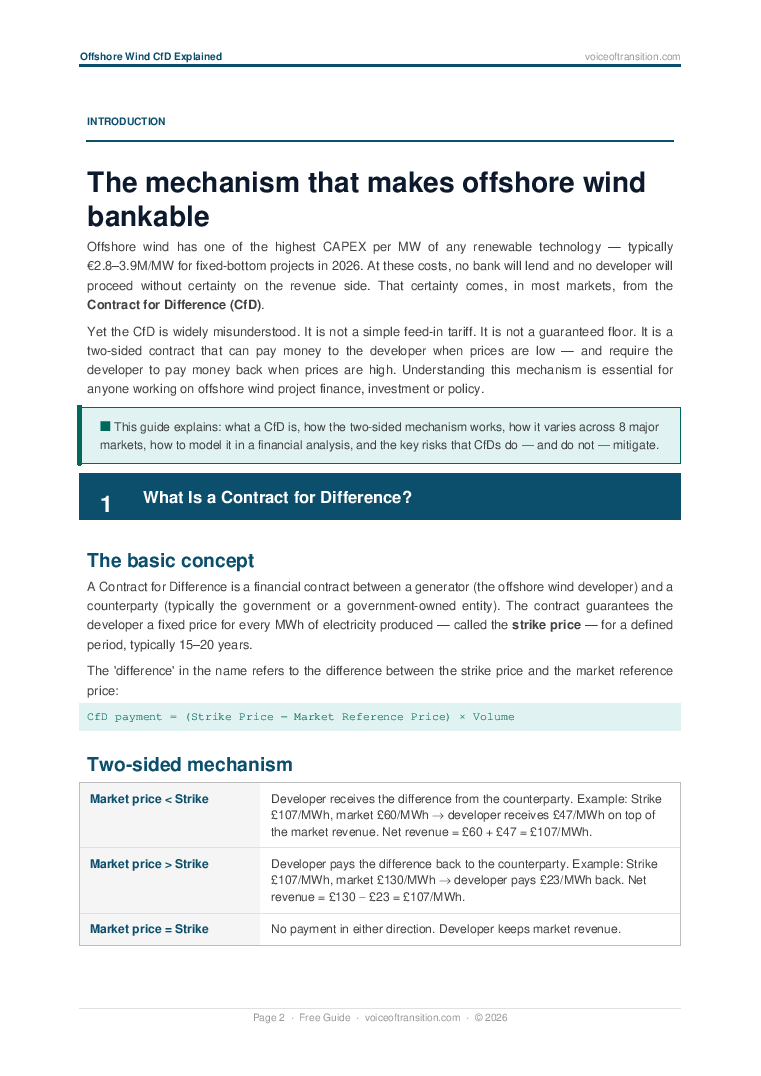
The CfD is widely misunderstood. It is not a simple feed-in tariff or a guaranteed floor. It is a two-sided contract that pays the developer when market prices are below the strike price — and requires the developer to pay back the difference when prices are above it. The result is a fixed, predictable revenue stream regardless of market price volatility, which is exactly what project finance lenders require to size debt at 70–80% gearing over 20–25 year tenors.


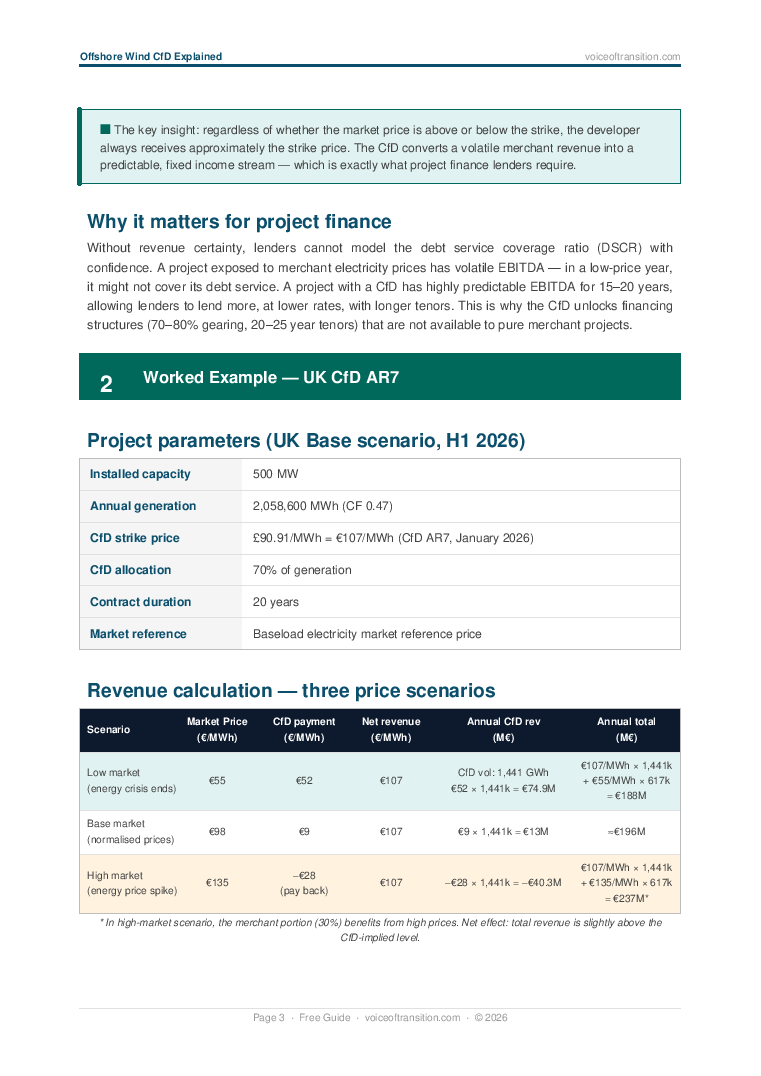
The guide opens with a step-by-step explanation of the CfD payment formula and a fully worked numerical example for a 500 MW offshore wind project under UK CfD AR7, showing revenue calculations across three price scenarios — low market (€55/MWh), base (€98/MWh) and high (€135/MWh) — and demonstrating why CfD revenue stability is so valuable compared to pure merchant exposure.


The market-by-market section covers all 8 major offshore wind support mechanisms in detail: UK CfD AR7 (£90.91/MWh, 20yr, two-sided), Germany EEG Marktprämie, France Complément de Rémunération, Italy FER E Aste, Netherlands SDE++ zero-subsidy, Nordic CfD and El-certifikat, USA OREC state-level schemes and Taiwan MOEA FiT. Each market entry covers strike price, duration, settlement mechanism, key features and the specific risks that the CfD does and does not protect against.


The final section explains how to model CfD revenue correctly in a financial model — including the standard revenue allocation splits (CfD%, PPA%, merchant%, balancing%) and haircut assumptions for each of the 8 markets, sourced from BNEF H2 2025 and market-specific regulatory sources.

This Best Practice includes
1 PDF Document

Piero Farenti offers you this Best Practice for free!

read for free

Add to bookmarks

Discuss


0.0 / 5 (0 votes)

please wait...