

Cleaning Services Business Monthly 5-Year 3-Statement Financial Forecast Model
Originally published: 27/08/2018 15:11
Last version published: 19/12/2025 21:29
Publication number: ELQ-22356-3
View all versions & Certificate
certified

Cleaning Services Business Monthly 5-Year 3-Statement Financial Forecast Model

Financial model for cleaning businesses, forecasting revenue, margins, cash flow, and valuation using billable hours, utilization, and operating cost drivers.

Description
This financial model is meticulously designed to analyze and forecast the financial performance of a residential and/or commercial cleaning services business, capturing the core revenue and cost drivers specific to labor-intensive, route-based service operations. The model focuses on revenue streams generated from Recurring Standard Cleaning, Deep Cleaning / Move-Out Services, and Specialty / Add-On Cleaning Services, with revenue primarily driven by billable labor hours.

The model incorporates labor capacity planning, billable-hour forecasting, service-line revenue mix, operational and market friction factors, and supplies & consumables cost logic, ensuring realistic projections that accurately reflect how cleaning businesses operate in practice.
The model delivers a 5-year forecast horizon (60 months) with both detailed monthly projections and annual summaries, making it suitable for operational planning, growth analysis, and valuation.

Model Structure – 5 Main Sections
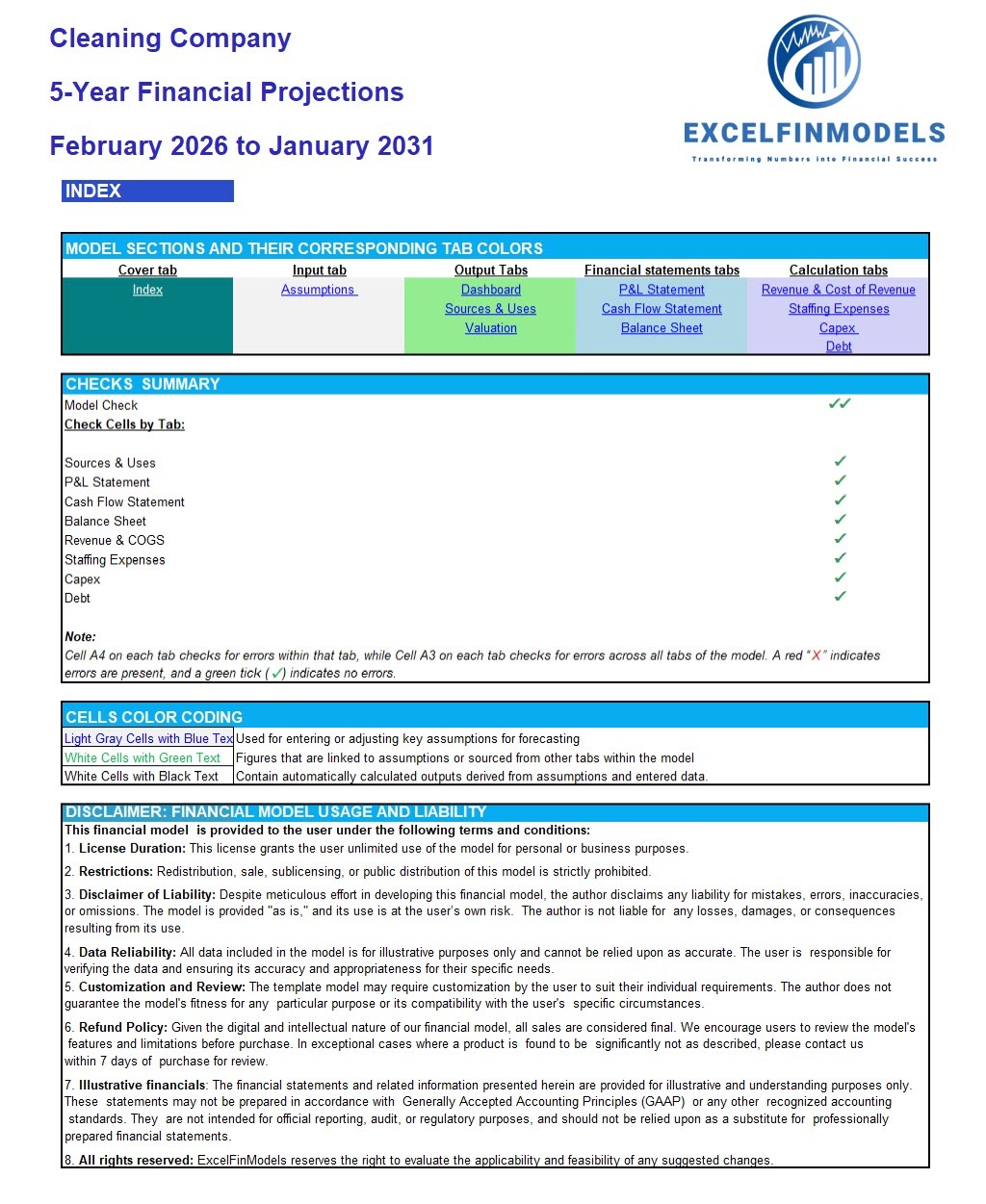
1. Cover Section
  • Index of all model sections with corresponding tab colors
  • Summary of validation checks across the workbook
  • Cell color-coding guidelines for assumptions, formulas, links, and outputs
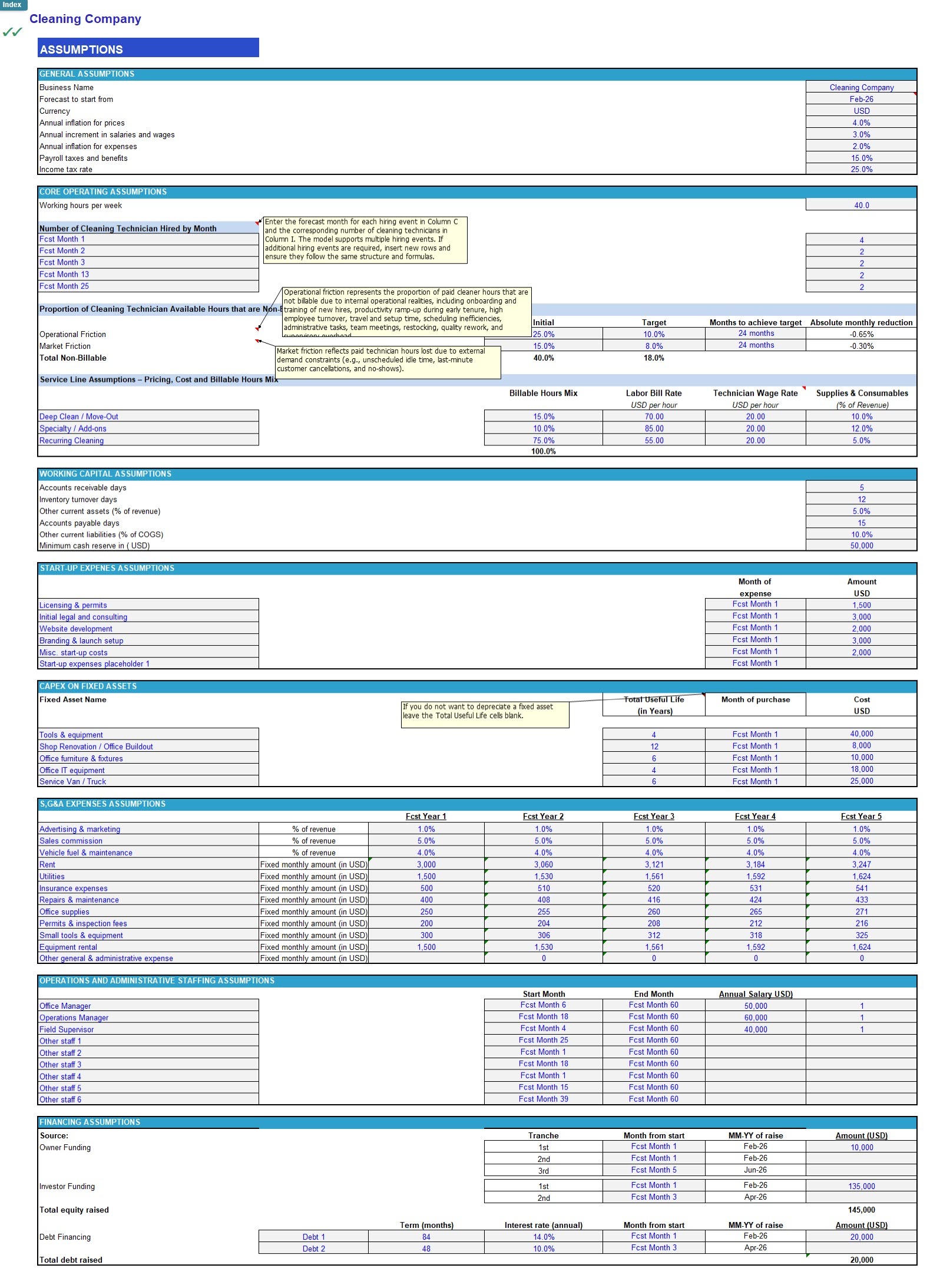
2. Input Section (Assumptions Tab)
All assumptions are consolidated into a single, user-friendly input tab, with editable cells highlighted in Light Gray with Blue Text.

Revenue Assumptions
  • Service line segmentation:
    • Recurring Standard Cleaning
    • Deep Cleaning / Move-Out
    • Specialty & Add-On Services
  • Hourly labor bill rates by service line
  • Billable hours mix across service lines
  • Productivity assumptions for billable vs. non-billable hours
Labor & Operational Assumptions
  • Cleaner hiring schedule (supports multiple hiring events)
  • Total available paid hours per cleaner
  • Operational friction (travel time, setup, restocking, admin tasks)
  • Market friction (cancellations, idle gaps, route inefficiencies)
General Business Assumptions
  • Business name, start date, reporting currency
  • Inflation assumptions for wages and pricing
  • Corporate tax rate and statutory inputs
Cost of Revenue Assumptions
  • Cleaner wage rates
  • Payroll taxes and statutory benefits
  • Supplies & consumables as % of revenue
Selling, General & Administrative (SG&A) Expenses
  • Operations and administrative staff salaries
  • Rent, utilities, insurance
  • Marketing and advertising spend
  • Vehicle fuel and maintenance
  • Software subscriptions and office expenses
  • Licensing, permits, and training
Capital Expenditure (CapEx) Assumptions
  • Vehicles, cleaning equipment, and tools
  • Office equipment
  • Depreciation schedules and replacement cycles
Working Capital Assumptions
  • Accounts receivable days
  • Accounts payable days
  • Minimum cash reserves
Financing & One-Time Expenses
  • Loan terms, interest rates, and amortization
  • Equity contributions
  • Start-up expenses (branding, licensing, website, initial setup)
3. Output Tabs Section
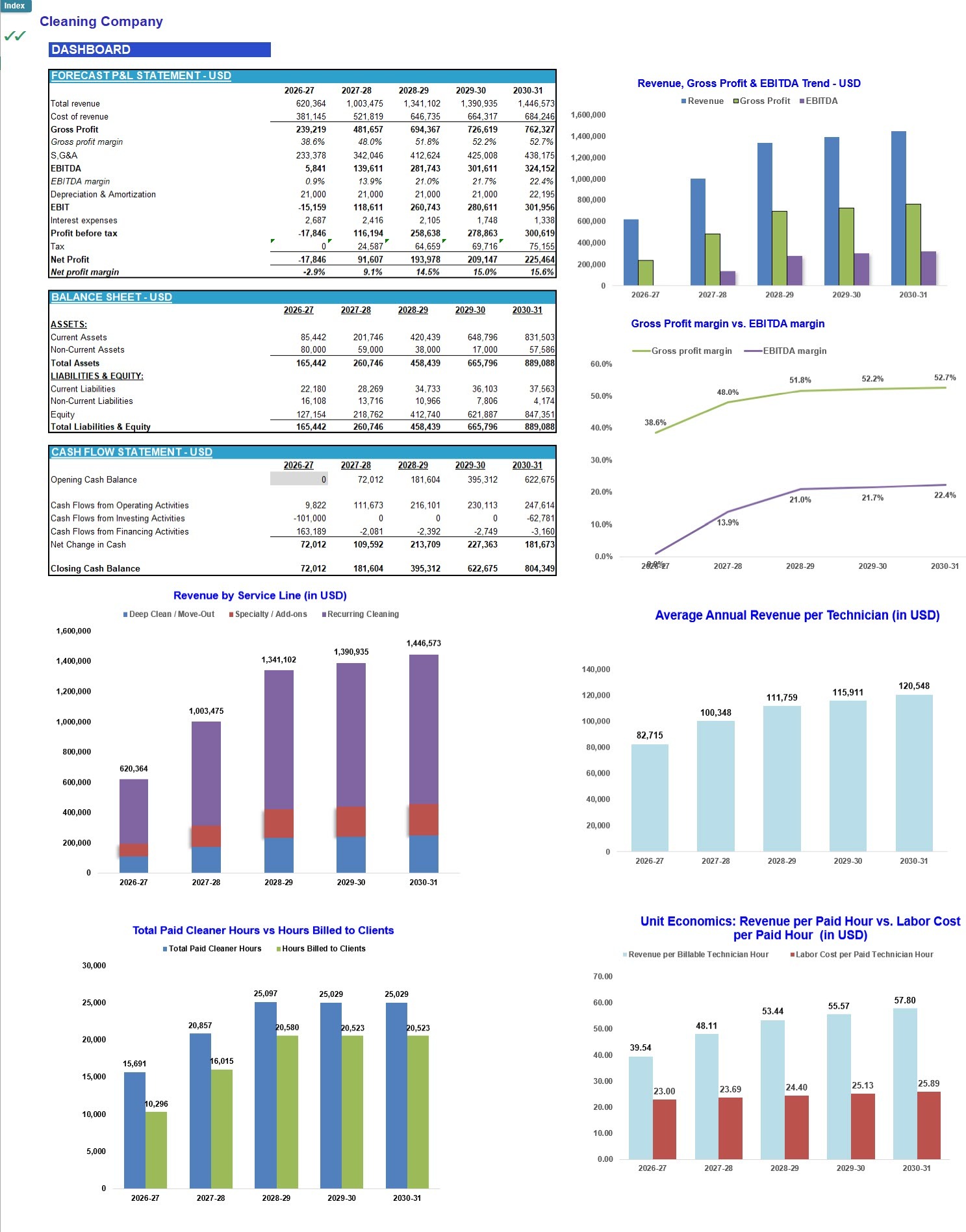
  • Dashboard
    • Revenue, gross profit, and EBITDA trends
    • Gross margin and EBITDA margin analysis
    • Revenue by service line
    • Paid vs. billable labor hours
    • Revenue per cleaner
    • Unit economics (effective bill rate vs. labor cost)
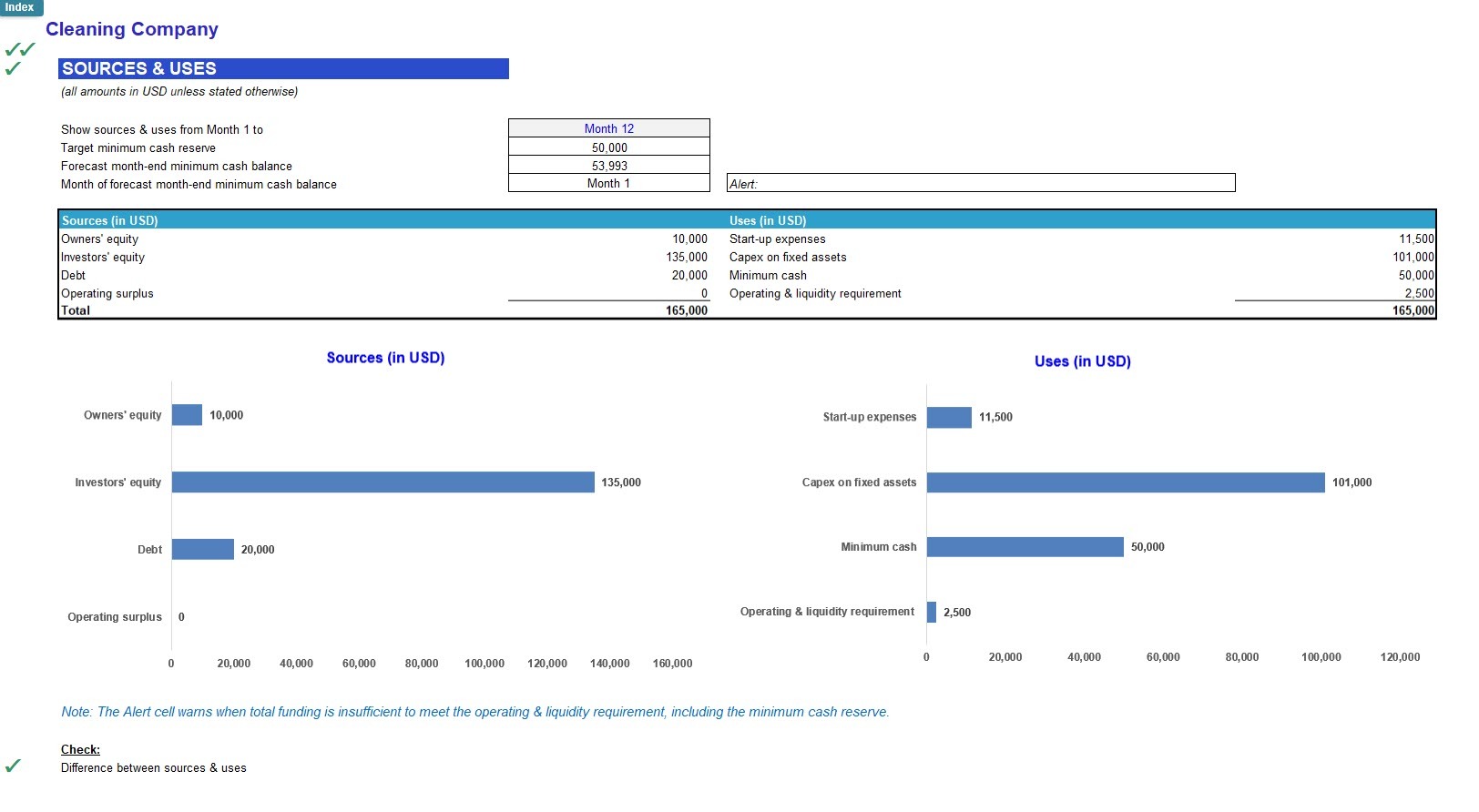
  • Sources & Uses
    • Breakdown of equity, debt, working capital, CapEx, and reserves
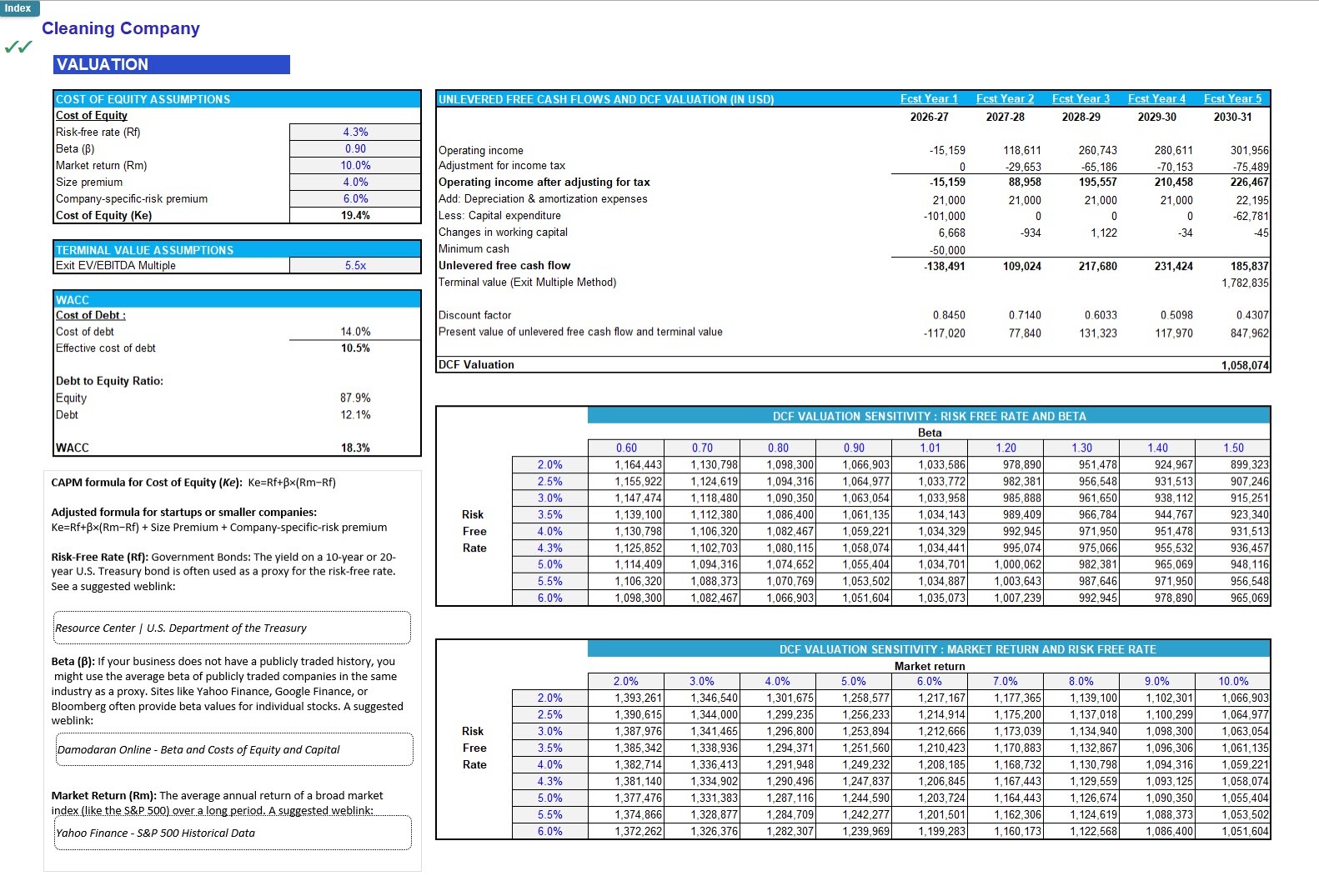
  • Valuation
    • Discounted Cash Flow (DCF) valuation
    • Sensitivity analysis on discount rates, pricing, utilization, and wage inflation
4. Financial Statements Section
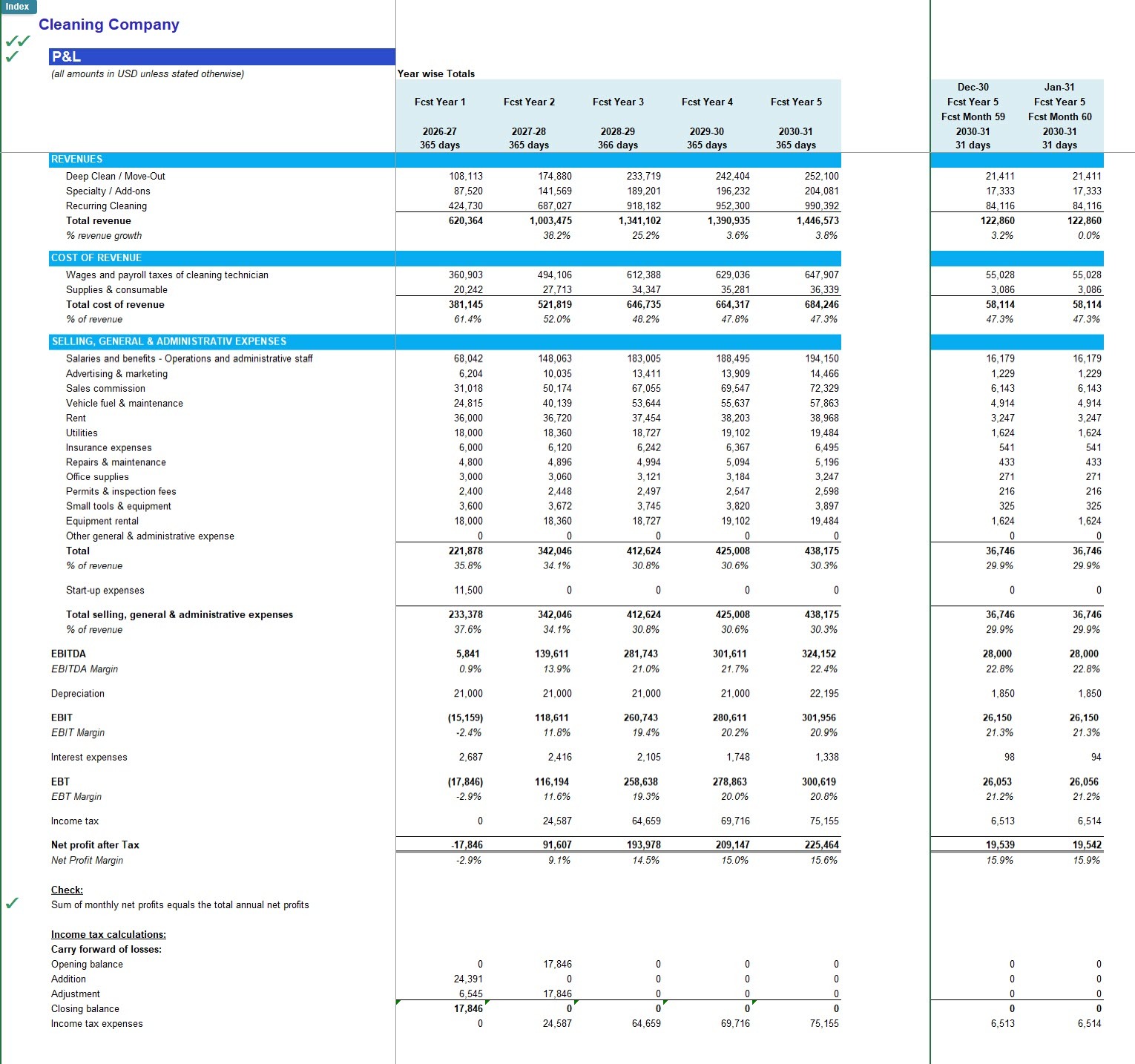
  • Profit & Loss Statement
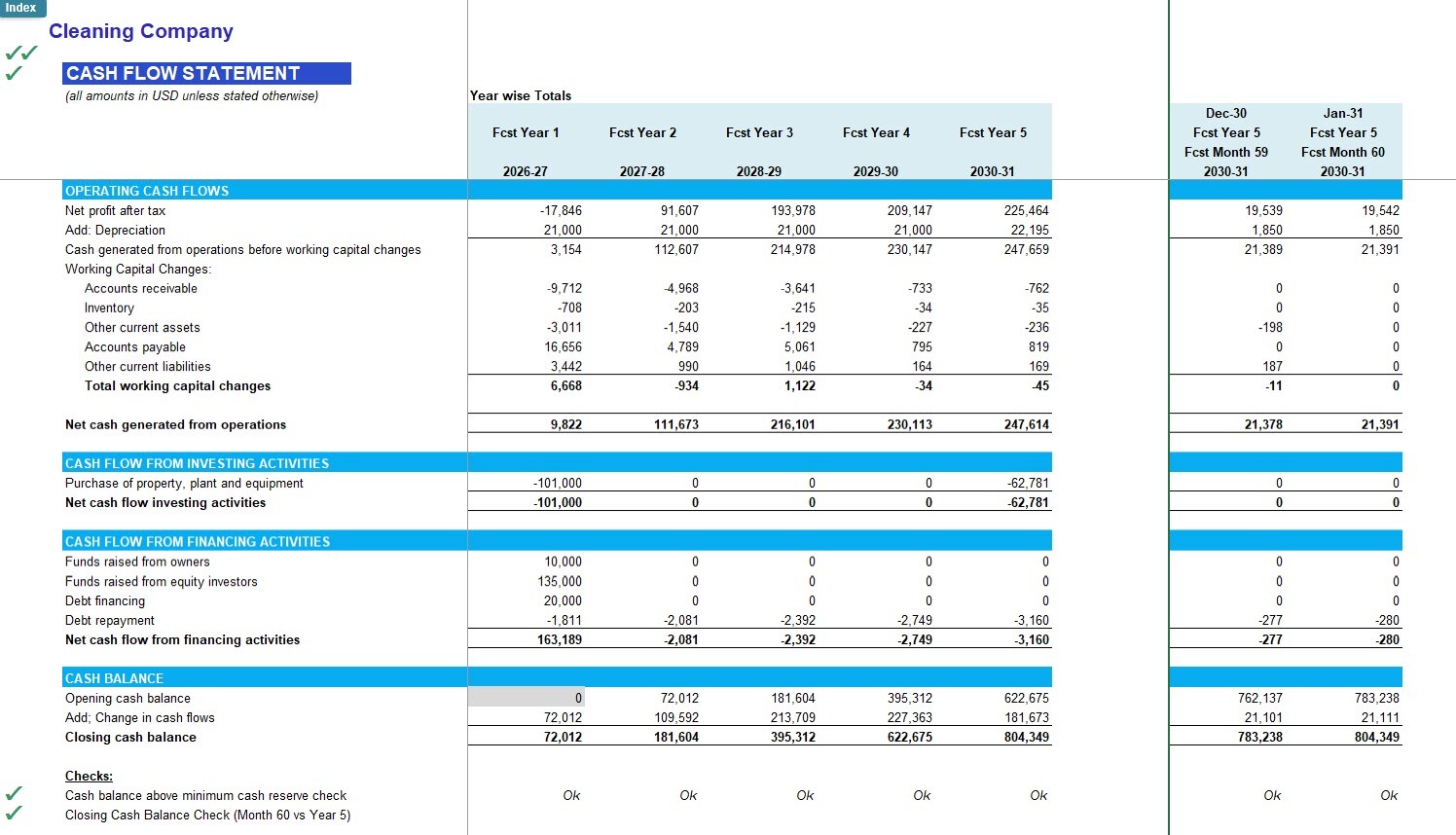
  • Cash Flow Statement
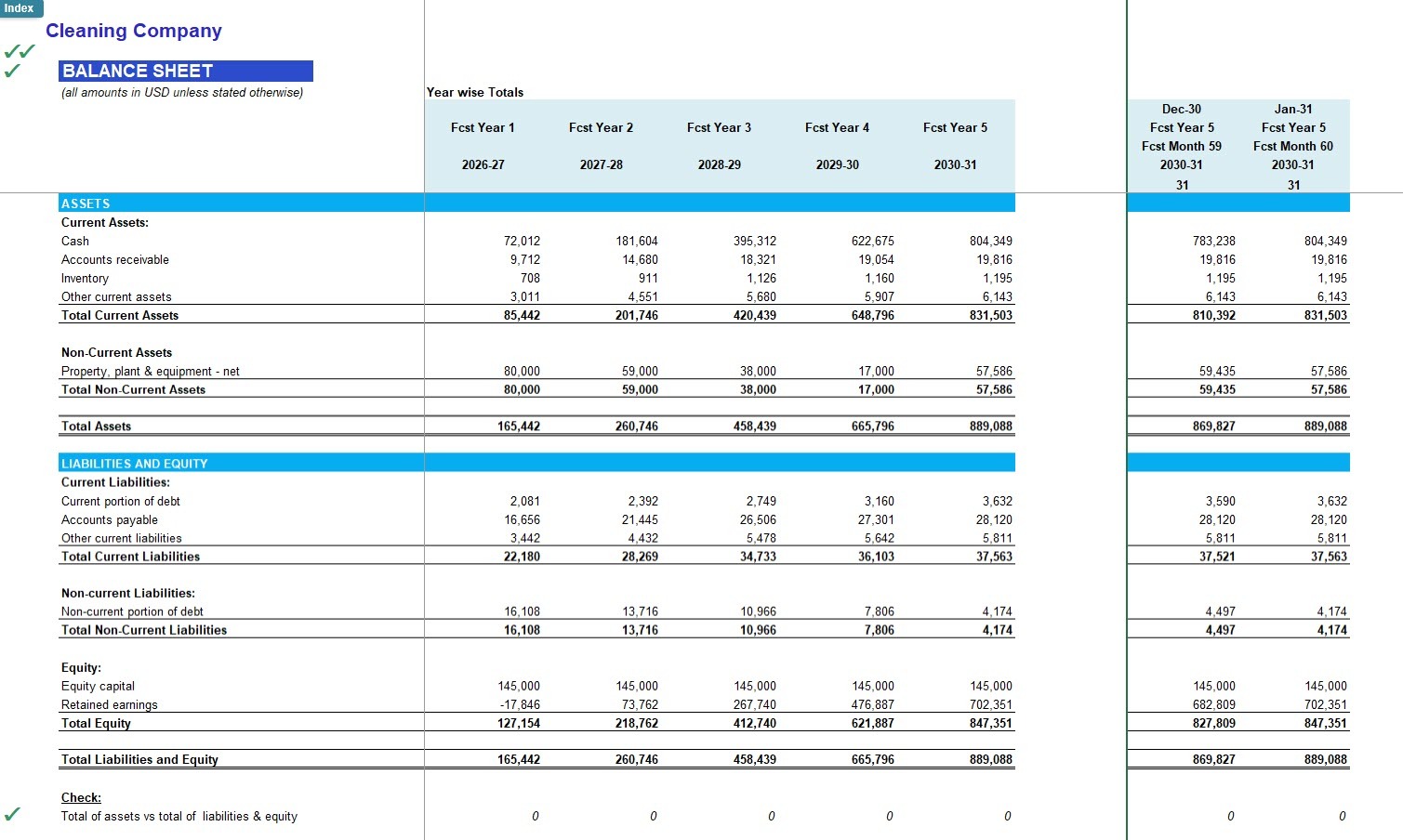
  • Balance Sheet
5. Calculations Section
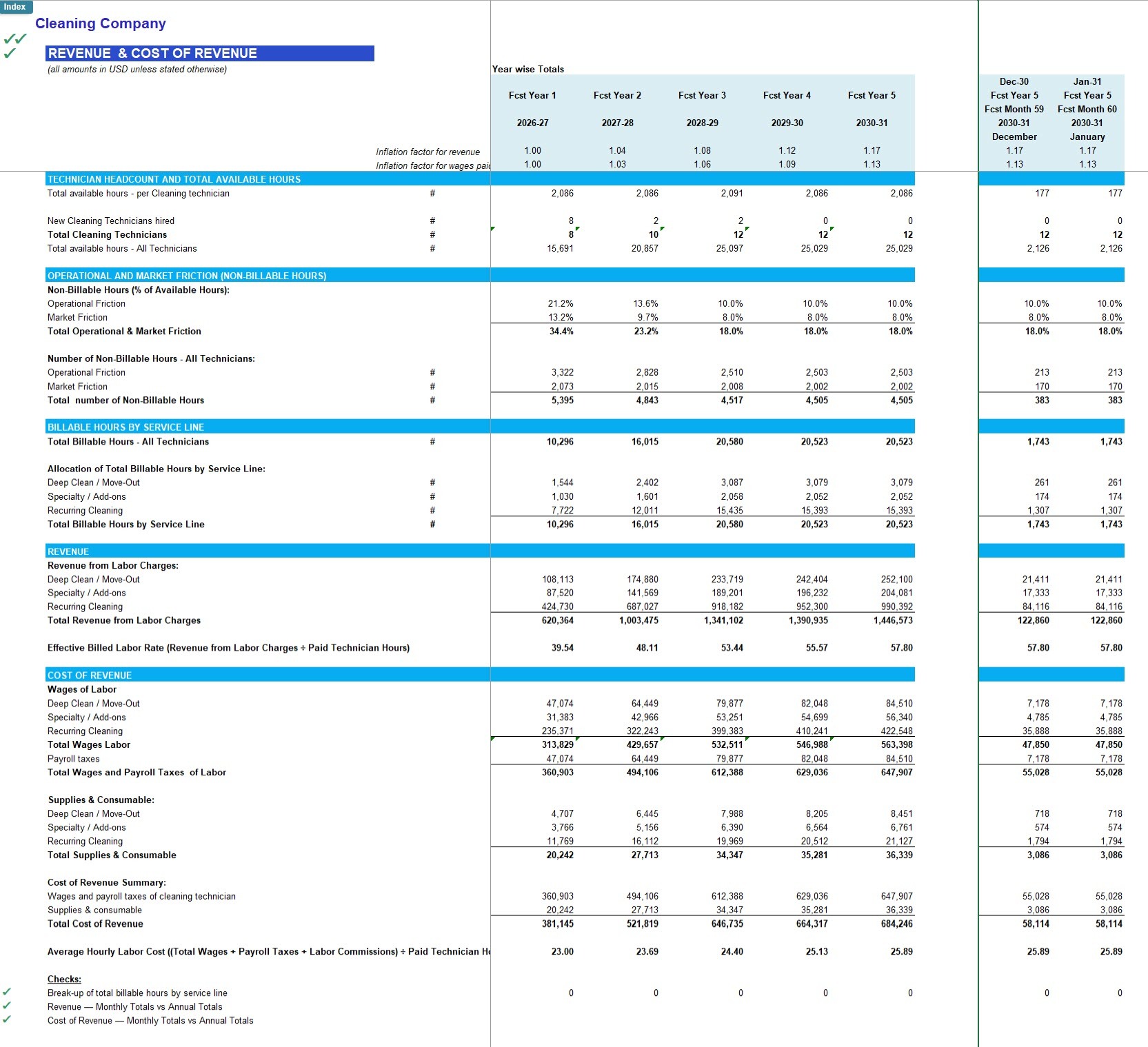
  • Revenue & COGS forecast
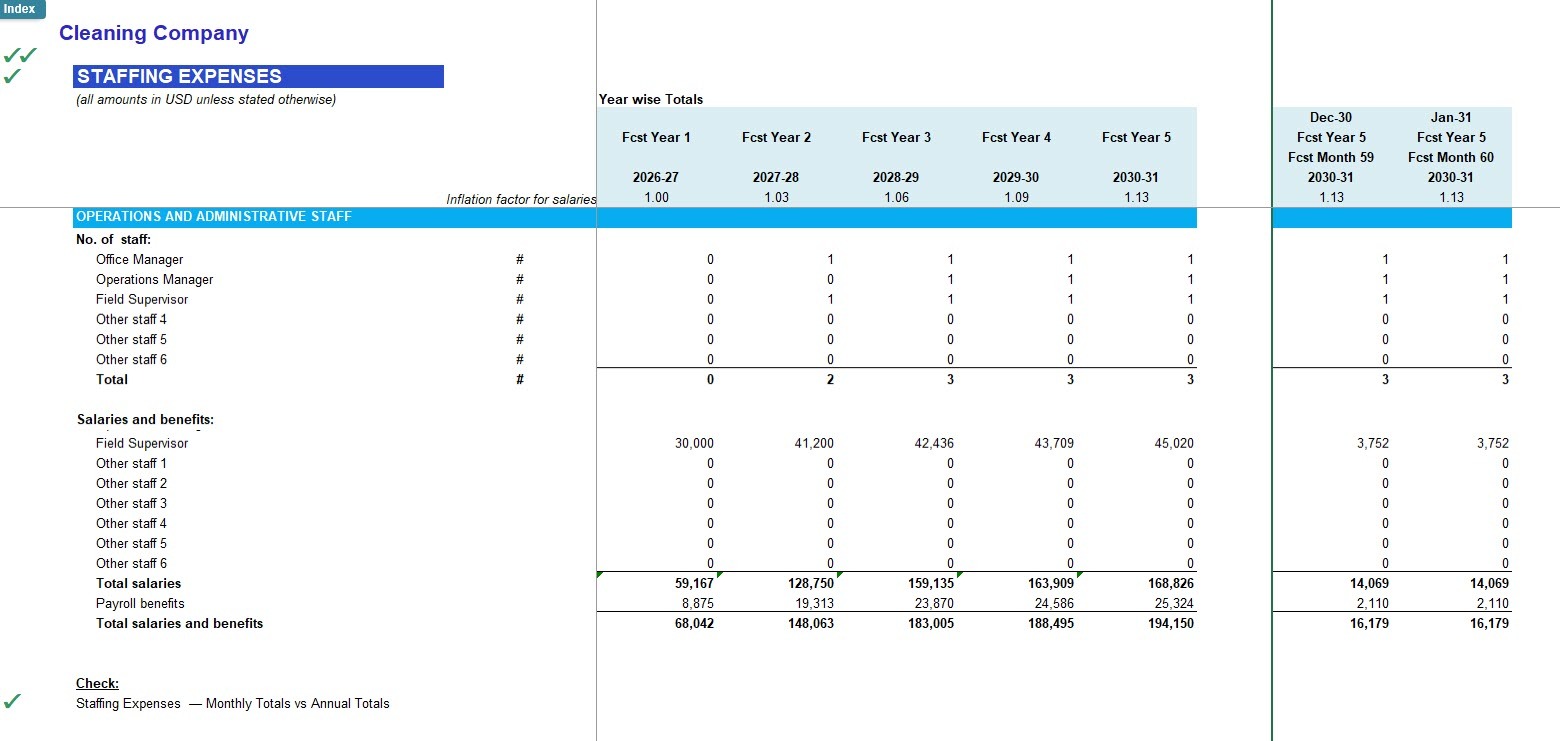
  • Operating staff expenses forecast
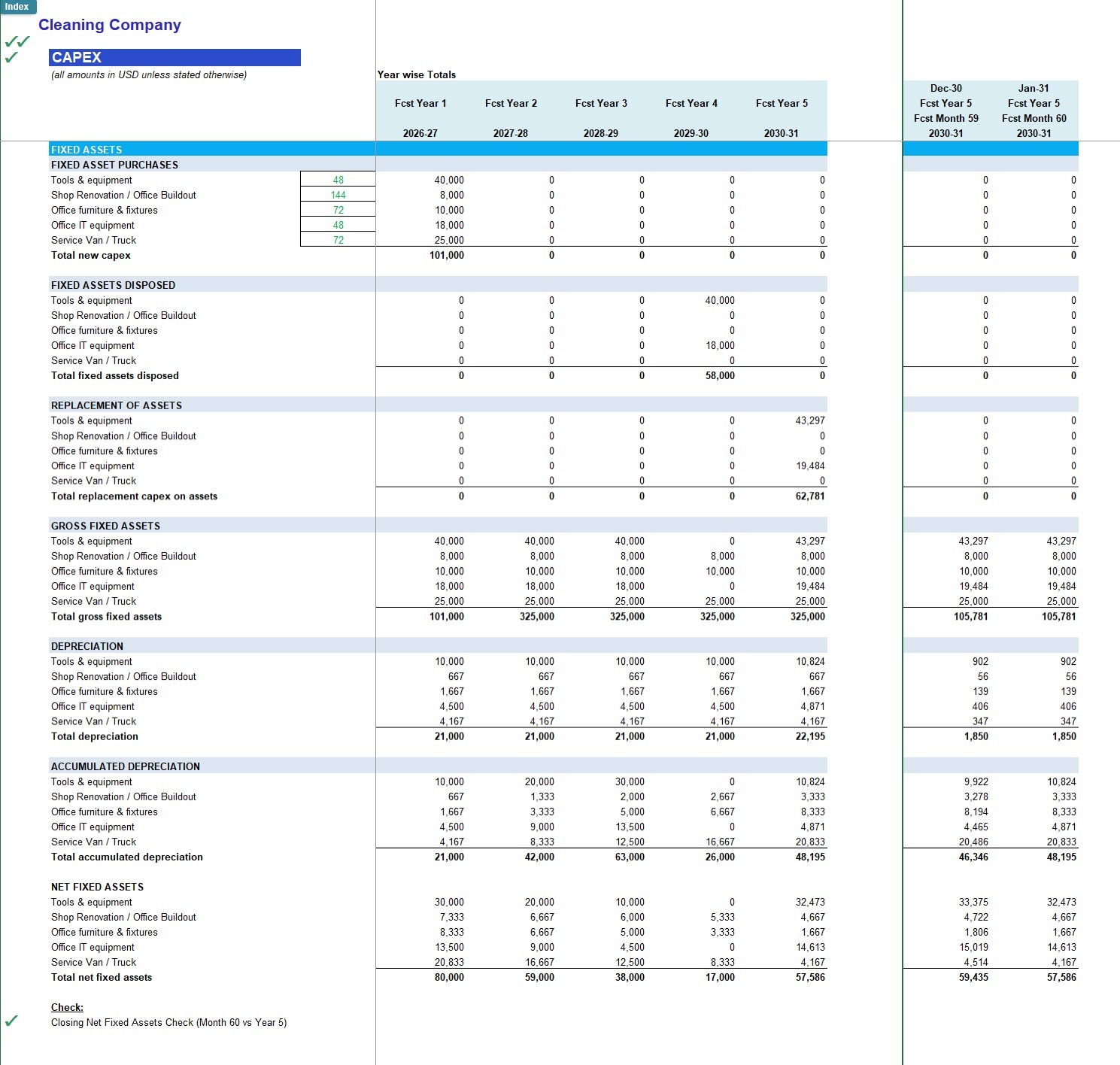
  • Capex and depreciation calcuations
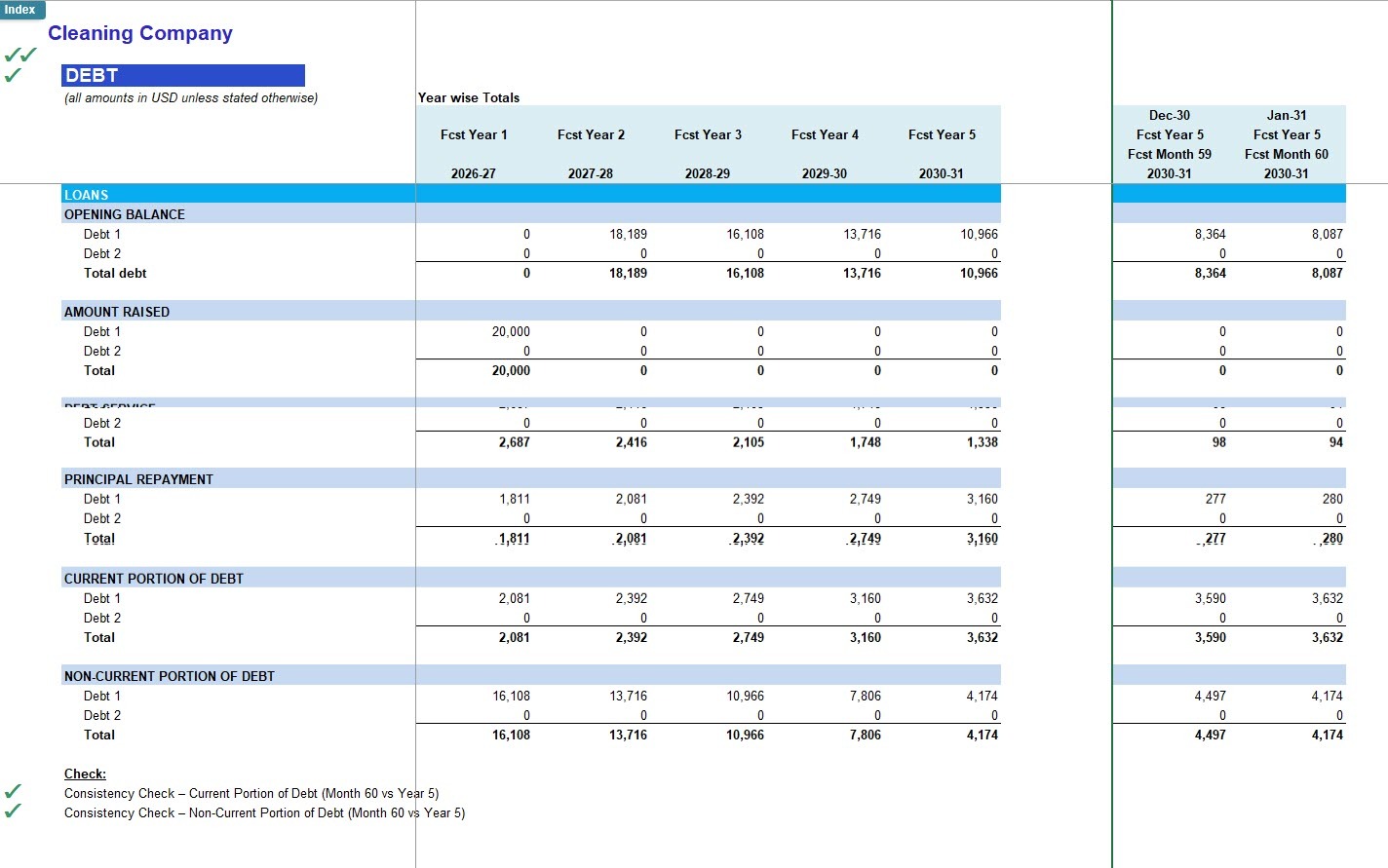
  • Debt schedule
Technical Specifications
  • No VBA or Macros – fully transparent and auditable
  • Circular-reference free – stable and reliable calculations
  • Excel compatibility – works with Microsoft Excel 2010 and later
Validation Checks
Built-in validation checks ensure model integrity across all sections.
  • Green ticks (✓) indicate consistent and correct logic
  • Red crosses (✗) flag missing inputs or inconsistencies

All validation results are consolidated on the Index tab for quick review.

Why Choose This Model?
This financial model is purpose-built for cleaning service businesses, delivering clarity, realism, and flexibility for financial decision-making. It is suitable for:
  • Internal planning and budgeting
  • Pricing and service-mix optimization
  • Labor capacity and hiring decisions
  • Loan applications and lender reporting
  • Investor presentations and business valuation
For tailored solutions or technical support, our team is available to customize the model to your specific service lines, hiring plan, operational structure, or financing strategy.

This Best Practice includes
1 Excel Sheet

Acquire business license for $99.00

Add to cart

Add to bookmarks

Discuss

Further information

This model aims to guide cleaning business owners and investors in developing accurate financial forecasts, cost assumptions, and revenue planning using a proven analytical structure. It helps streamline decision-making, enhance operational budgeting, and strengthen financial readiness for investment, lending, and internal performance management.

This financial model applies best to start-ups and established cleaning or janitorial service businesses seeking to plan, project, or optimize their financial performance. It is ideal for companies that offer residential, commercial, or specialized cleaning services and require a detailed, assumption-driven tool for internal budgeting, fundraising, or expansion planning.

This best-practice model applies best to cleaning businesses that generate revenue through billable labor hours and require forward-looking financial planning for scaling, hiring, and pricing. It is most effective for early-stage startups and established operators seeking structured budgeting, funding support, and profitability forecasting under realistic operational conditions.


0.0 / 5 (0 votes)

please wait...