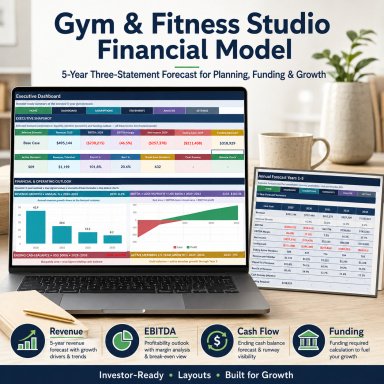




Gym & Fitness Studio 5-Year Financial Model Excel | Membership Growth, Cash Flow, Break-Even, Scenarios & Investor Deck

5-year gym financial model with membership growth, three statements, break-even, scenarios, sensitivity, funding analysis, investor deck and PDF guide.

Description

๐Ÿ‹๏ธ GYM & FITNESS STUDIO โ€“ 5-YEAR THREE-STATEMENT FINANCIAL MODEL


Plan membership growth, recurring revenue, ancillary services, staffing, operating expenses, equipment investment, debt, profitability, liquidity, and funding requirements with an integrated financial model designed for gyms and fitness studios.

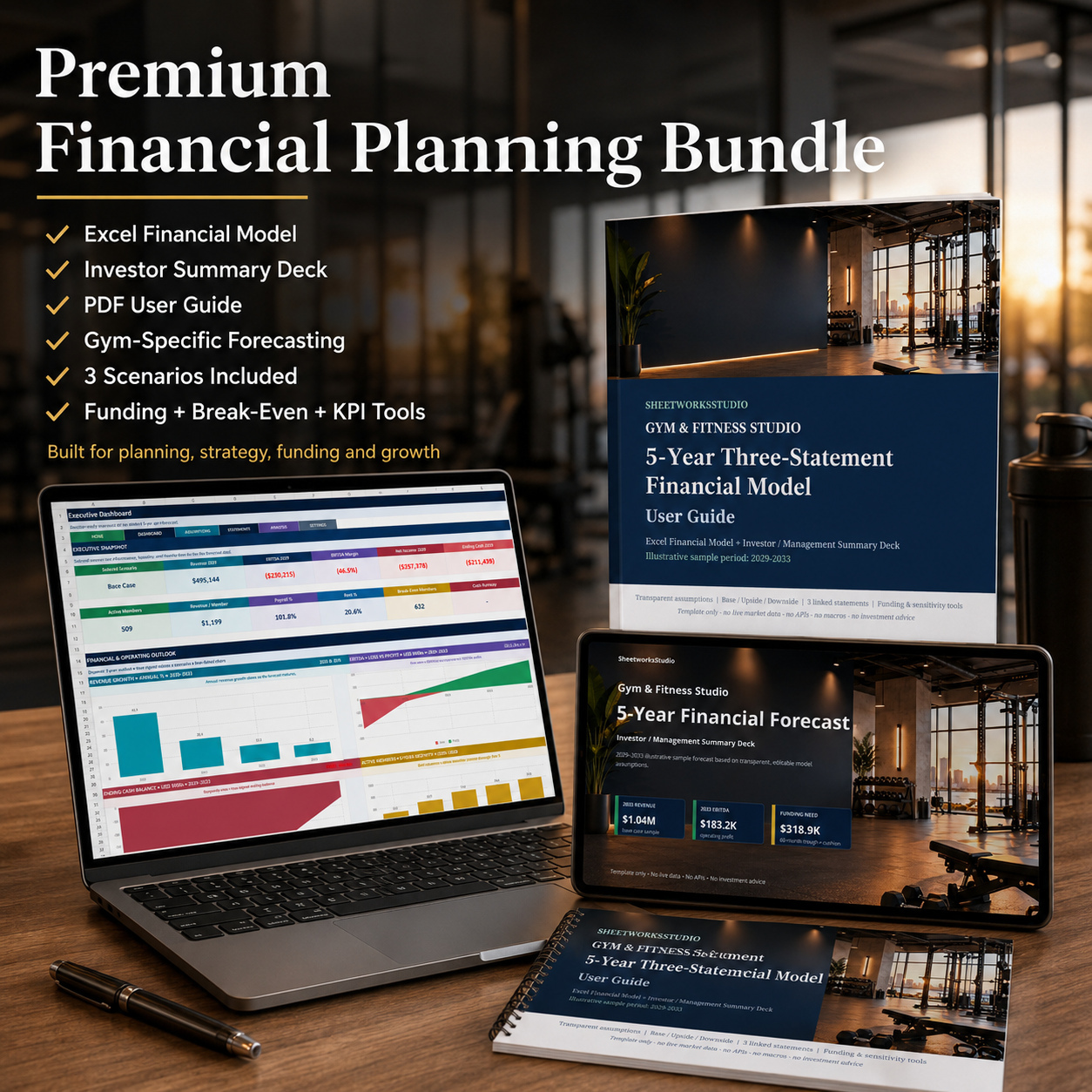
This professional package combines a 22-worksheet Excel Financial Model, an editable 14-slide Investor / Management PowerPoint Deck, and a detailed 22-page How-to-Use PDF Guide.


The model connects the main operating and financial drivers of a gym with a complete 2029โ€“2033 Three-Statement Forecast, helping owners, founders, consultants, finance professionals, and management teams evaluate how member acquisition, churn, pricing, ancillary revenue, payroll, fixed costs, CapEx, and financing may influence future performance.


๐Ÿ‘ฅ MEMBERSHIP GROWTH & RECURRING REVENUE

The membership model tracks:

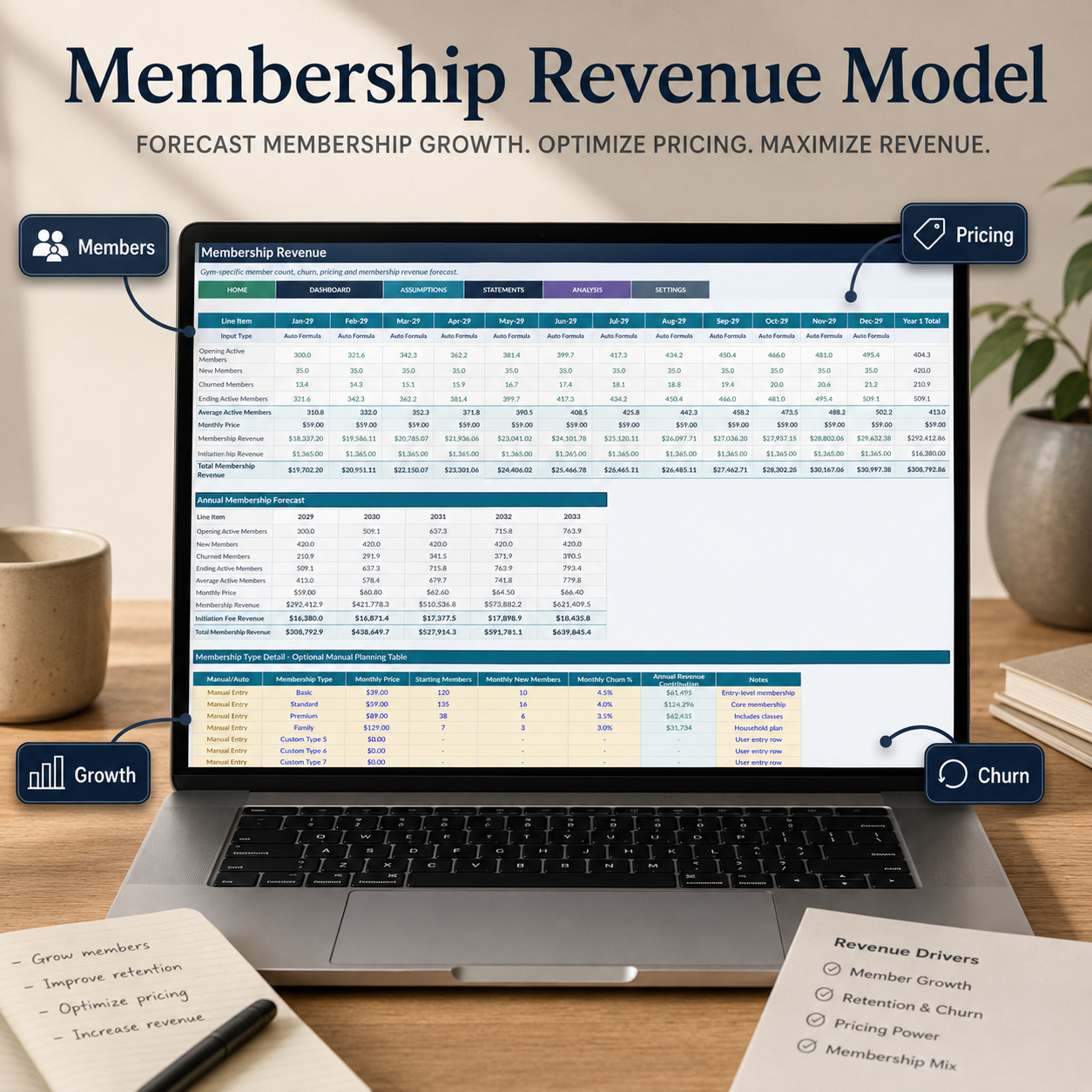
โœ… Starting Members โœ… Monthly New Members โœ… Monthly Churn โœ… Ending Active Members โœ… Average Active Members โœ… Monthly Membership Price โœ… Annual Price Increases โœ… Initiation Fees โœ… Membership Revenue

An optional 15-row planning table can also be used to document individual membership types such as Basic, Standard, Premium, Family, and custom plans.


๐Ÿ’ฐ ANCILLARY REVENUE

Additional revenue streams include:

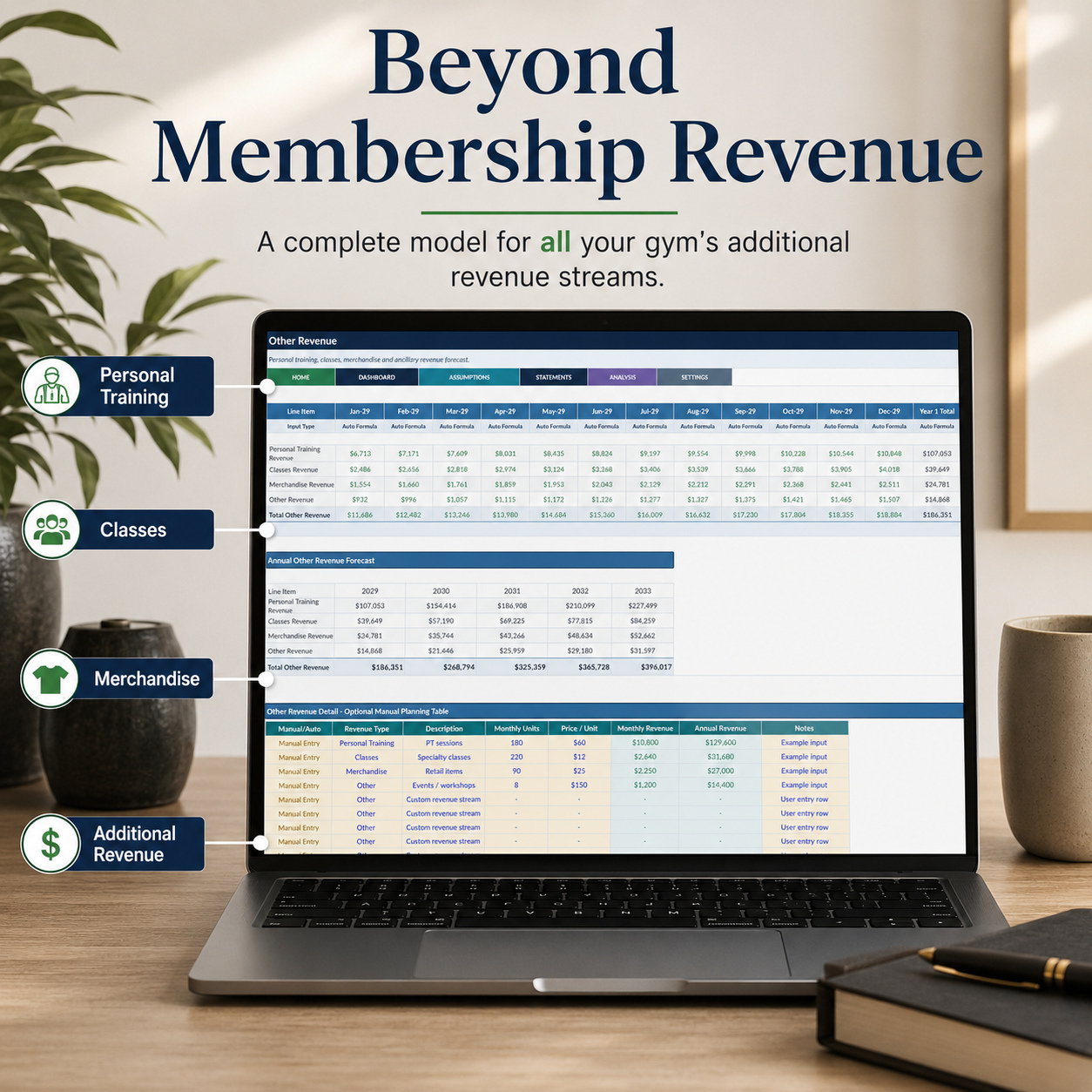
โœ… Personal Training โœ… Classes โœ… Merchandise โœ… Other Revenue โœ… Custom Revenue Streams

Personal Training can be modeled using attach rate, sessions per attached member, and price per session, while other ancillary revenue can be linked to the active membership base.


๐Ÿ‘จโ€๐Ÿ’ผ STAFFING & PAYROLL

The workbook includes structured payroll and contractor planning.

Optional role-level planning can document positions such as:

โœ… General Manager โœ… Front Desk โœ… Personal Trainers โœ… Class Instructors โœ… Cleaning โœ… Custom Employee / Contractor Roles

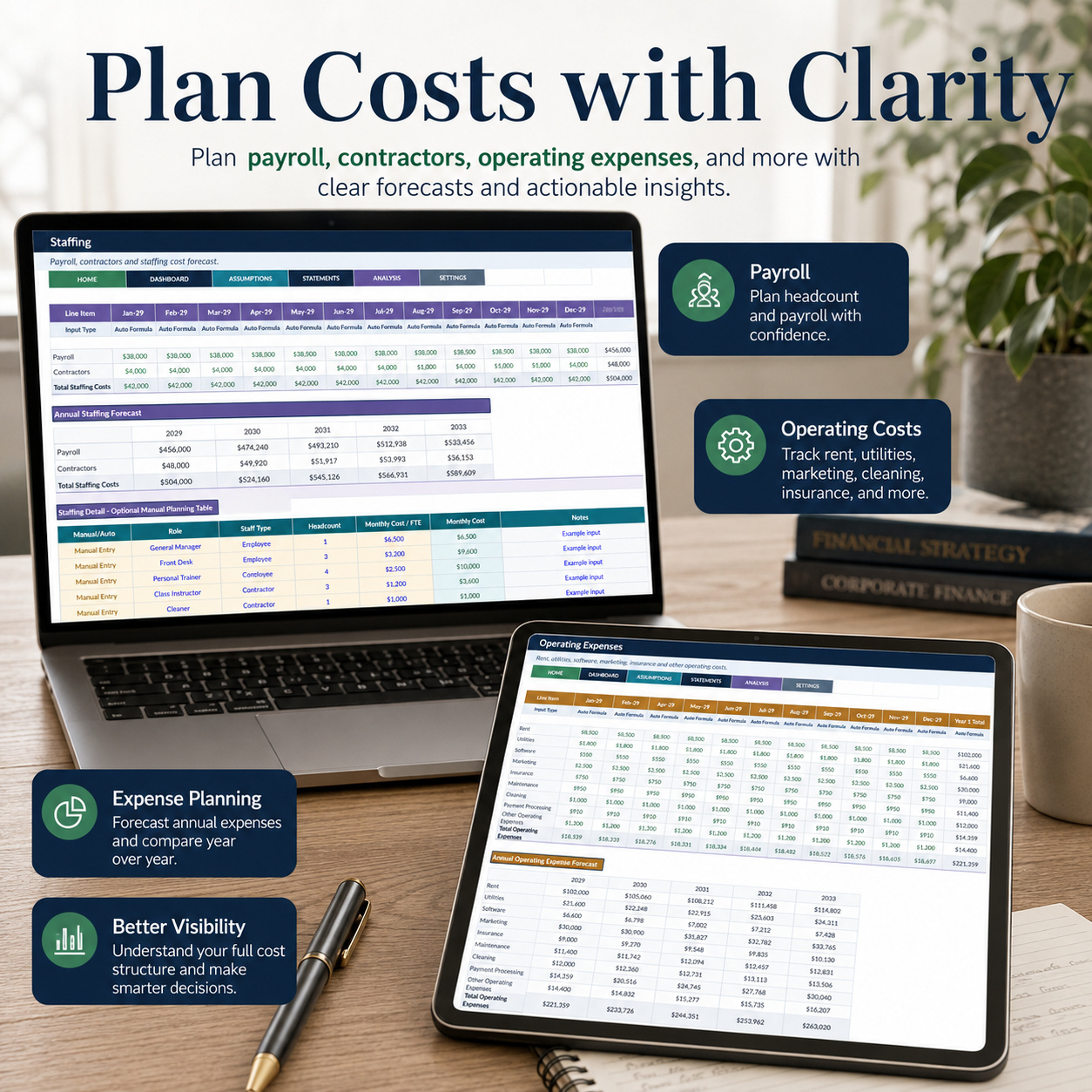
Users can plan headcount, monthly cost per FTE, monthly staffing cost, and annual staffing cost.


๐Ÿข OPERATING EXPENSES

Operating costs include:

โœ… Rent โœ… Utilities โœ… Software โœ… Marketing โœ… Insurance โœ… Maintenance โœ… Cleaning โœ… Payment Processing โœ… Other Operating Expenses

Payment-processing costs are linked to revenue, while other recurring operating costs can grow through inflation assumptions.


๐Ÿ—๏ธ CAPEX, DEPRECIATION & DEBT

Plan equipment and studio investment including:

โœ… Fitness Equipment โœ… Cardio Equipment โœ… Leasehold Improvements โœ… Technology โœ… Replacement Equipment โœ… Custom CapEx Items

The model includes useful-life assumptions, straight-line depreciation, debt draws, principal repayment, interest expense, and debt service.


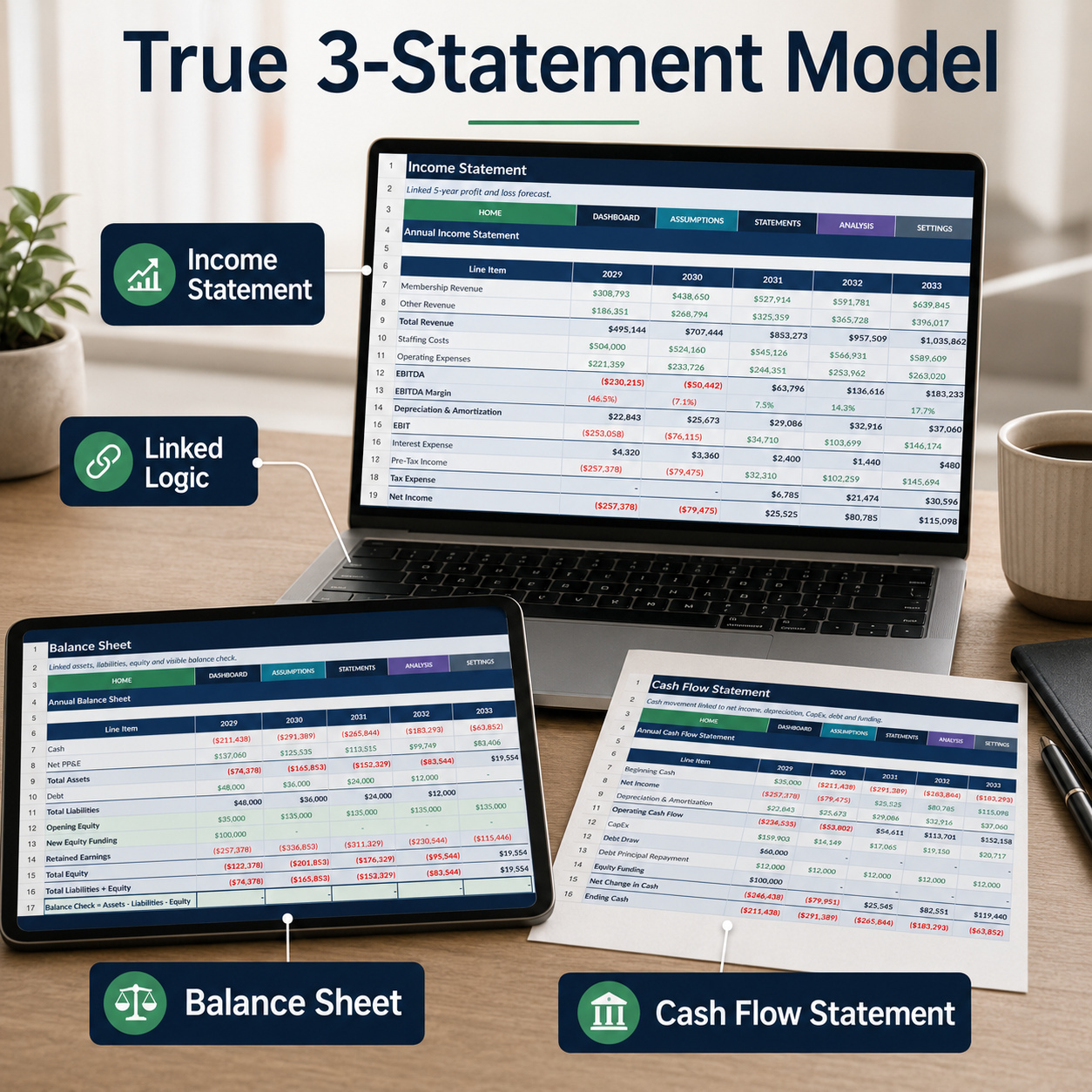
๐Ÿงพ FULL THREE-STATEMENT FINANCIAL MODEL

The workbook integrates:

โœ… Income Statement โœ… Balance Sheet โœ… Cash Flow Statement

Membership revenue, ancillary revenue, payroll, OPEX, CapEx, depreciation, debt, taxes, equity funding, and cash development flow through the connected statements.

A visible Balance Check supports model QA and financial consistency.


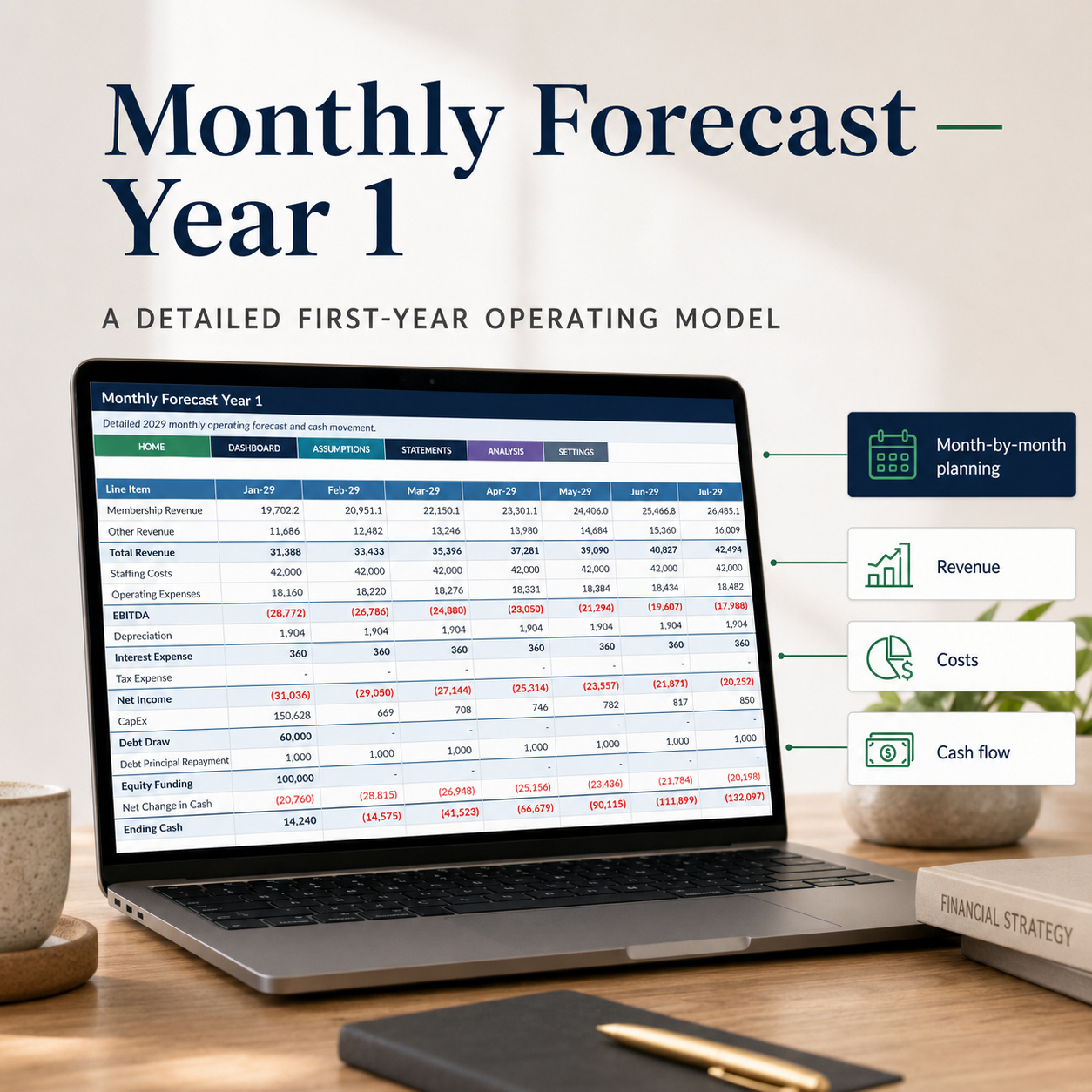
๐Ÿ“… MONTHLY + FIVE-YEAR FORECAST

The system includes:

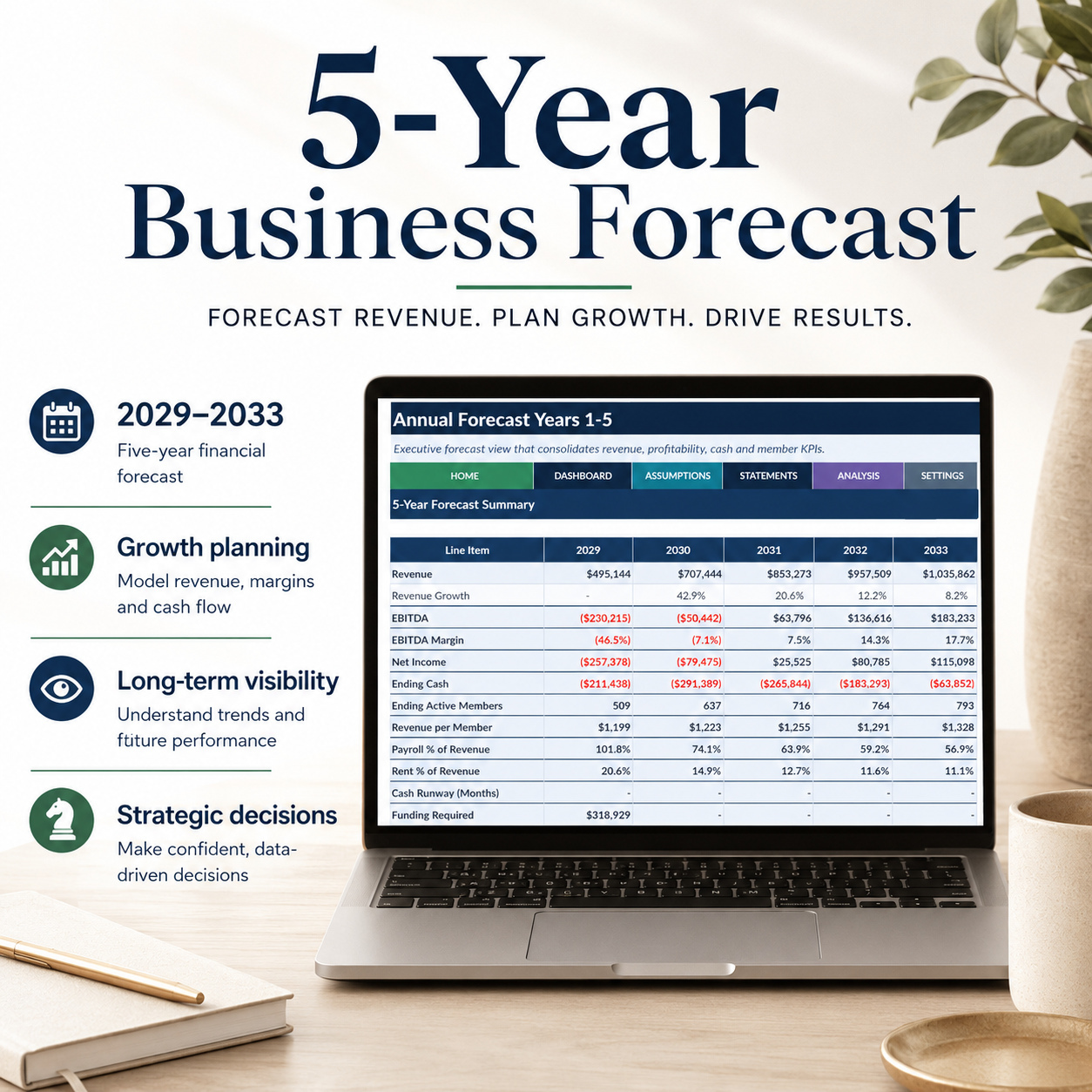
โœ… Monthly Forecast โ€” Year 1 โœ… Annual Forecast โ€” Years 1โ€“5 โœ… Illustrative forecast period 2029โ€“2033

This provides both near-term liquidity visibility and a longer-term management view of revenue, profitability, cash, member growth, and funding needs.


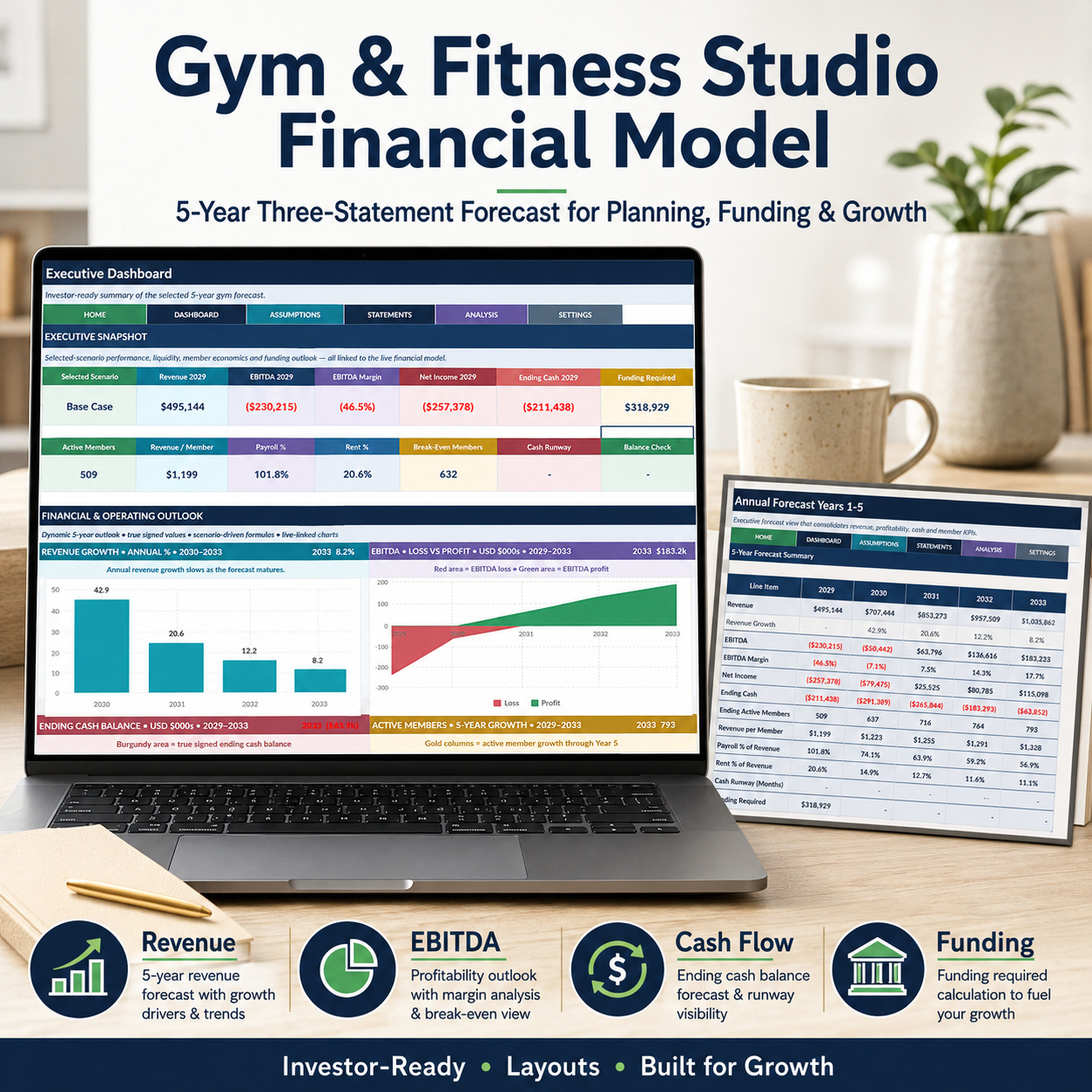
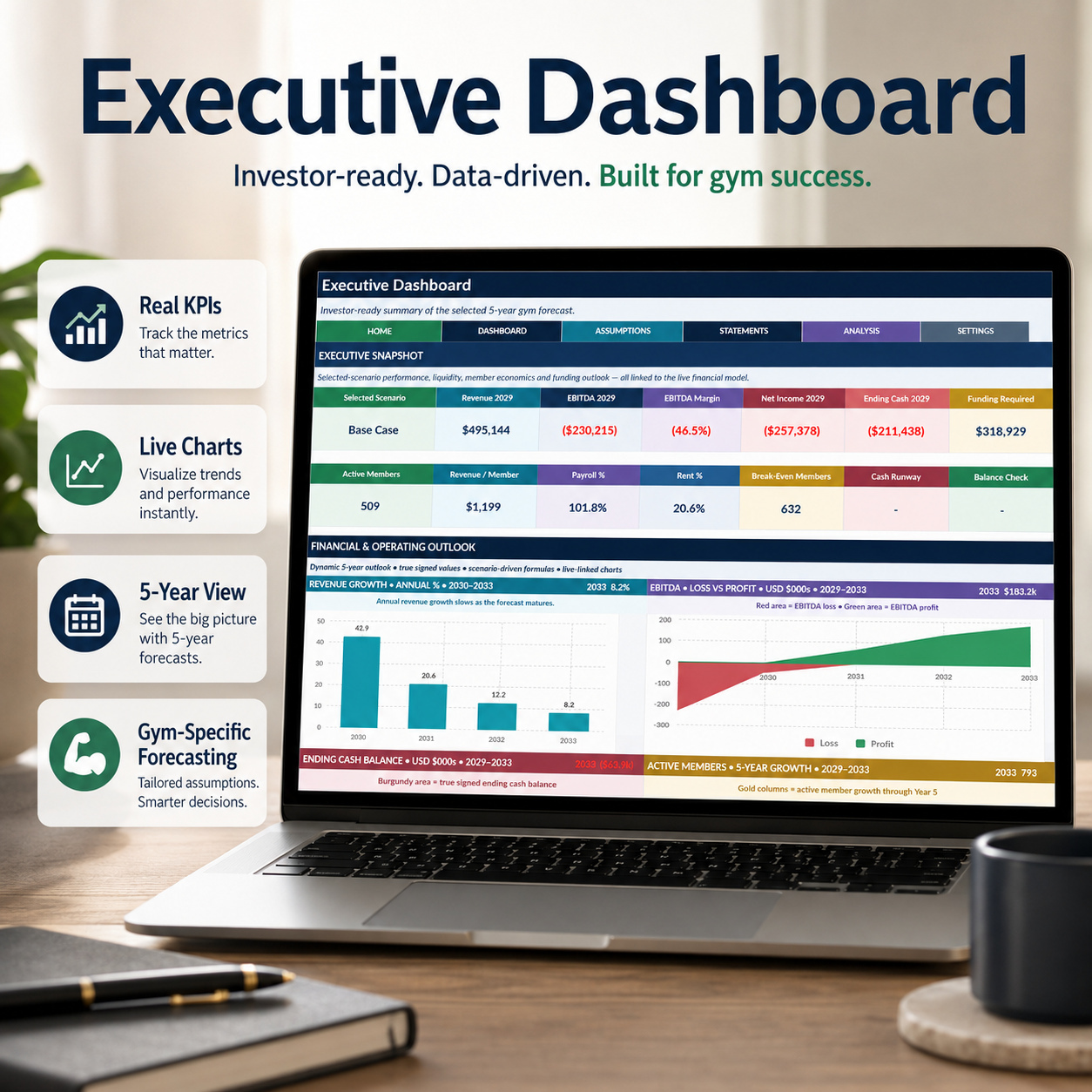
๐Ÿ“Š EXECUTIVE DASHBOARD & KPI ANALYSIS

The Executive Dashboard provides a selected-scenario management view including:

๐Ÿ’ต Revenue ๐Ÿ“ˆ EBITDA ๐Ÿ“Š EBITDA Margin ๐Ÿ’ฐ Net Income ๐Ÿฆ Ending Cash ๐Ÿ’ณ Funding Required ๐Ÿ‘ฅ Active Members ๐Ÿ’Ž Revenue per Member ๐Ÿ‘จโ€๐Ÿ’ผ Payroll % ๐Ÿข Rent % ๐ŸŽฏ Break-Even Members โณ Cash Runway โš–๏ธ Balance Check


Four integrated charts visualize:

๐Ÿ“ˆ Revenue Growth ๐Ÿ’Ž EBITDA โ€” Loss vs Profit ๐Ÿ’ต Ending Cash Balance ๐Ÿ‘ฅ Active Member Growth


The dedicated KPI Analysis provides annual operating and financial metrics across the full five-year period.


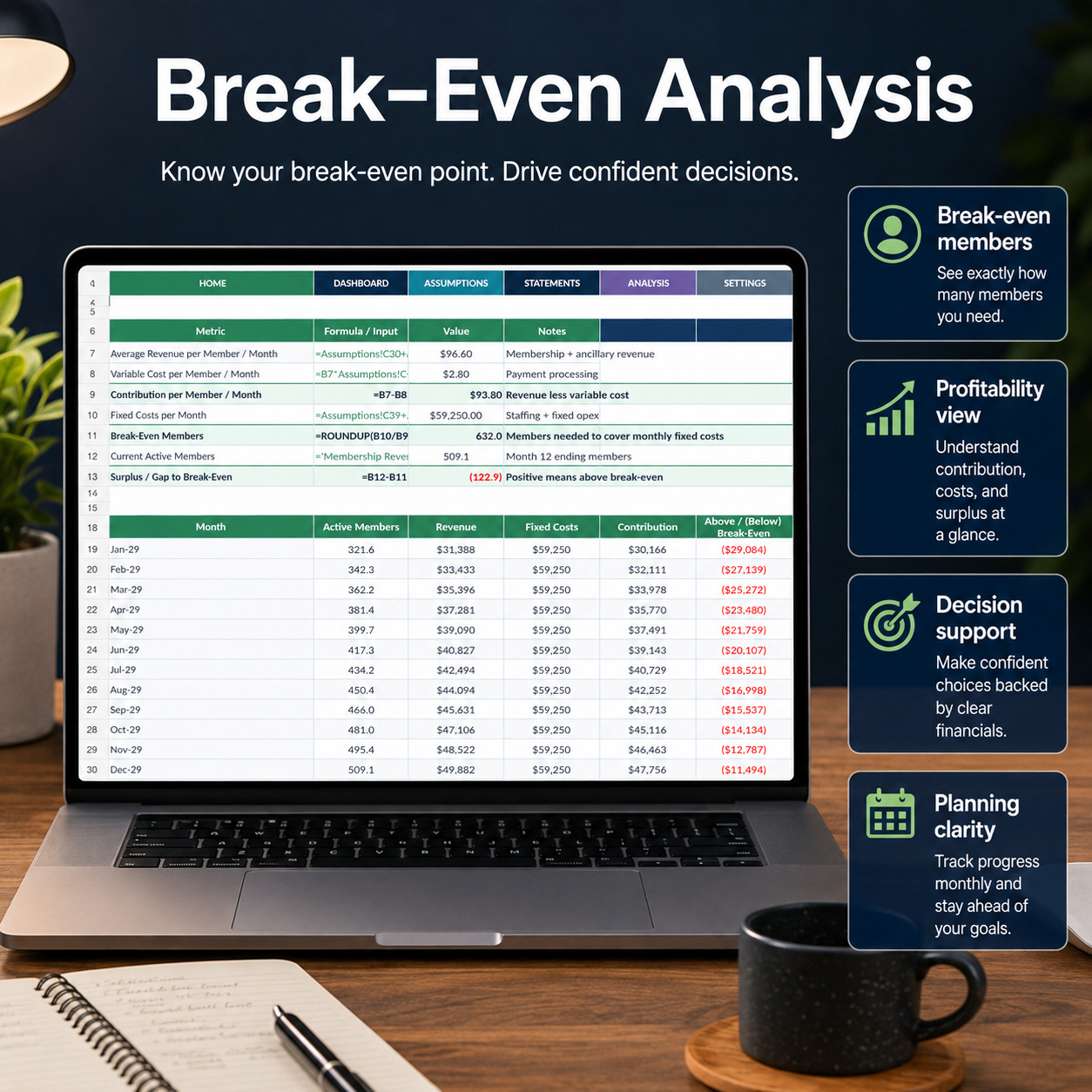
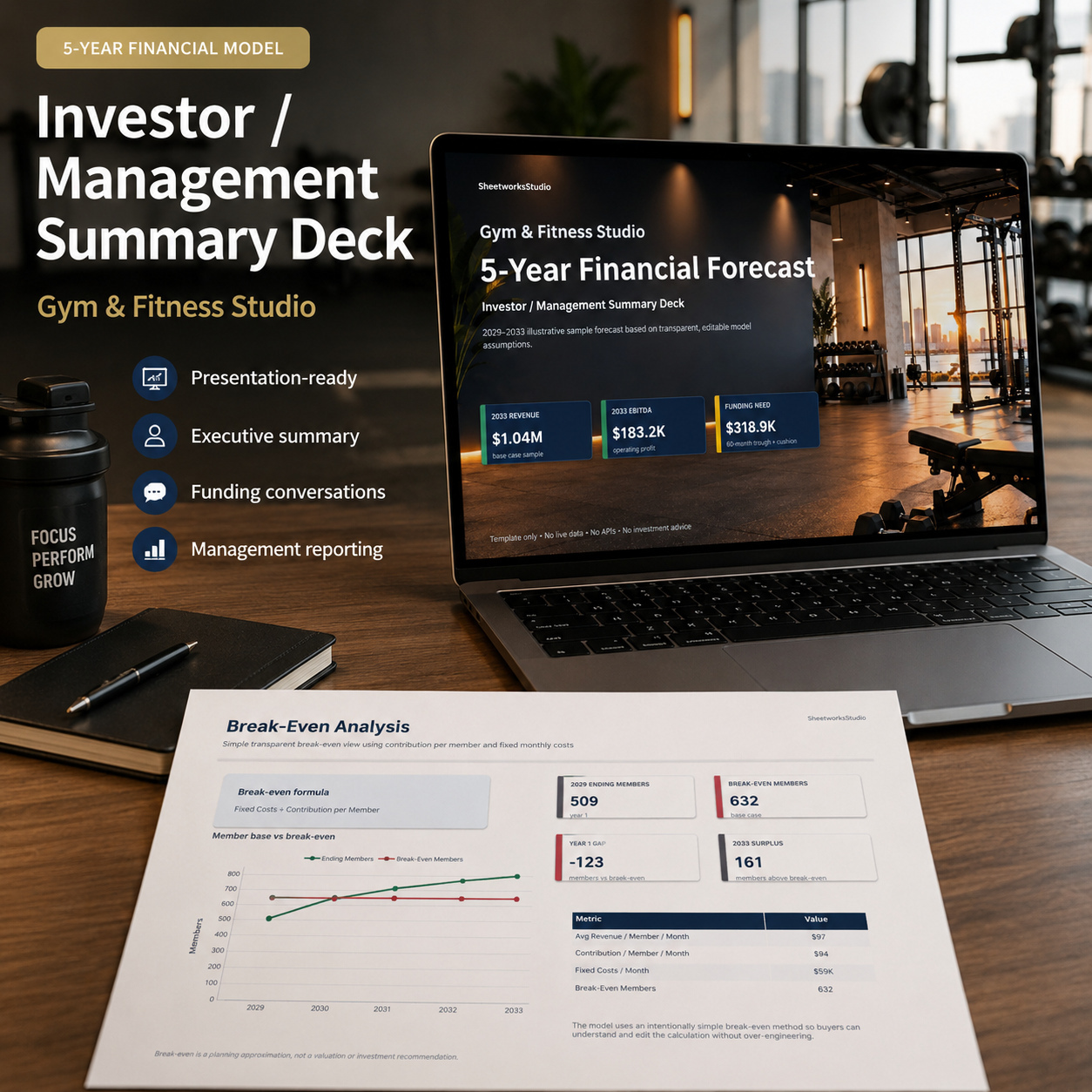
๐ŸŽฏ BREAK-EVEN ANALYSIS

The model calculates:

โœ… Average Revenue per Member โœ… Variable Cost per Member โœ… Contribution per Member โœ… Fixed Monthly Costs โœ… Break-Even Members โœ… Current Active Members โœ… Surplus / Gap to Break-Even

A monthly break-even ramp also shows how the member base develops relative to the calculated threshold.


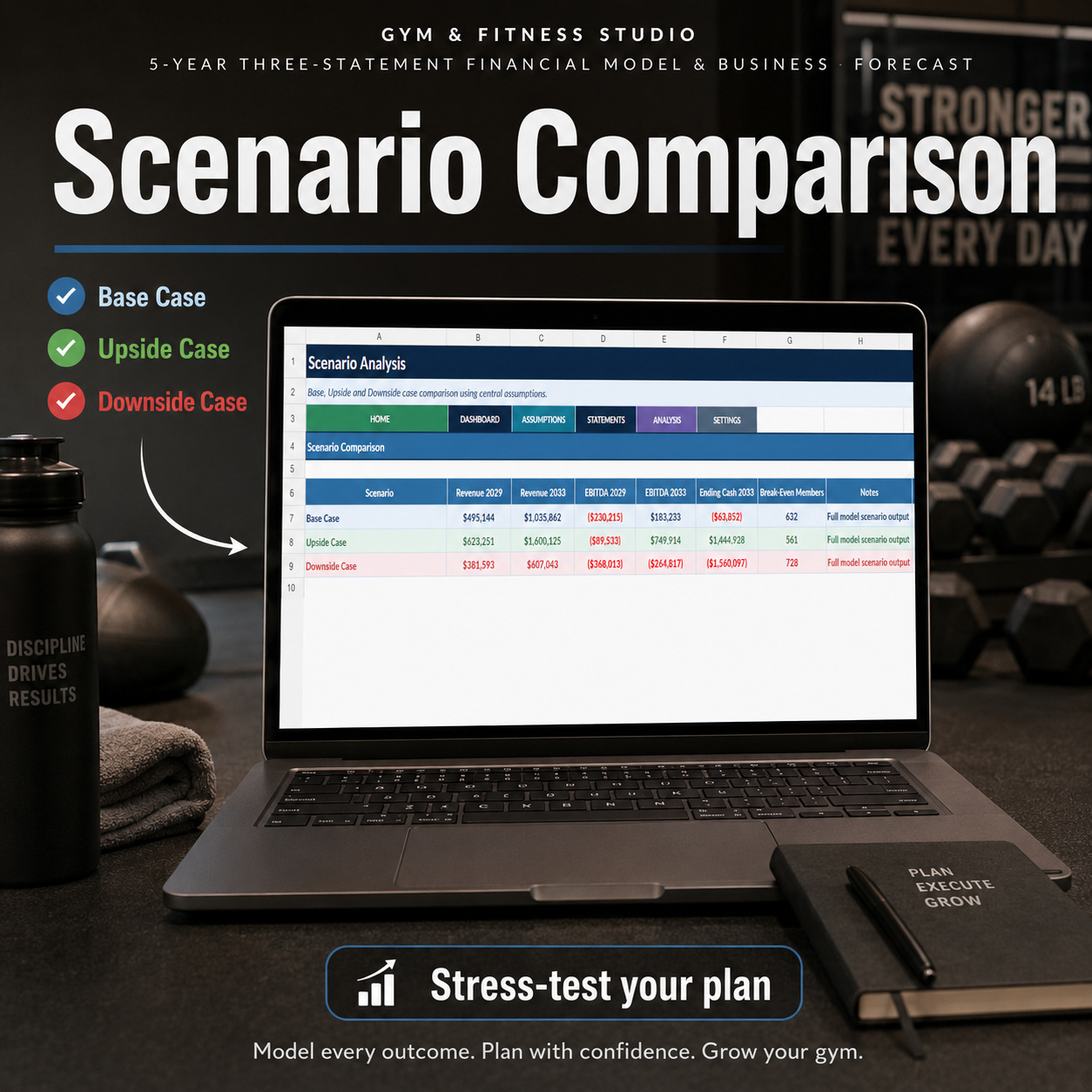
๐Ÿ”„ BASE โ€ข UPSIDE โ€ข DOWNSIDE SCENARIOS

Compare three complete planning cases:

๐Ÿ”ต Base Case ๐ŸŸข Upside Case ๐Ÿ”ป Downside Case

Scenario logic can flex:

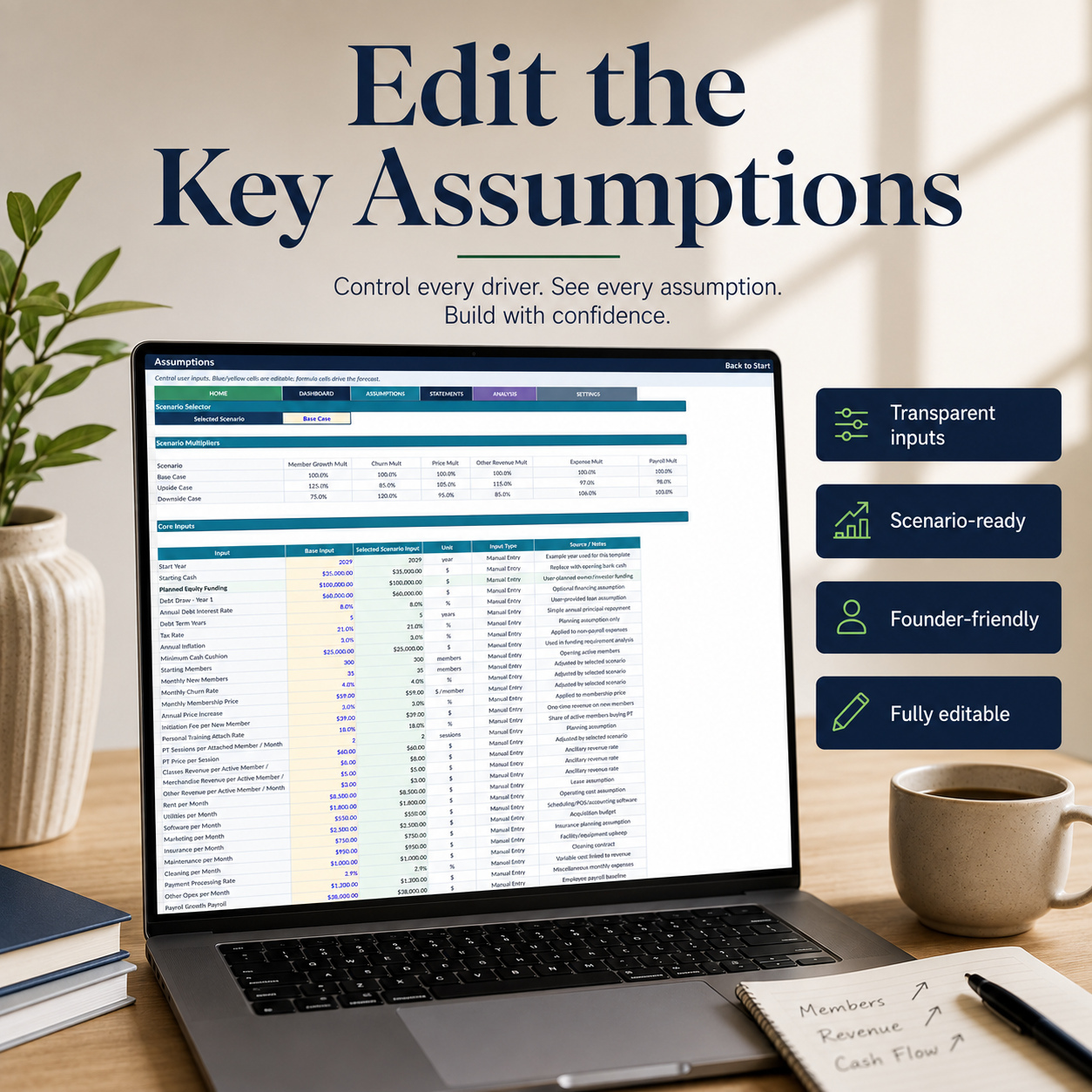
โœ… Member Growth โœ… Churn โœ… Membership Pricing โœ… Other Revenue โœ… Operating Expenses โœ… Payroll

The comparison provides independent model outputs for Revenue, EBITDA, Ending Cash, and Break-Even Members.


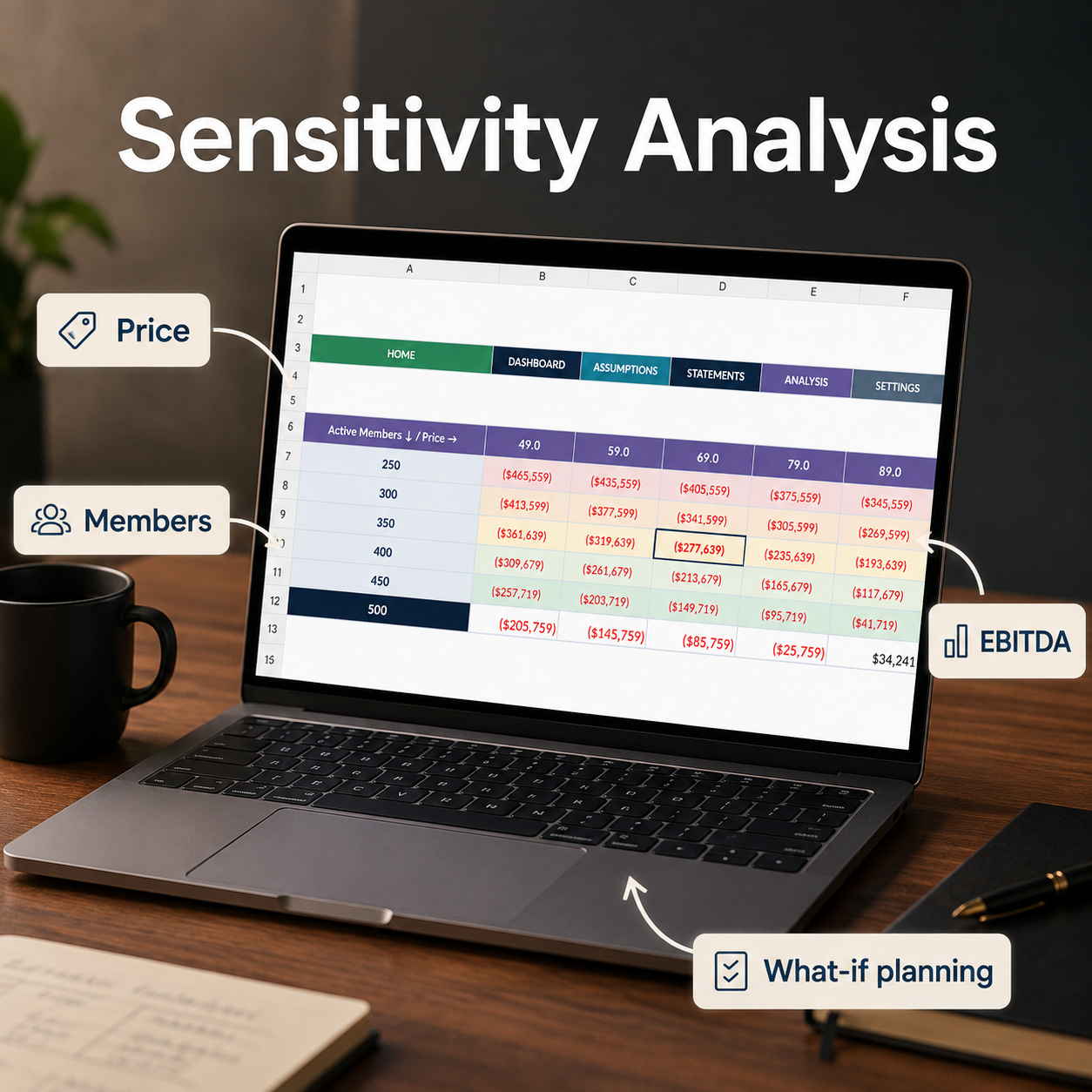
๐Ÿ” MEMBERSHIP PRICE ร— ACTIVE MEMBERS SENSITIVITY

The dedicated 2D Sensitivity Analysis evaluates how different combinations of:

Monthly Membership Price ร— Active Members

may affect projected annual EBITDA.

This provides a clear view of how membership scale and pricing interact with profitability.


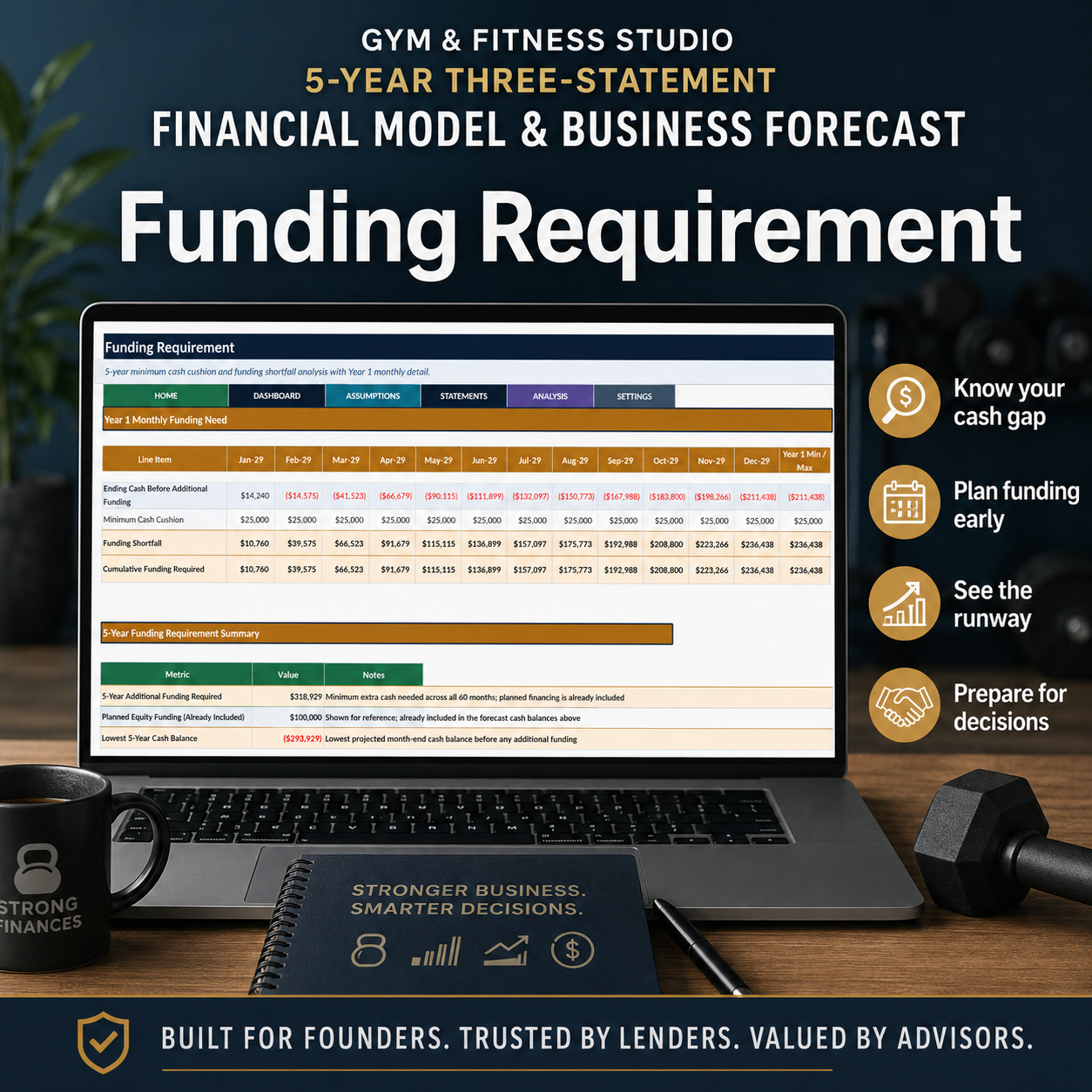
๐Ÿฆ FUNDING REQUIREMENT

The liquidity analysis includes:

โœ… Year 1 Monthly Cash Detail โœ… Ending Cash Before Additional Funding โœ… Minimum Cash Cushion โœ… Funding Shortfall โœ… Cumulative Funding Required โœ… 5-Year Additional Funding Requirement โœ… Planned Equity Funding โœ… Lowest 5-Year Cash Balance

The five-year requirement is based on the lowest projected cash position across the full 60-month planning period while maintaining the selected minimum cash cushion.


๐Ÿ“ฝ๏ธ 14-SLIDE INVESTOR / MANAGEMENT POWERPOINT

The included editable presentation covers:

โœจ Executive Summary ๐Ÿข Business Overview ๐Ÿ’ฐ Revenue Model ๐Ÿ“ˆ Growth Assumptions ๐Ÿ“Š 5-Year Financial Forecast ๐Ÿ’Ž Profitability Outlook ๐Ÿ‘ฅ Membership Growth ๐Ÿข Cost Structure ๐ŸŽฏ Break-Even Analysis ๐Ÿฆ Funding Requirement & Liquidity ๐Ÿ”„ Scenario Comparison โš ๏ธ Key Risks & Management Levers โญ Management Takeaways


The PowerPoint is a separate editable presentation and is not automatically linked to Excel. When model assumptions change, relevant presentation figures should be updated manually.

It is designed for internal management reviews, business planning, consulting engagements, and preparation for financing or stakeholder discussions.


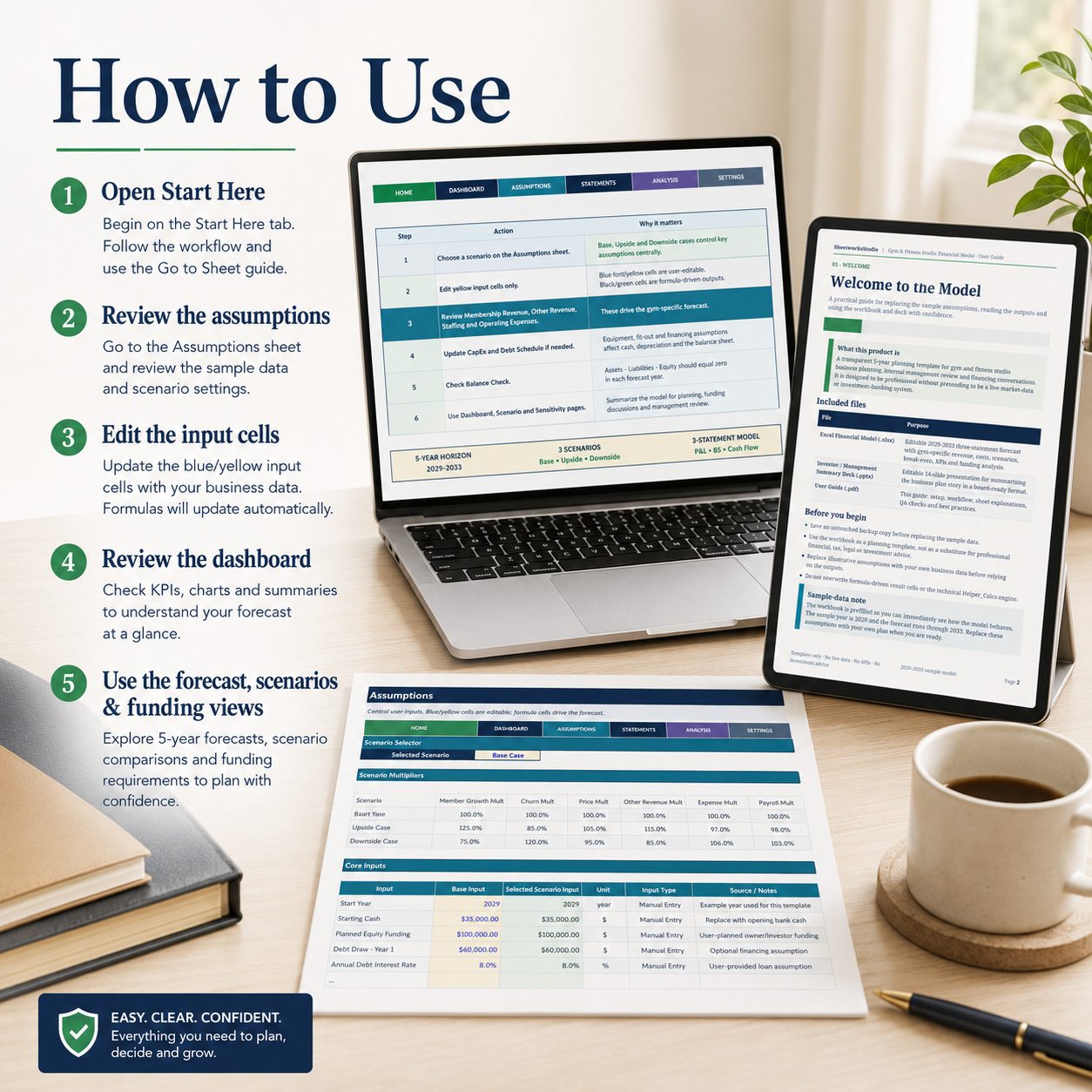
๐Ÿ“˜ 22-PAGE HOW-TO-USE GUIDE

The detailed guide covers:

โœ… Welcome & Quick Start โœ… Workbook Map โœ… Sheet-by-Sheet Reference โœ… Editing Rules โœ… Assumptions & Scenario Selector โœ… Membership Revenue โœ… Other Revenue โœ… Staffing & Operating Expenses โœ… CapEx, Depreciation & Debt โœ… Three-Statement Logic โœ… Monthly & Annual Forecasts โœ… Break-Even Analysis โœ… Scenario & Sensitivity Analysis โœ… KPI Analysis & Dashboard โœ… Funding Requirement โœ… PowerPoint Usage โœ… Recommended Planning Workflow โœ… Excel & Google Sheets Guidance โœ… Troubleshooting & QA Checklist โœ… Finance Glossary โœ… Final Review & Responsible Use


๐Ÿ’ป TECHNICAL COMPATIBILITY

โœ… Microsoft Excel (.xlsx) โœ… Microsoft PowerPoint (.pptx) โœ… PDF Guide โœ… Google Sheets import possible โœ… No macros or VBA โœ… No APIs โœ… No live market data โœ… No automatic gym-industry benchmarks โœ… No external Excel data connections


๐Ÿ“Œ Microsoft Excel remains the reference environment. When imported into Google Sheets, formatting, charts, dropdown styling, or other visual elements may vary.


โš–๏ธ IMPORTANT DISCLAIMER

This product is an editable financial planning and business-modeling template intended for organizational, informational, and decision-support purposes only. It does not constitute financial, investment, accounting, tax, legal, financing, valuation, fitness, or professional business advice. All sample membership figures, prices, churn rates, revenue assumptions, salaries, operating costs, CapEx values, financing assumptions, and other inputs are illustrative only and should be replaced with business-specific information before real-world use. The model does not contain live market data, automatic industry benchmarks, or guarantees regarding future membership growth, profitability, financing availability, or business performance.


๐Ÿ“Š This complete planning system brings membership economics, ancillary revenue, staffing, cost structure, financial forecasting, break-even analysis, liquidity, and funding requirements into one connected framework. It is designed to help gym owners, founders, consultants, and finance professionals evaluate assumptions more clearly, understand the relationship between member growth and profitability, and prepare more structured management and financing discussions.

This Best Practice includes
1 Gym & Fitness Studio Financial Model (.xlsx), 1 Investor / Management Summary Deck (.pptx), 1 How-to-Use Guide (.pdf)

Acquire business license for $79.90

Add to cart

Add to bookmarks

Discuss

Further information

The objective of this model is to provide gym and fitness studio owners, founders, finance professionals, consultants, and management teams with a structured framework for connecting membership economics with financial performance, profitability, liquidity, and funding requirements.

Users can model member acquisition, churn, membership pricing, initiation fees, personal training, classes, merchandise, staffing, contractors, operating expenses, CapEx, debt, taxes, and financing assumptions within one connected financial planning system.

The framework is designed to help users understand how membership growth and pricing influence revenue, evaluate fixed-cost coverage and break-even membership levels, compare alternative scenarios, assess profitability, and identify potential cash or funding requirements.

The integrated financial statements, Executive Dashboard, KPI Analysis, scenarios, sensitivity analysis, and presentation deck also provide a consistent framework for recurring management reviews and structured financing or stakeholder discussions.

This model is particularly suitable for:

Gyms
Fitness studios
Boutique fitness concepts
New gym startups
Existing fitness businesses
Gym owners and founders
Finance managers
Business planners
Management consultants
Fitness business consultants
Fractional CFOs
Management teams

It is especially useful when developing a five-year business plan, forecasting membership growth, reviewing churn and pricing, planning staffing and contractors, evaluating facility costs, planning equipment investment, estimating break-even membership requirements, comparing scenarios, or assessing future liquidity and funding needs.

This model does not replace accounting software, gym-management software, membership platforms, POS systems, ERP solutions, specialist FP&A software, professional valuations, or lender underwriting.

It does not provide live membership data, automatic gym-industry benchmarks, market pricing, fitness recommendations, APIs, bank integrations, accounting feeds, or external data connections.

The template does not constitute financial, investment, accounting, tax, legal, financing, valuation, fitness, or professional business advice.

All outputs depend on the assumptions entered by the user and should be reviewed against the individual business situation.


0.0 / 5 (0 votes)

please wait...