

Veterinary Practice  5-Year Monthly Financial Projection & Valuation Model
Originally published: 02/10/2024 07:30
Last version published: 06/11/2025 15:02
Publication number: ELQ-26548-4
View all versions & Certificate
certified

Veterinary Practice 5-Year Monthly Financial Projection & Valuation Model

Comprehensive 5-year financial model for vet practices, projecting revenue, expenses, and profitability, including staff costs, service streams, and valuation.

Description
This financial model is meticulously designed to analyze and forecast the financial performance of a veterinary practice, capturing the key revenue and cost drivers specific to the animal healthcare and pet services sector. It focuses on revenue generation from veterinary consultations, diagnostics, treatments, pharmacy sales, and ancillary services, segmented into Clinical & In-House Services, Partnered / External Diagnostic & Specialist Services, Referral & Commission Income, and Ancillary Operating Revenue.


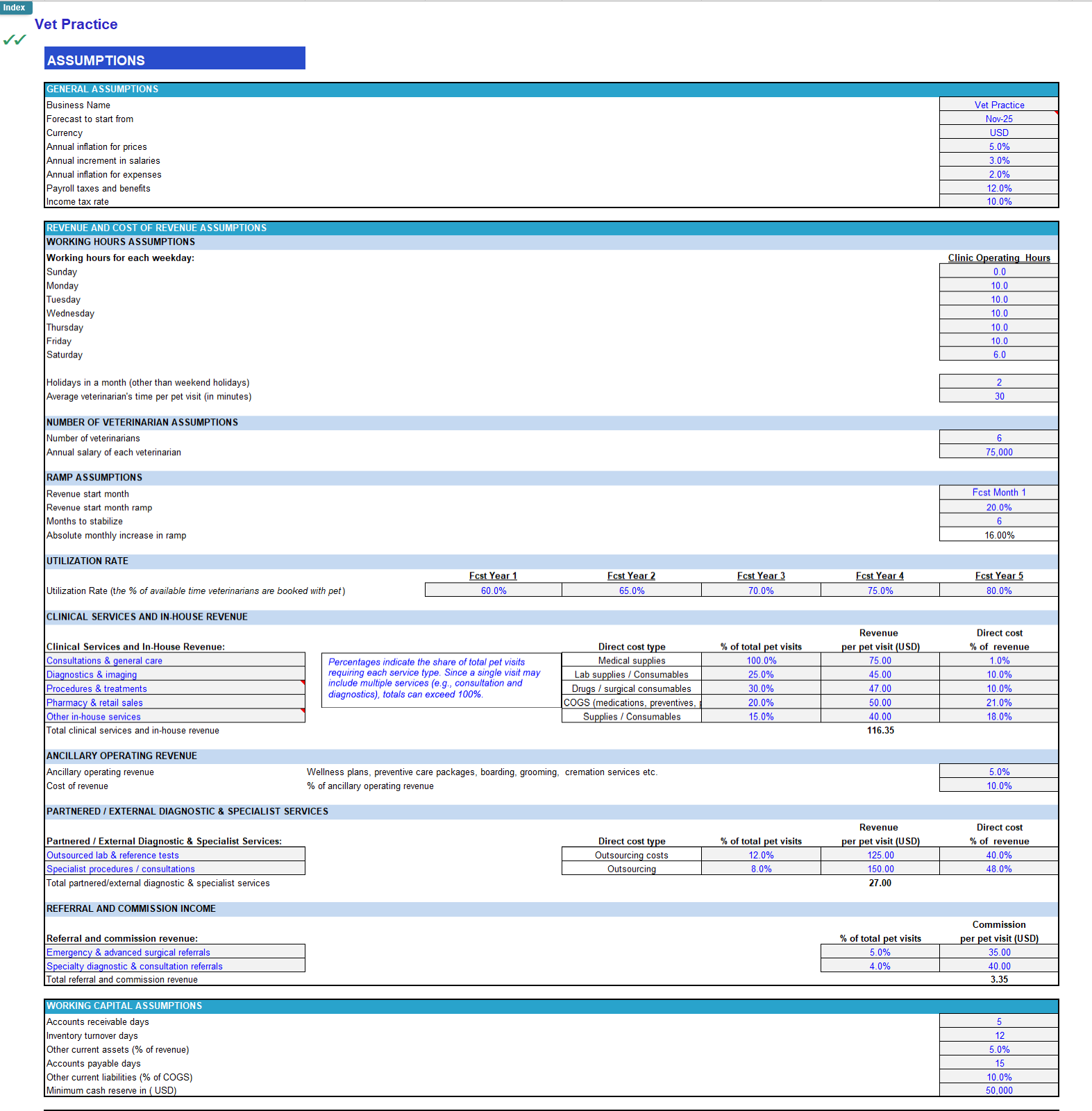
The model integrates operational parameters such as number of veterinarians, average time per pet visit, operating hours, treatment mix allocations etc, ensuring that all core drivers of a veterinary business are realistically represented.
It delivers a 5-year forecast horizon (60 months) with detailed monthly projections and annual summaries. Practical operating metrics such as utilization rates, ramp-up schedules, treatment mix assumptions, commission structures, and ancillary income ensure reliable and data-driven financial projections tailored for veterinary practices.


This financial model serves as a comprehensive planning and valuation tool for independent veterinary clinics, animal hospitals, and group practices, ideal for use in strategic planning, investor presentations, practice expansion, or bank loan applications.


Model Structure – 5 Main Sections
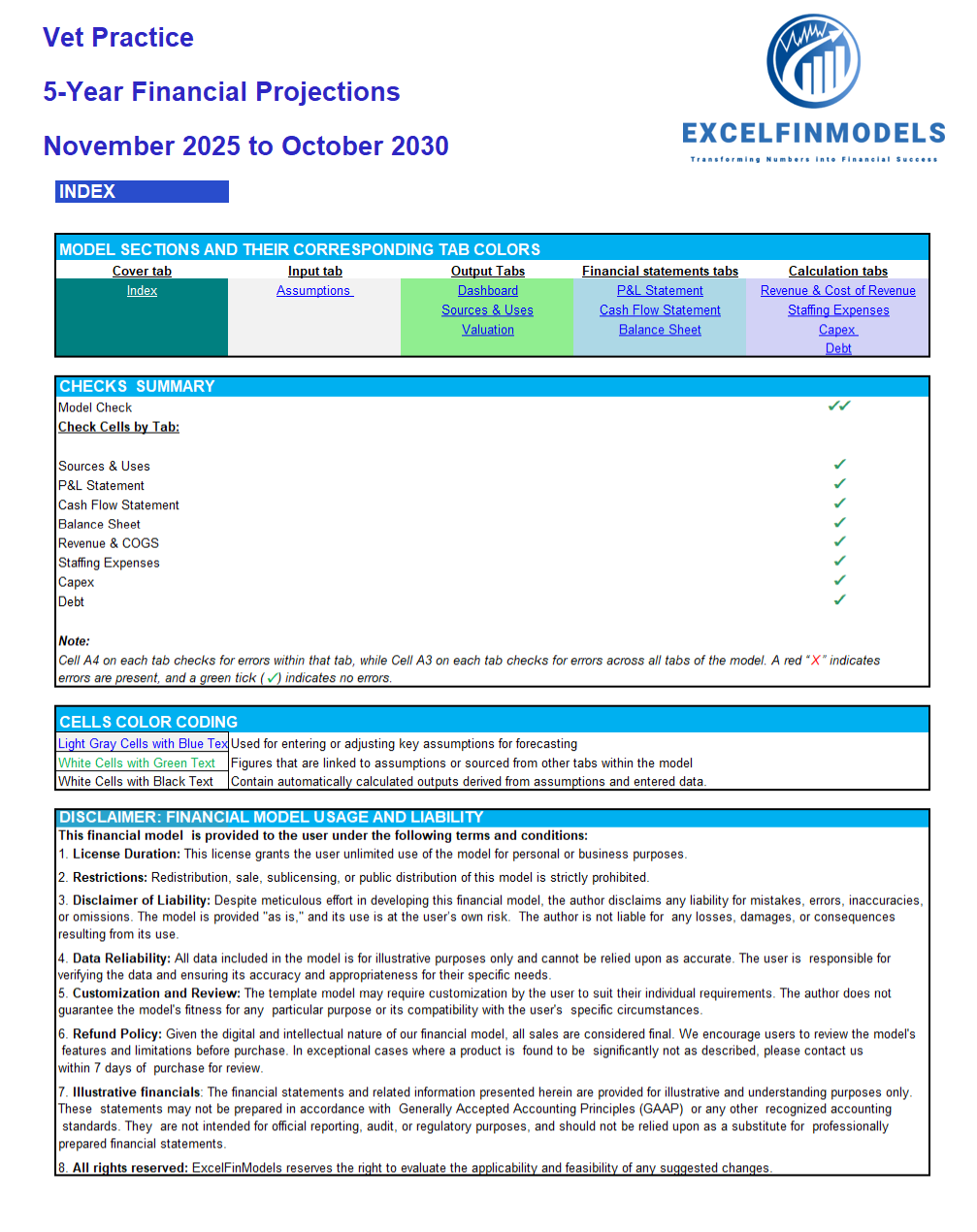
1. Cover Section
  • Index showing model sections and their corresponding tab colors
  • Summary of key validation checks and error indicators
  • Cell color-coding and tab color legend for user navigation


2. Input Section (Assumptions Tab)
All key assumptions are consolidated into a single, user-friendly tab, with inputs highlighted in Light Gray Cells with Blue Text.
Key Input Areas Include:
• Revenue Assumptions:
  • Number of veterinarians
  • Average time per pet visit and operating days per month
  • Utilization rate and ramp-up period
  • Service categories (consultations, diagnostics, procedures, pharmacy & retail sales, grooming, boarding, etc.)
  • % of pet visits requiring each service type
  • Average revenue per pet visit and referral commission percentages
  • Revenue from partnered / external diagnostic and specialist services
  • Income from commission and referral fees
  • Ancillary revenue such as boarding/day-care income, grooming services, and wellness plans
• General Assumptions:
  • Practice name, start date, reporting currency
  • Inflation, payroll tax, and corporate tax rates
• Cost of Revenue Assumptions:
  • Direct costs by service category (medical supplies, consumables, outsourced diagnostics)
  • Cost of treatments outsourced to partner labs or specialists
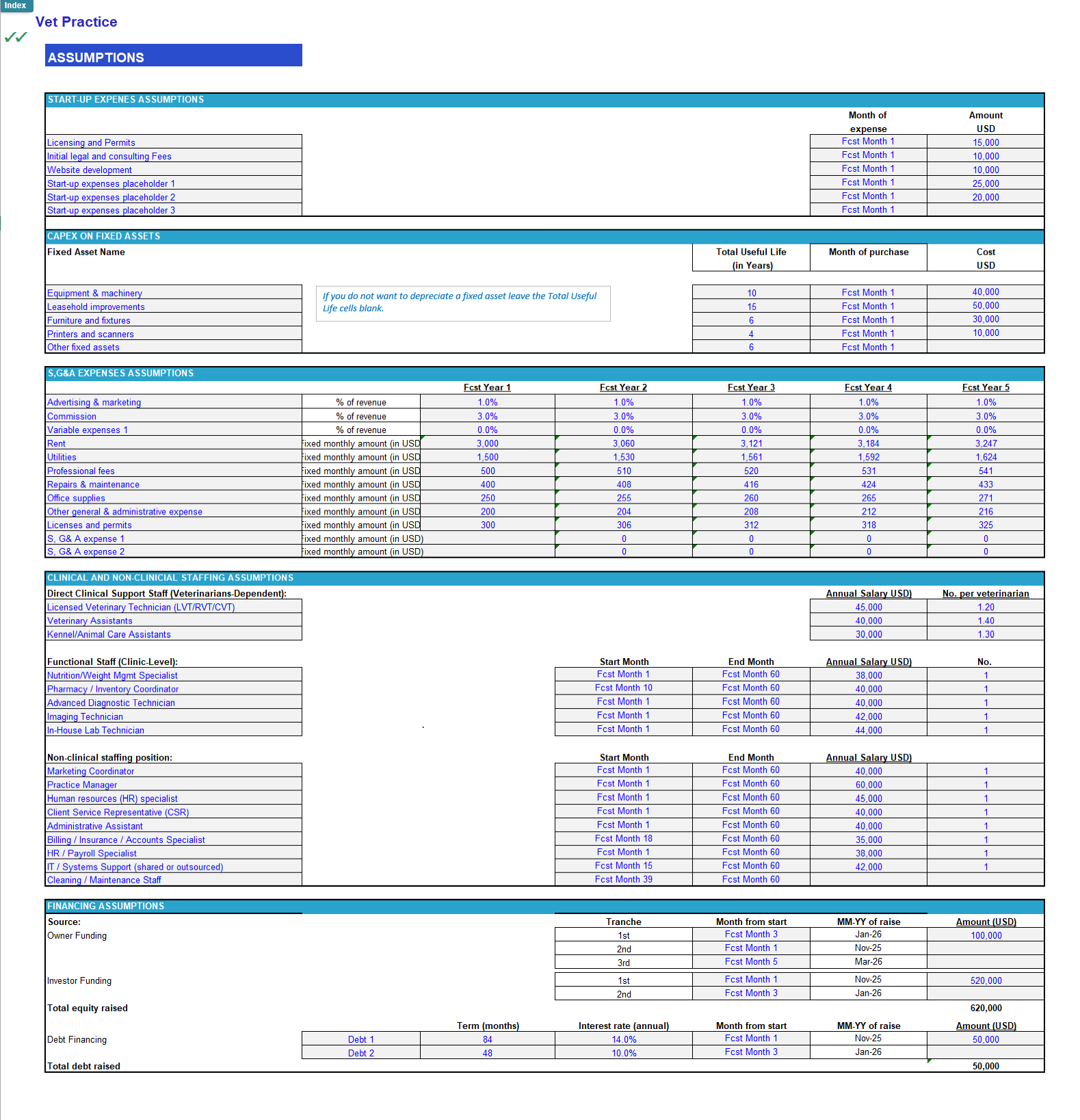
• S,G&A Expenses:
  • Fixed and variable operating expenses such as rent, utilities, staff salaries, and marketing
  • Clinical staffing costs (veterinarians, technicians, assistants, animal care attendants)
• CapEx Assumptions:
  • Initial setup costs for medical equipment, kennels, interiors, and furnishings
  • Depreciation schedules for capital assets
• Working Capital Assumptions:
  • Receivable and payable days, inventory turnover, and minimum cash reserves
• Financing & One-Time Expenses:
  • Loan terms, interest rates, and fundraising activities
  • Licensing, branding, and launch marketing costs


3. Output Tabs Section
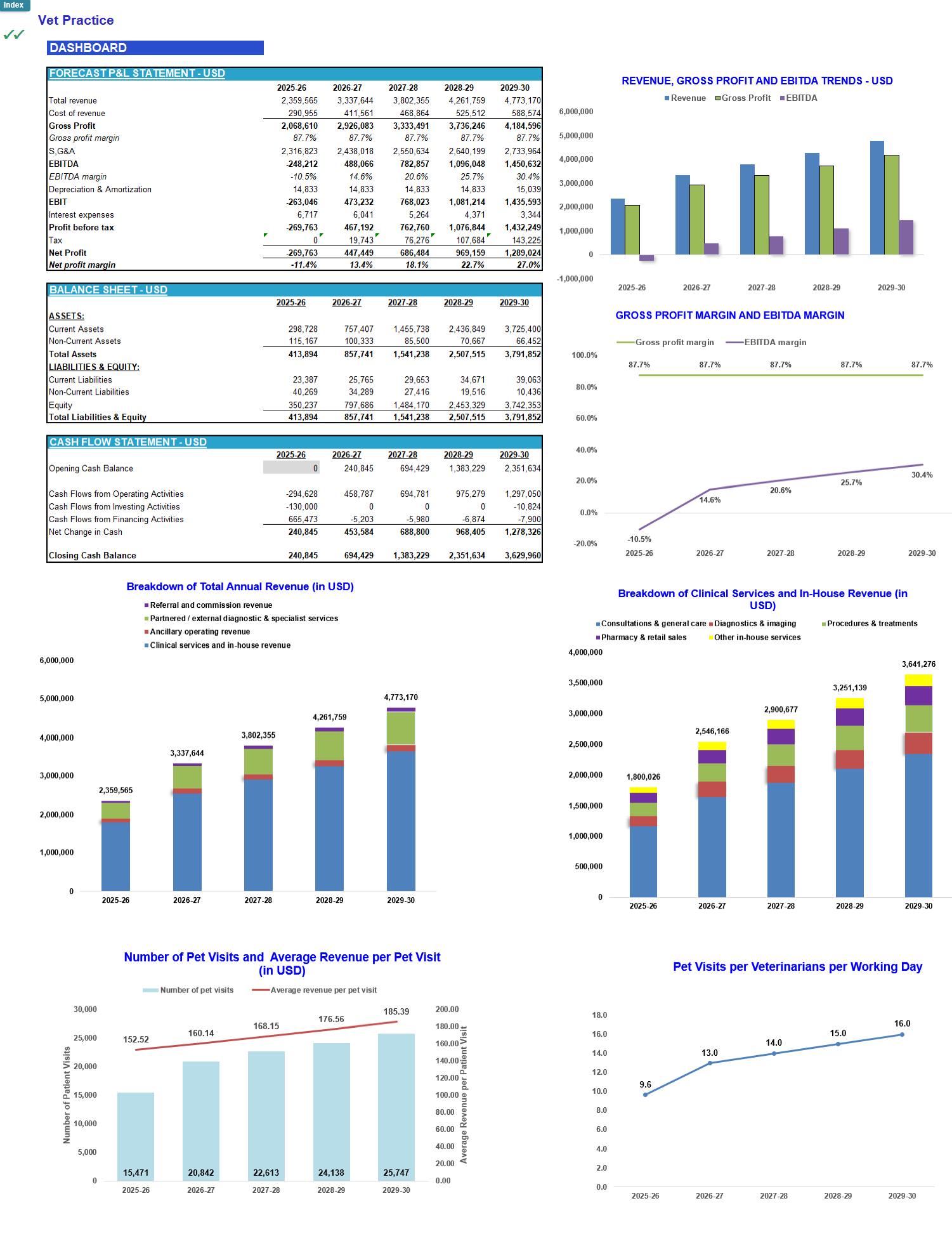
  • Dashboard: Comprehensive visual summary of revenue, cost, and profitability KPIs
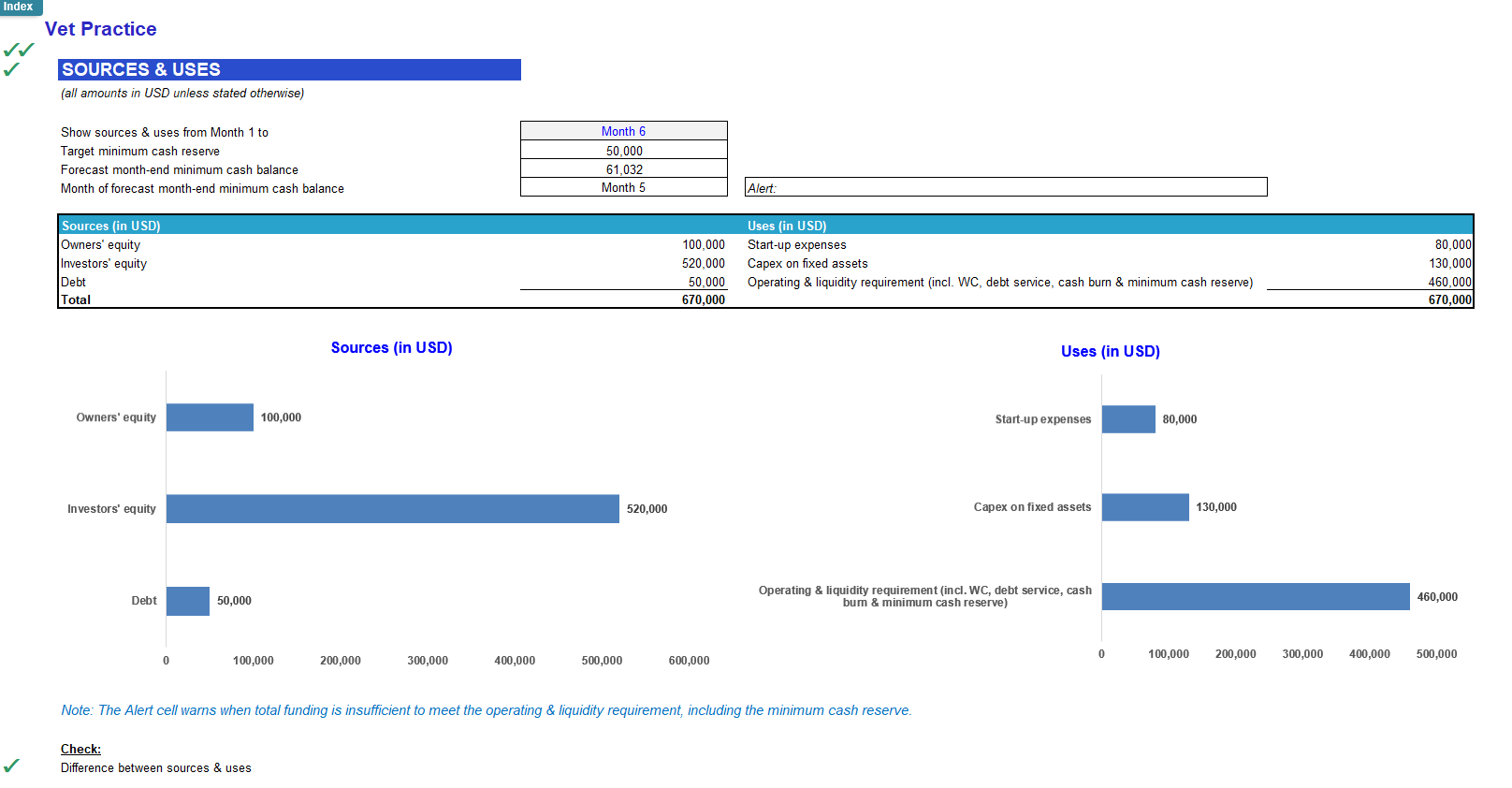
  • Sources & Uses: Overview of equity and debt sources, and allocation across capex, setup, and operations
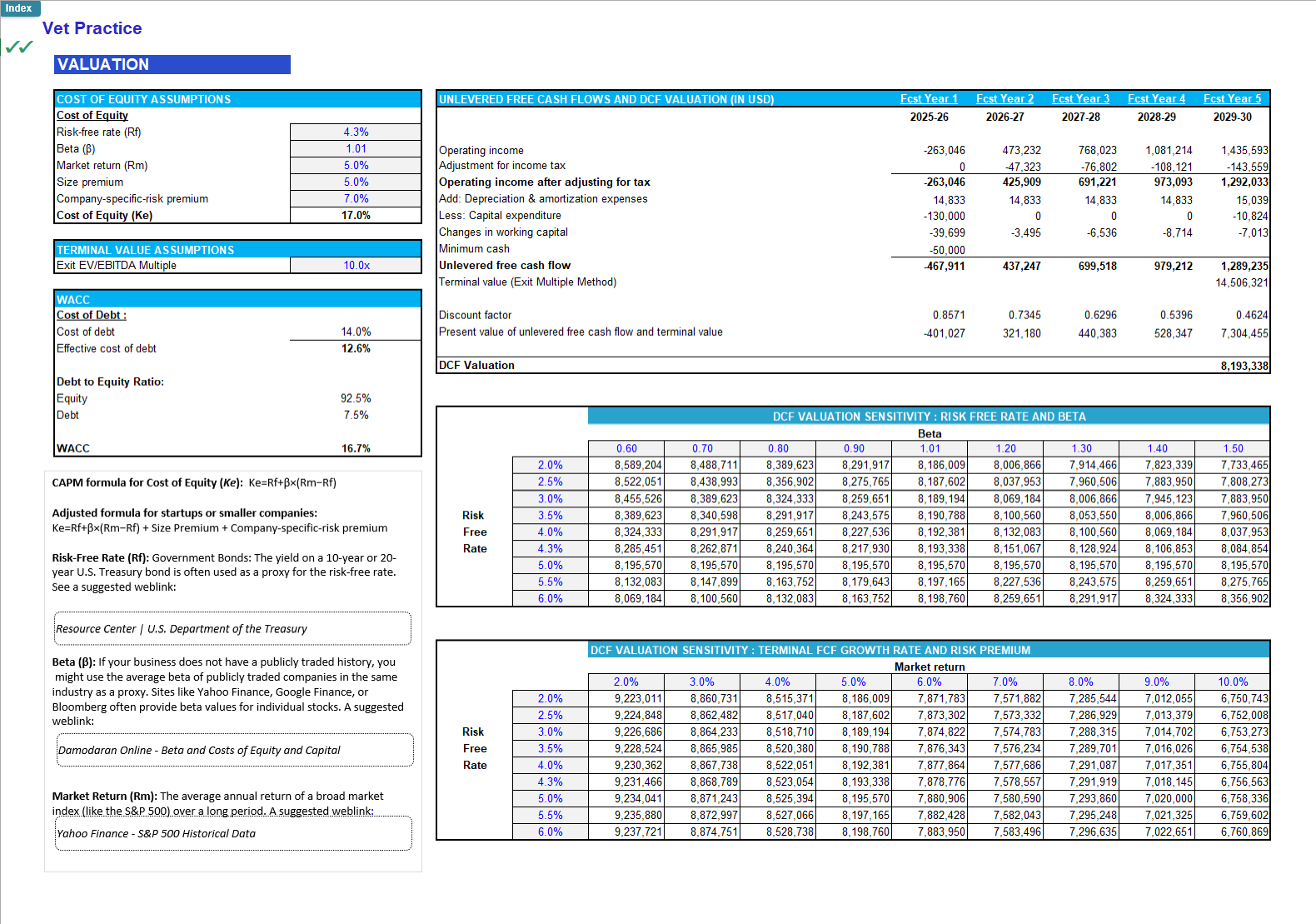
  • Valuation: DCF-based valuation model with sensitivity analysis


4. Financial Statements Section
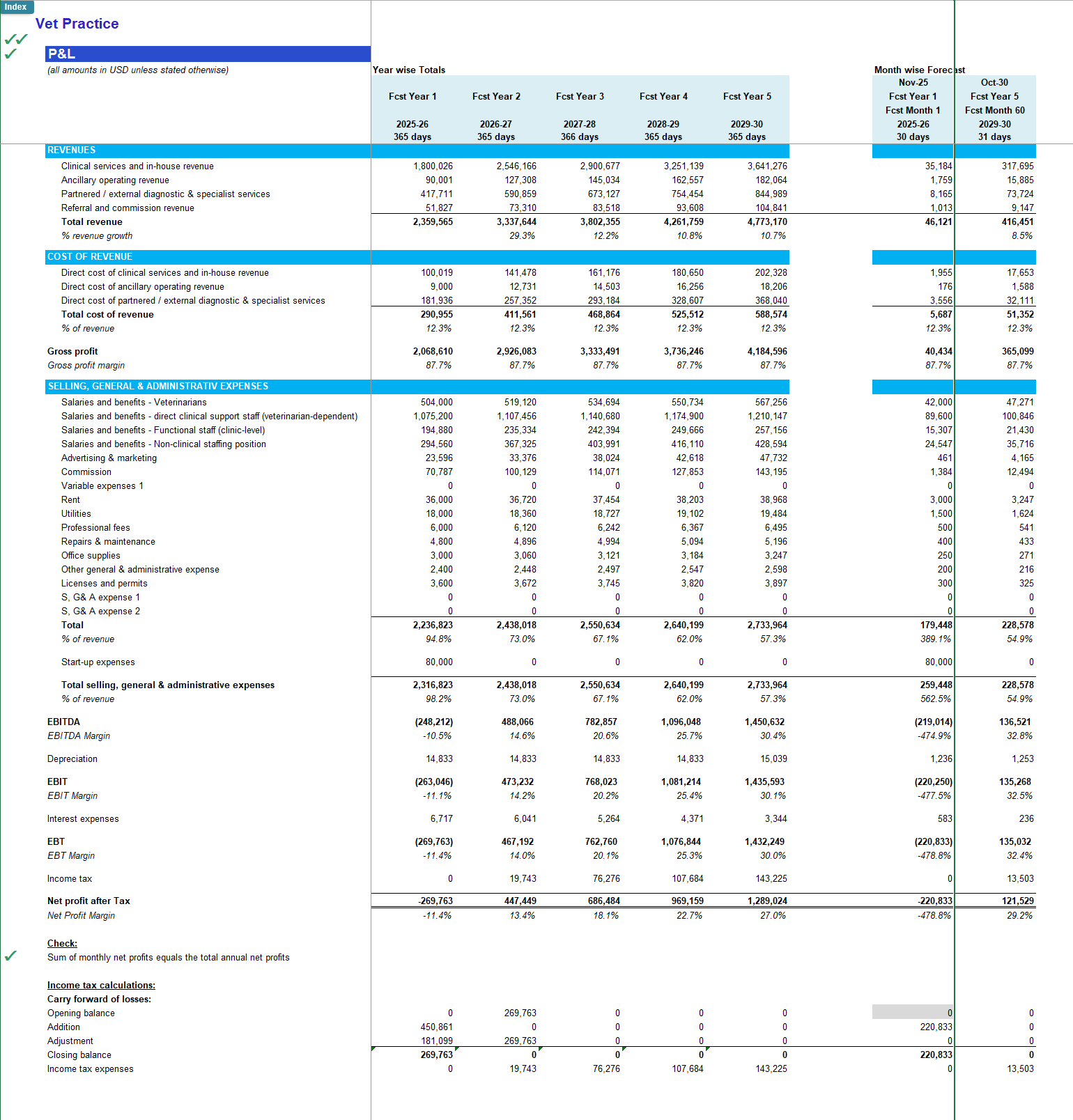
  • Profit & Loss Statement
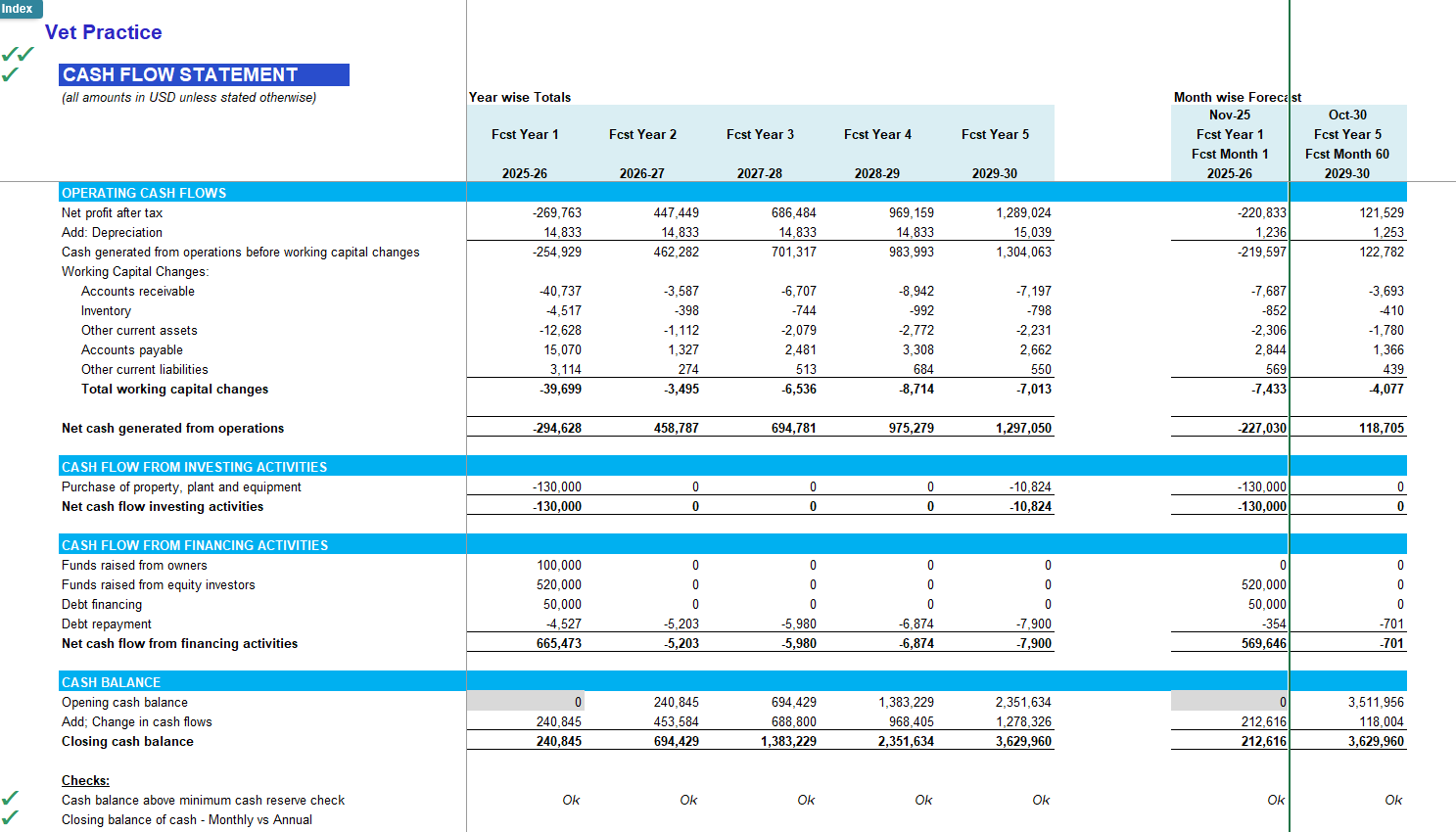
  • Cash Flow Statement
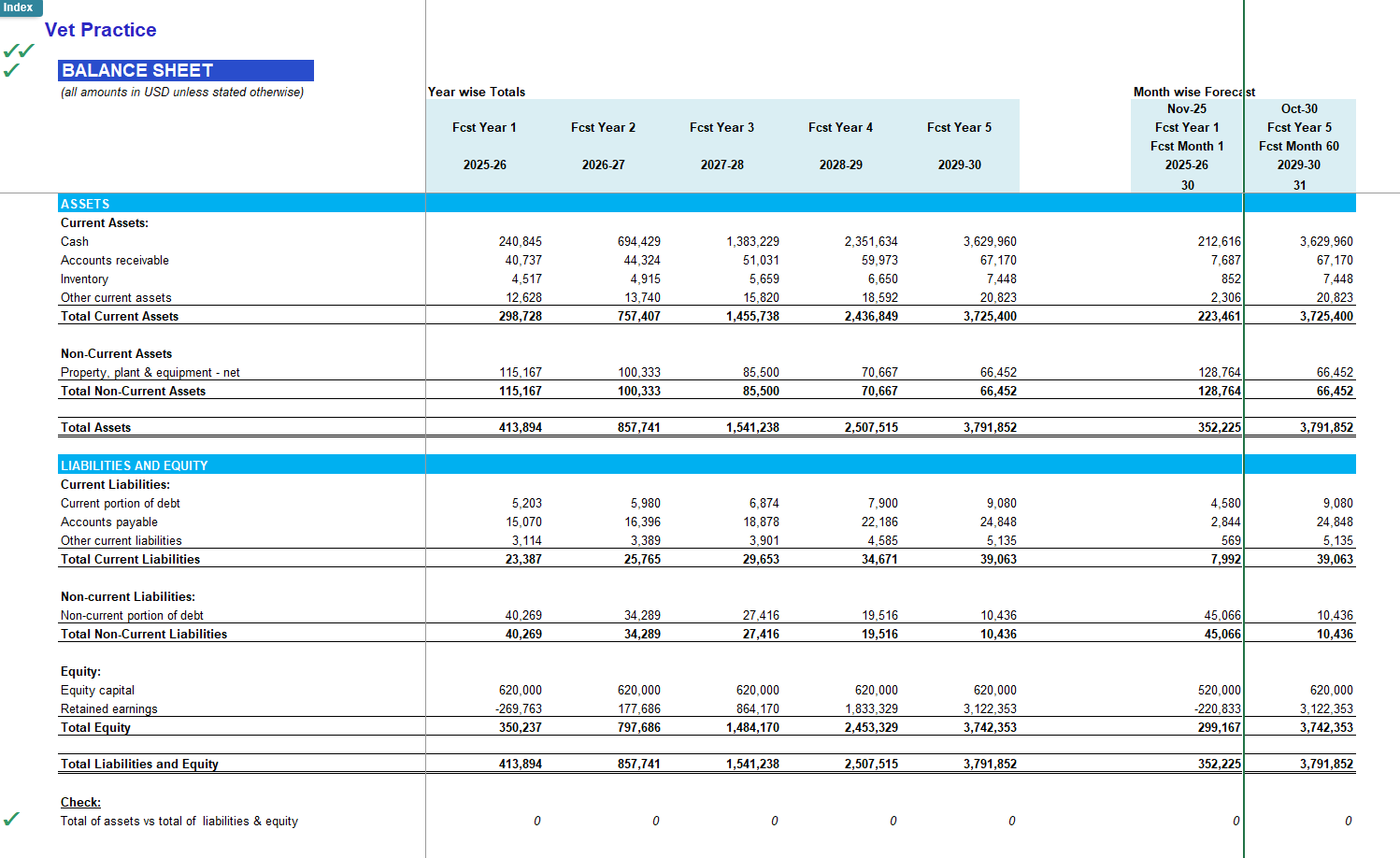
  • Balance Sheet


5. Calculations Section
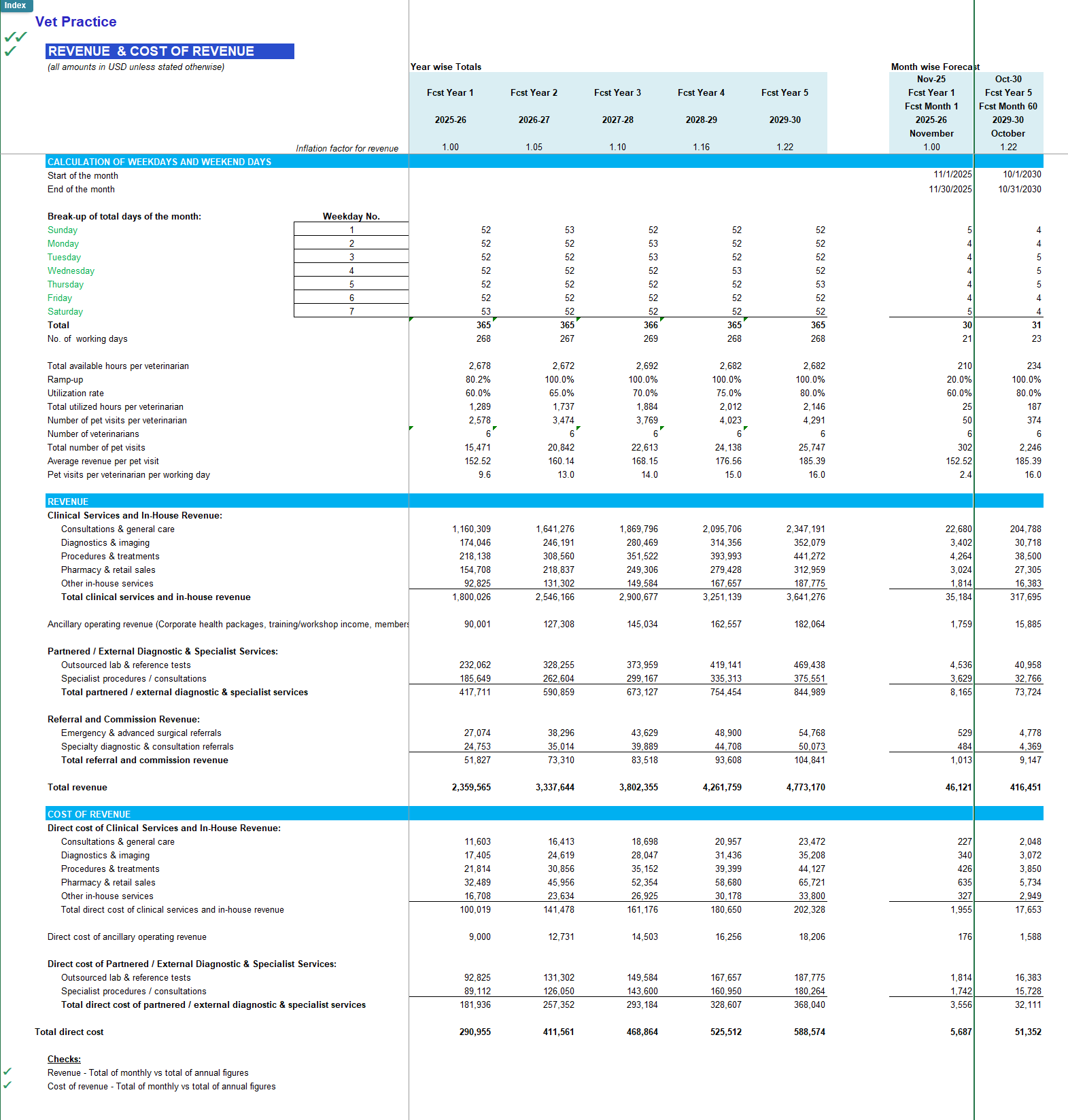
  • Detailed projections for Revenue & Cost of Revenue
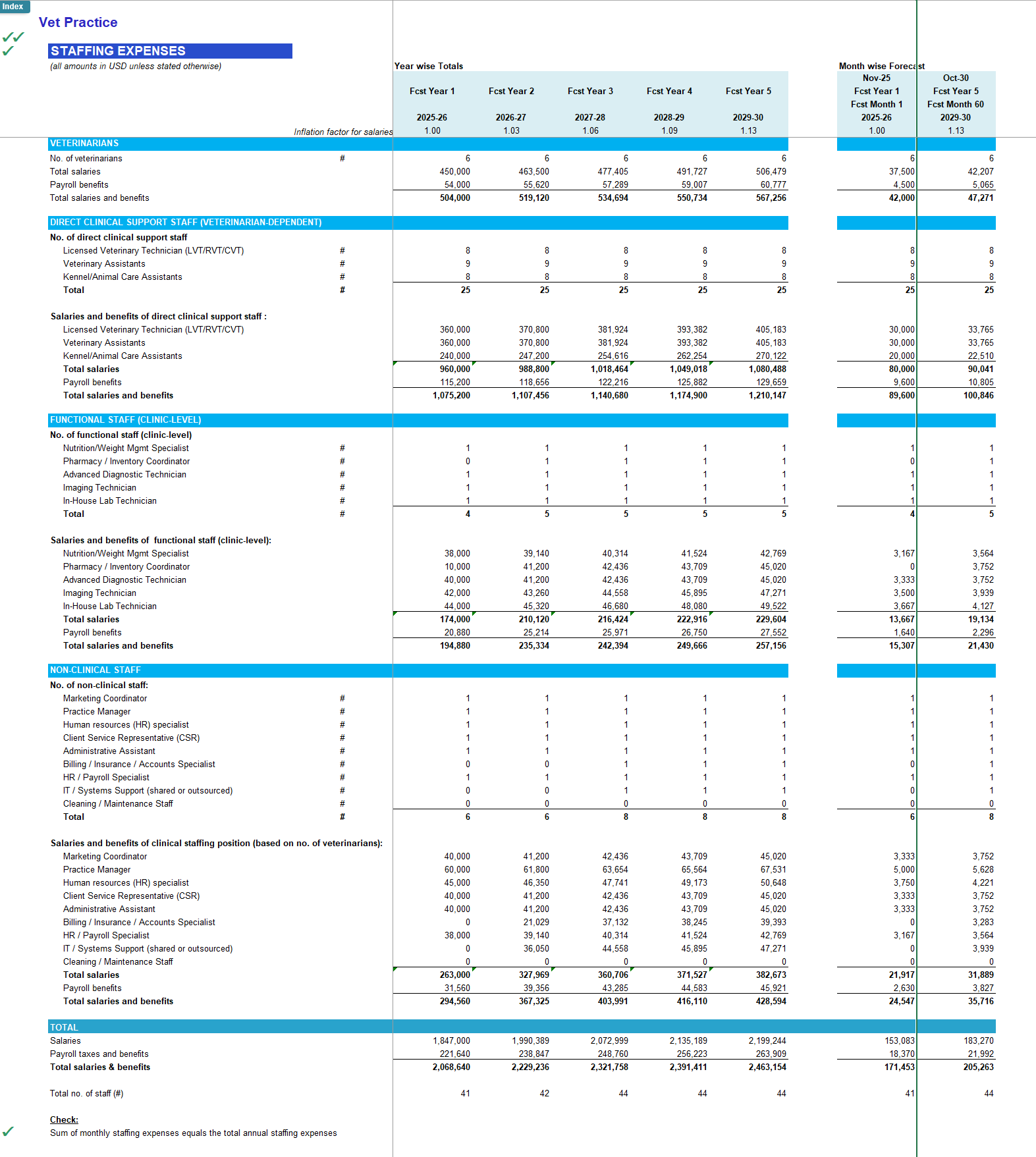
  • Staffing Expenses and overhead breakdown
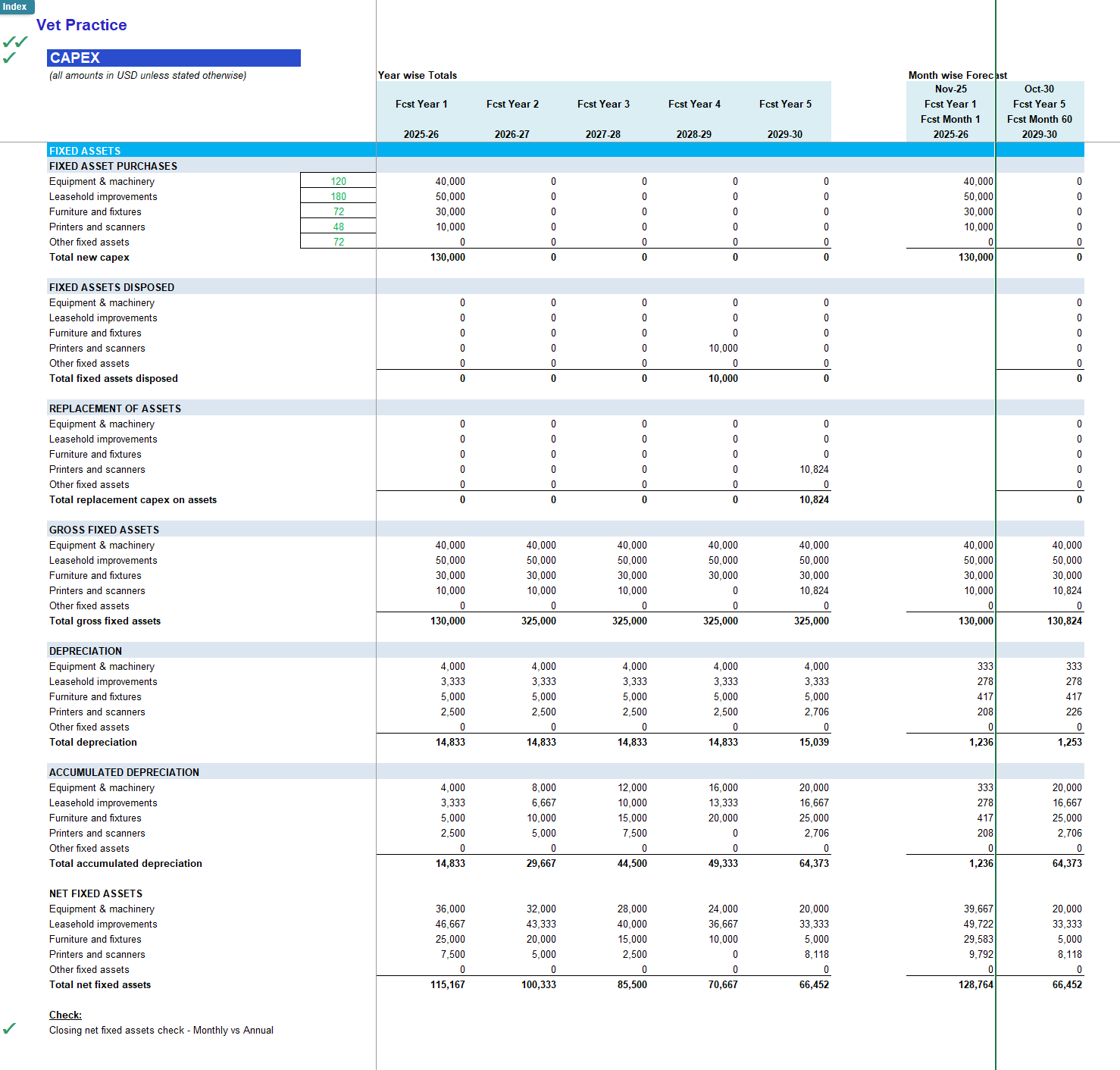
  • Capital Expenditures (CapEx)
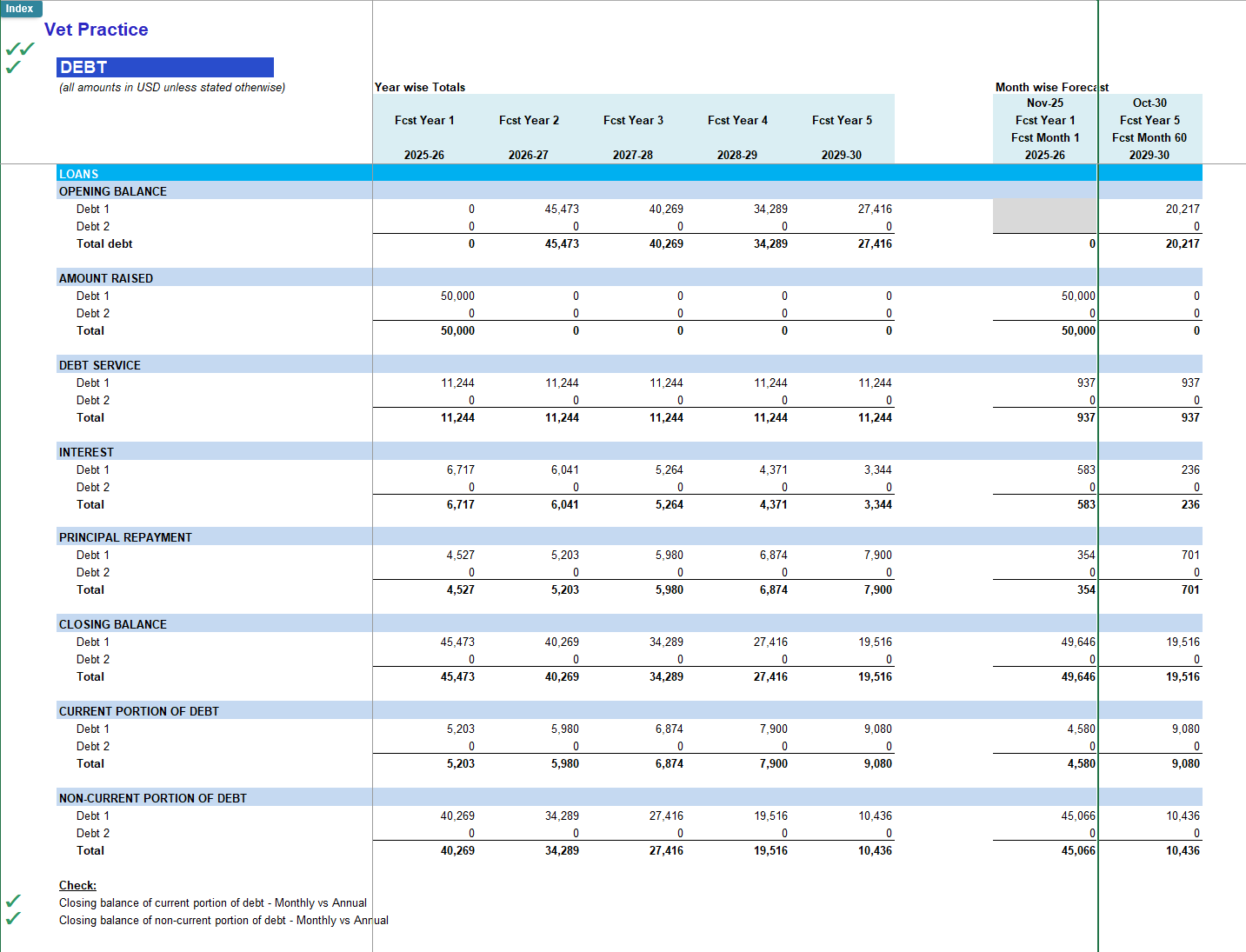
  • Debt schedule


Technical Specifications
  • No VBA or Macros: Ensures compatibility and transparency
  • Circular Reference-Free: Reliable calculations without iterative errors
  • Excel Compatibility: Fully functional in Microsoft Excel 2010 and later versions


Validation Checks
Integrated validation checks ensure model consistency and accuracy.
  • Each tab includes automatic error flags and data integrity indicators.
  • The Index tab aggregates validation results for quick review — green ticks (✓) indicate integrity, while red crosses (✗) highlight issues requiring user input.


Why Choose This Model?
This financial model is purpose-built for veterinary practices—providing an accurate, flexible, and presentation-ready tool for financial forecasting, budgeting, valuation, and investor communication.
Whether used for new practice launches, multi-location expansions, or financing applications, the model delivers clarity, credibility, and actionable insights for data-driven decision-making.


For customized enhancements or technical assistance, our team is available to tailor the model to your specific operational or regional requirements.

This Best Practice includes
1 Excel Sheet

Acquire business license for $99.00

Add to cart

Add to bookmarks

Discuss

Further information

The objective of this downloadable best practice is to provide a structured, comprehensive framework tailored specifically for veterinary practices. It offers actionable tools and financial models to improve decision-making, optimize clinic operations, and project long-term profitability. Designed to address key areas such as revenue streams, expense management, and staffing needs, this best practice helps veterinary centers enhance operational efficiency while supporting their strategic goals. Adaptable to various veterinary clinic scenarios, it ensures flexibility in financial planning and performance analysis.

This downloadable best practice applies best to small and mid-sized veterinary practices seeking structured financial planning and operational efficiency. It is ideal for clinics offering a range of veterinary services and looking for 5-year financial projections, including revenue forecasting, staffing optimization, and expense management. The model is particularly suited for vet centers planning for expansion, budgeting, or improved profitability analysis. Additionally, it helps veterinary practices manage cash flow and make strategic decisions for long-term growth.


0.0 / 5 (0 votes)

please wait...