Publication number: ELQ-61818-1
View all versions & Certificate

Data Center Energy Mix Configurator — PUE, PPA & Cost Calculator (Free)
Free Excel tool to calculate data center energy load, PUE and annual cost
Further information
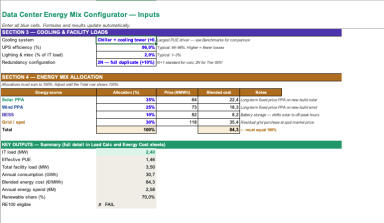
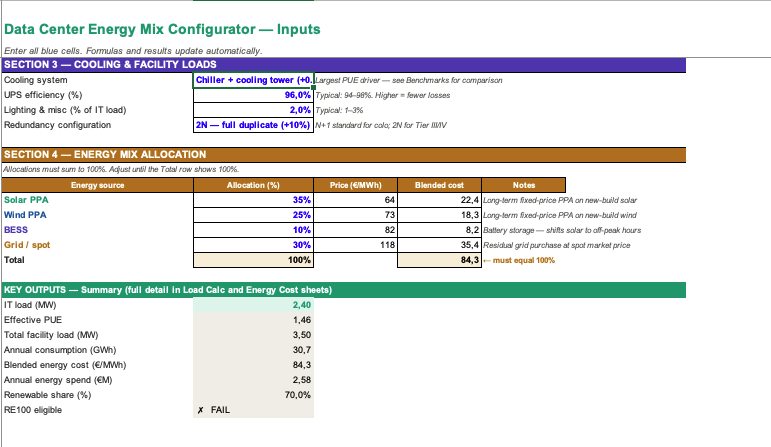
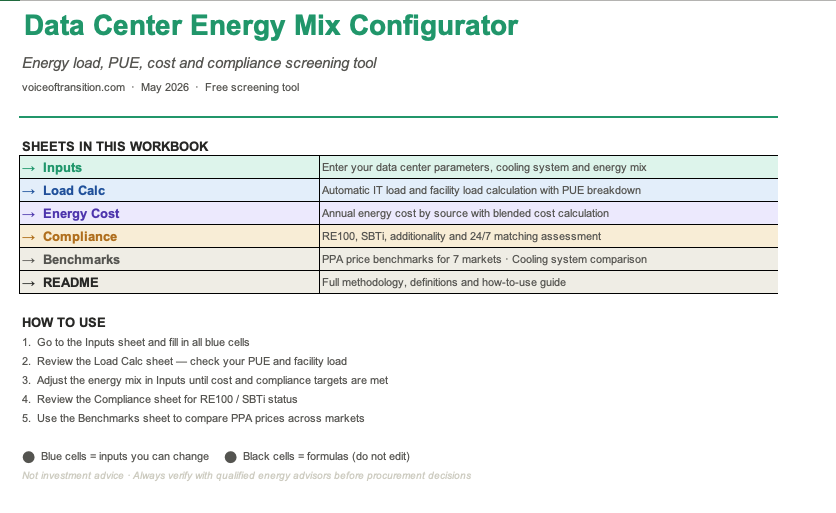
By downloading and using this tool, you will be able to calculate the total electrical load of your data center from its physical components — IT equipment, cooling system, UPS losses and redundancy overhead — without needing to build a model from scratch. You will understand exactly where your facility's energy goes and how your PUE is composed.
You will be able to model any combination of solar PPA, wind PPA, BESS and grid procurement, instantly seeing the impact on blended cost and annual spend across 7 European and US markets. The tool allows you to benchmark your energy cost against H1 2026 market prices and identify how much you could save by shifting from grid to PPA.
You will assess your compliance status against RE100, SBTi Scope 2, additionality and 24/7 CFE requirements automatically — no manual calculation needed. If you are short of a target, the tool tells you exactly how much additional renewable procurement is needed.
Finally, you will be able to project your 10-year energy spend under different grid and PPA escalation assumptions, giving you the financial context to justify a procurement decision to your CFO or investment committee.
This tool applies best when you are in the early to mid stages of a data center energy decision — before committing to a specific PPA structure, technology upgrade or procurement strategy, but after you have a clear picture of your current or planned IT load.
It is most useful when you are evaluating multiple energy mix scenarios side by side and need a quick, structured way to compare costs and compliance outcomes across different combinations of solar PPA, wind PPA, BESS and grid procurement. It works equally well for existing facilities looking to decarbonise and for new-build projects in the planning phase.
The tool is particularly relevant if you are operating or planning a data center in one of the 7 covered markets — Germany, UK, Italy, France, Spain, Netherlands or USA — and need market-specific PPA price benchmarks rather than generic assumptions.
It is less suitable for projects that have already reached the PPA negotiation stage and require detailed contract modelling, or for facilities where the energy procurement decision requires full 10-year DCF analysis, CAPEX modelling for on-site generation, or project finance structuring. For those use cases, the Data Center Energy Model Advanced on this profile provides the additional depth needed.
Ecco il testo per il campo "Conditions does not apply":
This tool is not the right fit if you have already moved past the screening phase and need to model the full financial mechanics of a PPA contract — including termination provisions, mark-to-market exposure, IFRS 9 hedge accounting for VPPAs or offtaker credit analysis. These require a dedicated PPA financial model.
It is not suitable for project finance structuring. If you are a renewable energy developer sizing debt against a data center PPA, calculating DSCR, modelling a cash flow waterfall or preparing an Information Memorandum for lenders, this tool does not cover those calculations. The Solar PV Ultimate, Wind Ultimate or Offshore Wind Ultimate models on this profile are better suited.
It does not apply well if your data center is located outside the 7 covered markets, or if your energy tariff structure involves complex time-of-use pricing, capacity market charges or network tariffs that significantly affect your blended cost — the tool uses average market prices and does not model tariff granularity.
It is also not designed for facilities with highly variable IT loads — such as high-performance computing clusters with burst demand profiles — where the flat-load assumption embedded in the annual GWh calculation would materially overestimate or underestimate actual consumption.
Finally, it is not a substitute for professional energy advisory or legal counsel when making binding procurement commitments. Always verify current PPA market prices and contract terms with a qualified energy advisor before making investment decisions.