


Wind Retrofit & Repowering Model — Evaluate Revamping, Repowering for Existing Onshore Wind Farms
Originally published: 01/06/2026 16:19
Publication number: ELQ-64468-1
View all versions & Certificate
certified

Wind Retrofit & Repowering Model — Evaluate Revamping, Repowering for Existing Onshore Wind Farms

Production-ready Excel model for financial evaluation of existing onshore wind farms. 8 countries, 5 analysis modes

Description
If you develop, advise on or finance revamping and repowering of existing onshore wind farms, you know the problem: the financial case is structurally different from a greenfield project. You are not evaluating a new investment in isolation — you are comparing it against the alternative of doing nothing with an asset that is still generating cash flow, still under an incentive contract in most markets, and still has a remaining useful life. The question is not whether the investment is profitable, but whether it is more profitable than the baseline, and by how much. No greenfield wind model answers that question.

This model does.
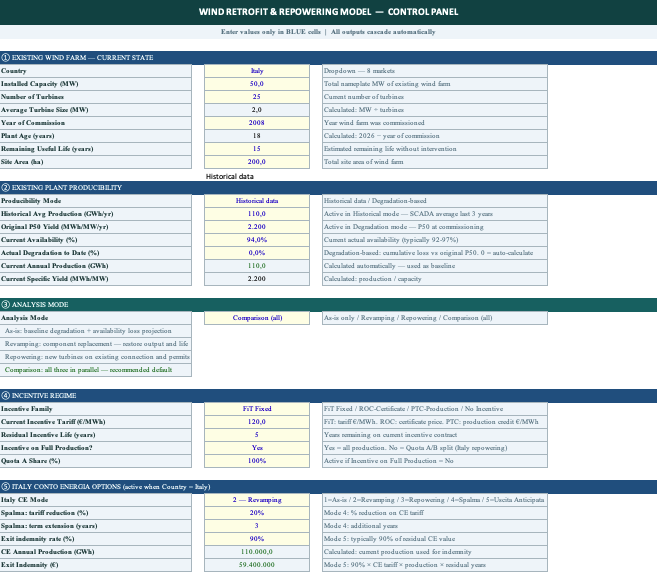
Open it, enter the existing wind farm data — capacity, number of turbines, year of commission, current production, incentive tariff and residual life — and every output updates automatically. The model runs the As-is baseline, the Revamping scenario and the Repowering scenario in parallel and tells you the NPV of each option, the incremental IRR of the investment versus the baseline, and which option creates the most value. All from a single control panel.


What makes it different from adapting a greenfield model
The baseline engine is built around wind farm reality, not a generic DCF template. The As-is projection models declining production using degradation at 0.60%/year combined with a current availability factor — which for an 18-year-old wind farm may already be 92-95%, well below the 97-98% of a new asset. This availability degradation is a significant source of value erosion in ageing wind farms that a standard model misses entirely. The baseline also projects incentive revenue until the contract expiry date and then switches to market revenue, capturing the revenue cliff that typically triggers the repowering decision.

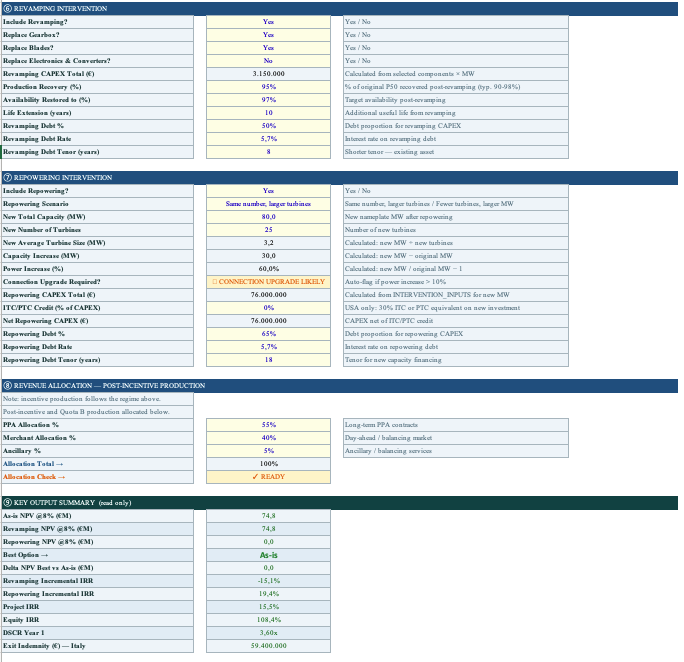
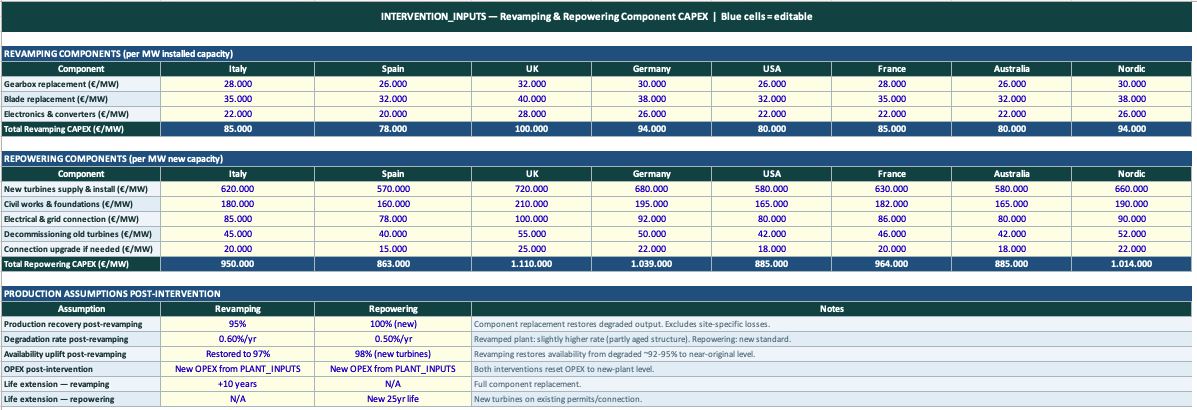
The revamping intervention covers gearbox replacement, blade replacement and electronics and converter replacement, each configurable independently by component and by country. Total revamping CAPEX ranges from €78k/MW in Spain to €100k/MW in the UK, with a full component breakdown in INTERVENTION_INPUTS. Post-revamping, production recovers to 95% of original P50 and availability is restored to 97%, with a degradation rate reset to 0.60%/year. Life extension is set at 10 years — a reasonable engineering assumption for full gearbox and blade replacement on an existing structure.
The repowering module handles the two most common scenarios: same number of turbines with larger units, or fewer turbines with higher individual ratings. New capacity is entered directly and the model calculates capacity increase, flags connection upgrade requirements automatically when power increase exceeds 10%, and structures the repowering financing separately from the revamping debt with appropriate tenors — 8 years for revamping on an existing asset, 18 years for repowering with a new 25-year plant life. Repowering CAPEX is broken down by country into turbines, civil works, electrical, decommissioning and connection upgrade, ranging from €863k/MW in Spain to €1,110k/MW in the UK.

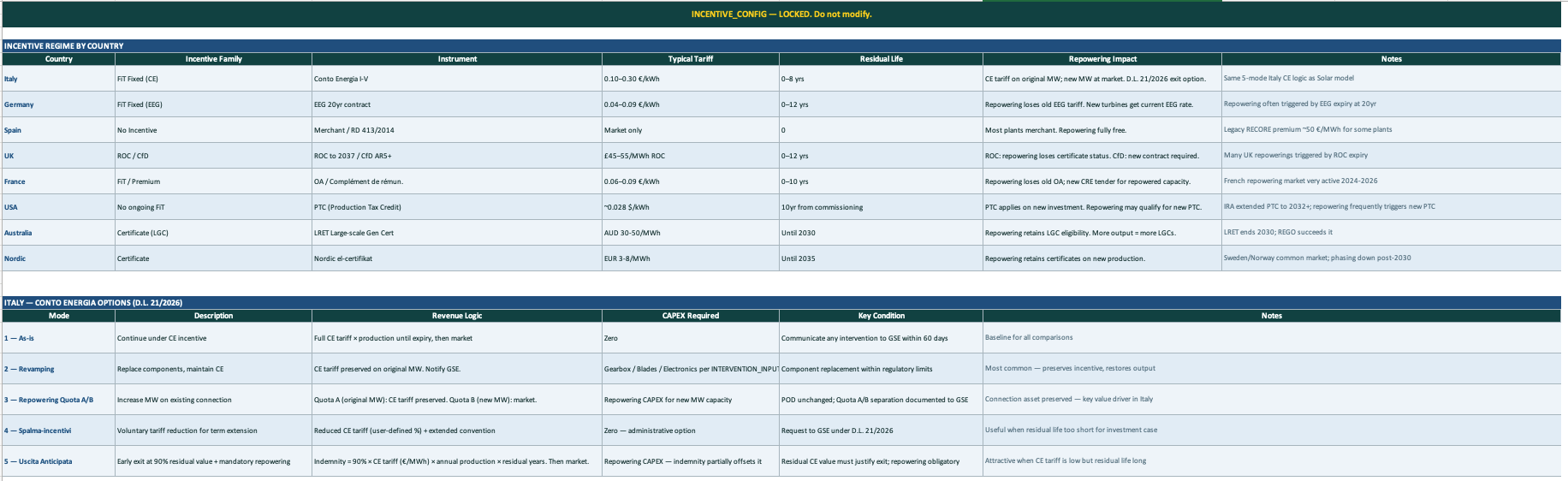
The incentive engine covers four families across all eight markets. Germany's EEG expiry at 20 years is one of the primary triggers for repowering decisions in that market — the model correctly reflects that repowering loses the old EEG tariff and the new turbines receive the current, much lower rate. UK ROC status, French OA and complément de rémunération, Australian LGC under LRET, and Nordic el-certifikat are all pre-configured with the correct repowering impact for each regime. The USA Production Tax Credit mechanics are also modelled — repowering may qualify for a new 10-year PTC under the IRA extension to 2032, and the model applies the credit accordingly.

The Italy Conto Energia module covers all five D.L. 21/2026 options with the same depth as the Solar Retrofit model. Mode 3 — Repowering with Quota A/B split — is particularly relevant for Italian wind farms, where the existing MW retain the CE tariff (Quota A) while new MW earn market revenue (Quota B). The exit indemnity calculation in Mode 5 is fully parametric: 90% of CE tariff multiplied by annual production multiplied by residual years, with the result partially offsetting the mandatory repowering CAPEX.

Post-incentive revenue — and all Quota B production in Italy — is allocated across PPA, Merchant and Ancillary streams with country-specific benchmark prices, fully user-configurable.


Who this is for
Asset managers and O&M teams managing portfolios of onshore wind farms approaching EEG expiry in Germany, ROC expiry in the UK, or CE expiry in Italy, where the repowering decision needs a rigorous financial justification. Developers evaluating repowering opportunities on sites with existing grid connections and permits, where the connection asset is the primary source of value. Financial advisors structuring the financing of wind revamping or repowering investments where incremental IRR and DSCR need to be demonstrated to lenders. M&A teams running valuations on operating wind assets where residual incentive life and repowering upside are material to the transaction price.


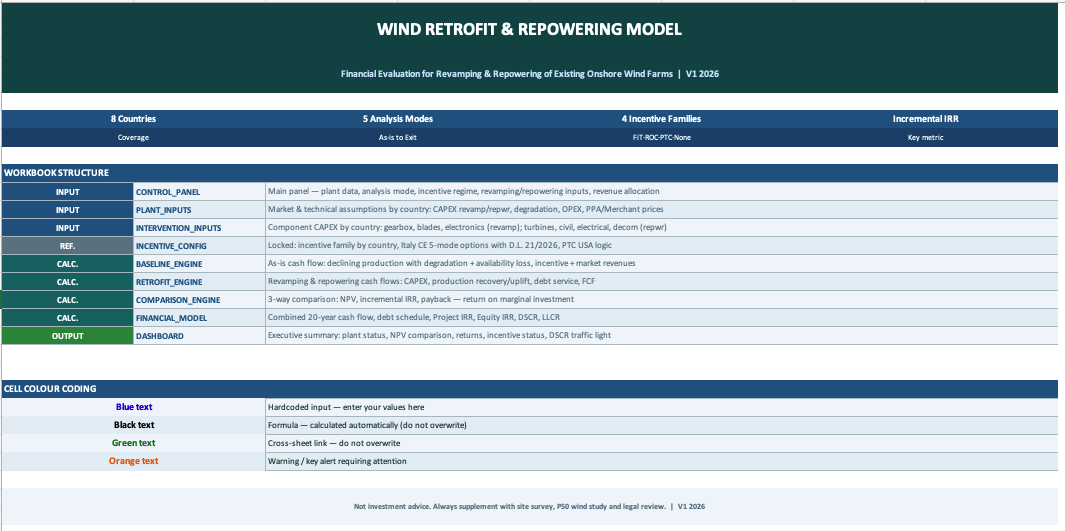
Workbook: Cover · CONTROL_PANEL · PLANT_INPUTS · INTERVENTION_INPUTS · INCENTIVE_CONFIG · BASELINE_ENGINE · RETROFIT_ENGINE · COMPARISON_ENGINE · FINANCIAL_MODEL · DASHBOARD.


For custom versions, country extensions or specific requests, contact us at [email protected]

This Best Practice includes
1 Excel Model, 1 PDF Guide

Acquire business license for $169.00

Add to cart

Add to bookmarks

Discuss

Further information

This model enables developers, advisors and asset managers to evaluate the financial case for revamping, repowering or maintaining an existing onshore wind farm across 8 international markets, producing a three-way NPV comparison — As-is versus Revamping versus Repowering — alongside incremental IRR, payback and a full 20-year DCF for the selected intervention. It models the existing plant baseline using degradation curves, availability loss trends and historical SCADA production data, applies country-specific incentive regimes across four families including Italy Conto Energia with all five D.L. 21/2026 options and USA Production Tax Credit mechanics, structures separate financing for revamping and repowering with appropriate tenor assumptions, and allocates post-incentive production across PPA, Merchant and Ancillary revenue streams with country-calibrated benchmark prices.

This model is best suited to operating onshore wind farms of 10 MW and above that are in the revamping or repowering evaluation window — typically plants aged 15-22 years with degraded availability, approaching or past EEG, ROC or CE incentive expiry, or where the existing grid connection and permit base creates repowering upside that would take years and significant cost to replicate on a greenfield site. It works particularly well for German wind farms approaching EEG expiry at 20 years, UK sites with residual ROC status, Italian CE plants under D.L. 21/2026, and USA projects where repowering may trigger a new PTC entitlement under the IRA extension. The comparison mode — running As-is, Revamping and Repowering in parallel — is the recommended default for any strategic review of an existing asset.

This model evaluates the financial case for revamping and repowering decisions and does not replace a site-specific technical assessment — production recovery assumptions post-revamping depend on the actual condition of individual turbines and should be validated with an independent technical advisor before any investment commitment. It covers onshore wind only and is not suited to offshore wind, which has a materially different cost structure, O&M model and regulatory framework. The Italy CE options module is calibrated for D.L. 21/2026 as of April 2026 — any subsequent regulatory changes should be reflected in the INCENTIVE_CONFIG parameters before use. It should not be used as the sole basis for a final investment or transaction decision without a site-specific P50 wind resource assessment, structural inspection of existing foundations and towers, and legal review of the applicable permit and incentive regime.


0.0 / 5 (0 votes)

please wait...