Offshore Wind Ultimate Model + Portfolio Manager — From Single Offshore Project to Full Pipeline in One Purchase
Originally published: 16/05/2026 07:29
Publication number: ELQ-20266-1
View all versions & Certificate
certified

Offshore Wind Ultimate Model + Portfolio Manager — From Single Offshore Project to Full Pipeline in One Purchase

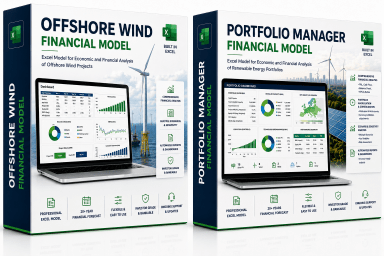
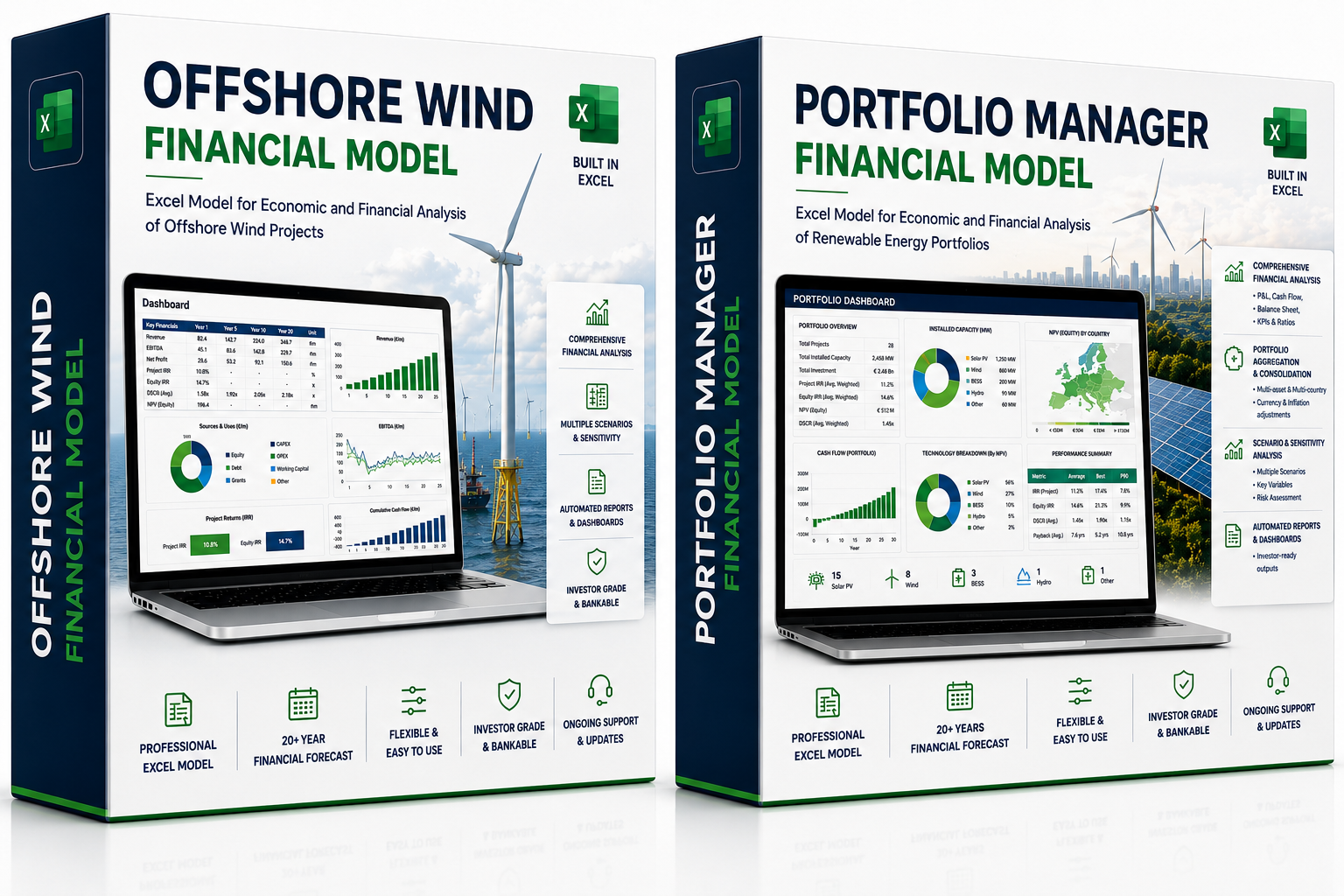
The Offshore Wind Ultimate Model and Portfolio Manager bundled together. Build a bankable fixed-bottom offshore wind business case for any of 8 markets,

Description
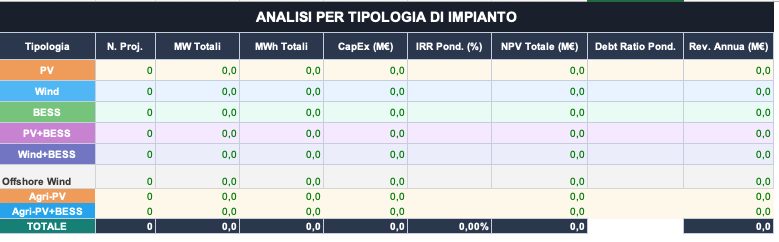
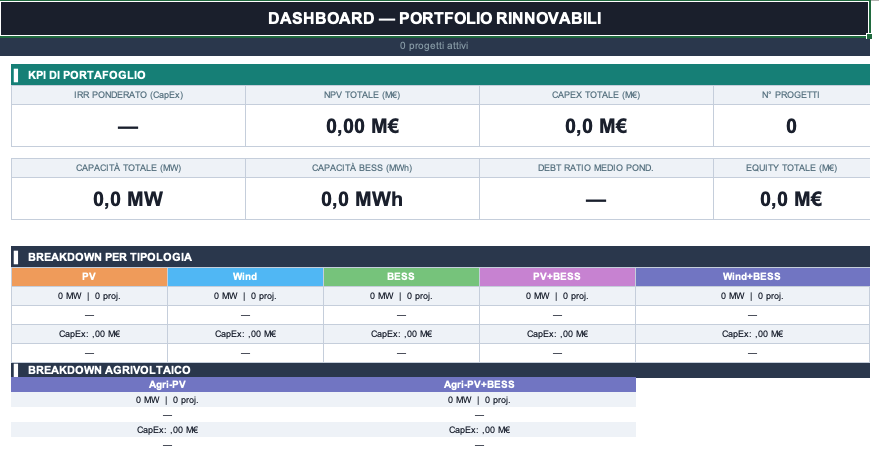
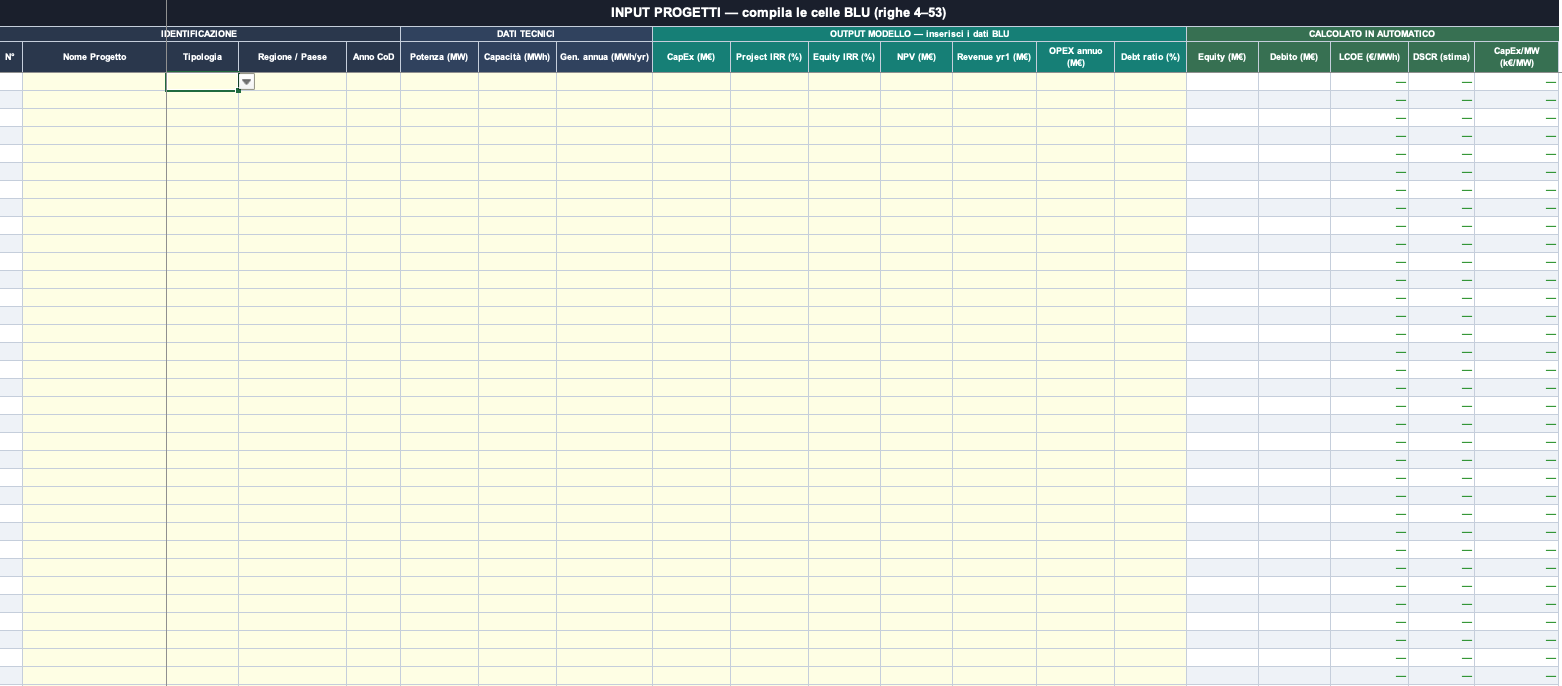
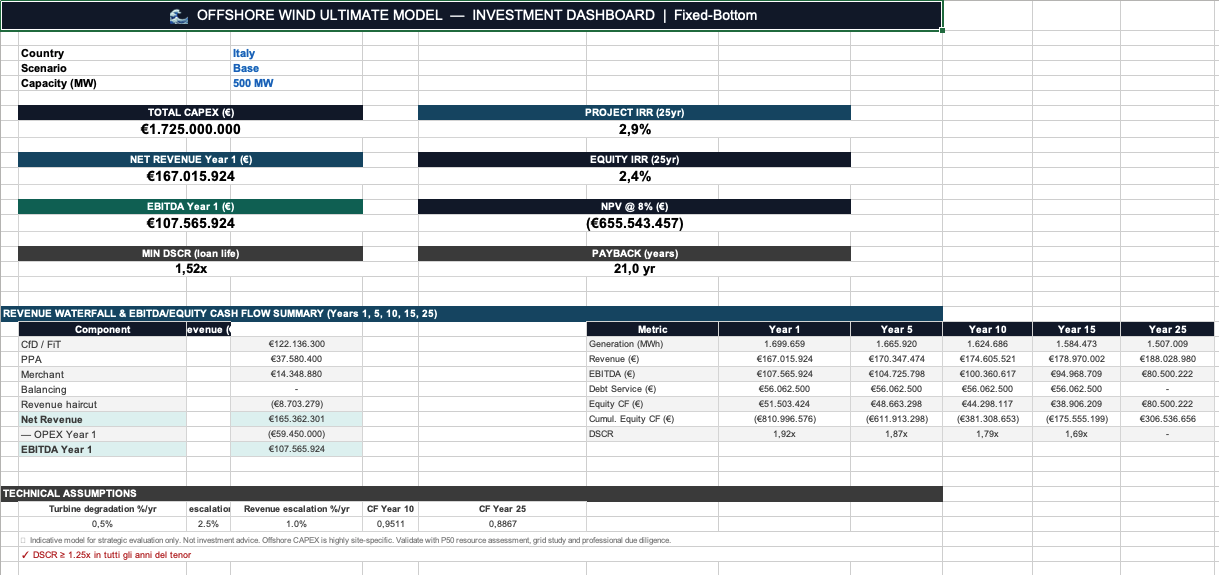
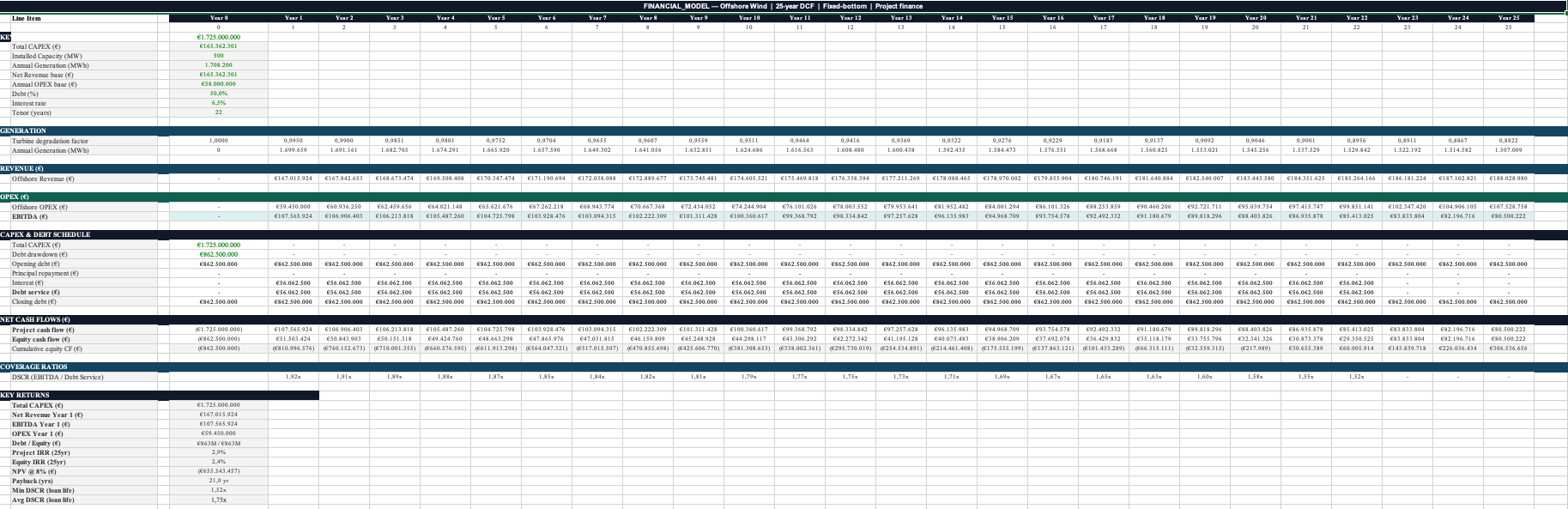
This bundle combines two complementary tools that most offshore wind professionals end up needing together. The Offshore Wind Ultimate Model handles the project-level analysis — a fully calibrated 25-year DCF for fixed-bottom offshore wind across 8 markets and 3 scenarios, with a two-sided CfD revenue engine, advanced debt structuring options and turbine degradation. The Portfolio Manager handles the portfolio-level view — aggregating up to 50 projects across all technologies into a single dashboard with weighted IRR, total NPV, LCOE, DSCR and a technology breakdown.
Used separately, each tool solves half the problem. Used together, they cover the full workflow from individual project evaluation to portfolio reporting.


How they work together
You run your offshore wind deal in the Offshore Wind Ultimate Model. Once you have your Project IRR, Equity IRR, NPV, Revenue, OPEX and Debt ratio, you transfer those outputs directly into a row in the Portfolio Manager. The portfolio KPIs update immediately. No reformatting, no manual aggregation, no formula rebuilding — the output structure of the project model maps directly to the input structure of the portfolio tracker.
As you add more projects — Solar PV, onshore Wind, BESS, Agrivoltaic — the Portfolio Manager accumulates them all, keeping the portfolio view current without any extra work.


What makes the Offshore Wind model different from an adapted onshore wind model
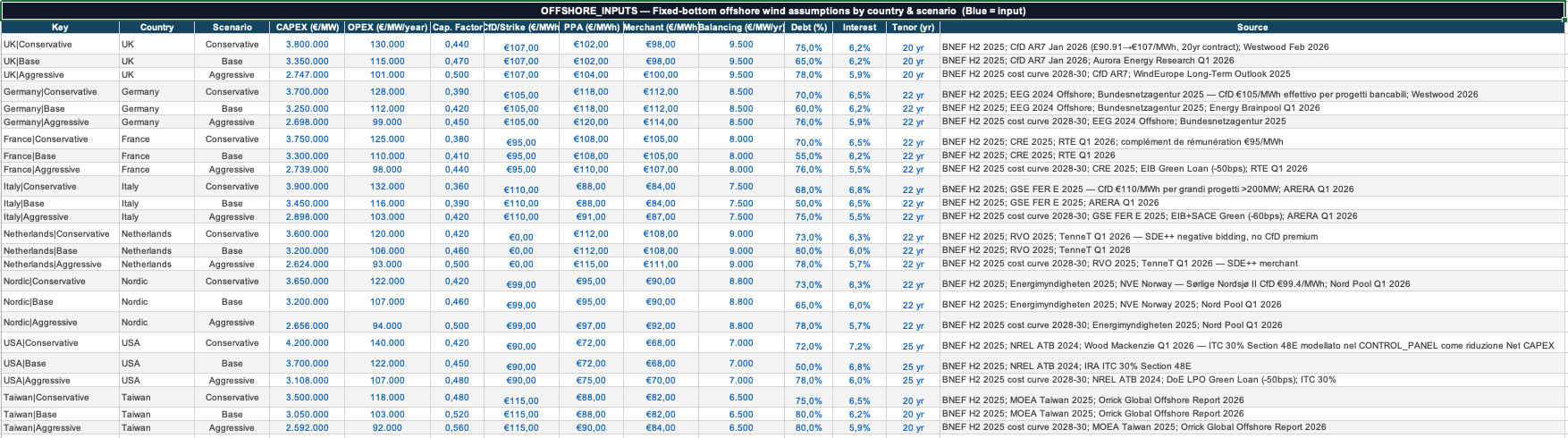
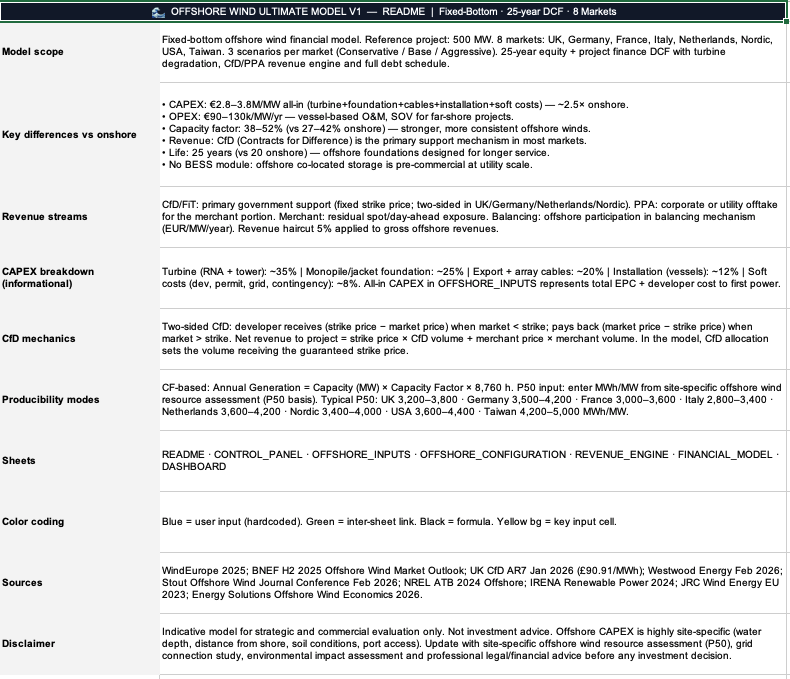
Offshore wind is a fundamentally different asset class and this model is built from the ground up to reflect that. CAPEX is expressed in €/MW all-in at the offshore level — turbine, monopile or jacket foundation, export and array cables, installation vessels, soft costs — ranging from €2.6M to €4.2M/MW depending on market and scenario, roughly 2.5 times the onshore equivalent. OPEX is vessel-based at €90–130k/MW/year, reflecting SOV operations for far-shore projects. The useful life is 25 years, consistent with offshore foundation design standards, which is why the financial model runs 5 years longer than the onshore equivalent.
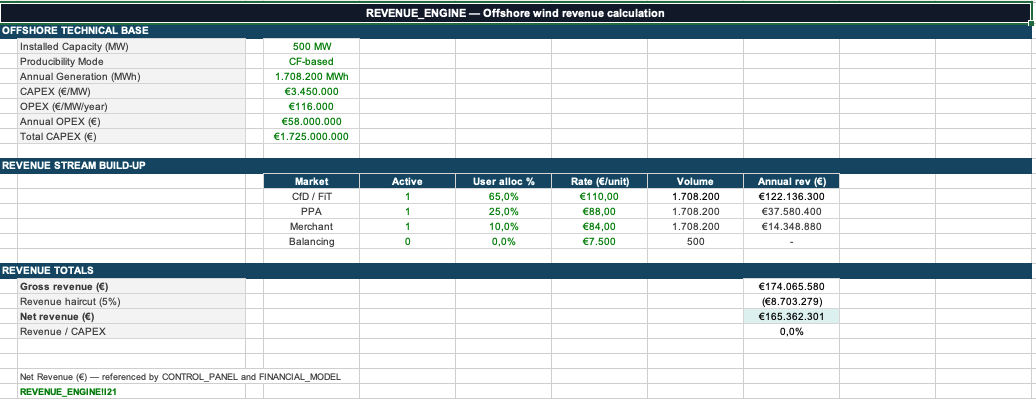
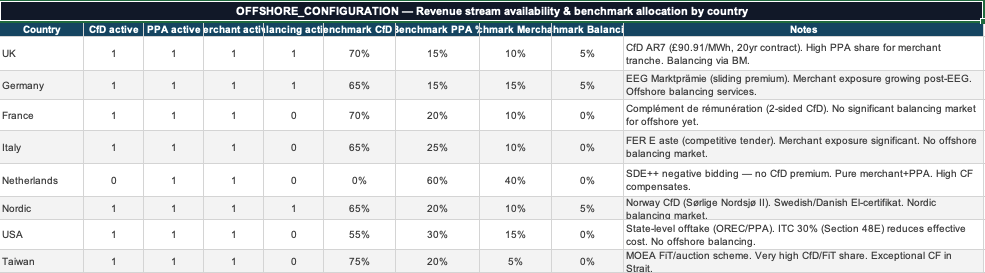
The CfD revenue engine handles two-sided contracts correctly. When market prices fall below the strike, the developer receives the top-up. When they rise above it, the model accounts for the clawback. This is the mechanics that actually governs revenue in the UK under CfD AR7, in Germany under EEG Marktprämie, and in France under the complément de rémunération — and the model reflects each market's specific structure. The Netherlands is a special case: under SDE++ negative bidding there is no CfD premium, so the model runs pure PPA and merchant there, with the high capacity factor compensating.
Eight markets are pre-loaded: UK, Germany, France, Italy, Netherlands, Nordic, USA and Taiwan. Each has Conservative, Base and Aggressive scenarios calibrated from WindEurope 2025, BNEF H2 2025, CfD AR7 January 2026, Westwood Energy February 2026, NREL ATB 2024 and Orrick Global Offshore Report 2026. The USA configuration includes the IRA Section 48E Investment Tax Credit as a net CAPEX reduction, modelled directly in the Control Panel. The Taiwan configuration reflects the exceptional capacity factors of the Taiwan Strait — P50 range 4,200–5,000 MWh/MW — alongside the MOEA auction scheme.
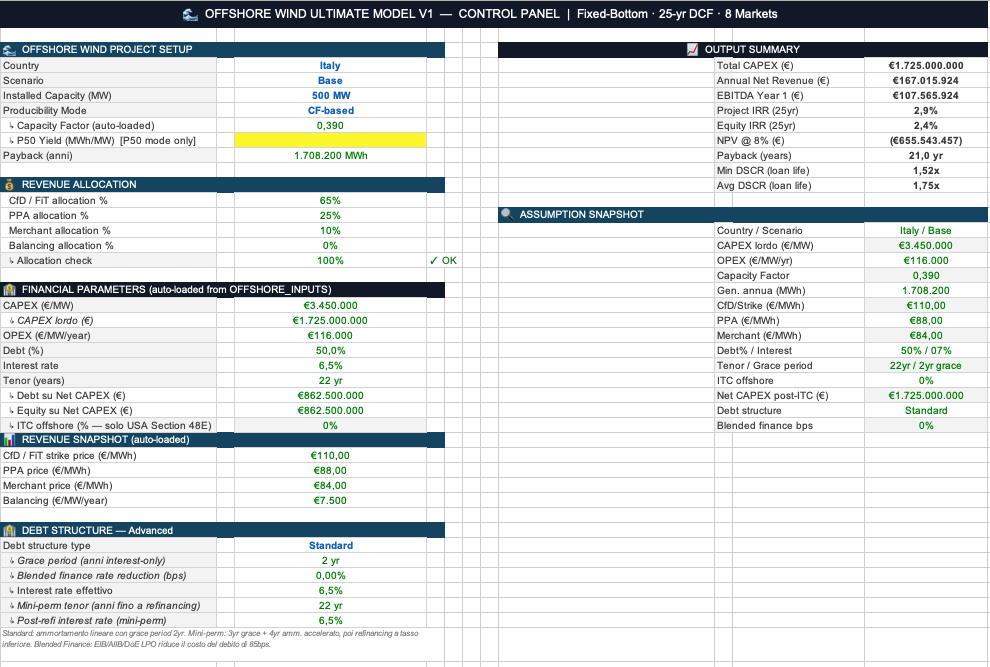
The debt structure module covers three configurations beyond standard linear amortisation: a grace period of up to 2 years of interest-only, a mini-perm structure with accelerated amortisation followed by refinancing at a lower rate, and a blended finance option that models the interest rate reduction from EIB, AIIB or DoE Loan Programs Office green loans. These are not academic options — they are the structures that appear in actual offshore wind financing term sheets.


Who this is for
Developers and sponsors evaluating fixed-bottom offshore wind projects at early-stage feasibility across European, US and Asian markets. Financial advisors and investment banks preparing project finance mandates or investor presentations for offshore wind assets. Infrastructure funds and institutional investors screening offshore wind opportunities where CAPEX intensity, CfD mechanics and debt structure need to be modelled explicitly. Anyone who needs a rigorous, market-calibrated starting point for a deal that is too capital-intensive to evaluate with a generic template.


Workbook Offshore Wind: README · CONTROL_PANEL · OFFSHORE_INPUTS · OFFSHORE_CONFIGURATION · REVENUE_ENGINE · FINANCIAL_MODEL · DASHBOARD.


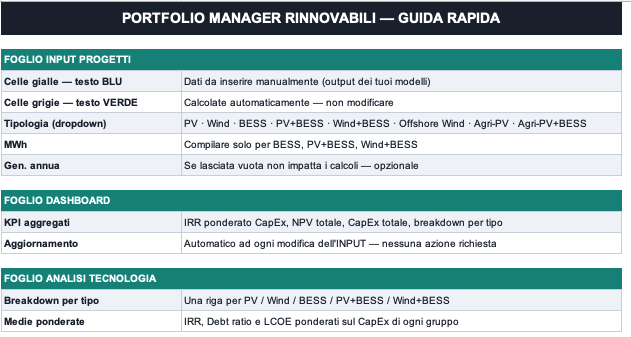
Workbook Portfolio Manager: Istruzioni · INPUT PROGETTI · Dashboard · Analisi Tecnologia.


For custom versions or specific requests,contact us at [email protected]

This Best Practice includes
2 Excel Models, 2 PDF Guides

Acquire business license for $193.00

Add to cart

Add to bookmarks

Discuss

Further information

This bundle enables developers, advisors and investors to evaluate individual fixed-bottom offshore wind projects across 8 international markets and aggregate their results into a consolidated portfolio view without building either tool from scratch. The Offshore Wind Ultimate Model produces Project IRR, Equity IRR, NPV, Min DSCR and Avg DSCR from a fully integrated 25-year cash flow with turbine degradation, two-sided CfD revenue mechanics, country-specific market configurations and three debt structure options — standard, mini-perm and blended finance. The Portfolio Manager aggregates those outputs alongside projects of any other technology into a CapEx-weighted portfolio IRR, total NPV, LCOE per project, DSCR traffic light and a technology breakdown across up to 50 active projects.

This bundle is best suited to professionals evaluating fixed-bottom offshore wind projects in the 200–1,000 MW range at early-stage feasibility or commercial evaluation, where the CfD or FiT support structure is known and the debt financing approach is being screened. It works particularly well for UK, German, French and Nordic markets where CfD mechanics are central to the revenue structure, and for USA projects where the IRA Section 48E ITC needs to be reflected in the financial model. It is also well suited to portfolio contexts where offshore wind sits alongside onshore renewables and the investor needs a single consolidated view of returns across technologies.

This model covers fixed-bottom offshore wind only and is not designed for floating offshore wind, which has a materially different cost structure, installation methodology and financing profile. It does not include a co-located BESS module, as offshore battery storage at utility scale remains pre-commercial. CAPEX assumptions are highly site-specific in offshore wind — water depth, distance from shore, soil conditions and port access can each shift the all-in cost significantly — and the model's pre-loaded assumptions should be treated as a starting point requiring site-specific validation before any investment decision. Neither tool replaces full project finance models, environmental impact assessments or grid connection studies required for a final financing or investment decision.


0.0 / 5 (0 votes)

please wait...