Valuation Services - Comparable Companies (Peer Group) Database & Matching Tool | 300 Case Library
Originally published: 15/01/2026 11:33
Last version published: 30/05/2026 13:08
Publication number: ELQ-66261-9
View all versions & Certificate
certified

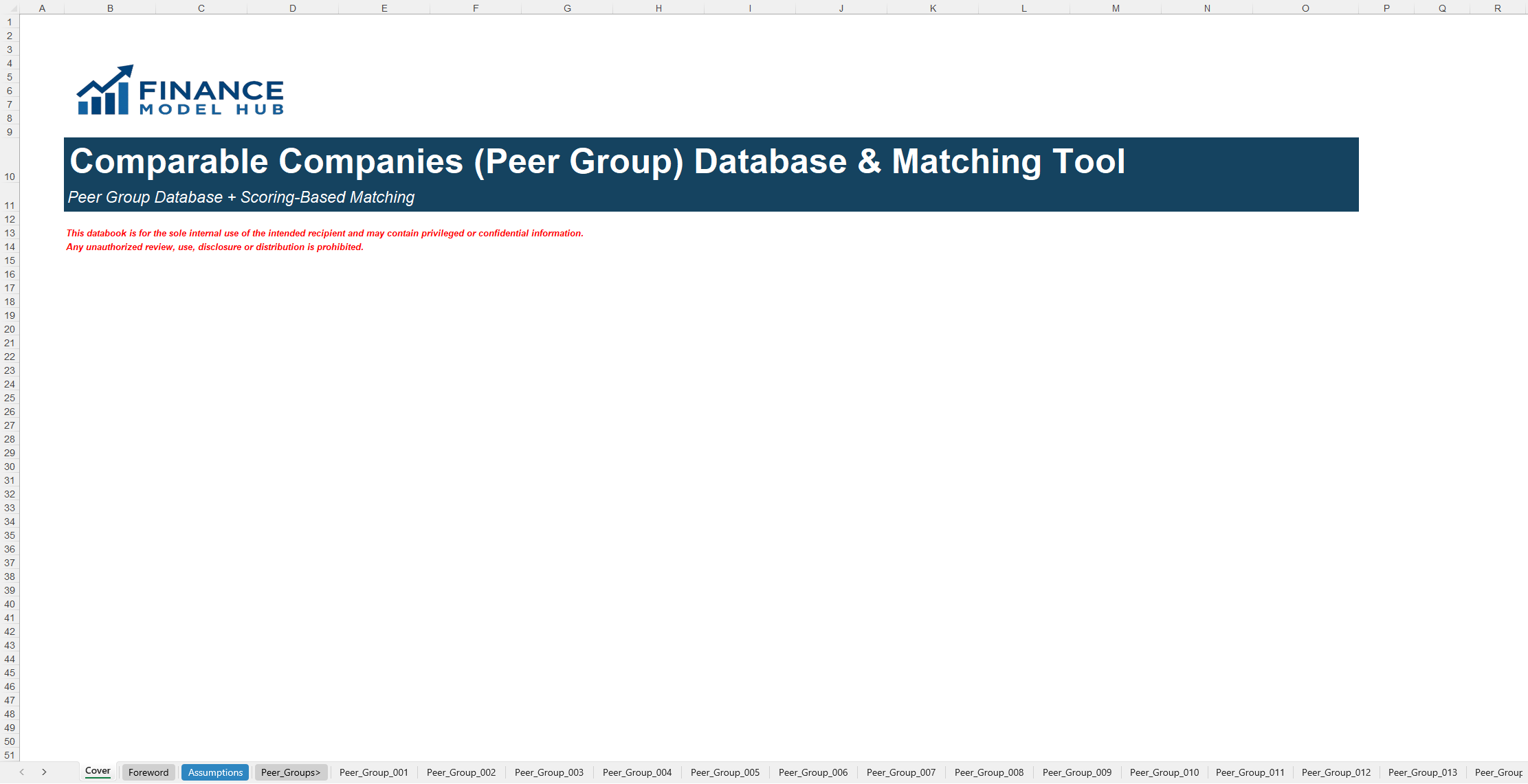
Valuation Services - Comparable Companies (Peer Group) Database & Matching Tool | 300 Case Library

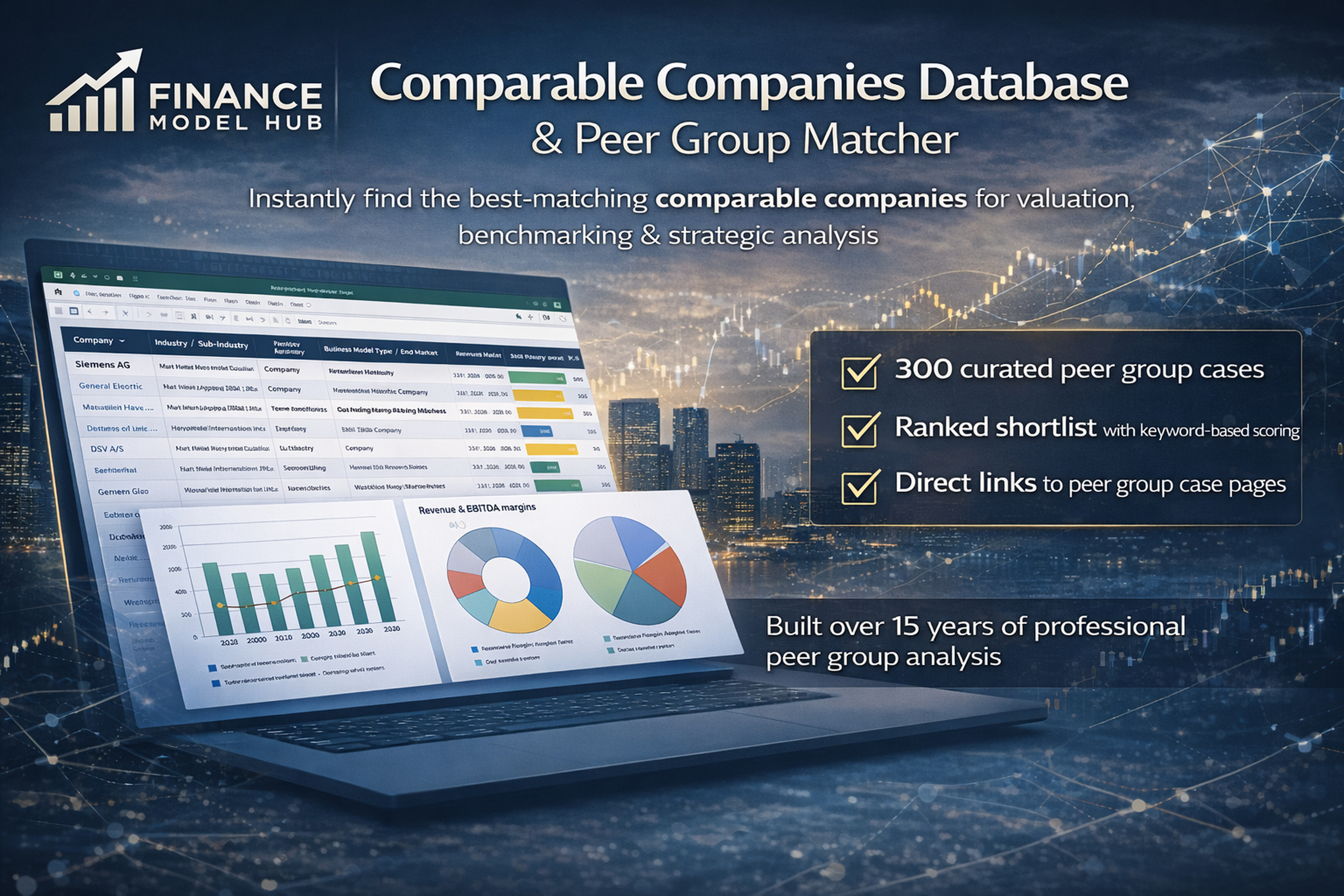
An Excel-based Comparable Companies (Peer Group) Database & Matching Tool with 300 curated peer group cases built over ~15 years of professional analysis.

Description
Purpose of the tool

This Excel-based Comparable Companies (Peer Group) Database & Matching Tool is designed to dramatically accelerate one of the most time-consuming tasks in corporate finance and strategic analysis: building a high-quality, defensible peer set. Whether you need comparable companies for valuation, benchmarking, strategy, performance comparisons, market positioning, investor materials, or any other use case where a peer group is required, the model helps you move from “blank page” to a robust shortlist within minutes.


The database is built on ~15 years of hands-on professional peer group work and is organised around historical Subject Companies. A Subject Company is the original reference business that served as the basis for a peer group build in prior analyses (e.g., valuations, PPAs, transaction-related work, benchmarking exercises, or similar contexts). For each Subject Company, a dedicated peer group was created through detailed manual research and iterative refinement—mirroring how comparable company selection is actually done in professional practice rather than relying on generic one-click screens. All Subject Companies have been anonymised, as the underlying work originates from prior professional projects.


The key idea of this model is simple: you define the profile of your current company and the tool identifies the most similar Subject Companies from the library. You can then reuse and adapt the peer groups that were originally built for those reference cases—giving you a proven starting point, clear reference logic, and substantial time savings. The comparison to the Subject Company is also critical when interpreting the output: the tool does not only rank peer lists, it ranks the underlying reference cases that explain why a given peer group exists and in which context it was originally constructed.


The library includes peer group cases across a broad range of industries. Coverage spans major sectors such as Energy, Materials, Industrials, Consumer Discretionary, Consumer Staples, Health Care, Financials, Information Technology, Communication Services, and Real Estate—with granular sub-industry differentiation (e.g., various industrial machinery categories, building products, chemicals, packaging, healthcare services/technology, software & services, semiconductors, media/telecom, REITs). This makes the tool suitable for a wide set of company profiles, while still allowing niche refinement via end-market and keyword matching.


With 300 curated peer group cases, consistent classifications, and a transparent scoring approach, the model helps you work faster while maintaining quality and repeatability—ideal for advisors, investors, corporates, and analysts working under time pressure.

Key outputs

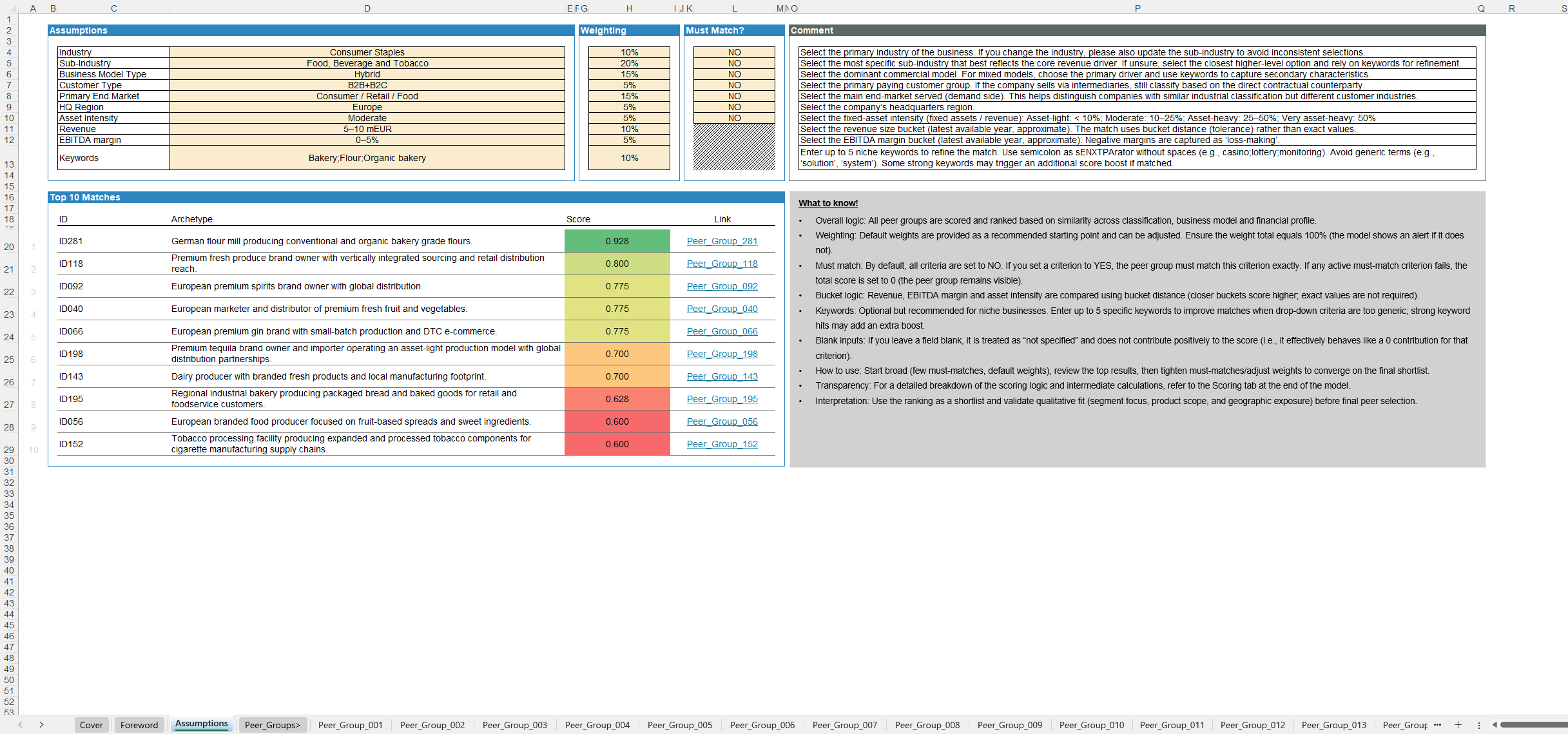
  • Top ranked peer group matches based on similarity to Subject Companies (shortlist)

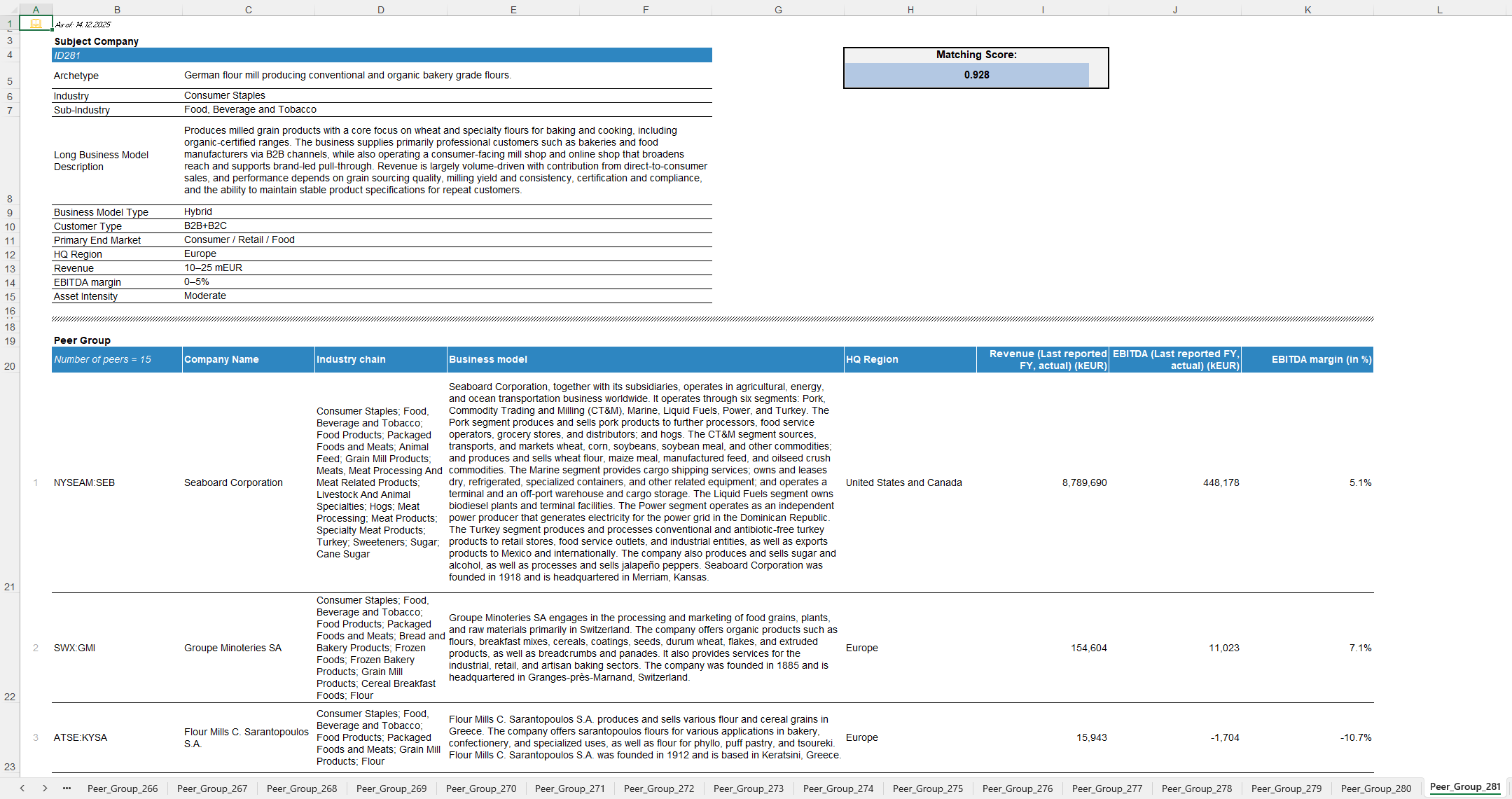
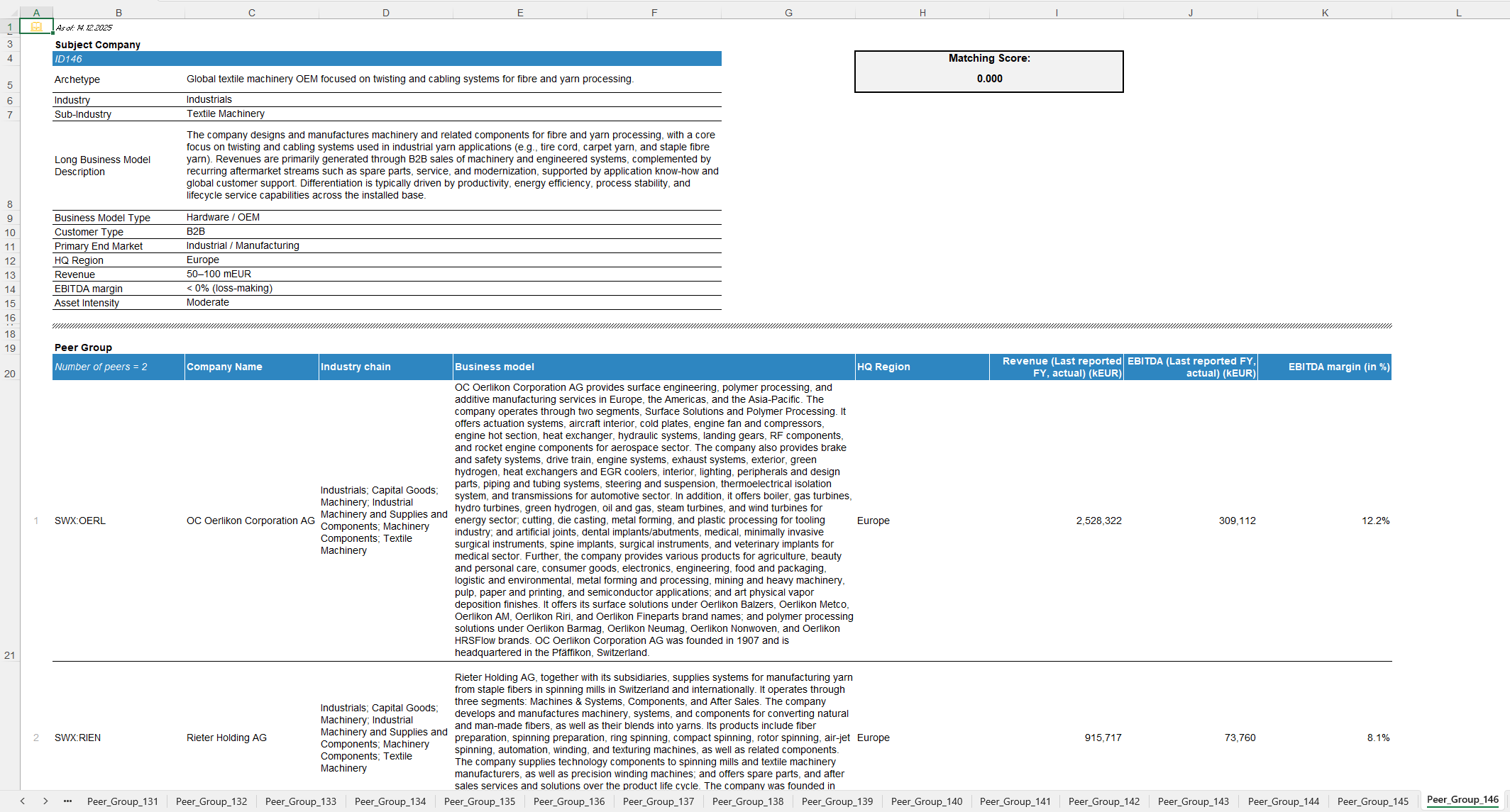
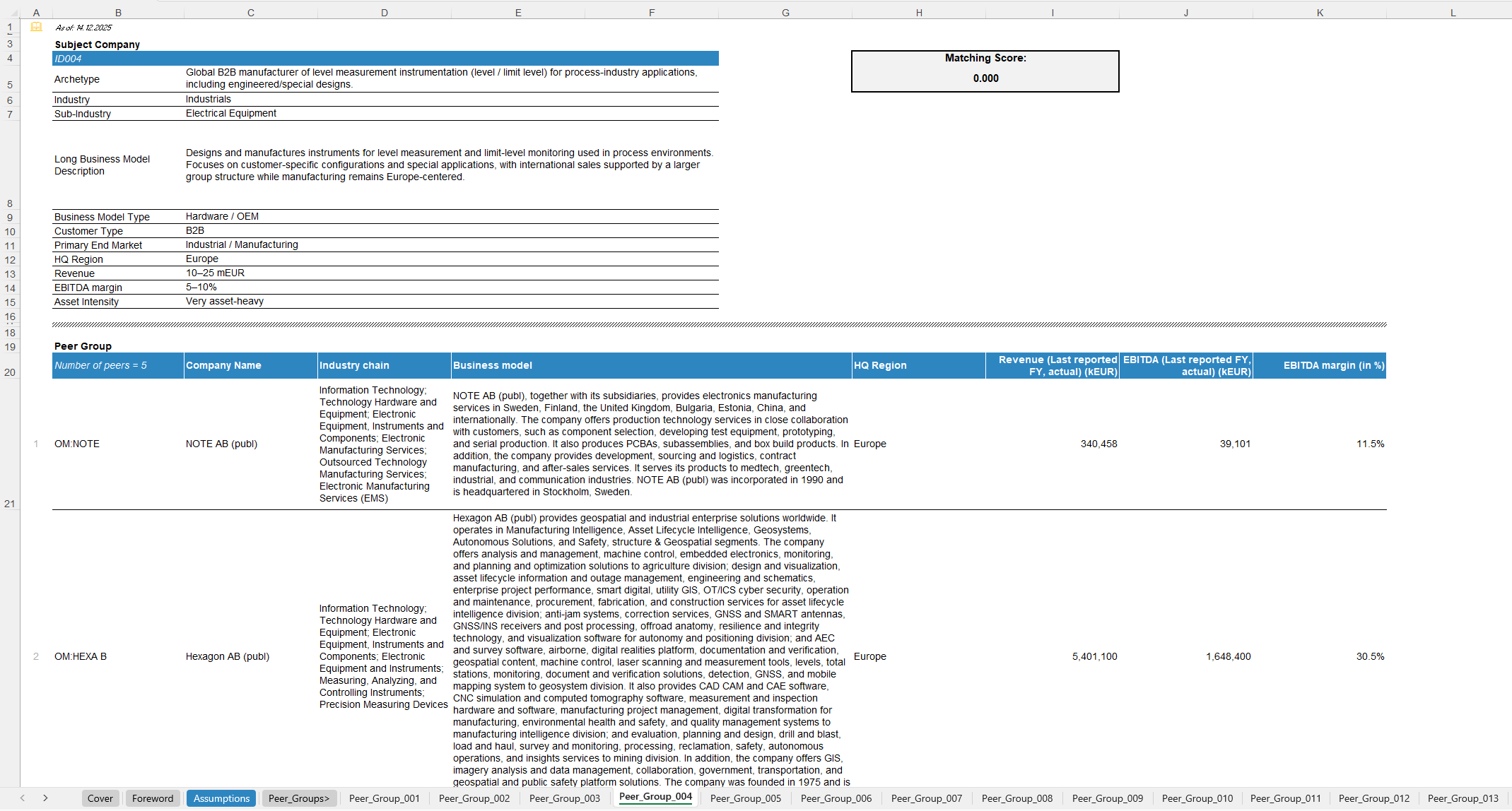
  • Direct links to peer group case pages, including the anonymised Subject Company profile and the identified peers

  • Transparent scoring logic (weights, must-match gates, bucket distance logic, and keyword matching)

  • Reusable classification framework (industry/sub-industry, business model type, customer type, end market, region, size and profitability buckets)

  • Keyword-based refinement to capture niche characteristics not fully reflected by drop-down criteria


Key inputs & assumptions
  • Industry / Sub-industry (drop-down)
  • Business model type (drop-down)
  • Customer type (B2B/B2C/B2G; drop-down)
  • Primary end market (drop-down)
  • HQ region (drop-down)
  • Revenue bucket, EBITDA margin bucket, asset intensity bucket (drop-down)
  • Optional keywords (up to 5, separated by semicolons) to refine niche matching

How to use
  1. Start in the Assumptions tab and enter your company profile (core drop-down selections + optional keywords).

  2. Adjust weights if needed (recommended defaults provided) and optionally activate must-match criteria for hard constraints.

  3. Review the Top Matches list (ranked Subject Companies) and open the linked case pages.

  4. Use the output as a shortlist and starting point: either adopt a peer group directly if the fit is strong, or combine and refine peers across several close Subject Company matches to build the final peer set for your specific application.


Best-practice notes
  • The model is designed as a professional workflow tool, not a black box. You can adjust weights, must-match rules and keyword usage to fit different contexts (valuation vs. operational benchmarking vs. strategic peer analysis).
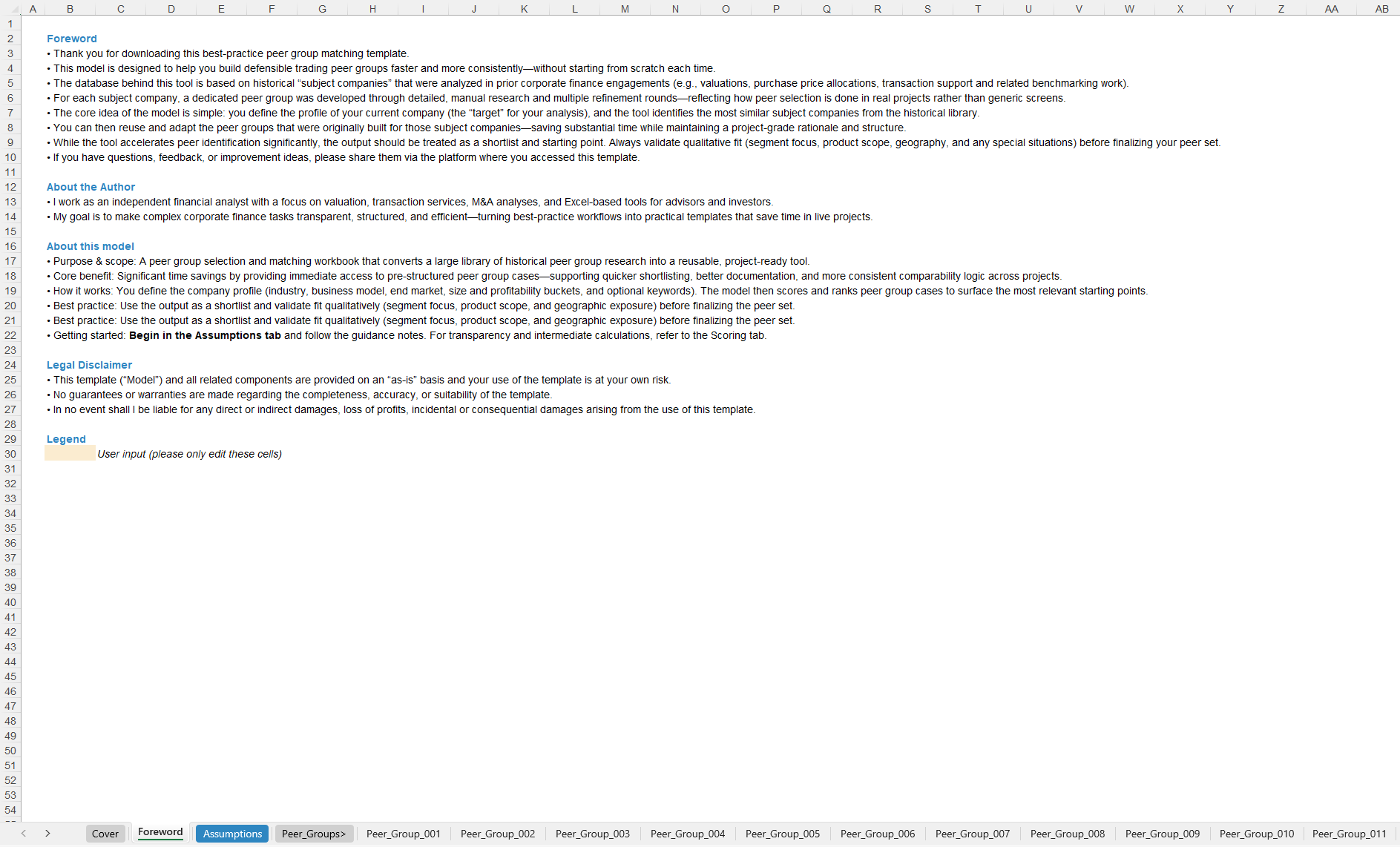
  • Peer selection should always include a qualitative reasonableness check; the scoring accelerates shortlisting and improves consistency, but it does not replace professional judgement.
  • For full transparency, the detailed calculation logic can be reviewed in the dedicated Scoring tab.

What’s included
  • Excel model with 300 peer group cases (subject-company based)
  • Structured peer group pages with consistent fields and links
  • Built-in scoring framework (weights, must-match, bucket distance, keywords/strong keywords)
  • Ready-to-use assumptions interface for fast screening and repeatable peer selection

Support
The screenshots and video provide a good first impression of the model, but they do not fully capture all functionalities and details—if you have any questions or would like to better understand specific features, feel free to reach out anytime.

This Best Practice includes
1 Excel File

Acquire business license for $40.00

Add to cart

Add to bookmarks

Discuss

Further information

Provide a fast, structured and defensible way to identify and document comparable companies by matching your company profile to a curated library of 300 historical peer group cases.

Best suited when you need a high-quality peer group quickly (valuation, benchmarking, strategy, investor materials, market positioning) and want to start from proven historical peer-selection work instead of running fresh screens from scratch.


0.0 / 5 (0 votes)

please wait...