Construction WIP Schedule, Bonding Capacity & Bank Covenant Model (Excel + Google Sheets)
Originally published: 03/08/2026 13:03
Publication number: ELQ-86214-1
View all versions & Certificate
certified

Construction WIP Schedule, Bonding Capacity & Bank Covenant Model (Excel + Google Sheets)

A 14-tab contractor finance model: cost-to-cost percentage-of-completion, contract asset/liability, EAC fade analysis, working-capital bonding capacity, four ba

Description
Built for the moment a bank or a surety asks a contractor for a WIP schedule. The model takes each job's contract value, approved change orders, estimated total cost, cost to date and billings, and produces cost-to-cost percentage-of-completion, earned revenue, over/(under) billing, and the contract asset and contract liability that belong on the balance sheet — then rolls the portfolio up into working capital, indicative bonding capacity, four covenant ratios and a one-page bank/surety package.

Why this one

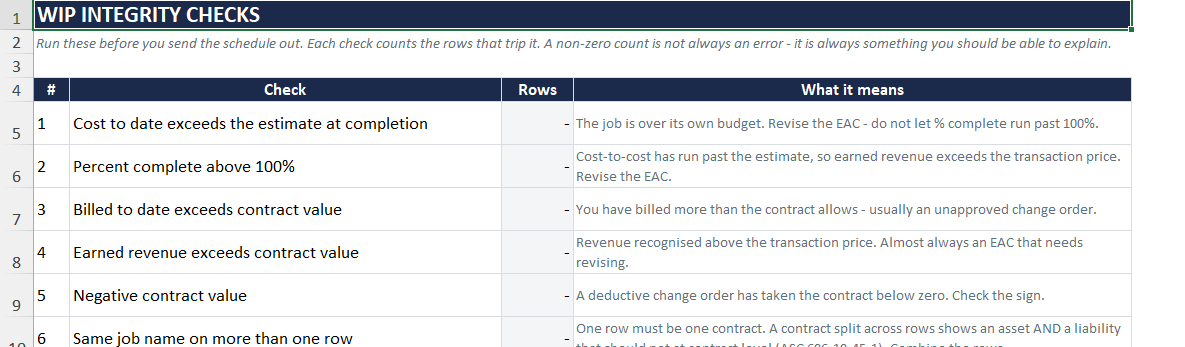
Percent complete is cost-to-cost (ASC 606-10-55-20/21), driven by cost data rather than a subjective slider. The contract asset and liability are computed per contract as mutually exclusive amounts and then aggregated (ASC 606-10-45-1) — cheap templates net them across jobs and report a figure that is not the balance-sheet number. Eleven integrity checks are built in, and each was proven to fire by seeding the defect it looks for. All 607 formulas are independently recomputed in a separate engine, and every figure quoted here is rebuilt from the shipped file.

Contents (14 tabs)
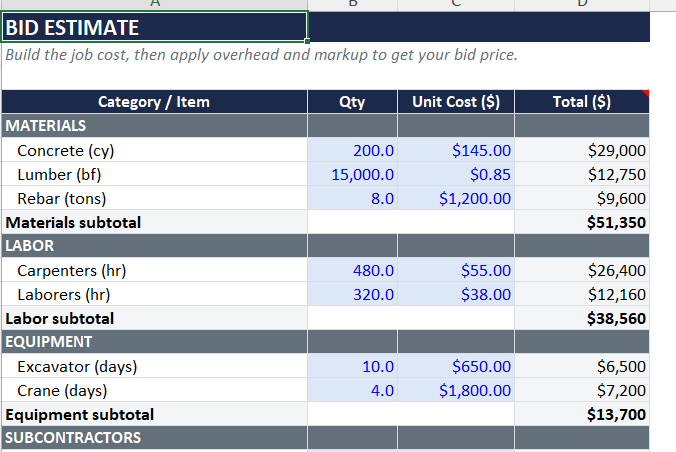
START HERE · Settings · Bid Estimate · WIP Schedule · Progress Billing · Period & EAC · Bonding & WC · Financial Covenants · Change Order Log · Portfolio Trend · Audit Checks · Dashboard · Bank & Surety Package · AI Prompts (12 lender-ready commentary prompts).

Worked example
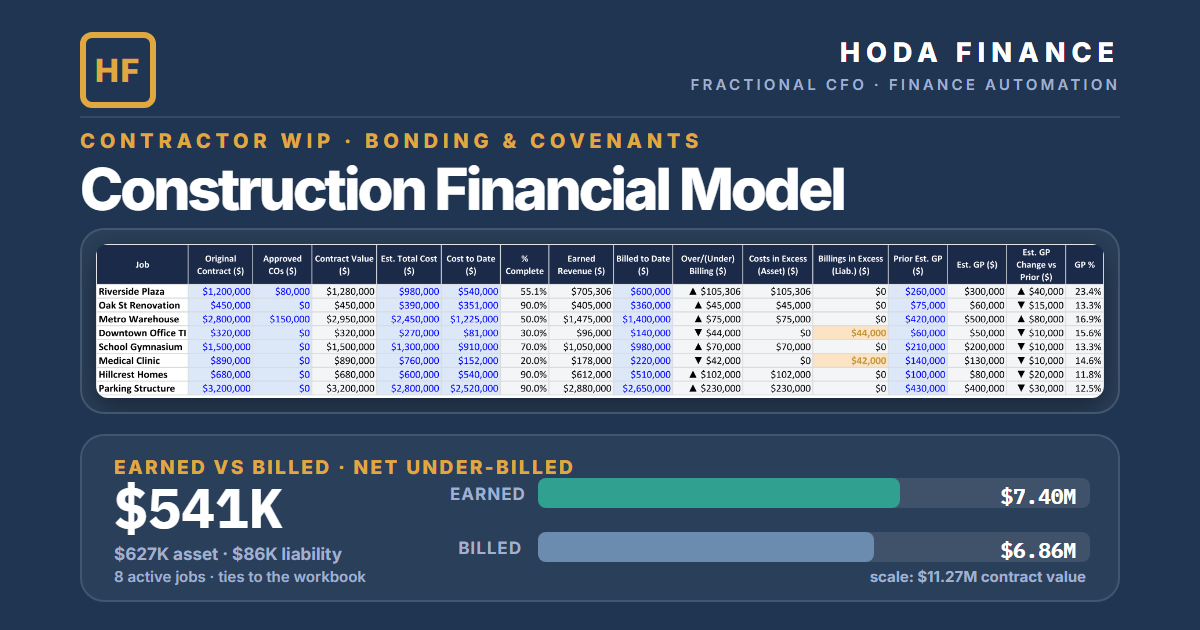
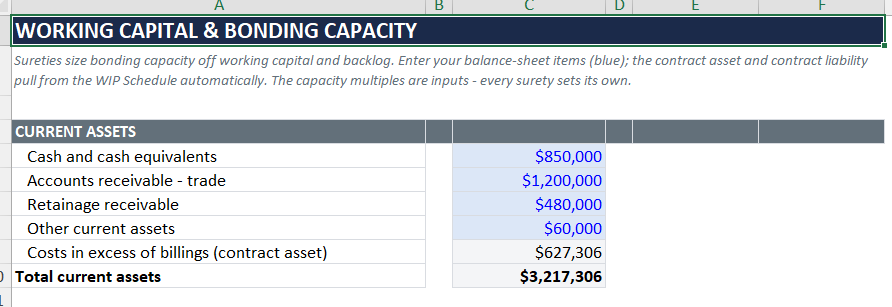
Granite Ridge Construction LLC: 8 jobs, $11.27M contract value including $230,000 of approved change orders, 66.2% complete. Earned $7,401,306 vs $6,860,000 billed → net under-billed $541,306 (contract asset $627,306 / liability $86,000). Estimated GP $1,720,000, +$25,000 period over period with 6 of 8 jobs eroding. Working capital $1,821,306 → ~$27.3M aggregate / ~$18.2M single-job indicative bonding capacity at 15× / 10×. Current ratio 2.30×, quick 1.56×, debt-to-TNW 0.83×. Draw $61,975 after $49,775 retainage.

Specification
14 tabs · 607 formulas · Excel 2019 / 2021 / 365 (Windows & Mac) and Google Sheets · no macros, no add-ins, no 365-only functions · calculated cells locked in Excel, inputs unlocked, no password (Google Sheets may not carry the sheet protection on import) · Excel edition + Google Sheets edition + 2-page methodology PDF.

Scope
Not a replacement for an accounting system. Excludes cost-code-level job costing within a job, payroll and certified payroll, equipment depreciation, retainage receivable aging, multi-entity consolidation, percentage-of-completion for income tax, multi-currency, and general ledger functions. One row is one contract.

ABOUT THE AUTHOR
Built by Hoda Elmorshidy — Financial Controller & Fractional CFO, 9+ years in IFRS reporting, FP&A, commodity trading, CFO/board reporting, UAE VAT & Corporate Tax, and finance automation. Practitioner-grade tools, not generic templates.

DISCLAIMER
This template is an analytical and educational tool, not professional accounting, tax, financial or legal advice. Verify all figures before use in any decision. Percentage-of-completion outputs are only as good as your estimated total cost (IFRS 15.B19 / ASC 606-10-55-21). Bonding capacity and covenant figures are indicative planning numbers based on multiples and thresholds you enter — not a commitment, quote, or guarantee of bonding or credit. "AIA-style" refers to the schedule-of-values format only. The sample company is fictional.

LICENSE & LIABILITY
LICENSE GRANT: Single-user license for your own or your organization's internal use. No resale, redistribution, sublicensing, or repackaging of the file or its templates.
AS IS: Provided "as is" without warranty of any kind, express or implied, including merchantability or fitness for a particular purpose.

LIMITATION OF LIABILITY: To the maximum extent permitted by law, total liability for any claim arising from this product is limited to the amount you paid for it. Not liable for indirect, incidental, or consequential losses.
NON-WAIVABLE RIGHTS: Nothing here limits rights that cannot be excluded under the consumer-protection law of your jurisdiction.
GOVERNING LAW: This purchase is governed by the terms of the platform you bought it on and by the consumer-protection law of your own country of residence. Where those permit, the limitations above apply to the maximum extent allowed.


TRADEMARKS & NON-AFFILIATION: "AIA", G702 and G703 are trademarks/forms of The American Institute of Architects; this product uses the schedule-of-values FORMAT only and is NOT affiliated with, endorsed by, or sponsored by the AIA. Microsoft Excel and Google Sheets are trademarks of Microsoft Corporation and Google LLC respectively. FASB (ASC) and IFRS references are for methodological attribution only

This Best Practice includes
14 tabs · 607 formulas · Excel 2019 / 2021 / 365 (Windows & Mac) and Google Sheets · no macros, no add-ins, no 365-only

Acquire business license for $179.00

Add to cart

Add to bookmarks

Discuss

Further information

• Produce a bank- and surety-ready work-in-progress schedule on the cost-to-cost
percentage-of-completion basis (ASC 606-10-55-20/21)
• Derive the contract asset and contract liability per contract (ASC 606-10-45-1) so the
WIP ties to the balance sheet
• Separate current-period revenue and gross profit from inception-to-date, and explain
gross-profit fade against the original estimate at completion
• Translate the portfolio into working capital, indicative bonding capacity and the four
covenant ratios a credit agreement tests
• Produce an AIA-style progress billing with retainage and a one-page bank/surety package

• A general contractor or specialty subcontractor with up to ~20 concurrent contracts
• Revenue recognised over time (IFRS 15.35 / ASC 606 criteria met), measured cost-to-cost
• One contract per row — a single, identifiable contract with its own estimate at completion
• A contractor preparing for a bank renewal, a bonding programme review, or a CPA-reviewed
year end
• An accounting system already exists and supplies cost-to-date and billings

• Cost-code-level job costing within a job (labour / material / subcontractor detail) —
that belongs in the accounting system or ERP
• Payroll, union fringes or certified payroll reporting
• Equipment depreciation or internal equipment rate build-ups
• Retainage receivable aging
• Multi-entity or joint-venture consolidation
• Percentage-of-completion for income tax purposes, including the look-back method
• Multi-currency contracts
• A contract deliberately split across multiple rows (this breaks the per-contract
contract-asset/liability presentation)


0.0 / 5 (0 votes)

please wait...