Last version published: 22/12/2025 21:47
Publication number: ELQ-64107-2
View all versions & Certificate

Capital Runway
Capital Runway in Microsoft Excel to download
Further information
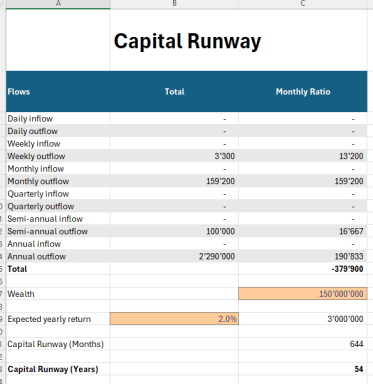
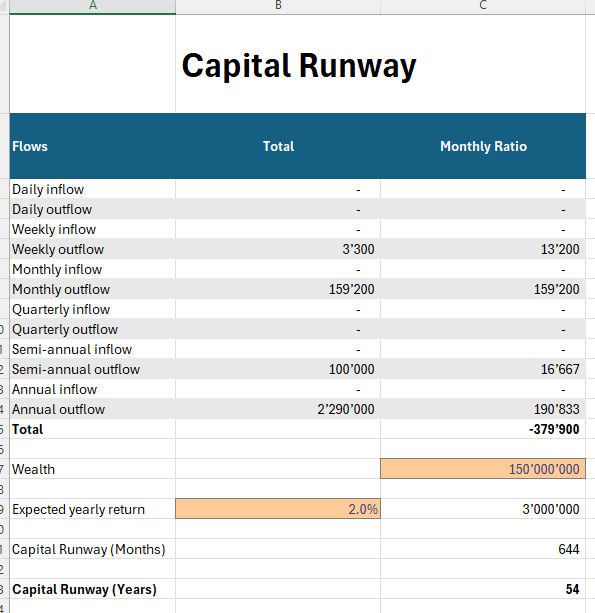
The Budget Calculator Excel tool is designed to help individuals manage their financial sustainability, especially after major life transitions such as selling a business or retiring. Its primary objective is to provide a clear, structured overview of income and expenses across various timeframes—daily, weekly, monthly, and annually—so users can accurately assess their burn rate and capital runway.
By aggregating inflows and outflows and factoring in expected investment returns, the tool calculates how long your current wealth can support your lifestyle. This is particularly useful for entrepreneurs or high-net-worth individuals who need to transition from active income to passive wealth management. The model includes categories such as housing, insurance, taxes, travel, and philanthropy, offering a comprehensive view of recurring costs.
A key feature is the integration of Excel’s NPER formula, which helps estimate how many months or years your capital will last under current conditions. This supports long-term planning and helps users make informed decisions about spending, saving, and investing.
Ultimately, this best practice tool empowers users to take control of their financial future by offering a transparent, customizable framework for budgeting, forecasting, and wealth preservation.
This Budget Calculator is ideally suited for individuals navigating significant financial transitions or seeking to gain clarity on their long-term financial sustainability. It is particularly valuable in the following scenarios:
Post-Exit Financial Planning: Entrepreneurs who have recently sold a business and are managing a lump-sum payout can use this tool to understand how long their capital will last under current or projected spending patterns.
Retirement Planning: Retirees or those approaching retirement can assess their capital runway, ensuring their savings and investments can sustain their desired lifestyle over time.
Life Transitions: Individuals experiencing major life changes—such as career shifts, relocation, inheritance, or changes in family structure—can use the calculator to reassess income and expenses across multiple timeframes (daily to annual).
Zero or Irregular Income Scenarios: The tool is especially helpful when income is minimal or unpredictable, highlighting the importance of managing outflows and understanding the impact on long-term financial health.
High Net-Worth Individuals: Those with significant assets but limited recurring income can benefit from the model’s ability to project capital depletion using Excel’s NPER formula, factoring in expected investment returns.
Philanthropic and Lifestyle Planning: Users with substantial discretionary spending—such as on travel, philanthropy, or luxury expenses—can evaluate the sustainability of their lifestyle and make informed adjustments.
By offering a structured, transparent, and customizable framework, this calculator empowers users to make data-driven decisions, optimize their spending, and plan confidently for the future.
While the Budget Calculator is a powerful tool for financial planning, there are certain scenarios where it may not be the most suitable solution:
Active Income Management: Individuals with complex, variable income streams—such as freelancers with fluctuating monthly earnings—may find the static input structure less adaptable without customization.
Business Financial Planning: This tool is designed for personal or household finances. It does not account for business-specific financial metrics such as profit margins, cash flow forecasting, or capital expenditures.
Debt Repayment Strategies: Users focused primarily on managing and optimizing debt repayment (e.g., credit card debt, student loans) may require more specialized tools that incorporate interest rate modeling and amortization schedules.
Investment Portfolio Analysis: While the calculator includes a basic expected return input, it does not provide detailed investment tracking, asset allocation modeling, or risk analysis.
Tax Optimization Planning: The tool includes annual tax outflows but does not support detailed tax planning, deductions, or scenario modeling for tax efficiency.
Real-Time Financial Tracking: This is a static planning tool and does not integrate with banking or financial platforms for real-time updates or transaction tracking.
In these cases, users may benefit from more specialized financial software or professional advisory services tailored to their specific needs.