ASME B31G Remaining Strength & Remaining Life Calculator — Pipeline Corrosion FFS (Excel)
Originally published: 12/09/2026 19:20
Last version published: 12/10/2026 12:37
Publication number: ELQ-68560-2
View all versions & Certificate
certified

ASME B31G Remaining Strength & Remaining Life Calculator — Pipeline Corrosion FFS (Excel)

Pass/fail a pipeline corrosion defect in minutes: Original + Modified B31G, safe pressure vs MAOP, remaining life. Validated on 9 ASME examples.

Description
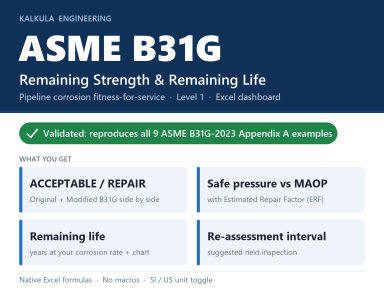
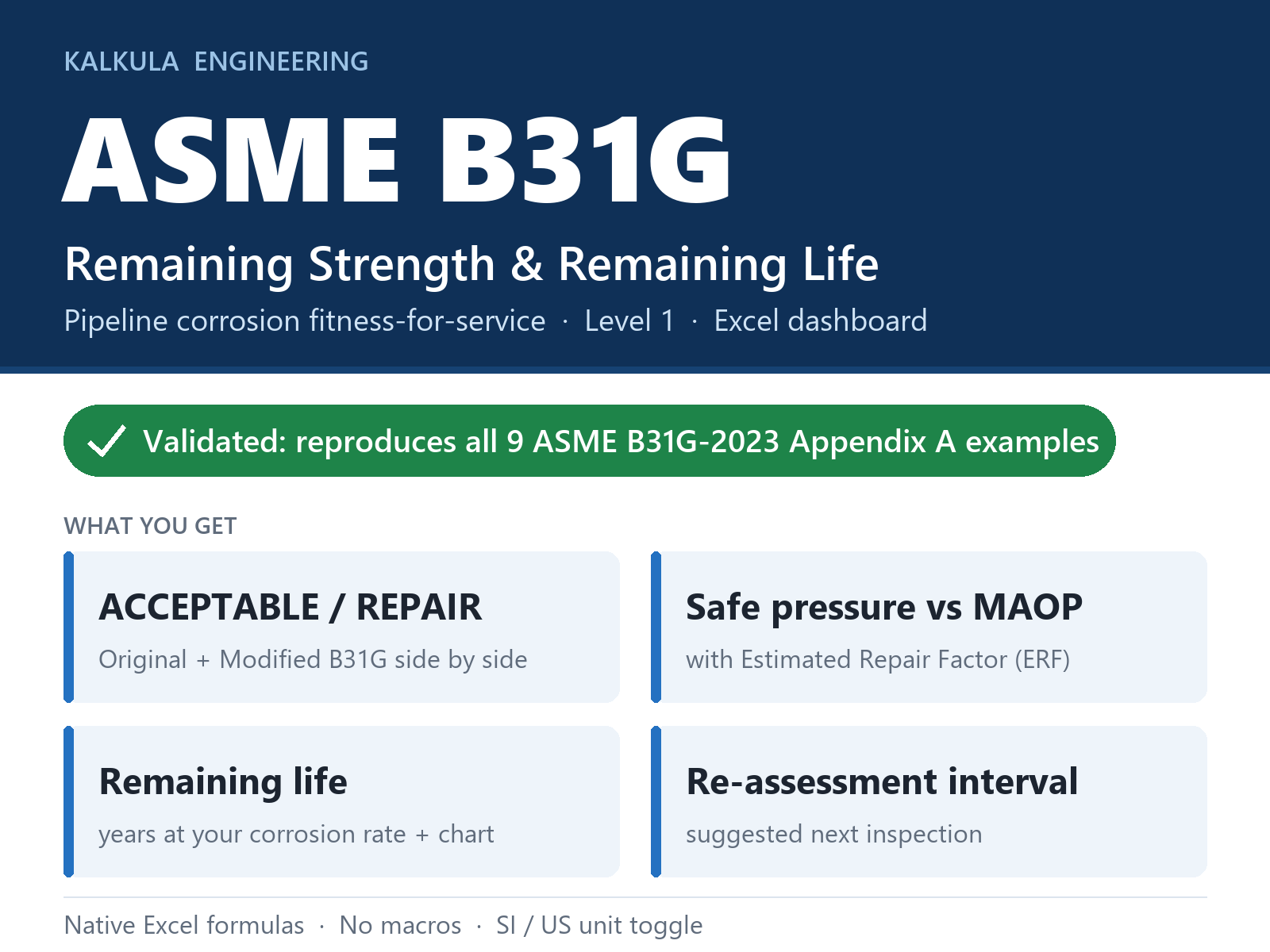
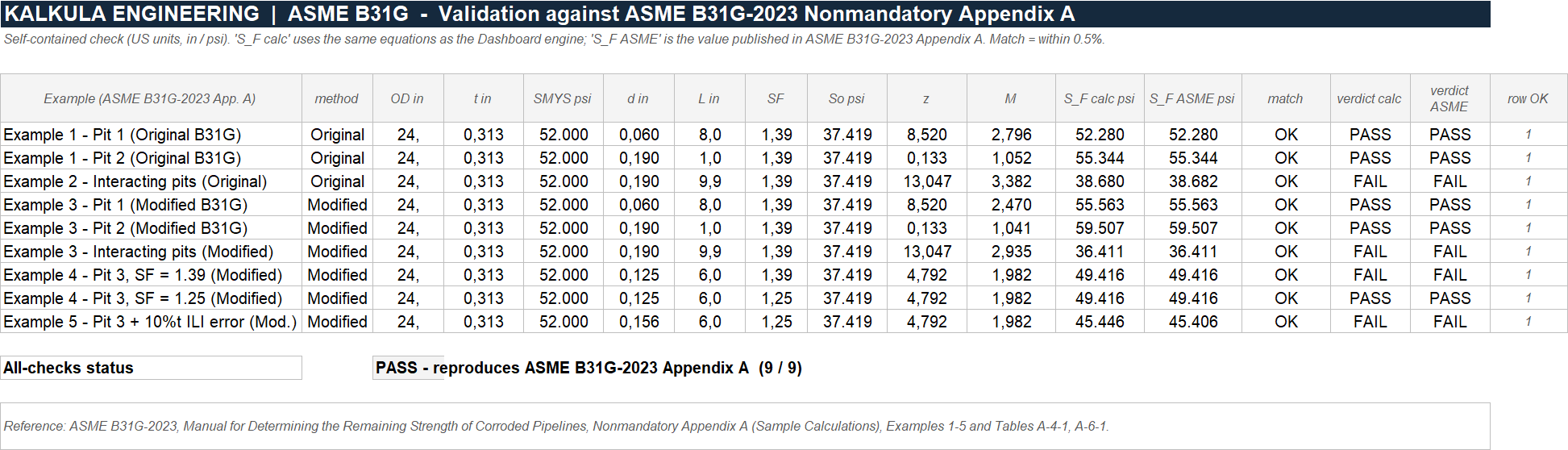
Validated before you trust it: the built-in Validation sheet reproduces all 9 worked examples in ASME B31G-2023 Nonmandatory Appendix A, so you can check the engine against the code's own numbers.
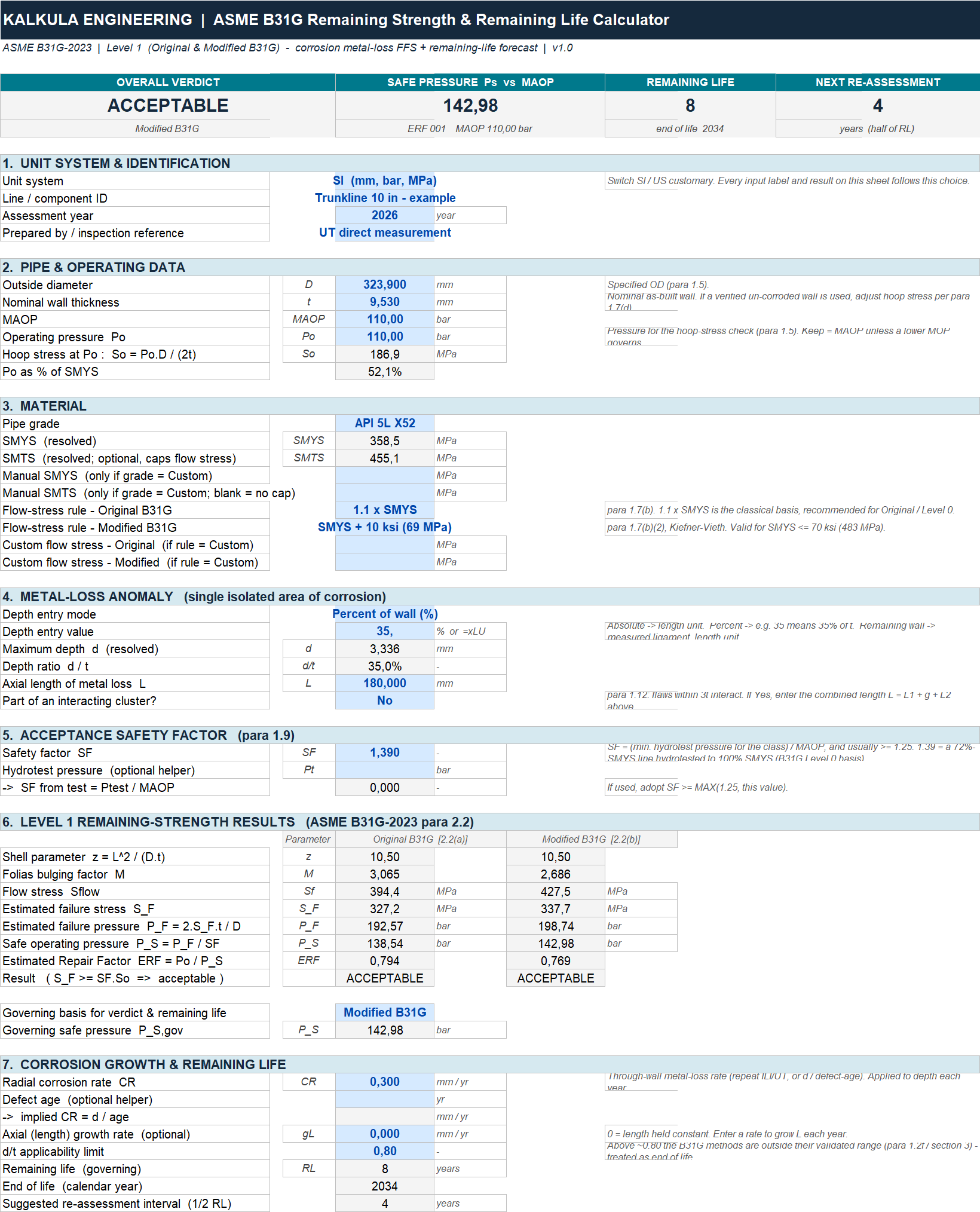
Screen a single isolated metal-loss defect per ASME B31G-2023 Level 1. Original and Modified B31G (Kiefner-Vieth) run side by side, so you see which method governs.
Inputs: pipe OD and wall, MAOP, grade (or custom SMYS/SMTS), defect depth and axial length, safety factor, corrosion rate.
One dashboard returns:
• Overall verdict — ACCEPTABLE or REPAIR
• Safe pressure vs MAOP, with Estimated Repair Factor (ERF)
• Remaining life in years at your corrosion rate
• Suggested re-assessment interval
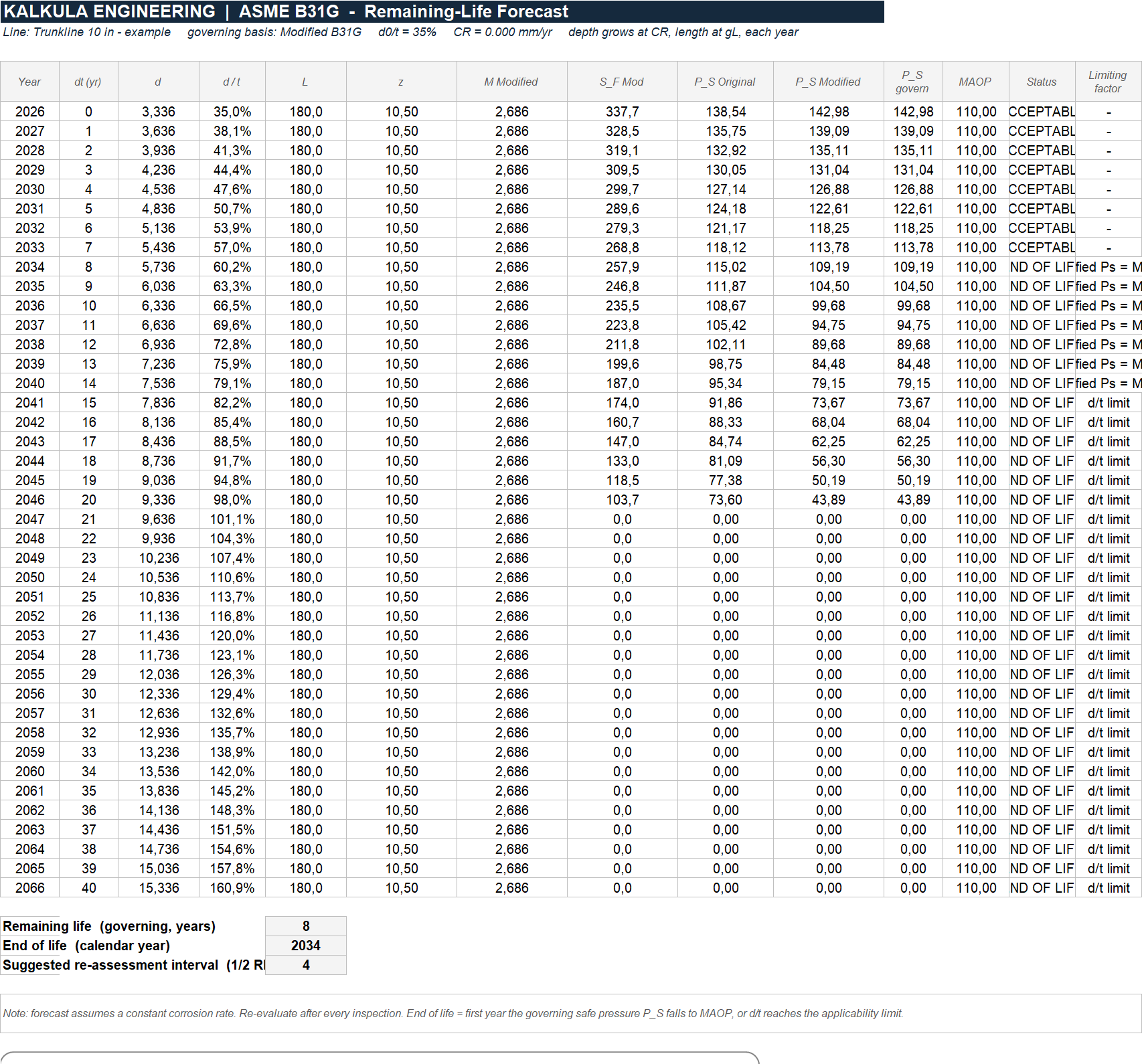
Plus a year-by-year remaining-life table with a pressure-vs-time chart, and a one-click SI/US unit toggle. Native Excel formulas, no macros, nothing hidden.
How to use:
1. Choose SI or US customary units.
2. Enter pipe and operating data, then the anomaly's maximum depth and axial length from your ILI or UT report.
3. Set the acceptance safety factor and corrosion growth rate.
4. Read the four verdict cards, then open the Remaining Life sheet for the year-by-year table and chart you can paste into a report.
Typical use: quick pass/fail on ILI or UT findings, remaining-life numbers for turnaround and budget planning, and checking contractor assessments.
Scope: Level 1 only (no RSTRENG effective-area). Not for cracks, dents, gouges, weld-seam corrosion or d/t above 0.80. Preliminary screening — dispositions must be signed off by a qualified integrity engineer. Not affiliated with or endorsed by ASME.

This Best Practice includes
Excel workbook (.xlsx, no macros): Dashboard, Remaining Life + chart, Validation (9 ASME examples), Read Me

Acquire business license for $30.00 $25.50

Add to cart

Add to bookmarks

Discuss

Further information

Screen a corrosion metal-loss anomaly on a pressurized pipeline for fitness-for-service using ASME B31G-2023 Level 1 (Original and Modified methods), determine whether the pipeline is safe to operate at MAOP, and forecast how many years remain before the defect requires repair.

Preliminary FFS screening of a single, isolated internal or external corrosion area on in-service pipelines (oil, gas, water, slurry) where hoop stress from internal pressure governs. Useful for integrity engineers doing quick pass/fail checks on ILI or UT findings, remaining-life estimates for turnaround/budget planning, and setting re-inspection intervals.

Not for crack-like defects, gouges, mechanical damage, dents/buckles, or corrosion at seam/girth welds — those need API 579-1/ASME FFS-1. Not a Level 2 (RSTRENG effective-area) assessment — no detailed river-bottom profile input. Not valid above d/t ≈ 0.80. Not a substitute for a signed integrity engineering disposition.


0.0 / 5 (0 votes)

please wait...