Oil & Gas - ASME B31G Remaining Strength & Remaining Life Calculator (Corrosion Fitness-for-Service, Excel Dashboard)
Originally published: 12/09/2026 19:20
Publication number: ELQ-68560-1
View all versions & Certificate
certified

Oil & Gas - ASME B31G Remaining Strength & Remaining Life Calculator (Corrosion Fitness-for-Service, Excel Dashboard)

An Excel dashboard that screens a corrosion metal-loss defect on a pressurized pipeline per ASME B31G-2023 Level 1 — runs Original and Modified B31G side by sid

Description
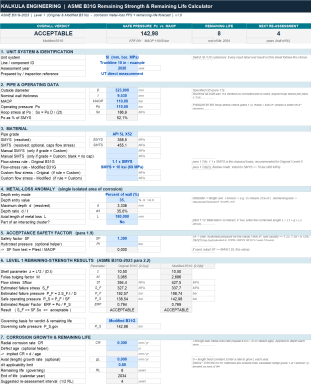
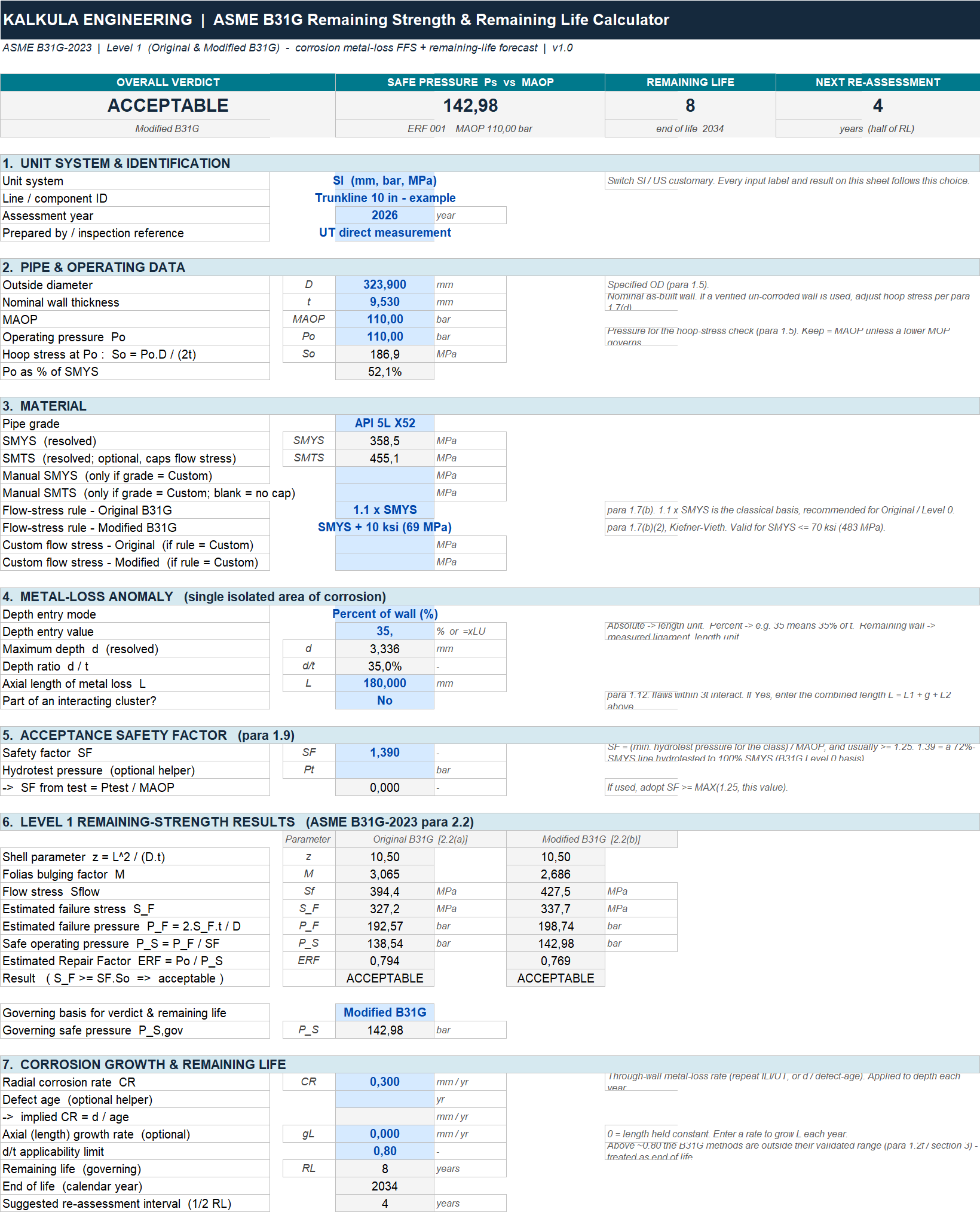
Fitness-for-service screening for a single isolated area of corrosion metal loss, per ASME B31G-2023 Level 1. Runs both the Original B31G and Modified B31G (Kiefner-Vieth) methods side by side, so you see where they agree and where the governing method matters.

Enter pipe geometry, MAOP/operating pressure, pipe grade (or custom SMYS/SMTS), the defect's depth and axial length, an acceptance safety factor, and a corrosion growth rate. The dashboard returns:
  • Overall Verdict — ACCEPTABLE or REPAIR, per your chosen governing basis
  • Safe Pressure vs. MAOP — with Estimated Repair Factor (ERF)
  • Remaining Life — years to end-of-life at your input corrosion rate
  • Next Re-Assessment — suggested re-inspection interval (half of remaining life)

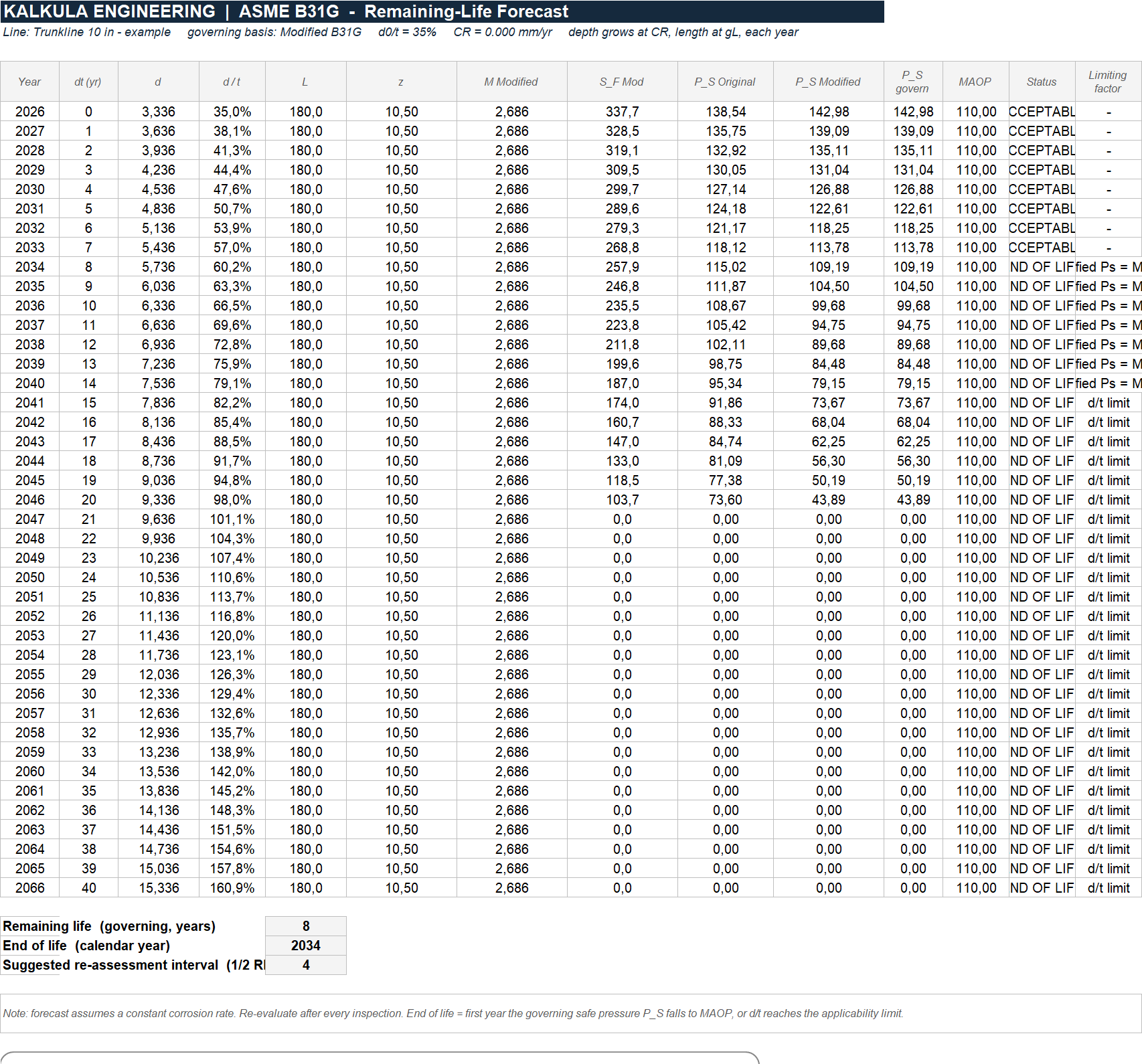
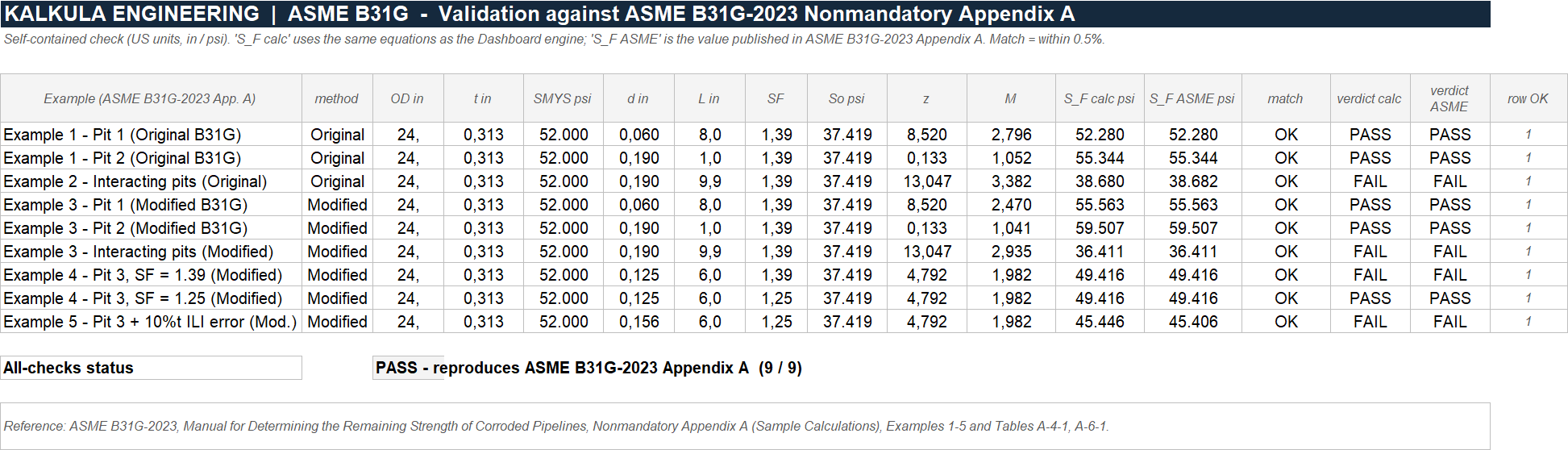
A dedicated Remaining Life sheet gives the year-by-year table and a pressure-vs-time chart. Switch between SI and US customary units — every label and result follows the choice. A Validation sheet reproduces all nine worked examples from ASME B31G-2023 Nonmandatory Appendix A, so you can check the engine against the code's own numbers before you trust it on real data.

Limitations: Level 1 only — one maximum depth and one axial length per anomaly (Level 2/RSTRENG effective-area method is not included; use dedicated software for that). Applies to a single isolated area of internal/external corrosion where internal-pressure hoop stress governs. Not for crack-like defects, gouges, dents, seam/girth-weld selective corrosion, or metal loss under high axial/bending stress (para 1.3) — use API 579-1/ASME FFS-1 for those. Above d/t ≈ 0.80 the methods are outside their validated range. This tool supports preliminary screening only — every disposition and re-inspection interval must be reviewed and signed by a qualified pipeline-integrity engineer against the current code and governing pipeline regulations

This Best Practice includes
Excel Support Sheet

Acquire business license for $30.00

Add to cart

Add to bookmarks

Discuss

Further information

Screen a corrosion metal-loss anomaly on a pressurized pipeline for fitness-for-service using ASME B31G-2023 Level 1 (Original and Modified methods), determine whether the pipeline is safe to operate at MAOP, and forecast how many years remain before the defect requires repair.

Preliminary FFS screening of a single, isolated internal or external corrosion area on in-service pipelines (oil, gas, water, slurry) where hoop stress from internal pressure governs. Useful for integrity engineers doing quick pass/fail checks on ILI or UT findings, remaining-life estimates for turnaround/budget planning, and setting re-inspection intervals.

Not for crack-like defects, gouges, mechanical damage, dents/buckles, or corrosion at seam/girth welds — those need API 579-1/ASME FFS-1. Not a Level 2 (RSTRENG effective-area) assessment — no detailed river-bottom profile input. Not valid above d/t ≈ 0.80. Not a substitute for a signed integrity engineering disposition.


0.0 / 5 (0 votes)

please wait...