Publication number: ELQ-34199-1
View all versions & Certificate

Cash Runway / Liquidity Planning
Cash Runway/Liquidity Planning in Excel to download.
Further information
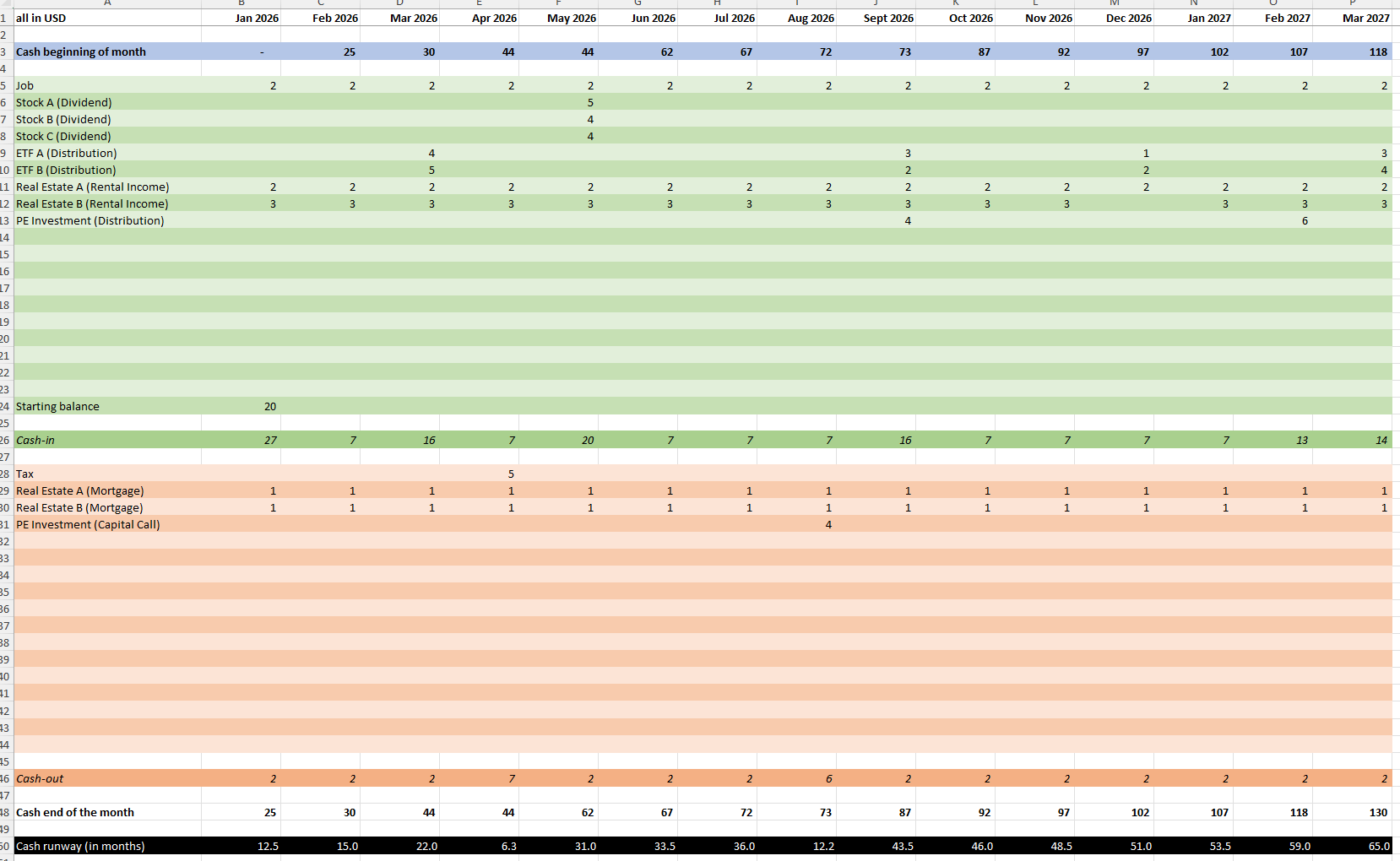
The Cash Runway / Liquidity Planning Excel tool is designed to provide individuals and businesses with a clear, structured framework for understanding and managing their financial liquidity over time. Its primary objective is to help users anticipate how long their available cash reserves will last under current and projected income and expense scenarios.
For individuals, especially ultra-high-net-worth individuals (UHNWIs), the tool supports personal liquidity planning by tracking diverse income sources—such as dividends, rental income, and investment distributions—against recurring obligations like taxes, mortgages, and capital calls. This enables better decision-making around spending, investment timing, and reserve management.
For businesses, the tool serves as a practical instrument for cash flow forecasting and operational planning. It helps identify potential liquidity gaps, assess the impact of revenue fluctuations, and determine the sustainability of operations over time.
Key objectives include:
Providing a month-by-month view of cash inflows, outflows, and ending balances
Calculating the cash runway in months to assess financial resilience
Supporting proactive financial planning and contingency preparation
Enhancing transparency and control over liquidity management
Enabling informed decisions for both short-term needs and long-term goals
This tool empowers users to take a data-driven approach to financial stability, ensuring they remain prepared for both opportunities and uncertainties.
This Cash Runway / Liquidity Planning tool is most effective in scenarios where individuals or businesses need a clear, month-by-month view of their financial liquidity. It is particularly well-suited for:
Ultra-High-Net-Worth Individuals (UHNWIs) managing complex income streams—such as dividends, rental income, and private equity distributions—alongside significant recurring expenses like taxes, mortgages, and capital calls.
Entrepreneurs or business owners assessing how long their company can operate under current cash flow conditions, especially during periods of uncertainty or transition.
Family offices and wealth managers seeking a transparent, customizable framework to monitor and plan liquidity for clients with diverse asset classes and income sources.
Individuals undergoing major life changes (e.g., retirement, business exit, relocation) who need to reassess their financial sustainability and plan for the future.
Organizations or startups preparing for fundraising rounds or managing burn rates to ensure operational continuity.
The tool is ideal when cash flows are relatively predictable and can be projected over a 12–15 month horizon. It enables proactive financial decision-making, helping users identify potential shortfalls early and adjust strategies to maintain financial stability.
While the Cash Runway / Liquidity Planning tool is highly effective for structured financial forecasting, there are certain scenarios where it may not be ideally suited:
Highly Volatile or Unpredictable Cash Flows: If income or expenses are extremely irregular or unpredictable—such as in early-stage startups with no revenue or individuals with speculative income—this tool may not provide reliable projections.
Real-Time Financial Tracking: The tool is not connected to live banking or investment platforms, so it requires manual data entry and updates. It is not intended for real-time cash management or automated tracking.
Complex Corporate Financial Modeling: For large enterprises with intricate financial structures, intercompany transactions, or multi-entity consolidations, more advanced financial planning software may be necessary.
Short-Term Trading or Treasury Operations: The model is designed for medium- to long-term liquidity planning and may not be suitable for high-frequency cash management or intraday treasury functions.
Tax Optimization or Scenario Planning: The tool does not include tax modeling, scenario simulations, or stress testing, which may be required for more advanced financial planning.
In such cases, specialized financial software or professional advisory tools may offer more robust capabilities.