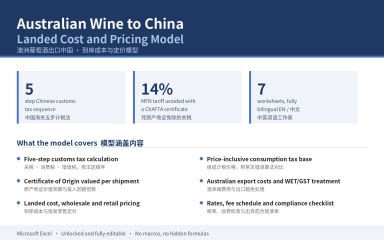
Australian Wine to China: Landed Cost and Pricing Model
Originally published: 25/09/2026 16:21
Publication number: ELQ-55233-1
View all versions & Certificate
certified

Australian Wine to China: Landed Cost and Pricing Model

Calculate bottle landed cost and selling price of Australian bottled wine imported into mainland China. Bilingual English and Chinese.

Description
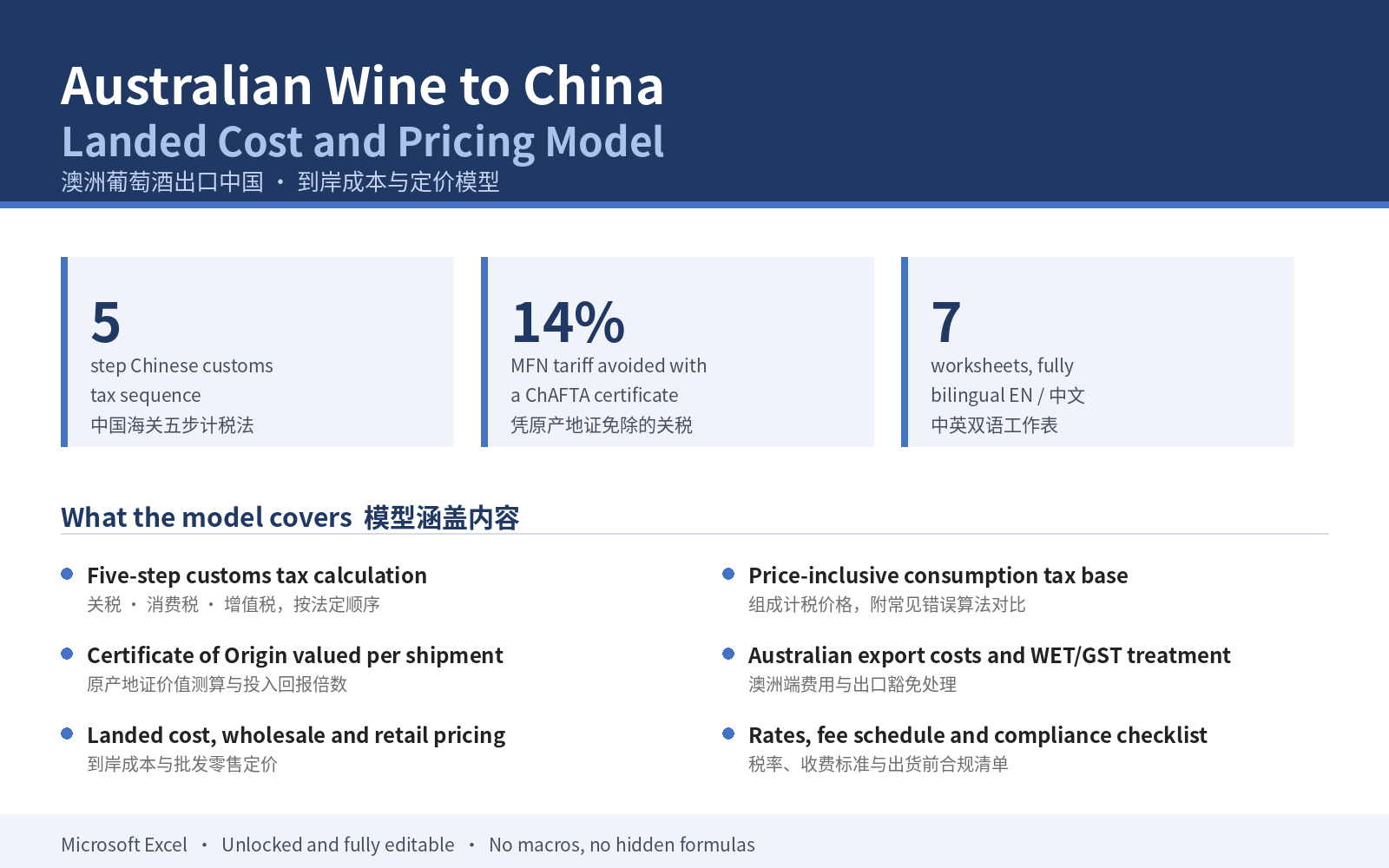
Importing Australian bottled wine into mainland China is a trade lane where the tax mechanics, not the freight bill, decide whether a shipment makes money. This Excel model turns that calculation into something you can run in under an hour, in English and Chinese.

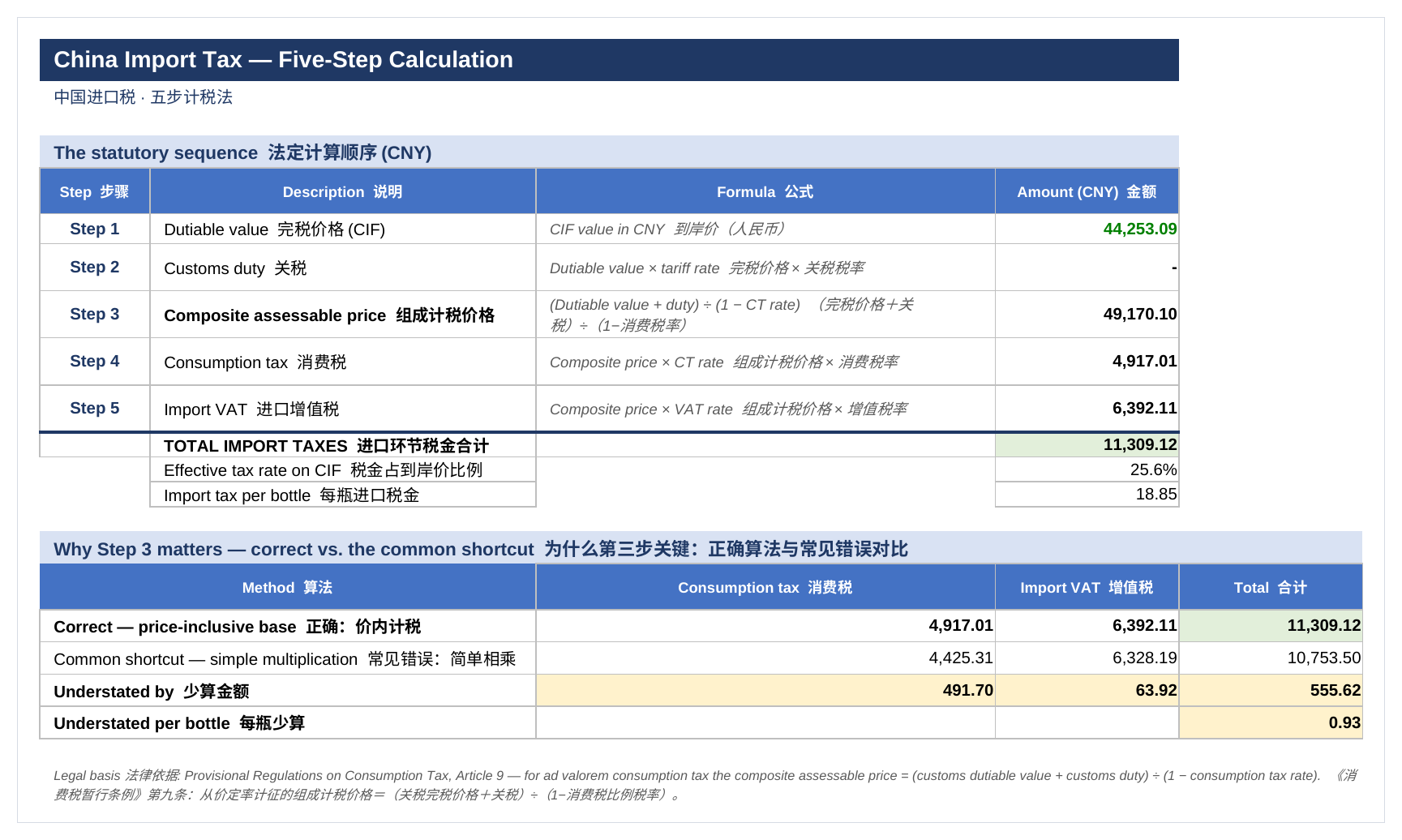
The model follows the five-step sequence Chinese customs actually applies: dutiable value, customs duty, composite assessable price, consumption tax, and import VAT. Step three is where most spreadsheets fail. China's consumption tax on wine is price-inclusive, so its base is grossed up by dividing by one minus the rate rather than multiplying the duty-paid value. A comparison table places the correct treatment beside the common shortcut and quantifies the gap, so you can see exactly what a simplified model would have cost you.

A dedicated worksheet prices the ChAFTA Certificate of Origin for your own consignment. Because duty feeds the consumption tax and VAT bases, the gap between the zero preferential rate and the fourteen percent most-favoured-nation rate cascades well past fourteen percent of goods value. The model nets the certificate fee against the tax saved and expresses the result as a return multiple.
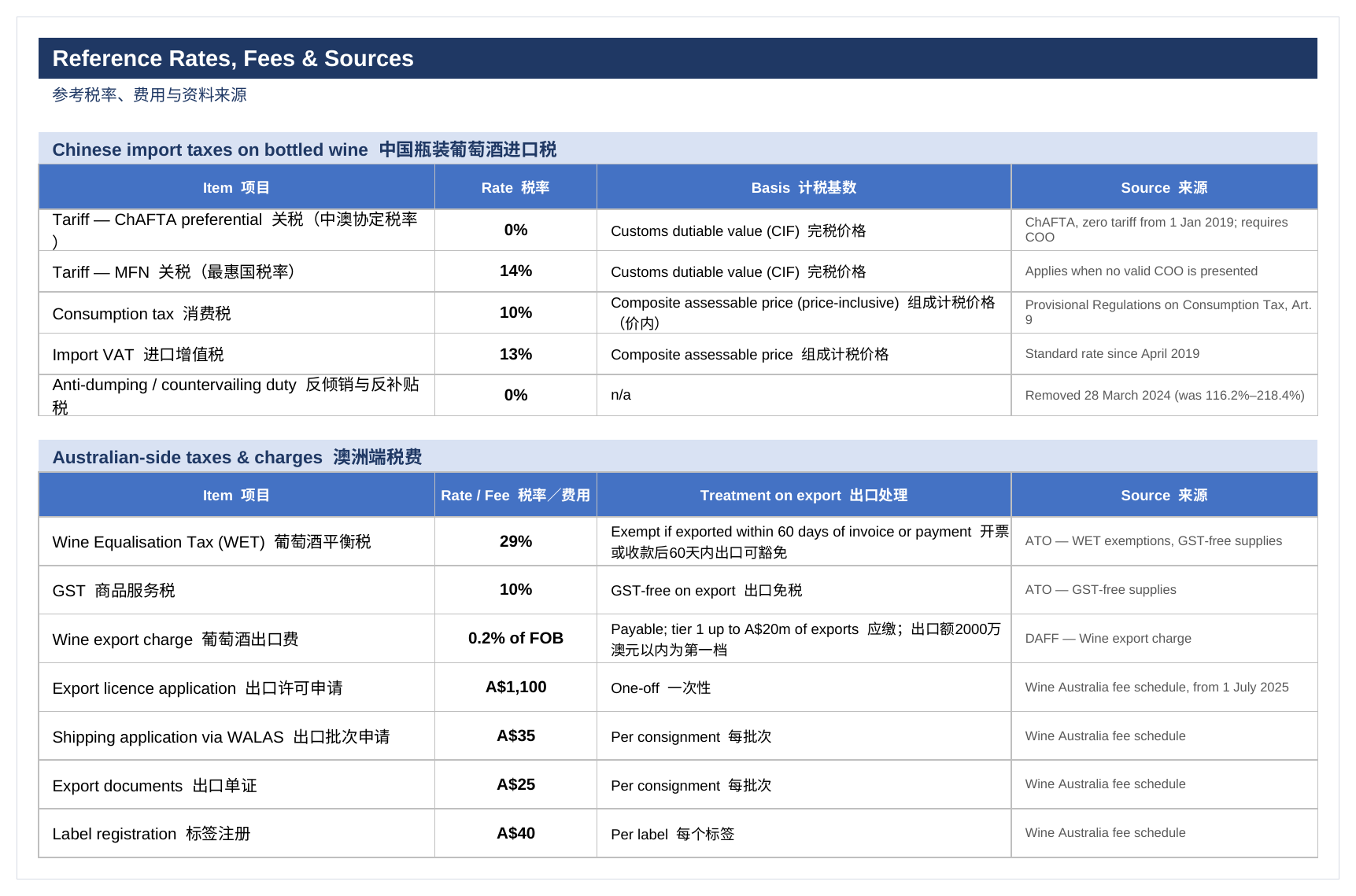
Australian-side costs are modelled line by line rather than buried in a freight figure. Wine Equalisation Tax and GST appear as reference rates and are correctly excluded on export, with a reminder that the exemption is conditional and that wineries routinely quote domestic WET-inclusive prices unless asked otherwise. Export charge, consignment fees, label registration and certificate costs each sit on their own editable row.

All inputs live on one colour-coded worksheet; everything downstream is formula-driven. Two toggles change the commercial picture materially: whether a valid certificate is held, and whether import VAT is recoverable or a sunk cost in private-channel resale. A closing reference sheet carries the rates, the Australian fee schedule, a pre-shipment compliance checklist covering GACC registration and Chinese back-label filing, and the source and verification date for every figure.

This Best Practice includes
1 Microsoft Excel workbook, 7 worksheets: instructions, inputs, cost build-up (EXW to FOB to CIF), China import tax (fiv

Acquire business license for $49.00

Add to cart

Add to bookmarks

Discuss

Further information

Give wine exporters, importers and distributors a defensible per-bottle landed cost for an Australia-to-China consignment, calculated the way Chinese customs actually assesses it, and translate that cost into wholesale and retail prices. A secondary objective is to make the value of the ChAFTA Certificate of Origin explicit, so that obtaining it becomes a numbers decision rather than a paperwork afterthought.

Bottled wine shipped from Australia to mainland China under general trade by sea freight, whether LCL or FCL. Suits trial orders and regular consignments alike, and works for exporters quoting a Chinese buyer as well as importers checking a landed cost they have been given. Particularly useful where a ChAFTA Certificate of Origin is available or under consideration.

Not built for cross-border e-commerce under the 1210 bonded warehouse model, which taxes on a retail price base and prohibits B2B resale. Not suited to personal baggage or postal and courier channels. Consumption tax rates differ for spirits and beer, so the model should not be reused for those categories without changing the rate. Origins other than Australia require a different tariff and certificate treatment.


0.0 / 5 (0 votes)

please wait...