Renewable Development Pipeline Acquisition | Risk-Adjusted MW, Queue & Safe Harbor
Originally published: 30/08/2026 12:35
Publication number: ELQ-67250-1
View all versions & Certificate
certified

Renewable Development Pipeline Acquisition | Risk-Adjusted MW, Queue & Safe Harbor

Turns a seller's nameplate megawatts into risk-adjusted delivered megawatts, and prices the 4 July 2026 safe-harbor split project by project.

Description
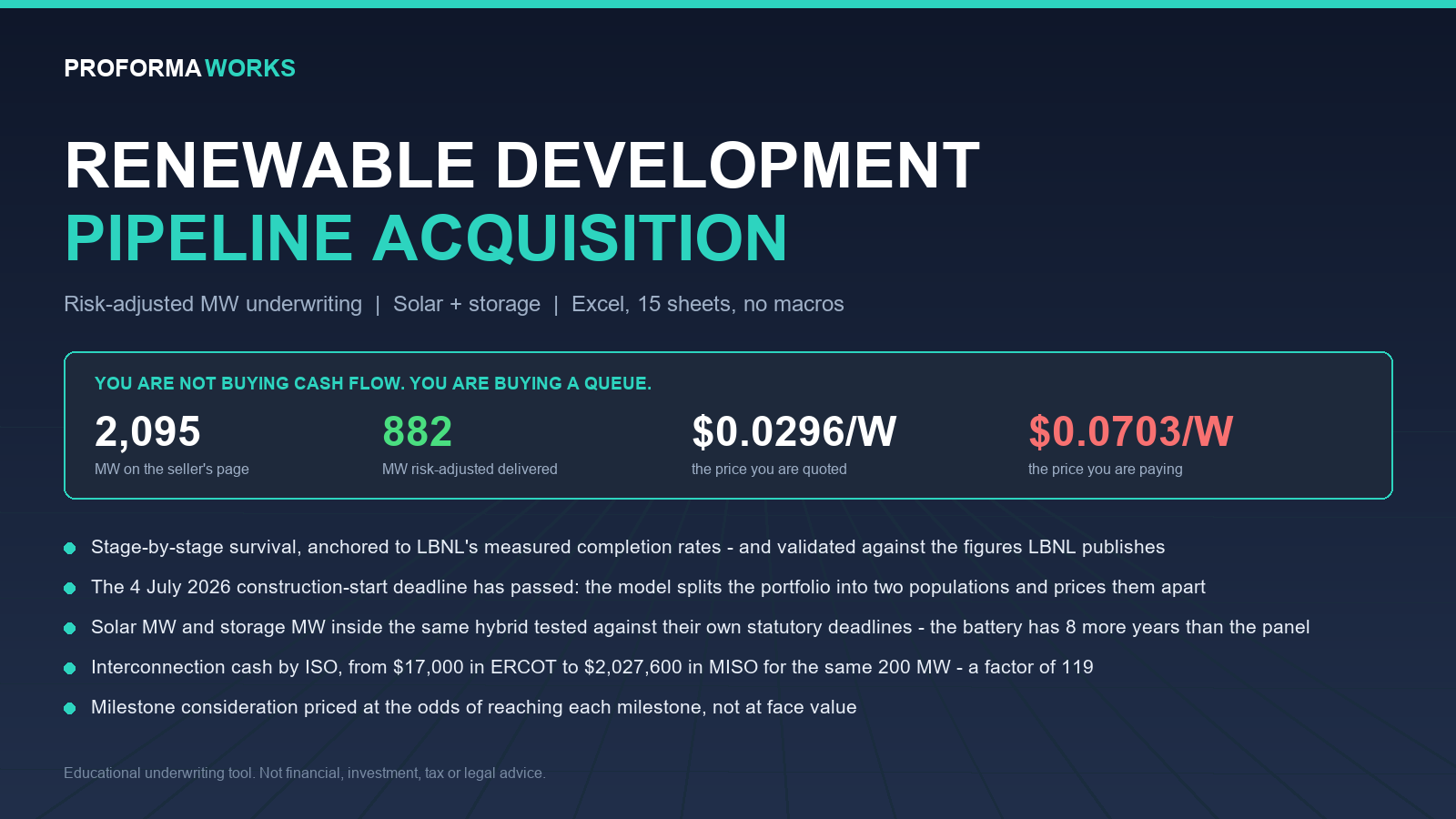
You are not buying cash flow. You are buying a queue.
Every renewable financial model on the market forecasts one project for the developer building it. This one underwrites the purchase of a PIPELINE: a portfolio of solar and storage projects at different stages, in different markets, with different tax positions, and different odds of ever being built.

A seller hands you a page with a megawatt number and a price per watt. Both are true. Neither is the number to underwrite on, because between the megawatts on the page and the megawatts you will own sit four filters, and every one of them has been measured. Of interconnection requests filed in the United States between 2000 and 2020, about 19 percent of projects and 13 percent of capacity had reached commercial operation by the end of 2025. For solar alone, 10.9 percent of capacity. Signing the interconnection agreement does not end that risk, it halves it: 41 percent of the capacity that signed agreements between 2000 and 2022 had withdrawn by the end of 2025. And the median clock from request to operation is 61 months, against 22 in 2008.

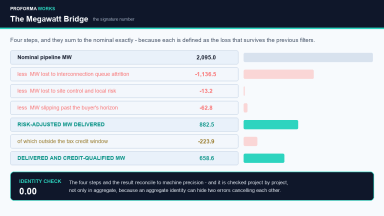
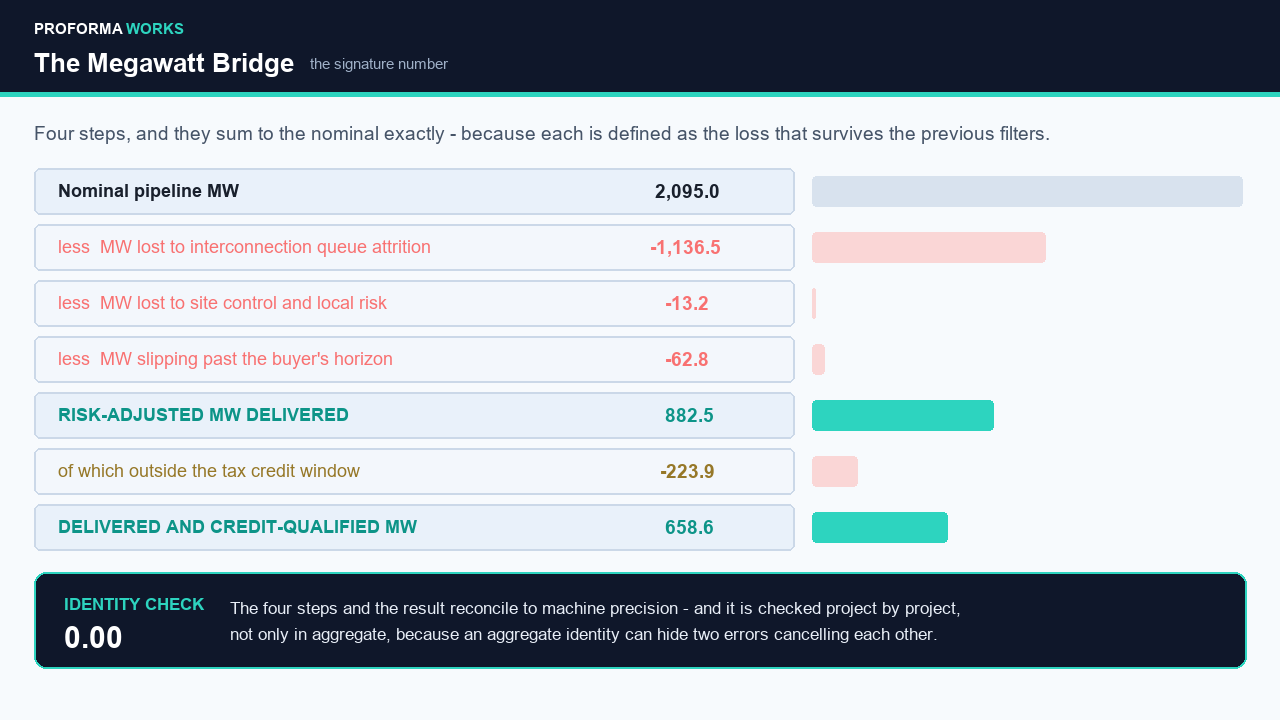
THE SIGNATURE OUTPUT IS A BRIDGE, AND IT IS AN IDENTITY RATHER THAN AN ESTIMATE. Nominal megawatts, less queue attrition, less site control and local risk, less capacity slipping past your horizon, equals risk-adjusted megawatts delivered. The four steps sum to the nominal exactly, checked project by project rather than only in aggregate. Set the risks to zero and the price per delivered watt collapses onto the price per nominal watt, which proves the gap is those four steps and nothing else.

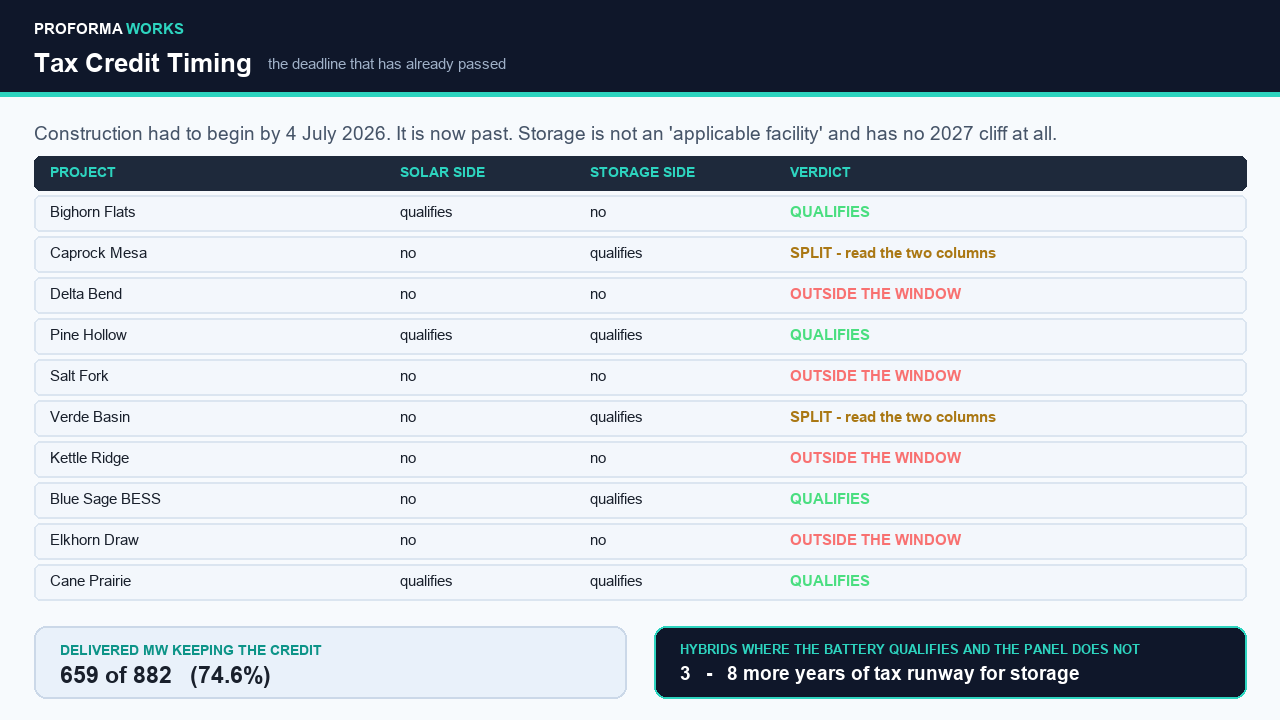
THE TAX DEADLINE HAS ALREADY PASSED. A wind or solar facility loses the clean electricity credits if placed in service after 31 December 2027, unless construction began on or before 4 July 2026. The model prices the two populations apart, project by project, and separates solar megawatts from storage megawatts inside the same hybrid, because storage is not an applicable facility and has no 2027 cliff: the battery has roughly eight more years of tax runway than the panel beside it.

THE QUEUE IS NINE MARKETS, NOT ONE. Cash at the interconnection request runs from 17,000 dollars in ERCOT to 2,027,600 in MISO for the same 200 megawatt project, a factor of 119. Conditional completion runs from 36.6 percent in ERCOT to 13.5 percent in CAISO. Readiness deposits are cumulative rather than additive, and adding them overstates the cash need by about 1.75 times. The network upgrade cost is a distribution that is explicitly not normal: in PJM, 30 percent of completed projects came in under 5 dollars per kilowatt and one came in at 3,728.

VALIDATION YOU CAN CHECK RATHER THAN TRUST. The survival arithmetic is run against Lawrence Berkeley National Laboratory's own published figures on a dedicated sheet, and reproduces the percentages the laboratory prints. Seventeen logic proofs compute live from your inputs; sixteen must pass and one is designed to fail, because the published median durations do not add up and a model that adds them is wrong by fifteen months.

WHAT IT REFUSES TO TELL YOU: a standard probability of success by stage (no standard exists, and the most cited source on pipeline diligence says so itself); a market price per watt for pipeline (the market says of itself that there is not a value mark); whether a project validly began construction (a tax position resting on guidance a federal court vacated in June 2026, so you get a three-state switch and the answer under each); and a development hurdle rate, because none is published anywhere verifiable.

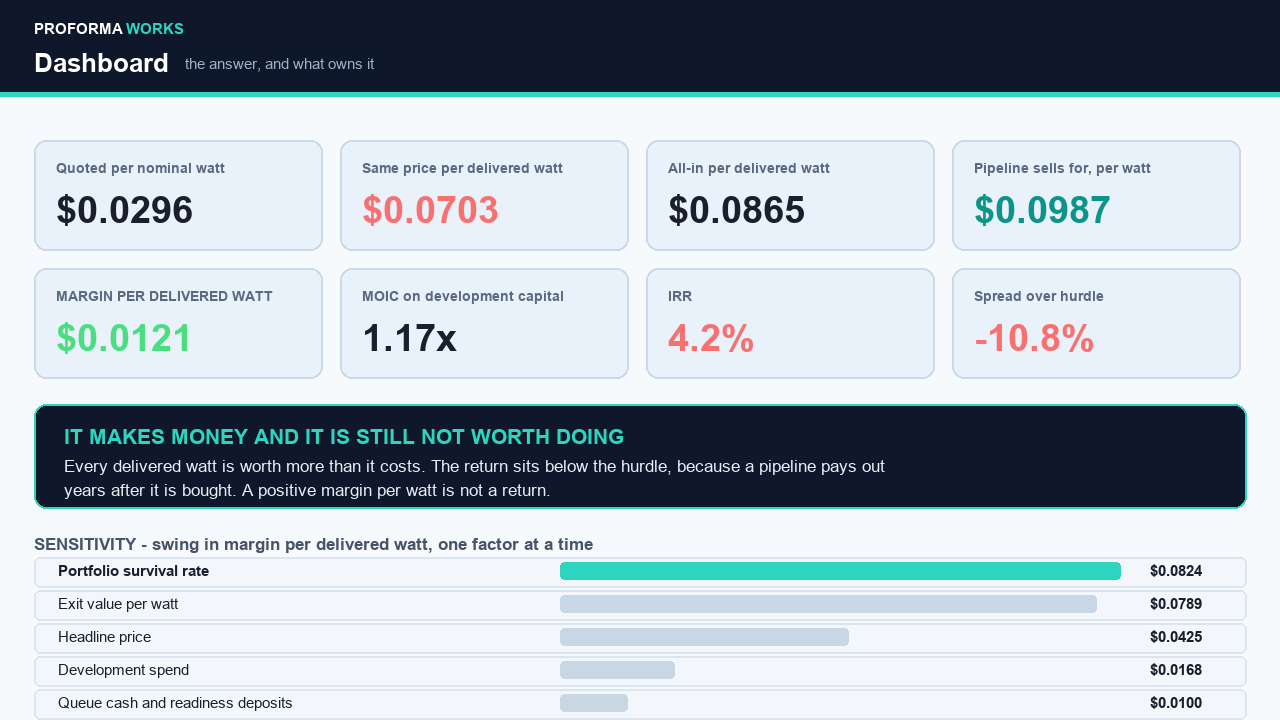
The default case is deliberately marginal: the margin per delivered watt is positive and the internal rate of return is below the hurdle. The deal makes money and is still not worth doing, because a pipeline pays out years after it is bought.
Fifteen sheets, 828 formulas. Excel and Google Sheets, no macros, no external links. Includes a 10-page guide with every source named in full. Educational underwriting tool, not financial, investment, tax or legal advice.

This Best Practice includes
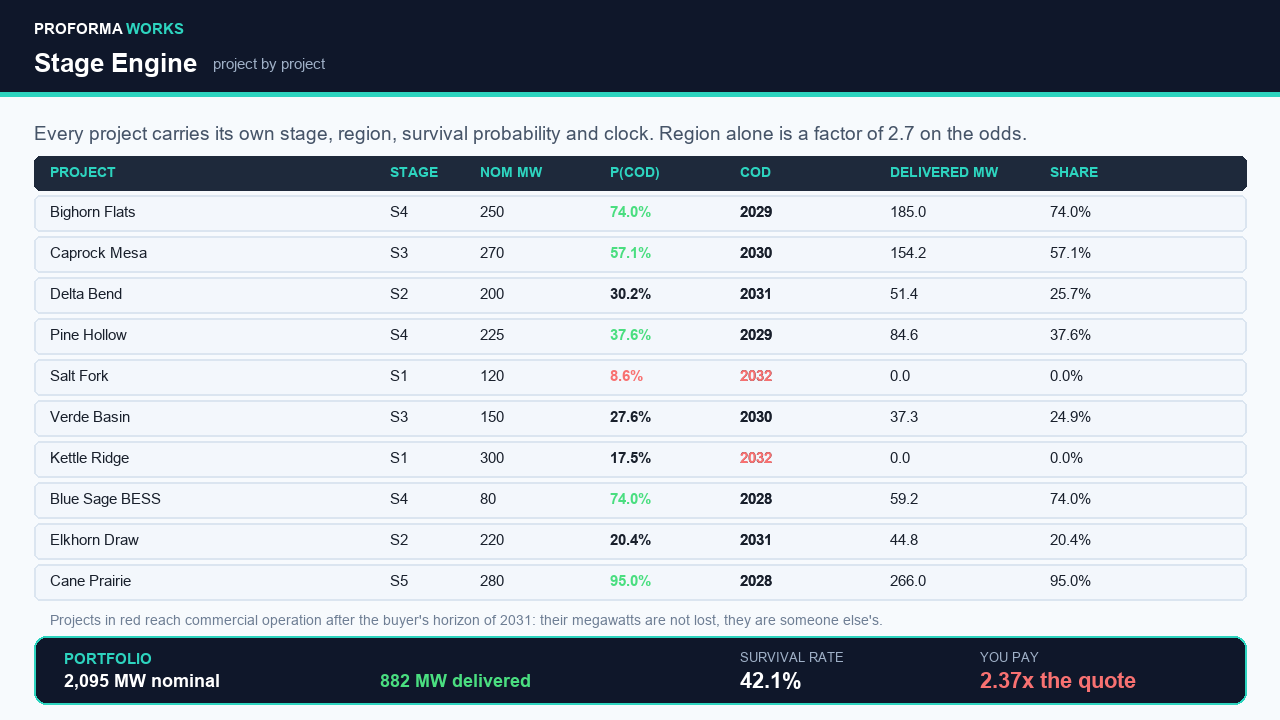
START HERE - what the model answers and what it refuses to claimInputs - Pipeline - the seller's project list: capacity, stage, region, COD, declared construction startInputs - Deal - price, milestone schedule, earnout, capacity true-up, horizonInputs - Assumptions - stage probabilities, region table, network upgrade distribution, exit value, all with sourcesStage Engine - risk-adjusted megawatts project by project, with the bridge identity checked per rowInterconnection - cash at the request by ISO, readiness deposits, network upgrade exposureTax Credit Timing - the 4 July 2026 split, the three-state switch, solar and storage tested separatelyDevelopment Spend - what it costs to carry the pipeline, on the correct cost baseValuation - the megawatt bridge, the dollars-per-watt bridge, and the published reference pointsDeal & Milestones - what each tranche is worth at the odds of reaching itReturns - IRR, MOIC, NPV on development capitalDashboard - the signature number and sixteen indicatorsSensitivity - one factor at a time on margin per delivered watt, rankedLogic Proofs - seventeen identities computed liveLBNL Validation - the survival engine run on the laboratory's own published figures

Acquire business license for $119.00

Add to cart

Add to bookmarks

Discuss

Further information

Decide what to pay for a solar or storage development pipeline, by converting the seller’s nameplate megawatts into the megawatts you will actually own and the dollars per watt you are actually paying for them.

You are acquiring a development platform or a portfolio of projects, or selling one and want to see the buyer’s arithmetic before they show it to you.

You are forecasting a single project you are building yourself: this is a buy-side portfolio tool, not a project pro forma, and it does not model construction or operations.


0.0 / 5 (0 votes)

please wait...