Publication number: ELQ-18713-1
View all versions & Certificate

Startup AI Data Center Financial Model with 10-Year Forecast, DCF Valuation & Investor Returns
Revenue depends on capacity utilization, tenant acquisition, colocation pricing, deployed MW, GPU compute demand, power costs, infrastructure investment.
Startup AI Data Center Financial Model with 10-Year Forecast, DCF Valuation & Investor Returns
Building an AI data center without a serious financial model is like committing millions of dollars to power, cooling, servers, and infrastructure without knowing whether the economics will actually work.
The AI infrastructure boom creates enormous opportunities, but data center businesses are brutally capital-intensive. Revenue depends on capacity utilization, tenant acquisition, colocation pricing, deployed MW, GPU compute demand, power costs, infrastructure investment, and operating efficiency. A small mistake in any of these assumptions can create a massive difference in cash flow and valuation.
This isn't a basic revenue-and-expense spreadsheet.
It's a comprehensive AI Data Center Financial Model, 10-Year Forecast, DCF Valuation, Scenario Analysis, Investor Returns, and IPO Planning tool designed to help founders, infrastructure investors, analysts, and entrepreneurs evaluate an AI/data center business before committing real capital.
Model capacity. Model tenants. Model revenue. Model capex. Model financing. Model valuation. Model investor returns.See the economics before you build the infrastructure.
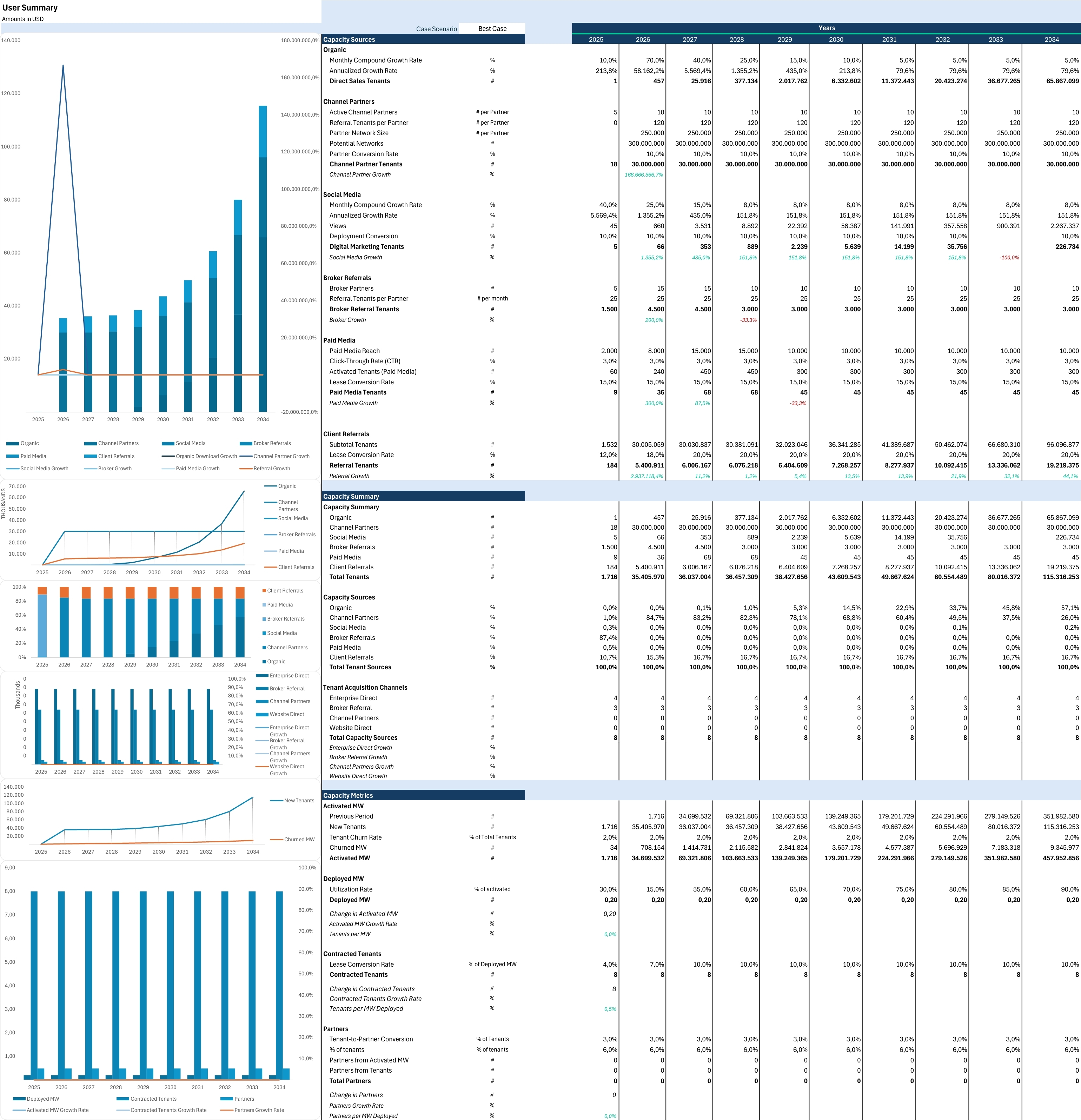
Why This Model Is a Game-Changer for AI Data Center Founders & Investors?+ Capacity & Utilization Drive EverythingData center economics don't work like a typical SaaS business. Installed MW, deployed MW, utilization, lease conversion, tenant acquisition, and uptime directly influence the revenue potential of the facility.
This model allows you to separately model:
- Installed data center capacity
- Deployed MW
- Target utilization
- Lease conversion
- Tenant acquisition
- Uptime
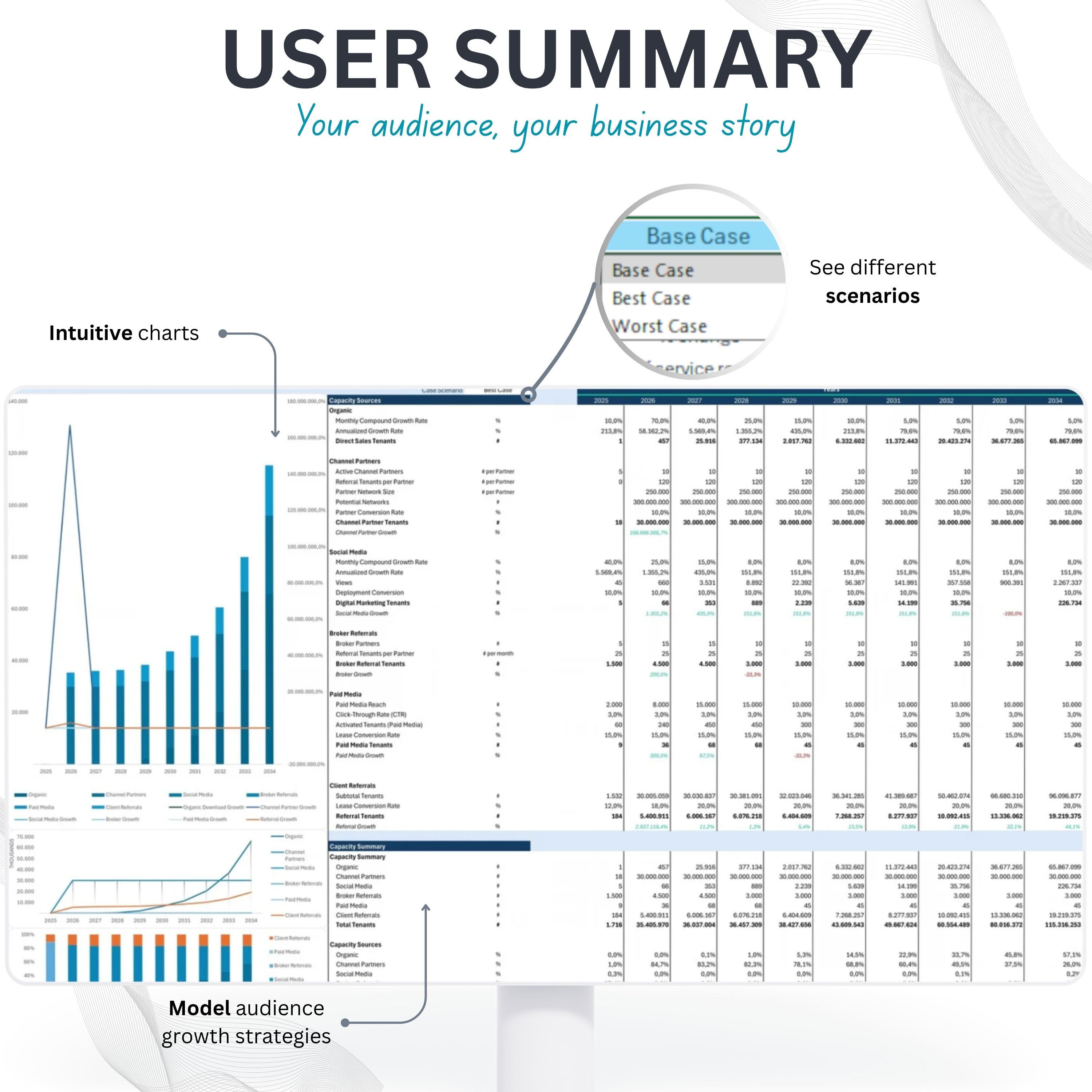
- Capacity sources
- Partner and broker channels
- Demand growth
Instead of simply applying a generic revenue growth percentage, you can build the operational drivers behind the revenue.
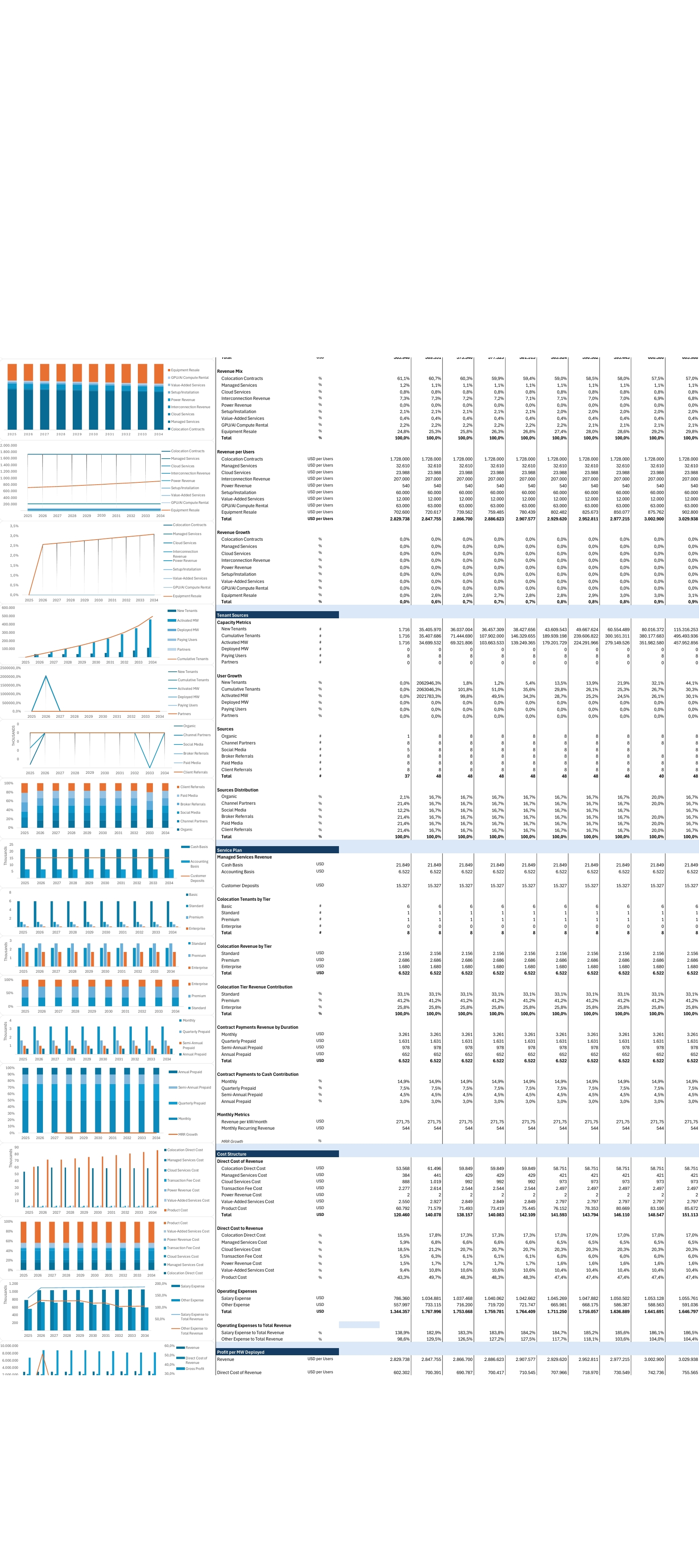
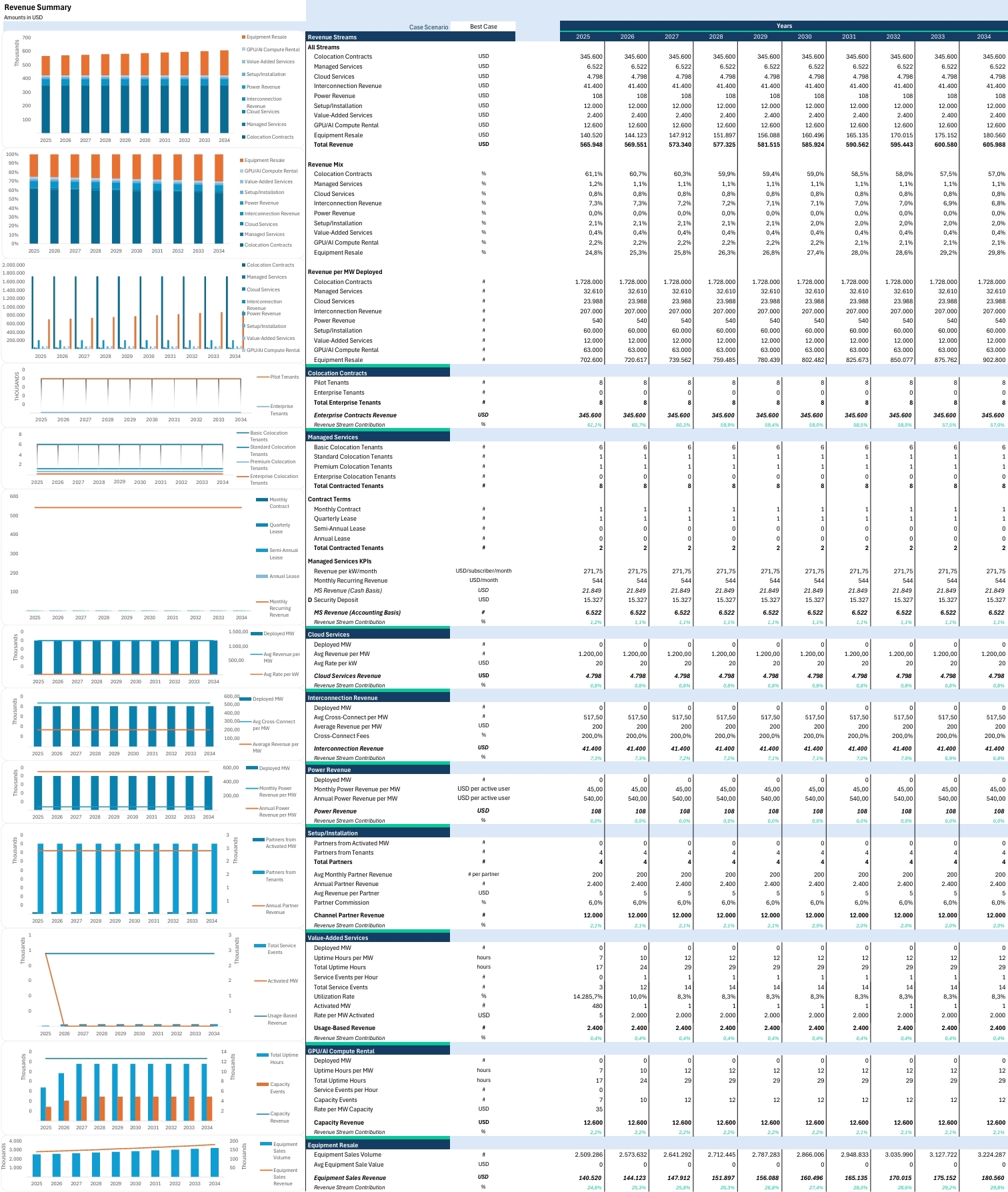
+ Multiple Data Center Revenue Streams
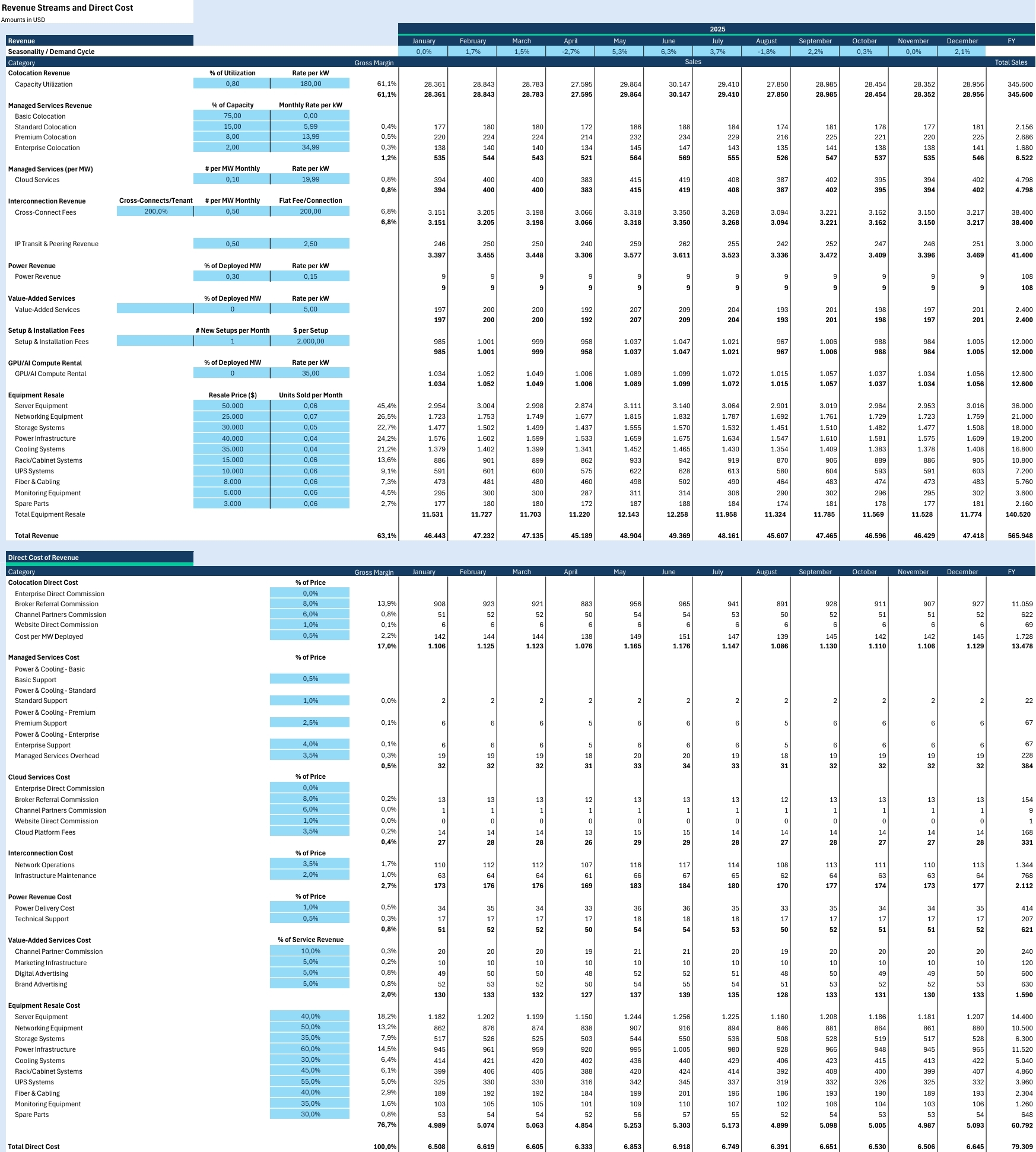
A modern AI data center can generate revenue from far more than basic rack space. This model allows you to model multiple revenue streams, including:
- Colocation contracts
- Basic, Standard, Premium, and Enterprise colocation
- Managed services
- Cloud services
- Interconnection revenue
- Cross-connects
- IP transit & peering
- Power revenue
- Setup / installation revenue
- Value-added services
- GPU / AI compute rental
- Equipment resale
This gives you a much clearer picture of where revenue actually comes from and how each business line contributes to total sales and gross margin.
+ AI Compute & GPU Revenue Modeling
AI infrastructure increasingly depends on high-density compute rather than traditional server hosting alone. The model includes a dedicated GPU / AI Compute Rental revenue stream, allowing you to model AI compute economics alongside conventional colocation and infrastructure revenue.
This makes the template particularly useful for businesses combining:
Data Center + Colocation + AI Compute + Infrastructure Services
+ Capital-Intensive Infrastructure Modeling
Data centers require substantial upfront investment in infrastructure. The model includes an Assets Register with depreciation tracking for infrastructure and equipment, including categories such as:
- Land & buildings
- Leasehold improvements
- Server equipment
- Power infrastructure
- Rack / cabinet systems
- Office and IT equipment
- Other tangible assets
You can define purchase year, useful life, purchase price, salvage value, and depreciation methodology.
This allows capital expenditures to flow properly into depreciation and the financial statements.
+ Power & Infrastructure Economics
Power is one of the most important cost drivers in data center economics. The model allows you to incorporate assumptions such as:
- Power cost per kWh
- Power revenue
- Power delivery costs
- Power & cooling costs
- Maintenance costs
- Infrastructure investment
- Capacity deployment
This helps you understand how energy economics affect margins and ultimately valuation.
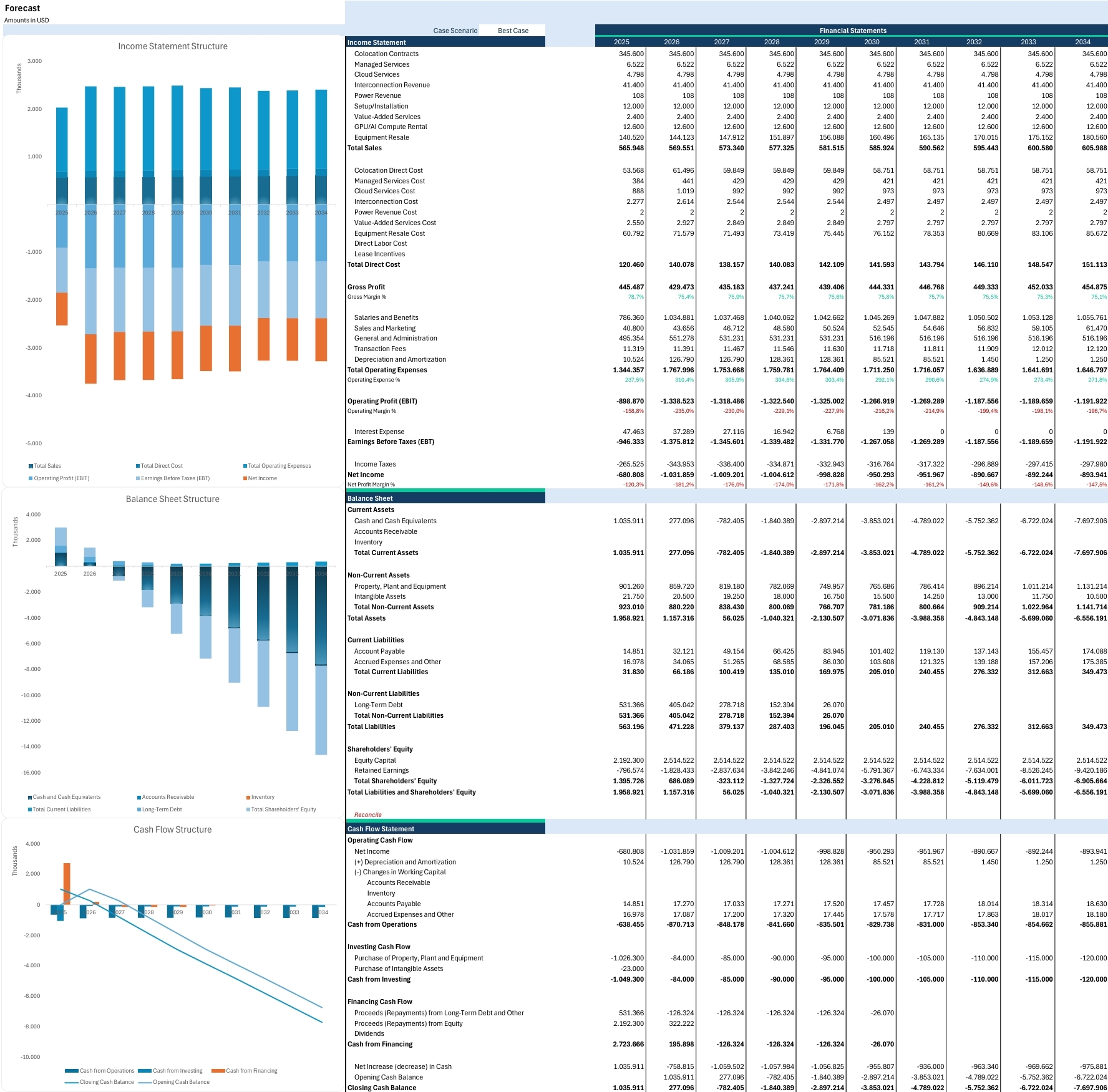
+ Full 10-Year Financial Forecast
Most financial templates provide a simple five-year projection. This model provides up to 10 years of financial projections, allowing you to analyze the transition from initial infrastructure investment to a more mature data center operation.
You can analyze:
- Revenue
- Direct costs
- Gross profit
- Operating expenses
- EBITDA
- EBIT
- Net income
- Assets
- Liabilities
- Equity
- Cash flow
- Capital expenditures
- Financing
+ Detailed 12-Month Monthly Forecast
Long-term projections are useful, but the first year is where operational assumptions can become reality. The model includes a detailed 12-month financial projection, allowing you to examine monthly:
- Revenue
- Direct costs
- Operating expenses
- Profitability
- Cash flow
- Investing activities
- Financing activities
This gives you both the monthly operating picture and the 10-year strategic picture.
+ Base, Best & Worst Case Scenario Analysis
AI infrastructure demand is difficult to predict.
What happens if tenant acquisition is slower?
What if utilization is lower?
What if revenue grows faster?
What if direct costs increase?
What if capital expenditure requirements are higher?
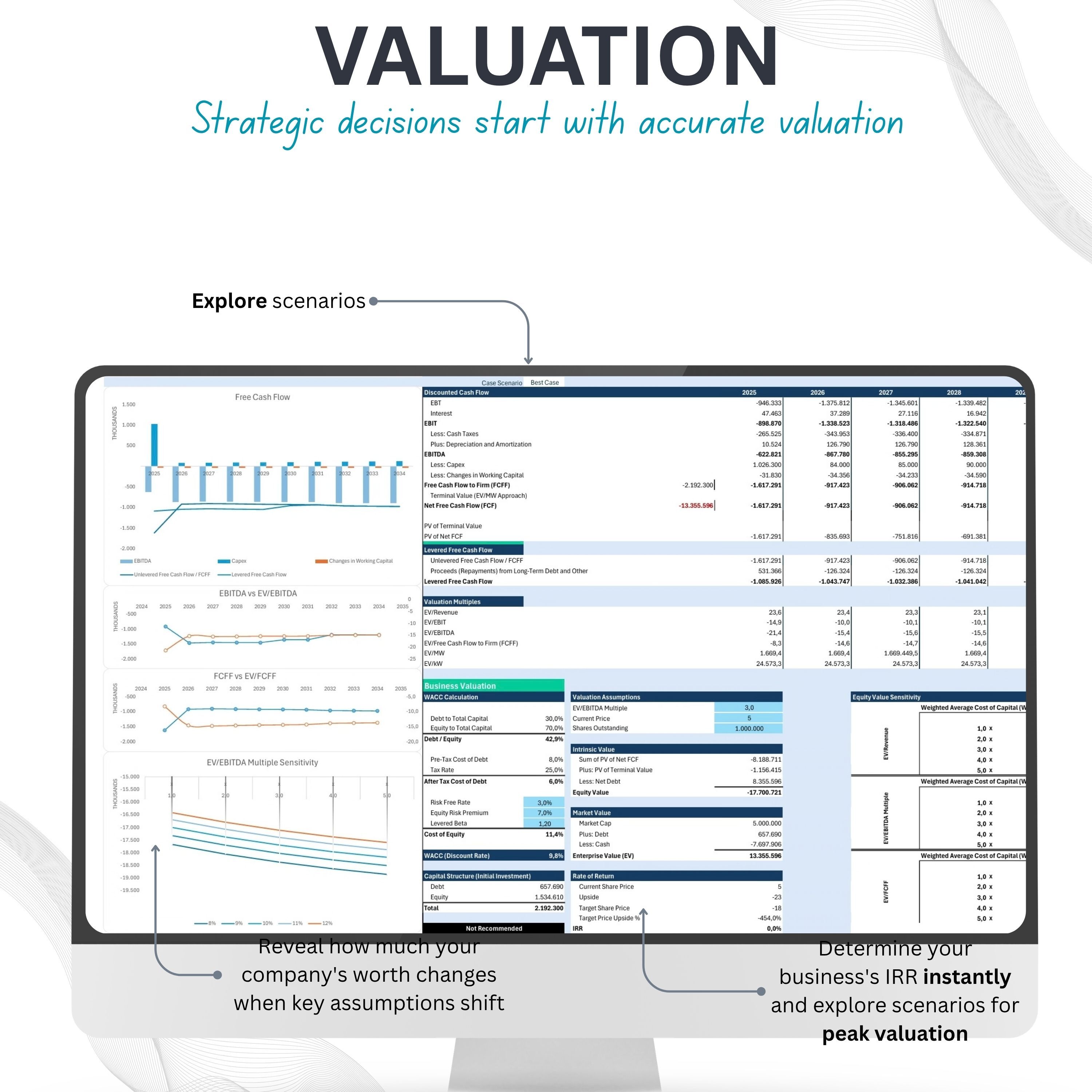
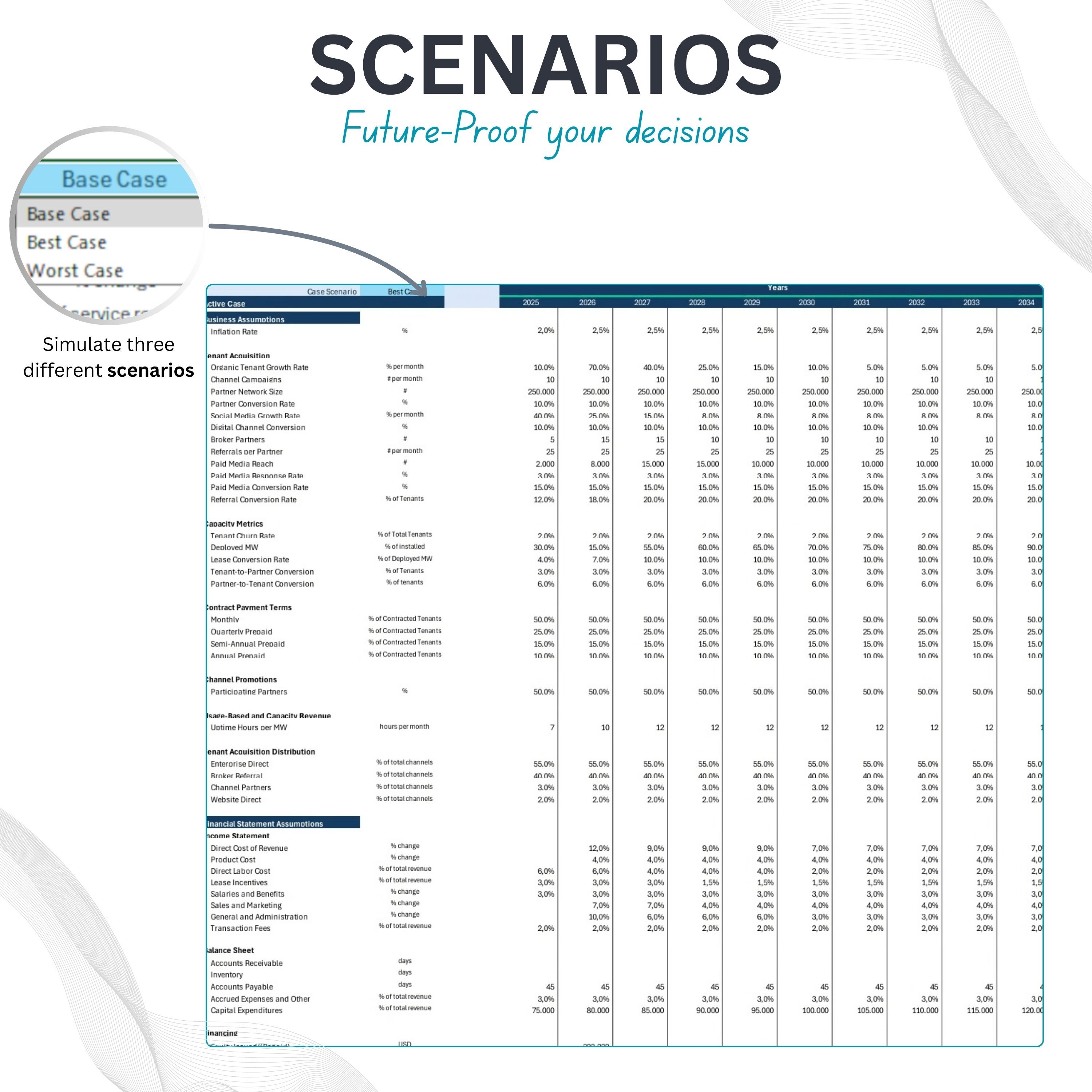
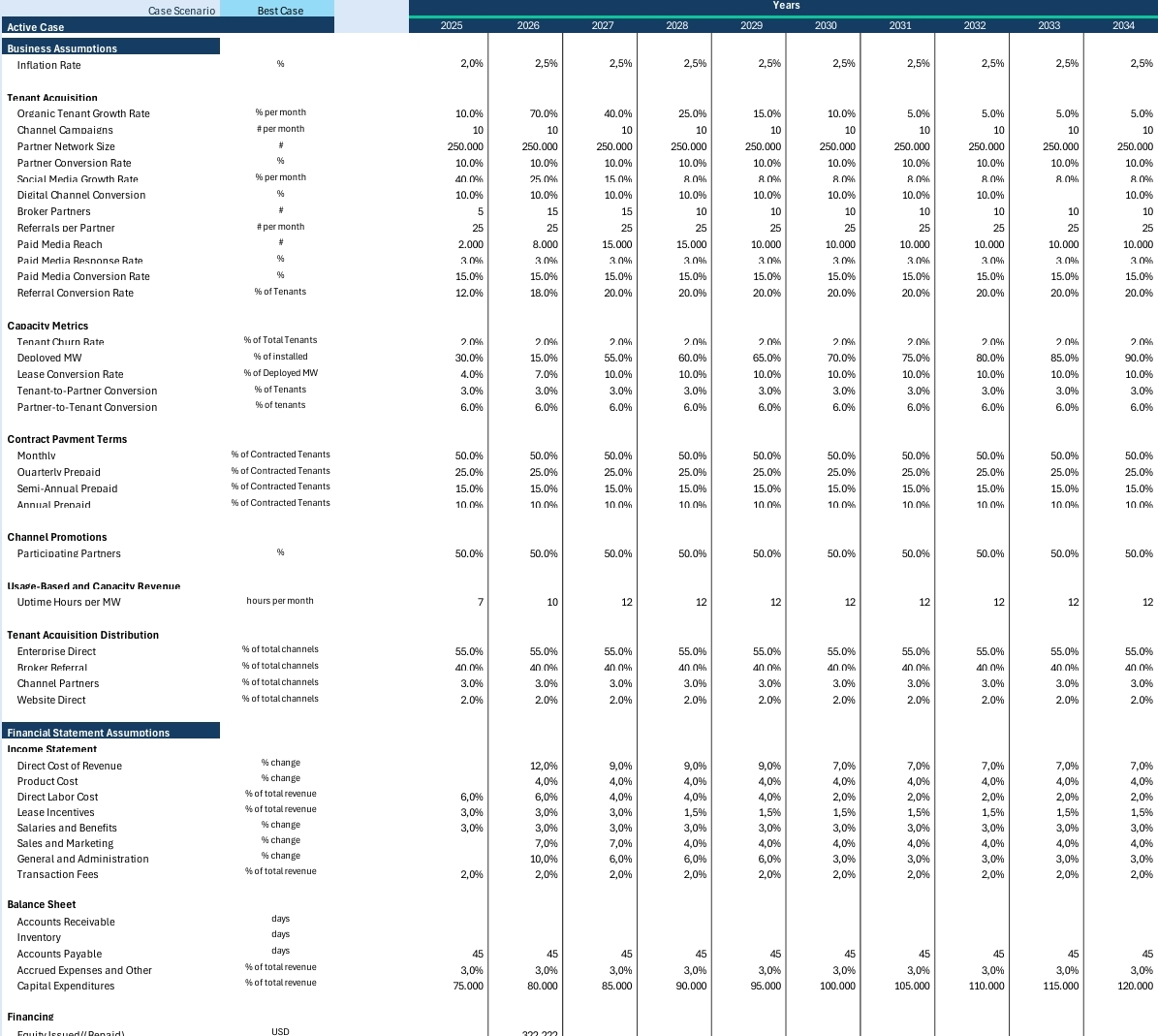
The Business Scenario tab lets you build and compare:
- Base Case
- Best Case
- Worst Case
Scenarios can incorporate assumptions for:
- Inflation
- Tenant growth
- Channel campaigns
- Partner networks
- Conversion rates
- Social media growth
- Broker partners
- Deployed MW
- Lease conversion
- Uptime
- Revenue growth
- Direct costs
- Labor costs
- Lease incentives
- Transaction fees
- Operating expenses
- Capital expenditures
Instead of relying on one forecast, you can see how the business behaves under different operating conditions.
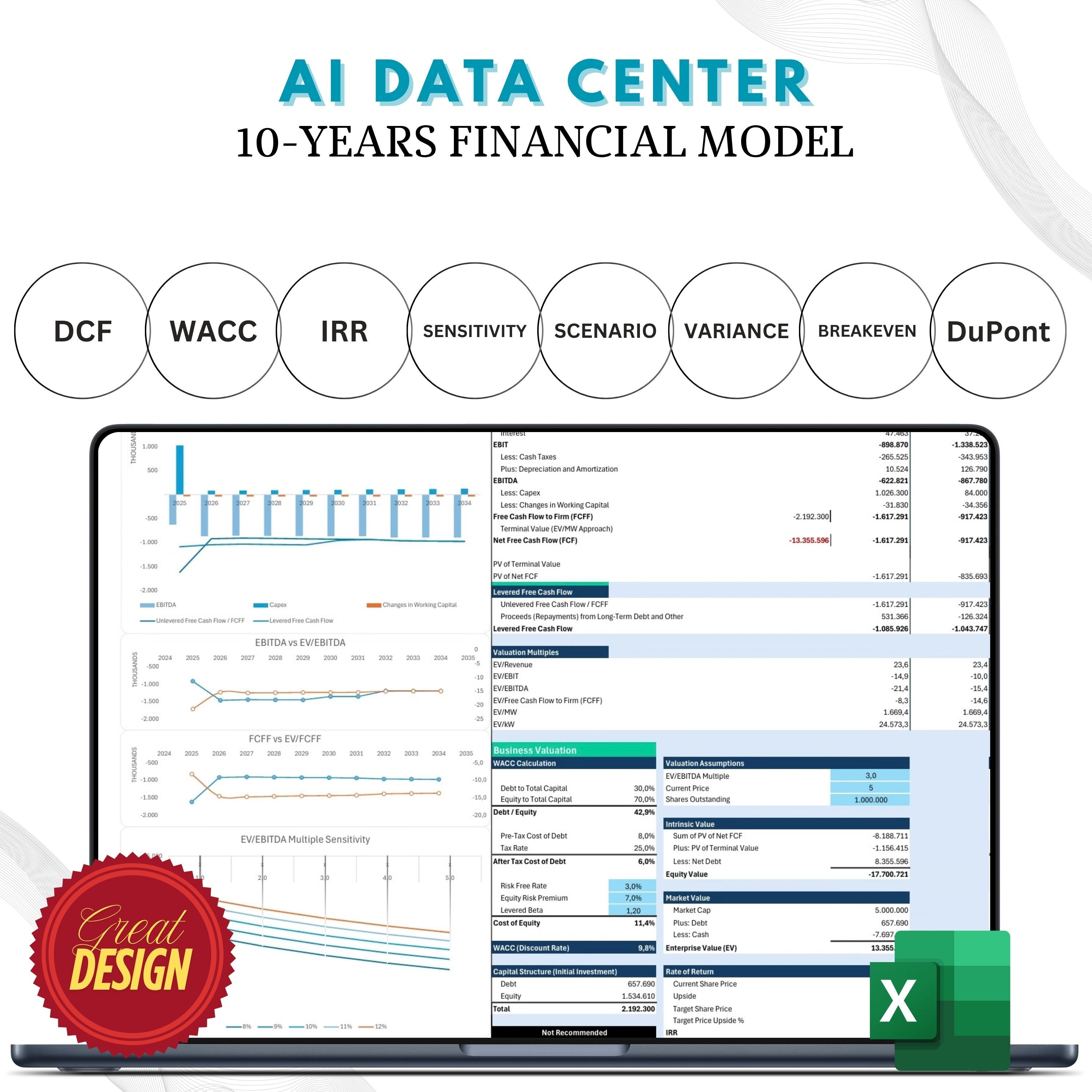
+ DCF Business Valuation
A financial projection is only half the story. The model includes a dedicated Business Valuation module using Discounted Cash Flow methodology.
It incorporates:
- EBIT
- EBITDA
- Capital expenditure
- Working capital changes
- Free Cash Flow to Firm
- Free Cash Flow
- Terminal Value
- Present Value
- Enterprise Value
- Equity Value
- WACC
- Valuation multiples
The valuation module also includes alternative approaches such as:
- EV / Revenue
- EV / EBITDA
- EV / MW
This allows you to connect operational assumptions directly to business valuation.
+ WACC & Capital Structure Analysis
The model doesn't treat valuation as an arbitrary multiple. It includes a dedicated WACC calculation incorporating:
- Tax rate
- Debt
- Equity
- Cost of capital
- Capital structure
- Discount rateThis gives you a more defensible framework for DCF valuation and investment analysis.
+ Financing & Debt Modeling
Data center projects frequently require significant external financing. The Setup module allows you to model financing assumptions, including:
- Loan-to-initial-investment ratio
- Annual interest rate- Loan term
- Interest-only period
- Loan amount
- Annual debt payment
- APR
This allows debt financing to flow into the broader financial model rather than being treated as a separate calculation.
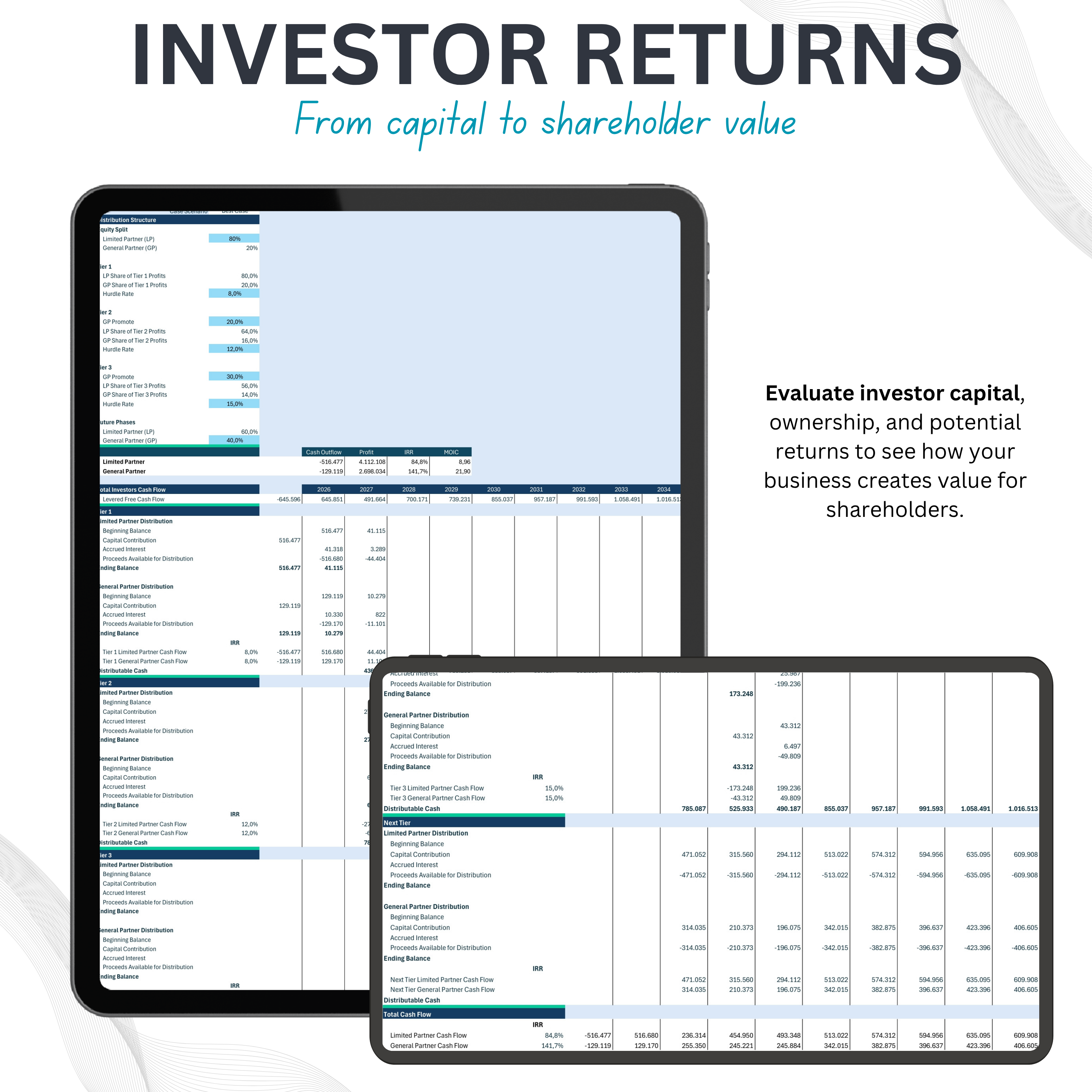
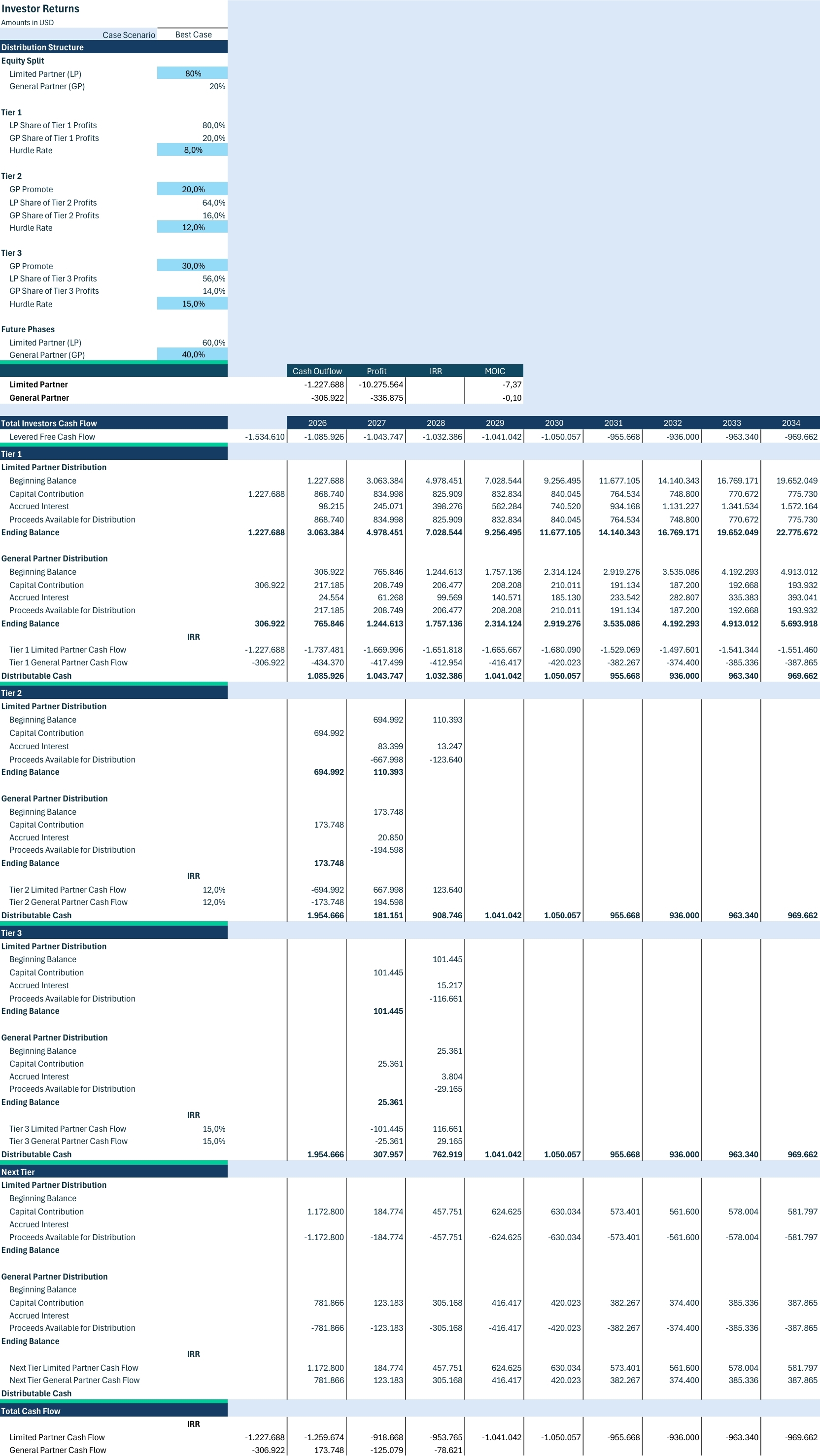
+ Investor Returns & Distribution Waterfall
For investors, project economics don't stop at enterprise value. The model includes a dedicated Investor Returns module with a distribution structure that can model:
- Limited Partner (LP)
- General Partner (GP)
- Equity split
- Tier 1 distributions
- Hurdle rate
- Tier 2 distributions
- GP promote
- Investor cash flows
This makes the model useful not only for operating-company analysis but also for infrastructure investment and sponsor/LP structures
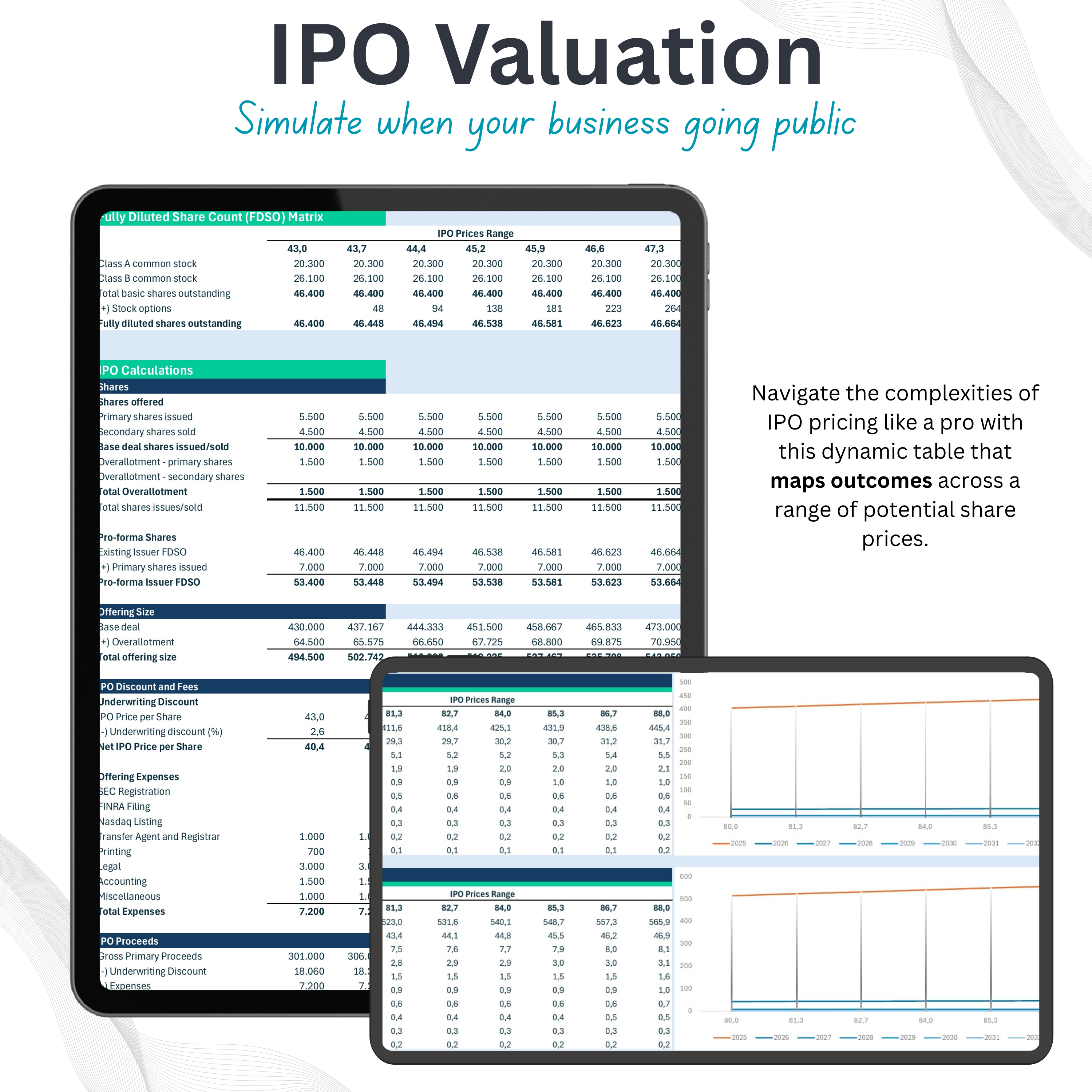
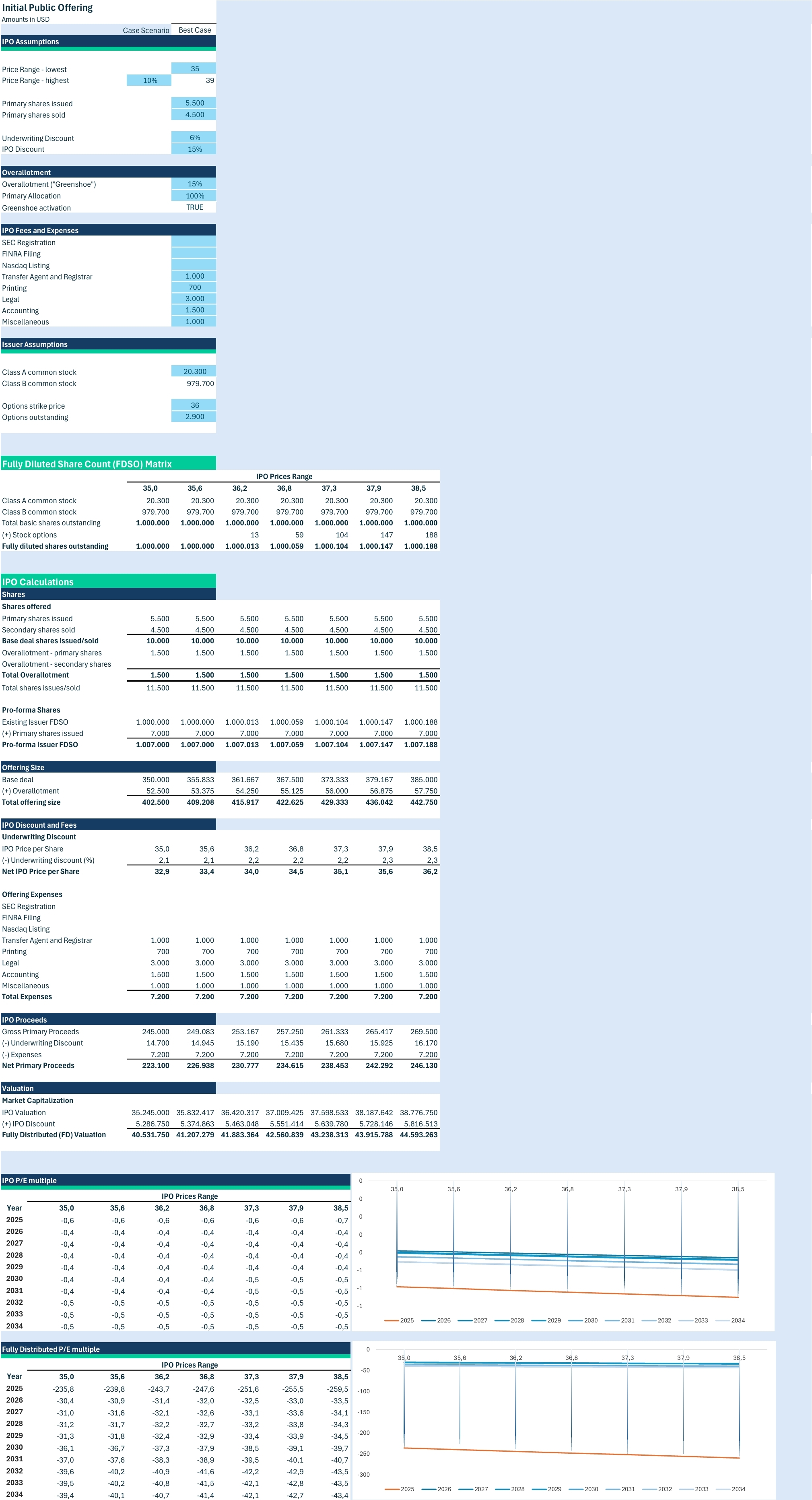
.+ IPO Planning & Valuation
The model goes beyond traditional private-company valuation. A dedicated IPO module allows you to explore a potential public offering, including:
- IPO price range
- Primary shares issued
- Primary shares sold
- Underwriting discount
- IPO discount
- Overallotment
- IPO fees and expenses
- Net IPO price per share
- IPO proceeds
- IPO valuation
- Fully distributed valuation
- IPO P/E multiple
- IPO price sensitivity
This can help founders and investors explore how the business could transition from private infrastructure investment toward a public-market scenario.
+ Real Financial Health Analysis
Revenue and EBITDA alone don't tell the whole story. The model includes dedicated analysis for:
- Profitability
- Financial ratios
- Liquidity
- Efficiency
- Leverage
- Return on equity
- DuPont analysis
- Breakeven
This gives you a much deeper understanding of financial performance than a standard P&L spreadsheet.
What's Inside This AI Data Center Financial Model?
+ 10-Year Financial Forecast
Project revenue, expenses, profitability, assets, liabilities, equity, and cash flow for up to 10 years.
+ Data Center Capacity Modeling
Model installed MW, deployed MW, utilization, lease conversion, and capacity growth.
+ Colocation Revenue Model
Model multiple colocation tiers and pricing structures based on capacity utilization and kW economics.
+ AI / GPU Compute Rental
Model revenue generated from GPU and AI compute infrastructure.
+ Managed & Cloud Services
Build additional recurring revenue streams alongside core colocation revenue.
+ Interconnection & Network Revenue
Model cross-connects, IP transit, peering, and other connectivity-related revenue.
+ Power Revenue
Model power-related revenue and delivery costs based on deployed capacity.
+ Equipment Resale
Include server equipment and infrastructure resale as an additional revenue channel.
+ Business Scenario Analysis
Compare Base, Best, and Worst Case operating assumptions.
+ 3-Statement Financial Model
Integrated Income Statement, Balance Sheet, and Cash Flow structure.
+ DCF Valuation
Calculate FCFF, FCF, terminal value, present value, enterprise value, and equity value.
+ WACC Calculation
Build a discount rate based on capital structure and financing assumptions.
+ Valuation Multiples
Analyze EV/Revenue, EV/EBITDA, and EV/MW.
+ Investor Returns
Model LP/GP structures, hurdle rates, promotes, and investor cash flows.
+ IPO Analysis
Model IPO pricing, shares issued, discounts, proceeds, valuation, and P/E analysis.
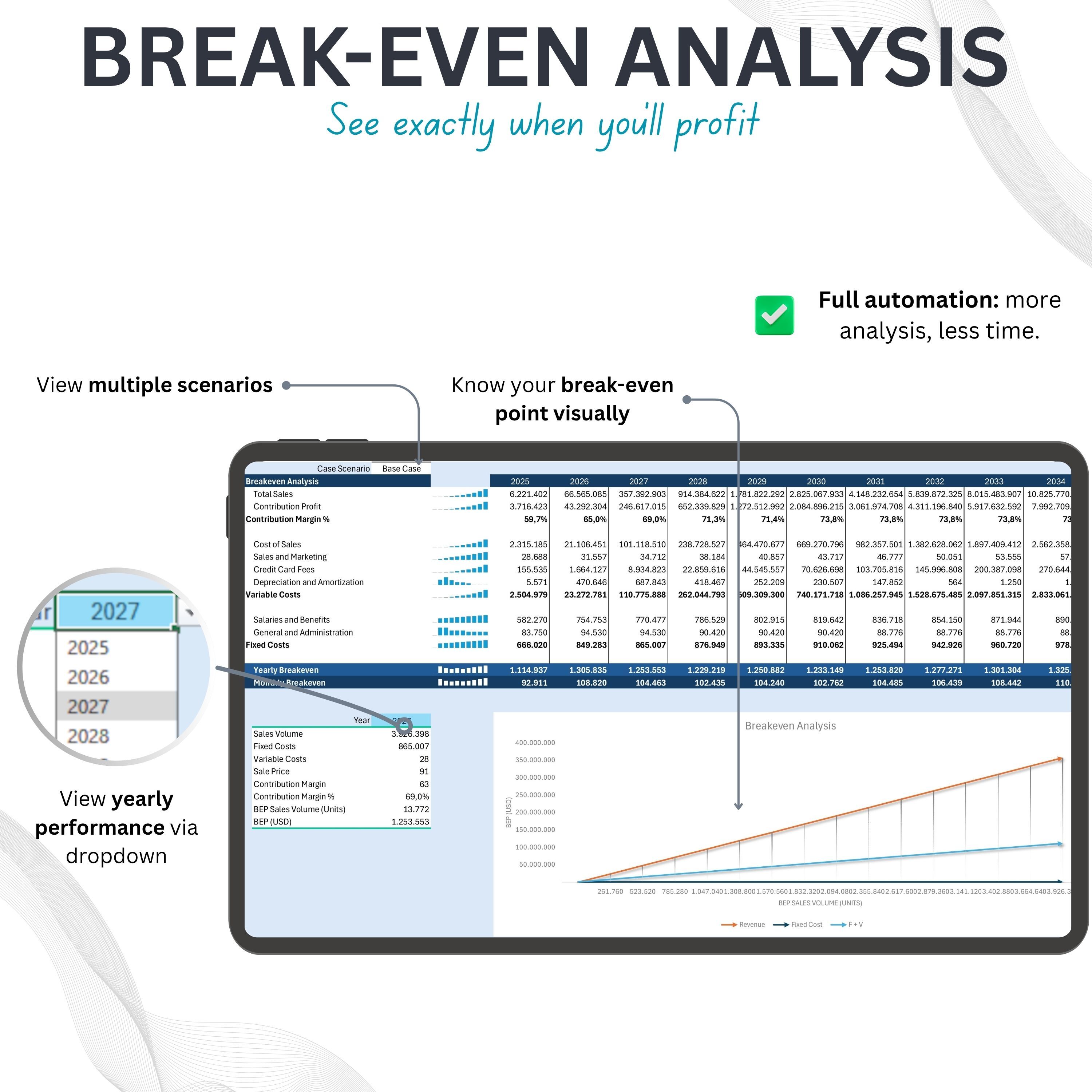
+ Breakeven Analysis
Determine the revenue required to cover fixed and variable costs.
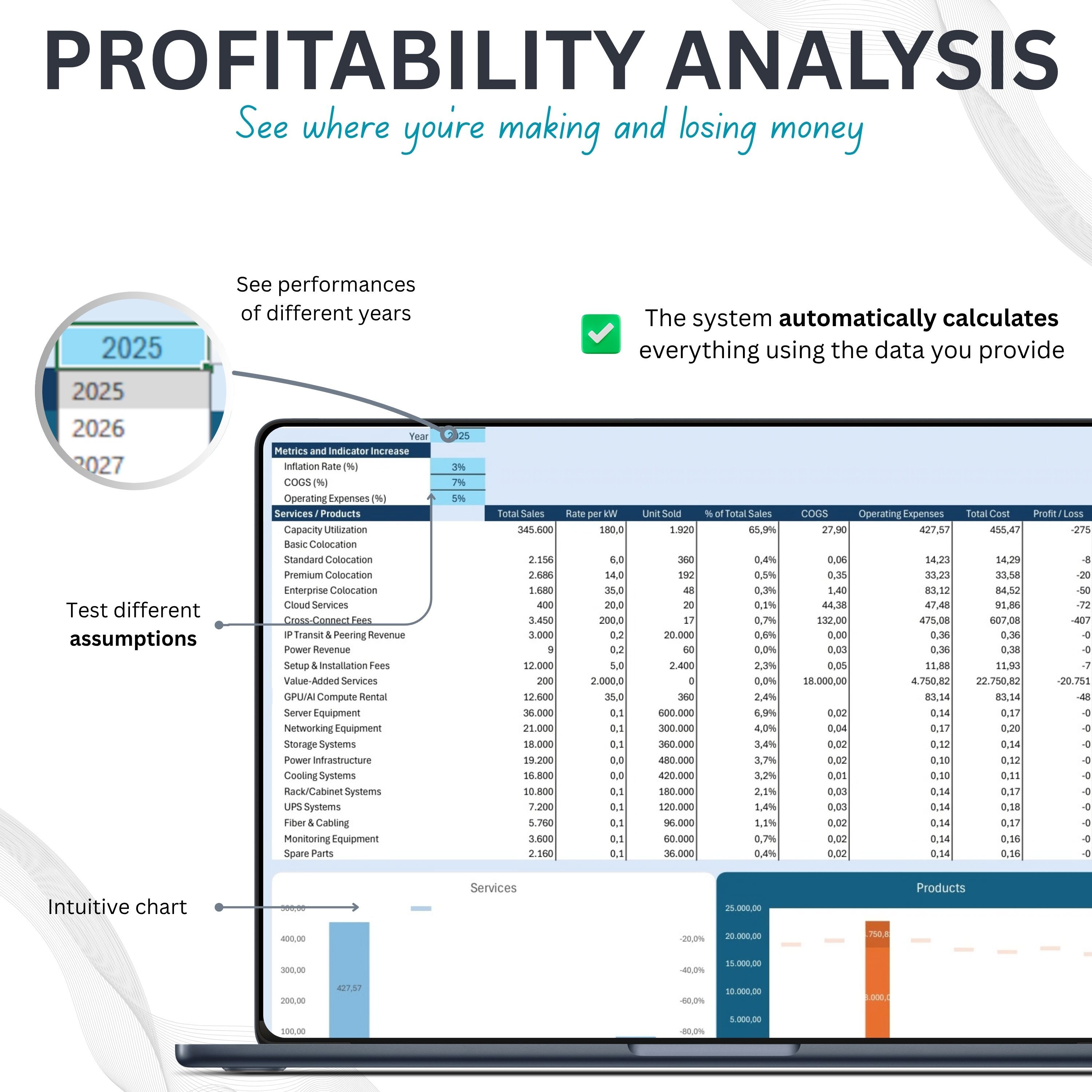
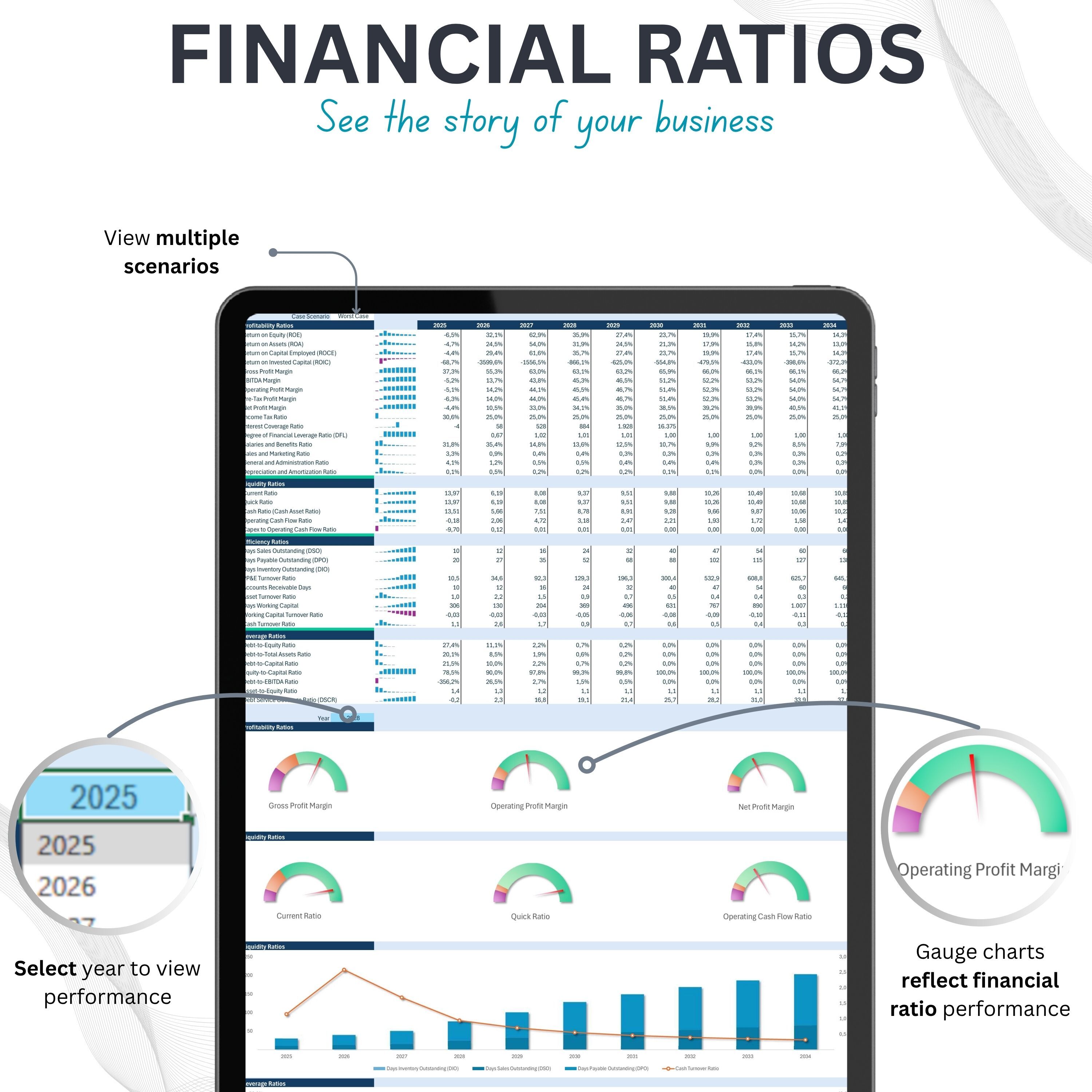
+ Profitability & Ratio Analysis
Analyze margins, returns, liquidity, leverage, and operating efficiency.
+ DuPont Analysis
Break down ROE into its underlying financial drivers.
+ Assets Register
Track infrastructure purchases, useful lives, salvage values, and depreciation.
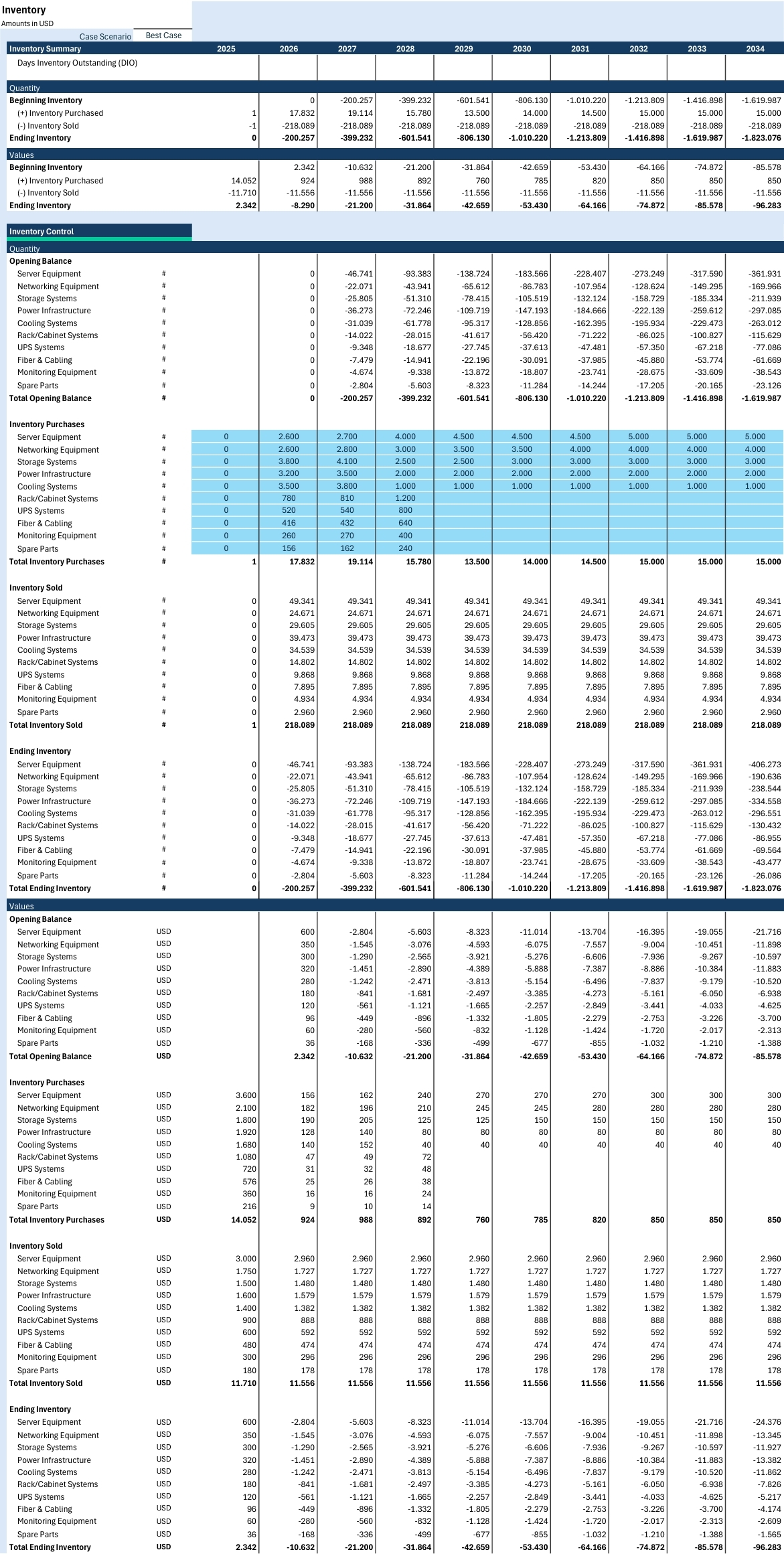
+ Inventory Control
Track inventory quantities and values.
+ Payroll Planning
Model employee counts, compensation, benefits, and staffing costs.
+ Operating Expense Planning
Build detailed operating expenses and their growth over time.
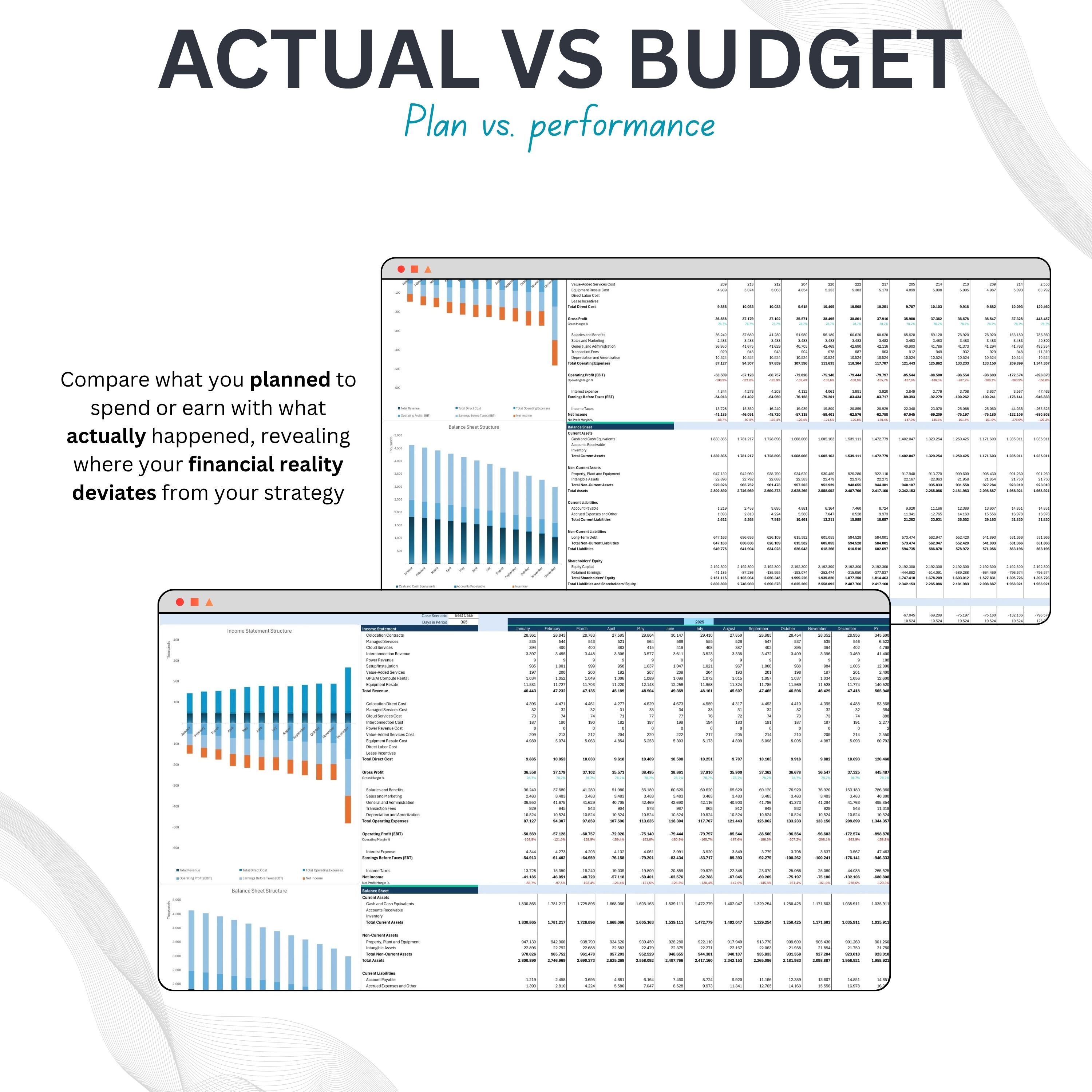
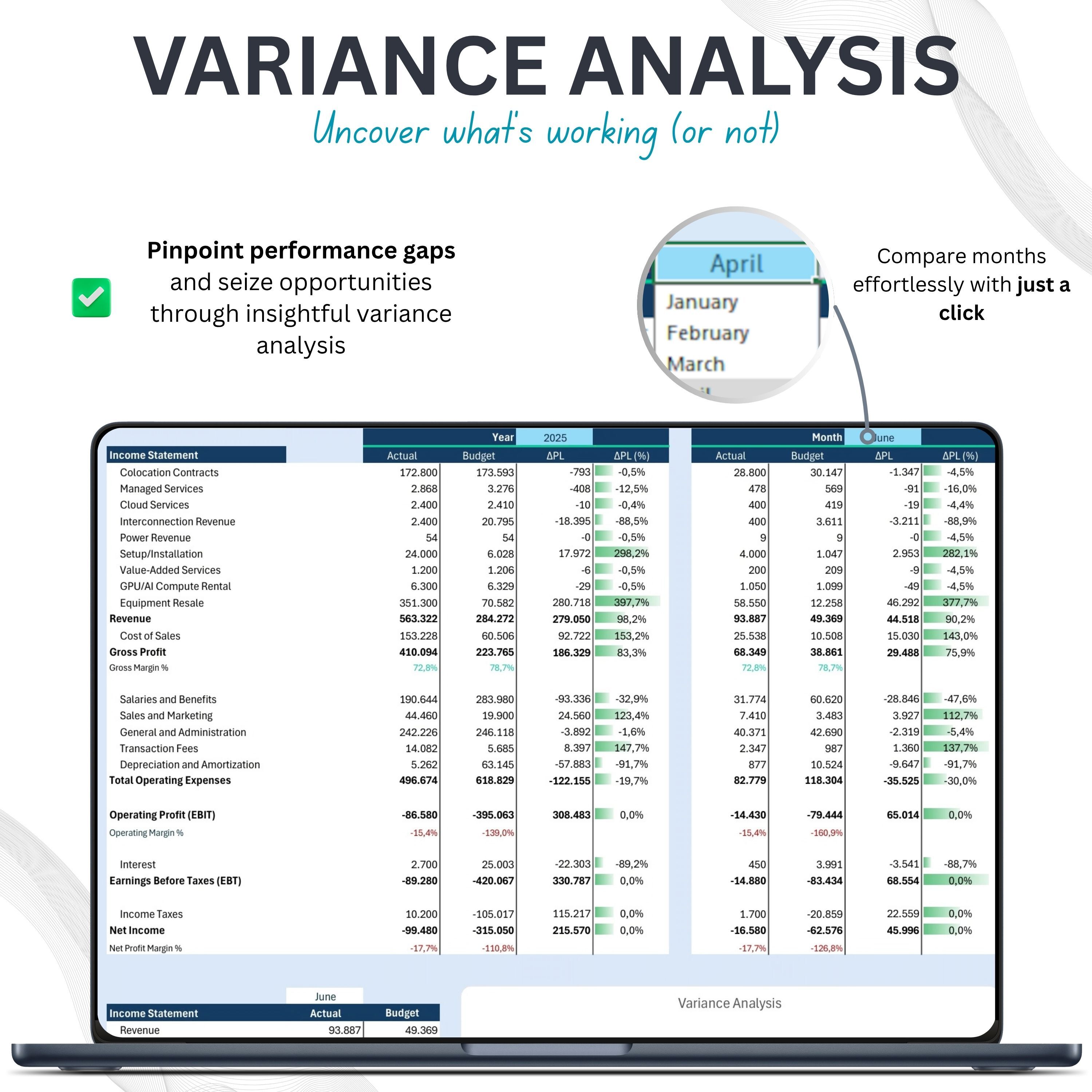
+ Actual vs. Forecast Variance
Compare actual financial performance against budget or forecast.
+ Monthly + Annual Forecasting
Get detailed first-year monthly projections plus the long-term annual forecast.
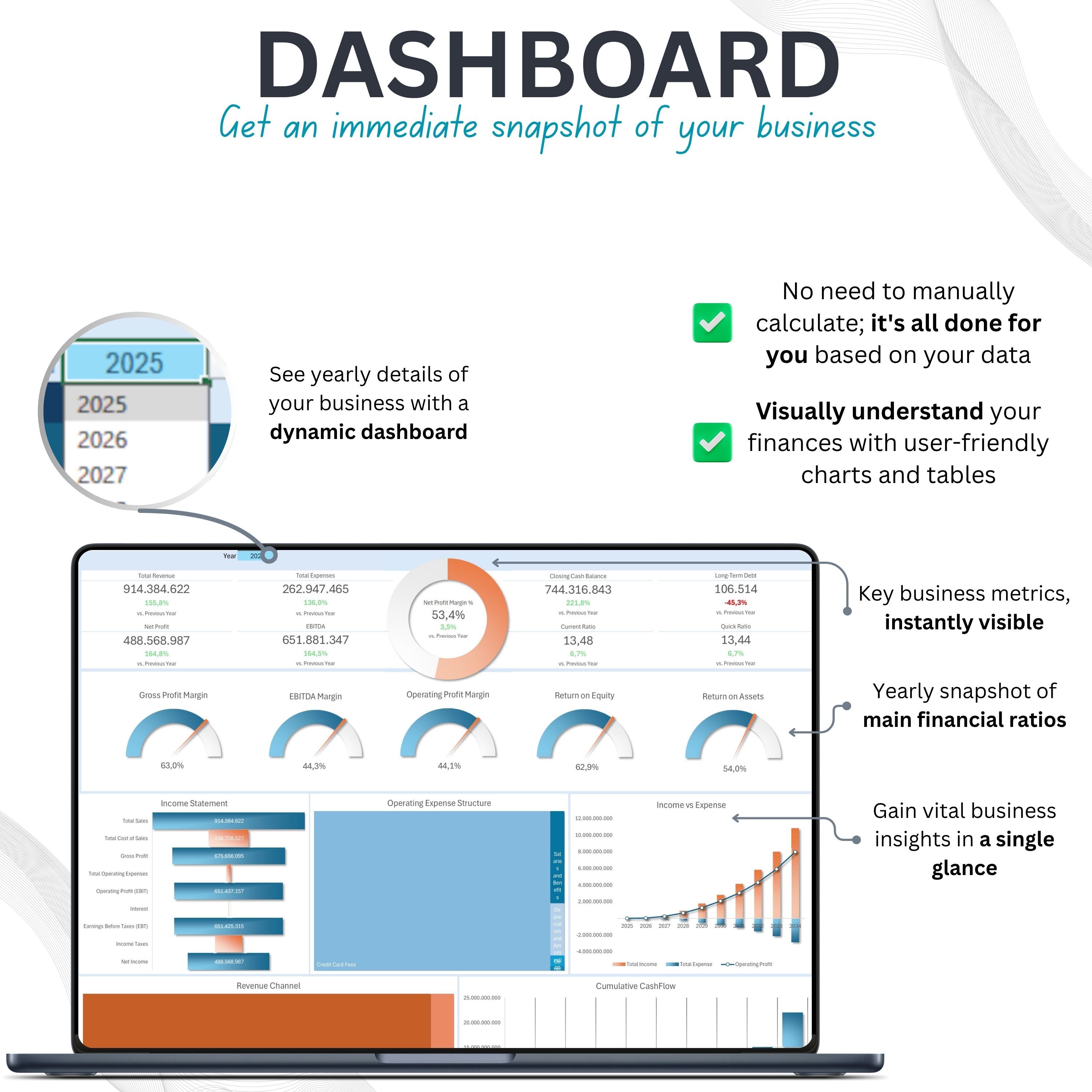
+ Executive Dashboard
Quickly review the most important financial and operating indicators.
Why It's the Best Deal?
Building a sophisticated AI data center financial model from scratch can take weeks and requires a strong understanding of financial modeling, infrastructure economics, valuation, and Excel.
Hiring a financial modeling consultant for a model with this breadth can cost thousands of dollars.
With this template, you can:
- Save Time: Start with an integrated financial model instead of a blank spreadsheet.
- Save Money: Avoid the cost of building the entire model from scratch.
- Model the Business: Connect MW capacity, utilization, tenants, pricing, power, costs, and capital investment.
- Stress-Test the Plan: Compare Base, Best, and Worst Case scenarios.
- Value the Business: Convert projected cash flows into a DCF-based enterprise and equity valuation.
- Prepare for Investors: Present structured financial projections and investor return analysis.
- Evaluate Financing: Model debt assumptions and their effect on cash flow.
- Plan for an IPO: Explore potential IPO pricing, proceeds, and valuation scenarios.
- Make Better Decisions: Understand the economics before committing capital to infrastructure.
- No Macros Required: Built with Excel formulas rather than VBA macros.
What You'll Get
File 1 (.xlsx): Startup AI Data Center Financial Model with 10-Year Forecast, DCF Valuation & Investor Returns
List of Tabs
- License: License and usage information
- Table of Contents: Model navigation and overview
- Setup: Core business, capacity, financing, and financial assumptions
- Executive Summary: High-level financial and operating overview
- User Summary: Capacity, demand, utilization, and operating metrics
- Revenue Summary: Revenue streams and key revenue drivers
- Valuation: DCF, WACC, valuation multiples, enterprise value, and equity value
- Dashboard: Visual financial and operating performance overview
- Business Scenario: Base, Best, and Worst Case assumptions
- Payroll: Staffing, salaries, benefits, and personnel costs
- Operating Expenses: Detailed operating expense planning
- Revenue: Detailed revenue streams, pricing, utilization, and direct costs
- Assets Register: Infrastructure assets, capex, useful life, and depreciation
- Inventory Control: Inventory quantity and value tracking
- Actual FS: Historical / actual financial statements
- Annual Forecast: Up to 10-year annual financial projections
- Monthly Forecast: Detailed 12-month financial projections
- Variance: Actual vs. budget / forecast analysis
- Breakeven: Revenue and cost breakeven analysis
- Profitability: Profitability and operating performance analysis
- Ratios: Comprehensive financial ratio analysis
- DuPont: ROE decomposition and performance analysis
- Investor Returns: LP/GP structure, distributions, and investor cash flows
- IPO: IPO pricing, proceeds, valuation, and public-market analysis
Who Is This Template For?
- AI data center founders
- Colocation business owners
- AI infrastructure entrepreneurs
- Data center developers
- Infrastructure investors
- Real estate investors
- Private equity professionals
- Financial analysts and consultants
- Investment banking / corporate finance professionals
- Business students and finance learners
- Entrepreneurs evaluating an AI infrastructure opportunity
- Investors assessing a data center fundraising opportunity
Whether you're evaluating your first AI data center, planning a colocation facility, adding GPU compute capacity, preparing a fundraising pitch, evaluating infrastructure financing, or exploring a future IPO, this model gives you a structured financial framework to work from.
Stop guessing. Start modeling.
Build the numbers before you build the data center.
This Best Practice includes
1 Excel file
Further information
A ready-to-use Excel template for building a comprehensive 10-year financial plan, forecasting, profitability analysis, breakeven analysis, and business valuation for an AI data center / colocation business. The model helps founders, operators, analysts, and investors test capacity, pricing, operating costs, staffing, capital expenditure, financing, and valuation assumptions before committing real capital.
- Early-stage or growing AI data center, colocation, or digital infrastructure businesses that need a structured 10-year financial forecasting and valuation framework without building a model from scratch.
- Founders, CFOs, financial analysts, or investors with basic-to-intermediate Excel and financial modeling literacy who want to adjust assumptions such as MW capacity, utilization, kW pricing, tenant growth, power costs, payroll, operating expenses, and capex.
- Businesses generating revenue from multiple data-center-related streams, including colocation, managed services, cloud services, interconnection, IP transit & peering, power, value-added services, setup fees, GPU/AI compute rental, and equipment resale.
- The business has a revenue structure fundamentally different from data center, colocation, cloud infrastructure, or AI compute services; a SaaS, retail, manufacturing, or conventional service-business model would require a different template.
- Users expect plug-and-play financial results without calibrating the assumptions. Capacity, utilization, pricing, power costs, tenant acquisition, payroll, capex, financing, and other operating assumptions must be adjusted to reflect the actual business.
- The business does not operate on a meaningful kW/MW capacity or infrastructure-based revenue model, since several forecasting and valuation calculations are designed around deployed capacity and data-center economics.