Last version published: 07/08/2026 12:34
Publication number: ELQ-46340-2
View all versions & Certificate

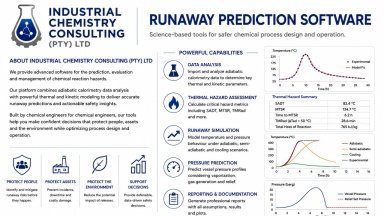
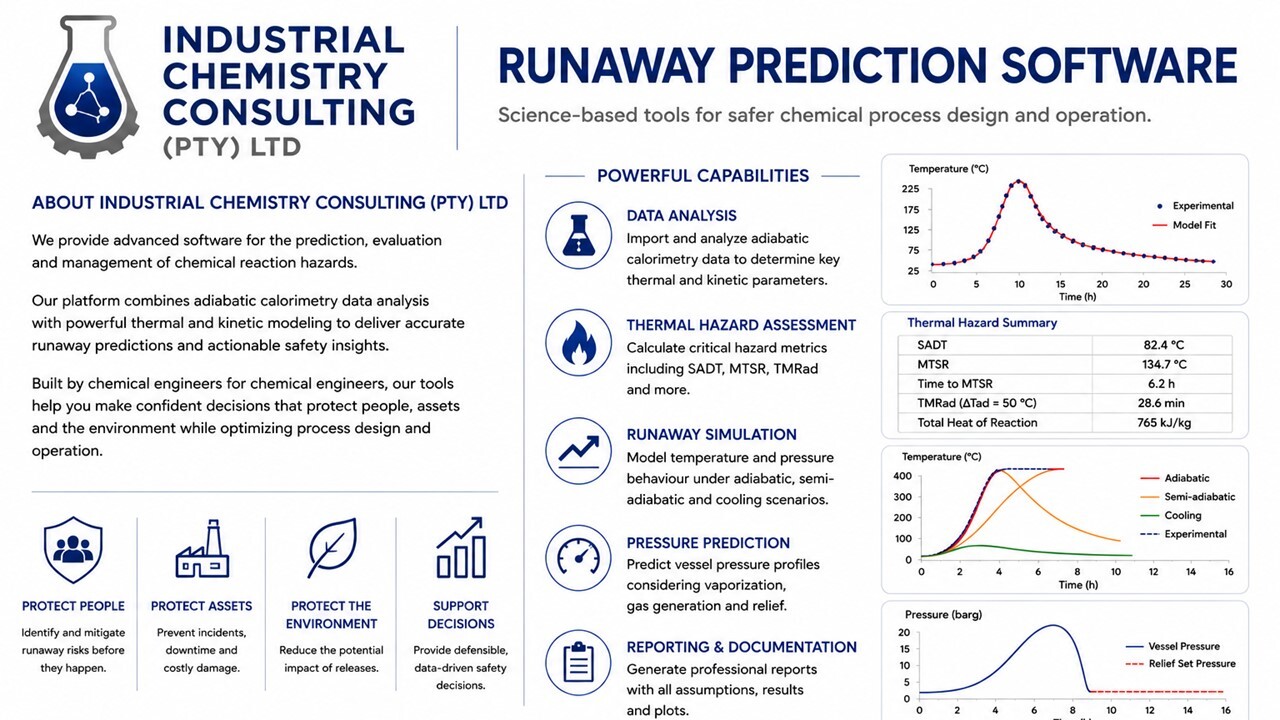
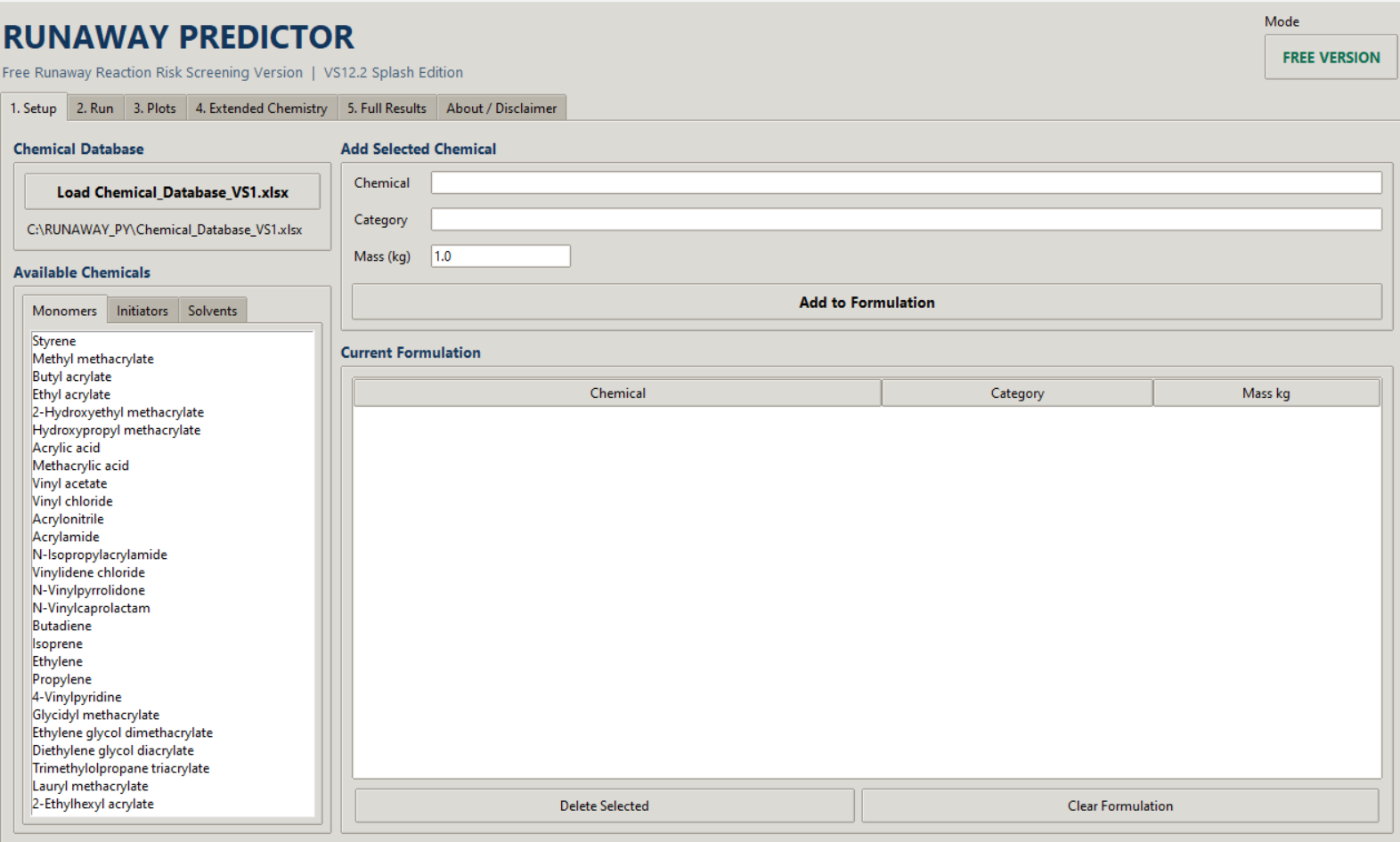
Runaway Reaction Risk Screening Tool – Excel/VBA App
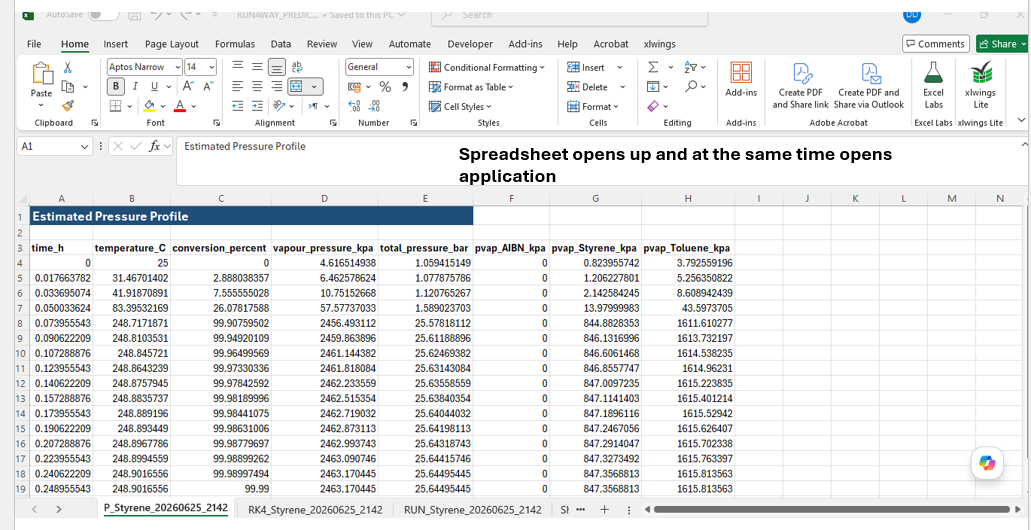
An Excel/VBA-based screening tool for estimating runaway reaction risk, adiabatic temperature rise, MTSR, pressure rise, vapour-pressure contribution, and preli
Further information
Objectives
The objective of Runaway Predictor Pro™ is to provide chemical engineers, polymer scientists, researchers and process safety professionals with a practical computational tool for evaluating the behaviour of free-radical polymerization systems before laboratory or production-scale implementation.
The software is designed to help users:
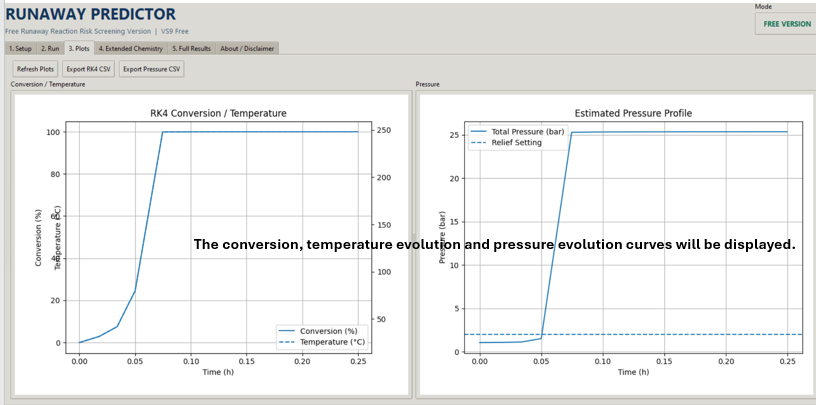
Predict polymer conversion profiles as a function of time.
Estimate reactor temperature evolution under adiabatic and cooled conditions.
Evaluate initiator decomposition and radical generation throughout the reaction.
Compare the behaviour of different monomer, initiator and solvent combinations.
Assess the influence of formulation changes on reaction rate and thermal stability.
Identify conditions that may lead to thermal runaway or uncontrolled polymerization.
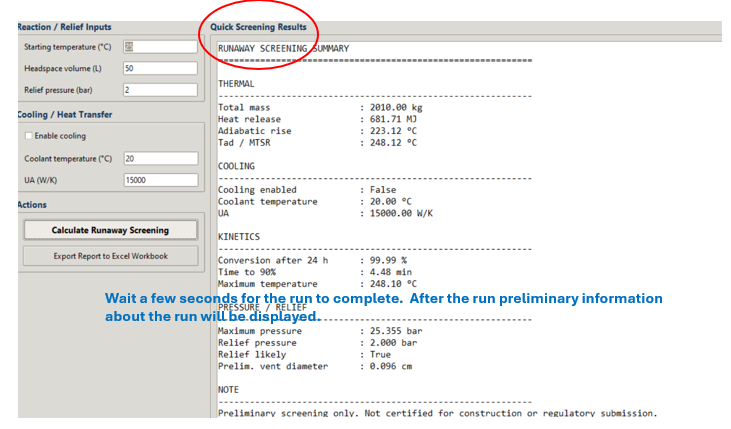
Perform preliminary DIERS-style screening of emergency pressure-relief requirements.
Compare multiple formulations before experimental work.
Improve process understanding through mechanistic kinetic modelling.
Reduce development time by screening candidate formulations computationally.
Support process safety studies during laboratory development, pilot-plant trials and scale-up.
Provide a visual educational platform for understanding free-radical polymerization kinetics.
Best Practice
For best results, users should:
Use experimentally measured kinetic parameters whenever available.
Verify imported chemical data before running simulations.
Compare predictions with laboratory DSC, ARC or reaction-calorimetry measurements where possible.
Use the built-in validation tools after adding new monomers or initiators.
Treat calculated vent-sizing results as preliminary engineering guidance only.
Perform sensitivity analyses by varying initiator concentration, cooling capacity and formulation composition.
Document assumptions and parameter sources when using the software for engineering studies.
Validate important simulations against experimental data before making process design decisions.
Maintain an up-to-date chemical database with literature references and parameter provenance.
Keep the software updated as new validated kinetic data become available.
Intended Use
Runaway Predictor Pro is intended for:
Research and development
Process development
Process safety screening
Polymer formulation development
Educational and training purposes
Laboratory hazard assessment
Preliminary engineering studies
Not Intended For
The software is not intended to replace:
Experimental reaction calorimetry
Certified emergency relief system design
Regulatory process hazard analyses
Professional engineering judgement
Mandatory plant safety reviews
Conditions for Which This Downloadable Best Practice Applies Best
This software is best suited to:
Free-radical polymerization systems operated in laboratory, pilot-plant and production environments.
Preliminary process safety evaluations during process development and scale-up.
Screening of monomer, initiator, inhibitor and solvent combinations before experimental work.
Comparative evaluation of formulation changes and operating conditions.
Assessment of reaction conversion, temperature and pressure profiles under adiabatic or cooled conditions.
Investigation of the influence of initiator concentration, cooling capacity and reactor operating conditions on runaway potential.
Preliminary emergency relief and DIERS-style screening studies.
Polymer chemistry education, research and professional training.
Process development projects where rapid comparison of multiple formulations is required.
Sensitivity analyses and "what-if" studies to identify critical process variables.
This software performs best when supported by reliable kinetic parameters, validated chemical-property data and appropriate engineering judgement. Results should be confirmed experimentally for safety-critical applications.
Conditions for Which This Downloadable Best Practice Does Not Apply Ideally
This software is not intended for the following applications without additional specialist analysis, experimental validation or certified engineering review:
Final design or certification of pressure-relief systems or emergency vent sizing.
Regulatory compliance studies requiring certified calculations or independent engineering approval.
Polymerization systems where kinetic parameters, thermodynamic properties or reaction mechanisms are unknown or unavailable.
Non-free-radical polymerization mechanisms (for example, ionic, coordination, ring-opening or step-growth polymerizations) unless specifically supported by the underlying kinetic model.
Highly complex reaction networks involving multiple competing reactions, significant side reactions or decomposition pathways that are not represented in the model.
Large-scale industrial process design where detailed computational fluid dynamics (CFD), reaction calorimetry, or pilot-plant validation is required.
Safety-critical engineering decisions without supporting laboratory data, hazard studies or professional engineering judgement.
Applications involving explosive decomposition, detonations, dust explosions or unrelated reactive chemistry outside the scope of the implemented polymerization models.
Situations where accurate physical property data, kinetic constants or operating conditions are unavailable or uncertain.
The software is intended as a professional screening and engineering-support tool. Important design decisions should always be supported by appropriate experimental measurements, recognised engineering practices and applicable industry standards.