


Publication number: ELQ-47005-1
View all versions & Certificate

Beneish M-Score Earnings Manipulation Scorecard: Detect Financial Fraud & Accounting Red Flags
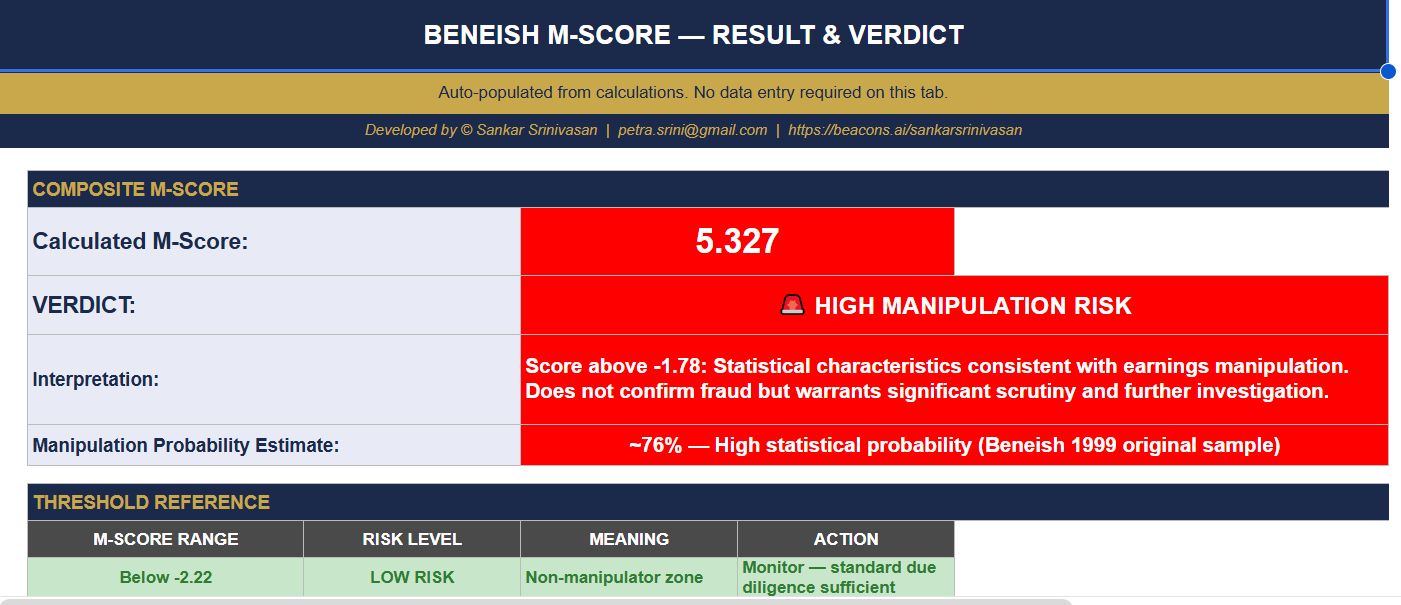
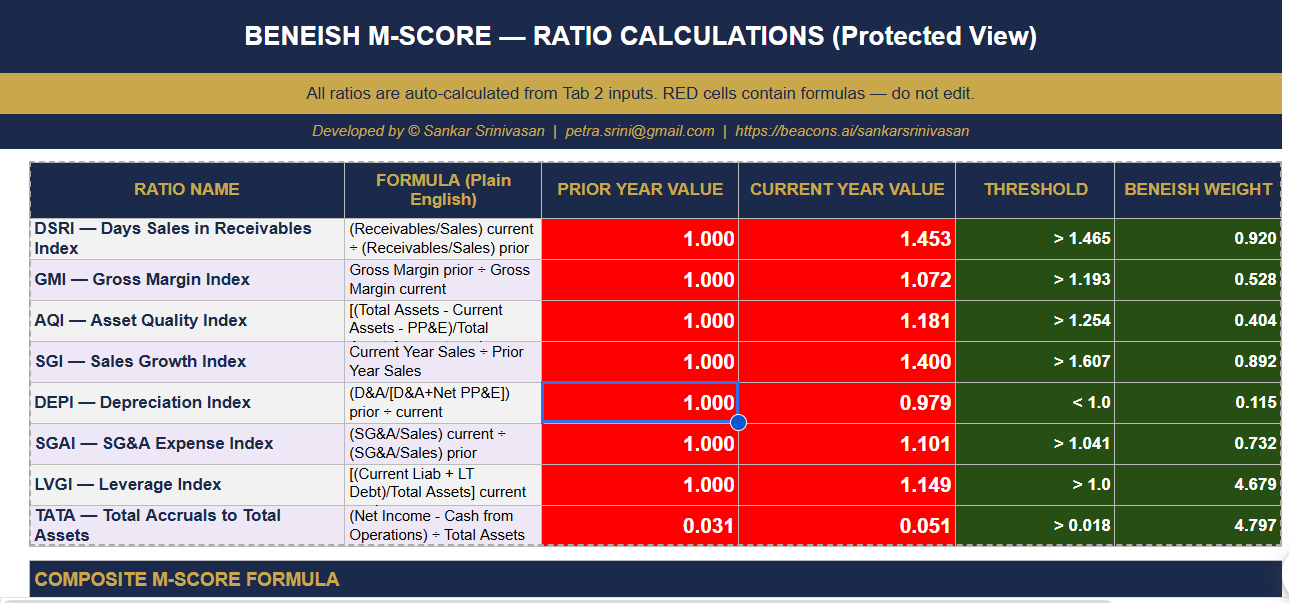
Uncover earnings manipulation: Beneish M-Score template uses 8 ratios to flag fraud risk. Essential for due diligence and transparent financial analysis.
 by Sankar Srinivasan
Stock Market Consultant | Options Strategies | Portfolio Risk Management & Professional Trading SystemsFollow
Further information
1. Simplify Complex Financial Analysis
Translate the academic Beneish M-Score formula into a structured, easy-to-use scorecard that any analyst, investor, or auditor can apply without advanced statistical knowledge.
2. Enable Early Fraud Detection
Help users identify warning signs of earnings manipulation before financial losses occur, by systematically evaluating eight key financial indices from publicly available statements.
3. Support Investment Due Diligence
Equip investors, portfolio managers, and equity researchers with a reliable pre-investment screening tool to assess the earnings quality and reporting integrity of target companies.
4. Strengthen Audit & Compliance Workflows
Provide auditors, CFOs, and compliance officers with a repeatable, documented framework that supports regulatory scrutiny and internal risk management processes.
5. Promote Financial Transparency
Encourage a culture of accountability by giving stakeholders a standardised method to benchmark and challenge reported financial performance against manipulation probability thresholds.
6. Save Time with a Ready-to-Use Template
Eliminate the need to build models from scratch — the downloadable scorecard delivers a professionally structured, plug-and-play tool that accelerates financial review cycles.
7. Educate & Upskill Finance Professionals
Serve as a practical learning resource for finance students, CFA candidates, and early-career analysts seeking hands-on exposure to forensic accounting methodologies.
The Beneish M-Score Earnings Manipulation Scorecard applies best under the following conditions:
1. Publicly Listed Companies
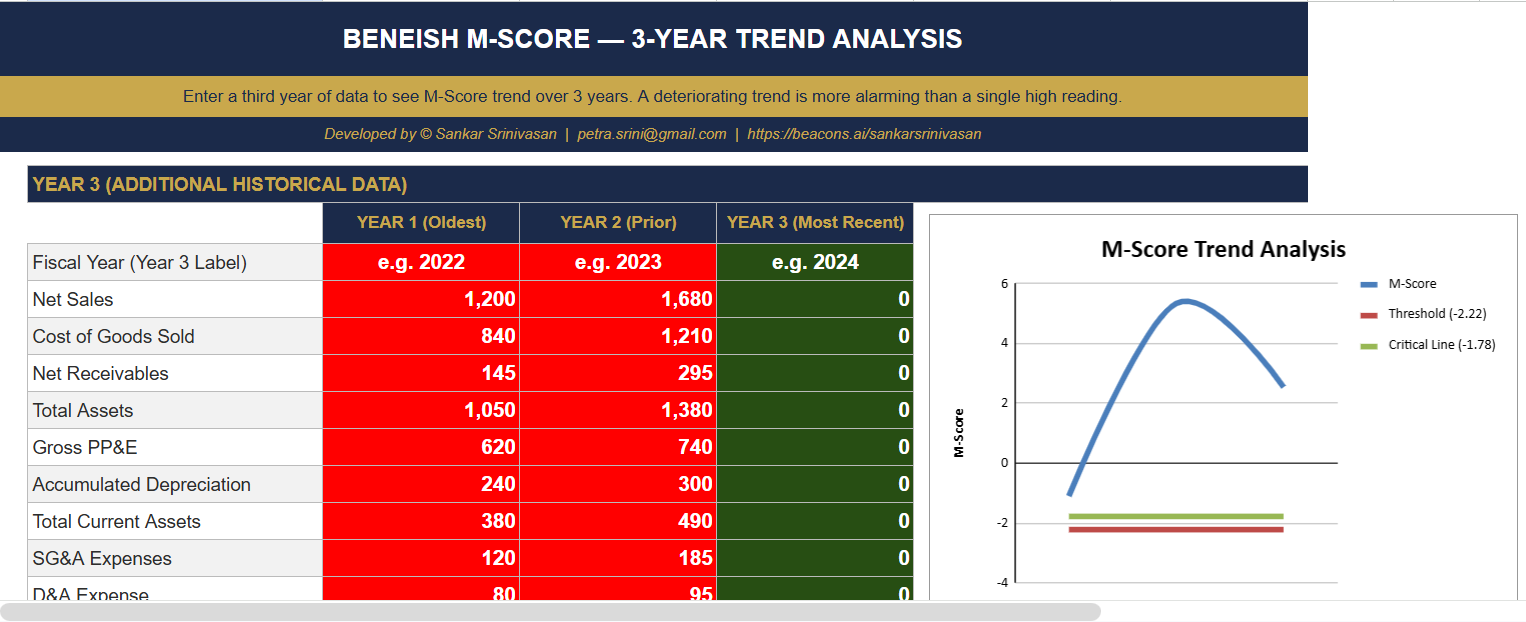
The model works best with companies that publish audited financial statements, as all eight indices rely on balance sheet and income statement data across at least two consecutive fiscal years.
2. Pre-Investment Due Diligence
Ideal for analysts and investors evaluating a stock before committing capital, particularly when financial ratios appear unusually strong or inconsistent with industry peers.
3. Audit & Forensic Review Engagements
Highly applicable when auditors or forensic accountants suspect aggressive revenue recognition, inflated assets, or understated expenses during a formal review.
4. Credit Risk & Lending Assessments
Useful for banks and credit analysts assessing borrower integrity before approving loans or credit facilities.
5. Distressed or High-Growth Companies
Most valuable when analysing companies showing sudden profit surges, rapid revenue growth, or deteriorating cash flows alongside rising reported profits — classic manipulation warning signs.
6. Regulatory & Compliance Investigations
Applicable in early-stage regulatory screenings where a quick, data-driven fraud probability score is needed before launching a full investigation.
The Beneish M-Score Earnings Manipulation Scorecard is not universally applicable and loses reliability or relevance under the following conditions:
Financial Sector Companies — Banks, insurance firms, and financial institutions follow different accounting standards and capital structures, making the M-Score indices incompatible and misleading.
Newly Incorporated Companies — Startups and early-stage businesses lack sufficient historical financial data across multiple periods, rendering ratio comparisons invalid.
Non-Profit Organisations — These entities do not report earnings in a commercial sense, so manipulation metrics based on profit-driven accounting are irrelevant.
Government & Public Sector Entities — Public bodies operate under fund-based or cash accounting, not GAAP/IFRS accrual standards the model depends on.
Private Unlisted Companies — Limited disclosure requirements mean financial statements may be incomplete, unaudited, or unavailable for accurate scoring.
Companies Under Restructuring or Bankruptcy — Distorted financials during insolvency proceedings produce misleading M-Score results unrelated to actual manipulation.
Single-Period Data Availability — The model requires at least two consecutive years of financial statements; single-year data makes index calculation impossible.
Highly Seasonal Businesses — Extreme revenue and cost fluctuations across periods can artificially inflate or deflate indices, producing false signals.