How to Read a Renewable Energy Financial Model — IRR, NPV, DSCR, LCOE, Payback (Free)
Originally published: 07/05/2026 16:02
Publication number: ELQ-47604-1
View all versions & Certificate
certified

How to Read a Renewable Energy Financial Model — IRR, NPV, DSCR, LCOE, Payback (Free)

A plain-language guide to the 5 KPIs every developer, analyst and investor needs to understand in a renewable energy financial model

Description
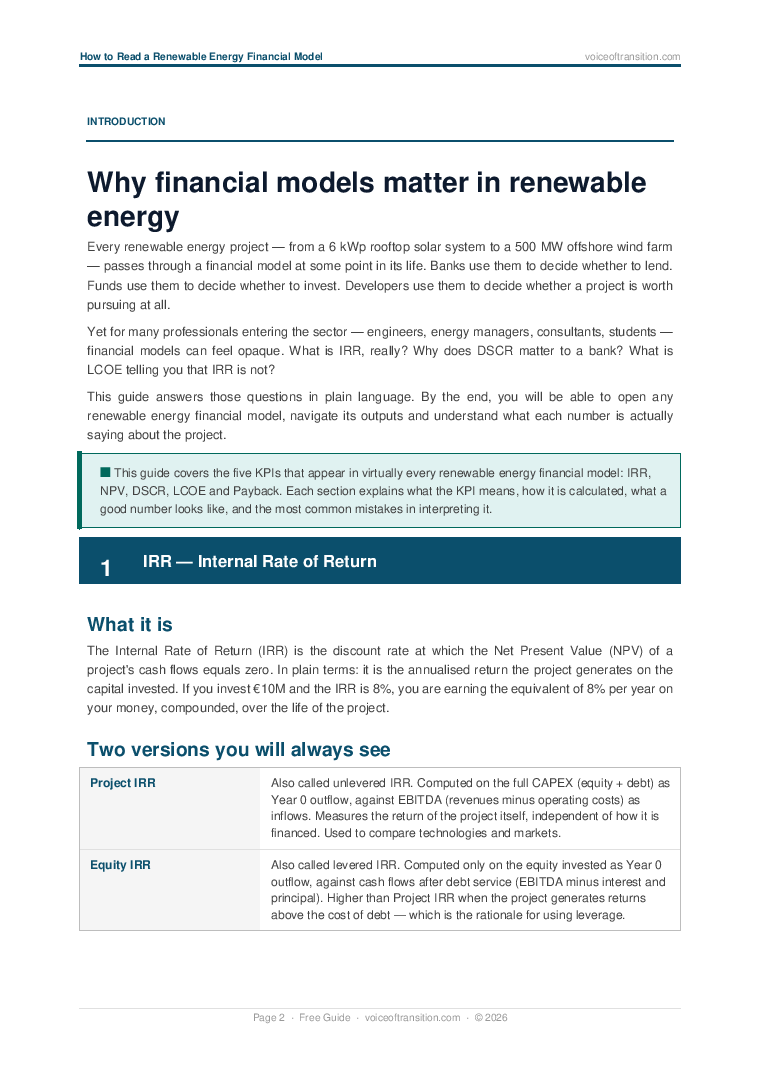
Every renewable energy project — from a rooftop solar system to a 500 MW offshore wind farm — passes through a financial model at some point in its life. Yet for many professionals entering the sector, financial models can feel opaque. This free 10-page guide explains the five KPIs that appear in virtually every renewable energy financial model, in plain language and with practical benchmarks.


The guide covers IRR (Internal Rate of Return), distinguishing clearly between Project IRR and Equity IRR, with reference return ranges by technology for H1 2026. It explains NPV (Net Present Value), when to use it versus IRR, and why the choice of discount rate is critical. DSCR (Debt Service Coverage Ratio) is presented as the primary metric for lenders in project finance, with minimum covenant thresholds by technology and an explanation of the difference between minimum and average DSCR. 


LCOE (Levelised Cost of Energy) is explained as a break-even cost benchmark and compared against typical PPA and CfD revenue levels for Solar PV, Onshore Wind, Offshore Wind and BESS across key European markets. Finally, Simple and Discounted Payback are covered with typical ranges by technology and a clear warning about their limitations as standalone metrics.


The guide concludes with a practical five-step framework for reading any renewable energy financial model in sequence — from IRR vs hurdle rate, to NPV for absolute value creation, to DSCR for bankability, to LCOE vs market price, to payback as a board-level sanity check. A quick-reference summary table consolidates all five KPIs with formulas, good-signal thresholds and common pitfalls.


Suitable for engineers, energy managers, project developers, financial analysts, consultants and students entering the renewable energy sector. Compatible with Solar PV, Onshore Wind, Offshore Wind and Battery Energy Storage Systems (BESS).

This Best Practice includes
1 PDF Document

Piero Farenti offers you this Best Practice for free!

read for free

Add to bookmarks

Discuss


0.0 / 5 (0 votes)

please wait...