
Originally published: 12/11/2024 16:00
Publication number: ELQ-90631-1
View all versions & Certificate
Publication number: ELQ-90631-1
View all versions & Certificate

Indian Equity Index Performance 1990-2024
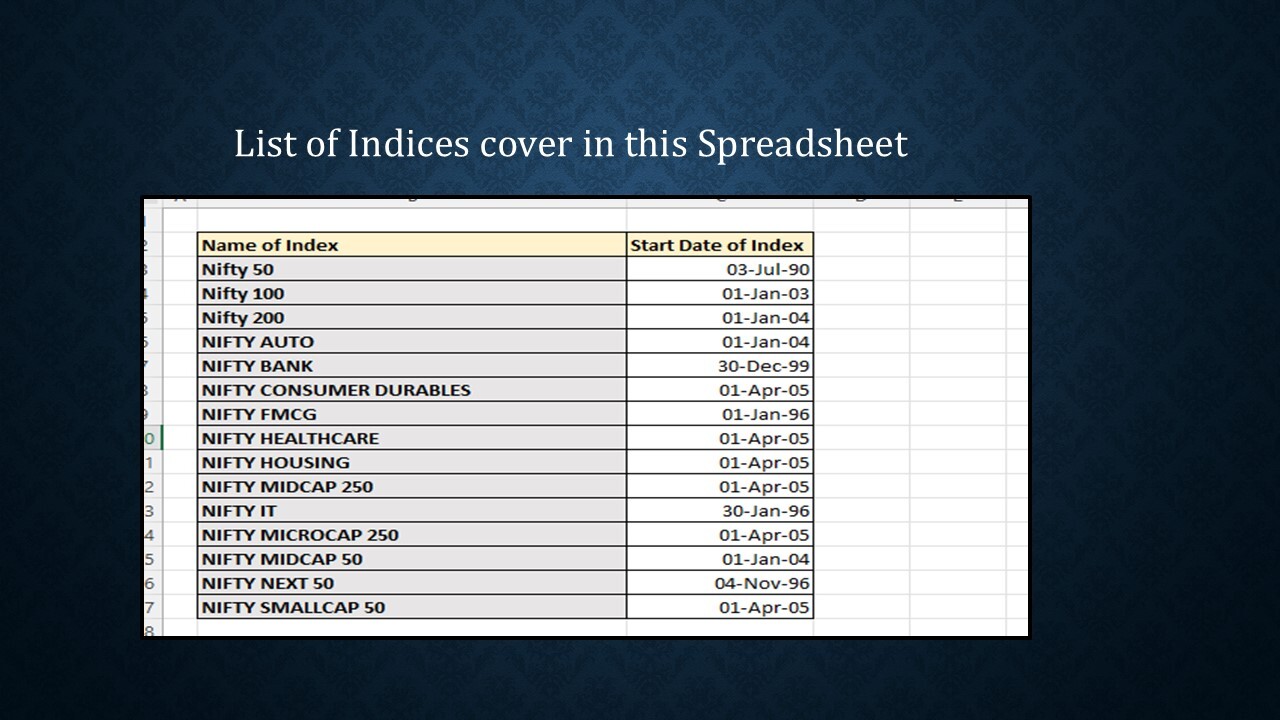
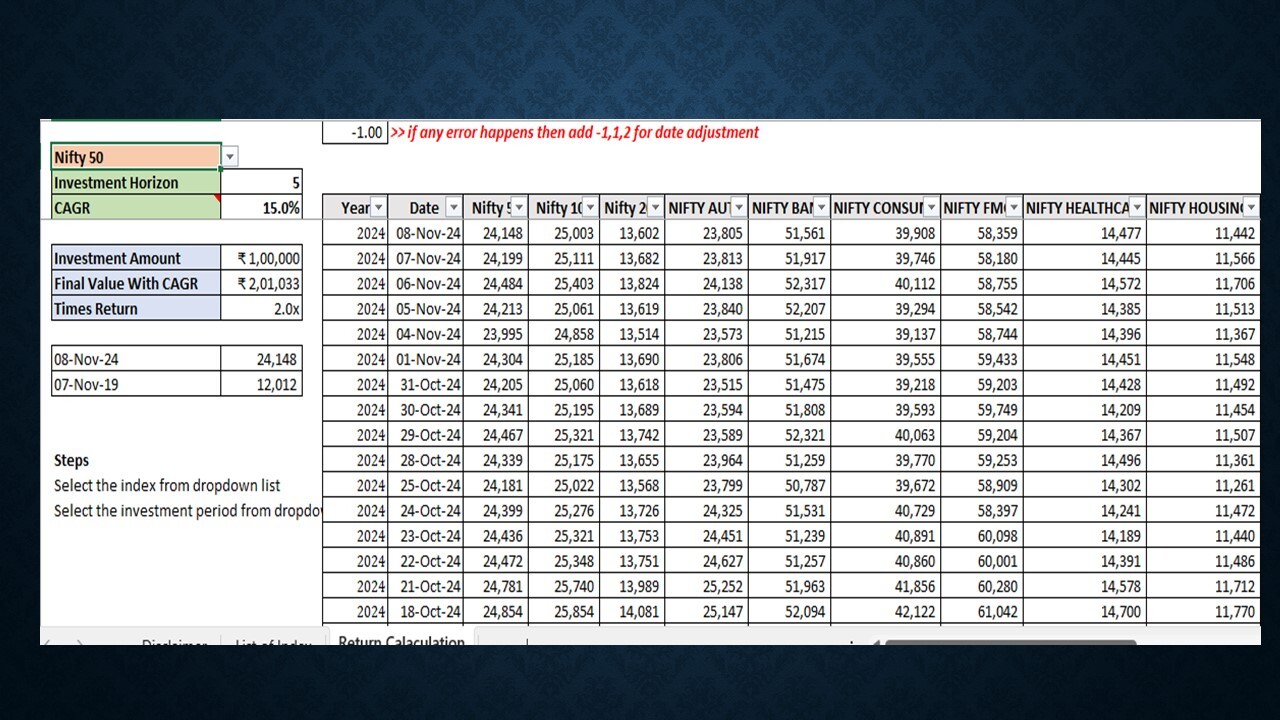
This spreadsheet provides a comprehensive analysis of the performance returns of various key stock market indices from the beginning to year 2024
Description
Nifty 50
The Nifty 50 is India’s benchmark equity index, comprising the 50 largest and most liquid stocks listed on the National Stock Exchange (NSE). It represents approximately 65% of the total free float market capitalization of the NSE. The index is a key barometer for the Indian stock market and is widely used by investors as a reference point for market performance. It covers multiple sectors, including financials, energy, IT, and consumer goods. The Nifty 50 is a crucial index for portfolio benchmarking and is often used for exchange-traded funds (ETFs) and index funds.
The Nifty 100 includes the top 100 companies listed on the NSE, based on free float market capitalization. This broader index encompasses the Nifty 50 stocks and adds 50 more to give a more diversified view of the Indian equity market. It represents a wide array of industries, including financials, technology, healthcare, and consumer products. The Nifty 100 helps investors track the performance of large and mid-cap stocks together, providing a clearer picture of market-wide trends. This index serves as a benchmark for many large-cap-focused funds and ETFs.
The Nifty 200 index includes the top 200 stocks listed on the NSE, providing a more comprehensive view of India’s equity market across large, mid, and some small-cap companies. It tracks the performance of a broader segment of the market than the Nifty 50 or Nifty 100, offering exposure to a wider range of sectors. The index is designed to capture the diversity and growth potential of India’s listed companies, with a focus on liquidity and market capitalization. It is a key reference point for investors seeking to diversify their portfolios beyond the top 100 companies.
The Nifty Auto index represents the performance of the automobile sector in India, including manufacturers of cars, trucks, two-wheelers, and auto components. This sector is a critical part of India’s industrial landscape, reflecting both domestic demand and export trends. The index includes leading automotive companies like Maruti Suzuki, Tata Motors, and Mahindra & Mahindra. It helps investors gauge the performance of the auto industry, which is closely linked to macroeconomic factors like consumer spending and interest rates. The Nifty Auto index is often used to track sector-specific trends and growth.
The Nifty Bank index tracks the performance of the banking sector, including major public and private sector banks in India. This index is widely followed as the banking sector plays a crucial role in the country’s economic growth, influencing credit, interest rates, and financial services. It includes prominent banks such as HDFC Bank, ICICI Bank, and State Bank of India. The Nifty Bank index is an important tool for investors looking to gauge the health of the financial system and its impact on the broader economy. It is also used as a benchmark for financial sector-focused funds and ETFs.
The Nifty Consumer Durables index captures the performance of companies involved in the manufacturing and retail of long-lasting consumer goods, such as home appliances, electronics, and personal care items. It includes leading firms like Asian Paints, Havells, and Whirlpool India. The index reflects consumer demand trends and the purchasing power of India’s middle class. As consumer spending on durable goods is highly sensitive to economic cycles, the Nifty Consumer Durables index can provide insights into consumer confidence and economic conditions. It serves as a reference for investors focusing on the consumer sector.
The Nifty FMCG index tracks the performance of India’s fast-moving consumer goods (FMCG) sector, which includes essential products like food, beverages, personal care, and household items. This sector is known for its stable demand and resilience, even during economic downturns. The index includes prominent companies such as Hindustan Unilever, Nestle India, and Dabur. Given its defensive nature, the Nifty FMCG index is often seen as a safe investment in volatile markets. It is widely used by investors looking for exposure to stable, high-quality consumer brands.
The Nifty Healthcare index represents the performance of India’s healthcare sector, which includes pharmaceutical companies, medical devices, and healthcare service providers. This index tracks firms such as Dr. Reddy’s Laboratories, Sun Pharmaceuticals, and Apollo Hospitals. The healthcare sector in India is expected to grow rapidly, driven by increasing healthcare needs, aging populations, and advancements in medical technology. The Nifty Healthcare index helps investors monitor developments in healthcare innovation, regulation, and market demand. It is a useful tool for those seeking exposure to this essential and expanding sector.
The Nifty Housing index includes companies in the real estate and construction sectors, tracking the performance of housing development and infrastructure companies. The index reflects trends in residential housing, commercial properties, and urban development. It includes key players such as DLF, Oberoi Realty, and Godrej Properties. The Nifty Housing index is sensitive to factors such as interest rates, consumer sentiment, and government housing policies. Investors use this index to assess the performance of the real estate market and its potential impact on the broader economy.
The Nifty Midcap 250 index tracks the performance of mid-sized companies, representing the next tier after the top 100 companies in terms of market capitalization. It offers a balance of growth potential and volatility compared to large-cap indices. This index includes firms from various sectors, providing a diverse look at mid-cap stock performance. The Nifty Midcap 250 is often seen as an indicator of economic trends, as mid-cap companies are more sensitive to changes in market conditions and domestic economic policies. Investors use it to gain exposure to mid-sized companies with growth potential.
The Nifty IT index represents the performance of India’s information technology (IT) sector, which has become a global powerhouse for software services, IT consulting, and outsourcing. Major companies in the index include Infosys, TCS, and Wipro. The IT sector is a critical driver of India’s export economy and one of the fastest-growing sectors in the stock market. The Nifty IT index is closely watched by investors seeking exposure to this export-oriented and innovation-driven sector. It is an important indicator of the health and global competitiveness of India’s IT industry.
The Nifty Microcap 250 index includes the smallest publicly listed companies in India, focusing on firms with low market capitalization. This index represents highly speculative and volatile stocks, often providing investors with the opportunity to tap into high-risk, high-reward opportunities. The index is more sensitive to market movements, liquidity constraints, and investor sentiment. It includes smaller companies across a wide range of industries, from emerging sectors to niche markets. The Nifty Microcap 250 is used by investors looking for significant growth potential in underdeveloped or emerging businesses.
The Nifty Midcap 50 index tracks the performance of 50 mid-cap stocks in India, representing the mid-sized companies that rank between the large-cap Nifty 50 and small-cap stocks. This index provides a more focused look at mid-sized companies with potential for growth, but less risk than micro or small-cap stocks. It includes a mix of firms from diverse sectors, such as industrials, consumer goods, and financial services. The Nifty Midcap 50 index serves as a useful benchmark for investors looking to diversify their portfolios with mid-cap stocks that offer a balance of growth and stability.
The Nifty Next 50 index includes 50 stocks that rank just below the Nifty 50, representing the next set of high-performing companies in terms of market capitalization. These firms are often seen as potential candidates for inclusion in the Nifty 50, offering investors exposure to growing companies across various sectors. The Nifty Next 50 is a key index for investors looking for dynamic and potentially high-growth stocks that may become part of the larger Nifty 50 in the future. It provides a mix of large-cap and emerging mid-cap stocks, offering diversification opportunities for growth-focused portfolios.
The Nifty Smallcap 50 index tracks the performance of the 50 smallest stocks on the NSE in terms of market capitalization. Small-cap stocks are generally considered to be riskier but have the potential for high growth as they are often in the early stages of development. The index includes companies from various sectors, including technology, healthcare, and industrials. Due to their smaller size, small-cap stocks tend to be more volatile, but they also offer investors the opportunity for significant returns if the companies succeed. The Nifty Smallcap 50 index is widely followed by those seeking to tap into India’s emerging and high-growth businesses.
Nifty 50
The Nifty 50 is India’s benchmark equity index, comprising the 50 largest and most liquid stocks listed on the National Stock Exchange (NSE). It represents approximately 65% of the total free float market capitalization of the NSE. The index is a key barometer for the Indian stock market and is widely used by investors as a reference point for market performance. It covers multiple sectors, including financials, energy, IT, and consumer goods. The Nifty 50 is a crucial index for portfolio benchmarking and is often used for exchange-traded funds (ETFs) and index funds.
The Nifty 100 includes the top 100 companies listed on the NSE, based on free float market capitalization. This broader index encompasses the Nifty 50 stocks and adds 50 more to give a more diversified view of the Indian equity market. It represents a wide array of industries, including financials, technology, healthcare, and consumer products. The Nifty 100 helps investors track the performance of large and mid-cap stocks together, providing a clearer picture of market-wide trends. This index serves as a benchmark for many large-cap-focused funds and ETFs.
The Nifty 200 index includes the top 200 stocks listed on the NSE, providing a more comprehensive view of India’s equity market across large, mid, and some small-cap companies. It tracks the performance of a broader segment of the market than the Nifty 50 or Nifty 100, offering exposure to a wider range of sectors. The index is designed to capture the diversity and growth potential of India’s listed companies, with a focus on liquidity and market capitalization. It is a key reference point for investors seeking to diversify their portfolios beyond the top 100 companies.
The Nifty Auto index represents the performance of the automobile sector in India, including manufacturers of cars, trucks, two-wheelers, and auto components. This sector is a critical part of India’s industrial landscape, reflecting both domestic demand and export trends. The index includes leading automotive companies like Maruti Suzuki, Tata Motors, and Mahindra & Mahindra. It helps investors gauge the performance of the auto industry, which is closely linked to macroeconomic factors like consumer spending and interest rates. The Nifty Auto index is often used to track sector-specific trends and growth.
The Nifty Bank index tracks the performance of the banking sector, including major public and private sector banks in India. This index is widely followed as the banking sector plays a crucial role in the country’s economic growth, influencing credit, interest rates, and financial services. It includes prominent banks such as HDFC Bank, ICICI Bank, and State Bank of India. The Nifty Bank index is an important tool for investors looking to gauge the health of the financial system and its impact on the broader economy. It is also used as a benchmark for financial sector-focused funds and ETFs.
The Nifty Consumer Durables index captures the performance of companies involved in the manufacturing and retail of long-lasting consumer goods, such as home appliances, electronics, and personal care items. It includes leading firms like Asian Paints, Havells, and Whirlpool India. The index reflects consumer demand trends and the purchasing power of India’s middle class. As consumer spending on durable goods is highly sensitive to economic cycles, the Nifty Consumer Durables index can provide insights into consumer confidence and economic conditions. It serves as a reference for investors focusing on the consumer sector.
The Nifty FMCG index tracks the performance of India’s fast-moving consumer goods (FMCG) sector, which includes essential products like food, beverages, personal care, and household items. This sector is known for its stable demand and resilience, even during economic downturns. The index includes prominent companies such as Hindustan Unilever, Nestle India, and Dabur. Given its defensive nature, the Nifty FMCG index is often seen as a safe investment in volatile markets. It is widely used by investors looking for exposure to stable, high-quality consumer brands.
The Nifty Healthcare index represents the performance of India’s healthcare sector, which includes pharmaceutical companies, medical devices, and healthcare service providers. This index tracks firms such as Dr. Reddy’s Laboratories, Sun Pharmaceuticals, and Apollo Hospitals. The healthcare sector in India is expected to grow rapidly, driven by increasing healthcare needs, aging populations, and advancements in medical technology. The Nifty Healthcare index helps investors monitor developments in healthcare innovation, regulation, and market demand. It is a useful tool for those seeking exposure to this essential and expanding sector.
The Nifty Housing index includes companies in the real estate and construction sectors, tracking the performance of housing development and infrastructure companies. The index reflects trends in residential housing, commercial properties, and urban development. It includes key players such as DLF, Oberoi Realty, and Godrej Properties. The Nifty Housing index is sensitive to factors such as interest rates, consumer sentiment, and government housing policies. Investors use this index to assess the performance of the real estate market and its potential impact on the broader economy.
The Nifty Midcap 250 index tracks the performance of mid-sized companies, representing the next tier after the top 100 companies in terms of market capitalization. It offers a balance of growth potential and volatility compared to large-cap indices. This index includes firms from various sectors, providing a diverse look at mid-cap stock performance. The Nifty Midcap 250 is often seen as an indicator of economic trends, as mid-cap companies are more sensitive to changes in market conditions and domestic economic policies. Investors use it to gain exposure to mid-sized companies with growth potential.
The Nifty IT index represents the performance of India’s information technology (IT) sector, which has become a global powerhouse for software services, IT consulting, and outsourcing. Major companies in the index include Infosys, TCS, and Wipro. The IT sector is a critical driver of India’s export economy and one of the fastest-growing sectors in the stock market. The Nifty IT index is closely watched by investors seeking exposure to this export-oriented and innovation-driven sector. It is an important indicator of the health and global competitiveness of India’s IT industry.
The Nifty Microcap 250 index includes the smallest publicly listed companies in India, focusing on firms with low market capitalization. This index represents highly speculative and volatile stocks, often providing investors with the opportunity to tap into high-risk, high-reward opportunities. The index is more sensitive to market movements, liquidity constraints, and investor sentiment. It includes smaller companies across a wide range of industries, from emerging sectors to niche markets. The Nifty Microcap 250 is used by investors looking for significant growth potential in underdeveloped or emerging businesses.
The Nifty Midcap 50 index tracks the performance of 50 mid-cap stocks in India, representing the mid-sized companies that rank between the large-cap Nifty 50 and small-cap stocks. This index provides a more focused look at mid-sized companies with potential for growth, but less risk than micro or small-cap stocks. It includes a mix of firms from diverse sectors, such as industrials, consumer goods, and financial services. The Nifty Midcap 50 index serves as a useful benchmark for investors looking to diversify their portfolios with mid-cap stocks that offer a balance of growth and stability.
The Nifty Next 50 index includes 50 stocks that rank just below the Nifty 50, representing the next set of high-performing companies in terms of market capitalization. These firms are often seen as potential candidates for inclusion in the Nifty 50, offering investors exposure to growing companies across various sectors. The Nifty Next 50 is a key index for investors looking for dynamic and potentially high-growth stocks that may become part of the larger Nifty 50 in the future. It provides a mix of large-cap and emerging mid-cap stocks, offering diversification opportunities for growth-focused portfolios.
The Nifty Smallcap 50 index tracks the performance of the 50 smallest stocks on the NSE in terms of market capitalization. Small-cap stocks are generally considered to be riskier but have the potential for high growth as they are often in the early stages of development. The index includes companies from various sectors, including technology, healthcare, and industrials. Due to their smaller size, small-cap stocks tend to be more volatile, but they also offer investors the opportunity for significant returns if the companies succeed. The Nifty Smallcap 50 index is widely followed by those seeking to tap into India’s emerging and high-growth businesses.
This Best Practice includes
1 Excel File