
Agrivoltaic Ultimate Model — Build a Bankable Business Case for Elevated Agrivoltaic Projects in Minutes, Not Weeks
Originally published: 16/05/2026 18:16
Publication number: ELQ-89809-1
View all versions & Certificate
certified

Agrivoltaic Ultimate Model — Build a Bankable Business Case for Elevated Agrivoltaic Projects in Minutes, Not Weeks

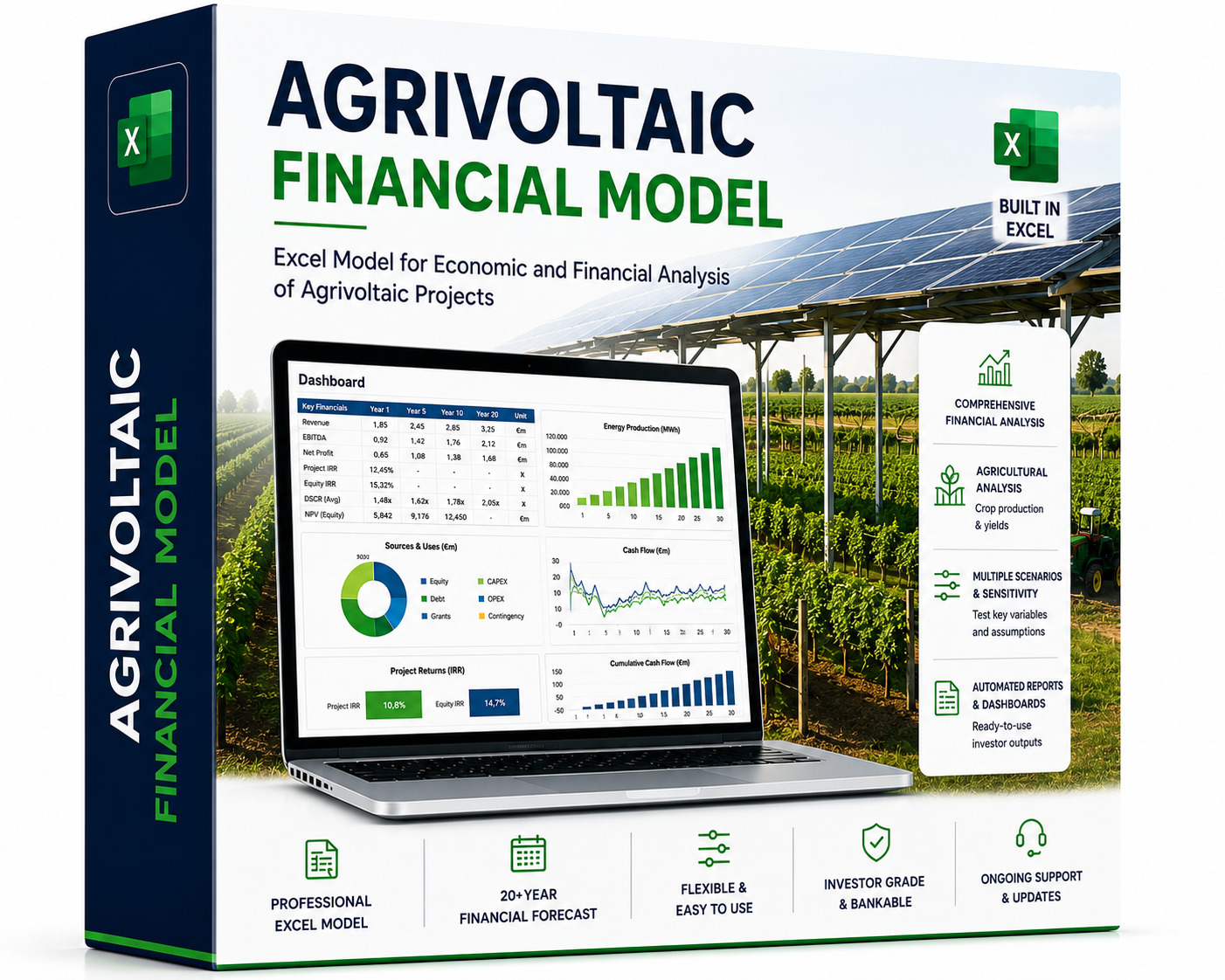
Production-ready Excel model for elevated agrivoltaic projects. 8 countries, 3 scenarios, three agricultural revenue modes, optional BESS

Description
If you develop, advise on or finance elevated agrivoltaic projects, you know the problem: every new deal requires building a model that handles both the photovoltaic side and the agricultural side simultaneously — calibrating CAPEX assumptions for an elevated structure, modelling the shading impact on generation, deciding how to treat the land revenue, and explaining the whole methodology to a lender or partner who has never seen an agrivoltaic deal before. Standard solar models do not do this. Building from scratch takes weeks.
This model eliminates that problem.

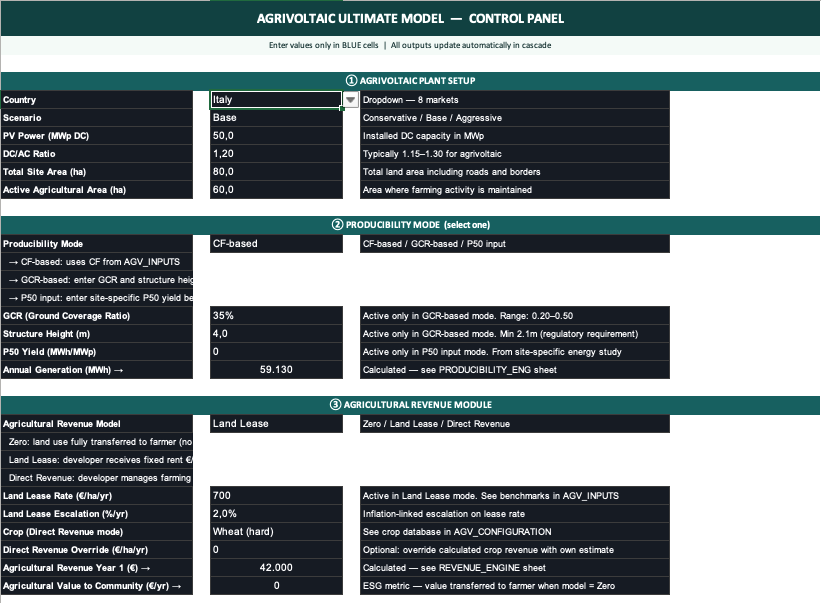
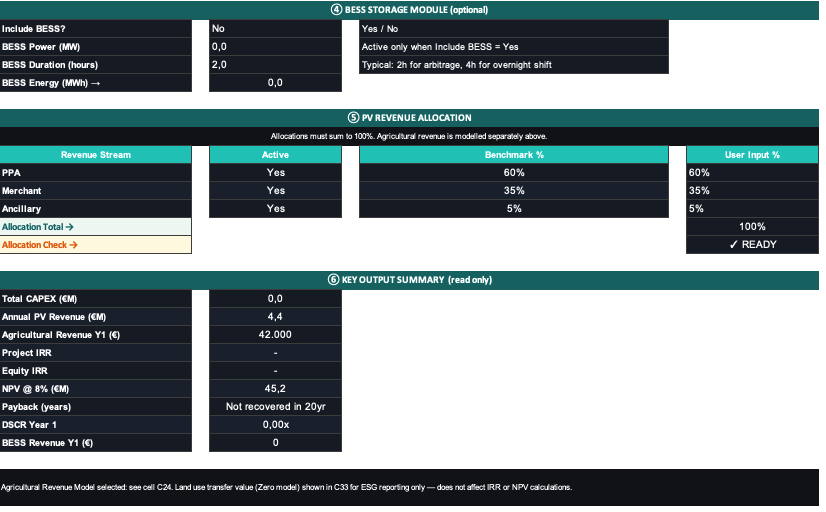
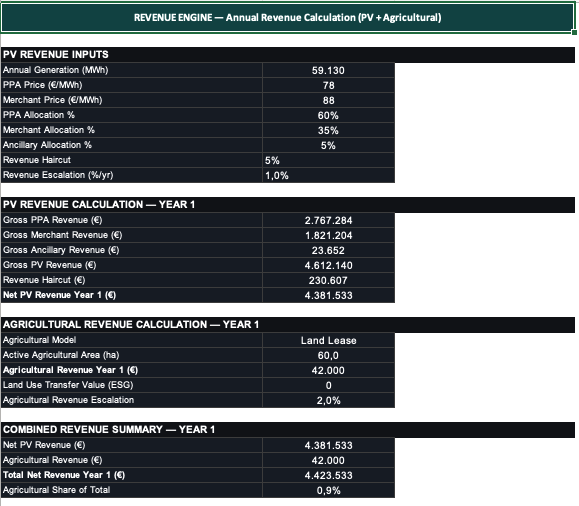
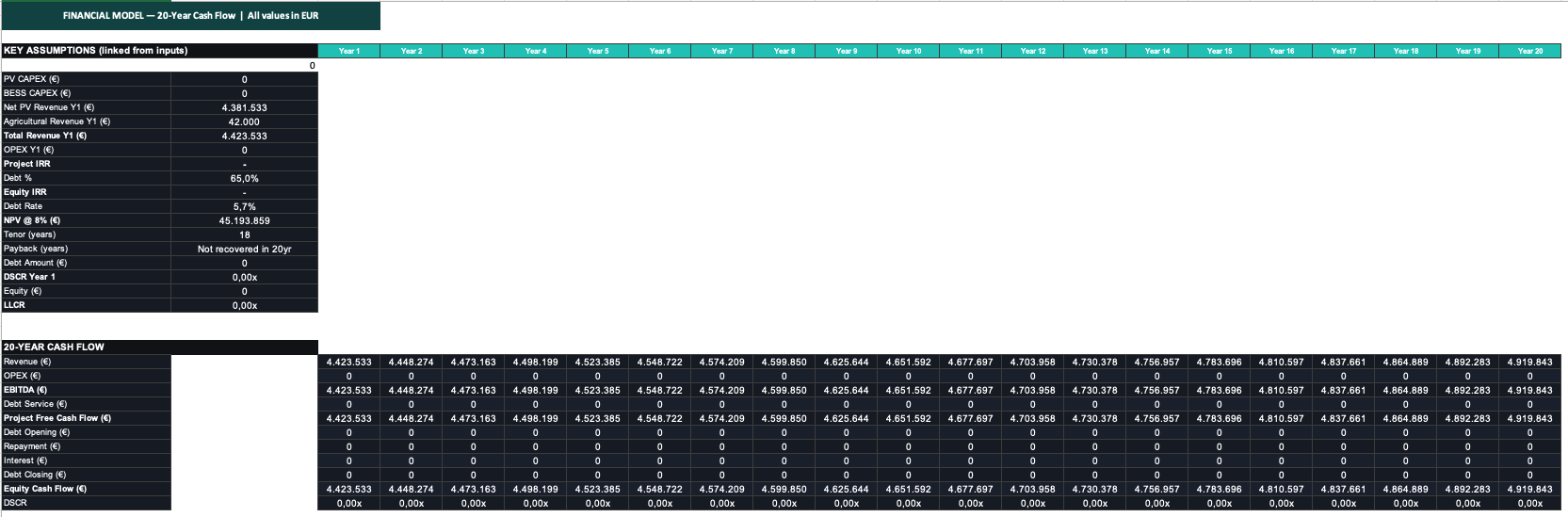
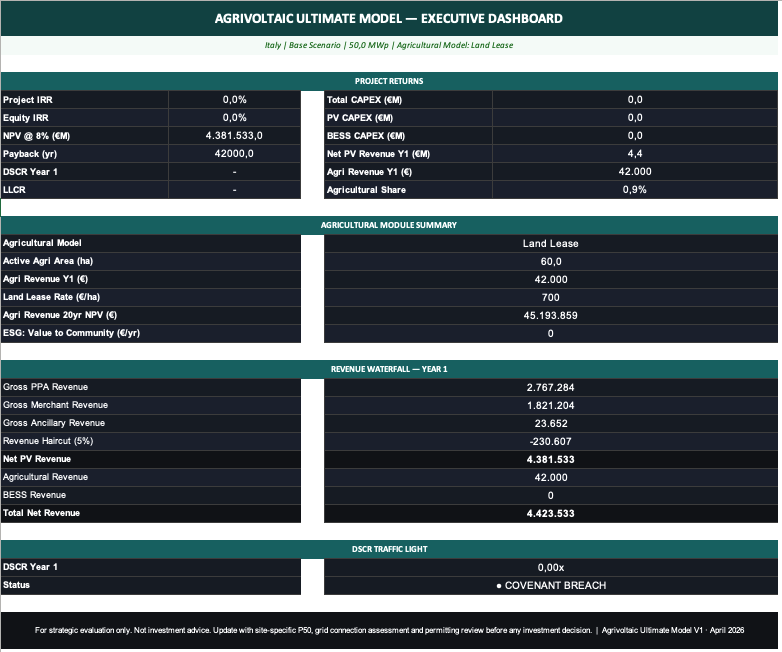
Open it, select your country and scenario, enter your plant size and agricultural configuration — and every output updates automatically. Project IRR, Equity IRR, NPV, payback, DSCR and LLCR. A full 20-year cash flow with panel degradation, OPEX escalation and a complete debt schedule. Agricultural revenue modelled separately and integrated into the cash flow. Ready to present, ready to share, ready to defend.


What makes it different from a standard solar DCF
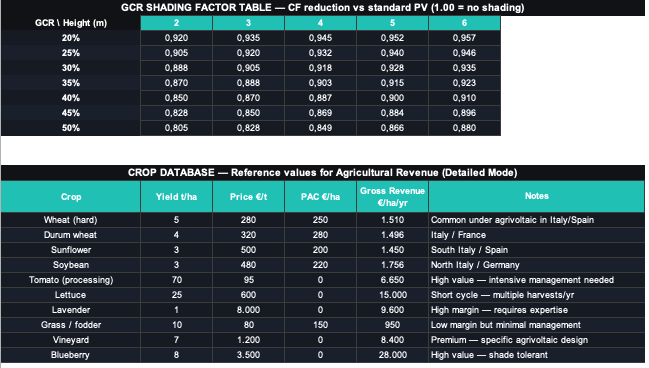
The agricultural module is the core differentiator. Three revenue modes cover every configuration a developer actually encounters. Zero transfers land use entirely to the farmer and reports the community value as an ESG metric without affecting IRR — useful when the agricultural activity is managed independently. Land Lease gives the developer a fixed rent per hectare per year, inflation-linked, with country-specific benchmarks pre-loaded from CREA, Wood Mackenzie and Aurora data. Direct Revenue models the developer managing the farming activity directly, with a crop database covering ten crop types — wheat, durum wheat, sunflower, soybean, tomato, lettuce, lavender, grass, vineyard and blueberry — each with calibrated yield, price and PAC subsidy assumptions.

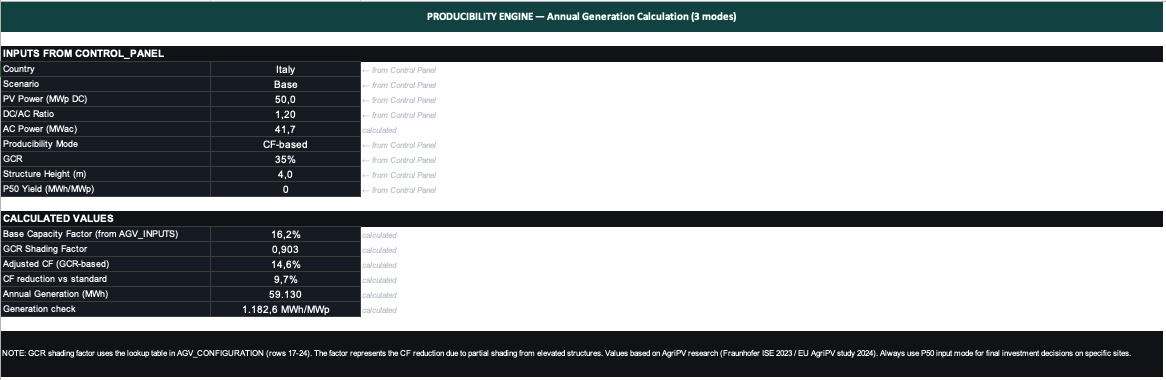
The producibility engine handles the structural complexity of elevated agrivoltaic systems specifically. Three modes are available: CF-based for rapid screening using country-calibrated capacity factors, GCR-based for projects where Ground Coverage Ratio and structure height are known — with a shading factor lookup table built from Fraunhofer ISE and EU AgriPV research — and P50 direct input for projects with a site-specific energy yield study. The DC/AC ratio input reflects the specific inverter loading strategies common in elevated agrivoltaic configurations.
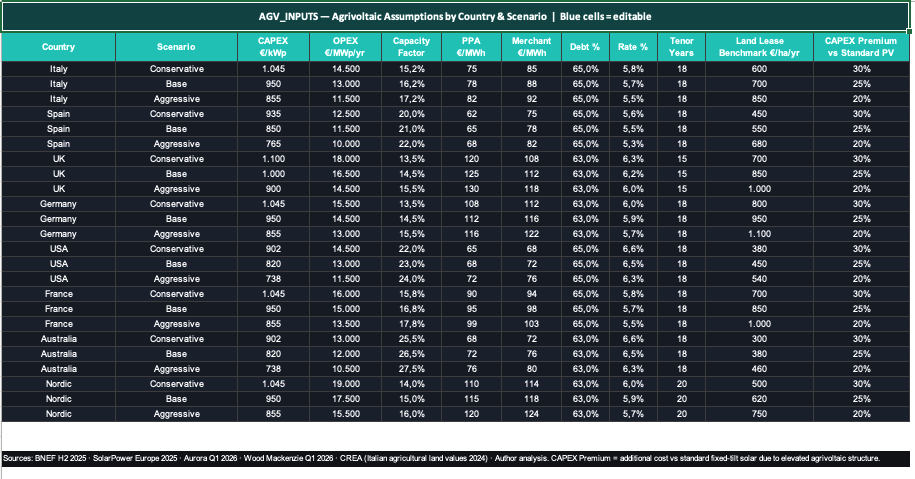
The assumptions are calibrated for agrivoltaic economics, not standard solar. The CAPEX assumptions include a country-specific premium over standard fixed-tilt solar — ranging from 20% to 30% depending on scenario — reflecting the additional structural cost of elevated mounting systems. OPEX, debt terms and revenue prices are all calibrated independently for each of the 8 countries across Conservative, Base and Aggressive scenarios, drawing on BNEF H2 2025, SolarPower Europe 2025, Aurora Q1 2026 and Wood Mackenzie Q1 2026.
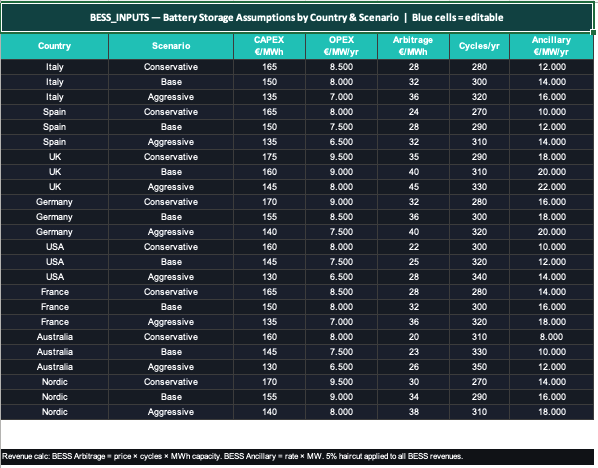
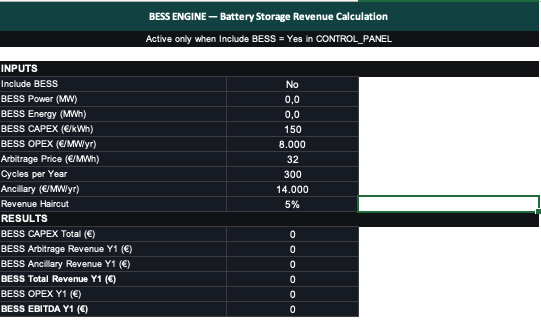
The optional BESS module evaluates co-located battery storage with a single toggle, loading CAPEX, OPEX, arbitrage revenue and ancillary revenue automatically by country and scenario.


Who this is for
Developers evaluating elevated agrivoltaic projects at early-stage feasibility across European and international markets. Financial advisors preparing investment memoranda or lender presentations for agrivoltaic deals. M&A teams running valuations on agrivoltaic assets where the agricultural revenue stream needs to be modelled explicitly. Anyone who needs a defensible, auditable number fast on a technology where no standard model exists.


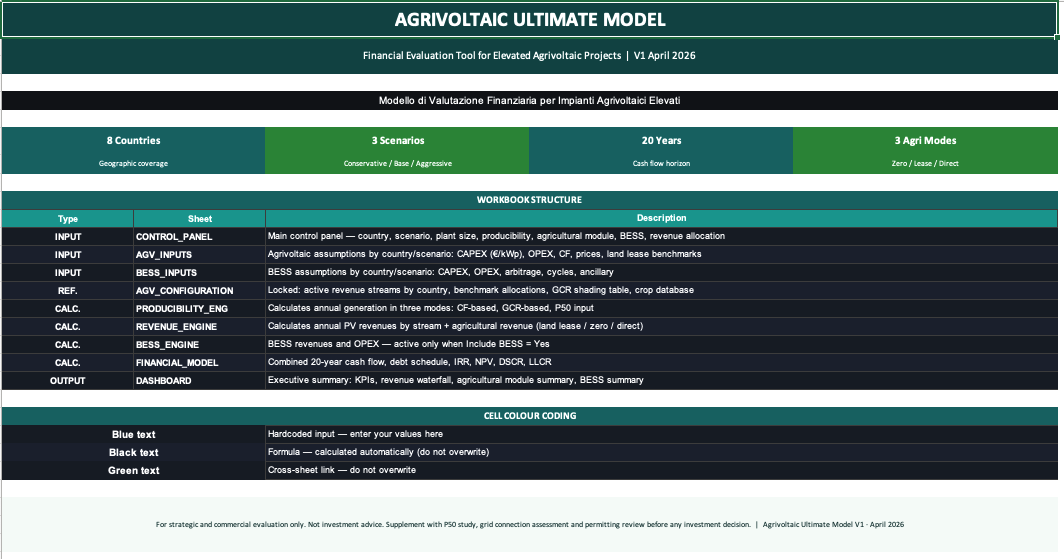
Workbook: CONTROL_PANEL · AGV_INPUTS · BESS_INPUTS · AGV_CONFIGURATION · PRODUCIBILITY_ENG · REVENUE_ENGINE · BESS_ENGINE · FINANCIAL_MODEL · DASHBOARD.


For custom versions, country extensions or specific requests, contact us at [email protected]

This Best Practice includes
1 Excel Tool, 1 PDF Guide

Acquire business license for $161.00

Add to cart

Add to bookmarks

Discuss

Further information

This model enables developers, advisors and investors to evaluate the financial viability of an elevated agrivoltaic project across 8 international markets without building a model from scratch. It supports three agricultural revenue configurations — Zero, Land Lease and Direct Revenue — allowing the user to model any ownership and operational arrangement between developer and farmer. It calculates generation using three producibility modes including a GCR-based shading engine calibrated on Fraunhofer ISE and EU AgriPV research, produces Project IRR, Equity IRR, NPV and payback from a fully integrated 20-year cash flow with a complete debt schedule including DSCR and LLCR, and allows scenario comparison across Conservative, Base and Aggressive assumptions with a single selector. It also assesses the incremental value of adding co-located BESS storage and produces an ESG metric for the agricultural value transferred to the farming community in the Zero revenue model.

This model is best suited to utility-scale elevated agrivoltaic projects in the 10–200 MWp range at early-stage feasibility or commercial evaluation, where the elevated structure configuration is known or being screened. It is calibrated for Italy, Spain, UK, Germany, USA, France, Australia and Nordic markets, and works particularly well when a P50 yield study is available to feed directly into the producibility engine. It is also well suited to projects where the agricultural revenue treatment — land lease versus direct crop revenue — is a structuring decision that needs to be tested financially before committing to a model.

This model is designed specifically for elevated agrivoltaic structures and does not reflect the economics of ground-mounted standard solar or floating PV. It is not suited to non-elevated agrivoltaic configurations where shading is negligible and the agricultural activity is unaffected by the PV installation. It should not be used as the sole basis for a final investment decision — it must be supplemented with site-specific irradiation data, agronomic assessment, grid connection costs and permitting review. It is not appropriate for markets outside the 8 pre-loaded countries without manual recalibration of the assumption sets, and BESS configurations that charge from the grid rather than from the co-located plant are not modelled.


0.0 / 5 (0 votes)

please wait...