Publication number: ELQ-25214-1
View all versions & Certificate

Off Campus Student Housing - Development Financing Analysis
Ground-up real estate development financing model: construction loan draws, DCF valuation, NPV analysis & land cost sensitivity — fully input-driven
 by Muhammad Nawaz, ACA
Senior Financial & Business Consultant | 15+ Years in Hospitality, Real Estate & Feasibility Analysis | IFRS, Valuation & Strategic Advisory | Serving Clients Across KSA, UAE, UK & USFollow
Further information
To provide a comprehensive, integrated financial model that replicates the full analytical process of a ground-up real estate development from site acquisition through stabilized operations and exit
To demonstrate the correct sequencing of development finance analysis: construction loan structuring → income statement → feasibility testing → DCF valuation → NPV-based investment decision
To enable practitioners to critically evaluate the limitations of simplified back-of-envelope feasibility methods versus rigorous discounted cash flow analysis
To quantify the maximum supportable land acquisition cost that preserves a required return on equity, informing bid and negotiation strategy
To support dynamic scenario testing by centralizing all assumptions in a single input panel, allowing rapid stress-testing of key variables including rents, construction costs, vacancy, cap rates, and financing terms
To serve as both a professional deal-analysis tool and a structured teaching resource for real estate finance and investment courses
Ground-up residential development projects — particularly multifamily, student housing, or mixed-use — where both a construction loan and permanent financing are required
Situations where the developer must determine the maximum justifiable land acquisition price before committing to a site purchase
Projects with a defined construction and lease-up timeline (typically 12–24 months) followed by a stabilized operating period and planned exit
Investment decisions where a required return on equity must be formally tested against projected development cash flows using a discounted NPV framework
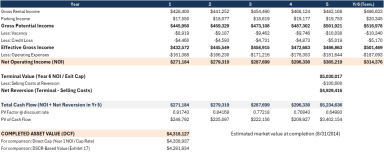
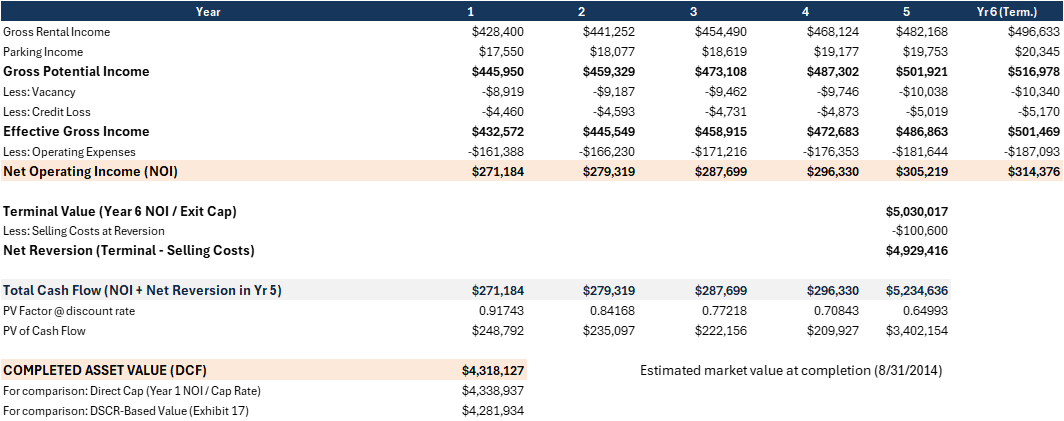
Feasibility studies where multiple valuation methods (direct cap, DSCR-implied, and DCF) need to be computed and compared for lender, investor, or internal review purposes
Transactions involving construction loan draw schedules with accruing interest, monthly equity funding, and a defined loan payoff at project completion
Academic, training, or presentation contexts where a worked example is needed to contrast simplified feasibility methods with rigorous financial modeling and to articulate the risks each method does or does not capture