Originally published: 12/06/2026 12:22
Publication number: ELQ-84319-1
View all versions & Certificate
Publication number: ELQ-84319-1
View all versions & Certificate

From Business Analyst to Delivery Manager - A Practitioner's Career Guide Through Four Roles
The honest career path from BA to Delivery Manager. Transition signals, common mistakes, salary realities, and 7 hard lessons no one teaches. Written by someone

business analystsenior business analystscrum masterdelivery managercareer pathcareer developmenttech career
Description
A Career Path Guide Written from Experience, Not Theory
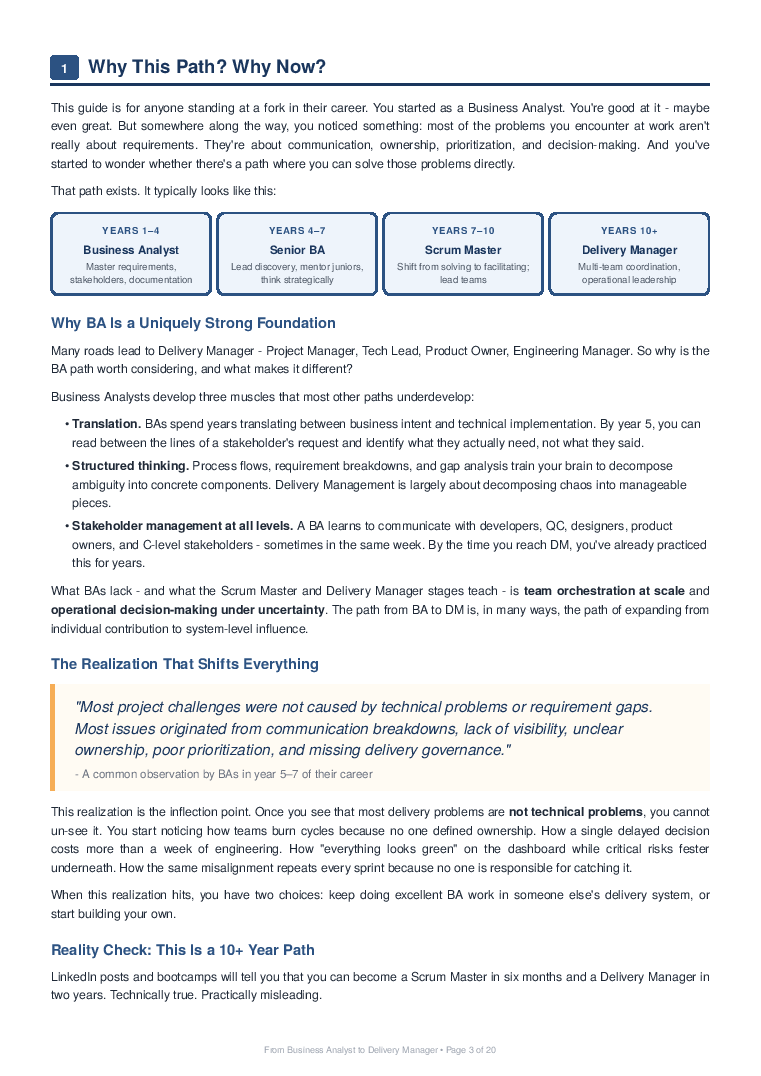
Most career content for Business Analysts is either too theoretical (career frameworks from people who never did the job) or too transactional (resume tips, interview hacks). This guide is different. It is written by a practitioner who spent approximately 10 years walking the exact path it describes: Business Analyst, Senior BA, Scrum Master, and now Delivery Manager.
The guide is shared freely as a contribution to the broader BA, Scrum, and delivery management community. It is not a sales document for a service or a course.
WHO THIS GUIDE IS FOR
This guide is written for tech professionals navigating one of the most common career paths in software delivery:
- Business Analysts wondering what comes after senior BA
- Senior BAs considering a pivot to Scrum Master
- Scrum Masters working toward the Delivery Manager
- Delivery Managers reflecting on their own path or mentoring others
- Engineering Managers and Heads of Delivery hiring or developing talent
- HR and Talent Development teams supporting tech career development
- CTOs and CEOs interested in how their delivery leaders develop
WHAT MAKES THIS GUIDE DIFFERENT
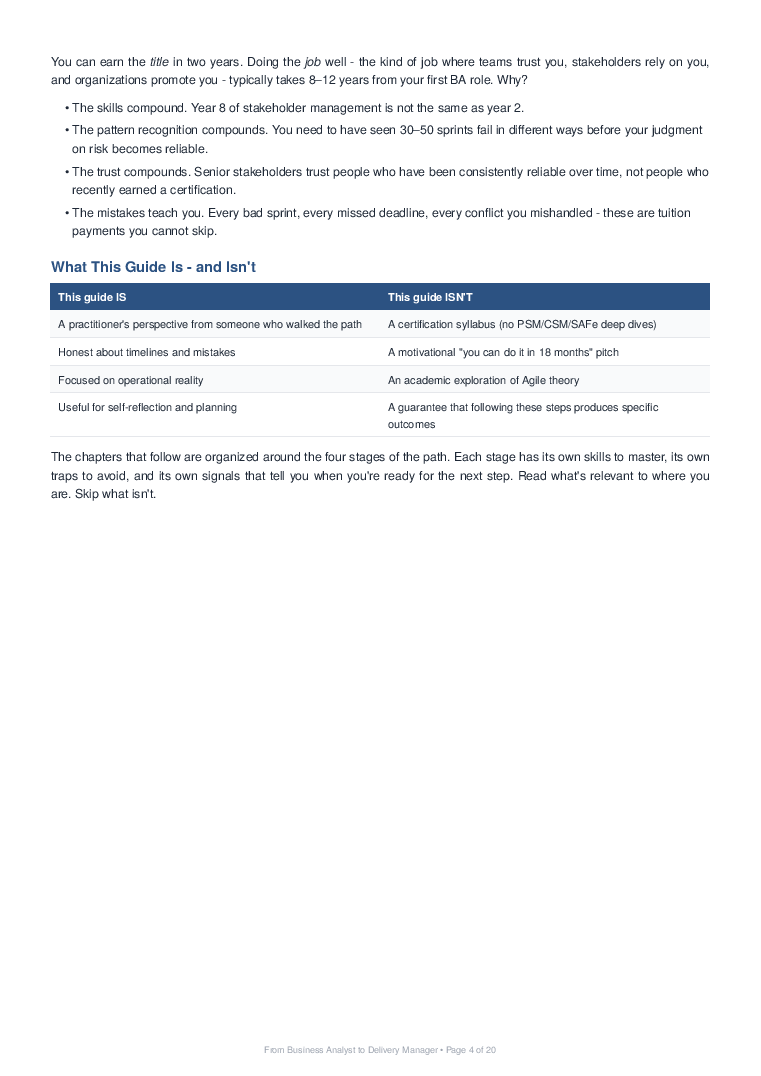
This guide is not a certification syllabus, a motivational pitch, or an academic exploration of Agile theory. It is a practitioner's honest reflection on a 10-year journey, with specific lessons that only come from doing the job.
Inside, you will find:
- Realistic timelines (8 to 12 years, not 2)
- Honest assessment of common mistakes at each transition
- The mindset shifts required when changing roles
- Case studies from real delivery situations (anonymized)
- Salary negotiation realities at each level
- A 7-question self-assessment for career readiness
ABOUT THE AUTHOR
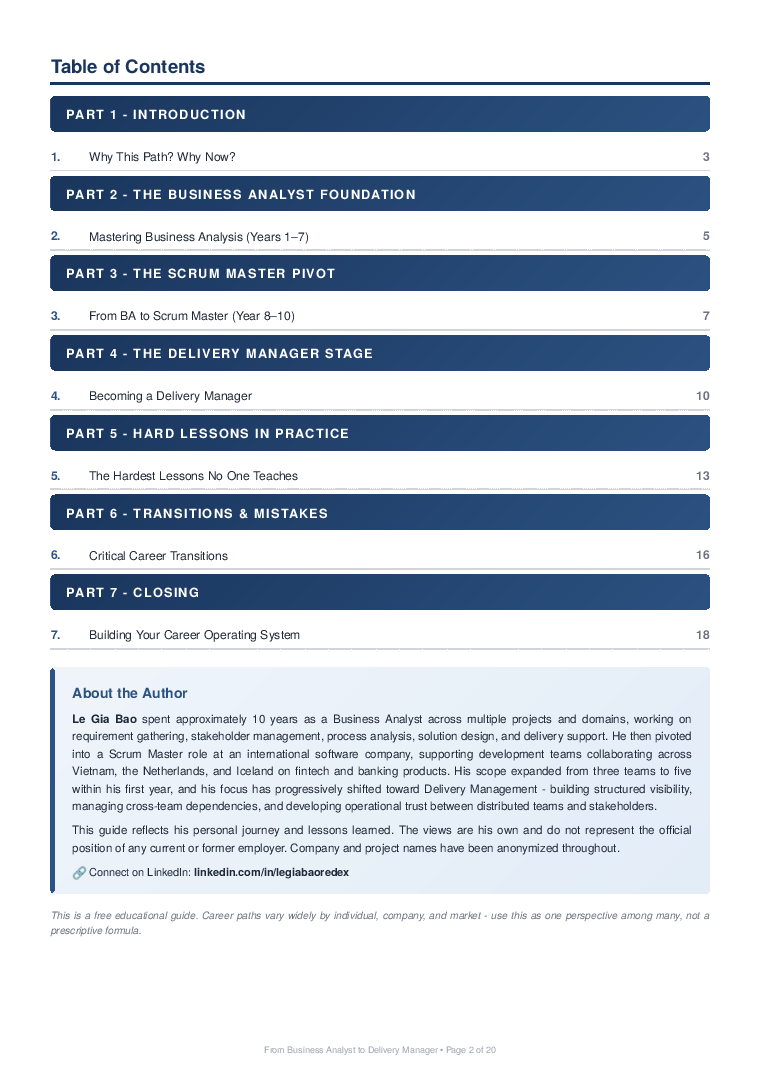
Gia Bao Le spent approximately 10 years as a Business Analyst across multiple projects and domains, then pivoted into a Scrum Master role at an international software company supporting development teams across Vietnam, the Netherlands, the US, Singapore, and Iceland on fintech, REC and banking products. His scope expanded from three teams to five within his first year, and his focus has progressively shifted toward Delivery Management.
This guide reflects his personal journey and lessons learned. The views are his own and do not represent any current or former employer. All company, client, and project names have been anonymized.
Connect on LinkedIn: linkedin.com/in/legiabaoredex
WHY FREE
This guide is shared freely because the BA to Delivery Manager community needs more honest practitioner content. If it helps even a few professionals navigate their careers with more clarity, that is reason enough.If you find it useful, the best way to thank the author is to share it with someone on the path, or connect on LinkedIn with your own observations and experiences.
A Career Path Guide Written from Experience, Not Theory
Most career content for Business Analysts is either too theoretical (career frameworks from people who never did the job) or too transactional (resume tips, interview hacks). This guide is different. It is written by a practitioner who spent approximately 10 years walking the exact path it describes: Business Analyst, Senior BA, Scrum Master, and now Delivery Manager.
The guide is shared freely as a contribution to the broader BA, Scrum, and delivery management community. It is not a sales document for a service or a course.
WHO THIS GUIDE IS FOR
This guide is written for tech professionals navigating one of the most common career paths in software delivery:
- Business Analysts wondering what comes after senior BA
- Senior BAs considering a pivot to Scrum Master
- Scrum Masters working toward the Delivery Manager
- Delivery Managers reflecting on their own path or mentoring others
- Engineering Managers and Heads of Delivery hiring or developing talent
- HR and Talent Development teams supporting tech career development
- CTOs and CEOs interested in how their delivery leaders develop
WHAT MAKES THIS GUIDE DIFFERENT
This guide is not a certification syllabus, a motivational pitch, or an academic exploration of Agile theory. It is a practitioner's honest reflection on a 10-year journey, with specific lessons that only come from doing the job.
Inside, you will find:
- Realistic timelines (8 to 12 years, not 2)
- Honest assessment of common mistakes at each transition
- The mindset shifts required when changing roles
- Case studies from real delivery situations (anonymized)
- Salary negotiation realities at each level
- A 7-question self-assessment for career readiness
ABOUT THE AUTHOR
Gia Bao Le spent approximately 10 years as a Business Analyst across multiple projects and domains, then pivoted into a Scrum Master role at an international software company supporting development teams across Vietnam, the Netherlands, the US, Singapore, and Iceland on fintech, REC and banking products. His scope expanded from three teams to five within his first year, and his focus has progressively shifted toward Delivery Management.
This guide reflects his personal journey and lessons learned. The views are his own and do not represent any current or former employer. All company, client, and project names have been anonymized.
Connect on LinkedIn: linkedin.com/in/legiabaoredex
WHY FREE
This guide is shared freely because the BA to Delivery Manager community needs more honest practitioner content. If it helps even a few professionals navigate their careers with more clarity, that is reason enough.If you find it useful, the best way to thank the author is to share it with someone on the path, or connect on LinkedIn with your own observations and experiences.
This Best Practice includes
1 PDF document (20 pages)
