Institutional-Grade DCF Valuation Model — 10-Year Excel with WACC Builder, Scenario Analysis & AI Commentary
Originally published: 16/05/2026 18:25
Last version published: 25/09/2026 16:11
Publication number: ELQ-13200-4
View all versions & Certificate
certified

Institutional-Grade DCF Valuation Model — 10-Year Excel with WACC Builder, Scenario Analysis & AI Commentary

A 10-year unlevered-FCF DCF valuation model in Excel: WACC builder (CAPM + Hamada + CSRP), Base/Bull/Bear scenarios, two sensitivity grids checked back against

Description

Built for the moment you have to defend an intrinsic value — to an investment committee, a board, a client, or a sceptical interviewer.

The model takes revenue-growth, margin, D&A, capex, and working-capital assumptions plus a WACC assembled from sourced components, and produces:

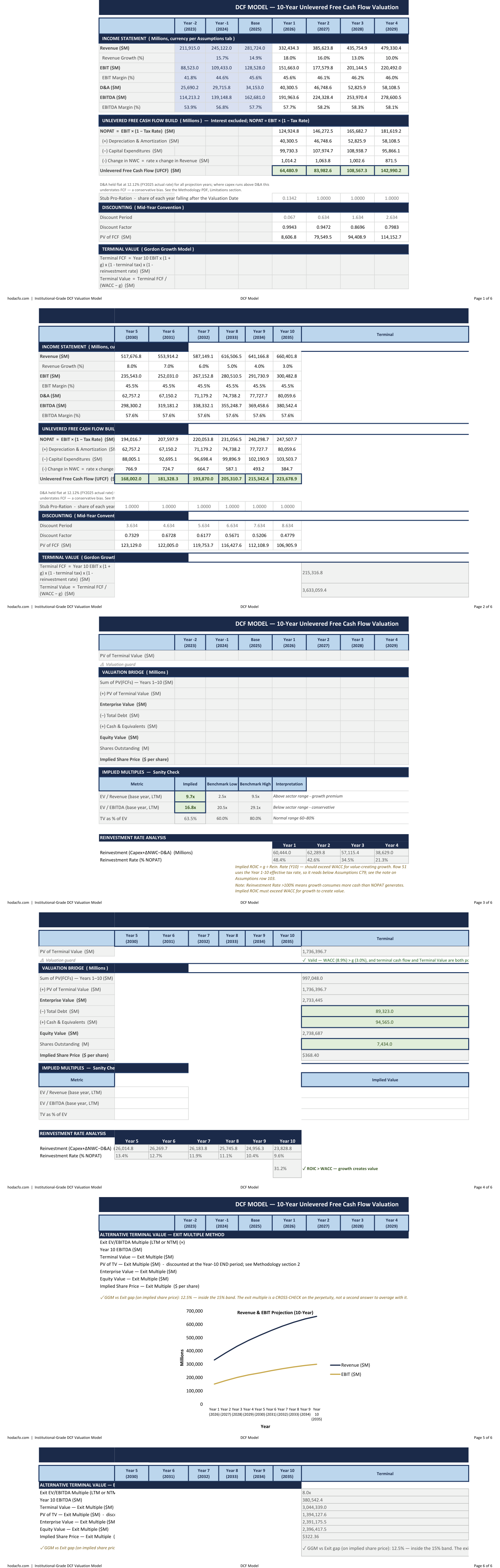
  • A 10-year unlevered free cash flow projection with mid-year discounting,

  • A guarded Gordon Growth terminal value with an exit-multiple cross-check,

  • Three scenarios,

  • Two sensitivity grids,

  • Implied multiples against published sector aggregates,

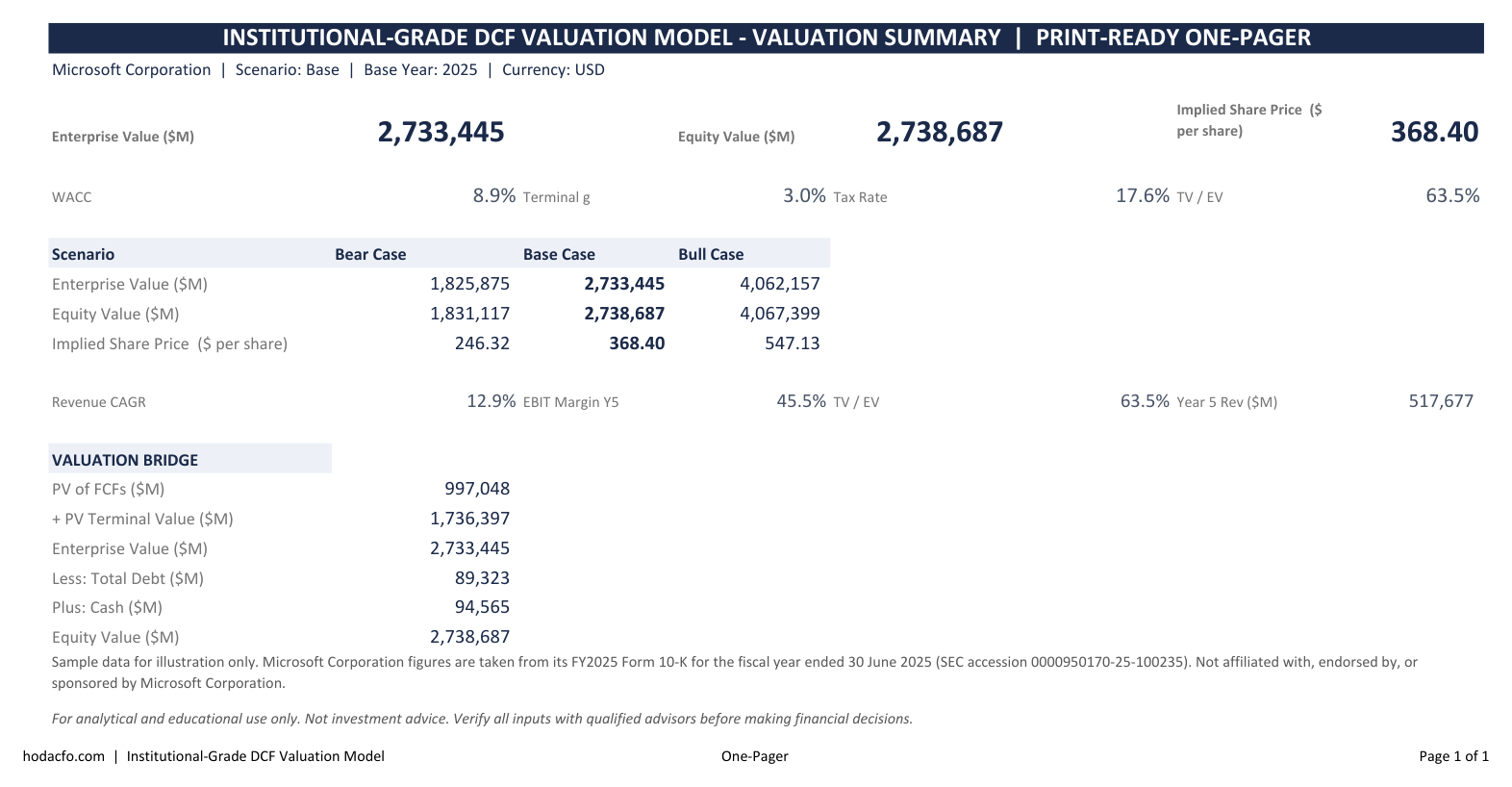
  • A board-ready one-pager, dashboard, and commentary template.

Why This OneArithmetic Verification
  • On the shipping build: zero error cells across all 12 tabs under an Excel full rebuild.

  • The golden-case oracle reproduces 18 of 18 stored answers within tolerance, largest absolute difference 0.

  • 13 headline figures and all 84 sensitivity-grid cells rebuilt independently outside Excel with a worst relative difference of 1.9e-15.

  • 27 live blocking checks tie, including:

    • The headline figures against the scenario engine,

    • Sensitivity Table 1's centre against the model (check 24),

    • Three further ties on Table 2 printed as a verdict line on the Sensitivity Analysis tab — four grid tie points in all, largest measured gap 2.3e-10.

Market Inputs
  • Every market input in the worked example is dated in the workbook and named to its source in the 12-page Methodology PDF:

    • The 10-year government-bond yield at the valuation date (US Treasury daily yield curve, per the PDF),

    • Damodaran January 2026 implied ERP,

    • SEC XBRL filing data (accession 0000950170-25-100235).

  • The levered beta is dated but deliberately not attributed to a vendor: it is a modelling assumption, and the PDF says so.

Scenario System
  • The scenario system computes the Base case unconditionally, so the comparison never collapses onto the live toggle.

Contents (12 Tabs)
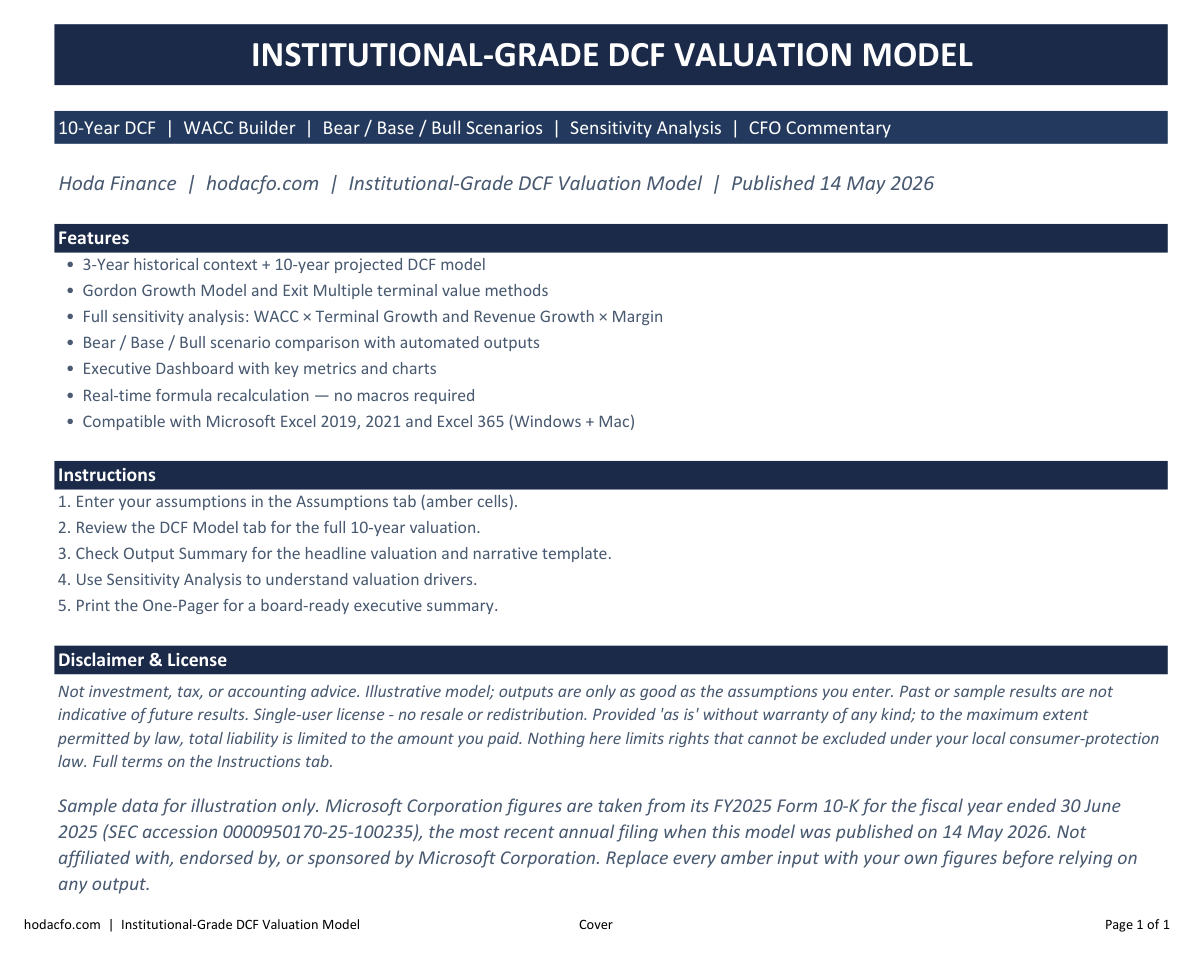
  1. Cover

  2. Quick Start

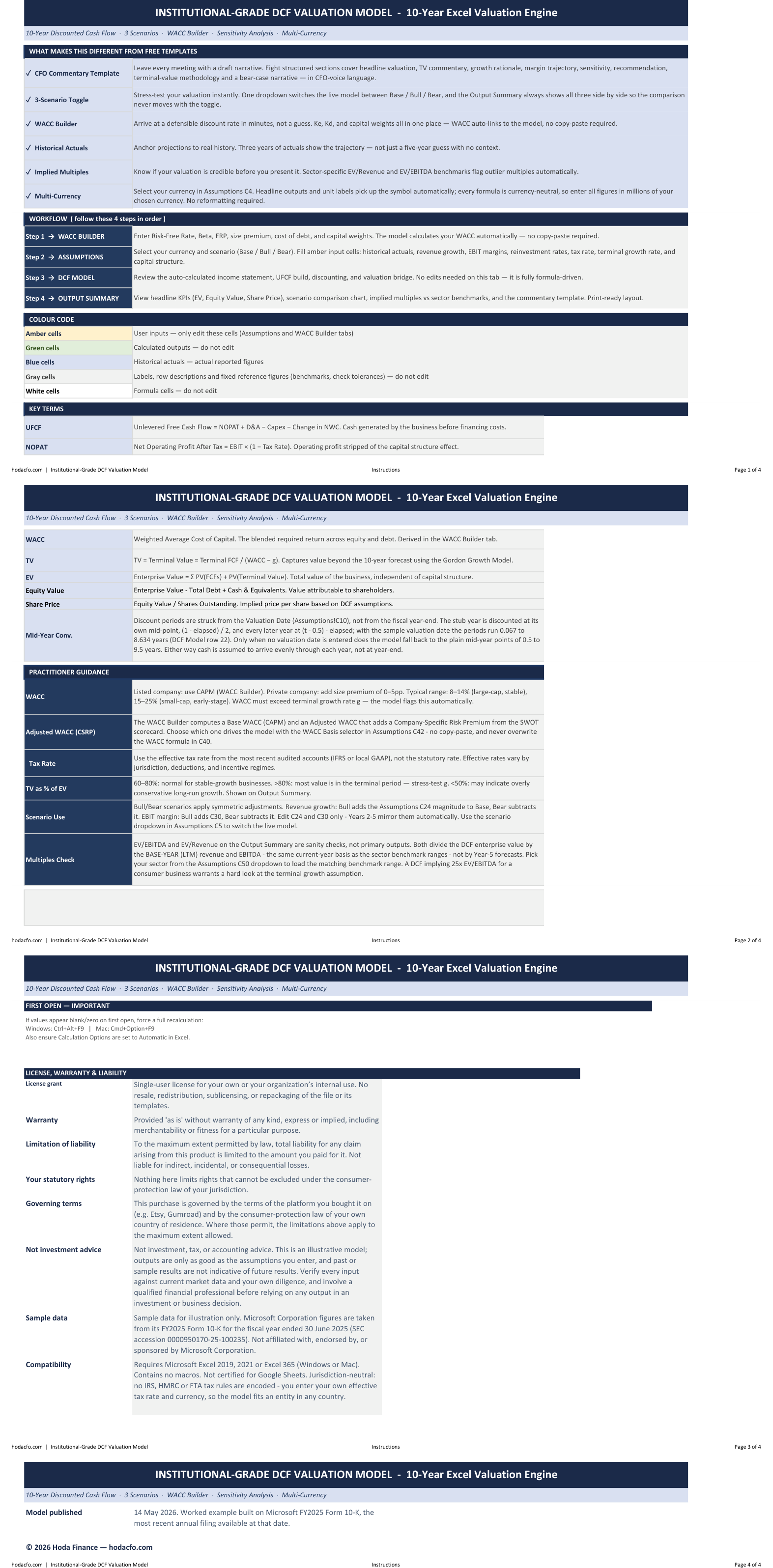
  3. Instructions

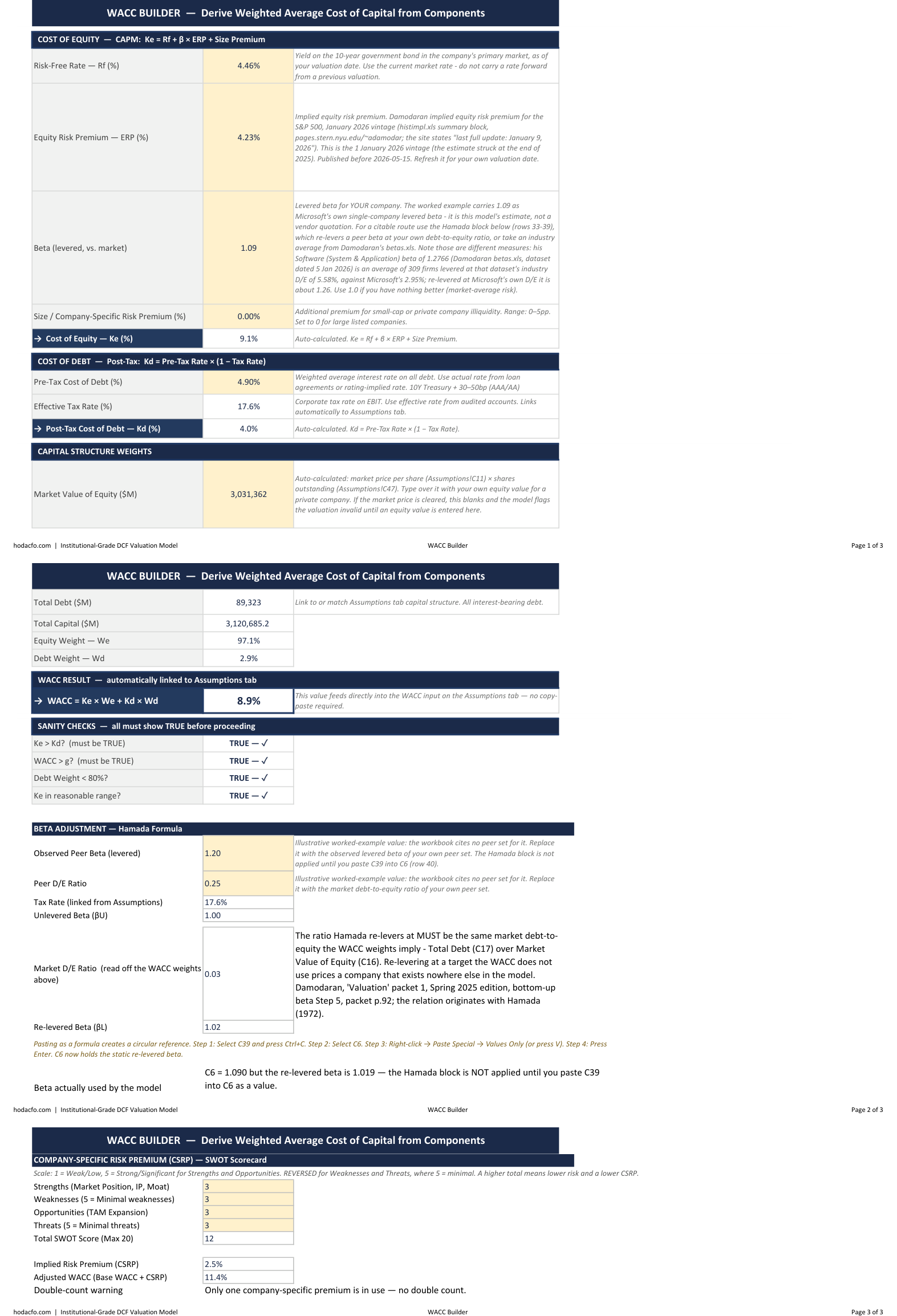
  4. WACC Builder (CAPM, Hamada re-levering, 0–5% CSRP SWOT scorecard, 4 sanity checks)

  5. Assumptions

  6. DCF Model (UFCF build, mid-year discounting, terminal value with guard, equity bridge, reinvestment-rate/ROIC analysis, exit-multiple cross-check)

  7. Sensitivity Analysis

  8. One-Pager

  9. Executive Dashboard (KPI tiles and both charts)

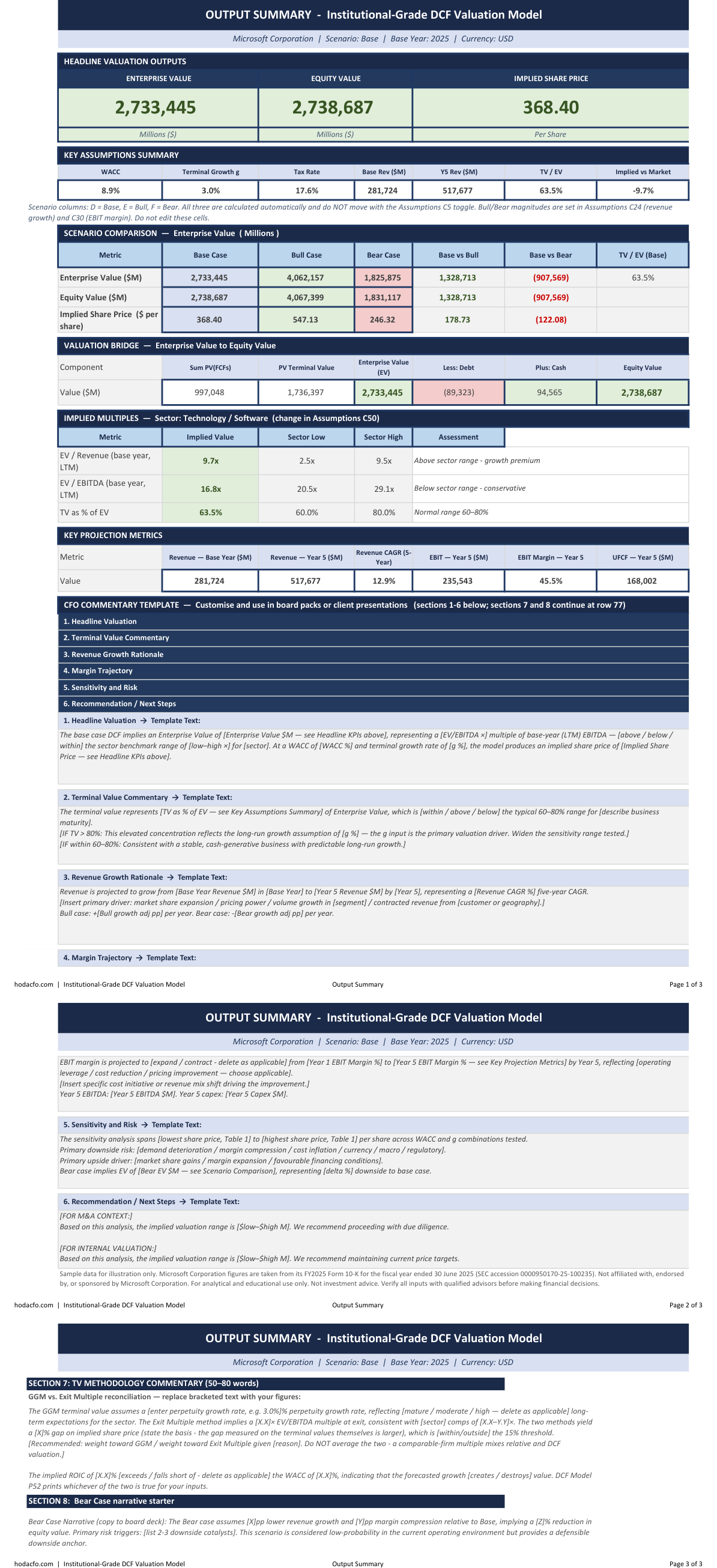
  10. Output Summary (three-scenario comparison computed in parallel, valuation bridge, implied multiples vs benchmarks, Share Price by Scenario bar chart, 8-section CFO Commentary Template)

  11. Checks (27 blocking checks against explicit tolerances: 7 independent rebuilds, 11 identities, 9 ordering/bound/link tests, master PASS/REVIEW flag, DATA AS-OF block)

  12. AI Prompts (5 structured prompts with anti-hallucination guardrails — no API, no subscription)

Worked Example

Microsoft FY2025 (Form 10-K):

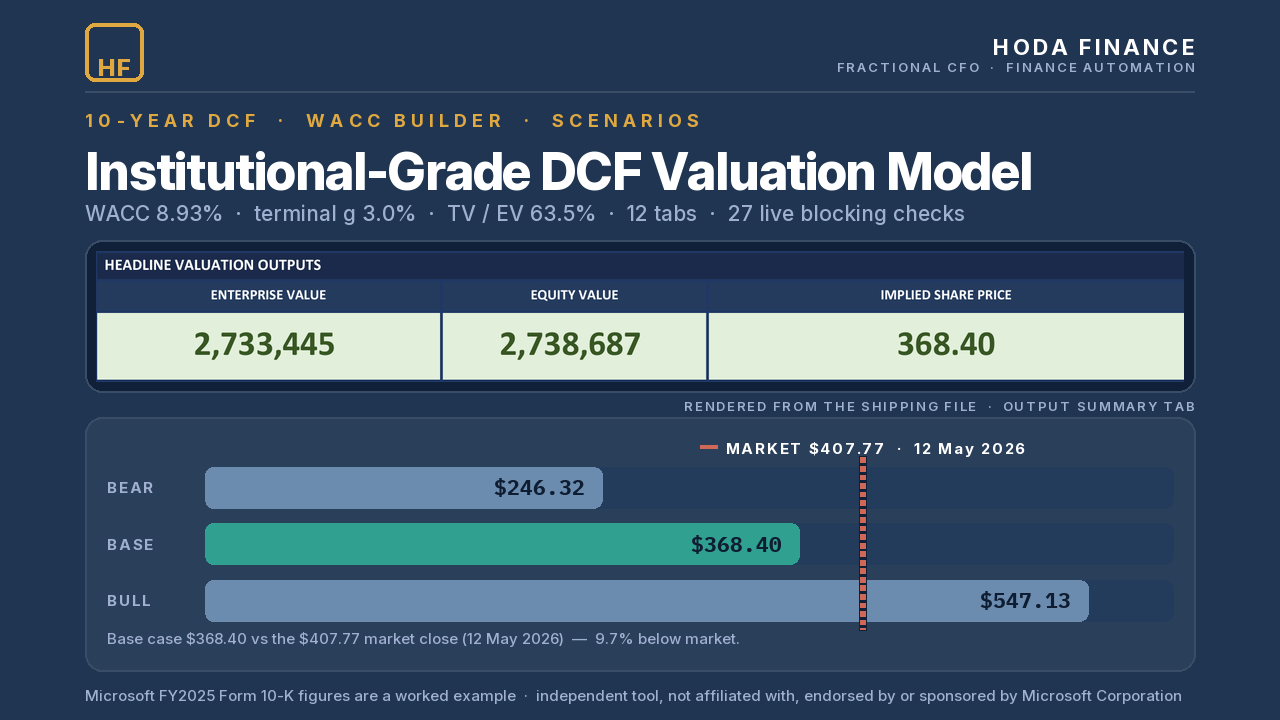
  • WACC: 8.93% (Ke 9.07%, post-tax Kd 4.04%)

  • Enterprise Value: $2,733,444.7M

  • Equity Value: $2,738,686.7M

  • Implied Share Price: $368.40 per share against a $407.77 market close on the 12 May 2026 valuation date — a -9.7% implied-vs-market gap the model prints explicitly.

  • Bear Case: $246.32

  • Bull Case: $547.13

  • Exit-Multiple Cross-Check: $322.36 at 8.0x

  • TV/EV: 63.5%

Customization:

  • Clear the amber inputs and enter your own company — public or private, any operating sector, five currency label options.

  • For a private company, the Hamada block re-levers the beta into WACC Builder C39, which you paste into C6 as a value, and the WACC Basis selector on Assumptions (C42) switches the company-specific premium in: two deliberate steps the sheet spells out rather than performing behind your back.

Default State:

  • Currency: USD

  • Scenario: Base

  • WACC Basis: Base

Specification
  • 12 tabs

  • 1,638 formula cells

  • 4 charts

  • Excel 2019 / 2021 / 365 (Windows & Mac)

  • Common functions only — no XLOOKUP, no LAMBDA, no LET, no dynamic arrays

  • No macros, no VBA

  • Calculated cells locked with no password, amber inputs editable

  • Includes:

    • 7-page Practitioner's Guide PDF

    • 12-page Methodology & Input Sources PDF

  • SHA256[:16]: 6df9a6e4ffd73b6f

  • Jurisdiction-neutral: No IRS, HMRC, or FTA tax rules are encoded — you enter your own effective tax rate, so it fits entities in any country.

  • Data Privacy: Your data stays with you — no macros, no external links, nothing transmitted — the AI prompts are text you paste into an AI tool under your own account.

Scope

What It Is:

  • A DCF model for intrinsic valuation using unlevered free cash flows.

What It Is Not:

  • Not for banks, insurers, or financial institutions (an unlevered-FCF DCF is the wrong tool there).

  • Not a three-statement model.

  • No LBO/merger analysis, sum-of-the-parts, quarterly periodicity, or FX translation.

  • Excel only — not certified for Google Sheets.

About the Author

Built by Hoda Elmorshidy — Financial Controller & Fractional CFO, in senior finance since 2017:

  • IFRS reporting,

  • FP&A,

  • Finance automation,

  • Quantitative Analysis,

  • Financial Modeling,

  • UAE VAT & Corporate Tax.

Practitioner-grade tools, not generic templates.

Disclaimer

Not investment, tax, or accounting advice. This is an illustrative analytical model; outputs are only as good as the assumptions you enter, and past or sample results are not indicative of future results. Verify all inputs and assumptions with a qualified financial professional before use in any investment or business decision.

Sample Data:

  • Microsoft Corporation figures are from its FY2025 Form 10-K (SEC accession 0000950170-25-100235, fiscal year ended 30 June 2025), market anchor dated 12 May 2026.

  • This product is not affiliated with, endorsed by, or sponsored by Microsoft Corporation.

License & LiabilityLicense Grant
  • Single-user license for your own or your organization's internal use.

  • No resale, redistribution, sublicensing, or repackaging of the file or its templates.

As Is
  • Provided "as is" without warranty of any kind, express or implied, including merchantability or fitness for a particular purpose.

Limitation of Liability
  • To the maximum extent permitted by law, total liability for any claim arising from this product is limited to the amount you paid for it.

  • Not liable for indirect, incidental, or consequential losses.

Non-Waivable Rights
  • Nothing here limits rights that cannot be excluded under the consumer-protection law of your jurisdiction.

Governing Law
  • This purchase is governed by the terms of the platform you bought it on and by the consumer-protection law of your own country of residence.

  • Where those permit, the limitations above apply to the maximum extent allowed.

Refunds & Fixes
  • This is an instant digital download, sold on a fix-first basis rather than a returns basis.

  • If something is genuinely wrong with the file — it will not open, a formula returns an error, a tab or feature described on this page is missing, or a stated calculation is wrong — contact the author through the platform you bought on, or email [email protected], with your order number and a screenshot.

  • If something genuinely cannot be fixed, the author will tell you so plainly rather than leave it open.

  • Change-of-mind refunds are not offered: the file is delivered in full and immediately, and the scope is set out before you buy, so you can check the fit first.

  • Outputs that depend on your own assumptions, and anything listed as out of scope, are not defects.

Trademarks & Non-Affiliation
  • Microsoft, Excel, and Copilot are trademarks of Microsoft Corporation.

  • Windows is a trademark of Microsoft Corporation.

  • Mac and macOS are trademarks of Apple Inc.

  • Google Sheets is a trademark of Google LLC.

  • ChatGPT is a trademark of OpenAI.

  • Claude is a trademark of Anthropic.

  • Etsy is a trademark of Etsy, Inc.

  • Gumroad is a trademark of Gumroad, Inc.

This product is an independent analytical tool: it is NOT affiliated with, endorsed by, or sponsored by any of the above entities.

  • References to Damodaran datasets, the US Treasury yield curve, SEC EDGAR/XBRL, and other public sources are source attributions only and imply no affiliation or endorsement.

This Best Practice includes
1 excel file, 2 PDF

Acquire business license for $129.00

Add to cart

Add to bookmarks

Discuss

Further information

• Produce a defensible single-company intrinsic valuation: 10-year unlevered
free cash flow, mid-year discounting, guarded Gordon Growth terminal value
• Build the discount rate from sourced components — CAPM cost of equity,
post-tax cost of debt, market-value weights — with Hamada re-levering and a
structured 0–5% company-specific risk premium for private companies
• Stress the answer before someone else does: Base/Bull/Bear scenarios, WACC ×
growth and growth × margin sensitivity grids, and an exit-multiple
cross-check with an automated divergence flag
• Communicate the result: board-ready one-pager, executive dashboard, CFO
commentary template and 5 structured AI prompts with anti-hallucination
guardrails

• Valuing an operating company — public or private — where free cash flow to
the firm is a meaningful measure
• An analyst, CFO, adviser or investor who must defend the number to an
investment committee, board, client or counterparty
• A private-company valuation needing a beta re-levered from listed peers and
an explicit, scored company-specific risk premium
• A user who wants every worked-example input dated in the workbook and traceable
to a named public source in the Methodology PDF before trusting the method with
their own data

• Banks, insurers and other financial institutions — an unlevered-FCF DCF is
the wrong tool; use a dividend-discount or excess-return model
• Full three-statement modelling (no balance sheet or cash-flow statement build)
• LBO, merger/accretion-dilution or sum-of-the-parts analysis
• Quarterly or monthly periodicity (the model is annual)
• Multi-currency consolidation (the currency dropdown changes labels, not FX)
• Google Sheets use — the product is Excel-only and not certified for Sheets


0.0 / 5 (0 votes)

please wait...