Publication number: ELQ-90776-1
View all versions & Certificate

Solar Project Finance Model (Excel) | DSCR Sculpting · LLCR/PLCR · DSRA · Covenant Testing · LP/GP Waterfall · P90 Yield
A 22-tab lender-grade solar project finance model: DSCR-sculpted debt with a gearing cap, LLCR/PLCR, construction IDC, a funded DSRA, covenant lock-up and defau
 by Hoda Elmorshidy
Financial Controller & Fractional CFO, in senior finance since 2017: IFRS reporting, FP&A, finance automation, Quantitative Analysis, Financial ModelingFollow
Most solar models tell you the deal works.
This one tells you when it breaks — the exact period the DSCR dips toward the covenant, whether the lock-up traps your distributions, and how much reserve it takes to hold the line.
Across the 53 solar-titled models on the largest financial-model marketplace, not one names DSCR sculpting, LLCR, PLCR, DSRA, P90, or LCOE in its title (measured on the live catalogue, 2026-08-02; titles only) — those six are what a credit committee asks about, and they are what this model is built around.
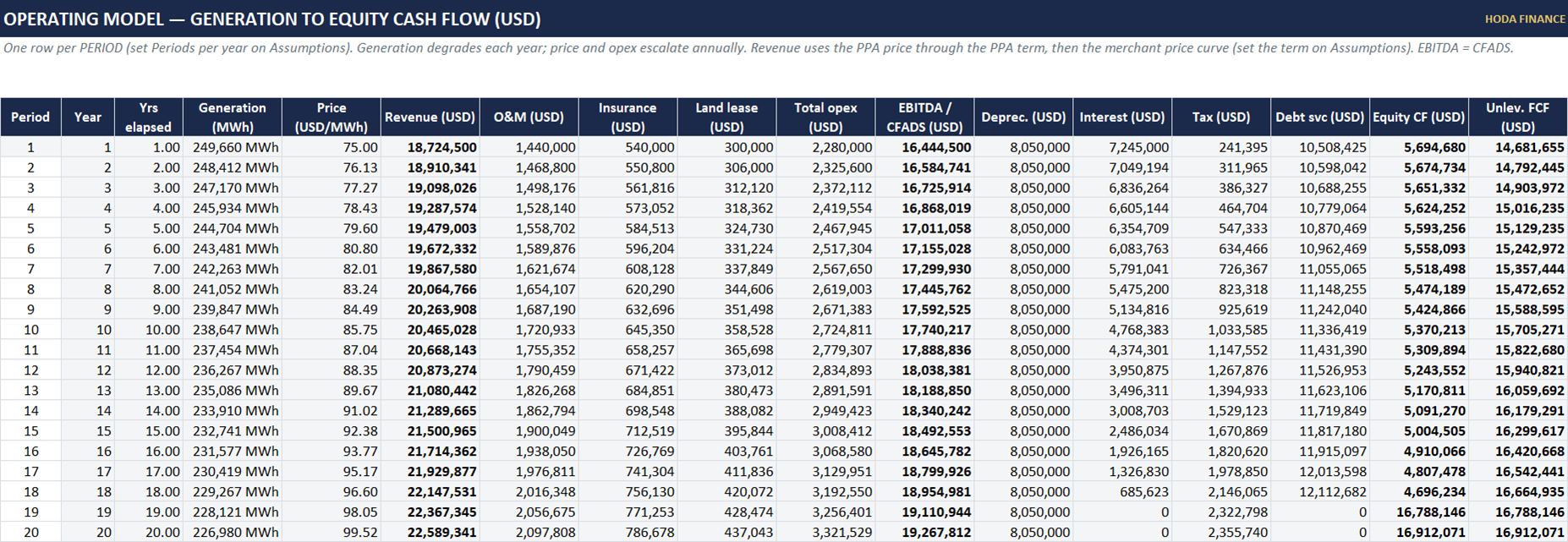
The Solar Project Finance Model is a self-contained, single-asset project finance model for lenders' credit teams, investment committees, developers, and infrastructure funds underwriting a contracted utility-scale solar project. Enter the plant, the offtake, the financing terms, and the tax profile; the model sizes the senior debt by sculpting it to a target DSCR, caps it at your maximum gearing, and builds the full generation-to-equity-cash-flow waterfall with the coverage, returns, and covenant outcomes a credit committee asks for.
The differentiator is verifiability.
Every headline figure is recomputed two independent ways:
- Every formula is re-derived in an independent engine.
- Each headline is rebuilt from raw inputs in a separate model sharing no formulas with the workbook.
- The release passes a five-stage verification chain before it ships.
The method has additionally survived an adversarial cross-lab review: a model from a different AI lab, instructed to break it rather than agree with it, ran against this exact shipping build, rebuilt the model blind from the raw inputs, and matched it — capital structure, coverage ratios, and both LCOE figures to the cent, return metrics within the documented solver tolerance, all five optional modules exercised.
THE PROBLEM
A solar deal lives or dies on the debt number, and the debt number depends on a chain most templates skip:
- Sculpt the debt to a target DSCR.
- Cap it at maximum gearing.
- Fund construction interest without creating a circular reference.
- Hold a reserve.
- Test the covenant every period.
Get one link wrong, and the model still balances — it is just wrong in the sponsor's favor. And the whole equity margin can sit inside a resource assumption that never gets stress-tested.
WHY NOT JUST USE A CHEAPER ONE?
Solar models run from $30 to $169.95 across a 3,100-listing template catalogue (the handful priced below $30 are country market studies, not models), and NREL's SAM is free and very good at energy yield. Use either if it gives you the right answer.
What you are paying for here is arithmetic that has been adversarially checked rather than assumed — and every claim below is one you can check yourself:
- Every one of the 13,951 formulas is re-derived in an independent engine, and every headline is rebuilt a second time from raw inputs by a separate model that shares no formulas with the workbook.
- The release passes a five-stage verification chain — including a golden case with a closed-form answer — before it ships.
- The method has been through an adversarial cross-lab review: a model from a different AI lab, instructed to break the model rather than agree with it, ran against this exact shipping build. It rebuilt the model blind from the raw inputs in its own code, matched the capital structure, coverage ratios, and both LCOE figures to the cent, matched the return metrics within the documented solver tolerance, and exercised all five optional modules, including forcing a covenant breach and locating the tax-equity flip from the file's own forward test.
- The debt number is bounded by construction:
debt = MAX(0, MIN(sculpted debt, maximum gearing × hard capex))
That bound is not automatic in DSCR sizing: NREL's SAM carried an unbounded debt fraction that could return debt above 100% of installed cost and negative equity — raised as NREL/SAM issue #534 in February 2021 and fixed that November.
Set the PPA price to zero here, and the debt floors at zero rather than turning negative; the same bound is reproduced independently by the Layer-B rebuild. - Defaults are calibrated to published data (LBNL capex, Lazard LCOE), not invented.
- Of the 53 solar-titled models in a 3,100-listing marketplace catalogue pulled 2026-08-02, not one names DSCR sculpting, LLCR, PLCR, DSRA, P90, or LCOE in its title (counting rule: title text only — a model can implement a mechanic without naming it in the title).
If a cheaper model gets those things right, it will agree with this one. That is the point — you can check.
WHAT YOU GET
Core Features
- DSCR-sculpted senior debt with a gearing cap on hard capex — closed form, no circular references.
- LLCR and PLCR, discounted at the cost of debt.
- A construction period with interest during construction capitalized into capex.
- A funded DSRA that re-times equity and revolves to zero at maturity.
- Covenant testing: per-period breach, distribution lock-up, cure periods, event of default.
- An LP/GP promote waterfall — preferred return, return of capital, GP catch-up, promote — with LP and GP IRR and MoIC.
- A depreciation engine (straight-line / declining-balance / custom) with an optional NOL carryforward.
- A post-PPA merchant tail.
- Analytic P50 / P75 / P90 / P95 / P99 yield and the LCOE at each.
- Nominal and real LCOE, project NPV, dated project and equity IRR, equity multiple.
Advanced Features
- Sub-annual periodicity — annual, semi-annual, or quarterly — from one input.
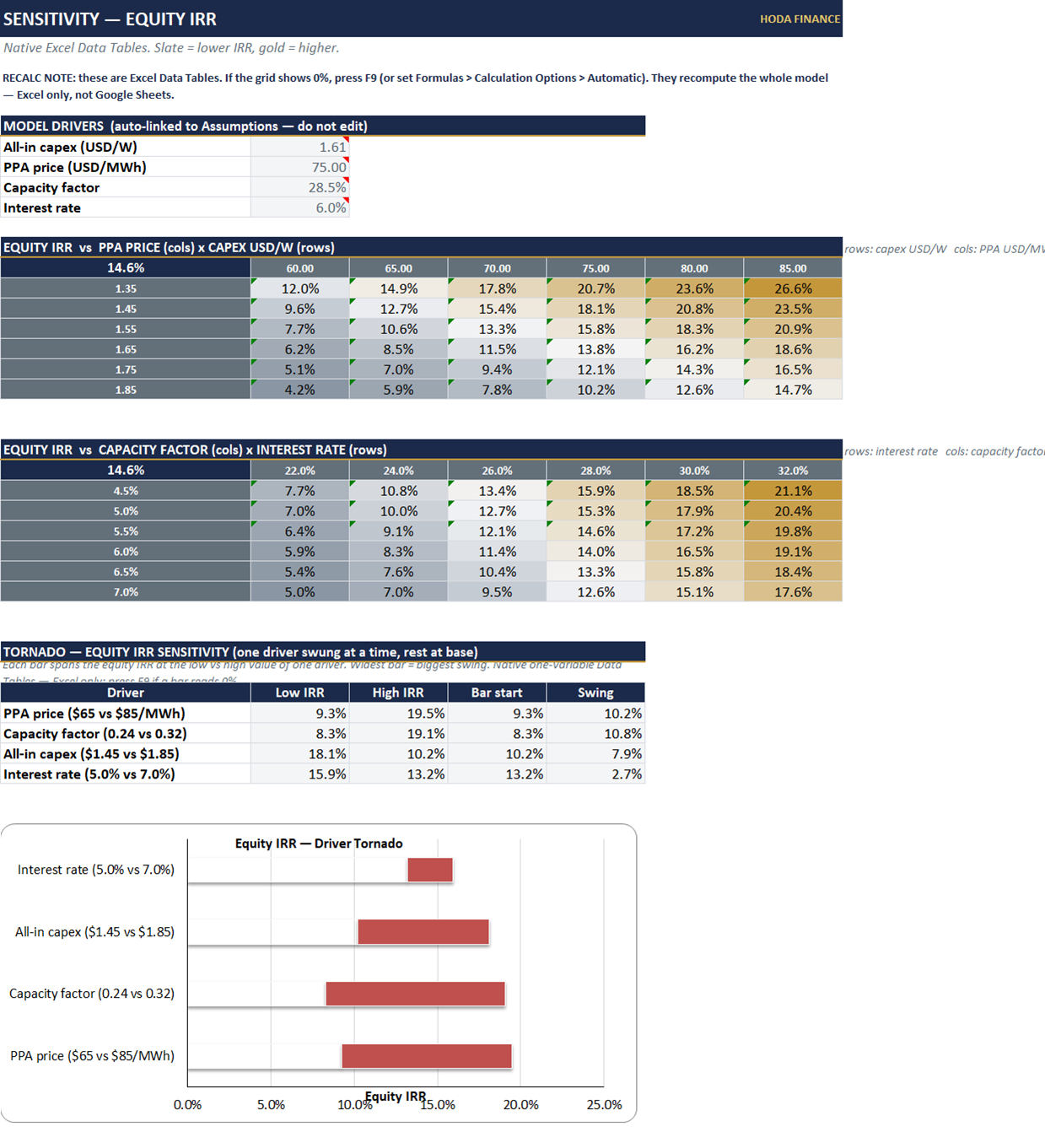
- Two native two-variable Data Tables and a driver tornado.
- An integrity Checks tab rolling every reconciliation into one PASS / REVIEW flag.
Documentation & Extras
- A 4-page deal book, a 2-page IC walkthrough, a 6-page lender print pack, a methodology PDF, and a 14-prompt AI commentary pack.
- A checksum file covering every file in the download, so you can verify the package arrived exactly as released.
MODEL STRUCTURE — 22 TABS
START HERE · Deal Dossier · Assumptions · Scenarios · Debt Schedule · Construction · Mezzanine · Storage · Operating Model · Tax · Covenants · DSRA · Returns · Waterfall · Tax Equity · Yield · Sensitivity · Checks · Dashboard · Glossary · Input Register · Change Log
SEE IT WORKING
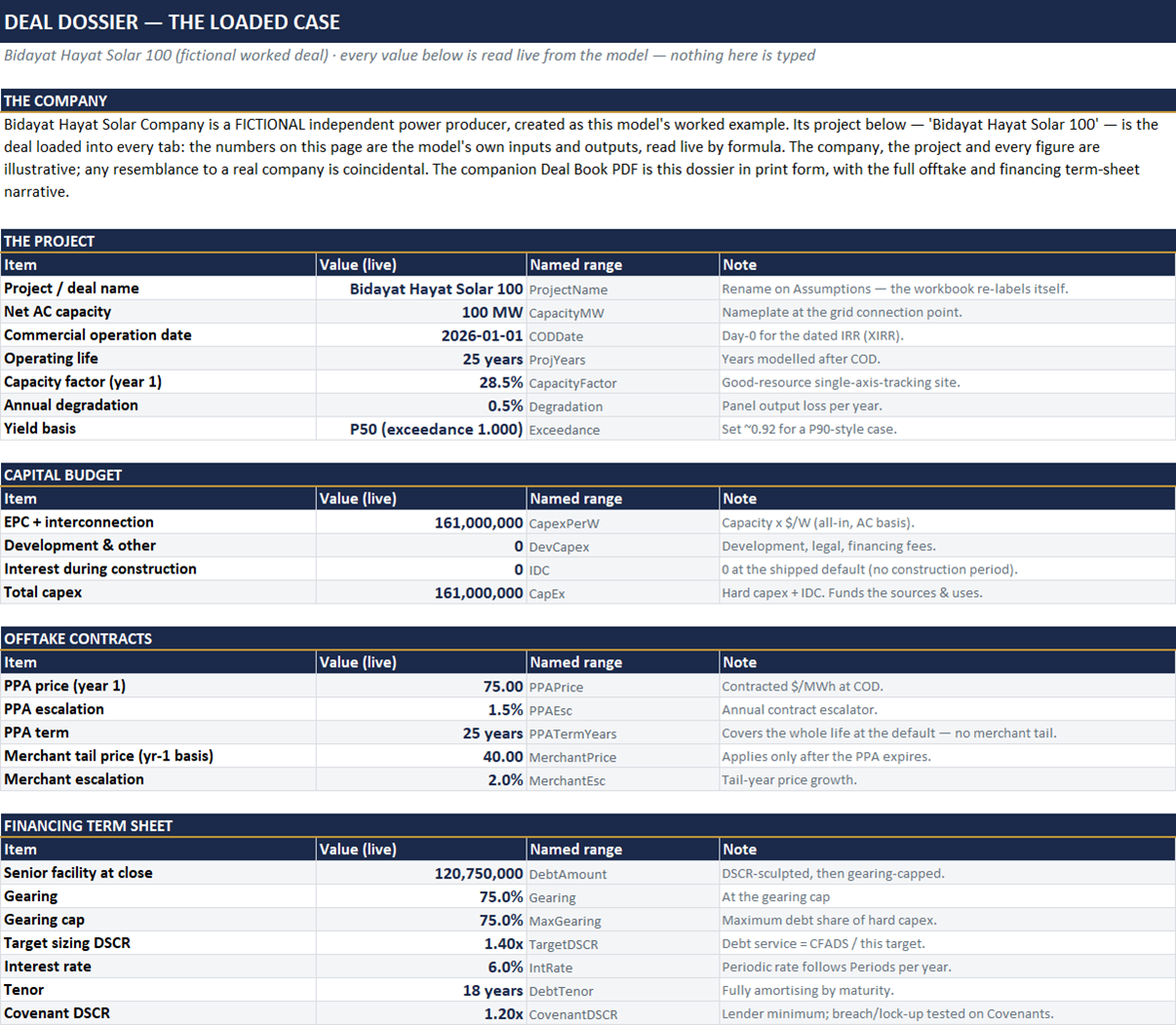
Pre-loaded with the fictional "Bidayat Hayat Solar 100" —
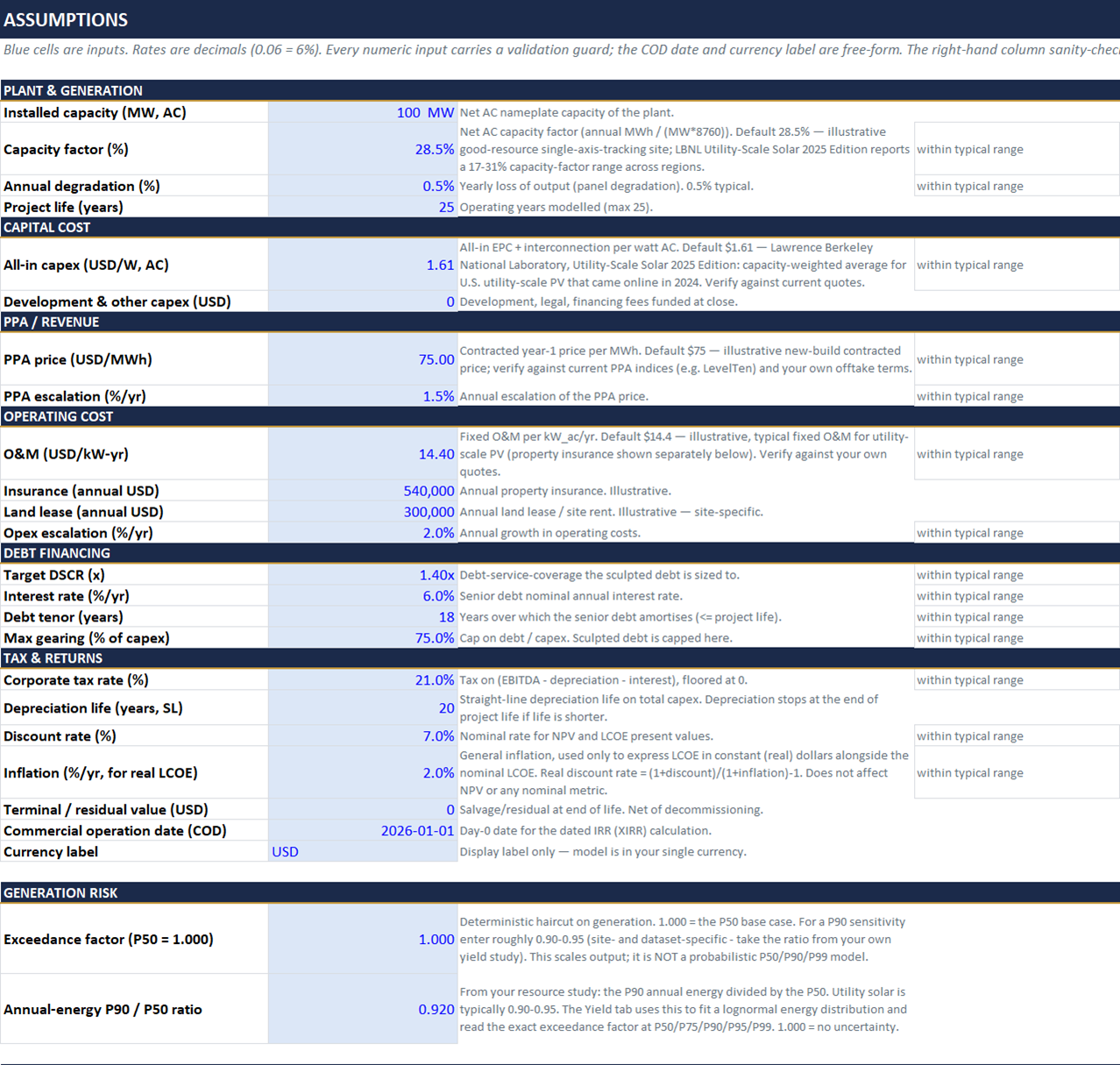
- 100 MW AC at $1.61/W ($161.0M), 28.5% capacity factor, $75/MWh PPA escalating 1.5%, 18-year debt at 6.0% sculpted to 1.40x against a 1.20x covenant, 25-year life.
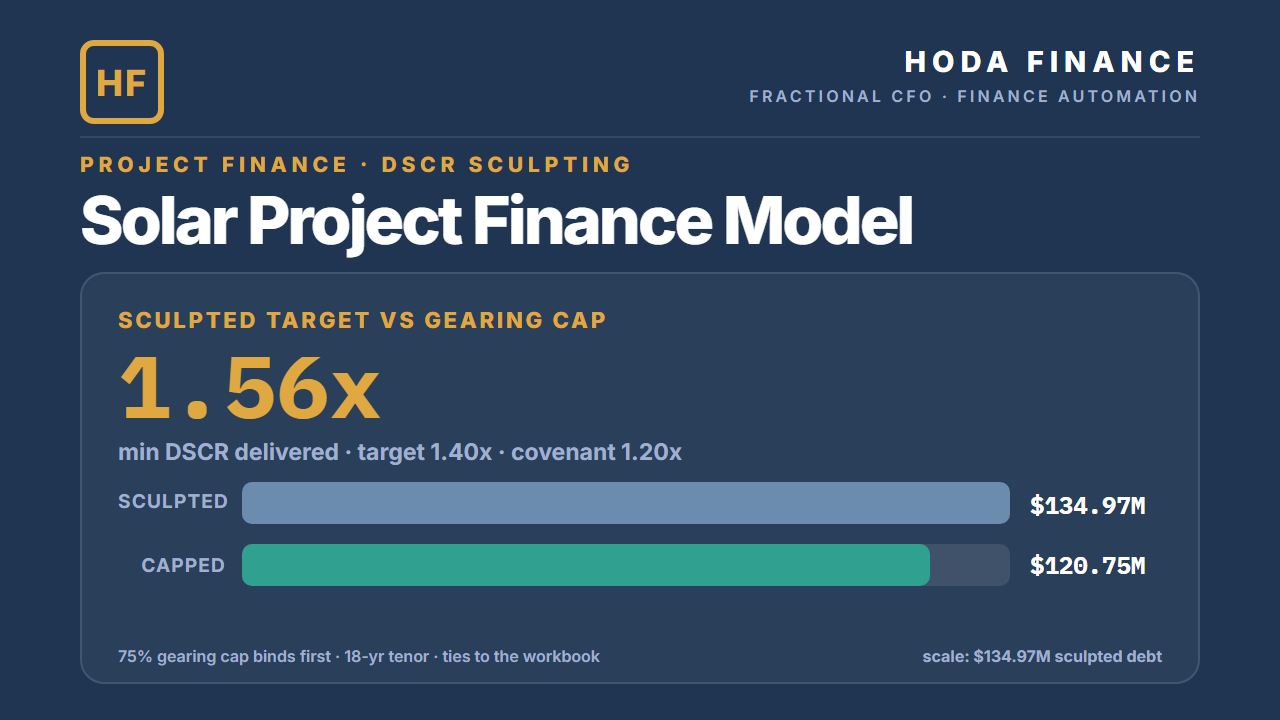
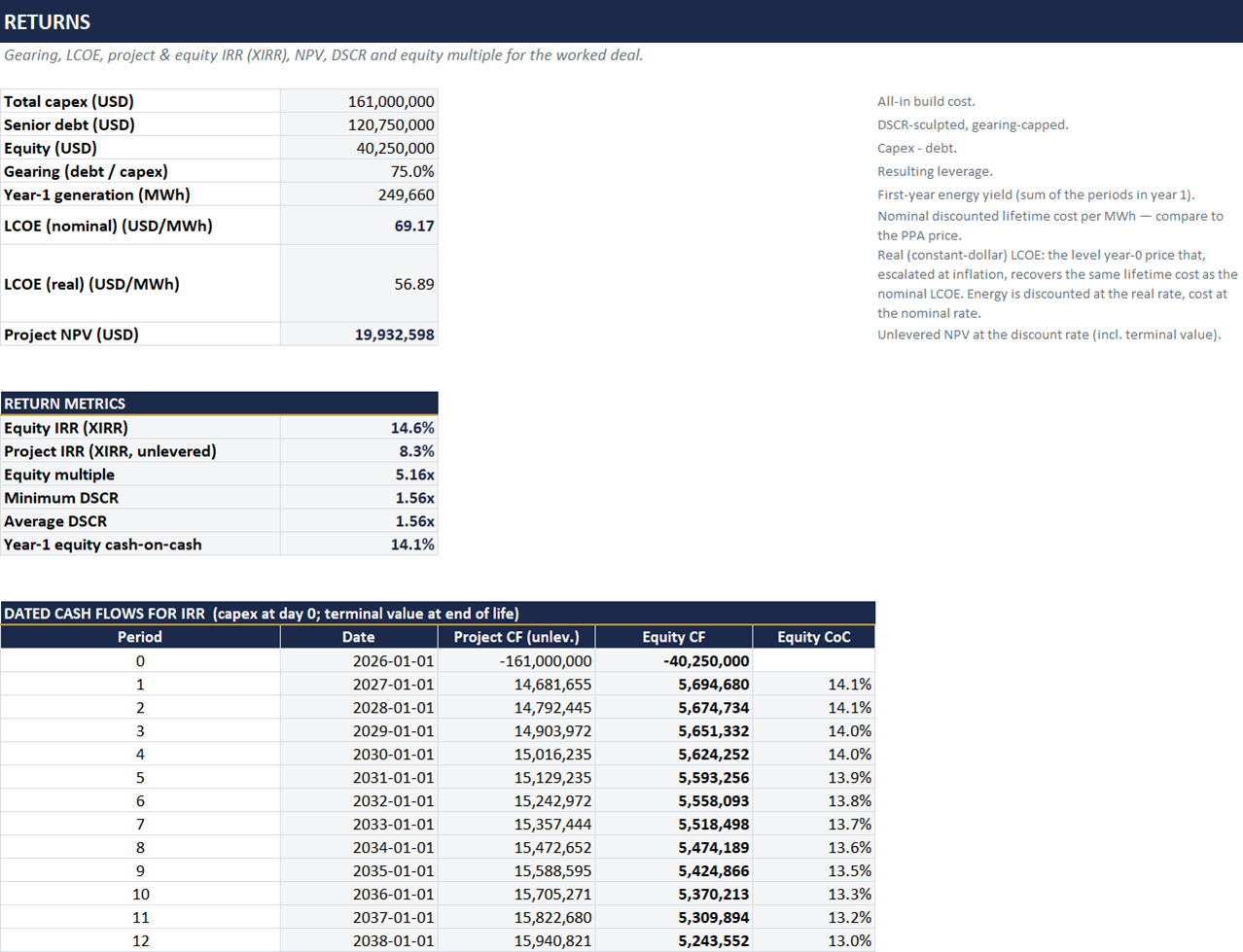
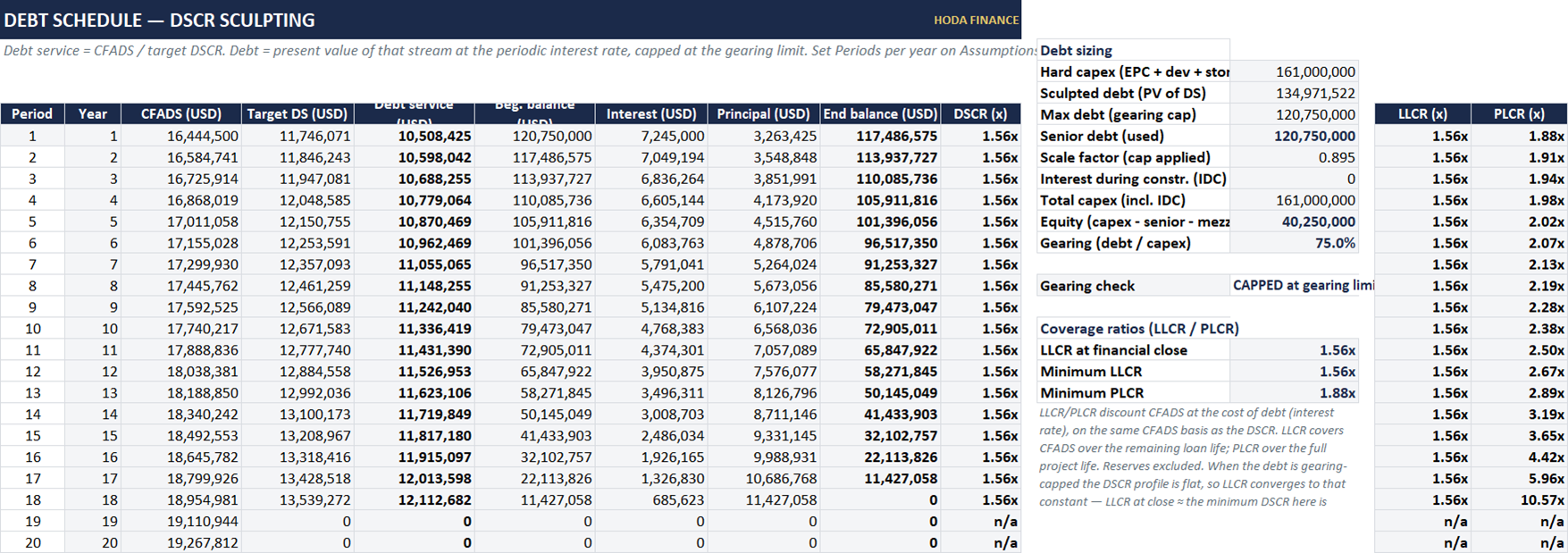
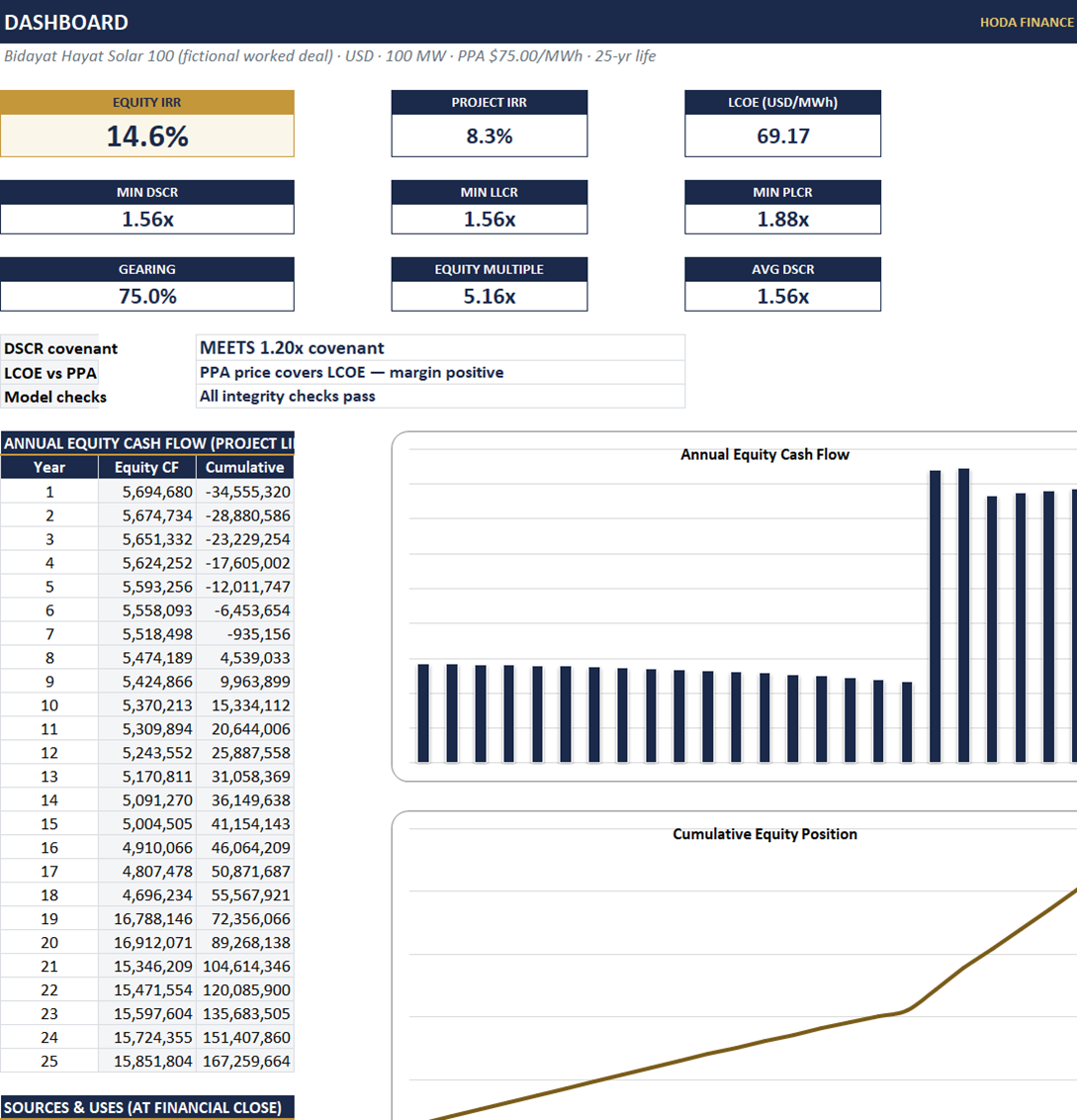
- Senior debt: $120.75M / equity $40.25M at 75% gearing with the cap binding (sculpted $134.97M before the cap).
- LCOE: $69.17/MWh nominal, $56.89/MWh real.
- Project NPV: $19.93M, project IRR: 8.31%, equity IRR: 14.59%, equity multiple: 5.16x.
- Minimum DSCR: 1.5649x, minimum LLCR: 1.5649x, minimum PLCR: 1.8815x, year-1 cash-on-cash: 14.15%.
- LP: 14.90% IRR at 4.78x vs. GP: 13.14% IRR at 8.51x — back-ended promote, explained on the tab.
- At a 0.92 P90/P50 ratio, the P90 LCOE is $75.18/MWh, above the PPA: the whole margin lives in the yield assumption.
- Replace the inputs, and every output re-prices.
CALIBRATION
Defaults are calibrated to published data, not invented:
- $1.61/W AC is the capacity-weighted average for utility-scale PV that came online in 2024 per LBNL's Utility-Scale Solar, 2025 Edition.
- The 28.5% capacity factor sits inside LBNL's 17-31% fleet range.
- The $75/MWh PPA sits inside the $40-98/MWh unsubsidized range in Lazard's LCOE+ v19.0 (2026).
Both are cited in the workbook and the Methodology PDF with a note to verify current editions. Not affiliated with LBNL or Lazard.
SCOPE
Single contracted solar asset.
Five optional modules ship switched off:
- US MACRS (all six IRS recovery classes).
- The investment tax credit (basis reduction + transfer monetization).
- A tax-equity flip.
- Battery storage (PV + BESS).
- Mezzanine debt with senior refinancing.
Not modeled by design:
- The US PTC.
- Multi-currency/FX.
- Portfolio roll-up across SPVs.
- In-workbook Monte Carlo (yield uses analytic quantiles).
- No separate inverter-replacement reserve — fold replacement capex into the fixed O&M per kW input.
TECHNICAL SPECIFICATIONS
- Format: .xlsx (single Excel edition) + 5 PDF companions.
- Compatibility: Excel 2019, 2021, 365 (Windows and Mac). NOT Google Sheets — native two-variable Data Tables.
- No macros, no VBA, no add-ins · no circular references.
- 22 tabs · 13,951 live formulas · 142 named ranges · 7 charts.
- Pre-filled worked deal · instant download · commercial / organization-internal license.
HOW IT WORKS — THE METHOD, IN THE OPEN
No macros, no hidden sheets, no iterative calculation. These are the actual formulas in the shipped workbook, written with each input's name in place of its cell reference and without the period-range guards — open the cell, and you will find the same arithmetic:
Generation (Operating Model)= CapacityMW * 8760 * CapacityFactor * Exceedance * (1-Degradation)^(year-1) / PeriodsPerYear
Sculpted Debt Service (Debt Schedule)= IF(AND(period 0), CFADS/TargetDSCR, 0)
Debt Capacity, Then the Binding Constraint- SculptedDebt = SUMPRODUCT(debt-service range / (1+IntRate/PeriodsPerYear)^period)
- MaxDebt = MaxGearing * HardCapex
- DebtAmount = MAX(0, MIN(SculptedDebt, MaxDebt))
DSRA Target
= DSRAMonths/12 * (the forward 12 months of debt service)
LCOE, Nominal= (CapEx + PV of opex at DiscRate) / (PV of generation at DiscRate)
LCOE, Real — A Fisher Conversion, Not a Subtractionreal rate = (1+DiscRate)/(1+Inflation) - 1
Exceedance Factors (Yield)- P90 = P90P50
- P75 = P90P50^0.526307
- P99 = P90P50^1.815259
Those exponents are the standard-normal quantile ratios z75/z90 and z99/z90, so the P50-P99 fan is a lognormal yield distribution anchored on the P90/P50 ratio you enter — not three numbers typed in by hand.
Sculpting to a 1.40x DSCR on the shipped deal wants $134.97M of debt; the 75% gearing cap binds first, so the model sizes $120.75M, and the minimum DSCR comes out at 1.56x rather than the 1.40x target. That is the cap doing its job, and you can watch it happen by moving MaxGearing.
FAQ
Does it work in Google Sheets?
No — this is the one hard incompatibility. The two sensitivity grids are native Excel two-variable Data Tables, which Sheets cannot compute. Import it, and those grids arrive as static numbers that no longer respond to your inputs. Microsoft Excel 2019, 2021, or 365, Windows or Mac.
You can change any input; you cannot silently break the arithmetic. Every input carries a validation bound, formula cells are locked (no password — Review > Unprotect Sheet if you want it off), and the Checks tab is a live integrity roll-up. Push the deal somewhere it cannot compute — a zero PPA price, say — and the debt floors at zero and coverage reads "n/a" instead of cascading errors.
Does it do MACRS, the ITC, or bonus depreciation?Yes — US MACRS and the investment tax credit ship as optional modules, switched off by default so the base case stays jurisdiction-neutral.
- MACRS uses the IRS Publication 946 Table A-1 half-year-convention percentages at a selectable recovery class.
- The ITC computes the credit on eligible basis, applies the 50% basis reduction, and either offsets federal tax or monetizes by transfer at a price you set.
- The PTC is not implemented, and bonus depreciation has no dedicated switch — a front-loaded custom schedule can approximate it.
Not tax advice: Verify current credit rules against IRS guidance before relying on them.
Is it really free of circular references?
Yes. Construction interest is capitalized without an iterative loop, and the file needs no iterative-calculation setting. Confirm it yourself: Formulas > Error Checking > Circular References is empty.
SHA256SUMS.txt ships inside the download with a checksum for every other file.
- On macOS, Linux, or WSL, run: sha256sum -c SHA256SUMS.txt.
- The PowerShell equivalent is in the file's own header.
The workbook's hash is also printed in the footer of every PDF, so the sources agree independently.
What is pre-filled?
A fictional 100 MW single-axis-tracking project:
- $1.61/W AC capex, 28.5% capacity factor, $75/MWh PPA, 75% maximum gearing, 1.40x target DSCR.
Illustrative, not a real company.
Why $479 when there are $149 solar models?
Because of what the number has to survive. The shipped base case sizes $120.75M of senior debt against a $161M asset, and the model is built so that figure can be defended line by line — every headline in it is independently re-derived twice before release.
For a screening case, a cheaper model is the right tool. For a number that goes in front of a credit committee, that difference is what you are buying.
For scale:
- The dedicated software a project team would otherwise license runs $876–$1,575 per seat per year (PVsyst and HOMER Pro, vendor pricing pages, August 2026).
- Solar models are listed at up to $495 on the major template marketplaces.
$479 is a one-time purchase, below all three.
ABOUT THE AUTHOR
Built by Hoda Elmorshidy — Financial Controller & Fractional CFO, 9+ years in IFRS reporting, FP&A, commodity trading, CFO/board reporting, UAE VAT & Corporate Tax, and finance automation. Practitioner-grade tools, not generic templates.
DISCLAIMER
This template is an analytical and educational tool, not investment, tax, accounting, legal, or transaction-structuring advice, and its use creates no professional or fiduciary relationship.
All assumptions and figures are illustrative — outputs are only as good as the assumptions you enter, and past or sample results are not indicative.
Depreciation, NOL, ITC/PTC, and partnership terms are fact-specific and change over time; verify current rules and every figure against your own data, resource study, and financing documents, with qualified advisors, before relying on any output.
The sample project "Bidayat Hayat Solar 100" and its sponsor are fictional, and all of their figures are illustrative.
Liability is limited as set out in the license terms below.
LICENSE & LIABILITY
LICENSE GRANT
Non-exclusive, non-transferable license for your own or your organization's internal business use — including modeling real deals and sharing filled copies with colleagues, your investment committee, and your professional advisors within that organization.
No resale, redistribution, sublicensing, or repackaging of the file, its templates, or its formulas as a competing or standalone product.
Provided "as is" without warranty of any kind, express or implied, including merchantability or fitness for a particular purpose.
To the maximum extent permitted by law, total aggregate liability for any claim arising from this product is limited to the amount you paid for it. Not liable for indirect, incidental, or consequential losses.
Nothing here limits rights that cannot be excluded under the consumer-protection law of your jurisdiction.
This purchase is governed by the terms of the platform you bought it on and by the consumer-protection law of your own country of residence. Where those permit, the limitations above apply to the maximum extent allowed.
Past or sample results are not indicative.
REFUNDS & FIXES
This is an instant digital download, sold on a fix-first basis rather than a returns basis.
If something is genuinely wrong with the file:
- It will not open.
- A formula returns an error.
- A tab or feature described on this page is missing.
- A stated calculation is wrong.
Contact the author through the platform you bought on, or email [email protected], with your order number and a screenshot. The author will correct it and send you the updated workbook, free, for 12 months from purchase.
If a defect cannot be fixed, you get a full refund.
Change-of-mind refunds are not offered: the file is delivered in full and immediately, and the scope is set out before you buy — see "What it does" and "What it does not do" — so you can check the fit first.
Outputs that depend on your own assumptions, and anything listed as out of scope, are not defects.
Nothing here limits rights that cannot be excluded under the consumer-protection law of your country, and the terms of the platform you bought on also apply.
TRADEMARKS & NON-AFFILIATION
Lawrence Berkeley National Laboratory (LBNL) and its Utility-Scale Solar series, Lazard and its LCOE+ series, and the National Renewable Energy Laboratory (NREL) and its SAM software, are cited for methodological calibration and context only; this product is an independent analytical template and is NOT affiliated with, endorsed by, or sponsored by either.
Microsoft Excel is a trademark of Microsoft Corporation; this product is not affiliated with, endorsed by, or sponsored by Microsoft.
This Best Practice includes
- Format: .xlsx (single Excel edition) + 5 PDF companions - Compatibility: Excel 2019, 2021, 365 (Windows and Mac).
Further information
• Size senior debt on a contracted utility-scale solar project by sculpting it to a
target DSCR and capping it at maximum gearing — in closed form, with no circular references
• Test the covenant package the way a lender does: per-period DSCR, distribution
lock-up, cure periods and event of default
• Report the full coverage set a credit committee asks for — minimum and average
DSCR, LLCR and PLCR at close and minimum
• Model the equity story end to end — construction IDC, a funded DSRA, tax with
depreciation and optional NOL, and an LP/GP promote waterfall with LP and GP IRR and MoIC
• Quantify resource risk analytically — P50 to P99 exceedance factors and the LCOE at each
• Give the buyer an auditable model: every formula independently recomputed, an
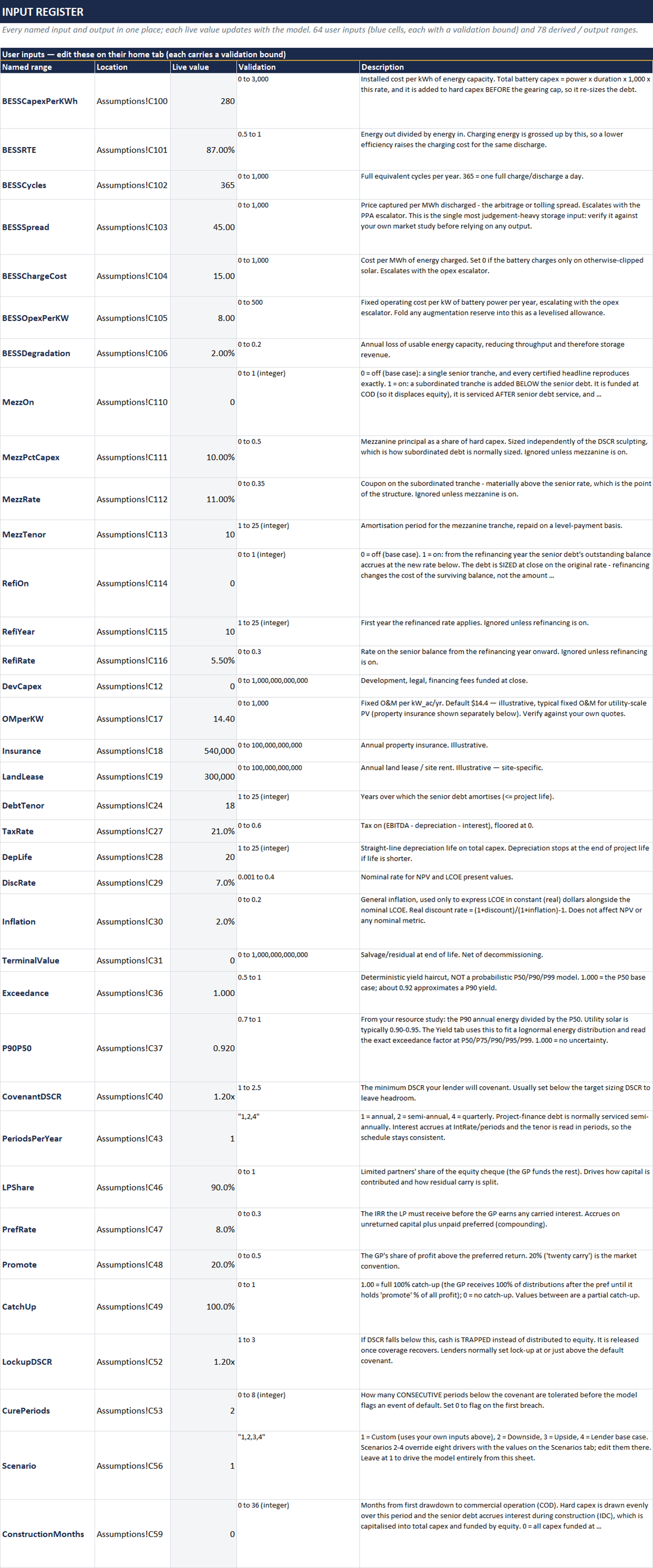
integrity Checks roll-up, and an Input Register listing every input and output
• Single-asset, contracted (PPA) utility-scale solar projects
• Deals underwritten on cash-flow coverage — DSCR-sculpted senior debt with a gearing cap
• Lender, investment-committee or independent-review work where the debt number must be defensible
• Sponsors preparing a financing request or an IC paper
• Structures with a construction period, a debt service reserve, or an LP/GP promote
• Users on Microsoft Excel 2019 / 2021 / 365 (Windows or Mac)
• Deals underwritten on the US production tax credit (PTC) — MACRS, the ITC and
the tax-equity flip are modelled (optional modules, off by default); the PTC is not
• Portfolio or fund-level aggregation across several SPVs — this is a single-asset model
• Merchant-only projects with no contracted offtake (a merchant tail is modelled, but the base case is a PPA)
• Google Sheets users — the sensitivity grids are native Excel Data Tables
• Buyers seeking live market data feeds — all inputs are entered manually by design