Publication number: ELQ-95628-1
View all versions & Certificate

Mastering the SBI Model: High-Impact Feedback Template
SBI Model: High-Impact Feedback Template
 by StrategyPunk
Every Organization Needs a Strategy. Unlock Free Insights and Templates to Master Yours.Follow 105
Master The Art Of High-Impact Feedback 🚀
Giving feedback is one of the most vital skills in your arsenal, yet it’s often executed poorly.
When feedback is vague, subjective, or accusatory, it triggers defensiveness, shuts down communication, and halts progress. Your goal shouldn’t be to correct; it should be to coach.
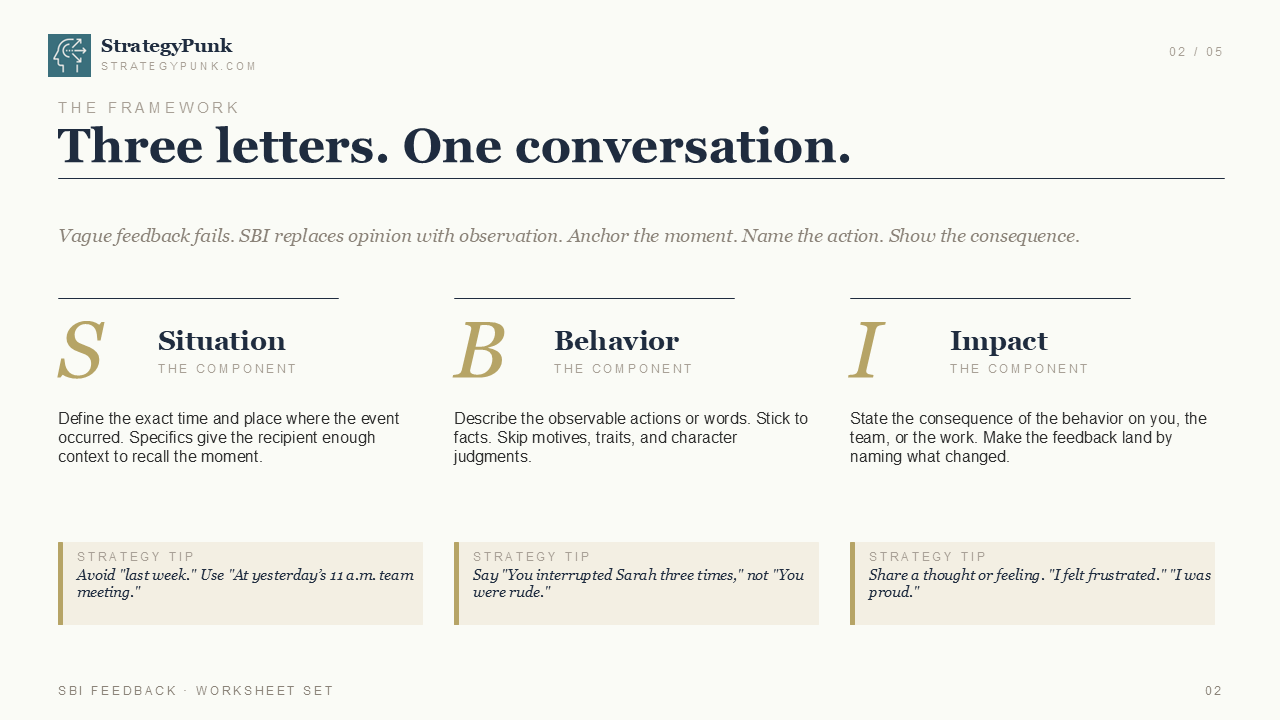
Developed by the Center for Creative Leadership (CCL), the SBI Model is the definitive tool for removing subjectivity and building trust. Let’s break down the three pillars as shown in the image:
1️⃣ 1. SITUATION: Anchor the context. Context is everything. Generalities confuse. General statements like "Recently, I noticed..." are confusing and force the recipient to "reconstruct" the scene. Be surgically precise about the "where" and "when." Set the stage to remove ambiguity and help the recipient visualize the specific occurrence.
2️⃣ 2. BEHAVIOR: Isolate the variables. This is where most leaders fail. You must stick to observable actions and words. If you can't see it or hear it, it's an interpretation. State only the facts with no judgment attached. Speak only from your personal observation, not hearsay, to maintain authority and objectivity.
3️⃣ 3. IMPACT: Close the loop. Explain the "ripple effect" and inspire action. Rather than passing judgment (e.g., "You were rude"), describe the resulting thoughts, feelings, or consequences. By explaining the consequences and results—rather than passing judgment—the listener is far more likely to absorb the feedback without getting defensive and understand why the behavior needs to change.
💡 LEVELING UP: The Advanced SBI+N/I Model
While the standard SBI model (Situation-Behavior-Impact) shown in the image is powerful, sophisticated leaders take this a step further by bridging the gap between impact and the path forward. At StrategyPunk.com, we advocate for integrating two more crucial dimensions to make it a coaching powerhouse:
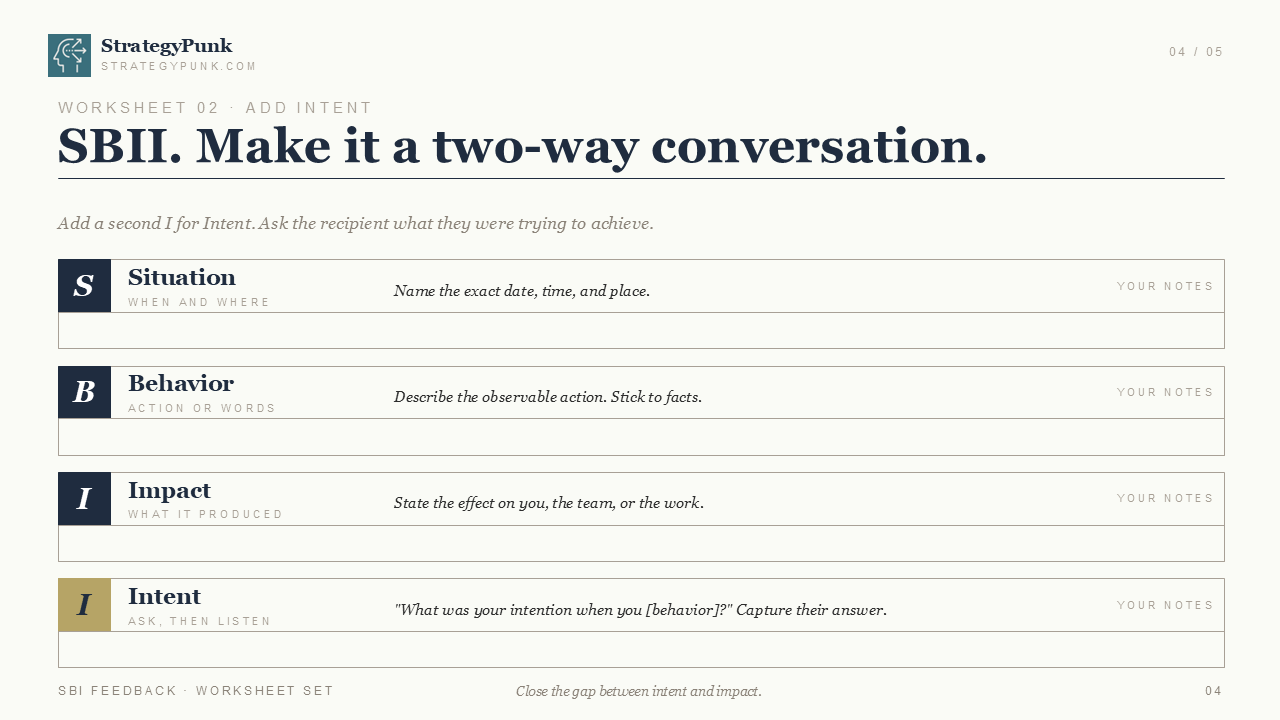
4. INTENT: The intent gap is real. People often judge themselves by their intent, but others judge them by their impact. Before lecturing, ask about their intent. Simply asking, "What was your intention behind that action?" uncovers context you might not have considered and turns a statement into a real two-way dialogue.
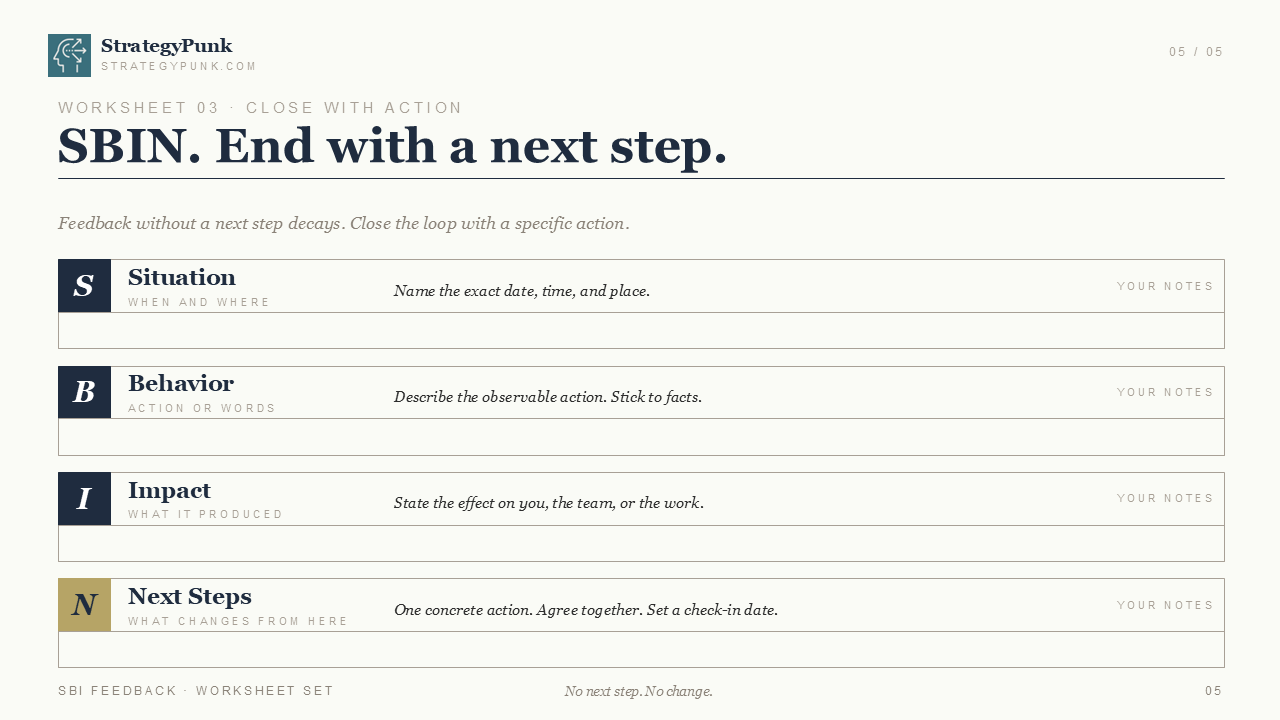
5. NEXT STEPS: No next step. No change. Feedback without a path forward is just a critique of the past. A successful coaching session must conclude with an agreed-upon blueprint for success. Work with your team member to define concrete actions and set a check-in date. Use the "Keep-Stop-Start" lens: "What will you do more of, what will you do less of, and what will you keep doing to ensure a different outcome?" This turns a critique into a collaboration.
Build a continuous coaching culture. Feedback doesn't have to be a dreaded event. When you master frameworks like SBI and integrate Intent and Next Steps, you establish a common language of accountability. Defensiveness drops, and professional growth accelerates.
📥 Put It Into Practice
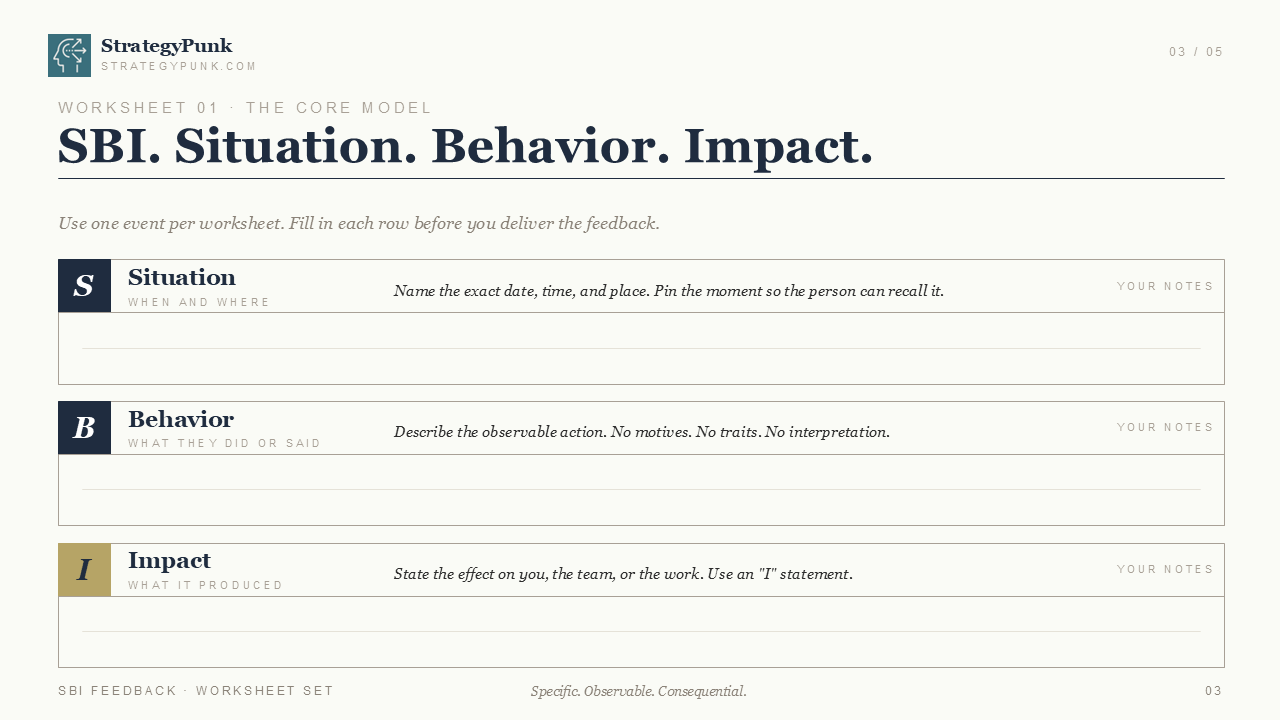
Ready to build a culture of continuous improvement? Reading about SBI is one thing; using it consistently is another. We've built a ready-to-use SBI Feedback Worksheet.
This Best Practice includes
1 PowerPoint Slide Deck with 5 slides