
ERP UAT & Test Management Toolkit - Excel Template for Test Scripts, Coverage, Defect Log, Sign-off & Go/No-Go
Originally published: 09/10/2026 06:28
Publication number: ELQ-96326-1
View all versions & Certificate
certified

ERP UAT & Test Management Toolkit - Excel Template for Test Scripts, Coverage, Defect Log, Sign-off & Go/No-Go

Eleven linked worksheets that take ERP user acceptance testing from scope to a signed Go/No-Go decision.

Description
Most ERP programmes do not fail because nobody tested. They fail because at the end of UAT nobody can say, with a number, whether the business is ready to go live.

This is the control set for that question. Eleven linked worksheets take user acceptance testing from scope through scripts, execution, defects and sign-off, and end in a calculated GO / NO-GO verdict that reads every other sheet.
It is deliberately ERP-agnostic. The control questions do not change with the vendor, so it works the same whether the target is SAP, Oracle, Dynamics 365, NetSuite, Infor or a banking core.

WHAT IS INSIDE
01 Test Scope. Business processes in scope, criticality and owners. The single source of truth every other sheet looks up.
02 Test Scripts. One row per test case, with preconditions, steps, data, expected and actual result. A Process ID that does not exist in sheet 01 is flagged in red.
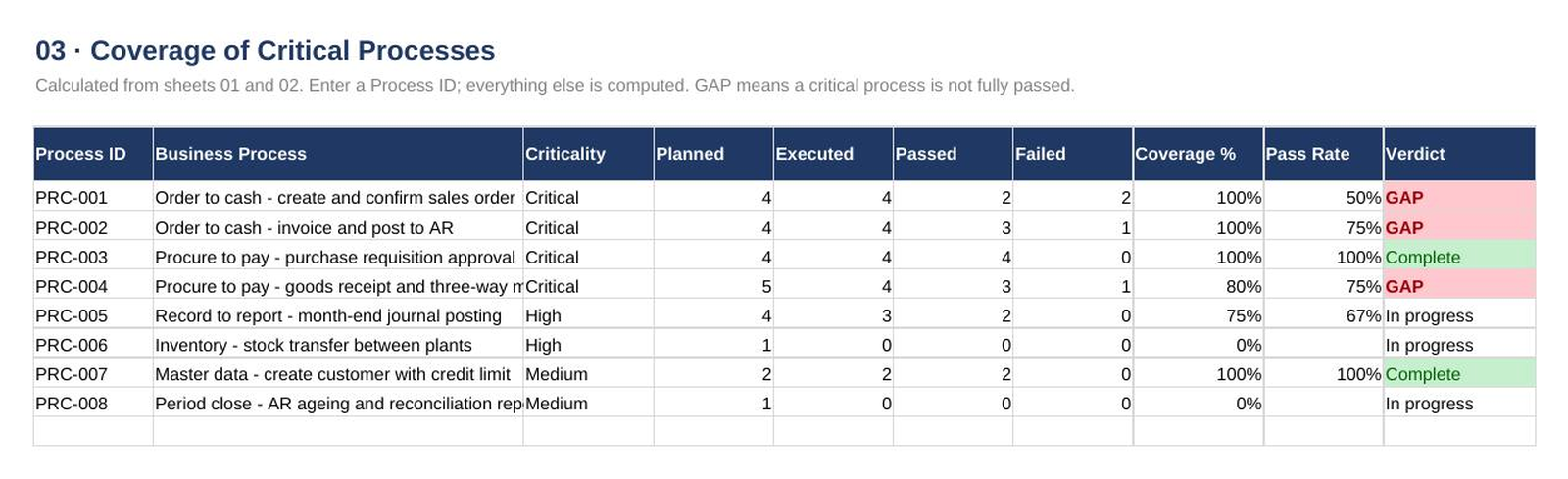
03 Coverage Matrix. Calculated. Planned versus executed versus passed per process, with a GAP verdict when a critical process is not fully passed.
04 Cycle Plan. SIT, UAT 1, UAT 2 and regression, with dates, environment and calculated counts per cycle.
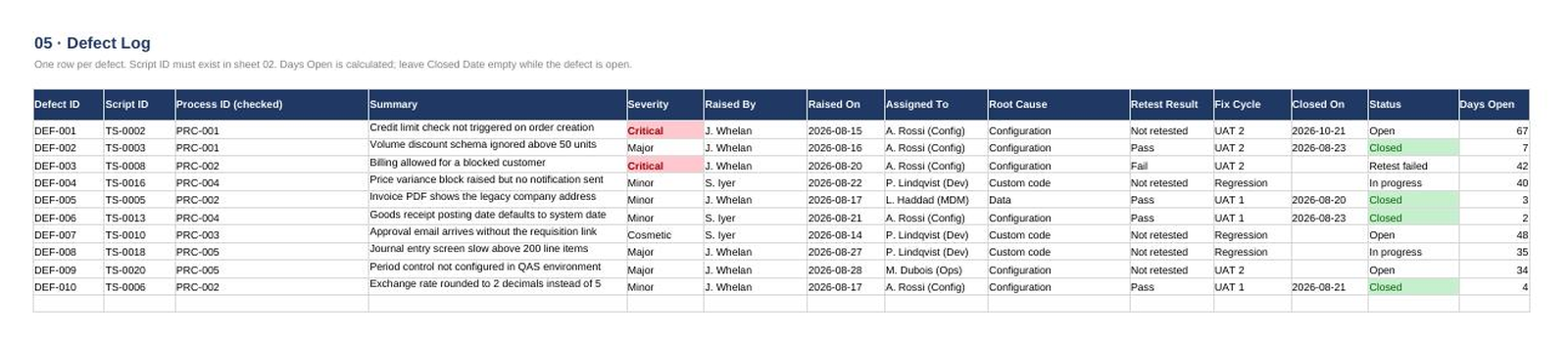
05 Defect Log. Severity, root cause, retest result and days open, with Script IDs validated against sheet 02.
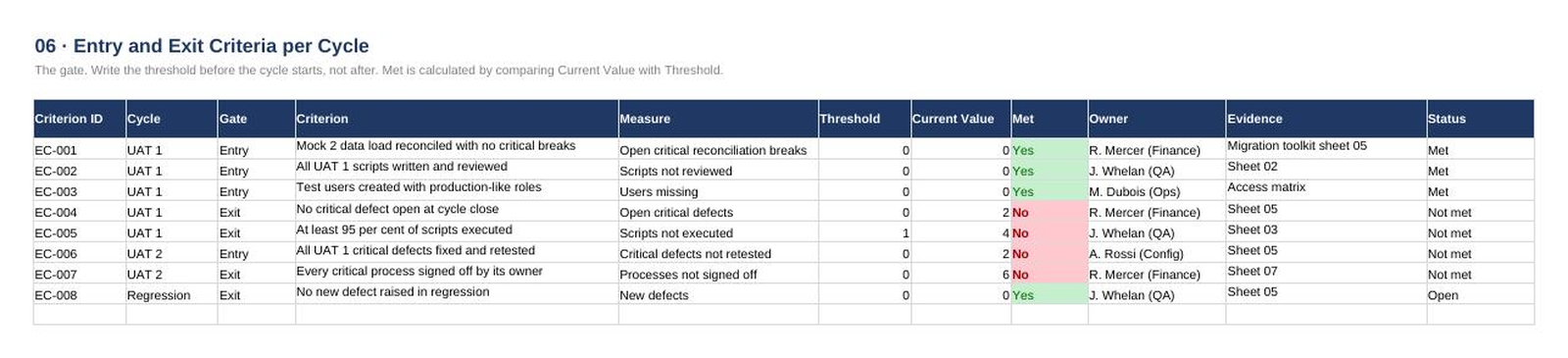
06 Entry and Exit Criteria. The gate for each cycle. Write the threshold before the cycle starts; Met is calculated against it.
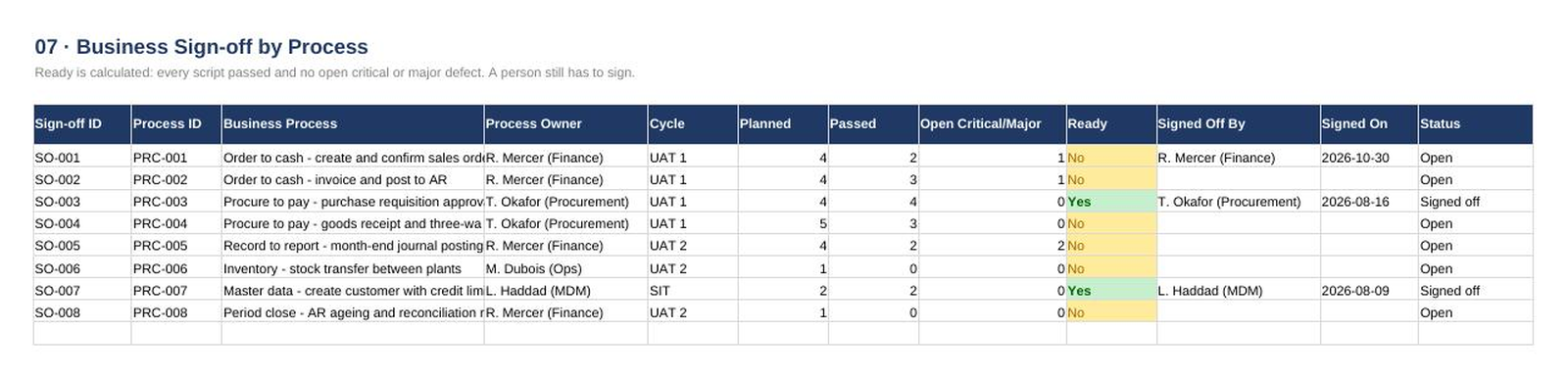
07 Sign-off Tracker. Calculated readiness per process: every script passed and no open critical or major defect. A person still signs.
08 Decision Log. Test scope and approach decisions, with the cost of reversing each one.
09 RACI. Who executes, who accepts, who to call when a cycle is blocked.
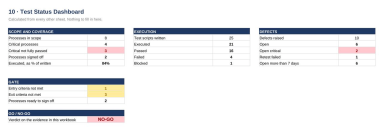
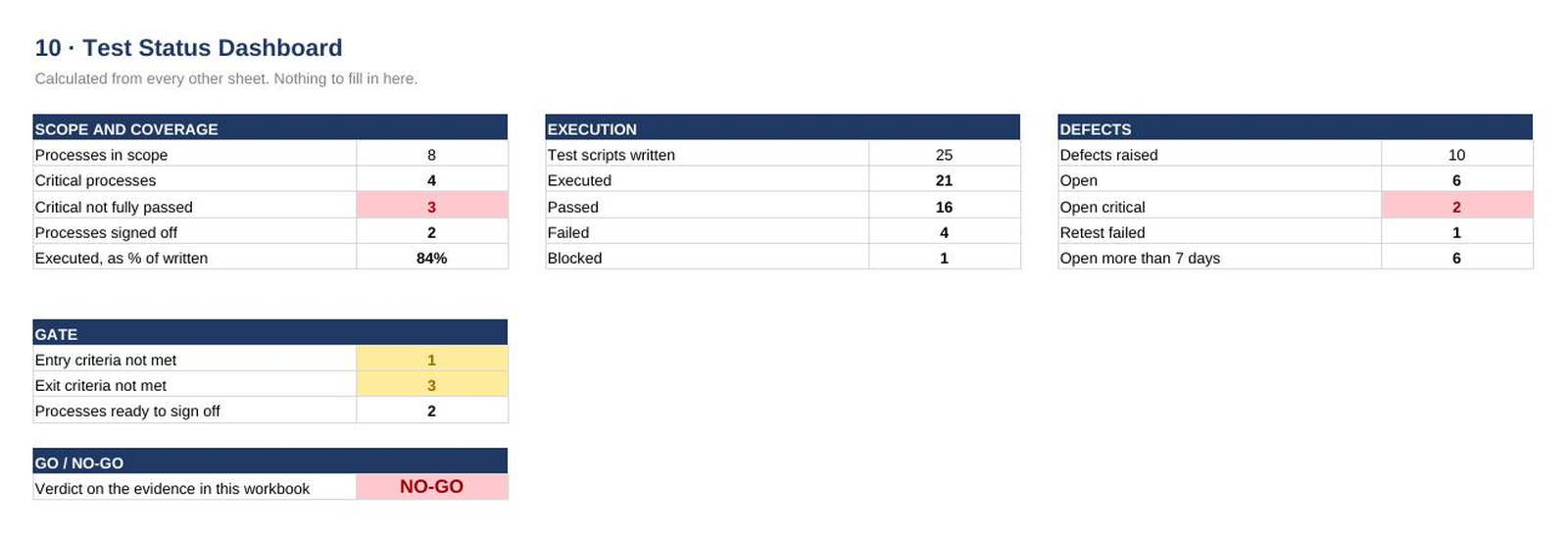
10 Dashboard. Calculated roll-up across every sheet, ending in GO / NO-GO.
Lists. Every dropdown value, editable.

BUILT IN
A calculated GO / NO-GO verdict. It reads NO-GO while a critical process is not fully passed, a critical defect is open, or an entry or exit criterion is unmet.
Cross-sheet validation: a Process ID or Script ID that does not exist upstream is flagged, not silently accepted.
Readiness per process calculated from the evidence, not from an opinion.
Dropdowns throughout, so a test team of twelve fills it in the same way.
A worked example on the first row of every sheet, showing the level of detail expected.
No macros. It opens in Excel, LibreOffice and Google Sheets.

WHO IT IS FOR
ERP implementation consultants and test managers, UAT leads, process owners who have to sign off before go-live, and internal teams preparing a first go-live.

LICENCE
Business licence: use and adapt this workbook inside the organisation that purchased it, on that organisation's own implementation, replacement or consolidation projects. Consulting licence: use and adapt it on client engagements, including projects delivered for third parties. Both: do not resell, redistribute or publish it, in whole or in part, as a template or as part of another product. One purchase covers one user.

This Best Practice includes
1 Excel workbook, 12 linked worksheets, no macros

Acquire business license for $29.00

Add to cart

Add to bookmarks

Discuss

Further information

An ERP implementation, replacement or consolidation where user acceptance testing has to end in a defensible go-live decision. Works best when several process owners have to sign off and someone needs a single place that shows, with numbers, what is ready and what is not. Suits teams running SIT, UAT and regression cycles against a date.

Teams already running a dedicated test management platform such as Jira with Xray, qTest or ALM, where this would duplicate the system of record. Also a poor fit for continuous delivery with automated regression, where testing is not organised into cycles with entry and exit gates.


0.0 / 5 (0 votes)

please wait...